Grandma had survived the fight of her life, but the people who promised to stand beside her were nowhere to be found. By the time she asked me one quiet question, I knew I could never look at my family the same way again.
The day my grandmother finally beat cancer should have been one of the happiest days of our lives.
After months of appointments, treatments, fear, and exhaustion, she was supposed to ring the hospital’s victory bell with all of us cheering beside her.
I showed up with flowers, balloons, and my phone ready to capture the moment.
Instead, we discovered that our family didn’t even bother to come.
My name is Marissa, and if you had asked me a year earlier, I would have told you that I came from a close family.
We had Sunday dinners almost every week.
We celebrated birthdays together.
We filled every holiday with noisy conversations, shared recipes, and endless family photos.
At least, that was the picture we showed everyone else.
The truth was that the person holding us together had always been my grandmother.
She never missed a birthday, and she remembered every anniversary.
If someone was sick, she cooked meals.
If someone lost a job, she quietly slipped money into an envelope without embarrassing them.
If someone needed a babysitter, she rearranged her own plans without complaint.
She spent her entire life showing up for everyone.
Then she got cancer, and everything changed.
The diagnosis shook us all.
I still remembered sitting around Grandma’s dining room table when she shared the news.
My father, Dennis, stared at the floor.
My mother, Linda, cried quietly into a tissue.
My older brother, Ethan, promised, “We’re all going to help.”
My sister, Brooke, nodded immediately.
“We’ll get through this together,” she said.
Even my aunt Claire insisted that no one would let Grandma fight alone.
Back then, every promise sounded sincere.
For the first few weeks, people actually tried.
My dad drove her to two appointments.
My mom made soup several times.
Brooke accompanied Grandma to chemotherapy once.
Aunt Claire organized a meal schedule, and Uncle Victor offered to mow the lawn.
However, life slowly returned to normal for everyone except Grandma.
Appointments became inconvenient.
Treatments took too long.
Hospital visits interrupted weekend plans.
One by one, excuses replaced promises.
Without anyone saying it aloud, the responsibility quietly landed on me.
I never intended to become Grandma’s full-time support. It simply happened.
I drove her to appointments.
I sat beside her during chemotherapy.
I learned how to organize her medications, and I listened when she admitted that she was terrified.
Some days, she barely spoke.
On other days, she joked with the nurses as though she were not fighting for her life.
She amazed me every single day.
Whenever I suggested asking someone else for help, she smiled gently.
“They all have busy lives, sweetheart.”
That sentence became her favorite excuse for everyone else’s absence.
She defended people who did not deserve defending.
If dad canceled, she said work was stressful.
If mom forgot to call, she said mothers sometimes became overwhelmed.
If Ethan skipped another visit, she said he was building his career.
If Brooke stayed away, she said young families had a lot going on.
There was always an explanation, but there was never a complaint.
The nurses noticed.
One afternoon, while Grandma was having blood work done, a nurse named Alicia pulled me aside.
“You’re here for every visit,” she said.
“I know,” I answered.
“You’re doing an incredible job.”
I smiled politely, but inside, I wanted to scream because I was not supposed to be the only one.
Months passed.
Grandma endured surgeries, radiation, countless scans, and sleepless nights.
Every time the phone rang, my stomach twisted into knots.
Then, finally, we received the news.
The treatments had worked.
The scans were clear.
Grandma was cancer-free.
I cried harder than I had cried since childhood.
Grandma simply smiled and whispered, “Thank God.”
The hospital scheduled her victory bell ceremony for Friday afternoon.
Everyone knew the date.
Grandma talked about it for nearly three weeks.
“I can’t wait until we’re all together,” she said.
She even picked out a soft blue blouse because she wanted to look nice in the pictures.
The family group chat buzzed with cheerful replies.
“We’ll be there.”
“Wouldn’t miss it.”
“So proud of Mom.”
“I’ll bring cupcakes.”
Even Ethan sent a thumbs-up emoji.
For the first time in months, I believed everyone meant what they said.
When Friday arrived, I took the afternoon off work.
I bought fresh flowers, bright yellow balloons, and Grandma’s favorite chocolate.
I even charged my phone so I could record the entire ceremony.
When we arrived on the oncology floor, Grandma squeezed my hand.
“I’m nervous,” she admitted.
“You’ve earned this,” I told her.
She smiled.
The nurses welcomed her warmly, and several recognized us immediately.
“There she is!” Alicia exclaimed happily. “Our bell ringer.”
Grandma laughed.
“I wasn’t sure I would ever make it.”
“Oh, we knew you would,” another nurse replied.
They asked whether the rest of the family was coming.
“Any minute now,” Grandma answered confidently.
I looked toward the elevator.
The doors opened, and a man pushing a wheelchair stepped out.
It was not anyone from our family.
Five minutes passed, and then ten.
Grandma checked the hallway again.
“Traffic must be bad,” she said.
“I’m sure they’ll be here,” I replied.
The elevator opened again, and two children walked past with their parents.
Still, no one came.
Every time those doors opened, Grandma looked up with hope shining in her eyes.
Every time strangers appeared instead, that hope faded a little more.
I kept smiling because I refused to let her see what I was feeling.
Inside, I was furious.
I hugged her tightly.
“I brought flowers,” I said.
“They’re beautiful.”
“And balloons.”
She laughed softly.
“You always know how to spoil me.”
I glanced at my watch.
They were 20 minutes late, and there was still no sign of anyone.
Trying to distract myself, I opened our family group chat.
What I found made my hands shake.
Ethan had written, “Long week. I’m too tired.”
Brooke had replied, “Sorry. We already have dinner plans.”
My father had written, “I thought someone else was driving your mother there, so I made plans.”
Then mom had answered, “Oh, no. I completely forgot what time it started.”
She had forgotten.
They had all known about the ceremony for weeks.
I stared at the messages in disbelief.
There were no emergencies, accidents, or crises.
There were only excuses.
I wanted to throw my phone across the hallway.
Instead, I slipped it back into my purse before Grandma could notice.
The nurses gathered around.
A small crowd of patients waiting for appointments also stopped to watch.
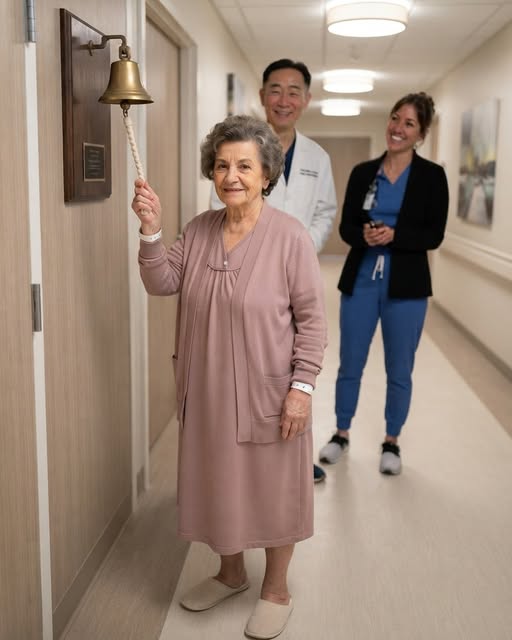
Someone handed Grandma the rope attached to the brass bell.
“Are you ready?” Alicia asked.
Grandma nodded.
Her eyes searched the hallway one last time.
Then, she looked at me.
“Would you stand beside me?”
“Always,” I promised.
She took a deep breath and pulled the rope.
The bell echoed through the hallway once, twice, and then a third time.
The nurses erupted into applause.
Some of them even wiped away tears.
One patient clapped so enthusiastically that his wife laughed through her own tears.
The celebration from complete strangers was louder than anything our own family had ever given Grandma.
I recorded every second, not because my family deserved to see it, but because Grandma deserved to remember it.
When the applause finally settled, several nurses hugged her.
“You did it.”
“We’re so proud of you.”
“You beat it.”
Grandma thanked each one individually.
That was who she was.
She was always grateful and always gracious.
As we slowly walked toward the elevator, she remained unusually quiet.
I thought she might be overwhelmed.
Then, she reached for my hand.
Her voice was barely above a whisper.
“Marissa?”
“Yes?”
She looked at the closed elevator doors before asking the question that shattered my heart.
“Do you think they even care?”
For a moment, I could not speak.
The woman who had spent her entire life putting everyone else first was finally wondering whether any of it had mattered.
I swallowed the lump in my throat and forced a smile that did not fool either of us.
“I care,” I said softly.
She squeezed my hand.
“I know you do.”
The elevator doors opened, and we stepped inside together.
As they closed, I looked at my reflection in the polished metal.
Something inside me had changed.
I had spent months making excuses for my family, just as Grandma had.
I was done.
The moment we walked out of the hospital, I pulled out my phone and made one call.
I called my aunt Claire.
She answered on the second ring.
“Hey, Marissa. Is everything okay?”
I took a slow breath before speaking.
“Did you know nobody came?”
There was a brief silence.
“What do you mean?”
“I mean exactly what I said. Grandma rang the victory bell with me and the nurses. No one else showed up.”
Another long pause followed.
“I thought your dad was taking everyone,” she said. “I was still at work, and I believed all of you were going to the hospital together.”
“Dad thought someone else was driving Mom. Ethan was too tired. Brooke had dinner plans. Mom forgot the time.”
Claire sighed heavily.
“I didn’t know.”
“I believe you.”
She sounded genuinely shocked, unlike everyone else.
“How is your grandmother?” she asked quietly.
I glanced toward Grandma, who was sitting in the passenger seat and looking out the window.
“She asked me if anyone even cared.”
Aunt Claire inhaled sharply.
“Oh, no.”
“Yes.”
“I’ll call you back,” she said.
She hung up before I could say anything else.
I drove Grandma home.
She tried to pretend that everything was normal.
She complimented the weather, asked whether I wanted leftovers for dinner, and thanked me again for the flowers.
She never mentioned the empty hallway.
That hurt more than it would have if she had cried.
When we pulled into her driveway, I helped her inside.
The balloons floated gently toward the ceiling, and I placed the flowers in her favorite crystal vase.
She smiled politely.
“They’re beautiful.”
I looked around the quiet living room.
There were no decorations, welcome-home banner, cake, or surprise celebration.
There was nothing.
So much for the excuse I had made earlier.
I walked into the kitchen.
“Sit down,” I told her.
“You don’t have to fuss over me.”
“I want to.”
I ordered her favorite Italian food from the little family restaurant nearby.
While we waited, I found candles in one of the kitchen drawers.
Then, I remembered that there was a bakery just three blocks away.
“I’ll be back in 20 minutes,” I said.
“You don’t need to do that.”
“I do.”
I returned carrying a small chocolate cake decorated with white frosting.
Across the top, the baker had written, “YOU BEAT CANCER!”
Grandma covered her mouth.
“You bought this?”
“You deserve a celebration.”
Her eyes filled with tears again.
“I only expected everyone to come.”
“I know.”
“I didn’t expect presents.”
She looked at the cake for a long moment.
“I just wanted my family.”
That sentence stayed with me all evening.
Aunt Claire arrived just before dinner.
She walked through the front door carrying another bouquet of flowers.
The moment she saw Grandma, she hugged her tightly.
“I’m so proud of you, mom.”
Grandma smiled.
“I knew you would come eventually. You’re my daughter.”
Claire looked at me over Grandma’s shoulder.
The guilt on her face was obvious.
“I’m sorry I wasn’t there,” she said.
Grandma patted her back.
“You’re here now.”
We ate together, and for a couple of hours, things almost felt normal.
Then, my phone buzzed.
It was a message from Brooke.
“Hope everything went well today! How did it go?”
I stared at the message in disbelief.
She had not even remembered until that evening.
Another notification appeared. This one was from Ethan.
“Did she ring the bell already?”
Then my father wrote, “We’re stopping by tomorrow.”
Tomorrow.
They acted as though the timing did not matter and as though the ceremony had simply been another doctor’s appointment.
I did not answer any of them.
Instead, I started another group chat that included every adult in the family.
Then, I uploaded the video.
I added no caption or explanation.
I sent only the full recording.
It began with Grandma smiling nervously.
It showed the empty hallway behind her and captured every glance toward the elevator, every hopeful expression, and every disappointment.
Then, the bell rang.
The nurses applauded.
Patients clapped.
One nurse wiped away tears.
The camera never moved from Grandma’s face.
Near the end of the video, her quiet voice could be heard asking me, “Do you think they even care?”
I had not realized that my phone had captured that moment.
Now, everyone else heard it, too.
The group chat remained silent for almost five minutes.
Then, Brooke finally replied.
“I didn’t realize everyone else wasn’t going.”
I answered immediately.
“You didn’t need everyone else. You needed yourself.”
Ethan wrote next.
“I already said I was exhausted.”
I responded, “Grandma spent months exhausted, and she still showed up for every treatment.”
My father tried to smooth things over.
“Let’s not argue. We’ll visit tomorrow.”
I typed back before anyone else could answer.
“Tomorrow isn’t today. She only rang that bell once.”
Nobody replied after that.
The silence lasted all night.
The following morning, my mother called.
“I feel terrible,” she said.
“You should.”
“I honestly forgot.”
“You remembered dinner with your friends.”
She did not answer.
“I’ve apologized,” she finally said.
“Not to the person who needed the apology.”
She started crying.
“I never meant to hurt her.”
“But you did.”
I was not angry simply because they had made a mistake.
I was angry because every single person expected someone else to carry the emotional weight.
They had all assumed Grandma would understand.
She always had before.
This time was different.
Aunt Claire called later that afternoon.
“I’ve been thinking,” she said.
“So have I.”
“I’m organizing something.”
“What?”
“A family dinner.”
I frowned.
“Why?”
“Because everyone needs to look your grandmother in the eye.”
Three days later, everyone gathered at Grandma’s house.
For the first time since her treatment ended, every chair around the dining room table was occupied.
The atmosphere was awkward, and nobody knew where to begin.
Grandma simply served food as she always had.
She smiled, asked everyone about work, complimented Brooke’s new haircut, and asked Ethan how his latest project was going.
She acted as though nothing had happened.
Halfway through dinner, Aunt Claire stood.
“I want to say something.”
Everyone looked up.
She placed her phone on the table and played the hospital video.
No one spoke.
The room remained completely silent except for the sound of the nurses applauding in the recording.
When Grandma asked, “Do you think they even care?” my father’s shoulders slumped.
Linda quietly covered her face. Brooke wiped away tears, and Ethan stared at his plate.
Claire stopped the video.
“That,” she said calmly, “is what every one of us missed.”
Nobody defended themselves or argued.
There was no excuse left to give.
Finally, my father stood and walked around the table. He knelt beside Grandma.
“I’m sorry, mom. I should have tried harder,” he said, tears filling his eyes.
She looked surprised.
“I failed you.”
Then, my mother joined him.
“So did I.”
Brooke cried openly.
“I kept thinking I would make it up to you later.”
Ethan, the most smug of them all, admitted fault.
“I was selfish.”
Grandma listened without interrupting.
When everyone had finished speaking, she smiled sadly.
“I forgive all of you.”
Relief spread across several faces.
Then, she continued.
“But forgiveness does not erase disappointment.”
The room fell silent again.
“I spent my whole life believing that family means showing up.”
She looked around the table.
“When I looked toward that elevator, I wasn’t waiting for perfection.”
Her voice remained soft.
“I was waiting for effort.”
No one could meet her eyes.
“I don’t need promises anymore.”
She folded her hands together.
“I only need actions.”
It was the gentlest rebuke I had ever heard, but it was also the most powerful.
Things changed after that.
The change was not immediate or perfect, but it was genuine.
My father began visiting every Saturday morning. Sometimes, he fixed little things around the house. On other mornings, he and Grandma simply drank coffee together.
My mother started taking Grandma grocery shopping every Wednesday.
Brooke invited Grandma to every school event involving her children.
Ethan called twice a week, and unlike before, he continued calling.
Aunt Claire organized a monthly family dinner that everyone treated as non-negotiable.
There were no excuses, forgotten dates, or assumptions that someone else would go.
Several weeks later, Grandma asked me to help her organize a photo album.
As we sorted through the pictures, she stopped at one photograph.
It was not from a holiday or birthday.
It was a screenshot that I had printed from the hospital video.
Grandma stood beside the victory bell, holding my flowers while the nurses applauded around her.
“I love this picture,” she said.
I looked at her in surprise.
“It doesn’t remind you of our family not showing up?”
She smiled.
“No.”
She gently touched the photograph.
“It reminds me that someone did.”
I reached across the table and squeezed her hand.
In the end, beating cancer was not the greatest victory Grandma celebrated that year.
The greatest victory was finally teaching the people she loved that showing up was the truest way to say, “I love you.”
From that day forward, they never forgot it again.