I worked night shifts at the hospital logistics center, pushing through physical exhaustion until my eyes burned. Every morning, I came home completely drained, yet I immediately grabbed the car keys to drive my husband to his chemotherapy sessions. I organized his countless medications, cooked his specialized meals, managed our overflowing bills, and stayed awake beside him through the endless nights when he was simply too weak to get out of bed. For eleven punishing months, my entire existence had shrunk down to one single mission: keeping my husband alive.
So when the specialist finally uttered the exact words we had spent a year praying to hear, I honestly believed our prolonged nightmare was over.
“The scans show clear results, continuous remission, and no remaining evidence of disease,” Dr. Callahan said as he smiled warmly at both of us inside the quiet consultation room. “You are officially cancer-free, Lucas.”
“We actually did it,” I whispered, throwing my arms around my husband as tears poured down my face. “You survived, Lucas. We made it through.”
“Thank you, Hannah,” Lucas murmured softly while weeping against my shoulder, his thin hands trembling as he squeezed me tightly. “Thank you for everything.”
For the very first time in nearly a year, we could finally breathe without fearing what terrible medical news would strike us next. But only hours later, while we were still sitting inside the main waiting area finishing the final discharge paperwork, Lucas looked at me with an unreadable expression and said something that shattered my heart in a completely different way.
“I want a divorce, Hannah,” Lucas said, staring straight ahead without any warmth in his eyes.
“What did you just say?” I asked, laughing nervously because I honestly believed I had misheard him due to my exhaustion. “Is this some kind of sick joke?”
“I am completely serious,” he replied in a flat, cold tone. “I have already made my decision, and I will be leaving today.”
“Lucas, please look at me!” I cried out, reaching for his wrist while my voice cracked. “After everything we have been through together, how can these be the first words you want to say to me after surviving cancer? Why are you doing this to us?”
“I cannot answer that right now,” he said quietly as he pulled his arm away from my reach. “I am sorry, but I just need to go.”
Then he picked up his small travel bag and walked out through the heavy glass doors of Saint Jude Regional Hospital. I sat alone on the vinyl couch, frozen in place, staring blankly at the empty hallway.
That was when his oncologist walked back into the lobby. Dr. Callahan looked toward the sliding doors where Lucas had just vanished, sighed deeply, and pulled a rolling chair directly in front of me.
“There is something critical you need to know, Hannah,” Dr. Callahan said, his expression intensely serious.
“Did his test results change?” I gasped, clutching my stomach. “Is he actually still sick?”
“No, his physical health is perfectly fine,” Dr. Callahan reassured me gently. “However, your husband gave me explicit permission weeks ago to tell you something if this exact day ever arrived.”
What the doctor revealed next forced me to rethink every single sacrifice I had made over the entire last year of our marriage.
PART 2: THE HIDDEN TRUTH
When Lucas was first diagnosed with aggressive lymphoma, we had already been married for eleven ordinary years in our small home in Columbus, Ohio. Our routine lives changed almost overnight as shock settled into our daily existence. He had to stop working his corporate job immediately, causing our income to plummet while terrifying medical bills began piling up on the kitchen counter. Our savings started disappearing faster than we could track, and because someone still had to keep our household running, I began taking exhausting overnight shifts at the shipment warehouse.
I would leave our quiet house for work just when most of our neighbors were getting ready for bed. I worked through the dark hours of the night moving heavy boxes, and then I would return home in the bright morning, sleep for two brief hours, and get right back up to drive Lucas to another grueling hospital appointment.
“You look completely pale, Hannah,” Lucas used to tell me while sitting in the passenger seat of our sedan. “You need to slow down before you collapse.”
“I am totally fine,” I would always reply with a forced smile, adjusting his seatbelt. “You just need to focus on drinking your water and resting today.”
I memorized his complicated medication schedule down to the exact minute, prepared soft meals that his damaged stomach could digest, tracked every prescription refill, and sat beside his bed during agonizing infusion sessions. When he was too frail to walk to the bathroom by himself, I put his arm around my neck and physically supported his weight.
“I am so heavy today,” Lucas whispered one afternoon, tears of humiliation building in his eyes as we shuffled down the hallway. “I am so sorry you have to carry me like this.”
“Don’t you dare apologize for being sick,” I told him firmly, kissing his warm forehead. “We are a team, and I will hold you up for as long as it takes.”
Some mornings, I would sit in my car inside the driveway for ten minutes after getting home from work because I was simply too exhausted to open the car door. But I never complained to Lucas about my fatigue. He was literally fighting for his life against a deadly illness, so how could I possibly make his emotional burden any heavier?
There were horrible days when the medical team was not optimistic about his prognosis, terrifying days when we were afraid to open his lab results, and days when Lucas could not even sit up without my help. Yet every single time he squeezed my trembling hand during those dark moments, he would repeat the exact same promise.
“When this whole nightmare is over, Hannah,” he would whisper softly, “I will spend the rest of my life making up every single sacrifice to you.”
“I don’t want you to make anything up to me,” I answered every time, wiping his sweat away with a damp cloth. “I don’t want money, gifts, or any kind of repayment. I just want my husband alive and healthy. That is more than enough for me.”
Then, after eleven torturous months of aggressive therapy, we finally heard the miraculous words we had been desperately waiting for from Dr. Callahan. There was no remaining evidence of disease, and he was completely cancer-free.
I had covered my face and wept tears of pure relief. Lucas was alive, and we had somehow survived the storm together. Or at least, that was what I truly believed until Dr. Callahan stepped out of the room to give us a few private moments.
I remember smiling through my tears, looking over at Lucas while my heart overflowed with hope for our future.
“We should definitely plan a trip to celebrate this,” I said eagerly, leaning toward him. “Maybe we can rent a cabin near Lake Erie, or go to a nice restaurant in downtown Columbus, or maybe we can just stay home and sleep without setting a single alarm clock for the first time in months.”
Lucas did not answer my excitement. He was just staring blankly down at the paper folder resting on his lap.
“Lucas, did you hear me?” I asked, my smile slowly fading. “What are you thinking about right now?”
“I want a divorce, Hannah,” he said quietly, looking directly into my eyes without a single tear.
“What are you saying?” I gasped, feeling the warm room suddenly turn freezing cold around me.
“I have made my final decision,” he repeated calmly, refusing to look back at my face.
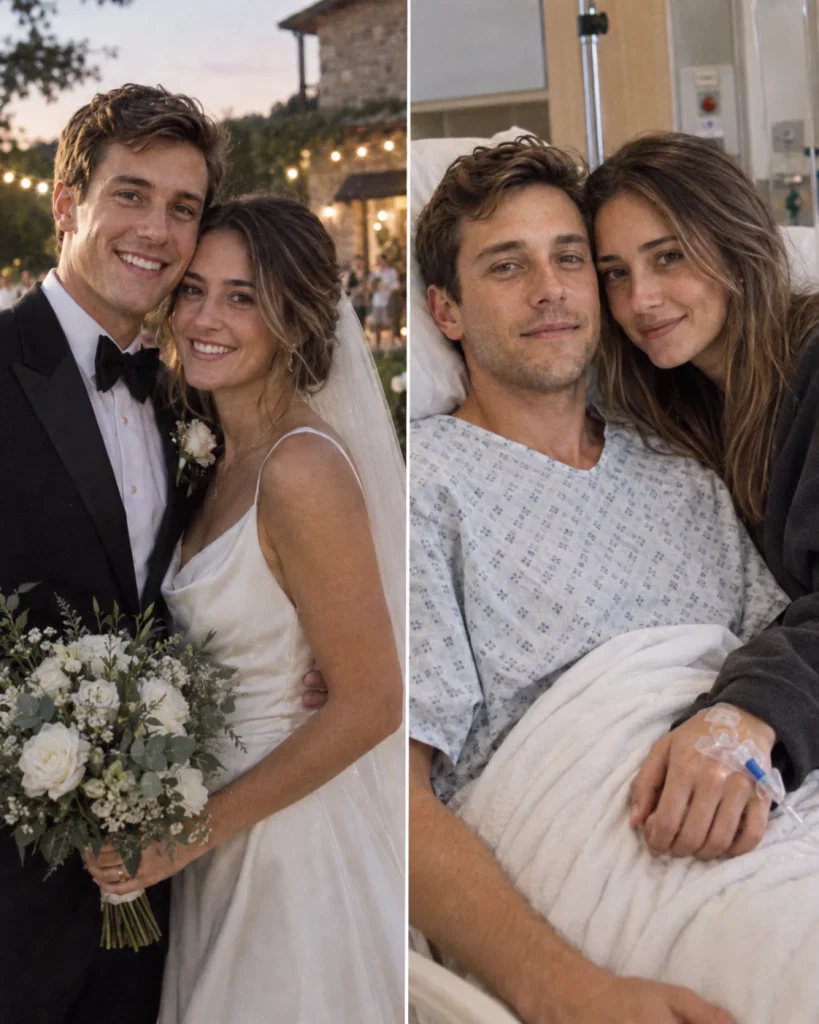
“Why are you doing this after everything we survived?” I begged, tears flooding my eyes once again. “Please just give me an explanation!”
He refused to say another word. He simply stood up, grabbed his small bag, and walked out the door, leaving me alone in the sterile room.
Sitting in the hospital chair after Lucas walked out, I listened intently as Dr. Callahan explained the painful truth that my husband had kept hidden from me throughout his entire battle.
“Your husband found something on your shared computer three days before his initial cancer diagnosis,” Dr. Callahan revealed softly, keeping his eyes fixed on mine.
“What could he have possibly found?” I asked, my voice barely audible as my heart sank into my chest.
“He found an old consultation email,” the doctor explained gently. “It was a confirmation message from a local family law attorney.”
PART 3: THE UNSEEN CRACKS
The moment Dr. Callahan mentioned that email, a heavy wave of reality crashed over me. It was an inquiry I had sent to a divorce lawyer, a document I had nearly forgotten even existed during the chaos of his illness.
Three days before Lucas was diagnosed with cancer, I had scheduled an initial legal consultation to discuss ending our marriage. I had never actually gone through with the appointment, and I had certainly never told Lucas about it. But he had accidentally uncovered the saved confirmation email while searching through digital files during a routine insurance dispute.
Suddenly, everything about his abrupt departure made total sense.
Our marriage had already been silently falling apart long before cancer ever entered our lives. It had not happened overnight, but rather quietly, slowly, and almost invisibly over several years. There had been no giant betrayal, no sudden violence, and no dramatic singular moment that destroyed our bond. Instead, our relationship had succumbed to years of small, unhealed wounds.
There were missed anniversaries, entire evenings spent in total silence, promises that kept getting postponed indefinitely, and the unbearable feeling of being completely invisible beside the person I had promised to love forever. I had still loved Lucas deeply, but I had grown hopelessly exhausted from feeling profoundly alone inside my own home. Three days before his diagnosis, I had finally reached my breaking point and decided to seek a way out.
Then the sudden cancer diagnosis blew our lives apart, and everything changed in an instant. The divorce consultation immediately vanished into the background as if it had never existed. I instantly stepped into the demanding roles of his primary caregiver, his medical advocate, his private nurse, his financial manager, and his ultimate source of strength.
However, Lucas had seen that email, and the knowledge of it had burnt itself into his mind. According to Dr. Callahan, Lucas had been carrying one agonizing fear throughout his entire eleven months of toxic treatment. He believed with absolute certainty that I was only staying with him out of pity because he was critically ill.
“He told me he was terrified that if he survived, you would feel trapped forever by the weight of your own sacrifices,” Dr. Callahan explained, placing a comforting hand near mine. “He did not want to spend the rest of his life wondering whether you were staying because you loved him, or because your conscience would not allow you to leave a sick man.”
That was the true reason why Lucas had asked for a divorce the very second he was declared cancer-free. It was not because he hated me, and it was not because he had suddenly stopped caring. He did it because he genuinely believed that his recovery gave me the very first opportunity to choose my own future without carrying a shred of guilt.
I wish I could say that this massive revelation immediately fixed our fractured marriage, but it did not. We had spent far too many years hurting each other in silence to simply erase the deep emotional scars overnight.
Following that day at the hospital, I packed my clothes, left our house, and went to stay with my mother in nearby Dayton for several weeks. Lucas and I agreed to enter personal counseling separately to work through our individual trauma. For the first time in over a decade, we were both forced to honestly confront the broken marriage we had owned long before cancer took over our lives. We could no longer hide behind hospital schedules, medication lists, or the terrifying fear of mortality. We had to face the quiet reality of two people who had slowly stopped communicating with each other.
PART 4: CHOOSING A NEW PATH
After three months of living apart and attending intensive counseling sessions, Lucas finally sent me a text message asking if we could meet for dinner. We agreed to meet at the quiet Italian bistro in downtown Columbus where Lucas had famously forgotten our fifth anniversary years ago.
I arrived early and sat at a corner table, remembering how I had sat in that exact same spot years prior, watching the minutes tick by while my food grew cold and my heart broke in silence. But this time, Lucas arrived on time. He looked healthy, color had returned to his cheeks, and he walked with a firm, steady stride.
“Thank you for agreeing to see me, Hannah,” Lucas said softly as he sat down across from me. “You look really wonderful.”
“You look healthy, Lucas,” I replied, feeling a strange mix of relief and nervousness. “It is really good to see you standing strong.”
“I think we need to finally talk about everything,” he said, staring down at his glass of water before looking directly into my eyes. “I need to apologize for how I handled things at the hospital. I was terrified, and I thought I was doing the noble thing by cutting the cord immediately.”
“Dr. Callahan explained your reasoning to me,” I said gently. “Why didn’t you just ask me about the email when you first found it?”
“Because three days later, the doctors told me I had a tumor in my chest,” Lucas answered, his voice trembling slightly. “Suddenly, you were staying up all night taking care of me, crying for me, and fighting to keep me alive. How could I bring up a divorce email when you were saving my life? But every time I looked at you, I kept asking myself if you were doing it out of love, or just out of moral obligation.”
“I did it because I loved you, Lucas,” I said, leaning forward across the table. “But I also have to be completely honest with you tonight. During your treatment, being needed by you made me feel loved again for the first time in years. And somewhere along the way, I confused those two feelings.”
“What do you mean?” Lucas asked quietly.
“Being needed is not the same thing as being loved,” I explained, letting out a long breath. “Being your nurse was not the same thing as being your wife. Surviving your illness together was an incredible fight, but it did not automatically fix the broken communication we had before you got sick.”
“I know,” Lucas acknowledged, reaching out to gently touch the edge of my hand. “I thought asking for a divorce in the hospital was the only way to give you back your freedom. I thought you deserved the chance to choose me freely, without feeling like a prisoner to my illness.”
“I spent eleven months protecting your life, Lucas,” I told him tearfully. “It hurt so much because I thought you were throwing away everything we survived together. But now I realize that cancer forced us to fight for your physical survival, but it never taught us how to fight for our relationship.”
We decided right then that we would not rush back into living together. We did not pretend that the painful eleven years prior had never happened, and we did not make foolish promises that love alone would magically resolve our deep-seated issues.
Instead, we made a conscious decision to rebuild everything from the ground up. We began dating each other again, meeting twice a week for simple dinners or walks through the local park. We continued our therapy sessions, learning how to express our hurt feelings before small misunderstandings turned into resentful silence. Most importantly, we learned how to ask difficult, uncomfortable questions instead of pretending everything was perfect just to keep the peace.
Months later, as I sat on the porch of my mother’s house watching the sunset, I finally understood the true transformation of that terrible day in the hospital lobby. When Lucas had looked at me and said those cold words, I thought he was destroying our entire history. But in his own complex way, he was actually offering both of us something we had lost long before his diagnosis: a genuine choice.
For nearly a year, I had acted purely as his devoted caregiver, and he had existed as my fragile patient. Illness had aggressively dictated our daily routines, our conversations, and our futures. Once the disease was completely gone, we were forced to stand face to face with the uncomfortable truth we had avoided for years.
Could we still choose to stay together when there was no crisis forcing us into the same room? Could we build a brand new relationship instead of settling for the broken dynamic that had almost separated us years ago?
I still do not know with absolute certainty what the final chapter of our story will look like. Perhaps our marriage will endure the test of time, or perhaps we will eventually realize that our paths need to part ways gracefully. But for the very first time in over a decade, whatever decision we make next will not be driven by fear, guilt, exhaustion, or physical illness.
Lucas is no longer my patient, and I am no longer his savior. If we choose to hold hands and walk forward into the future together, it will be because we truly want each other in our lives, not because we feel obligated to stay. And after everything life takes from us, the ultimate proof of love is not clinging to someone out of fear, but giving them the complete freedom to choose you all over again.
THE END.