“If your wife dies tonight, at least have the decency to answer your phone, you coward.”
Those were the first words I heard at 2:17 a.m.
I was lying in a luxury suite in Miami Beach, the kind of room where floor-to-ceiling windows looked out over black water glittering beneath the moon, and the sheets felt softer than anything I deserved. The air smelled of expensive champagne, warm perfume, and betrayal.
My phone had been vibrating nonstop on the marble nightstand. I ignored the first three calls. But when Nathan’s name appeared for the fourth time, irritation finally won over sleep. Nathan was my best friend. My brother in every way except blood. He knew where I had started, which meant he also knew exactly how far I had fallen.
I answered quietly, keeping my voice low and annoyed. “What do you want, Nate? It’s the middle of the night.”
His voice came through cold and sharp. “Where are you, Victor?”
Victor. My own name sounded strange coming from him like that, stripped of friendship, stripped of warmth. It sounded like he was speaking to the hungry, desperate boy I used to be before money taught me how to lie better.
“I’m in Miami,” I said smoothly. “At the conference. I told you that.”
“Don’t lie to me,” he snapped. Behind his voice, I could hear the hollow echo of a hospital corridor. “Claire is in the hospital.”
Claire.
My wife.
The woman who had stood beside me when I had nothing but unpaid bills, cheap shoes, and impossible plans. The woman who pawned her grandmother’s earrings so I could afford the permits for my first project. The woman who stayed when our apartment went dark because the electricity was cut off, when our fridge held only water, when bankers laughed at the blueprints I carried like holy scripture.
She helped build the man I became.
And I had treated her like a ghost fading in the corner of my life.
“What happened?” I asked.
But I didn’t ask with fear. I didn’t ask with love. I asked with the tired irritation of a man being interrupted.
Nathan’s breathing was ragged. “She collapsed. Mrs. Whitfield called me. I got her to the emergency room. It’s a ruptured appendix, Victor. Severe infection. They’re rushing her into surgery, but they need next-of-kin authorization.”
I sat up slowly.
Beside me, Brooke shifted beneath the Egyptian cotton sheets. The moonlight caught the diamond bracelet on her wrist—the one I had bought three days earlier with a platinum card connected to an account I shared with my wife.
For one brief, suffocating second, the man I once was tried to come back. I thought about getting dressed. Calling the airport. Chartering a flight. Doing the right thing.
Then I looked around.
The ocean view. The sleeping woman who asked me for nothing but money and charm. The perfect silence of my escape.
And I chose myself.
“I can’t leave,” I lied, staring at the wall. “There’s a storm. Flights are grounded. Sign whatever they need for me.”
The silence on the other end was worse than shouting. It was the sound of something sacred burning down.
Then Nathan spoke, his voice shaking with rage. “Your wife could die tonight, Victor.”
I closed my eyes and pushed the truth away. “Do whatever is necessary. I’ll pay for everything.”
Then I hung up.
That quickly.
That easily.
That shamefully.
Brooke opened her eyes and stretched lazily in the dim light. “Everything okay, baby?”
I looked at her while my pulse settled into a cold, lifeless rhythm.
“Yeah,” I said. “Nothing important.”
Nothing important.
My wife was being cut open while infection poisoned her body, and I called it nothing important. I turned off my phone and shoved it into the nightstand drawer, as if killing the screen could kill the guilt.
I drank the rest of the champagne. I pulled Brooke closer. I told myself the world would continue turning exactly the way I had designed it.
But it didn’t.
Because while I was drowning in luxury in Miami Beach, beneath the brutal fluorescent lights of that hospital, Nathan did more than sign a medical authorization.
He helped Claire sign something else.
Something that would take apart the empire I thought I owned.
Three days later, I came home.
On the first-class flight back, I practiced my face in the lavatory mirror. Concerned. Exhausted. A little guilty, but not too guilty. Just enough to look like a husband trapped by the burdens of business. Just enough to protect the illusion of respectable Victor Hayes.
When I walked into the private hospital room, the smell of antiseptic and floor wax hit me first.
Claire was in the bed.
Pale. Fragile. Alive.
An IV line ran into the back of her bruised hand. Her lips were dry. Her hair was pulled loosely away from her face. For a moment, relief moved through me.
Then something uglier followed.
Annoyance.
Because now that she had survived, I had to keep performing.
I walked toward her bed with my practiced expression of concern. “Claire—”
She did not smile. She did not cry. She did not ask where I had been. She only looked at me.
That look was not love.
It was judgment.
“You’re late,” she said softly, her voice rough from the tube they had put down her throat.
I stopped at the foot of the bed. “There were no flights. The weather—”
“Sit down, Victor.”
Her calm frightened me more than screaming could have. I slowly sat in the vinyl guest chair beside the bed.
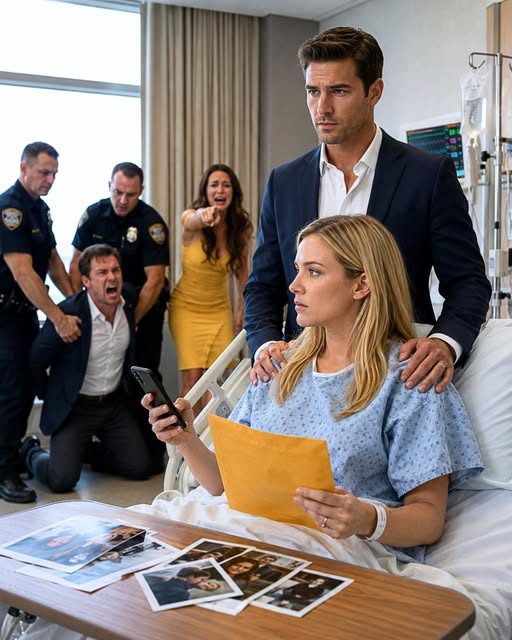
With a weak but deliberate hand, she reached toward the bedside table and slid a thick manila envelope across the tray.
“Open it.”
My fingers went numb.
I unfastened the clasp and pulled out a stack of glossy photographs.
Me and Brooke.
The balcony of the Miami suite.
The yacht rental in Key West.
The champagne bottles.
Our hands joined across a candlelit table at a five-star restaurant.
Every betrayal was captured in sharp detail, each photo stamped with a time and date in the corner.
My throat closed. “How did you—”
“America is smaller than you think, Victor,” Claire said, her eyes fixed on mine. “And people talk. Especially when you pay for your mistress with corporate cards that don’t belong only to you.”
For the first time in twenty years, I had no words.
I was not simply exposed. I was morally undressed.
“Claire, I can explain—”
“No,” she interrupted, wincing as she shifted against the pillows. “You already explained everything. While I was being rolled into surgery, wondering if I would wake up again, you were drinking. While I signed away power of attorney in case I slipped into a coma, you were spending our money on another woman.”
I reached toward her.
She pulled away as if my touch could infect her.
“Don’t touch me.”
Her voice was quiet. Cold. Final.
Then she looked toward the door.
It opened.
Nathan walked in. But he was not alone. Behind him was a woman in a sharp navy suit carrying a leather briefcase. Her eyes had the calm, predatory focus of a lawyer who had already won before entering the room.
My stomach dropped.
“What is this?” I demanded.
Claire held my gaze. Her pale face looked carved from stone.
“This,” she said, “is the bill.”
The lawyer placed a thick stack of papers on the tray table.
Divorce petitions.
Emergency asset separation documents.
A formal complaint for financial misconduct and misuse of marital and corporate accounts.
I stared at the pages, then back at the woman I had underestimated for two decades.
“You can’t do this to me,” I whispered.
Claire gave a faint, exhausted laugh. “Can’t I?”
The room went silent.
Then she said the sentence that broke something permanent inside me.
“I lifted you out of the dirt when you had nothing, Victor. But I will not keep carrying a man who chose to become trash.”
Humiliation burned through my chest like acid.
I looked at Nathan. “You’re my friend. You set me up.”
Nathan stepped closer, jaw tight. “I was your friend,” he said. “Until you stopped being a man.”
I stood, pride rising faster than shame. Men like me do not fall to their knees when truth arrives. We look for someone else to blame.
“You think a few photos can ruin me?” I snarled. “I’m Victor Hayes. I built everything. Hayes Development, the warehouses, the real estate holdings. You can’t touch the company.”
“The company?” Claire asked softly. “Which part, Victor? My money paid for the first office. My jewelry paid for your first permits. My father’s land secured the first warehouse loan. My signature is on half the documents you never bothered to read because you thought love meant silence.”
I turned on Nathan, venom pouring out of me. “And what do you get from this? Did you always want to play hero? Did you want my wife too?”
The slap came so fast I barely saw him move.
Nathan’s palm cracked across my face loud enough for the nurse in the hallway to stop walking. My cheek burned. My hands curled into fists, but I did not swing.
Because Nathan looked at me like a man looking at a rabid dog.
“Say one more filthy thing about her,” he whispered, “and I’ll forget we were ever brothers.”
The lawyer cleared her throat and tapped a silver pen against the papers.
“Mr. Hayes, you have two options. Sign this temporary agreement now, leave the marital home tonight, and settle this privately. Or refuse, and tomorrow morning we file for an injunction. Your personal and business accounts will be frozen while a judge reviews how marital assets were spent during an affair while your wife was undergoing emergency surgery.”
Frozen accounts.
Public exposure.
I looked at Claire.
Then I grabbed the pen.
My hand shook as I signed. Each signature felt like skin being peeled from bone. I signed away my access, my home, my leverage.
I threw the pen down and stormed out, convinced I could still outsmart them.
I was Victor Hayes.
I still had my house.
I still had my company.
I thought the worst had passed.
I had no idea my execution had only begun.
Outside, the morning felt cruelly normal. People bought coffee. Cars honked. A woman laughed into her phone near the hospital entrance. For one absurd second, I hated the world for continuing while mine collapsed.
I dialed Brooke.
Of course I did.
I did not call my lawyer. I did not call the bank. I called the woman I had destroyed my life for.
It rang six times and went to voicemail.
I called again.
Nothing.
I texted: Emergency. Call me.
The message turned blue.
Read.
No reply.
Anxiety pricked at my ribs, but I refused to call it fear. Fear belonged to men who had lost control.
I took a taxi to my estate in Coral Gables. When we turned onto my tree-lined street, I saw two vehicles outside the wrought-iron gate. Nathan’s SUV. And a battered white locksmith van.
I stepped out before the taxi stopped.
“What the hell is this?”
The locksmith flinched. Nathan did not. He stood by the gate with a folder under one arm. Beside him was Mrs. Whitfield, our elderly neighbor—the woman who had found Claire collapsed on the kitchen floor. She held a plastic grocery bag, and when she saw me, her mouth tightened with disgust.
I marched toward Nathan. “This is my house.”
He pressed a paper against my chest. “Temporary occupancy order. You signed it thirty minutes ago.”
“I signed under pressure!”
“You signed after your wife almost died while you were with a prostitute,” he said evenly.
I lunged toward the locksmith, who was replacing the heavy brass lock.
“Stop working.”
Nathan blocked me. “Don’t.”
I laughed, high and shaky. “You think you can throw me out of my own house?”
“No,” he said. “Claire can.”
The new lock clicked into place.
The sound echoed across the quiet street like a gunshot.
The gate opened.
I shoved past Nathan and stormed inside.
Everything looked the same, which somehow made it worse. The same mahogany entry table. The same painting Claire bought from a street artist in Savannah. The same faint scent of lavender cleaner and strong coffee.
But my things were gone from their places.
My keys were missing from the ceramic bowl. My Businessman of the Year award had vanished from the hallway wall. In the center of the living room sat four large suitcases.
They had been packed with terrifying care. My suits were folded. My watches were zipped into leather travel cases. My passport rested in a clear envelope on top.
That was what finally cracked something inside me.
Not the photos. Not the lawyer. Not Nathan’s slap.
The neatness.
Claire had not thrown me out in a storm of broken glass and screaming. She had removed me like a stain she had finally learned how to clean.
“You had no right to let him in,” I snapped at Mrs. Whitfield.
Her voice was small, but it cut deep. “She had every right, Victor.”
“Mind your own business.”
She lifted her chin. “I did. That is why your wife is alive.”
That shut me up.
Nathan pointed to the suitcases. “Take them. If you don’t, I call the police, and the whole neighborhood watches.”
Curtains across the street were already moving. I had hosted fundraisers in this house. I had built a reputation on this block.
Now I was being removed like a trespasser.
I dragged the suitcases out. Their wheels clicked across the marble floor, each sound a humiliation.
That night, I stayed in a beige business hotel near the financial district. Not a suite. No ocean view. Just a humming mini-fridge and walls the color of dust.
I opened my banking app to book a penthouse.
Password Incorrect.
I tried again.
Incorrect.
I called the bank. The representative was polite in the deadliest possible way.
“Mr. Hayes, there is a temporary restriction on all joint and linked corporate accounts pending legal review.”
“I am the primary account holder!”
“I’m sorry, sir. Please contact your legal representative.”
I threw the phone against the wall.
I had lost my home.
I had lost access to my money.
But I still had Hayes Development.
The next morning, I would walk into my boardroom and remind everyone who built the throne they sat around.
I did not know the throne had already burned.
By 8:30 a.m., my replacement phone was swarming with panic.
Messages from partners. Board members. My CFO, Owen.
Urgent. Account restrictions flagged.
Bank froze credit line.
Call me now.
At 9:15, my assistant texted:
Sir, two attorneys are here asking for ledgers. Mrs. Hayes is with them.
I read that sentence five times.
Mrs. Hayes is with them.
She was supposed to be in a hospital bed, weak from surgery.
When I burst through the glass doors of Hayes Development forty minutes later, the floor went silent.
Claire stood in the lobby wearing a cream blouse and black slacks. She was pale, one hand resting lightly against her stomach, but her posture was perfect. Nathan stood behind her like a wall. The lawyer from the hospital stood beside them with spreadsheets in her hand.
My employees pretended to stare at their monitors, but every ear belonged to us.
“Claire,” I hissed. “What are you doing here?”
She turned. For a heartbeat, I saw the young woman she used to be—the one who ate cheap street food with me, who said being poor did not matter as long as we were honest.
Then the woman I created returned.
“I own forty percent of Hayes Development,” she said clearly, letting everyone hear.
I lowered my voice. “On paper. Stop embarrassing yourself. Go back to the hospital.”
Her lawyer smiled. “Paper is where ownership lives, Mr. Hayes. We are proceeding to the conference room to review withdrawals from joint-controlled operating reserves.”
The meeting lasted three hours.
I tried to dominate it. I interrupted. I slammed my hand on the table. I demanded explanations.
Then the lawyer connected a laptop to the projector.
Every receipt appeared.
Brooke’s diamond bracelet.
The Miami suite.
The Key West yacht.
The spa visits.
And the dinner for two on the exact night Claire was admitted for emergency surgery.
No one said the word affair.
They didn’t need to.
The receipts told the story better than gossip ever could.
Owen, my CFO of eleven years, removed his glasses and rubbed his eyes. He knew the difference between client hospitality and a man using company money to decorate his mistress.
“Victor,” he said carefully, “some of these were categorized under your signature as business expenses.”
“They were,” I lied.
Claire looked across the table. “Which client?”
Silence swallowed the room.
I hated her then. Not because she lied.
Because she didn’t have to.
By noon, the board requested temporary spending controls. By one, my corporate credit access was suspended. By two, Owen asked me to step back from financial approvals until the audit finished.
I laughed in his face.
No one laughed with me.
That was when I understood. They were afraid of the scandal, yes. But more than that, they were afraid of my recklessness. I had become a liability to my own legacy.
I left without saying goodbye.
No one followed me to the elevator.
In the underground parking garage, I called Brooke again.
She answered on the second ring.
“Hello?”
“It’s me,” I breathed.
Silence.
“Victor?”
“Where are you? I need to see you.”
“I don’t think that’s a good idea.”
My fingers tightened on the steering wheel. “What does that mean?”
“I didn’t know you were married like that.”
A bitter laugh almost escaped me. “You saw my ring, Brooke. I told you it was complicated.”
“You said it was over,” she snapped. “You said she knew. You said you were separated emotionally.”
Separated emotionally.
The phrase sounded vile now. I had used it like cheap perfume sprayed over something rotten.
“I need you,” I said, my voice cracking.
A long silence followed.
“I’m sorry, Victor.”
Cold dread moved through me. “What did you do?”
“They came to my apartment,” she whispered.
“Who?”
“Her lawyers. They had photos. Receipts. They said if I kept spending disputed marital money, I could be named in a civil fraud case.” She inhaled shakily. “I gave them a sworn statement. I said you lied to me. I said you told me the marriage was over.”
“You gave them a statement? You betrayed me?”
“I protected myself!” she cried. “You would have done the same thing.”
There it was.
The mirror I never wanted.
I wanted to call her a liar, a gold digger, a snake. But the most horrifying part was that she had learned betrayal by watching me.
“You said you loved me,” I whispered.
“I loved the life you showed me,” Brooke said.
Then the line went dead.
That night, the dam broke.
The photos reached the press.
Not all of them. Just the perfect ones.
Me at a resort bar leaning close to Brooke. My wedding ring visible beside a crystal champagne flute. The timestamp sharp in the corner. A redacted credit card statement showing the jewelry purchase.
Then came the headline that turned my name into a weapon:
PROMINENT DEVELOPER ABANDONS WIFE DURING EMERGENCY SURGERY TO FUND MISTRESS’S LUXURY VACATION.
By midnight, everyone in Miami society knew. By morning, my face was everywhere.
My inbox became a graveyard.
The charity foundation delayed my humanitarian award. A city council aide said the mayor’s office needed distance. Two major clients emailed Owen directly, asking whether the scandal would affect projects.
I did not sleep.
At six in the morning, I stood in the hotel bathroom beneath fluorescent light. I was still well dressed. Still Victor Hayes.
But the man in the mirror looked hollow.
My phone buzzed.
Unknown number.
A video file.
I knew I should not open it.
I did anyway.
It was security footage from my kitchen—the camera system I installed years earlier and forgot about.
The timestamp matched the night of Claire’s surgery.
I watched my wife stumble into the dark kitchen alone. She was in pajamas, one hand pressed to her abdomen. She leaned against the marble island, her face twisted in pure agony. She reached for water, missed, and knocked the glass to the floor. It shattered across the tile.
I stopped breathing.
On the screen, Claire tried to clean up the broken glass while her body was shutting down from infection. She took two steps toward the hallway. Her legs failed.
She collapsed.
For nearly a full minute, she lay there in the dark, fighting for air.
While I drank champagne hundreds of miles away.
Then Mrs. Whitfield rushed in with the spare key. Ten minutes later, Nathan arrived barefoot, terror on his face, and carried my wife out.
The video ended.
A message appeared beneath it:
This is what you called nothing important. Tomorrow, the world sees it.
No name.
It didn’t need one.
I sat on the closed toilet lid and pressed my fist to my mouth. I did not cry. Crying would mean something human remained inside me, and I was not ready to believe that.
The settlement negotiations over the next two months were a bloodbath because I had no weapons left.
Claire did not ask for everything, which made it worse. If she had tried to take it all, I could have hated her cleanly. I could have called her greedy, vindictive, cruel.
But she was precise.
She kept the house in Coral Gables. She demanded public recognition of her forty percent ownership in Hayes Development. She demanded repayment of the misused corporate funds, deducted from my personal dividends.
Then came the condition that made me throw the contract across my lawyer’s desk.
“She wants me to publicly admit she financed the company’s beginning?” I shouted in Henry’s office. “That’s not the story. I built this from nothing.”
Henry leaned back. “She did finance it, Victor. We have the collateral records from her father’s land.”
“But that’s not the story.”
“No,” he said quietly. “It’s not your story.”
For years, my origin myth had been polished until people could barely see past it. Poor boy. Big dream. No help. No shortcuts. I told it at business breakfasts while Claire sat beside me, smiling softly, never interrupting.
Only then did I understand.
Her silence had not been submission.
It had been a gift.
And like every gift she gave me, I had mistaken it for something owed.
“I won’t sign.”
Henry sighed. “Then prepare for discovery. Emails. Bank records. Testimony. The world will see every place your legend overlaps with her sacrifice. It means the truth, Victor. With receipts.”
I signed two days later.
The divorce was finalized on a gray Thursday in late October.
I saw Claire in court. She wore a sharp navy suit. Not black. She was not mourning. Her hair was shorter, framing a face that looked rested, powerful, and detached from me.
Nathan sat in the gallery behind her.
So did Owen. My former assistant. Mrs. Whitfield. A row of silent witnesses behind the woman I had failed to erase.
My side held only Henry.
When the judge brought down the gavel, the words were dry and procedural. Marriage dissolved. Property awarded. Corporate ownership affirmed. No contact except through legal channels.
Each word was a steel door slamming shut.
Afterward, I waited in the marble hallway because some pathetic part of my ego still wanted a final scene.
Claire exited with her lawyer and Nathan.
“Claire,” I called.
She stopped.
Nathan immediately stepped forward, but she lifted one finger. He obeyed.
That loyalty hurt more than the decree.
I walked closer. “I never wanted it to end like this.”
She studied me like a document she had already read and discarded.
“No,” she said. “You just wanted it not to cost you anything.”
I swallowed. “I loved you. You know I did.”
For the first time in months, sadness cracked through her armor.
“I know,” she whispered. “That’s the saddest part. You loved me when I was useful. You loved me when I forgave your late nights. You loved me when my sacrifices made you feel chosen. But when loving me required you to show up and be a man, you sent someone else to sign for my life.”
My throat closed. “I was ashamed,” I said.
It was the first honest thing I had said in a year.
Claire nodded. “You should be.”
Then she walked away.
Her heels clicked down the marble corridor, and I stood there watching the woman who built my life walk completely out of it.
Six months later, my company changed the lobby sign.
The brass letters no longer read:
Hayes Development: Founded by Victor Hayes.
They read:
Hayes Development: Founded by Victor and Claire Hayes.
Someone sent me a photo.
Claire stood beside the new sign. She was smiling, not with triumph, but peace. Owen stood on one side of her. Nathan on the other. Employees clapped behind them.
She looked smaller than the sign, but somehow larger than the building.
That was the day I finally cried.
Not dramatically.
Not loudly.
Just one tear first, then another.
The world did not forgive me because I cried.
Claire never came back. Nathan never called. Brooke married a wealthy hotel investor in Palm Beach a year later, and when I saw the photos online, all I felt was embarrassment at how predictable we had all been.
My reputation stabilized, but it never fully healed. Money softens many moral judgments, and some clients returned. But the reverence was gone. I became a cautionary joke men told after too much whiskey.
“Don’t pull a Victor.”
I heard about it.
I deserved it.
For two years, I lived like a ghost with good credit. I worked. I paid alimony and restitution. I avoided hospitals, beach resorts, and women who smiled too quickly at expensive watches.
Then, one rainy Tuesday evening, I saw her again.
I was at a small bookstore café downtown. Henry had recommended a book about accountability after I finally admitted that drinking scotch alone in the dark was not a recovery plan.
I smelled coffee and wet paper as I walked in.
Then I froze.
Claire sat by the window beneath an amber reading lamp. There was more silver in her hair now, and it made her look beautiful in a way I had no right to notice. She wore tortoiseshell glasses and reviewed architectural blueprints.
Across from her sat Nathan.
My body stiffened.
Then Nathan’s wife approached from the counter carrying three mugs, laughing at something Claire had said.
It was not romance.
It was family.
The kind of family I lost because I treated loyalty like disposable furniture.
I turned to leave, but Claire looked up.
Our eyes met.
For one second, I was back in the hospital room, watching my life shatter.
Then she gave me a small nod.
Not warm.
Not angry.
Just human.
I nodded back.
Nathan saw me and hardened instantly, but Claire touched his arm and said something quiet. He relaxed. Not for me. For her.
I ordered black coffee and sat in the back with shaking hands. I did not approach them. It was the first respectful thing I had done in years.
Ten minutes later, a shadow fell across my table.
Claire stood beside me.
She held a small folded piece of thick paper.
“I found this while cleaning out the old desk in storage,” she said softly.
The old desk.
Our first cheap wooden office desk with peeling paint.
She placed the paper in front of my coffee.
“I thought you should have it.”
Before I could speak, she turned and left. The bell over the café door jingled as she, Nathan, and his wife stepped into the rain.
I unfolded the paper.
It was a photograph.
Me and Claire, twenty years younger, standing outside that first broken-down office. I was grinning like a maniac in a suit too large for me, looking like a man with nothing in his pockets but hope. Claire stood beside me holding a plastic bag of cheap takeout, looking up at me as if she could already see the skyline I wanted to build.
I flipped it over.
In her elegant handwriting were three words:
We begin here.
I stared at those words until the café disappeared.
I did not chase her. I did not beg. I did not perform regret.
I just sat there, holding the photograph, and finally understood my punishment.
It was not losing the house. It was not the frozen accounts, the headlines, the company, or the mistress who sold me out to save herself.
The true price of my arrogance was that life had given me one person who loved me before the world ever applauded, and I taught her how to live without me.
Years from now, men in tailored suits will still whisper over drinks, wondering what really happened to Victor Hayes. Some will say scandal ruined me. Some will say a gold-digging mistress exposed me. Some will say my best friend betrayed me to steal my company.
They will all be wrong.
I was not ruined when Claire finally left me.
I was ruined the night she was dying, and I chose not to come.
Everything after that was just the world catching up to the man I had already become.
If you want more stories like this, or if you’d like to share your thoughts about what you would have done in my situation, I’d love to hear from you. Your perspective helps these stories reach more people, so don’t be shy about commenting or sharing.