### Part 1
My mother’s jade plant had survived seven years on the sill beside my sunroom.
My brother’s truck destroyed the wall behind it in less than three seconds.
I bought my little three-bedroom house on Delmare Street after Mom died. Her life insurance paid $68,000, split evenly between Dad and me. My father, Gordon, put his $34,000 into savings. I used mine as a down payment.
Everything after that was mine to carry.
I worked dispatch for a trucking company, made about $48,000 a year, paid my mortgage every month, skipped vacations, and eventually paid off my dark-gray SUV. I also built the sunroom myself from a kit—tempered glass, aluminum framing, ceramic tile—about $12,000 total.
For two years, I quietly paid Gordon’s $85 phone bill and my younger brother Dylan’s $140 auto insurance.
Neither ever thanked me.
I never asked them to.
Dylan was turning twenty-five when things finally broke.
Dad hosted dinner at his rental. Dylan’s girlfriend, Megan, was there, along with two guys from the tire shop where Dylan worked part-time. I brought him a canvas jacket and a $200 gift card.
He opened both, barely reacted, then looked straight at me.
“I want your SUV.”
At first, I thought he was joking.
He wasn’t.
“You barely use it,” he said. “You drive to work and home. I actually have places to be.”
“No.”
His face tightened.
“Claire, I’m serious.”
“So am I.”
Then came the sentence that made the room go still.
“It was bought with Mom’s money anyway.”
“It wasn’t,” I said. “My share went into the house. I paid for the car.”
“Then give me the house,” he said with a smile that wasn’t really a joke.
Dad put down his fork.
“Don’t be selfish. Your brother is asking for one thing.”
I looked at the folding table, the cheap garlic bread, Megan staring down at her plate, Dylan’s friends suddenly fascinated by their food.
Something had been decided before I arrived.
Just not by me.
“If you want something from me,” I said, “ask me. Don’t tell me it’s already yours.”
Nobody answered.
I left.
At home, I made tea, checked the jade plant, and went to bed.
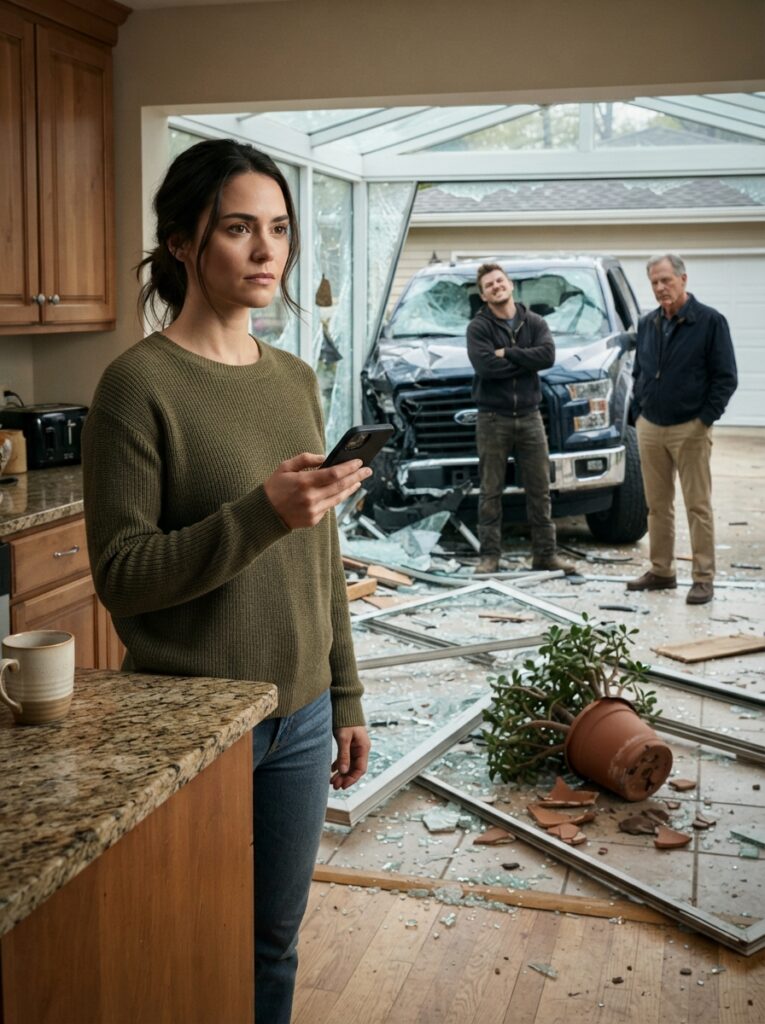
At 10:14 p.m., a crushing metallic scream ripped through the back of my house.
I ran into the kitchen.
Dylan’s truck was halfway inside my sunroom.
Glass had folded inward. Aluminum framing twisted around the hood. My tile was split under his front tire. Cold air pushed through the wreckage, carrying the smell of exhaust and broken ceramic.
The jade plant lay on the floor, its pot cracked.
Dylan climbed out.
He looked at the damage.
Then he smiled.
“Guess my foot slipped.”
Dad’s car was parked at the curb.
He walked through the gate only after the truck stopped.
He stared at my ruined room and said, “A stingy nobody like you doesn’t deserve nice things.”
Then he and Dylan left me standing there.
I didn’t chase them.
I picked up my mother’s plant, pressed the loose soil around its roots, and set it safely on the kitchen counter.
Then I reached for my phone.
Because dispatch had taught me something my family never understood.
When everything goes wrong, emotion can wait.
Evidence can’t.
### Part 2
By 10:30 p.m., I had taken seventy-one photos.
Wide shots. Close-ups. Tire position. Bent framing. Cracked tile. License plate. Damage from every angle.
Then I opened my security camera app.
That was when “my foot slipped” stopped being a bad excuse and became something else.
The footage showed Dylan at the far end of my driveway. His truck idled for several seconds.
He looked left.
Then right.
Then he deliberately accelerated backward into the sunroom.
And through the entire recording, Dad’s car sat at the curb with its headlights on.
Watching.
I called the police non-emergency line.
An officer arrived before midnight, photographed everything, copied the footage details into her report, and gave me a case number. The damage estimate put the incident well beyond a minor property dispute.
Then I called a tow company.
Dylan had abandoned his disabled truck inside my house.
By midnight, it was on a flatbed heading to an impound lot.
My neighbor Elise came over after the police left. She was a postal carrier who had the useful habit of showing up without demanding explanations.
She brought chamomile tea and a blanket.
Her first question was, “Is the plant okay?”
“Yes.”
She nodded.
That mattered more than she probably knew.
At 8:04 the next morning, Dylan called.
I watched his name flash across my screen.
Four rings.
Voicemail.
“WHERE IS MY TRUCK? WHAT DID YOU DO?”
I set the phone facedown.
Then I called my homeowner’s insurance.
By Monday, I was sitting across from an attorney with the police report, security footage, a contractor’s estimate, towing costs, emergency repair receipts, and two years of bank statements.
Those statements showed something Dylan and Dad had apparently forgotten.
Every month, $85 for Dad’s phone.
Every month, $140 for Dylan’s insurance.
Twenty-four months.
$5,400.
My attorney drafted a demand for the full property damage and related costs and named both men.
The letters went certified.
Dad called soon afterward.
“This is getting out of hand. We need to sit down before this goes further.”
I didn’t return the call.
Then, Wednesday afternoon, Megan texted me.
We had never spoken privately before.
Her message was short.
“I didn’t know he was going to do that. But there’s something you need to know. Your dad told Dylan months ago that the SUV was already his. Dylan has been telling people since January.”
I read it three times.
January.
Ten weeks before the birthday dinner.
Suddenly Dylan’s shocked face when I said no made sense.
He hadn’t believed he was asking me for my car.
He believed he was collecting it.
Dad had promised away something that belonged to me, then spent months letting Dylan build his plans around that promise.
And when I ruined Dad’s lie with one word—no—he drove Dylan to my house and watched the retaliation from the curb.
The broken sunroom wasn’t the beginning.
It was the cleanup.
Dad had spent years telling Dylan I had received more than my share.
Now I finally understood why.
And for the first time since Mom died, I stopped wondering whether my father was simply grieving.
He knew exactly what he was doing.
### Part 3
Saturday morning, I went to Dad’s house with a folder under my arm.
Elise drove me and parked around the corner.
Inside, Gordon sat in his armchair like he was chairing a business meeting. Dylan was on the couch with his arms crossed. Megan stood near the kitchen doorway with her purse still over her shoulder.
Dad began immediately.
“We need to handle this as a family.”
I put my phone on the coffee table.
“No. We’re going to handle it with facts.”
I connected my phone to his television and played the security footage.
Sixty-three seconds.
Dylan’s truck idling.
His head turning left.
Then right.
The pause.
The deliberate reverse.
The crash.
And Dad’s car sitting at the curb through every second.
When the video ended, nobody spoke.
Dad stared at the carpet.
Dylan looked at him.
Then Dylan said, “You told me she was giving me the car.”
Dad didn’t answer.
“You said it was already decided.”
Still nothing.
That silence told me more than an apology ever could.
I placed my bank statements on the coffee table.
“Two years,” I said. “Your phone. Dylan’s insurance. $5,400.”
Dad finally looked up.
I kept going.
“While I was paying your bills, you were telling him I had taken everything from Mom. You made me the villain while living partly on my money.”
Dylan rubbed the back of his neck.
“I didn’t think it would go this far.”
“You drove a truck through my wall. How far did you think it would go?”
His eyes dropped.
I turned to Dad.
“You promised him my property without asking me. When I said no, you drove him to my house. You watched him destroy my sunroom. Then you walked inside and told me I deserved it.”
“I never told him to hit the house,” Dad said.
“You didn’t have to.”
He flinched.
I slid the attorney’s demand letter toward them.
“There’s a police report. There’s an insurance claim. There’s video. From now on, everything goes through formal channels.”
Dad leaned forward.
“We can still settle this ourselves.”
“We’re past that.”
Then I gave them the part they hadn’t prepared for.
“Your phone bill is no longer on my account. Dylan’s insurance is no longer on my account. No more grocery runs. No rides. No emergency money. No birthday rescues.”
Dylan’s face changed.
Not anger.
Fear.
“I’ll pay for the room,” he said quickly. “Just drop the report. Please. We can start over.”
I looked at him.
For years, “starting over” had meant I absorbed the cost and everyone else forgot what happened.
Not this time.
“No.”
Megan quietly crossed the room, opened the front door, and left.
Dylan stared after her.
Dad stared at the demand letter.
I stood.
“This isn’t revenge. I’m simply done financing people who punish me for having what I worked for.”
Dad said my name once.
I kept walking.
Outside, Elise handed me her travel mug.
I took one sip and looked back at the house.
For seven years, I had thought keeping my promise to Mom meant protecting Dylan from consequences.
That morning, I finally understood the difference between helping someone and becoming the floor they expect to land on.
And I had just stepped away.
### Part 4
Consequences arrived faster than either of them expected.
Dylan’s truck sat in impound while storage fees climbed. When he finally went to retrieve it, his card was declined.
He called Dad.
Dad said, “I don’t have it.”
That may have been the first honest sentence between them in years.
Eventually Dylan scraped together enough money to release the truck, but the front end was badly damaged. He moved it to Dad’s driveway and missed two loan payments.
Dad had co-signed.
Six weeks after the sunroom was destroyed, a repo truck arrived before breakfast.
Dylan stood in the doorway and watched his truck leave on a flatbed for the second time.
Dad sat behind him at the kitchen table holding a collection notice with his own name on it.
Neither had anyone left to blame who was still willing to listen.
Dad began paying his own phone bill again.
Dylan asked the tire shop for full-time hours because he needed the money.
Megan never went back.
As for me, the insurance claim moved forward. The damaged wall stayed boarded for several weeks while materials were ordered.
Without the glass, my kitchen felt darker in the mornings.
But the jade plant sat in a new ceramic pot on the sill above the sink.
Elise had brought the pot over the day after the crash.
“Roots don’t care what container they’re in,” she said.
She was right.
The plant kept reaching toward the light.
Dad left me a forty-three-second voicemail a month after our meeting.
I never listened to it.
Not because I was still furious.
Because I no longer needed whatever version of the story he had finally constructed.
Maybe it was an apology.
Maybe an excuse.
Maybe another speech about family.
It didn’t matter.
By June, the sunroom was rebuilt.
Same dimensions.
Same glass.
Same tile pattern.
Elise helped me lay the new ceramic floor one Saturday, and we laughed when we realized I had measured one corner three times again, exactly like the first build.
“You know,” she said, “most people would redesign the whole thing after something like this.”
I looked around the unfinished room.
“The room wasn’t the problem.”
That became the truth I kept.
My house had never been selfish.
My paid-off SUV had never been selfish.
My savings, my quiet life, my plants, my careful bills—none of those things had harmed anyone.
The problem was that two people had mistaken my generosity for permanent access.
Once I closed that access, they called me cruel.
I stopped caring.
I did not forgive Dylan.
I did not reconcile with Dad.
I also did not spend my days hating them.
I simply stopped making room for them in a life they had repeatedly treated as available property.
One morning, after the final glass panel was installed, I carried the jade plant back into the sunroom.
Sunlight spread across the new tile.
I turned the pot once, placing the thickest stem toward the window, exactly the way Mom had done years earlier.
She had told me the plant would outlast everything if I left it alone.
She was almost right.
Sometimes survival requires more than being left alone.
Sometimes you have to pick yourself up, change the soil, find a new window—and stop letting the people who broke the old one back inside.
THE END!