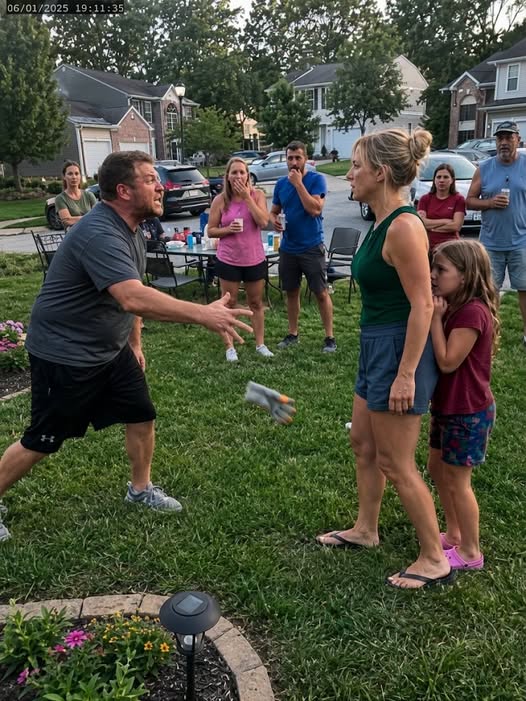
The black MMA gloves landed at my boots with a dull leather thump, and my eleven-year-old daughter stopped breathing, like she was afraid even that small sound might make things worse.
Travis Caldwell stood ten feet away on the grass, rolling his shoulders under a sleeveless shirt while four men from his fighting gym watched from behind him.
“Put the gloves on, almighty sister-in-law,” he shouted. “Or should I snap your arm and send you to the hospital in front of your daughter?”
His father, Grant, laughed beside the barbecue. “Teach this pathetic desk soldier a lesson,” he called. “Show her who runs this neighborhood.”
Forty people had gathered for the Labor Day cookout at the end of our suburban street, but nobody joined his laughter. Paper plates sagged in people’s hands. Burgers cooled beside open bags of chips. The sprinkler kept hissing over Mr. Palmer’s lawn as if nothing had changed.
Everything had changed.
My daughter, Sophie, stood at the edge of the crowd twisting the bottom of her T-shirt between both hands. She wasn’t watching Travis. She was watching me, searching my face for proof that I could keep her safe.
“Sophie,” I said, never taking my eyes off my brother-in-law, “go stand beside Mr. Palmer.”
Her sneakers scraped across the pavement behind me.
Travis laughed and bounced on the balls of his feet. “That’s right,” he said. “Move the kid so she doesn’t have to watch her mom beg.”
I bent down and picked up the gloves. I did not put them on. I held them loosely at my side and looked at the man who had just threatened to cripple me in front of my child.
“Take one more step toward my daughter, Travis.”
His grin widened. Mine did not.
To most of the neighborhood, I was Claire. The quiet single mother who worked in records management for a federal agency and drove an SUV old enough to still have a cassette deck. I bought curtains at thrift stores, drank coffee from a chipped mug, and spent Saturday mornings helping Sophie build forts out of fallen branches near the fence. My civilian profile listed me as an administrative support specialist. That description was accurate in the same way that calling a hurricane a change in weather is accurate. The rest of my service history required clearances that Grant Caldwell’s money would never buy.
Travis knew none of that. My sister Natalie had known only fragments, because I’d spent years teaching my family not to ask questions I wasn’t permitted to answer. She knew I’d served. She believed I’d spent most of it behind a desk. And that was the version of me she had apparently handed to her husband as entertainment.
Natalie stood beside Grant in an expensive summer dress, arms folded tight beneath her chest. She didn’t look frightened by Travis’s threat. She looked pleased that the attention wasn’t on her. That hurt more than the gloves had.
Travis took one step forward.
I dropped the gloves back onto the grass. The leather landed between us.
“I warned you,” I said.
“You warned me?” He pointed at himself and laughed. “You think because you filled out paperwork for the military, you can talk to me like that?”
One of the gym men shifted uncomfortably. This had probably been sold to them as a friendly demonstration, the kind of dumb backyard challenge built around bragging rights and beer. Now there was a child hiding behind a lawn chair while a grown man threatened her mother. It no longer looked like sport.
Mr. Palmer stepped closer to Sophie and put himself between her and the lawn. “That’s enough, Travis,” he said.
Grant rounded on him instantly. “Stay out of family business.”
“It stopped being family business when he threatened her in the street,” Mr. Palmer replied.
Travis’s eyes flicked toward Sophie. It lasted less than a second, but I saw the calculation in it. He understood that my attention was split between him and my daughter, and he believed that made me weaker. He moved toward the pavement. I stepped into his path.
His grin came back. “There she is,” he said. “Finally ready to do something.”
“No,” I told him. “I’m ready to stop something.”
He shoved me with both hands. It wasn’t a testing push. He put his weight into it, trying to send me backward in front of the whole neighborhood. I turned with the force instead of fighting it, guided his right wrist past my shoulder, and stepped behind his balance before he understood that he’d lost it. His own momentum carried him down. One second he was standing over me. The next, a knee hit the grass and his right arm was secured behind him at an angle that controlled the joint without damaging it.
I kept my weight low and my hand open. I did not punch him. I did not twist harder than necessary. I did not give him the injury he had promised me.
Travis made a furious sound and tried to surge up. I adjusted my position by less than an inch. He stopped moving.
“Do not fight the pressure,” I said quietly. “You’ll hurt yourself.”
The crowd had gone so still that the sprinkler sounded deafening. Grant dropped his plastic cup. Natalie unfolded her arms. The four gym men no longer looked amused. One of them raised both hands and backed away. “This wasn’t what he told us,” he said.
Grant pointed at me like I’d staged the whole thing. “You all saw that,” he shouted. “She attacked him.”
“No,” Mr. Palmer said. “We saw him shove her after threatening to break her arm.”
Several neighbors spoke at once, each confirming the same sequence. The gloves. The threat. The step toward Sophie. The shove. Grant’s face hardened as he understood the crowd wasn’t going to repeat his version just because he said it louder.
Travis tried to turn his head toward me. “You got lucky,” he hissed.
I leaned close enough that only he could hear. “Luck would have been you listening the first time.”
His breathing went rough and embarrassed. Men like Travis often mistake restraint for hesitation, because they’ve never learned how much control restraint actually takes. I’d spent years making decisions in places where one unnecessary movement could cost someone their life. Holding an angry man safely on a suburban lawn was not difficult. Doing it while my daughter watched was.
“Sophie,” I called.
“I’m here,” she answered from behind Mr. Palmer. Her voice shook, but she answered.
“That’s my girl. Stay where you are.”
Travis jerked again at the sound of her voice. I tightened the hold just enough to stop the movement. “You will remain still,” I told him. “When I release you, you will step away from my daughter and leave my property line. Do you understand?”
“You don’t give me orders.”
“Then we can stay like this until the officers arrive.”
His body stiffened. Someone nearby had already called for help, which was the sensible response to a public threat involving a child.
Grant heard me and started talking faster. “This is ridiculous. Travis was joking. Everyone here knows he was joking.”
“No,” Natalie said. Her voice was quiet, but it cut through the noise.
Grant turned toward her. “What did you say?”
Natalie looked at her husband on the ground, then at Sophie behind the lawn chair. “He wasn’t joking.”
Travis stopped struggling. Grant’s expression shifted from anger to warning. “Natalie.”
She flinched at the sound of her own name, and I understood something I should have seen earlier. Her folded arms hadn’t been confidence. They’d been armor. The satisfied line of her mouth had been the face of someone trying desperately to stay on the winning side of a dangerous man. That didn’t excuse what she’d done. It only explained why she’d done it.
Natalie looked at me. “He planned this,” she said. “He’s been talking about it for two weeks.”
A murmur moved through the neighbors. Travis cursed under his breath. Natalie kept going, maybe because stopping would have meant losing the nerve to continue.
“He said you acted like you were better than him. That you ignored him when he bragged about his fights. Grant told him the whole neighborhood needed to see you put in your place.”
Grant took a step toward her. “You’re confused.”
Natalie stepped back. “No, I’m not.” For the first time that afternoon, she sounded certain. She pointed toward the gloves on the grass. “They bought those yesterday. Travis practiced what he was going to say. They told the gym guys Claire had challenged him and then backed out.”
The men behind Travis looked at one another. The largest of them pulled a set of car keys from his pocket. “We were told this was agreed sparring,” he said. “We’re leaving.”
Grant blocked him with an outstretched arm. “You’re not going anywhere until you explain what you saw.”
“I saw Travis threaten a woman in front of her kid and shove her first.” The man moved around Grant. The others followed.
Travis heard their shoes crossing the pavement and finally understood that the audience he’d assembled was walking out on him. “Get off me,” he said.
“Tell me you understand the condition.”
His jaw pressed into the grass. “I understand.”
“Say it clearly.”
“I’ll stay away from Sophie.”
I released him and stepped back immediately, keeping myself between him and my daughter. Travis rose too fast, humiliated and red-faced. For half a second, his right shoulder pulled back.
His father shouted, “Don’t let her embarrass you!”
That was the moment Travis made his last mistake. He listened to Grant. He lunged.
This time I did not take him to the ground. I redirected his arm, planted an open hand against the center of his chest, and stopped him hard enough to break his forward drive without touching his face or his throat. His feet tangled beneath him and he stumbled backward into an empty folding table. The table collapsed. Plastic cups bounced across the lawn and a tray of burned onions slid harmlessly into the grass. Travis stayed upright, but the shock on his face was unmistakable. He had thrown everything he had into that charge, and I’d stopped it without throwing a punch.
“Stand down,” I said. The command came out in a voice I hadn’t used at home in years. It wasn’t loud. It didn’t need to be. Travis froze. So did Grant. My posture, my tone, and the precision of what had just happened finally forced them to reconsider the woman they thought they’d cornered.
Natalie stared at me. “Claire,” she whispered, “what did you do in the military?”
I kept my attention on Travis. “My job.”
“What job?” Grant demanded. The question carried less authority than it had a minute ago.
I heard vehicles turning onto the street in the distance. Travis heard them too. His breathing changed.
I could have humiliated him then. I could have listed assignments and qualifications and commands and years of service until every person on that lawn understood exactly how wrong he’d been. Instead I gave him the only information that mattered.
“I spent eighteen years learning how to end dangerous situations,” I said. “Today I chose to end this one without injuring you.”
His eyes dropped to the gloves.
Grant tried one more time to seize control. “Anybody can claim anything,” he said. “She’s a clerk.”
I looked at him for the first time. “My rank is major.”
The words settled over the lawn. Natalie covered her mouth. Travis stared at me like the person in front of him had replaced the sister-in-law he thought he knew.
Grant gave a brittle laugh. “A major in records management?”
“Special operations,” I said. I offered no unit name, no mission details, no stories polished for an audience. The truth didn’t require decoration.
Travis looked at his taped hands, then at the woman he’d called weak. For the first time all afternoon, he had nothing to say.
When the responding officers arrived, the scene was still easy to read. The gloves lay on the grass where Travis had thrown them. The collapsed table showed where he’d charged the second time. Dozens of witnesses could describe the threat and the shove in the same order. I gave a factual statement and nothing more. Travis tried to claim we’d agreed to fight, but the gym men had already left their names and confirmed that he’d lied to them about the arrangement. Grant interrupted so many times that an officer finally instructed him to step back. Natalie stood alone near the grill, looking smaller than she had when the whole thing started.
Sophie stayed beside Mr. Palmer until I was allowed to go to her. Then she ran. I caught her with both arms, and the force of her body against mine nearly broke the control I’d held all afternoon.
“Are you hurt?” she asked into my shoulder.
“No.”
“Did you hurt him?”
“No.”
She pulled back and searched my face. “You could have.”
It wasn’t admiration in her voice. It was fear of what power might do to a person.
I brushed a strand of hair off her cheek. “Yes,” I said. “That’s why it mattered that I didn’t.”
Her breathing slowed. Behind us, Travis was being escorted away from the center of the gathering while Grant argued about reputation and misunderstanding and family loyalty. Natalie didn’t defend either of them. She walked toward me, then stopped several feet away.
“I’m sorry,” she said.
I kept one arm around Sophie. The apology was too small for what she’d allowed, and all three of us knew it.
“You watched him threaten me in front of my daughter,” I said.
Her eyes filled, but I didn’t rescue her from the truth. “I know.”
“You helped him believe it would be safe.”
“I know.”
Sophie pressed closer to my side. Natalie looked at her and began to cry. “I thought if I laughed with them, they wouldn’t turn on me.”
And there it was. The fuller truth behind the expensive dress and the folded arms and the satisfied expression. She hadn’t joined the cruelty because she felt powerful. She’d joined because she was afraid of becoming its next target. Fear explained her choice. It did not erase it.
“You don’t get to use my child as the shield that keeps them from choosing you,” I said.
Natalie nodded. “I understand.”
“No. You understand the sentence. Understanding the damage will take longer.”
She lowered her head. I told her she could not come into my home that night, and could not contact Sophie until I decided it was appropriate. I also told her that if she believed she was unsafe, she could ask Mr. Palmer to stay nearby while she gathered what she needed and found somewhere else to go. I would not pretend nothing had happened. And I would not abandon her to men who rewarded obedience with temporary protection. Both of those things could be true at once. She accepted the boundaries without bargaining, which was the first responsible thing she’d done all day.
The cookout ended quietly. Neighbors folded chairs, collected plates, and carried food back toward their houses while the sun dropped behind the roofs. Mr. Palmer picked up the black gloves with two fingers and asked what I wanted done with them.
“Leave them there for now,” I said.
Sophie looked at them as we walked home. “Were you really a special operations major?”
“I am a major,” I said. “Some of the work was with special operations.”
“Why didn’t you tell me?”
“Because I wanted you to know me as your mom before you knew me as anything else.”
She thought about that as we crossed the driveway. “Did Aunt Natalie know?”
“Not all of it.”
“Did you hide it because it was secret?”
“Some parts were secret. Some parts were private.”
“What’s the difference?”
I opened the front door and let her step inside first. “A secret protects information,” I said. “Privacy protects a life.”
For four months I’d been trying to build us a private life in that neighborhood. Ordinary mornings, grocery lists on the fridge, school projects spread across the kitchen table, coffee from the same chipped mug. I’d believed that keeping my past locked away was the only way to protect those things. That evening I understood that Sophie didn’t need a mother with no past. She needed a mother who could explain why strength should have limits.
We sat at the kitchen table while the last daylight faded through the thrift-store curtains. I told her I had led people in dangerous places. I told her I had made mistakes, followed orders, questioned orders, and learned that courage is rarely as loud as television makes it look. I didn’t give her details she was too young to carry. I gave her the truth she needed. The strongest person in a conflict is not always the one who can cause the most pain. Sometimes it’s the one who can stop.
Natalie didn’t come back that night. She stayed with a friend from work and sent me one message saying she was safe. I didn’t answer right away. The next morning she sent another, accepting the boundary I’d set and asking whether she could write Sophie an apology without expecting a response. I agreed, on the condition that the letter contain no excuses and no request for forgiveness.
Three days later, Sophie read it at the kitchen table. Natalie admitted that she had laughed when she should have intervened, that she had helped Travis turn a family gathering into a trap, and that fear did not make her actions harmless.
Sophie folded the letter carefully. “Do I have to forgive her?”
“No.”
“Can I forgive her later?”
“Yes.”
“Can I still be mad if I forgive her?”
“Yes.”
She put the letter in a drawer beside her school supplies. For the first time since the cookout, her shoulders came down.
Travis never apologized. Grant sent two angry messages accusing me of destroying the family and humiliating his son. I saved them and blocked his number.
The neighborhood did not treat me like a hero afterward, which was exactly what I wanted. Mr. Palmer still complained about squirrels in his flower beds. The woman across the street still left for work every morning with a paper coffee cup balanced on the roof of her car until someone reminded her. Children still rode bikes through the cul-de-sac before dinner. Life came back. But not quite the way it had been. People stopped mistaking quietness for permission.
A week after the cookout, Mr. Palmer brought the MMA gloves to my porch in a plain grocery bag. He said the officers no longer needed them and asked whether he should throw them away. Sophie stood behind me in the doorway. I looked at the gloves, then at her.
“Not ours,” I said.
I gave the bag to Natalie when she came by later to collect the last of her things from the Caldwell house. She’d moved out, but she didn’t present it as some grand act of courage. She only said she was beginning to understand how many times she had mistaken temporary peace for safety.
I handed her the bag. “What are these?”
“The gloves Travis threw at me.”
Her face tightened. “What should I do with them?”
“That’s between you and him.”
She nodded and carried them away. The object that had been meant to force me into Travis’s rules left my porch unopened and powerless.
Two months later, Sophie joined a youth self-defense class at a community gym. Not because I wanted her to fight. Because I wanted her to understand distance, boundaries, balance, and the confidence to use her voice before a threat ever became physical. On her first day she stood beside me in worn sneakers and a gray T-shirt, nervous but determined. The instructor offered her a pair of padded training gloves. Sophie looked at them, then looked at me.
“Do I have to wear these?”
“For this class, yes.”
She smiled a little. “Are you going to tell everyone you were a major?”
“No.”
“Special operations?”
“No.”
“What are you going to tell them?”
I took a seat against the wall while she joined the other kids on the mat. “I’m going to tell them I’m Sophie’s mom.”
That seemed to satisfy her.
The class began with no punches, no threats, and no audience waiting for someone to be humiliated. The children practiced planting their feet, raising open hands, and saying one word clearly enough to be heard across the room.
“Stop.”
Sophie’s first attempt was quiet. Her second was stronger. On the third, every head in the room turned. She glanced toward me, not searching this time for proof that I could keep her safe, but checking whether I’d seen her begin to believe she could protect her own boundaries too.
I nodded. She turned back to the instructor and raised her hands again.
Months later, when people asked Sophie what happened at the Labor Day cookout, she never talked about the takedown, or my rank, or the moment Travis learned that the woman he’d called defenseless had commanded soldiers in places he could barely imagine. She remembered one simpler thing.
Her uncle threw a pair of gloves at my feet and demanded that I fight by his rules.
I picked them up.
And then I chose not to put them on.
Shadows of the Past
The calm that settled over our cul-de-sac in the weeks following the cookout was fragile, built on the quiet understanding that quiet people are not necessarily helpless. Yet, while the neighborhood returned to its mundane routines—lawnmowers on Saturday mornings, the rustle of dry autumn leaves against the pavement—the ripple effects inside our family had only just begun.
Grant’s anger didn’t dissipate; it curdled. Two weeks after he sent the messages I’d archived and blocked, an unfamiliar sedan idling at the end of our street became a daily occurrence. I noticed it on my morning run: a gray Ford, parked just far enough from the streetlight to blend into the shadows. My tactical instincts, honed over a decade in special operations, wouldn’t allow me to ignore it.
One evening, after putting Sophie to bed with her favorite book, I walked out to the driveway. The cool night air carried the sharp scent of pine. I didn’t approach the vehicle with aggression; I simply stood by my mailbox, arms crossed, letting the driver know they had been burned. The car’s headlights flashed once, then it pulled away into the darkness.
The next day, a formal envelope arrived in the mail—not from Grant directly, but from a legal firm representing his family’s interests. It contained a notice alleging breach of family trust and threatening civil litigation over property rights regarding the house I was renting, which had brief, historical ties to our family’s estate. It was a transparent maneuver, designed not to win in court, but to drain my resources and force me back into communication.
I sat at the kitchen counter, tracing the raised seal on the letterhead. Sophie was at the table, humming softly as she colored a drawing of her self-defense class.
“Mom?” she asked, looking up. “Is that another letter from Uncle Grant?”
“It’s just paperwork, sweetie,” I said, keeping my tone even. “Nothing to worry about.”
“He’s still mad, isn’t he?”
“He’s confused,” I corrected gently. “Sometimes when people lose control, they try to use rules and papers to get it back.”
“Are we going to have to move?”
I set the letter down and looked straight into her eyes. “No. We built this home, Sophie. A piece of paper doesn’t change that.”
That afternoon, I called Captain Marcus Vance, a former legal officer from my old unit who now ran a private practice downtown. Marcus had seen me lead teams through high-stakes operations in Al Anbar; he knew how I operated under pressure.
“Major,” Marcus said, his voice echoing slightly over the speakerphone. “I saw the summary of the situation you sent over. Grant’s counsel is blowing smoke. They have no legal standing regarding the lease agreement you signed with the actual property owner.”
“I know,” I replied. “But he’s using it to probe for leverage. I want a firm, clean response. No aggression, just ironclad legal boundaries.”
“Consider it done. I’ll send a formal cease-and-desist regarding his harassment tactics, along with a clarification of the property lease terms. If he steps one foot onto your property, we go straight to a restraining order.”
“Thank you, Marcus.”
“How is Sophie holding up?” he asked, his tone softening.
“She’s resilient. Better than I was at her age.”
“She’s your daughter, Sarah. Courage runs in the blood. Just remember—you don’t have to carry the whole world on your shoulders anymore. You left the service for a reason.”
After hanging up, I walked out to the back porch. The sun was dipping low, casting long, crimson shadows across the yard. Marcus was right. I had spent years carrying the weight of command, making split-second decisions where lives hung in the balance. Compared to that, Grant’s petulant legal threats were minor turbulence. But the emotional toll on Sophie was what mattered most.
Later that week, Natalie called from a new number. I hesitated before answering, balancing my need to protect my space with the promise of fairness I had made to myself.
“Sarah?” her voice was hesitant, stripped of the glossy confidence she used to hide behind. “I’m calling because… I wanted you to know I’ve enrolled in counseling. And I returned the gloves to Travis. I told him never to contact me again.”
“How did he take it?” I asked, keeping my voice neutral.
“He was furious. He called me a traitor. But for the first time in my life… I didn’t apologize.” She paused, taking a shaky breath. “I’m not asking to come over. I know I haven’t earned that. I just… I wanted you to know I’m trying to fix what I broke in myself.”
“I appreciate you telling me, Natalie,” I said honestly. “Progress takes time. Keep doing the work.”
“Thank you, Sarah. Give Sophie my love… if she’s ready to hear it.”
“I will when the time is right.”
As I hung up, I realized that the cookout hadn’t just exposed Travis’s weakness or Grant’s arrogance; it had started a slow, painful chain reaction of accountability. The walls of illusion that kept our family trapped in toxic dynamics were finally coming down.
The Unspoken Contract
Winter arrived with a quiet intensity, dusting the suburban streets in pale frosting. The neighborhood shifted indoors, light spilling from living room windows into the early darkness.
At Sophie’s gym, the self-defense classes progressed from basic footwork to situational awareness. I watched from the wooden benches as the instructor, a retired police officer named Dan, guided the kids through scenario drills. Sophie moved with a quiet, deliberate intent that reminded me of my early days in basic training—focused, observant, and unwilling to be rushed.
One Tuesday evening, after class, Dan walked over to where I was sitting. He carried two paper cups of hot coffee, offering one to me.
“She’s got your discipline,” Dan observed, watching Sophie pack her gear into her duffel bag.
“She gets her determination from her own spirit,” I replied, accepting the cup. “I just try not to get in her way.”
Dan leaned back against the wall. “I heard a rumor around town. A couple of the local vets mentioned a Major Sarah Miller who used to run logistics and tactical coordination down south. Said she was a ghost.”
I took a slow sip of coffee. “People like to tell stories in small towns, Dan.”
“Fair enough,” he smiled. “Whatever the story is, you’ve raised a good kid. She doesn’t fight out of anger. That’s rare for kids her age. Most of them want to look tough.”
“Toughness is an act,” I said softly. “Real strength is knowing you don’t have to prove anything to the room.”
As we drove home, the snow began to fall in heavy, lazy flakes. The car heater hummed, warming our hands.
“Mom?” Sophie broke the silence.
“Yes, honey?”
“At school today, a boy named Leo took Maya’s drawing and ripped it up. He wanted everyone to laugh.”
I kept my eyes on the road. “What did you do?”
“I stood up and told him to stop. I used my loud voice, like in class.”
“And what happened?”
“He looked surprised. Then he dropped the paper and walked away. But…” she hesitated, looking out the window at the passing streetlights. “Some of the other kids called me bossy.”
I felt a tight knot in my chest, an old memory of how the world often treats girls who assert control over their space. I pulled the car into our driveway, turned off the engine, and turned to face her.
“Sophie, when you stand up for someone who can’t stand up for themselves, people who are comfortable with cruelty will always try to call your courage a bad word. ‘Bossy’ is just a word weak people use when they can’t push you around.”
She met my eyes, digesting the words. “Did they call you bossy in the army?”
I let out a soft laugh. “They called me worse. But it never stopped me from doing what was right.”
“Did it hurt your feelings?”
“At first, maybe. But then I realized their opinion didn’t change who I was. Your integrity belongs to you, Sophie. Nobody can take it unless you hand it to them.”
She smiled, a small, genuine expression that reached her eyes, and nodded. “Okay. I’m glad I helped Maya.”
“I am too.”
That night, as the snow accumulated on the roof, I sat down at my desk to write a letter of my own. Not to Grant, nor to Natalie, but to my former commanding officer, General Vance, who had reached out weeks ago offering me a civilian consultant role at a regional security institute. I had hesitated for months, fearing that taking the job would drag my past back into the sanctuary I’d built for Sophie.
Writing under the soft glow of the desk lamp, I put pen to paper:
Dear General Vance,
I am ready to accept the consulting position, provided the terms allow me to remain based locally. My primary duty remains here, raising my daughter. But I realize now that stepping away from my experience entirely does not protect her; demonstrating how to use that experience with purpose is what matters.
I sealed the letter, feeling a profound shift within myself. I was no longer hiding behind a quiet civilian persona out of fear. I was embracing the totality of who I was—mother, soldier, leader—on my own terms.
The Confrontation at the Park
Spring returned, melting the snow into muddy slush and bringing bright green buds to the oak trees along the avenue. With the warmer weather, the neighborhood park became the central gathering spot for local families again.
It was an unseasonably warm Saturday afternoon when Sophie asked to go to the park to ride her scooter. I brought a book and settled onto a bench near the playground, keeping a watchful eye on her as she maneuvered around the paved paths.
The peaceful afternoon was disrupted when a familiar black SUV pulled up alongside the curb. My heart tightened slightly, though my posture remained calm and relaxed. Grant stepped out of the vehicle, followed by Travis.
They hadn’t seen me yet. Grant was talking loudly on his phone, gesturing aggressively, while Travis walked behind him, looking sullen and detached. Travis was wearing a heavy jacket despite the warmth, his eyes fixed on the ground.
I stood up from the bench, positioning myself between them and the playground where Sophie was riding. I wasn’t going to let them bring their drama into her space.
Grant caught sight of me and paused, hanging up his phone. He walked toward me with quick, rigid steps, his expression thunderous. Travis lagged several paces behind.
“Sarah,” Grant said, his voice laced with venom. “I see you’re still playing the victim.”
“Grant,” I replied, keeping my voice low and steady. “You’re on public property, but this is a park full of children. State your business or move along.”
“My business?” Grant scoffed, crossing his arms. “You ruined my family’s standing in this town! You humiliated Travis! You turned Natalie against us!”
“You humiliated yourself, Grant,” I said quietly. “And Travis made his own choices when he tried to bully me in front of my child. As for Natalie, she made a choice to stop living in fear of your temper.”
Travis shifted uncomfortably, avoiding my gaze. The arrogant swagger he had displayed at the cookout was entirely absent, replaced by a hollow, defeated posture.
“He’s my son!” Grant snapped, stepping closer. “He was just trying to teach you a lesson about respect!”
“Respect isn’t demanded through intimidation, Grant. It’s earned through character.” I took one deliberate step forward, reducing the distance between us. I didn’t raise my voice, but the weight of my military presence filled the space between us. “You came here expecting to intimidate a single mother. You forgot who you were talking to.”
Grant hesitated. For the first time, he saw the total lack of fear in my eyes—the cold, calculating assessment of an officer who had faced far greater threats than a frustrated suburban patriarch.
“If you ever follow me, send legal threats to my landlord, or approach my daughter again,” I continued, each word sharp and precise, “I will ensure that every document, message, and police report from the Labor Day incident becomes part of a public record that no amount of family influence can erase. Am I clear?”
Grant opened his mouth to reply, but the words seemed to stick in his throat. He looked at Travis, then back at me. The silence stretched between us, heavy and absolute.
Travis spoke up unexpectedly, his voice barely above a whisper. “Dad… let’s just go.”
Grant turned to his son, surprised by the intervention. Travis didn’t look at him; he simply turned around and walked back toward the SUV.
Grant glared at me for a long moment, realization finally settling in. He had lost his audience, his leverage, and his authority. Without another word, he turned and followed his son.
I watched the SUV pull away until it disappeared around the corner. I took a deep breath of the spring air, feeling the tension drain from my shoulders.
“Mom?”
I turned to see Sophie standing a few feet away, holding her scooter. She had watched the exchange from a distance.
“Are you okay?” she asked softly.
I walked over to her, kneeling down to meet her eye level. “I’m great, sweetie. How was your ride?”
“It was good,” she said, looking toward the street where the car had gone. “Did Uncle Grant leave for good?”
“Yes,” I said, putting a hand on her shoulder. “He left.”
“Did you have to use your loud voice?”
“No,” I smiled, brushing a stray lock of hair from her forehead. “Sometimes, when you stand firm enough, you don’t even have to raise your voice.”
Reclaiming the Narrative
By mid-summer, the quiet stability we had fought for felt permanent. My work as a civilian security consultant allowed me to work mostly from home, reviewing strategic plans and advising on crisis management frameworks while remaining fully present for Sophie’s daily life.
Natalie began visiting us again, though under carefully maintained boundaries. She came over on Sunday afternoons, bringing homemade pastries or art supplies for Sophie. The transformation in her was remarkable; the frantic need to please everyone had been replaced by a quiet, reflective humility.
One afternoon, while Sophie was upstairs working on a school project, Natalie sat with me on the back porch.
“I saw Travis last week,” Natalie admitted, holding a cup of tea. “He’s moving out of Grant’s house. He got a job in the next town over, working in construction.”
“That’s a good step for him,” I said. “Getting out from under Grant’s shadow.”
“He asked about you and Sophie,” she continued. “He seemed… ashamed. He told me he couldn’t believe he let his father convince him to act like that.”
“Ashamed is the beginning of responsibility,” I noted. “I hope he sticks with it.”
Natalie looked out over the yard, where the summer flowers were in full bloom. “Sarah, how did you know? How did you know that not fighting back with violence was the right choice that day?”
I leaned back against the porch chair, looking at the trees rustling in the breeze. “When you’ve seen what real power looks like—what real destruction looks like—you realize that unnecessary force is just a sign of weakness. Travis wanted a fight because he thought a fight would validate his strength. By refusing to give him one, I showed him that his rules didn’t apply to me.”
“I used to think being strong meant never letting anyone see you drop your guard,” Natalie said softly. “Now I see that true strength is being so secure in who you are that nobody else can define your terms.”
“That’s what I want Sophie to understand,” I replied. “Not how to win fights, but how to render them irrelevant.”
Later that evening, Sophie came downstairs holding a small notebook. It was her journal from her self-defense class, where she recorded notes on techniques, rules, and personal reflections.
“Look, Mom,” she said, opening the book to a page with a hand-drawn diagram of a shield.
“What’s this?” I asked, leaning in.
“Coach Dan asked us to draw what protection means to us,” she explained. “Most of the boys drew swords and armor. But I drew this.”
Underneath the drawing of the shield, in her neat, careful handwriting, she had written three sentences:
- Protection is keeping your space safe.
- Protection is saying ‘stop’ before things hurt.
- Protection is knowing when to walk away.
I felt a surge of pride so profound it brought a warm sting to my eyes. I pulled her into a tight hug, holding her close as the twilight faded outside the window.
“That is the best definition of protection I’ve ever read, Sophie,” I whispered.
“I learned it from you,” she said simply.
A Mother’s Legacy
The anniversary of the Labor Day cookout arrived on a warm, clear afternoon. The neighborhood association had planned another gathering, but this year felt distinctly different. The atmosphere was light, unburdened by the heavy undercurrents of ego and tension that had dominated the previous year’s event.
Mr. Palmer was there, busy grilling burgers and chatting amiably with the neighbors. The woman from across the street was laughing with a group of parents near the picnic tables. Children ran across the green lawn, their laughter echoing in the clear air.
Sophie and I walked over together. She was taller now, carrying herself with an easy, unforced grace. She wore her favorite summer dress, her hands free, her expression relaxed.
As we walked up, Mr. Palmer waved us over, a wide smile on his weathered face. “Major! Sophie! Glad you could make it!”
“Good to see you, Mr. Palmer,” I said, offering a warm smile.
“I saved a couple of hot dogs for Sophie,” he said, handing a plate over with a wink. “No squirrels interfered with these!”
Sophie laughed and accepted the plate. “Thanks, Mr. Palmer!”
As Sophie went over to join her friends from the self-defense class who were playing tag on the lawn, Mr. Palmer turned to me, his tone growing slightly more reflective.
“You know, Sarah,” he said quietly, looking across the park. “Things have been different around here this past year. Better.”
“How so?” I asked.
“People talk to each other more. They look out for each other. That thing that happened last year… it woke a lot of us up. Showed us what kind of community we wanted to be.” He paused, looking at me with deep respect. “You showed us what leadership looks like without shouting.”
“It was just about setting boundaries, Mr. Palmer,” I replied.
“Maybe so. But boundaries make good neighbors.”
I watched Sophie run across the grass, her laughter ringing out clear above the crowd. She dodged another child, planted her feet with effortless balance, and turned to call out to her team. She wasn’t fearful. She wasn’t defensive. She was simply present, alive, and completely free.
Natalie joined us a little later, bringing a homemade salad. She greeted the neighbors warmly, no longer hiding behind nervous smiles or seeking validation. She had found her own grounding, step by painful step.
“She looks happy,” Natalie said, standing beside me as we watched Sophie.
“She is,” I said. “We both are.”
“Thank you, Sarah,” Natalie whispered. “For not giving up on me, even when I gave you every reason to.”
“Everyone deserves a chance to choose a different path,” I said. “What matters is what you do when you realize you were on the wrong one.”
The Unbroken Circle
As autumn returned once more, bringing crisp mornings and golden foliage, a package arrived at our front door. It had no return address, only my name printed in clear, block lettering.
I brought it inside and opened it at the kitchen table. Inside was a small, wooden display box containing a set of neatly folded military patches—the insignias of my former special operations unit—along with a hand-written letter on heavy cardstock.
The letter was from Travis.
Sarah,
I’m writing this because I owe you an explanation, though I know it doesn’t excuse what I did. For years, I thought my father’s way of doing things was the only way to be a man. I thought strength meant dominating people, making them afraid, and forcing them to respect you. When I threw those gloves at your feet, I thought I was putting you in your place.
I was wrong. Watching you stand there—calm, unbothered, refusing to play my game—was the moment I realized how weak I actually was. You didn’t need to punch me to prove you were stronger. You just had to stand your ground.
I’m working on myself now. I’ve cut ties with my father’s toxic expectations, and I’m trying to build a life based on real respect. I asked Natalie to return those gloves because I couldn’t bear to look at them anymore. I’m sending these patches back to you because they belong with someone who actually understands what honor means.
I don’t expect you to reply. I just wanted you to know that your choice that day changed more than one life.
Sincerely,
Travis
I read the letter twice, feeling a deep, quiet sense of closure. I placed the wooden box on the desk beside my military commendations—not as a trophy of victory, but as a reminder of the quiet ripple effect that principled choices can create.
When Sophie came home from school, she saw the box on the desk. She walked over and looked at the patches inside.
“Are these yours, Mom?” she asked, tracing the embroidered borders with her finger.
“They are,” I said, coming up behind her and placing a hand on her shoulder. “They’re tokens from my past.”
“Are you proud of them?”
“I’m proud of what they taught me,” I answered thoughtfully. “They taught me that the real test of strength isn’t how hard you can hit. It’s how much peace you can maintain when everyone around you wants a war.”
Sophie looked up at me, her brown eyes clear and perceptive. “Is that why you didn’t fight Uncle Travis?”
“Yes,” I said. “Because fighting him would have meant accepting his idea of power. I wanted you to see a different kind.”
She nodded, turning back to the patches. “I get it now.”
The Measure of Strength
Three years passed. The events of that Labor Day cookout gradually dissolved into local history, remembered not as a dramatic scandal, but as the turning point when our neighborhood became a community built on mutual respect and clear boundaries.
Sophie was fourteen now, tall and confident, moving through her teenage years with a rare balance of independence and kindness. She was a senior student assistant in her self-defense class, helping Coach Dan train younger children.
One Saturday afternoon, I sat in the gym watching her work with a group of seven-year-olds. She demonstrated basic stance and balance, her tone patient, encouraging, and clear.
“Remember,” Sophie told the small group, standing at the front of the mat with her hands open and held high. “Your stance isn’t about getting ready to hurt someone. It’s about letting them know your space belongs to you. You stand firm, you look them in the eye, and you say your word.”
“Stop!” the children chorused, their small voices ringing across the gym floor.
“Good,” Sophie smiled, her posture poised and strong. “Again, louder this time. Make sure they hear you.”
“STOP!” they shouted in unison.
I leaned back against the bench, feeling an overwhelming warmth in my chest.
In that moment, I realized that the greatest victory of my life hadn’t occurred on a battlefield in a distant country, nor had it been sealed with military honors or tactical success. My greatest victory had taken place on a mundane suburban lawn on a hot September afternoon, when I chose to pick up a pair of gloves and set them aside.
By refusing to fight on Travis’s terms, I had broken a cycle of anger, intimidation, and fear that had plagued our family for generations. I had given my daughter something far more valuable than a demonstration of physical dominance; I had given her a blueprint for self-worth that no bully, no threat, and no circumstance could ever take away.
After class ended, Sophie walked over to where I was waiting. She slung her gym bag over her shoulder, flushed and smiling.
“How was that?” she asked, wiping a light sheen of sweat from her forehead.
“You were incredible,” I said, handing her a bottle of water. “You’re a natural teacher.”
“Thanks, Mom,” she said, taking a long drink. “Coach Dan said I can start leading the advanced group next month.”
“You’ve earned it.”
We walked out of the gym together into the bright, warm afternoon sun. The air was soft, carrying the scent of blooming jasmine from the garden beds nearby. As we reached the car, Sophie stopped and looked over at me, a reflective smile playing on her lips.
“Hey, Mom?”
“Yeah, honey?”
“Do you ever think about those gloves?”
I paused, looking at her in the clear sunlight. “Sometimes. Why do you ask?”
“I was thinking about them today while teaching the kids,” she said softly, opening the passenger door. “I realized something.”
“What’s that?”
“Putting those gloves on would have been the easy thing to do,” she said, meeting my eyes with steady, mature clarity. “Leaving them on the grass took real strength.”
I smiled, feeling a quiet, perfect peace settle inside me.
“I’m glad you see it that way, Sophie,” I said, stepping around to the driver’s side. “Let’s go home.”
THE END..!