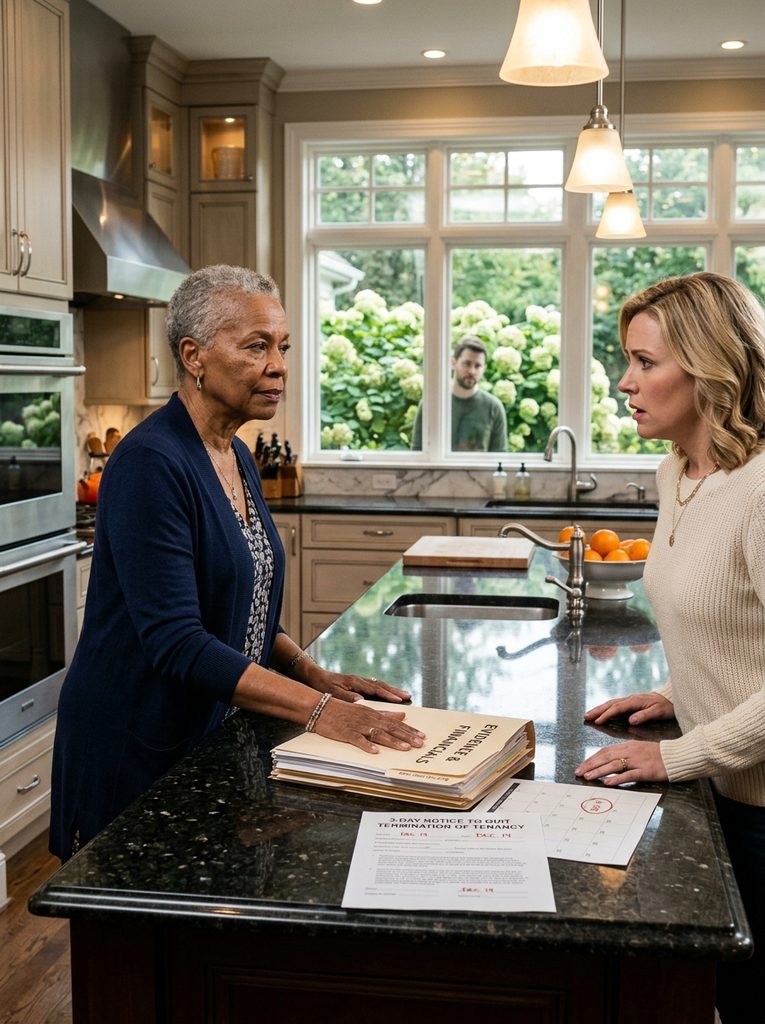
Chapter 1: The Three-Day Eviction
My daughter-in-law had already signed a fraudulent lease agreement, promising my upstairs bedroom to her own mother, long before she ever marched into my kitchen to deliver her ultimatum.
It was a Tuesday evening in late October. The sunlight slanting through the kitchen windows of my Plano, Texas home had shifted into that flat, heavy gold that bleeds across the sky just before the sun dips behind the neighboring rooflines. I stood at the granite island, methodically slicing heirloom tomatoes for a salad I suddenly had absolutely zero appetite for.
I heard the violent slam of a car door in the driveway. Over the past nine months of sharing a roof with my son and his wife, I had developed a secondary survival instinct. One part of my brain focused on the mundane task of holding the chef’s knife, while the other part went completely, dangerously still, listening to the cadence of the approaching footsteps.
Kelsey breached the side entryway without bothering to remove her tailored trench coat. That single sartorial choice telegraphed everything I needed to know about the nature of the confrontation she had spent her forty-minute commute rehearsing.
She marched over and dumped her heavy leather work tote onto the breakfast bar—my breakfast bar, in the house my late husband, Theodore, and I had refinanced twice over two decades to build equity. The very same house I had quietly transferred into my personal, revocable trust fourteen months ago after I liquidated my savings to rescue my son’s collapsing business.
With the exaggerated, practiced deliberateness of an amateur stage actor, Kelsey withdrew a sharply folded sheet of premium printer paper and slapped it onto the granite.
“We need to address your living arrangements, Lorraine. Immediately,” Kelsey demanded, her chin tilted upward in an arrogant posture of assumed authority. She did not sit down. She wanted to loom over me, to establish dominance.
I set my ceramic knife down on the bamboo cutting board. I wiped my hands on a dish towel and turned to face her. In my thirty-one years working as a senior commercial insurance underwriter, navigating hostile conference rooms filled with belligerent adjusters and screaming corporate attorneys, I had learned one immutable law of human conflict: the person who takes a seat first has already lost the negotiation.
“Go ahead,” I replied, my voice as level and smooth as a pane of glass.
Kelsey unfolded the paper and aggressively slid it across the island toward me. It was a printed calendar grid. The upcoming Saturday was circled in thick, bleeding red marker. Beneath the calendar was a tightly typed paragraph. It stated that she and Aaron required the entirety of the house for their “growing family dynamics,” that my presence in the downstairs master suite was an “ongoing source of suffocating tension,” and that I was hereby granted three days to make alternative arrangements.
She had utilized that specific, sterile phrasing twice. Make alternative arrangements. It sounded exactly like a phrase she had Googled on a lunch break, enamored with how legally intimidating she thought it sounded.
I read the paper once, slowly, absorbing the sheer, unadulterated audacity of it. Then, I lifted my gaze to meet her defiant glare.
“Saturday,” I murmured, tapping the red circle. “That gives me exactly three days.”
Kelsey crossed her arms over her chest, a smug, self-satisfied smile playing at the corners of her mouth. “That timeline is more than generous, honestly. We have been incredibly patient about this cramped situation for months. It’s time you vacate.”
Through the kitchen window behind her, I could see my son. Aaron was crouched near the far hydrangea bushes, clutching a pair of rusty garden shears he wasn’t actively using. His shoulders were hunched, his spine curved in the exact same posture of cowardly avoidance he used to adopt at age nine when he broke a window and was waiting in the yard to see if I had noticed the shattered glass.
I had noticed. I always noticed everything.
I turned away from Kelsey’s smirking face, opened the top drawer of the mahogany cabinet beside the refrigerator, and withdrew the thick Manila folder I had stashed there eleven days prior.
“Three days,” I repeated, dropping the heavy folder onto the granite countertop with a sharp, percussive slap. “That is a fascinating deadline, Kelsey. Because I was planning to initiate a very similar conversation tonight. Except, I am not giving you three days to vacate my property. I am giving you exactly one hour.”
Kelsey let out a sharp, mocking bark of laughter, entirely unaware that the manila folder sitting between us contained the complete and utter demolition of the false reality she thought she controlled.
Chapter 2: The Deed and the Coward
Kelsey’s laughter was a brittle, ugly sound. It was the specific type of forced amusement people deploy when they want to broadcast that their opponent has said something so astronomically absurd it doesn’t even warrant a dignified rebuttal.
“One hour? Are you having a cognitive episode, Lorraine?” She leaned over the counter, her eyes flashing with venom. “This is our home. My husband owns this house. You are merely a guest who has vastly overstayed her welcome.”
“I suggest you inspect the deed,” I countered smoothly.
I flipped open the Manila folder and rotated the very first document toward her. I tapped my index finger against the blue ink of the county recorder’s official seal stamped across the top margin.
“Aaron signed the property deed entirely into my private trust fourteen months ago,” I explained, watching the color begin to drain from her arrogant face. “That transfer occurred the morning I wired eighty-seven thousand dollars to clear his defaulted SBA loan and the underwater second mortgage you two secretly took out. The math is fully itemized on page two. The trust holds the absolute title to this property, Kelsey. And I am the sole trustee.”
Kelsey snatched the heavy parchment from the counter. I watched her pupils dart frantically left to right, scanning the legal jargon, desperately searching for a loophole that didn’t exist. The mocking smile melted off her face, replaced by a rigid, white-knuckled panic.
“This is…” she stammered, her breathing growing shallow. “Aaron would have disclosed this to me. This is a forgery.”
“Then go ask him,” I offered, gesturing toward the window.
Kelsey spun around. She marched to the back door and shrieked Aaron’s name through the screen. It was a shrill, clipped bark—the specific tone she weaponized when she wanted him to know she was absolutely not going to ask twice.
Aaron trudged up the wooden patio stairs and entered the kitchen, still clutching the garden shears like a useless metal shield. He looked at the recorded deed trembling in his wife’s hand, then immediately dropped his gaze to the scuffed hardwood floor.
That pathetic, downward glance was his complete confession.
“You knew,” Kelsey hissed. Her voice plummeted into a low, vibrating register. It was the quiet, dangerous frequency she utilized while calculating the blast radius of her impending explosion. “You let this old woman hold the deed to our house, and you never breathed a single word of it to me?”
“It… it was the arrangement we agreed upon to save the business,” Aaron mumbled. He sounded exactly like a terrified seventeen-year-old who had missed curfew and entirely run out of plausible alibis. “I didn’t think it would ever actually come up like this.”
“Well, it has spectacularly come up now,” I interjected, slicing through their marital dysfunction.
I turned back to my folder and extracted the second document. It was a photocopy of the basic living covenant both Aaron and Kelsey had signed nine months ago when they begged to move in.
“This agreement,” I stated, tapping the paper, “explicitly outlined your monthly responsibility for the property taxes, the municipal utility bills, and the exterior maintenance. I drafted it to be intentionally simplistic. A simple contract is exceptionally difficult to claim you misunderstood.”
Kelsey’s jaw clenched so tightly I thought her teeth might crack.
“You are currently four months delinquent on the property tax escrow contribution,” I noted. “I paid the county directly out of my retirement fund last week to prevent a municipal lien from being placed on my asset.”
“That is a minor cash-flow issue!” Kelsey deflected, her voice rising in pitch.
“And you have been actively running your online cosmetics retail inventory out of my attached garage since mid-July without ever requesting authorization,” I continued, ignoring her outburst. “The garage is explicitly codified as a shared space in paragraph four.”
“The garage was sitting empty!” Kelsey yelled, pivoting with the frantic agility of a cornered animal. When one angle of attack failed, she seamlessly shifted to another, already weaponizing her next excuse before the first one had even settled. “You are being incredibly petty, Lorraine! Your downstairs suite is fully self-contained. You have a private entrance, a private bath. You don’t need the upstairs! My mother, Darlene, sold her condo in Garland two months ago. She is currently living out of a Residence Inn. She needs a proper, stable home, and the upstairs bedroom makes the most logistical sense for everyone!”
I looked at my daughter-in-law, marveling at the sheer depth of her deception.
“Let’s discuss your mother’s condo in Garland,” I said softly, my fingers grazing the edge of the third document in my folder. “And more importantly, let’s discuss exactly where the money from that sale went.”
Aaron’s head snapped up from the floor, his eyes wide with sudden, sickening realization, as he realized his wife’s lies extended far beyond my property lines.
Chapter 3: The Forged Lease
“The proceeds from Darlene’s condo sale,” I continued, my voice echoing in the dead quiet of the kitchen, “were directly wired into your private joint checking account. They were not deposited into a designated housing escrow for your mother. I know this absolute fact because Connie, the real estate broker who handled Darlene’s closing, has been my trusted associate for sixteen years.”
Kelsey’s chest heaved. The arrogant posture had entirely collapsed, replaced by a feral, trapped panic.
“Connie telephoned me the following week,” I explained, “to inquire if I possessed any suitable rental properties in my portfolio for Darlene. Because Darlene, at that specific time, had absolutely no idea where her life savings had disappeared to. She genuinely believed those funds were being held as a down payment on a new townhouse.”
Aaron finally moved. He set the heavy garden shears onto the kitchen island. The metal blades clacked against the granite with a dull, heavy thud. He didn’t drop them; he placed them down with agonizing care, which meant the fog of his complacency had finally burned away. He was hanging onto my every syllable.
“That is a highly private financial matter between a daughter and her mother,” Kelsey spat, her eyes darting toward the door as if calculating an escape route.
“It ceased being a private family matter,” I countered, my tone dropping to a glacial chill, “the precise moment you funneled your mother’s retirement money to pay off your staggering personal credit card debts, and then placated her by claiming my property was being renovated for her to move into.”
I peeled back the third page and revealed the fourth.
“I possess a digital copy of the lease agreement you emailed her, Kelsey.” I slid the fraudulent document across the counter. “It has my legal address printed at the top. It specifies a move-in date of this coming Saturday. You never consulted me. You never even hinted at this arrangement. You drafted and executed a residential lease for a property you possess zero legal right to govern, and then you strutted into my kitchen with a three-day eviction notice because you desperately needed me out of the way before your mother showed up with her moving boxes.”
Kelsey’s palm slammed flat against the granite countertop. For a singular, terrifying moment, the kitchen went absolutely still. It was the suffocating, heavy silence that drops over a landscape right before the barometric pressure snaps and a tornado touches down.
“You have been illegally hacking into my private emails,” Kelsey accused, her voice trembling with synthetic outrage.
“I didn’t need to,” I replied smoothly. “Your mother, who is a fundamentally decent woman who foolishly trusted her daughter, forwarded this fake lease to Connie to verify if the clauses were standard for Plano. Connie immediately forwarded it to me.”
Aaron took two slow, dragging steps forward from the back door. He pulled out one of the heavy oak dining chairs and collapsed into it. He looked like a man who had just set down a crushing physical burden, only to realize his spine was permanently broken.
“Kelsey…” Aaron croaked, dragging a trembling hand down his pale face. “Did you actually tell Darlene her room was ready before we even broached the subject with my mother?”
Kelsey stared at the stainless steel refrigerator, refusing to look at her husband.
“That silence translates to a definitive yes,” I observed.
A sharp, familiar sting of betrayal flared in my chest, but it wasn’t born of surprise. I had anticipated a catastrophic escalation since a sweltering Tuesday in August.
“I knew a hostile maneuver was imminent,” I said, “ever since I discovered a structural contractor’s business card slipped beneath the welcome mat of my private entrance. A card with a handwritten quote number scrawled on the back.”
Kelsey’s head snapped toward me, her eyes blown wide with genuine shock. She hadn’t accounted for my diligence.
“I telephoned that number,” I explained, relishing the utter devastation on her face. “I spoke to a gentleman named Dale. After a very awkward pause—where Dale clearly realized he had stumbled into a domestic warzone—he confessed he had been contracted to evaluate the structural feasibility of demolishing the load-bearing partition wall between my master suite and the utility room to create an ‘open-concept lounge’ for your mother.”
“You hired a demolition crew?” Aaron whispered, staring at his wife as if she had just removed a human mask to reveal a reptile underneath.
“I thanked Dale,” I continued, ignoring my son, “informed him I was the sole titleholder, explicitly denied any authorization for modifications, and requested he forward his quote paperwork to my email for my legal files. He was remarkably professional about the entire ordeal.”
“I was merely trying to plan ahead!” Kelsey shrieked, cornered and desperate. “I was attempting to solve a logistical nightmare! My mother is functionally homeless, and every single alternative I proposed, you instantly vetoed! Your mother’s fragile feelings were always deemed more important than my family’s survival!”
“My feelings,” I stated, my voice slicing through her hysteria like a scalpel, “were never a variable in the deceitful conversations you conducted with the contractor, with your mother, or with the municipal county tax assessor’s office.”
That final revelation stopped her dead in her tracks. The blood drained entirely from Kelsey’s face as I reached into the Manila folder for the final, most devastating document of all.
Chapter 4: The Tax Trap
I withdrew the final sheet of paper from the dossier and placed it directly in the center of the granite island, perfectly equidistant between Kelsey’s trembling hands and Aaron’s bowed head.
It was a high-resolution, printed screenshot of a digital municipal account portal.
“You established this shadow account in late August,” I said, my tone adopting the clinical, merciless cadence of a senior underwriter denying a fraudulent claim. “You utilized the main property address but cleverly redirected the annual municipal tax assessment notices away from my primary mailing address and into a digital inbox you exclusively controlled.”
Kelsey stared at the printed screenshot. She looked like she had stopped breathing.
“I recognize the exact mechanics of this scheme,” I continued, leaning forward slightly. “The premeditated intent was to intercept the autumn tax bill. You planned to pay it from your personal account—likely utilizing the embezzled funds from your mother’s condo sale. You would then accumulate a paper trail of property tax receipts in your own name. After a few cycles, you intended to file a hostile partition action in civil court, claiming a legal equity interest in the estate through undocumented structural improvements and tax maintenance.”
Aaron let out a strangled, nauseated gasp.
“I had a very illuminating lunch with a specialized real estate attorney three weeks ago,” I told her. “He mapped out precisely how this predatory strategy functions. And more importantly, he explained exactly how spectacularly it implodes when the defending trust documents are iron-clad. Which, thanks to my meticulous nature, mine are.”
Kelsey stared at the paper for a torturous eternity. Then, she slowly turned her head to look at Aaron. Whatever microscopic shred of salvation she hoped to find in her husband’s expression was gone. His eyes were hollow, completely devoid of the protective affection that had shielded her for a decade. She looked away, defeated.
“You cannot be serious about kicking us out,” she whispered. But the venom, the fight, the arrogant fire had entirely extinguished from her words. They were just empty, pathetic sounds falling onto the countertops.
“I am sixty-four years old,” I replied, squaring my shoulders. “I spent thirty-one grueling years reviewing catastrophic liability contracts for a living. I have been ruthlessly serious about forensic documentation since a decade before you were even born.”
I shifted my gaze to the digital clock glowing above the oven. It read 5:17 PM.
“You currently have exactly forty-three minutes remaining,” I declared. “I contacted Ray, my preferred locksmith, at dawn this morning. He will arrive at precisely 6:00 PM to drill out and replace every exterior deadbolt on this property. I strongly advise you to focus solely on packing absolute essentials—passports, daily medications, toiletries. You may return for the remainder of your hoarded inventory next week, strictly by appointment, and only with Aaron present.”
For a prolonged, agonizing minute, the kitchen was frozen in amber. No one twitched. No one breathed.
Then, Kelsey slowly pushed herself away from the granite island. She didn’t offer an apology. She didn’t scream. She simply turned on her heel and marched down the hallway toward the main staircase. A few seconds later, the upstairs bedroom door slammed shut with enough concussive force to violently rattle the framed family photographs hung along the corridor walls.
Aaron remained paralyzed at the dining table.
He was forty years old, but in that devastating light, he looked genuinely, heartbreakingly young. Not in a nostalgic, endearing way, but in the tragic manner of a man who has been shielded from the harsh friction of reality for far too long. He had been kept warm and comfortable past the critical point where discomfort would have forced him to develop a spine.
“I didn’t know about any of the severe stuff, Mom,” Aaron whispered, his voice cracking. “The forged lease. The demolition guy. The shadow tax account. I swear to God.”
“I know you didn’t,” I said softly. And it was the absolute truth.
Aaron was not a malicious entity. He was something that was almost harder to endure: he was profoundly, incurably passive. In the years since his logistics business had nearly filed for bankruptcy—and I had swooped in, writing the checks to clean up his mess—he had internalized a dangerous lesson. He had learned that someone stronger would always intervene to manage the agonizing realities of adulthood, allowing him to peacefully tend to his rose beds, stroke his clients’ egos, and maintain a careful, cowardly distance from anything requiring a hard choice.
“I protected you, Aaron,” I said, my voice thick with a grief I hadn’t expected. “I protected you when the supply chain failed. I protected you long before that, when you desperately needed the down payment for your first condo. I protected you when your father died, and you needed a solvent cosigner for your commercial equipment lease.”
I walked around the island and stood near his chair.
“I executed all of those rescues because you are my only child, and I love you fiercely. But I have realized something terrible today. I cannot protect you from the catastrophic consequences of actively choosing to close your eyes to the evil happening inside your own house.”
Aaron buried his face in his trembling hands, the weight of his ruined life finally crushing down upon him, as the sound of frantic packing echoed through the ceiling.
Chapter 5: The Locksmith
Aaron dragged his hands down his face, leaving red marks across his cheeks. “I just thought she was heavily stressed,” he mumbled, a final, pathetic attempt at an alibi. “About her mother getting older. About our finances.”
“She was stressed about finances because she was recklessly spending money that she had effectively stolen,” I corrected him, refusing to let the delusion breathe. “Stress is an emotion, Aaron. It is not a legal justification to forge a residential lease and attempt to hijack a deed.”
From the ceiling above us came the rapid, percussive thud of dresser drawers being violently yanked open and slammed shut.
“What happens to us now?” Aaron asked, staring blankly at the grain of the oak table.
He wasn’t inquiring about the survival of his marriage. I could hear the detachment in his tone. He was mourning the sudden, violent death of the comfortable, frictionless version of his life. The illusion of the sprawling Plano estate, the invisible mother-in-law who subsidized his existence, and the quiet arrangement that hummed in the background while he played at being a successful entrepreneur.
“That is entirely yours to figure out,” I replied, stepping back. “You are forty years old. Your business has finally stabilized. You possess a decent income, marketable skills, and a credit score that is vastly superior to what it was fourteen months ago—solely because I liquidated my assets to pay off your toxic debt. You can easily secure an apartment that aligns with what you actually earn. This eviction is not a malicious punishment, Aaron. It is simply the baseline requirement of being an adult.”
I reached into the Manila folder one final time and extracted a crisp, white envelope. I laid it on the table near his elbow.
“There is a certified cashier’s check inside for three thousand dollars,” I stated. “That sum will comfortably cover a security deposit and the first month’s rent on a respectable two-bedroom unit in this zip code. It is absolutely not a loan. I will never ask for repayment. But I need you to listen to me very carefully: This is the final financial transfer you will ever receive from my accounts.”
He looked up, his eyes glassy with unshed tears.
“The next time you encounter a financial crisis, you will engineer your own salvation,” I said, my voice ironclad. “I am resigning as your safety net. I am returning to my role solely as your mother. Those are two fundamentally different jobs, and I am done doing both.”
Aaron slowly reached out and picked up the envelope. He held it suspended in the air for a long moment, as if attempting to gauge the physical weight of his new reality.
“I am so sorry, Mom,” he choked out. “I should have been paying closer attention.”
“Yes,” I agreed softly. “You absolutely should have.”
He pushed himself up from the table and trudged heavily up the stairs. For the next twenty minutes, I heard the muffled, taut frequencies of his voice clashing with Kelsey’s panicked shrieks through the floorboards. I actively chose to stop listening.
At ten minutes before 6:00 PM, the crunch of heavy tires on gravel announced the arrival of Ray’s familiar white utility truck.
By 6:15 PM, the heavy brass exterior deadbolts on the front door, the side patio entry, and the internal door bridging the garage to the main house had all been violently drilled out and replaced with high-security cylinders. Ray, a man of beautiful brevity, handed me two sets of freshly cut silver keys, signed his triplicate work order, and drove away into the creeping, violet twilight of early November.
Aaron and Kelsey descended the staircase hauling three stuffed duffel bags and a translucent plastic bin overflowing with her retail cosmetics samples.
Kelsey marched past me, her eyes locked dead ahead, refusing to utter a single syllable. Aaron paused on the threshold. He looked back at me, his mouth opening as if to speak, but the words died in his throat. He looked away, stepping out into the chilly air to follow his wife to their idling SUV.
I stood on the concrete front porch, the new keys digging into my palm, until the red glow of their taillights vanished around the corner, merging onto the main arterial road.
The suburban neighborhood was eerily quiet. Somewhere two blocks over, a golden retriever barked indignantly at a timed sprinkler system that had activated off-schedule.
I stepped back inside and engaged the new, heavy deadbolt. The metallic clack echoed through the foyer.
The house felt cavernous, and for the first time in two years, entirely still. I walked through the rooms with a slow, deliberate reverence. I passed through the formal dining room where we had hosted Thanksgiving dinner six times. I lingered in the living room, staring at the worn leather of Theodore’s reading chair situated by the bay window. Finally, I returned to the kitchen.
The half-finished salad was still resting on the cutting board, the edges of the heirloom tomatoes beginning to turn soft and translucent. I calmly covered the ceramic bowl with plastic wrap and slid it onto a shelf in the refrigerator.
Then, I sat down at the kitchen table, picked up my smartphone, and dialed Connie’s direct line.
The heavy lifting was finally over, but the true work of reclaiming my stolen peace was just about to begin.
Chapter 6: The Long Arc
“Connie,” I said when she answered on the second ring. “I am ready to officially list the property. Whenever you can secure your architectural photographer, send them over.”
“I can have my best guy out there by Friday morning,” Connie replied, her voice thick with unspoken concern. “Lorraine… honey, are you going to be all right?”
“I am completely fine,” I told her. And for the first time in an agonizingly long chapter of my life, I meant it. It wasn’t deployed as a polite reassurance or a defensive deflection. It was a concrete, undeniable statement of fact.
The Plano house sold thirty-one days later, after a vicious bidding war, closing at twelve thousand dollars over the aggressive asking price. The buyers were a vibrant family relocating from Houston with three young children and a clumsy sheepdog. I genuinely think Theodore would have loved knowing that kind of chaotic joy was returning to those halls.
I downsized and relocated into a sleek, two-bedroom condominium in the bustling Uptown neighborhood of Dallas. My new sanctuary was situated nine floors up, boasting a sweeping, glass-lined balcony that faced west toward the jagged, glittering downtown skyline. I furnished the space exclusively with the antique pieces that had always belonged to me, and ruthlessly donated the remnants of my old life to a charity resale shop.
The condo was steeped in a profound, healing quiet every morning—a tranquility the sprawling Plano house had never managed to achieve during the two years it had been infected by Kelsey’s entitlement.
I enrolled in an advanced watercolor masterclass at the local arts center on Thursday afternoons. I integrated into an early-morning walking club that navigated the Katy Trail; a group of resilient older women who never required anyone to explain their scars or justify their circumstances. I lunched with Sharon, my financial advisor, every few weeks to audit the robust investment account generated by the home sale. The dividends produced enough passive monthly income that I didn’t need to siphon a single dime from my primary retirement funds.
Aaron initiated a routine of calling me every Sunday evening.
He had secured a modest, functional apartment near his logistics company’s primary service hub in Frisco. He lived entirely on his own. Kelsey had retreated to her mother’s new, cramped rental unit in Garland. It turned out that Darlene, furious at the deception, had retained her own aggressive attorney and successfully clawed back the majority of her stolen condo proceeds from her daughter’s accounts.
Aaron and Kelsey were formally separated. He never explicitly stated that the marriage was terminating in divorce, and I never prodded him for the details. It wasn’t my puzzle to solve anymore.
What I did observe was a profound shift in the topography of our Sunday conversations. He sounded fundamentally different. The lazy entitlement was gone, replaced by a careful, grounded presence. He genuinely inquired about the techniques I was learning in my painting class. He memorized the names of the women in my walking group. Most importantly, he no longer paused during the calls, waiting for me to offer unprompted advice or financial assistance before he said goodbye.
One crisp Sunday in late February, he drove down into the city proper and treated me to a lavish brunch at a trendy bistro near the trail. We sat outside beneath the humming patio heaters. He ordered a complex eggs Benedict; I enjoyed an avocado toast. We discussed the expansion of his largest commercial account, and I detailed a solo trip I was mapping out to hike the Grand Canyon in the spring.
Midway through his second coffee, he set his mug down, looked directly across the small iron table, and held my gaze.
“I just wanted you to know that I am actively handling all of my own finances now. Every single bill. Everything.”
“I know,” I said gently.
“I know you know,” he replied, a small, genuine smile touching his lips. “I just needed to say it out loud to you.”
I looked at my son, witnessing the arduous, painful evolution of the man he was finally becoming. It was much slower work than a mother would ever wish for her child, but it was real work. It was the hardened, resilient kind of growth that doesn’t instantly unravel the moment a comfortable, subsidized arrangement falls apart.
I thought of Theodore, who had always stubbornly maintained that Aaron would eventually find his solid footing. Theodore had possessed an infinite well of patience regarding the long, complicated arc of human development. He had also, not incidentally, been the brilliant mind who initially insisted we hire a specialized property attorney to structure the revocable trust when I first floated the idea of bailing Aaron out of his business debt.
“Get every single clause in writing, Lorraine,” Theodore had told me, his voice raspy but firm, exactly six weeks before his heart failed. “Not because you don’t trust the boy. Because the paperwork protects everyone. Including him.”
The iron-clad paperwork had accomplished exactly that. It had shielded Aaron from a predatory situation that could have cost him substantially more than a three-thousand-dollar security deposit and a few awkward brunch conversations to recover from.
And it had gifted me back something fundamental—something I hadn’t even fully realized Kelsey was systematically attempting to steal. It wasn’t merely the physical real estate, or the financial peace of mind. It was the simple, profound daily certainty that my home was sovereign territory. That my decisions were autonomous. And that absolutely no one possessed the standing to slap a three-day eviction notice onto my granite counter on a Tuesday evening and expect me to meekly start packing my bags.
I hadn’t packed. I had opened a Manila folder.
There is a sanitized, triumphant version of this story where I proudly declare, “I possess zero regrets regarding how it all ended.” The dramatic reveal, the sixty-minute countdown, the changing of the locks.
But that narrative would be a partial lie.
What I deeply regret is the silent, agonizing months I wasted watching, waiting, and meticulously cataloging the slow, toxic erosion of the ordinary comfort of living in a home that was supposed to be mine. I regret tolerating the Sunday dinners I was aggressively excluded from. I regret enduring the long weeks when the only human being who bothered to bid me good morning was Aaron, shouting it over his shoulder as he bolted out the door for a client meeting.
I should have moved decisively, much earlier. Not moved out—I possessed every legal and moral right to remain. But I should have moved toward the agonizing confrontation that desperately needed to happen, long before Kelsey had the unchecked time to architect a hostile fiction and invite her own mother to move inside it.
I know that absolute truth now. I carry it as a daily reminder that passive patience and tactical preparation are not the same thing as simply waiting to be attacked. And I learned that boundaries established early cost infinitely less than boundaries violently enforced late.
My ninth-floor balcony faces the west, and the violent, bruised-purple sunsets over the Dallas skyline in the spring are genuinely something to behold. I carry my chamomile tea out there most evenings. I watch the golden light fracture and change across the glass skyscrapers. I think about Theodore’s wisdom, about the logistics of my impending Grand Canyon excursion, and about what specific hues of watercolor I will attempt to blend next Thursday afternoon.
And I have never once, in the seven peaceful months since I handed Kelsey her sixty-minute notice, looked back at that Plano kitchen and wished I had given her three days instead.