Chapter One: The Altitude of Terror
At thirty thousand feet, suspended in the freezing stratosphere halfway between Denver and Norfolk, the world was supposed to be manageable. I was Colonel Nathan Cole, and I was meticulously signing off on a classified operational deployment via an encrypted military tablet. The low, steady thrum of the aircraft’s engines was a comforting white noise, a familiar rhythm I had known for two decades.
Then, my personal cell phone vibrated violently against the plastic tray table.
I glanced down, annoyed by the interruption. The push notification illuminating the glass screen made absolutely no logical sense.
RIDGEWAY HOME SECURITY: Emergency motion detected. Zone: Driveway.
I almost swiped it away. It was a Tuesday evening. It was probably just a stray neighborhood dog, or perhaps the mail carrier dropping a late package at our home in Ridgeway, Virginia. Almost.
Then, a second, blood-red notification flashed across the screen, overriding the first.
Audio detected: High-decibel distress.
A cold, jagged spike of adrenaline drove itself directly through my chest. I tapped the alert, opening the live doorbell camera footage.
Instantly, my entire universe violently narrowed to a six-inch digital rectangle.
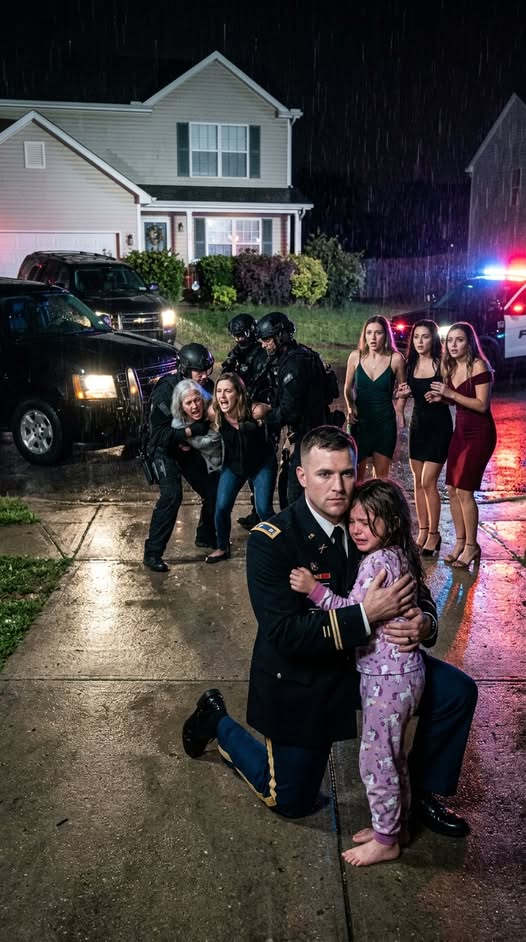
My eight-year-old daughter, Lily, was scrambling frantically backward on the driveway. She was wearing her favorite fleece unicorn pajamas, her small, bare feet scraping against the unforgiving, cold concrete. Her tiny hands were desperately clawing at a pair of adult hands that were violently tangled in her long, brown hair.
The hands belonged to Meredith Vale—my mother-in-law. Meredith was violently dragging my daughter across the pavement. The older woman’s face was flushed a furious, mottled red, her mouth twisted into a grotesque, venomous sneer I had never witnessed on a human being.
“Scream for your daddy!” Meredith hissed, leaning down, her face practically pressed into the camera lens. “Let’s see if he comes to save you this time!”
Lily screamed. It was a raw, primal sound of absolute terror that shattered the quiet of the aircraft cabin around me.
But it wasn’t just Meredith. Standing mere feet behind her was my wife, Claire.
Claire was not intervening. Claire was holding her smartphone up, the camera flash engaged.
She was recording. And she was smiling.
Surrounding them, forming a sickening, predatory circle, were Claire’s three sisters—Vanessa, Brooke, and Erin. They were moving around my terrified child as if staging some twisted, sadistic ritual. Brooke was gripping a heavy, red plastic gasoline can. Vanessa was holding a large bottle of industrial dish soap. Erin was laughing with such hysterical intensity that she had to brace her hand against Claire’s shoulder to keep from falling over.
Then, Brooke casually tipped the nozzle of the red plastic can.
A heavy splash of clear liquid coated Lily’s pajama pants, pooling darkly on the concrete beneath her bare feet.
The air in my lungs turned to ash. The tactical, heavily compartmentalized military commander evaporated, leaving only a fiercely protective, terrified father.
“Captain,” I commanded, my voice dropping to a flat, lethal register as I unbuckled my seatbelt.
The pilot turned from the open cockpit doorway, his brow furrowed in confusion. “Sir?”
“Divert this aircraft. Right now. Nearest military airfield.”
The pilot blinked, completely taken aback. “Colonel Cole, with all due respect, we are on a rigid flight path to—”
I stood up, holding the tablet directly in his line of sight. On the screen, my supreme command authorization codes glowed green—still active, still legally binding. “This is an emergency domestic threat involving a minor. I have absolute clearance. You will file this as a command necessity, and you will put this bird on the ground in the next twenty minutes.”
The pilot took one look at the dead, uncompromising look in my eyes, swallowed hard, and stopped arguing. He reached for his radio.
I sat back down and made a single phone call.
I did not call 911. Not first.
I dialed Marcus Reed, my former special operations chief. Marcus was the man who had physically dragged my bleeding body out of a burning armored vehicle in Kandahar seven years ago. In a decade of knowing him, he had never once failed to answer my call before the third ring.
“Reed,” his deep voice rumbled.
“My daughter is being actively assaulted at my residence,” I stated, the military precision returning to mask the panic. “Four adults. My wife is involved. I am currently airborne and diverting to the nearest strip. I need immediate eyes on the property, a legally binding chain of custody established, local law enforcement coordination, and absolutely no cowboy nonsense. Everything by the book.”
The casual tone in Marcus’s voice instantly vanished, replaced by cold steel. “Send me everything you have.”
I forwarded the live footage, the GPS location, the community gate codes, the architectural floor plan of my house, and my military custody documents.
Then, I called the Ridgeway Police Department. Then, my defense attorney. Then, child protective services.
Finally, I called my next-door neighbor, Mrs. Alvarez.
She answered on the first ring, already weeping hysterically. She had heard Lily screaming through the thick laurel hedges separating our properties.
“Nathan,” she sobbed into the receiver, her voice trembling with sheer panic. “They just dragged her inside the house.”
The military jet banked sharply, dropping through the cloud cover like a stone, but as I stared at the blank security screen, I knew I was descending into a nightmare that was already out of my control.
Chapter Two: The Perimeter Breach
Three hours and forty-one agonizing minutes later, the landing gear of the jet slammed onto the rainy tarmac at Langley Air Force Base.
The moment the cabin door opened, I stepped out into the muggy Virginia night. I was met by two black, idling SUVs with flashing blue dashboard lights. Marcus Reed was standing by the lead vehicle, the collar of his tactical jacket turned up against the wind, holding a glowing tablet.
His jaw was clenched so tightly a muscle feathered in his cheek.
“They are still inside the house, Colonel,” Marcus reported, falling into step beside me. “And Nathan… they posted part of the video online.”
I didn’t break my stride. I didn’t run. I walked toward the SUV with the measured, terrifying calm of a man who realized that war had just followed him home.
The drive from Langley to Ridgeway should have taken forty-five minutes. It took exactly nineteen, with two state police cruisers clearing the intersections ahead of us.
I sat in the dark cavern of the back seat, methodically watching the screen-recorded footage Marcus had managed to collect from Claire’s social media accounts before she restricted them. I did not utter a single syllable during the first horrific clip. I didn’t blink during the second.
By the third video, Claire’s sister, Vanessa, leaned directly into the camera lens, her eyes wide with manic glee. “This is exactly what happens when spoiled little princesses think their deployed father owns the entire world,” she sneered.
Marcus quietly reached over and lowered the volume without being asked.
“She was desperately trying to call you,” Marcus said, his voice thick with controlled rage. “Lily had that old, deactivated field phone you gave her to play with. Claire took it from her and smashed it.”
I simply stared out the rain-streaked window into the darkness.
When the convoy finally turned onto Briar Lane, the neighborhood appeared sickeningly normal. The manicured lawns were perfectly trimmed. Warm, yellow porch lights glowed against colonial brick. American flags moved gently in the evening breeze.
That was the part that made my stomach turn. There was absolutely nothing about the serene, wealthy street that announced a child had been systematically terrorized here. There was no smoke billowing into the sky. No shattered glass on the pavement. No alarms blaring loud enough to force the entire world to stop and pay attention.
But the house at the dead-end of the cul-de-sac was completely surrounded.
Ridgeway police cruisers had barricaded the driveway with crime-scene tape. Two uniformed officers stood rigidly near the front door. Another was standing on the wet grass, taking a frantic statement from Mrs. Alvarez, who had a plaid blanket wrapped tightly around her shaking shoulders and a look of absolute, righteous fury in her eyes.
I kicked the SUV door open before it fully stopped.
A police lieutenant named Harmon intercepted me on the walkway before my boots could touch the porch stairs.
“Colonel Cole,” Harmon stated, holding a hand up. “I need you to remain completely calm and let us handle the scene.”
I stopped, looking down at the man with a gaze devoid of any warmth. “Where is my daughter, Lieutenant?”
“She is inside. She is alive. She is conscious. Paramedics are currently with her.”
The word alive passed through my chest like a jagged piece of shrapnel finally being extracted. I took a slow, deliberate breath.
“Then why are those four people still standing comfortably inside my house?”
Harmon’s face tightened with bureaucratic frustration. “Your wife vehemently refused us entry at first. She claimed it was a private, family discipline matter. Then, your mother-in-law attempted to claim the child had injured herself playing. But your uploaded security footage, your neighbor’s sworn statement, and the viral online video gave us undeniable probable cause. We breached the door six minutes ago.”
Before I could respond, a sound drifted out through the open front door.
It was small. Broken. The sound of a wounded animal.
“Daddy?”
I moved past the lieutenant before a single officer could even twitch to stop me.
I crossed the threshold into a house that smelled distinctly of sharp vinegar, lavender dish soap, and raw, suffocating fear. The pristine family photos still lined the hallway walls: Claire smiling radiantly in a white sundress, Lily perched happily on my shoulders at Virginia Beach, Meredith posing beside a massive birthday cake. The absolute, grotesque lie of all of it stared down at me from the drywall.
Lily was sitting shivering on the edge of our leather living room couch. She was wrapped tightly in a gray, foil emergency blanket. Her hair was damp and matted, her face violently blotched from hyperventilating. A female paramedic was kneeling in front of her, gently inspecting the raw, red scrape marks on her wrists.
When Lily looked up and saw me standing in the doorway in my uniform, her entire body simply folded in half.
I dropped to my knees on the hardwood floor just as she launched herself into my chest.
“I screamed,” she sobbed into the heavy fabric of my jacket, her small fists gripping my lapels like a lifeline. “Daddy, I screamed so, so loud.”
“I heard you, sweetie,” I whispered, burying my face in her tangled hair, holding her as carefully as if she were constructed of shattered glass. “I heard you, and I came.”
Claire was standing near the stone fireplace. Her arms were crossed defensively over her chest, her face pale but masking a terrifying, arrogant defiance. Meredith was forced into a wooden dining chair, her wrists firmly cuffed in steel behind her back, breathing heavily through her nose. Vanessa, Brooke, and Erin were lined up against the far wall like common criminals while officers systematically searched their designer handbags.
Claire’s voice shook, but not with remorse. It shook with indignation. “This is absolute insanity, Nathan. You used your military connections to send a tactical team against your own family?!”
I did not even grant her the dignity of making eye contact.
Lily trembled against my chest, her voice a tiny, broken whisper. “Mommy laughed at me.”
The living room went graveyard silent.
I pressed a kiss to the top of Lily’s head, slowly stood up with her securely in my arms, and finally looked at Lieutenant Harmon.
“I want every single recording device in this house preserved,” I commanded, my voice echoing off the vaulted ceiling. “Every cell phone. Every tablet. Every social media post. Every text message. There will be no private, out-of-court family settlement. There will be no quiet, civilized divorce. And there will certainly be no public apology tour.”
Claire scoffed loudly, rolling her eyes. “You honestly think you have the power to destroy us over a practical joke?”
I finally turned my head and looked directly into the eyes of the woman I had married.
“No, Claire,” I said softly, the absolute finality ringing in the quiet room. “I don’t have to destroy you. You did that all on your own, on camera.”
I turned my back on the wreckage of my marriage and walked out the front door, unaware that securing the perimeter was only the very first battle of a much longer war.
Chapter Three: The Safe Haven
The very first tactical decision I made was to completely abandon my own home.
I didn’t leave because Claire had demanded it. I didn’t leave because Meredith was screaming obscenities from the doorway as two burly officers forcibly guided her into the back of a caged patrol car. I didn’t leave because Vanessa was shouting that I was a “narcissist overreacting for attention,” or because Brooke was sobbing hysterically while Erin aggressively demanded her lawyer.
I left the property because Lily asked me to.
“Daddy,” she whispered, burying her face into my neck as we stepped off the porch. “Can we please go somewhere that doesn’t smell like them?”
I didn’t hesitate. I carried my daughter straight across the manicured lawns to Mrs. Alvarez’s covered porch.
The older woman was waiting for us with the screen door held wide open. She had already prepared a mug of hot chocolate that she likely knew Lily wouldn’t have the stomach to drink. A thick, scratchy wool blanket was meticulously laid out on her floral sofa. Sitting squarely on the center cushion was a stuffed orange cat, hastily borrowed from Mrs. Alvarez’s own granddaughter. It sat there like a silent, plush sentry.
Lily curled her small body into my side on the sofa, clutching the orange cat to her chest, and absolutely refused to let go of my uniform sleeve.
Through the sheer curtains of the bay window, the house across the street pulsed under the relentless strobe of red and blue police lights.
Detectives were moving in and out of my front door carrying brown paper evidence bags. Smartphones and laptops were being tagged and collected. The red plastic gas can was extensively photographed on the concrete. The driveway was marked with yellow chalk where the mystery liquid had pooled and spread. Uniformed officers were knocking on doors, taking statements from adjacent neighbors who sheepishly admitted they had heard the screaming, but had hesitated to call the authorities, uncertain whether it was just “private family business.”
Mrs. Alvarez had suffered no such hesitation.
She had dialed 911 twice. She had recorded the abuse on her iPad from her upstairs bedroom window. She had marched down to her fence line and shouted at them to stop, until Meredith had marched over and violently threatened to “come after her next.”
“She looked me dead in the eye and told me I was a meddling old bat,” Mrs. Alvarez recalled, her hands trembling with residual adrenaline as she spoke to Detective Rachel Kim in the kitchen. “That poor baby was on her knees, begging for her father. Begging! And her own mother just stood there filming it like it was a television show.”
Detective Kim meticulously documented every word in her notepad.
When Kim approached the sofa, I answered her logistical questions with sterile, military precision. Where had I been? Airborne, en route to Norfolk. Why was I on a secured aircraft? Classified deployment. Who had unrestricted access to the home? Claire and her mother. Was there a documented history of domestic conflict?
I paused. There was.
Not physical violence. Not like the nightmare I had witnessed tonight. But there was a creeping, toxic rot.
Claire had grown incredibly resentful after I received full command responsibilities two years ago. She frequently belittled my career, mockingly referring to my deployments as “playing hero in the sandbox.” Meredith had loudly complained that Lily was far too attached to me, claiming she was “disobedient around strong women,” and far too much like her father. Claire’s sisters constantly mocked Lily for being quiet, for preferring chemistry science kits over competitive dance recitals, and for asking me to teach her the complexities of chess.
I had noticed the snide comments. I had firmly intervened. Just last Thanksgiving, I had banned Meredith from unsupervised visits after I caught her violently slapping Lily’s hand hard enough to leave a red mark for accidentally spilling cranberry sauce on a tablecloth.
Claire had immediately accused me of being a controlling, paranoid tyrant.
The foundation of the marriage had been fracturing for months, but I had foolishly, arrogantly believed the cracks were strictly confined between the adults. I had failed to see the shrapnel hitting my child.
At exactly 11:27 p.m., a child services supervisor named Angela Morris arrived on the porch, carrying a thick clipboard of emergency custody paperwork. I read every single line of the legal jargon before signing my name in black ink.
“Mrs. Cole will not be permitted any contact, physical or digital, with Lily until a family court judge formally reviews the matter,” Morris stated softly, glancing sympathetically at the sleeping child against my ribs. “Given the severity of the video footage and the initial police report, we will be requesting an emergency protective order first thing in the morning.”
I nodded once, my jaw tight. “Good.”
Lily shifted against me. She was half-asleep, exhausted by the trauma, but her small fingers tightened their death grip on my sleeve.
“No Mommy?” she whispered, her voice laced with a complex cocktail of fear and sorrow.
I looked down at her bruised wrists. “Not unless a federal judge looks me in the eye and says it is safe. And not unless you are completely protected.”
Lily sniffled, pressing her face into my chest. “She said nobody would ever believe me. She said I was a liar.”
Detective Kim, who had been quietly standing near the hallway arch, looked up, her expression hardening.
I kept my voice incredibly steady, ensuring the absolute certainty in my tone would anchor her. “They believed the video, Lily. Mrs. Alvarez believed you. The police believed you. And I believe you.”
Lily’s blue eyes filled with fresh tears, but this time, the frantic, hyperventilating sobs did not return. She simply pressed her forehead deep into my chest, closed her eyes, and finally allowed herself to breathe.
By midnight, Claire had been formally escorted to the station for booking. Her sisters followed in separate cruisers. Meredith went last, violently shouting obscenities until the heavy metal door of the patrol car slammed shut, cutting her off.
At first, the initial charges read to me by Lieutenant Harmon sounded infuriatingly ordinary for the sheer psychological terror I had witnessed: child endangerment, simple assault, unlawful restraint, harassment. There was also a charge of evidence tampering after Vanessa had frantically tried to delete the videos from her phone while the police were breaching the door.
Later, after cyber-investigators ripped the data from the confiscated devices, the list of charges grew exponentially. The clear liquid poured from the gas can, it turned out, was not actual gasoline; it was a potent mixture of vinegar and water, deliberately designed to smell horrific and frighten Lily into thinking she was going to be set on fire.
Legally, that chemical distinction mattered to the prosecutor. It meant it wasn’t attempted murder.
But to an eight-year-old girl’s nightmares, the distinction didn’t matter at all.
In the chaotic, media-frenzied days that immediately followed, Claire desperately attempted to rewrite the narrative.
Her first public statement, released through a cheap defense attorney, claimed the entire event was merely “a misunderstood, tough-love family intervention.”
Her second statement ridiculously claimed that I had maliciously edited the security footage using military AI to make her look guilty.
Her third, and most desperate statement, claimed she had been paralyzed by fear of her own mother and was forced to record.
That specific lie lasted exactly forty-eight hours. Right up until Detective Kim recovered the deleted family group chat from Claire’s iCloud.
The chilling text messages had started two full weeks before the incident.
Meredith: The girl needs to learn a hard lesson. She needs to know he cannot always swoop in and save her from the women in this family.
Vanessa: Make it super dramatic. He checks those cameras. He’ll see it eventually.
Brooke: Claire should definitely record it. It’ll be proof she finally stopped being so soft on the brat.
Claire: I’m just so exhausted from constantly being in second place to a child.
That final, damning message from my wife became the undisputed center of gravity for the entire criminal case.
I did not read it twice. I couldn’t stomach it.
Instead, I sat perfectly still as my attorney, Grace Whitmore, read it aloud for the public record in family court three days later, effectively dropping the guillotine on the lives they used to know.
Chapter Four: The Digital Guillotine
The fluorescent lighting of the Ridgeway County Family Court cast a harsh, unforgiving pallor over the proceedings. I sat rigidly at the petitioner’s table, my Class-A uniform pressed flawlessly, my hands folded securely over my legal documents.
Grace Whitmore stood beside me, her voice echoing off the wood-paneled walls as she methodically entered the group chat transcripts into the official record.
Directly across the aisle, Claire sat at the respondent’s table. She wore a conservative navy-blue dress, her hair pinned back in a severe bun. Her eyes were artificially red, performing the role of the devastated, misunderstood mother for the judge. Meredith was conspicuously absent; her high-priced criminal defense attorney had advised that appearing in family court would severely prejudice her impending felony trial. Vanessa, Brooke, and Erin were legally named in the emergency protective order, but none possessed the courage to show their faces in the gallery.
Presiding over the chaos was Judge Eleanor Price. She was a woman who had earned a terrifying reputation in the county for sitting in stony silence, allowing people to talk just long enough to comfortably hang themselves with their own words.
Claire’s attorney made a valiant, ultimately suicidal attempt to spin the narrative.
He painted Claire as a “severely overwhelmed military spouse,” described Meredith as “an old-fashioned disciplinarian from a different era,” and characterized the horrifying video as “a standard disciplinary moment that unfortunately escalated due to high emotions.”
Judge Price slowly lowered her reading glasses, fixing the attorney with a glare that could have frozen a roaring fire.
“Counselor,” Judge Price’s voice cracked like a whip. “Systematically dragging a terrified eight-year-old child by the hair across concrete, while four adult women gleefully film and taunt her, will never be classified as ‘discipline’ in my courtroom.”
Claire immediately buried her face in her hands, her shoulders shaking with loud, theatrical sobs.
I watched her without a single flicker of expression. The woman I had married was dead to me.
The judge requested a ten-minute recess to review the unedited security footage in her private chambers. When she returned to the bench, her face was carved from absolute, unforgiving granite.
The gavel strikes were swift and brutal.
Temporary, sole physical and legal custody was immediately granted to me. Claire was explicitly barred from any direct or indirect contact with Lily. Meredith and the three sisters were legally banned from coming within five hundred yards of myself, Lily, Lily’s elementary school, or our primary residence. A forensic child psychologist was mandated for Lily’s recovery. Claire was ordered to immediately surrender her house keys to the bailiff, remove her personal belongings from the Briar Lane residence under strict police supervision, and ordered to preserve all electronic communications under threat of federal perjury.
When the final gavel fell, echoing like a gunshot, Claire turned frantically toward my table.
“Nathan!” she cried, dropping the facade. “You’re really going to take my daughter away from me?”
I calmly gathered my signed legal orders, tapped the edges on the table to align them, and slipped them into a manila folder.
I looked at her, feeling absolutely nothing.
“No, Claire,” I corrected her, my voice barely above a whisper. “I’m keeping my daughter away from you.”
The court battle was a decisive victory, but the true devastation of the Vale family occurred outside the courthouse walls.
The ten-second clip of Claire smiling sadistically behind the camera lens spread across the internet faster than a crown fire in dry brush.
I did not release the footage. Mrs. Alvarez did not leak it to the press. The police department certainly hadn’t released it.
Claire and her sisters had arrogantly posted enough of it on their own private stories before the arrests, assuming their social circles would find it amusing.
Instead, the internet found them. And the internet is utterly ruthless.
Within a single week, the foundation of their privileged lives collapsed. Claire was summarily terminated from her lucrative position at a private school consulting firm, citing a strict moral turpitude clause. Vanessa’s upscale boutique fitness studio permanently canceled her instructor contract after members threatened a mass boycott. Brooke’s wealthy fiancé, citing the sheer humiliation of the viral scandal, returned her engagement ring via his brother and moved to Boston. Erin, who had laughed the loudest on the tape, frantically deleted every social media account she owned, but not before screenshots of her face and employer information followed her name into every digital corner of the web.
Even Meredith’s prestigious community church quietly, yet firmly, removed her from the women’s auxiliary committee.
The people in our affluent suburb who had once publicly praised the Vale family’s legacy of “strong, independent women” suddenly stopped answering their phone calls, treating them like radioactive material.
It was a total, absolute social annihilation.
But as I sat in the quiet of my living room, watching the news coverage, a hollow realization settled over me. Watching their lives burn to the ground was a matter of cosmic justice, yes.
But absolutely none of it healed Lily.
Healing wasn’t a gavel strike. It was infinitely smaller, and infinitely harder.
Healing was Lily refusing to sleep unless the bright hallway overhead light was left on. It was me meticulously learning to scuff my boots on the floorboards before entering a room, so I wouldn’t startle her. It was the heart-wrenching way she would grip my hand and ask, “Are you leaving again?” every single time I put on my uniform boots.
I realized, with a heavy, sinking certainty, that securing the perimeter was useless if the commander wasn’t there to hold the line.
The following Monday, I walked into my commanding general’s office. I formally requested sixty days of emergency leave. Then, I requested a permanent, stateside administrative desk assignment.
And finally, I officially submitted my resignation from the prestigious, highly competitive command track. I was giving up my stars. Because, in reality, the choice was no choice at all.
My commanding general, a man I had bled for, stared at the paperwork on his mahogany desk, shaking his head.
“You’ve given this country twenty years of exemplary service, Nathan,” he said softly. “You are throwing away your legacy.”
I looked at the small, framed family photo sitting on the corner of his desk. Then, I thought of the photo on my own desk at home—the one where Lily was missing both of her front teeth, offering a sloppy, crooked salute to the camera.
“I know I have, General,” I replied, standing at attention. “And now, I am giving my daughter the rest.”
Chapter Five: The Surrender of Stars
The house on Briar Lane underwent a quiet, methodical exorcism after Claire formally vacated the premises under police escort.
I didn’t just change the locks; I changed the entire sensory geography of the home. I replaced the front doorbell camera with a state-of-the-art system. I didn’t do it because I obsessively wanted to monitor the driveway for threats. I did it because Lily had developed a desperate need to constantly check the iPad screen to see exactly who was approaching the perimeter. I painted her bedroom a warm, soothing pale yellow, completely eradicating the oppressive lavender Claire had aggressively chosen for her years ago. I systematically walked through every room, taking down every single photograph, painting, or memento that included Meredith, Claire, or the sisters.
One rainy Tuesday afternoon, Lily stood hesitantly in the hallway. She was holding a heavy, silver-framed wedding picture of Claire and me that I had somehow missed on the mantel.
“Daddy,” she asked, her voice trembling slightly. “What do we do with this one?”
I knelt down and took the heavy frame gently from her small hands. I looked at the smiling faces of two people who no longer existed.
“What do you want to do with it, Lily?” I asked, giving her the agency she had been so brutally denied.
Lily stared at the photograph for a very long time, her brow furrowed in deep thought.
“Put it away,” she finally decided. “Not in the trash. Just… away in a box. In the dark.”
So, I did.
The criminal justice system ground forward with agonizing slowness. The process took eight exhausting months.
Claire’s defense attorney fought viciously to separate her culpability from Meredith’s violent physical actions. He argued passionately that Claire had never actually laid a hand on Lily. He argued that recording an assault was morally reprehensible, but legally distinct from causing physical harm. He tried to claim she had simply panicked and frozen in the moment.
The prosecutor didn’t argue back. She simply turned off the courtroom lights and played the video with the volume turned all the way up.
Then, she projected screenshots of Claire’s own words from the group chat onto a massive screen. I’m tired of being second place to a child.
Finally, she called Lily’s forensic psychologist to the stand, who eloquently and devastatingly explained the profound psychological trauma inflicted by a mother’s complicit laughter, sparing Lily the absolute horror of having to testify in open court.
Claire broke. She accepted a plea deal for felony child endangerment before the trial even reached closing arguments.
Meredith, however, vehemently refused to surrender.
Meredith wanted the stage. Her narcissism demanded it.
She took the stand in her own defense, staring down the jury with arrogant defiance. She testified that I had maliciously brainwashed Lily against her. She loudly proclaimed that modern children needed the “healthy motivation of fear” to respect their elders. She outrageously claimed that my intense military background made me the true danger to the child, not her. She looked the prosecutor dead in the eye and said the video only looked horrific because “woke modern society hated traditional grandmothers who actually disciplined their brats.”
The jury deliberated for exactly ninety-four minutes.
Guilty on all counts.
When the sentencing hearing arrived two weeks later, I was formally permitted to read a victim impact statement.
I stood at the heavy wooden podium in the center of the courtroom. I was not wearing my uniform; I wore a simple, dark charcoal suit. I was not speaking as a Colonel. I was speaking as a father. Lily was not present in the gallery. She was miles away, sitting safely in Mrs. Alvarez’s bright, sunny kitchen, making an absolute mess baking chocolate chip cookies.
I looked at Meredith first, sitting rigid and furious. Then I looked at Claire, whose eyes were downcast. Finally, I looked at the three sisters seated in the front row of the gallery behind the defense table.
“My daughter was eight years old,” I began, the microphone picking up the quiet, suppressed rage in my voice. “She implicitly trusted the adults in her bloodline to know the fundamental difference between correction and cruelty. You took that innocent trust, and you weaponized it. You subjected her to terror because you wanted her to learn a lesson. You wanted her to believe that I was too far away to save her.”
Claire covered her face, her shoulders shaking with silent sobs.
Meredith stared at me with naked, unrepentant hatred.
I gripped the edges of the podium.
“But your lesson failed,” I continued. “Instead, my daughter learned that when she calls out for help in the dark, the people who genuinely love her will move heaven, federal law, and physical distance to reach her.”
I looked up at the judge.
“Your Honor, I am not standing here asking this court for vengeance. The universe has already provided that. I am simply asking that you ensure my daughter never, ever has to look out her window and wonder whether the people who tortured her will be waiting in the driveway.”
The judge was merciless. She imposed maximum sentences and strict probation terms according to each woman’s role in the conspiracy. Meredith received the harshest penalty—a multi-year sentence in a state penitentiary. Claire received a lesser jail sentence, followed by years of mandatory psychiatric counseling, heavily supervised conditions upon release, and a permanent, ironclad no-contact order. The sisters received suspended sentences, thousands of hours of community service, strict probation, and their own permanent protective restrictions regarding Lily.
No one walked out of that courtroom untouched. The Vale dynasty was reduced to ash.
Chapter Six: The Constellation
A year later, the humid Virginia summer returned. Lily turned ten years old.
She didn’t want a massive party at a trampoline park. She didn’t want twenty screaming classmates running through the house.
She specifically requested chocolate chip pancakes for dinner, a massive chocolate cake with hilariously crooked vanilla frosting, and a very specific guest list. Mrs. Alvarez, Marcus Reed, Detective Rachel Kim, and my attorney, Grace Whitmore, all sat around our dining room table, eating pancakes and laughing loudly. We looked like a bizarre, unusual, deeply mismatched family unit. But to Lily, it was perfect.
For her main present, I bought her a high-powered, professional-grade telescope.
After we demolished the cake, Lily dragged the heavy tripod out to the back patio and aimed the lens up at the glowing, cratered surface of the summer moon.
“Daddy,” she said softly, peering through the eyepiece, adjusting the focus dial. “Do you think people can ever be good again, after they were really, really bad?”
I stood beside her in the cool, cricket-filled darkness. I looked down at the top of her head.
“Some people can, Lily,” I said carefully, choosing my words with tactical precision. “People can change. But simply being sorry doesn’t automatically give them a master key back into your life. Forgiveness is for you, so you don’t carry the anger. But boundaries are also for you, so you don’t get hurt again.”
Lily adjusted the telescope one final time, stepping back to admire the moon.
“Good,” she stated, with absolute, unwavering certainty.
For a long while, we just stood there on the patio without speaking. The neighborhood was enveloped in a peaceful, serene silence. The concrete driveway out front had been aggressively pressure-washed months ago, scrubbing away the phantom stains of the past. The yellow porch light glowed with a warm, inviting luminescence. The new security camera mounted above the door frame blinked once—a steady, watchful, protective green eye.
Lily turned away from the telescope and looked up at me. Her blue eyes were clear, unburdened by the shadows that used to haunt them.
“When I screamed that night,” she confessed, her voice barely a whisper, “I really thought you wouldn’t be able to hear me.”
I crouched down on the patio stones so we were perfectly eye to eye.
“I will not always be on the exact same street, Lily,” I told her, placing a hand on her small shoulder. “I may not always be close enough to drive a car fast enough to reach you in minutes. But I swear to you on my life, you will never, ever be alone with fear again. Look at the dining room. Look at who came tonight. We built an entire circle around you now. Mrs. Alvarez. Marcus. Detective Kim. Grace. Your teachers at school. Me. You have an entire constellation of doors you can knock on, and phones you can ring, and people who know the exact sound of your voice.”
Lily nodded slowly, processing the absolute truth of the statement.
Then, she threw both of her arms tightly around my neck, burying her face in my shoulder.
“I’m really glad you came, Daddy,” she whispered.
I closed my eyes, wrapping my arms around her, breathing in the scent of her vanilla shampoo.
Three hours and forty-one minutes trapped in the air over America had felt like the greatest failure of my entire life. I had agonized over the time it took to reach her.
But now, holding her on the patio, feeling the calm, steady rhythm of her breathing against my chest, I understood something fundamentally different about the architecture of a rescue.
I had not arrived in time to stop the very first scream. I would carry the guilt of that for the rest of my days.
But I had arrived with enough overwhelming force to ensure that she would never, ever have to scream into the void alone again.
And inside the house, sitting in a place of high honor on a wooden shelf in the hallway, nestled safely between the new, brightly colored family photos and Lily’s recent school science awards, sat the small, slightly worn, orange stuffed cat that Mrs. Alvarez had lent her on the darkest night of her life.
Lily had never offered to give it back.
And absolutely no one had ever asked her to.