The steam from the chipped plastic mug did little to warm my hands as I rocked three-month-old Grace in the darkest corner of our tiny, five-hundred-square-foot apartment. The radiator clanked a rhythmic, metallic protest against the howling Illinois wind outside, a bitter chill that seemed to seep straight through the cracked caulking of the single-pane windows. My eyes burned, packed with the abrasive grit of a twelve-hour night shift at Cook County Hospital. My muscles carried a deep, throbbing ache that settled into the marrow of my bones, but I forced a soft, exhausted smile as Grace let out a tiny, milk-drunk sigh.
Her small, warm weight against my chest was the only tether keeping me from floating away into the abyss of my own fatigue. You are safe, I thought, pressing my lips to the downy crown of her head. We are safe.
It was a lie, of course. A fragile illusion I reconstructed every morning when I stepped off the damp, rattling floorboards of the city bus. My past was not something that could be outrun by simply crossing city limits and changing my last name back to Miller. My past was Richard Harrington.
I hadn’t left Richard for money, though the tabloids he paid off loved to claim otherwise. I had fled the suffocating, windowless labyrinth of his control. Richard didn’t just want a wife; he wanted a possession. He was a man who quantified human emotion on a balance sheet. When the emotional abuse escalated from chilling isolation to screamed threats that rattled the crystal chandeliers of his gold-plated North Shore mansion, I walked out. I took nothing but a single suitcase and the unborn child growing in my womb. His parting words, hissed through perfectly veneered teeth, had haunted every hour of my life since: “I will make sure you have nothing left, Audrey. Not even her.”
Suddenly, a sharp, authoritative knock shattered the quiet of the morning. Grace startled, letting out a sharp cry. My stomach plummeted. I placed her gently in her second-hand bassinet, my palms suddenly slick with a cold, terrifying sweat.
Opening the door, I was met by a stone-faced process server. He didn’t look at me as a human being; I was just a destination for his paperwork.
“Audrey Miller? You’ve been served.”
He shoved a thick, heavy manila envelope into my hands and turned on his heel. I stood in the doorway, the freezing draft from the hallway wrapping around my ankles. Unwrapping the papers, my breath hitched, snagging painfully in my throat. The bold, black letters of the Cook County Family Court stared back at me, mocking my meager existence.
Richard was suing for emergency sole custody.
My eyes darted over the attached affidavit, the legal jargon swimming in my tear-filled vision. It was signed by Richard’s high-priced attack dog, attorney Arthur Pendelton. The document was a masterclass in weaponized fiction. It painted me as a negligent, impoverished night-shift worker who was actively exposing her child to unsafe, unsanitary living conditions. It detailed my income to the penny, mocking my struggles, twisting my honest, grueling work at the pediatric ward into a narrative of abandonment.
I collapsed against the peeling paint of the doorframe, clutching the stiff papers to my chest as if they were a physical wound. It felt as if a fault line had cracked open right through my chest, swallowing all the oxygen in the room. He was actually doing it. He was coming for my daughter.
With trembling fingers, I scrambled for my cheap prepaid phone and desperately dialed the number of the local legal aid clinic I had kept pinned to my fridge. The phone rang agonizingly long before a tired receptionist answered. I spilled my story, my voice a frantic, high-pitched whisper so as not to wake Grace.
The representative on the line sighed heavily, a sound of profound defeat, the moment I spoke my ex-husband’s name.
“I’m sorry, Ms. Miller,” she said, her voice dripping with a pity that made me want to scream. “Richard Harrington has half the family law firms in this city on retainer. The other half won’t risk the conflict of interest or his wrath. No pro bono lawyer will dare touch this case. I am so sorry, but you’re on your own.”
The line went dead. The silence in the apartment roared in my ears, heavy and absolute. I looked down at the court summons. The hearing was in forty-eight hours.
The courtroom smelled of old paper, stale floor wax, and polished mahogany—a scent that felt immediately to me like a gilded cage snapping shut. I sat entirely alone at the defense table, my fingers white-knuckled around a cheap plastic pen that I had already clicked a dozen times in nervous terror. The oversized, faded off-the-rack blazer I wore felt like a child’s costume of armor, entirely inadequate for the slaughter to come.
Across the wide, intimidating aisle, Richard sat with his hands casually clasped resting on the defense table. He wore a pristine, tailored charcoal suit that likely cost more than my entire nursing salary for the year. He was flanked by an entourage of three sleek, calculating attorneys who whispered to each other like vultures circling a dying animal. Richard didn’t even look at me. To him, I was a minor nuisance, a stain on the carpet to be scrubbed away by his hired help. A smug, imperceptible smirk played on the corner of his lips.
“Your Honor,” Arthur Pendelton’s voice boomed through the high-ceilinged room, dripping with a sickening, performative pity. He paced in front of the judge’s bench, a master of theatrical devastation. “The respondent lives in a dilapidated studio apartment with faulty heating. We have provided photographic evidence of peeling lead paint and exposed radiator pipes. She works twelve-hour night shifts at an understaffed hospital, leaving this fragile, innocent infant in the care of unvetted, low-cost babysitters. She is broke, exhausted, and fundamentally unfit.”
Every word was a strike of a hammer against my soul. Pendelton turned, fixing me with a look of utter disdain.
“We ask for immediate, temporary sole custody to be awarded to my client. Mr. Harrington can provide a secure, safe estate, a twenty-four-hour staff of certified pediatric nurses, and the stability this child desperately needs to survive.”
A cold dread coiled tightly in my gut. I looked at the man who had been assigned as my public defender—a weary, overworked attorney who hadn’t even looked at my file until ten minutes before we walked through the double doors. He was staring at his notepad, effectively paralyzed by the sheer weight of Pendelton’s presence.
I couldn’t take it anymore. I stood up, the chair scraping loudly against the polished floor. My voice cracked, raw and desperate. “That’s not true! I work to provide for her! Every hour I am away, she is with a licensed, loving caregiver, and I spend every waking moment—”
“Order in the court, Ms. Miller,” Judge Henderson interrupted, his tone heavy with severe condescension. He looked down at me from his elevated bench, shaking his graying head. He didn’t see a mother fighting for her child; he saw a hysterical woman who couldn’t afford her own defense. “The court respects hard work, but we must prioritize the physical and emotional well-being of the child. Your current lifestyle simply cannot support an infant’s needs.”
“Please,” I begged, tears finally spilling hot and fast down my cheeks. “She is my whole world. He doesn’t want her; he just wants to punish me!”
“That is enough!” Judge Henderson barked. He straightened his robes, his eyes turning hard and cold. “I have reviewed the affidavits. The disparity in living conditions is undeniable. I am prepared to rule.”
He reached for his heavy wooden gavel. Time seemed to drag into a thick, suffocating sludge. I watched his hand rise. The wood gleamed under the harsh fluorescent lights. This was it. The end of my life. The severing of my heart. I closed my eyes, waiting for the devastating crack of the wood.
The judge’s arm began its downward arc.
But just as the gavel was a fraction of an inch from striking the sounding block, a sudden, echoing click resonated from the back of the courtroom.
The massive, double-paned oak doors were thrown violently open. They rebounded against the exterior stone walls with a resounding, thunderous crash that made the bailiff physically jump, his hand reaching instinctively for the holster at his hip.
The silence that fell over the courtroom was absolute. It was the kind of breathless quiet that precedes a hurricane.
Walking down the center aisle with slow, deliberate, predatory steps was Alexander Thorne.
Even in the insular, terrifying world of high-stakes corporate law, Alexander was a legend—the brilliant, untouchable CEO of the nation’s premier legal empire, Thorne & Associates. He was a titan of industry, a man who dismantled Fortune 500 companies before his morning espresso. He wore a flawless, bespoke navy suit that seemed to absorb the light in the room. His presence didn’t just demand attention; it commanded immediate, unquestioning submission.
Behind him marched a phalanx of six junior partners, moving in perfect, silent unison, their leather briefcases gleaming under the overhead lights. They looked less like lawyers and more like a private, elite army arriving for a hostile takeover.
Richard’s smug jaw practically unhinged, dropping in sheer disbelief. Pendelton scrambled wildly to his feet, his meticulously organized papers fluttering messily to the floor.
“Mr… Mr. Thorne?” Pendelton stammered, the blood draining from his face so rapidly he looked sickly. His confident, theatrical facade evaporated in an instant, replaced by the stark terror of a man who suddenly realized he had brought a butter knife to a nuclear war.
Alexander ignored them entirely. He didn’t even grant Richard a passing glance. He walked straight past the dividing barrier, straight to my defense table.
I stared up at him, my chest heaving with a chaotic mixture of terror, confusion, and a frantic, flickering hope. Three days ago, driven by absolute desperation, I had managed to corner him in the lobby of his corporate headquarters. I had offered him the only thing of value I possessed: my insider knowledge of Richard’s illegal shell companies, gleaned from years of being forced to sign documents I wasn’t supposed to understand. In exchange, I begged for his firm’s protection. He had offered me a radical, terrifying pact, one I had signed in a blur of tears and panic in his private office. I thought it was just a paper shield, a corporate maneuver. I never imagined he would actually step into the mud of family court for me.
Alexander’s sharp, piercing blue eyes—usually as cold as glacial ice—softened dramatically as they met mine. He saw my trembling hands, my tear-stained face, the absolute ruin I was facing. He leaned down, his expensive cologne—a mix of cedar and cold rain—washing over me. He placed a large, warm, reassuring hand on my shoulder.
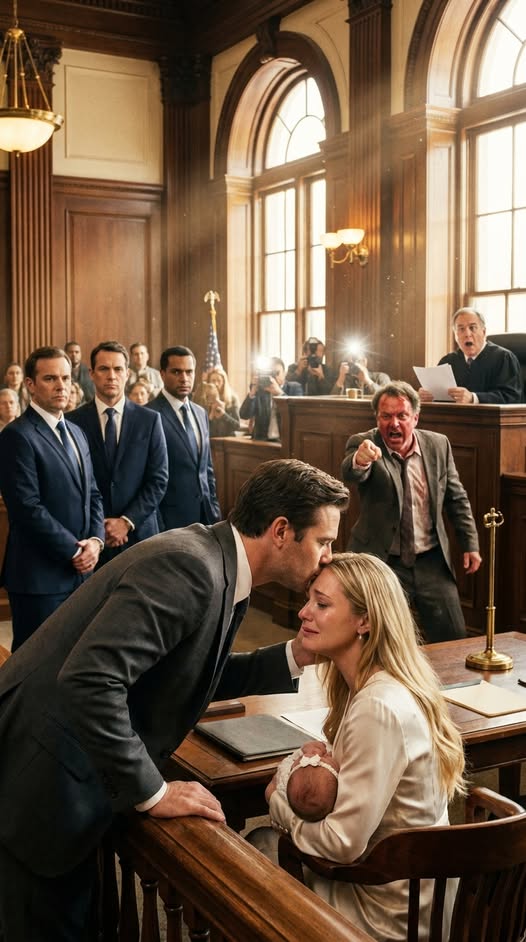
Then, right in front of the judge, Richard, and the entire court, he leaned in and gently kissed my forehead.
“I’ve got you,” he murmured, his voice a low, steady anchor in the violent storm of my reality. The warmth of his skin against mine sent a shockwave through my system. I wasn’t alone. I was no longer undefended.
Alexander turned smoothly to face the bench, his demeanor snapping back to that of the lethal corporate predator. He handed a thick, gold-embossed folder to the bewildered court clerk.
“Correction, Your Honor,” Alexander’s voice resonated through the room, cool, rich, and utterly commanding. “The respondent is not broke. She is my wife, the equal co-owner of my five-hundred-million-dollar estate, and the infant in question has been legally, irrevocably adopted by me.”
He paused, letting the words detonate in the dead silence of the room. He turned his head just a fraction to lock eyes with a now-trembling Arthur Pendelton.
“Now. I believe we have a counter-suit for egregious harassment, malicious prosecution, and the intentional infliction of emotional distress to discuss.”
Judge Henderson sat frozen, staring blankly at the gold-embossed document the clerk had timidly handed him. He flipped through the pages, his face growing increasingly pale. He looked at Richard, who was practically hyperventilating, then back at Alexander.
Judge Henderson cleared his throat nervously, the authority entirely stripped from his voice. “Mr. Thorne… these… these papers are indeed fully executed and legally filed. The adoption is sealed by a federal judge. But… how is this possible? Your marriage certificate states the union took place in secret just three days ago?”
“Your Honor,” Pendelton attempted to intervene, though his voice was shaking so badly it sounded like a gravel road. He clutched the edge of his table as if it were a life raft. “This is a mockery of the court! An emergency marriage and a rushed adoption cannot possibly invalidate my client’s sovereign biological rights—”
“Your client waived his biological rights the moment he forced his then-pregnant wife to sign a notarized financial disavowment during their divorce to avoid paying a single cent of child support,” Alexander countered smoothly, not even deigning to look at Pendelton. His voice didn’t rise; it didn’t need to. It cut through the air like a scalpel.
Alexander gestured subtly with two fingers. His lead partner, a sharp-eyed woman named Ms. Vance, stepped forward in perfect synchronization, handing a second, heavily indexed binder directly to the judge.
“Furthermore, Your Honor,” Alexander continued, pacing slow, measured steps across the floor, completely claiming the space. “We have submitted incontrovertible forensic evidence detailing Mr. Harrington’s illegal, GPS tracking of my wife’s vehicle. We have digital logs proving his unauthorized, felony access to her private medical records at Cook County Hospital. And, perhaps most troubling for this court’s integrity, we have the wire-transfer receipts for the fifty thousand dollars he paid to a private investigator to fabricate the ‘neighbor testimonies’ you were subjected to hearing today.”
Richard erupted. The polished veneer of the billionaire shattered, revealing the vicious, cornered animal underneath. He jumped out of his chair, his face flushed a mottled, ugly purple.
“This is a lie! It’s a setup!” Richard screamed, spit flying from his lips. He pointed a trembling finger at Alexander. “You think you can buy your way into my business, Thorne? I know what you’re doing! I’ll ruin you! I’ll have you disbarred!”
“Sit down and shut your mouth, Mr. Harrington!” Judge Henderson barked, slamming his gavel down so hard it chipped the block. The judge’s demeanor had completely violently shifted. The condescension he had aimed at me was now replaced by a blazing, self-preservationist fury directed entirely at Richard.
Judge Henderson looked down at the indexed binder of evidence, flipping through the bank records and GPS logs with mounting horror. No judge wanted to be the fool who granted custody based on bought perjury, especially not when a titan like Alexander Thorne was holding the receipts.
“Mr. Thorne,” the judge said, his voice tight, “this court is absolutely appalled by these findings. If these documents are verified—”
“They are verified by federal cyber-crime units, Your Honor,” Alexander interjected calmly.
“Then not only is this petition for emergency custody dismissed with extreme prejudice,” Judge Henderson declared, glaring at a now-sweating Pendelton, “but I am referring these egregious allegations of perjury, wire fraud, and illegal surveillance directly to the District Attorney’s office immediately. Bailiff, please escort Mr. Harrington from my courtroom before I hold him in criminal contempt.”
The courtroom erupted into frantic movement. Two heavy-set bailiffs moved aggressively toward Richard, grabbing him by the arms of his tailored suit. Richard thrashed against them, screaming obscenities, his eyes wide with the sudden, shocking realization that his money had finally failed him.
As the bailiffs dragged him toward the aisle, Alexander stepped forward, leaning across the dividing wood. He lowered his voice, dropping it into a register so dark and dangerous it made the hairs on my arms stand up.
“The District Attorney is the very least of your worries, Richard,” Alexander whispered, his eyes locked onto his prey. “My firm just acquired fifty-one percent of Harrington Industries’ outstanding mezzanine debt. By tomorrow morning at nine a.m., I will initiate a hostile foreclosure on your beloved North Shore estate. You told Audrey you would leave her with nothing. I am just returning the favor.”
The afternoon sun streamed in thick, lazy beams through the floor-to-ceiling windows of the Thorne Estate, casting a warm, golden glow over the expansive nursery. It had been four weeks since the courtroom doors blew open and my entire universe was rewritten.
Grace lay in a beautifully carved, mahogany crib, sleeping peacefully, her little chest rising and falling in a rhythmic, undisturbed slumber. She was completely oblivious to the war that had been waged—and won—for her soul.
I stood by the window, wrapping my hands around a delicate porcelain cup of real, freshly brewed chamomile tea. Outside, the sprawling manicured lawns rolled down to the edge of Lake Michigan. I took a deep breath. For the first time in years, the crushing, physical weight in my chest was gone. My shoulders were no longer braced against an invisible, impending blow. I was safe.
The heavy oak door opened softly behind me, the hinges completely silent. Alexander stepped in, shedding his suit jacket and loosening his silk tie. He looked radically different here, stripped of his courtroom armor. The lethal, icy edge he presented to the world softened into something distinctly human, something deeply weary but peaceful.
“How is she?” he asked quietly, keeping his voice to a soft murmur as he nodded toward the crib.
“She’s perfect,” I whispered, turning to look at him. My heart gave a strange, complicated flutter.
Alexander walked over, standing close enough for me to feel the radiant heat of his body, but meticulously maintaining a respectful distance. It was the careful dance we had been doing for a month. Our marriage was forged in the fires of a legal strategy—a transaction to save my daughter and give him the leverage to destroy a corrupt rival. Yet, every day in this house, the lines of our transaction were blurring.
“Alexander…” I started, looking down at my tea. “I still don’t know how to adequately thank you. You didn’t just save my custody of Grace; you gave us a life, a shield we could never have dreamed of. But this marriage… I know why we did it. But I don’t want to be a permanent burden to your life or your reputation. Once the dust fully settles, I can—”
Alexander stepped closer, gently placing a finger under my chin and lifting my gaze to meet his. The intensity in his blue eyes stole my breath.
“Audrey, you are not a burden,” he said, his voice thick with a raw, unfamiliar emotion. “I have spent my entire life in rooms filled with billionaires, politicians, and the so-called elite. I have never seen anyone with half the strength and honor you possess. Watching you fight for your daughter against impossible odds, with nothing but your own terrifying courage… it was the most beautiful thing I’ve ever seen.”
He slowly moved his hand from my chin, gently tucking a stray lock of hair behind my ear. His touch was electric.
“This family is real to me, Audrey,” he confessed, his gaze dropping to my lips before rising back to my eyes. “It started as a shield. But if you’ll have me, I want it to be real for the rest of our lives.”
A profound, quiet peace settled over the sunlit room, wrapping around us like a warm blanket. I leaned into his touch, closing my eyes, finally allowing myself to be held.
Meanwhile, in the adjoining study, the large television screen played a muted news broadcast. The scrolling ticker at the bottom of the screen displayed the latest headlines in bold red letters: “HARRINGTON INDUSTRIES FILES FOR CHAPTER 11 BANKRUPTCY. FORMER CEO RICHARD HARRINGTON FACES 15-COUNT FEDERAL INDICTMENT FOR WIRE FRAUD AND EMBEZZLEMENT.”
Karma, it turned out, wore a bespoke navy suit and didn’t take prisoners.
Our quiet, tender moment was abruptly shattered by the sharp, secure chime of Alexander’s private encrypted phone resting on the nursery dresser. He sighed, stepping back, his expression instantly hardening back into the cold, calculated mask of the elite attorney. He picked up the device, scanning the text.
“It’s from the federal holding facility,” he said, his voice dropping an octave, the tension returning to his jaw. “Richard’s lawyer, Arthur Pendelton, is panicking. He wants to cut a plea deal with the feds, and he wants my firm to broker immunity.”
“Immunity for what?” I asked, a sliver of the old dread returning.
Alexander looked at me, his eyes narrowing. “Pendelton says Richard has a hidden asset. A massive offshore trust fund specifically set up in the Cayman Islands. It was designed to financially target and ruin you and Grace if he ever went to prison.”
Three years later.
The grand, opulent ballroom of the Drake Hotel was filled with the soft, melodic clinking of crystal champagne glasses and the low, sophisticated hum of Chicago’s elite. Crystal chandeliers cast a dazzling, fractured light over the hundreds of attendees gathered below.
At the podium, centered under a spotlight, I stood tall. I wore an elegant, sweeping emerald silk gown that whispered against the polished floorboards. My posture was poised, my shoulders pulled back, my hands resting lightly on the wooden edges of the lectern. Gone entirely was the trembling, broken woman in the oversized blazer who had once wept in a family courtroom. In her place stood a force to be reckoned with.
I looked out over the sea of faces, taking a deep, grounding breath.
“Three years ago, I stood in a sterile courtroom, mere minutes away from losing my infant daughter,” I spoke into the microphone, my voice ringing out steady, resonant, and unapologetic. The room fell into an immediate, pin-drop silence. “I was targeted because I was vulnerable. I was told I would lose because I couldn’t afford a lawyer who could fight against millions of dollars of weaponized wealth.”
I looked down into the front row. Sitting there was Alexander, looking impossibly handsome in a classic black tuxedo. Sitting on his lap, clapping her hands and giggling at the shiny lights, was a vibrant, healthy, fiercely loved three-year-old Grace. Alexander caught my eye, his face breaking into a smile so full of pure pride and love it made my heart ache in the best possible way.
“But I learned a vital lesson that day,” I continued, my voice rising with conviction. “Wealth can buy temporary power. It can buy silence. It can buy a terrifying illusion of invincibility. But it can never, ever defeat the fierce, unyielding spirit of a mother’s love when it is backed by the truth.”
I gestured to the massive banner hanging behind me, bearing the golden logo of our life’s work.
“Tonight, I am proud to announce that through the Grace Miller Foundation, we have successfully provided elite, uncompromising legal representation to over five hundred mothers and children facing domestic and legal harassment from wealthy abusers. We have leveled the playing field. We have proved, time and time again, that justice in this country is not a luxury item reserved strictly for the highest bidder!”
The ballroom erupted. The applause was a physical wave of sound, a thunderous standing ovation that shook the floorboards. I stepped down from the stage, the heavy silk of my gown trailing behind me, and walked straight into the front row.
Alexander stood, passing a squirming Grace to her beaming nanny, and caught me in his arms. He pulled me flush against his chest, dipping me slightly as he kissed me deeply, right in front of the flashing cameras of the local press.
“You did it, my love,” he whispered fiercely against my lips. “You changed the world.”
Looking out over the glittering Chicago skyline visible through the ballroom windows, I knew with absolute certainty that we were finally, permanently safe. The past had been a terrifying crucible of fire, a descent into an abyss that almost swallowed me whole. But Richard’s cruelty had been the catalyst for his own destruction. We had emerged from the ashes stronger, wiser, and completely, beautifully unbroken.
As we turned to walk toward the exit, hand in hand, the foundation’s private phone tucked into my clutch buzzed with an urgent, staccato notification.
I stopped, pulling the device out. The screen illuminated with an emergency text from our foundation’s secure hotline. It was a message from a terrified young mother in New York:
“My ex-husband just served me with emergency custody papers. He locked me out of the bank accounts. He says his family practically owns the judge in this district. Please. I have nowhere else to go. Please help me.”
I stared at the glowing words, feeling the phantom echo of my own terror from three years ago. But this time, I wasn’t helpless. I felt a fierce, burning, protective light ignite in my chest. I looked up at Alexander. He saw the shift in my eyes, the battle-ready tightening of my jaw, and he immediately understood. He didn’t sigh; he smiled, a lethal, thrilling grin.
“Get the private jet ready, Alexander,” I said, my voice slipping into the cool, commanding tone I had learned from the man standing beside me. “We have another family to save.”
If you want more stories like this, or if you’d like to share your thoughts about what you would have done in my situation, I’d love to hear from you. Your perspective helps these stories reach more people, so don’t be shy about commenting or sharing.