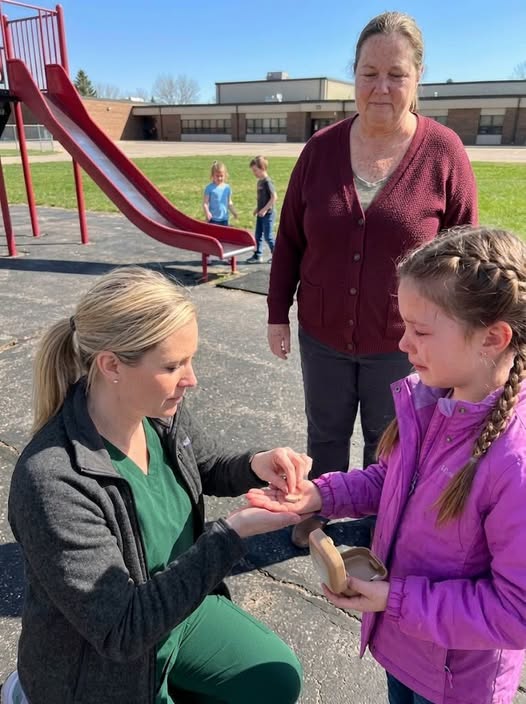
“I can hear it.”
Her voice was so small that I almost missed it.
“I can hear everything.”
I pulled her into my arms.
She buried her face in my shoulder, and I felt her body shake.
“Why did you take so long?” she whispered.
That question broke something inside me.
I had driven sixty miles. I had left work without permission. I had spent money I didn’t have to spare.
But none of that mattered.
My daughter had spent an entire morning sitting in a classroom, watching people’s lips move, pretending she understood.
And she had been carrying an empty hearing aid case because she thought someone might give her back what belonged to her.
“I’m sorry, sweetheart,” I whispered. “I’m so sorry.”
Mrs. Lund stood a few feet away.
Her eyes were wet.
“She didn’t tell me everything,” she said quietly. “She just kept saying she was in trouble and wasn’t supposed to have them.”
I looked at Emma.
“Who told you that?”
She lowered her eyes.
“Kendall.”
Her stepmother.
“What exactly did she say?”
Emma twisted the zipper on her purple jacket.
“She said I was being disrespectful. She said I needed to learn that I don’t get everything I want just because I cry.”
I felt my jaw tighten.
“Did she say anything about your hearing aids?”
Emma nodded.
“She put them in the kitchen drawer. She said I could have them back when I learned to listen.”
I closed my eyes.
There are moments when anger comes so quickly that you have to physically remind yourself that a child is standing in front of you.
This was one of those moments.
I wanted to call Chad.
I wanted to drive straight to his house and demand that he explain how this had happened.
But Emma was watching my face.
So I took a breath.
“Listen to me, sweetheart. Your hearing aids are not toys. They are not rewards. Nobody gets to take away something you need to hear.”
She nodded.
“Even if I’m bad?”
I crouched lower until our eyes met.
“Even if you make a mistake. We can talk about mistakes. We can talk about manners. We can talk about anything. But nobody takes away your ability to hear.”
She started crying again.
This time, I didn’t ask her to stop.
I just held her.
After recess, Mrs. Lund walked us back inside.
Before Emma entered her classroom, she turned around.
“Mom?”
“Yes?”
“Can you call Daddy?”
I hesitated.
“Do you want me to?”
She nodded.
“I don’t want him to think I lost them.”
That sentence told me more than anything else could have.
Emma wasn’t just afraid of losing her hearing aids.
She was afraid of being blamed.
I kissed her forehead.
“I’ll handle it.”
I waited until she was inside before taking out my phone.
Then I called Chad.
He answered on the fourth ring.
“Hey, Amanda. Everything okay?”
“No.”
There was silence.
“What happened?”
“Emma’s hearing aids are at your house.”
“Yeah, I know.”
I gripped the phone.
“You know?”
“Kendall told me she put them away for the weekend. Emma was talking back at supper.”
I stared at the school parking lot.
“Chad, she went to school without them.”
Another silence.
“What?”
“She spent the entire morning unable to hear her teacher. She cried through a spelling test. Her teacher called me because she couldn’t understand why Emma wasn’t wearing them.”
“Wait. What do you mean she didn’t have them?”
“I mean exactly what I said. Kendall took them away, and Emma was sent back to school without them.”
Chad exhaled.
“Jesus Christ.”
“Don’t say Jesus Christ. Say something useful.”
“Amanda, I didn’t know she was going to school without them.”
“Then you need to start paying attention.”
“I’ll talk to Kendall.”
“No. You’re going to make sure Emma’s original hearing aids are returned today.”
“Okay.”
“And Chad?”
“Yeah?”
“If anything like this happens again, I will not treat it like a misunderstanding.”
He didn’t answer.
I ended the call.
For the first time that morning, my hands stopped shaking.
I thought that would be the end of it.
I was wrong.
At 3:17 that afternoon, my phone rang again.
It was Mrs. Lund.
“Amanda, I think you need to come back.”
My stomach dropped.
“What’s wrong?”
“Emma’s fine. But something happened when her father arrived.”
I looked at the clock.
“Her father?”
“He’s here with Kendall.”
I grabbed my keys.
And drove back to the school.
PART 3: The Woman Who Thought She Could Punish My Daughter
When I walked into the school office, I immediately heard Kendall’s voice.
“She is making this into something it isn’t.”
Chad stood beside her with his arms crossed.
He looked exhausted.
Kendall looked irritated.
And Emma was sitting on a small chair beside Mrs. Lund, holding her backpack in her lap.
Her loaner hearing aids were still behind her ears.
I walked straight toward her.
“Are you okay, baby?”
She nodded.
Then she reached for my hand.
Kendall noticed me.
“Oh, good. You’re here.”
I didn’t answer.
She folded her arms.
“Since we’re all here, perhaps we can clear up this ridiculous situation.”
I looked at Chad.
“Did you bring Emma’s hearing aids?”
He glanced at Kendall.
She looked away.
“No,” he said.
I stared at him.
“Why not?”
“Kendall said she couldn’t find them.”
I turned toward her.
“You couldn’t find them?”
“They’re somewhere in the kitchen. I haven’t had time to look.”
I felt something cold settle in my chest.
“You took them from a nine-year-old girl, put them somewhere in your kitchen, and didn’t bother to return them when she left for school?”
Kendall rolled her eyes.
“She was being disrespectful. I’m tired of everyone acting like she gets special treatment.”
I looked at her.
“Special treatment?”
“Yes. Every little thing becomes a crisis because Emma has hearing problems.”
Mrs. Lund stood up.
“Excuse me.”
Her voice was calm, but there was something firm beneath it.
“Emma’s hearing aids are medical devices. They are not privileges.”
Kendall gave a short laugh.
“I’m not asking for your opinion.”
“Actually,” Mrs. Lund replied, “you should be very interested in my opinion. I’m the person who watched your stepdaughter struggle through an entire school morning because she couldn’t hear her lessons.”
Chad looked down.
I turned back to Kendall.
“Do you understand what happened today?”
“She survived one morning without them.”
The words hung in the room.
I felt Emma’s fingers tighten around mine.
“One morning?” I repeated.
“Yes. Children exaggerate. She wasn’t in danger.”
I took a breath.
“She couldn’t hear her teacher. She couldn’t follow the spelling test. She couldn’t participate in recess conversations. She sat there watching other children because she didn’t know what they were saying.”
Kendall shrugged.
“Maybe she’ll learn to listen next time.”
Chad finally spoke.
“Kendall, enough.”
She turned toward him.
“What?”
“Just stop.”
Her expression changed.
For the first time, she seemed surprised that he wasn’t defending her.
I knelt beside Emma.
“Sweetheart, do you want to go home with me?”
She nodded immediately.
Chad rubbed his forehead.
“Can we talk about this outside?”
I stood.
“No. We can talk about it when Emma isn’t sitting here listening to adults argue about whether she deserves to hear.”
He looked ashamed.
And maybe he should have.
I took Emma’s backpack.
Mrs. Lund walked us to the front door.
Before we left, she quietly handed me a folded piece of paper.
“These are the details of what happened today,” she whispered. “I documented the missed instruction time and the conversation Emma had with me this morning.”
I looked at her.
“Thank you.”
She squeezed my arm.
“She is a wonderful little girl. Please don’t let her believe this was her fault.”
I nodded.
Outside, Emma climbed into the passenger seat.
She was quiet for several minutes.
Then she asked something I wasn’t prepared for.
“Mom?”
“Yes, baby?”
“Is Kendall mad because I’m not her real daughter?”
I stopped with my hand on the steering wheel.
I turned toward her.
“Why would you think that?”
Emma stared out the window.
“Because she says things are different when it’s just Daddy and her.”
My heart sank.
“What kind of things?”
“She says Daddy has to spend too much money on me. She says I make everything difficult.”
I closed my eyes briefly.
Then I reached across the console and took her hand.
“Emma, listen carefully. You are not difficult. You are not a burden. And you are never too expensive to love.”
She began crying silently.
I pulled her into my arms.
That evening, after dinner, I checked the loaner hearing aids.
They were working, although they didn’t fit as comfortably as her custom ones.
I called the audiologist to ask how long we could keep them.
“Take your time,” she said. “We’d rather she have something reliable than go without.”
I thanked her.
Then I called Chad again.
He answered immediately.
“I found them.”
“Found what?”
“Emma’s hearing aids. They were in the kitchen drawer.”
I stared at the wall.
“Are they damaged?”
“No. They look fine.”
“Then bring them tomorrow morning.”
“I will.”
There was a pause.
Then he said something I hadn’t expected.
“Amanda, I owe you an apology.”
I didn’t respond immediately.
He continued.
“I should have known. I should have checked. I let Kendall handle something she had no business handling.”
I looked toward Emma.
She was sitting at the kitchen table, drawing a picture.
“You’re her father, Chad. You don’t get to hand over responsibility for her just because you’re married to someone else.”
“I know.”
“Then prove it.”
“I will.”
The next morning, Chad arrived at my house at 7:30.
He was holding the small tan hearing aid case.
Emma opened the door.
“Daddy!”
He knelt and hugged her.
“I’m sorry, peanut.”
She looked at the case.
“Are those mine?”
He nodded.
“Yes. And they’re staying yours.”
Emma took them carefully.
Then she looked at him.
“Are you mad at me?”
Chad’s face changed.
“No, sweetheart.”
“Because Kendall said I was being bad.”
He swallowed.
“You’re allowed to be upset. You’re allowed to tell adults when something is wrong. And nobody should take away your hearing aids.”
Emma nodded.
Then she hugged him again.
I stood in the doorway watching.
I wanted to believe things would improve.
But that afternoon, I received a message from Kendall.
And it changed everything.
THE FULL ENDING: The Day Everyone Finally Heard Emma
The message arrived at 2:46 p.m.
I was folding laundry when my phone buzzed.
It was from Kendall.
I almost ignored it.
Then I saw the preview.
You need to stop turning Emma against us.
I opened it.
The message was longer than I expected.
She accused me of making Chad look like a bad father. She said I had embarrassed her in front of the school. She said I had encouraged Emma to exaggerate what happened.
Then came the sentence that made me sit down.
If you keep making these things into emergencies, maybe Emma should spend less time with us.
I read it twice.
Then I put the phone down.
I wasn’t going to argue with her.
I wasn’t going to trade insults.
And I certainly wasn’t going to let Emma become the messenger between two adults who couldn’t behave themselves.
I took a screenshot.
I saved the teacher’s written account.
I saved the audiologist’s paperwork.
I made a note of the dates and times.
Then I called my attorney.
I explained what happened.
She listened without interrupting.
When I finished, she said, “Amanda, this isn’t about whether Kendall likes you. It’s about whether Emma’s needs are being respected during parenting time.”
“I understand.”
“Keep everything documented. Communicate with Chad in writing when possible. And if you believe Emma is being denied necessary medical equipment again, take appropriate steps to protect her and seek formal guidance about the custody arrangement.”
I thanked her.
For the first time since Monday morning, I felt like I had a plan.
Not revenge.
A plan.
That Friday, Chad came to pick Emma up.
He arrived alone.
I stood on the porch while Emma zipped her purple jacket.
Her hearing aids were in place.
Her backpack was packed.
She looked happy, but I noticed she kept glancing at her father.
“Everything okay, baby?” I asked.
She nodded.
Chad took her bag.
“I want you to know I talked to Kendall.”
I folded my arms.
“Okay.”
“I told her Emma’s hearing aids are never to be touched again. Not for punishment. Not as a joke. Not for any reason.”
I watched him carefully.
“And?”
“And I told her that if she has a problem with Emma’s behavior, she comes to me. She doesn’t punish her by taking away something medical.”
I nodded.
“Good.”
He looked uncomfortable.
“I also think we need to change a few things.”
“What things?”
“I’m going to make sure Emma’s hearing aid case stays in her backpack when she’s at my house. I’ll check that she has them before school and before she comes home.”
“That’s a start.”
He looked toward Emma.
“I don’t want her thinking she has to choose between us.”
I softened slightly.
“Then don’t make her.”
He nodded.
Emma came down the porch steps.
“Can I go now?”
Chad smiled.
“Of course, peanut.”
She hugged me.
Then she whispered in my ear.
“Mom?”
“Yes?”
“Can I tell you something when I get home?”
I kissed her cheek.
“Always.”
She climbed into the truck.
I watched them drive away.
For the first time, I didn’t feel like I was sending my daughter into a situation I couldn’t understand.
But I wasn’t ready to trust everything either.
That weekend, I kept myself busy.
I worked extra hours.
I cleaned the house.
I called the audiologist about Emma’s custom molds and arranged for a follow-up appointment.
On Sunday evening, my phone rang.
It was Chad.
“Emma wants to talk to you.”
I smiled.
“Put her on.”
A moment later, I heard her voice.
“Hi, Mommy.”
“Hi, sweetheart. How was your weekend?”
“Good.”
“Did you have fun?”
“Yeah. Daddy took me to the park.”
“That sounds nice.”
There was a pause.
Then she said, “Kendall talked to me.”
I stopped folding the towel in my hands.
“What did she say?”
“She said she was sorry.”
I sat down.
“She did?”
“She said she didn’t understand how important the hearing aids were.”
I didn’t know what to say.
Emma continued.
“She said she thought I could hear okay without them.”
I closed my eyes.
“How did that make you feel?”
“Better.”
Then, after a moment:
“But I don’t think she really understands.”
That was the most honest thing a nine-year-old could have said.
I didn’t tell her Kendall was lying.
I didn’t tell her to forgive anyone.
I simply said, “You don’t have to decide how you feel about everything right now.”
“Okay.”
“And remember, baby, you can always tell me when something makes you uncomfortable.”
“I know.”
Then she asked:
“Mom?”
“Yes?”
“Can I have my old hearing aids back when I come home?”
I smiled.
“Of course. They’re yours.”
“Good. I like those better.”
We talked for another few minutes.
Then she said she loved me and handed the phone back to her father.
I went to bed that night feeling cautiously hopeful.
But the most important moment happened two weeks later.
It was a Thursday.
Emma’s school was holding a small classroom presentation.
The children had been preparing short speeches about something important to them.
Mrs. Lund had sent me an invitation.
I arrived early and took a seat near the back.
Parents filled the little classroom.
Some were holding phones.
Others were whispering.
Then Emma walked to the front.
She wore a blue dress and white shoes.
Her brown braid rested over one shoulder.
Her hearing aids were tucked neatly behind her ears.
She unfolded a piece of paper.
Mrs. Lund smiled.
“Whenever you’re ready, Emma.”
Emma looked at the room.
Then she began.
“My name is Emma, and I want to talk about something important.”
Her voice trembled slightly.
“Some people think hearing aids are like glasses. You wear them because they help you.”
She paused.
“But sometimes people forget that you need them.”
I felt my throat tighten.
Emma continued.
“Sometimes, when I don’t have them, I can see people talking, but I don’t know what they’re saying.”
The classroom became quiet.
“And sometimes I feel like everybody is having a conversation, but I’m not invited.”
I pressed my fingers against my mouth.
“One day, I went to school without my hearing aids. I couldn’t hear my teacher. I couldn’t hear my friends. I thought maybe I had done something wrong.”
She looked down at her paper.
Then she looked up again.
“But my mom told me something.”
Her eyes found mine.
“She told me that needing help doesn’t mean I’m being bad.”
I couldn’t hold back my tears.
Emma smiled.
“And she told me that my hearing aids are not something people can take away because they’re angry with me.”
Mrs. Lund wiped her eyes.
Emma folded her paper.
“That’s why I think everybody should know that some things are not punishments. Some things are needs.”
The classroom stayed silent for a moment.
Then people began clapping.
I stood up.
I didn’t care who saw me crying.
My daughter had found her voice.
And that voice was louder than anything Kendall had said.
After the presentation, Mrs. Lund approached me.
“She’s remarkable.”
I smiled.
“She really is.”
Then I saw Chad standing near the classroom door.
He had come too.
He was holding a small bouquet of flowers.
When Emma spotted him, she ran over.
“Daddy!”
He handed her the flowers.
“You did amazing, peanut.”
She hugged him.
Then she turned toward me.
“Can we take a picture?”
“Of course.”
Chad stood on one side of her.
I stood on the other.
Emma held her flowers in front of her dress.
And for the first time in a long time, all three of us smiled without pretending.
Kendall wasn’t there.
I didn’t know whether she had chosen not to come or whether Chad hadn’t invited her.
And honestly, I didn’t need to know.
That evening, Emma and I sat at the kitchen table eating grilled cheese sandwiches.
She was telling me about a girl in her class who had asked about her hearing aids.
“She wanted to know if they hurt.”
“What did you tell her?”
“I said no. I said they just help me hear.”
I smiled.
“That’s a good answer.”
Emma dipped her sandwich into her tomato soup.
Then she looked up.
“Mom?”
“Yes?”
“Do you think people can change?”
I considered the question.
“I think people can change when they understand that what they’re doing is hurting someone.”
She nodded thoughtfully.
“Do you think Kendall will?”
“I don’t know, sweetheart. That’s something she has to show you.”
Emma took another bite.
Then she said something I will never forget.
“I don’t need everybody to understand my ears.”
I looked at her.
“What do you need?”
She smiled.
“Just the people who love me to listen.”
I reached across the table and held her little hand.
“That’s all you should ever have to ask.”
That night, after she went to bed, I placed her hearing aid case on the nightstand.
Her original pair was inside.
I checked the batteries.
I checked the molds.
Then I placed the loaner pair in the drawer, ready to return to the audiologist.
The tan case that had been empty on Monday morning was now holding the two tiny devices that helped my daughter hear the world.
I thought about that morning.
The spelling test.
The empty case.
The sixty-mile drive.
The little girl standing beside the red slide, watching other children laugh because she couldn’t hear what they were saying.
And I thought about how close I had come to accepting the situation as just another disagreement between divorced parents.
But it wasn’t.
It was about a child who needed something essential.
It was about adults remembering that discipline should never take away a child’s ability to communicate, learn, or feel safe.
And it was about a father learning that being a good parent means paying attention, even when someone else is doing the talking.
A few days later, Chad sent me a message.
I ordered an extra protective case for Emma. It’s staying in my truck. I also put reminders on my phone to check her hearing aids before school.
I read it.
Then I replied:
Thank you. She deserves consistency from both homes.
That was all.
No argument.
No accusation.
Just two parents finally agreeing on something that should never have been negotiable.
I still don’t know whether Kendall fully understands what she did.
Maybe she does.
Maybe she doesn’t.
But I know this:
Emma will never again be made to feel that her hearing is a privilege she has to earn.
Because the world is already difficult enough for a little girl learning to navigate it with hearing loss.
She doesn’t need to fight for the right to hear inside her own home.
And I will never forget the sight of her on that playground.
Purple jacket.
Brown braid.
Empty tan case.
Waiting beside a red slide.
She thought she had done something wrong.
She thought the grown-ups were angry because she had failed to listen.
But the truth was much simpler.
She had been listening all along.
The adults were the ones who needed to learn.
And that Monday, when I drove sixty miles to put a pair of hearing aids into my daughter’s trembling hands, I wasn’t just bringing her the ability to hear again.
I was reminding her that she would never have to earn the right to be heard.
Not by being perfect. Not by being quiet. Not by making everyone happy.
She was nine years old. She was loved. And that was enough.