Chapter 1: The Blueprint of Silence
I will not begin this chronicle at the true beginning, because thirty-two years of systemic diminishment requires a volume of time I refuse to surrender. Instead, I will pull you directly into the epicenter: the morning of October 14th. I stood rigidly inside a sterile bathroom at the Marriott in downtown Austin, Texas, staring at a stranger in the mirror. She was sheathed in a pale green chiffon dress, a garment I had painstakingly selected for its absolute lack of ambition. It was designed to camouflage, to ensure I would not accidentally upstage a single soul.
With a trembling hand, I applied a final coat of waterproof mascara. I was actively rehearsing the vast inventory of things I would force myself not to say today.
I will not mention that my invitation arrived a mere six weeks ago, suspiciously late for a lavish affair. I will not point out that you intentionally mailed the bridal shower invite to an apartment I vacated three years ago. I will not say, aloud, that I know exactly what kind of people you truly are.
I had engineered this specific brand of silence over an entire lifetime. It is a survival mechanism. You construct it layer by layer, building thick, unyielding calluses over the tender parts of your psyche that other people don’t even realize possess nerve endings.
My name is Meredith Calloway. I am thirty-two, and I hold a license as a structural engineer at Hargrove and Sims, a boutique firm of fourteen brilliant minds where we know each other’s bagel orders and willingly burn the midnight oil because the math demands it. I ran our Southwest residential division. I held the deed to a mid-century home with a detached garage I had stripped to the studs and converted into a sunlit drafting studio. I woke up every morning to the thumping tail of a golden retriever mix named Scout. And, most crucially, I had a marriage.
My biological family knew absolutely nothing of this infrastructure.
To the Calloway clan, I remained the eternal cautionary tale. I was the spinster who hadn’t settled down, the abrasive workaholic who laughed a decibel too loud, skipped Thanksgiving to hike, and mailed holiday cards devoid of a return address. At a rare family dinner I had foolishly attended months prior, my mother, Eleanor, had diagnosed my life status to her wealthy friends.
“Meredith is just… between chapters,” she had purred, her voice dripping with such heavily practiced, synthetic warmth that three of my aunts nodded in tragic sympathy. Beneath the mahogany table, I had driven the steel tines of my salad fork into the meat of my palm, using the sharp physical pain to keep my facial muscles paralyzed in a polite smile.
My younger sister, Allison, was not merely a chapter. Allison was the leather-bound, best-selling, critically acclaimed manuscript. At twenty-eight, she possessed that effortless, symmetrical beauty that fractured light perfectly through any camera lens. Today, she was marrying Bradford Whitmore III—yes, the third—a man whose lineage boasted a regional insurance monopoly, a sprawling compound in the Texas Hill Country, and apparently enough societal leverage to pack a four-hundred-person ballroom at The Driskill Hotel. The floral budget alone eclipsed the cost of my first vehicle.
I arrived at the grand, sweeping staircase of the venue at precisely 3:47 p.m. The string quartet was scheduled to strike their first chord at four o’clock.
“You actually came alone?”
The voice boomed from the landing above me. My father, Richard Calloway, possessed a terrifying talent for calibrating his volume to maximize the echo in any architectural space.
“I came,” I murmured, keeping my chin level.
He dramatically scanned the opulent marble foyer behind my shoulder, squinting as if my fictional date might miraculously materialize from the valet line. “No date. Still flying solo.” He pivoted toward my uncle, who was feigning intense interest in a towering arrangement of white hydrangeas. “Randy, look who it is! Meredith. Still incapable of holding down a man.”
Uncle Randall chuckled—that specific, cowardly bark of a man profoundly relieved he wasn’t the target of the apex predator’s claws. I swallowed the bile rising in my throat and continued my ascent up the stairs, unaware that the true trap had already been set, waiting for me in the ballroom.
Chapter 2: The Monogrammed Guillotine
The ceremony was undeniably breathtaking, assuming you possessed the ability to look past the cold, calculated architecture of the arrangement. The towering arches of eucalyptus were freshly cut. The string quartet wept out a flawless rendition of Vivaldi. At the altar, Allison dabbed at her eyes, her tears appearing startlingly genuine. Perhaps they were. I had never been permitted close enough to the golden child to decipher her private emotional baseline. Bradford’s voice fractured with raw emotion as he recited his vows, and strangely, I believed him. Whatever transaction this union represented, Bradford was deeply invested. The tragedy was that his devotion was anchored to a curated mirage of Allison that I knew did not exist.
I was relegated to the fourth row. Technically, this was the absolute front row of the general guest seating, deliberately segregated from the velvet-roped family pews. It was a vicious demographic distinction that required no spoken explanation and received none.
My mother held court in the front row, draped in pale blue silk. Eleanor always looked as though she had personally art-directed the ambient lighting of whatever room she occupied. During the exchange of rings, she craned her neck to glance back at me twice. The first look was an inventory check—is she causing a scene? The second was a jagged, silent warning—do not ruin this. I offered her a placid, dead-eyed smile both times.
The reception unfurled in the adjacent grand ballroom, accessible through towering, gilded double doors draped in cascades of white roses. It smelled overwhelmingly of wealth and crushed petals. I located my assigned exile at Table 11, wedged in the dark periphery between two of Allison’s former sorority sisters who possessed the collective depth of a puddle and introduced themselves to me twice within twenty minutes. I flagged a waiter, procured a glass of sparkling water, and focused on breathing in measured, rhythmic counts.
For forty agonizing minutes, I achieved perfect invisibility. Invisibility was a state I could manage. Invisibility meant survival.
And then, the sharp, piercing squeal of microphone feedback hijacked the room.
My father had commandeered the stage. He was not on the printed itinerary for toasts; that was strictly my mother’s domain. I had watched her slide three meticulously color-coded index cards into her clutch before the salad course. But Richard Calloway had never encountered an amplification device he didn’t feel a divine entitlement to wield. He intercepted the mic from the bandleader, tapping the steel mesh twice. The sprawling ballroom snapped to immediate, obedient attention.
“Before the official toasts commence,” he boomed, his voice vibrating through the massive speakers, “I demand a moment to express the sheer magnitude of my pride.”
Thunderous applause washed over the tables.
“Allison, my beautiful girl, you are the absolute manifestation of everything your mother and I dreamed of.” He shifted his heavy gaze to the groom. “And Bradford, welcome to the madness. You are a brave, brave man.”
A polite, practiced ripple of laughter rolled through the crowd.
“I also want to acknowledge,” my father continued, his tone suddenly dropping into a theatrical, hushed register, “that we have our entire family gathered here tonight.” He paused. The silence stretched, thick and suffocating. “Well… almost the entire family.”
Another pause. He raised his free hand, horizontally shading his eyes from the crystal chandeliers, pantomiming a sailor searching a distant horizon. “I believe Meredith is lurking out there somewhere.”
At Table 11, my blood turned to glacial ice. One of the sorority sisters pointed directly at me. I watched the physical gesture ripple outward like a terrible seismic wave until hundreds of heads turned in my direction.
“Ah! There she is,” my father declared, his voice radiating the false, condescending warmth of a tourist observing a peculiar animal behind zoo glass. “All by her lonesome. Couldn’t scrounge up a single date for her sister’s big day.” He offered a dramatic, exaggerated shrug to the audience. “It’s perfectly fine, folks. We still love her anyway!”
Two hundred people laughed.
It was a staggering, physical sound. Some laughed out of sheer social compliance, following the alpha male’s cue. Some, my extended bloodline, laughed because degrading me was their favorite generational pastime. I saw my cousins hiding their vicious smirks behind monogrammed linen napkins. Up at the head table, my mother arranged her elegant features into a mask of faux-sympathy.
But Allison didn’t bother hiding it. She stared right at me and smiled. It was the exact same chilling, triumphant smile she had weaponized since childhood. The smile that explicitly communicated: Better you than me.
I carefully placed my sweating glass of water onto the linen tablecloth. I pushed my chair back. I needed oxygen before my lungs collapsed, but as I moved toward the glass doors leading to the exterior terrace, I heard the heavy, rhythmic thud of my father’s footsteps following right behind me.
Chapter 3: The Physics of a Fall
The Driskill’s terrace wrapped around the southern face of the historic building, an oasis of wrought-iron balustrades, warm string lights, and an ornate, tiered stone fountain. It was a purely aesthetic installation, a faux-Tuscan basin designed explicitly to serve as a backdrop for high-society photography. It was visually stunning. It was also, as I was about to discover, precisely eighteen inches deep.
“You skipped the bridal shower,” my father hissed, materializing directly behind my right shoulder.
His voice had dropped from the booming auditorium volume into his private, disciplinary register. It wasn’t a shout. It was a flat, inevitable drone that promised punishment.
“I skipped the rehearsal dinner, too,” I replied, my gaze locked on the shimmering water of the fountain. “I just needed a minute to breathe, Dad.”
He let out a short, hollow bark of laughter. “You were always so agonizingly dramatic.”
“Dad.” I kept my tone perfectly level, fighting the tremor in my chest. “Not today. Please, just walk away.”
“It is exactly today,” he countered, executing that incremental volume shift he had perfected over decades. It wasn’t quite a scene yet, but it was just loud enough to breach the perimeter of the nearby cocktail tables, forcing the smoking guests to eavesdrop. “Today is about commitment. It is about showing up for the people who actually matter in this world.”
“I bought the dress. I sat in the chair. I am here,” I whispered defensively.
He smiled outward, making eye contact with the eavesdropping guests. “Yes. Completely alone. As usual.”
A muffled snicker erupted from a group of men holding scotch glasses near the railing. Emboldened by the audience, my father closed the distance between us. He raised both of his large, calloused hands and placed them squarely on my bare shoulders. The grip was heavy, deliberate, and deeply possessive, like a sculptor adjusting a flawed piece of clay.
“Stop sulking, Meredith. You’re ruining the aesthetic,” he sneered.
And then, he pushed me.
I must be clinically precise about the mechanics of this moment. It was not a violent, aggressive heave. It wasn’t the kind of brutal shove you imagine in a bar fight. It was impossibly casual. It was dismissive. It was the exact amount of kinetic force one might use to carelessly roll a stray shopping cart out of a parking space. He was still wearing a charming, dimpled smile when he applied the pressure.
But my spiked heel caught the slick, wet edge of the stone basin.
The physical laws of gravity and momentum demanded a sacrifice. The backward angle of my spine, the treacherous stone, the sudden loss of friction—it all conspired in a microsecond.
I plummeted backward.
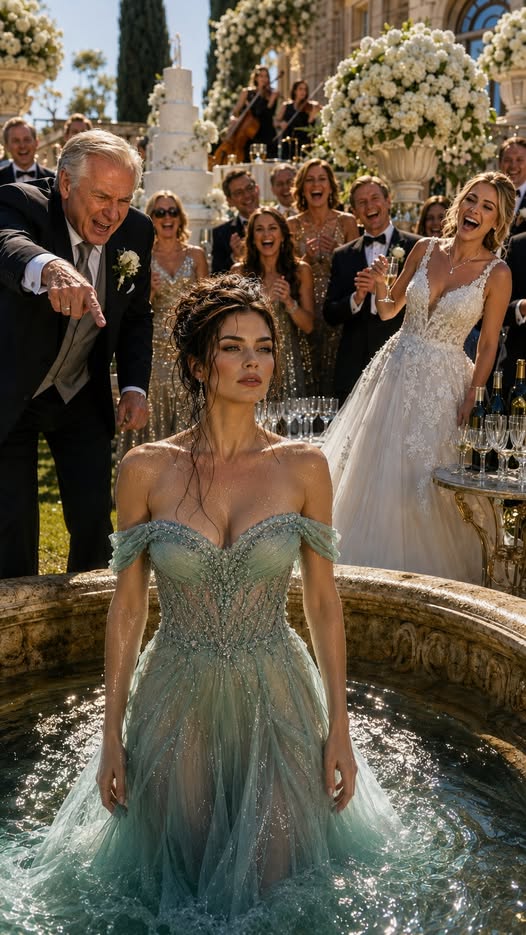
The golden chandeliers blurring through the glass doors morphed into streaks of light. I saw a flash of pale blue silk. Then, the freezing, heavily chlorinated water violently swallowed me.
Because the basin was only eighteen inches deep, I didn’t submerge. I crashed onto the hard stone bottom in a seated position. The icy water surged up to my sternum. The pale green chiffon of my dress instantly transformed into a heavy, dark algae, plastering itself to my freezing skin. One of my heels had been ripped off in the fall, floating pathetically near my knee. The string lights above me swayed, making the world spin dizzily.
I heard the sound before my shocked brain could fully process the data.
Applause.
There were no gasps of horror. There was no sudden, panicked silence. Nobody shouted, My God, is she hurt?
They applauded.
It was as if I was a hired clown who had finally executed the punchline they had been eagerly anticipating all evening. Through the stinging water in my eyes, I saw Trevor, the hired wedding photographer, raise his massive DSLR camera to his face, the shutter clicking in rapid-fire bursts.
My father stood at the absolute edge of the fountain. The microphone was still clutched in his left hand. He wasn’t looking down at my soaked, shivering body. He was looking out at the crowd, absorbing the adoration of the audience he had spent sixty years cultivating. He looked profoundly satisfied.
Sitting in the freezing water, something inside the deepest architecture of my soul went entirely, completely still.
It wasn’t the quietness of shock. It was the profound, terrifying silence of a final decision. It was the stillness that settles into your bones when you have been waiting decades for a ghost to show its true face, and the monster finally steps into the light.
I slowly wiped the dripping water from my eyelashes and locked eyes with my father.
“Remember this moment,” I said.
My voice wasn’t a scream, but the absolute, freezing conviction in it cut through the ambient noise like a scalpel. The applause hesitated. The laughter died in the throats of the guests. The quality of the atmosphere warped.
“Remember exactly what you just did to me,” I whispered, the sound carrying across the water. “Because I promise you, I will.”
His smug smile evaporated, replaced by a flicker of genuine confusion.
I placed my hands on the wet stone and dragged my soaked body out of the basin. Not a single person moved. Not one guest offered a hand, a napkin, or the most basic human reflex of assistance. I climbed out in absolute isolation, freezing water cascading off my ruined dress, and began the long march back into the hotel. I left a trail of dark, wet footprints across the pristine marble floors of the Driskill, tracking the evidence of their cruelty all the way to the lobby restroom. I was preparing to introduce them to a force of nature they had no defense against.
Chapter 4: The Load-Bearing Wall
Inside the cavernous, empty women’s restroom, I gripped the edges of the porcelain sink and stared into the mirror for a very long time.
There is a highly specific psychological phenomena that occurs when you finally perceive your own reflection with absolute clarity. I didn’t look different, but the toxic narrative I had been force-feeding myself had been violently stripped away. For thirty-two years, I had operated in a perpetual state of desperate hope. I believed that if I could just be quiet enough, useful enough, and undemanding enough, the emotional mathematics of my family would eventually balance out.
Standing there, dripping freezing fountain water onto imported tile, the realization hit me: I had been trying to solve an algebraic equation using numbers that did not exist. There was no love to uncover. There was only a power dynamic, and I was their designated victim.
I was officially done.
I retrieved my phone from my clutch, ignoring the water damage on the screen, and fired off a text message consisting of two words to a hidden contact: Come now.
Then, I walked down the corridor to the hotel coat check. Because I had spent my entire adult life anticipating my family’s sabotage, I had checked a canvas duffel bag that morning. Preparation was the only illusion of control I possessed. Inside the bathroom stall, I peeled off the heavy, freezing green chiffon. I aggressively toweled my hair dry. I slipped into a sharp, unforgiving black cocktail dress I had packed as a contingency. I reapplied my makeup with surgical precision. I dragged a tube of blood-red lipstick across my mouth. Because sometimes, dignity isn’t a feeling you wait for; it is a tactical decision you execute in front of a mirror.
I threw my shoulders back, pushed the restroom door open, and marched back toward the ballroom.
It is time you knew the truth about Daniel Reyes.
Daniel is forty-one years old. He is the founder and managing partner of Reyes Capital Partners, a private equity behemoth in Austin managing roughly three hundred and forty million dollars in diversified assets. He is not a loud man. He does not hijack microphones at social gatherings. He wears his astronomical wealth the way professional athletes wear their height—as a simple, undeniable biological fact that he has no interest in discussing.
His grandmother was Catalina Reyes, a woman who crossed the border from Oaxaca with thirty dollars in her shoe and built a Tex-Mex restaurant empire from the dirt up. The platinum and sapphire ring Catalina wore for fifty-three years of marriage is the exact ring that currently sits on my left ring finger.
I met him at a structural engineering symposium in Houston four years ago. I was presenting a highly technical paper on seismic load analysis in retrofitted residential concrete. Daniel sat in the third row. His firm had just acquired a massive commercial development company, and he ruthlessly demanded to understand the physical bones of what he owned. After my panel, he approached the podium, asked a devastatingly intelligent question about structural liability, and slid his embossed card across the table.
We shared a quiet dinner three weeks later. Fourteen months after that meal, we stood in the fluorescent-lit office of the Travis County Clerk and legally bound our lives together. The only witnesses were his cutthroat business partner, Marcus Tran, and my senior drafting colleague, Lynn Fong. We celebrated by eating world-class omakase at Uchi, drinking too much Junmai sake, and walking the river trails until the city lights burned out.
I never told my family.
The omission was not born of spite, nor was it a premeditated act of vengeance. It was an act of raw survival. I had watched the Calloways dismantle every beautiful thing I ever loved. My first serious boyfriend was relentlessly mocked into oblivion because he worked in IT. My massive promotion to division lead was suffocated at the dinner table so my mother could brag about Allison becoming a retail floor manager. My accomplishments were merely measuring sticks they used to beat me; my vulnerabilities were open invitations for cruelty.
Daniel Reyes was a load-bearing pillar in my life. I refused to let him become a weapon in their hands. So, I hid my absolute peace in a vault they couldn’t breach.
But as I strode down the plush carpet of the Driskill hallway, the era of hiding violently expired.
I was halfway to the gilded doors when they swung open from the outside. Two men entered the corridor first, moving with terrifying, synchronized purpose. I recognized Marcus Tran instantly. Marcus possessed a law degree from UT Austin that he kept lethally sharp, despite primarily dealing in high-finance acquisitions. Flanking him was Owen Briggs, Daniel’s private security consultant—a man who had spent seventeen years hunting ghosts in the FBI’s financial crimes division before going private. Owen moved like a phantom, his eyes scanning the sightlines, checking the exits, mapping the threats. They fanned out, securing the perimeter of the hallway.
Then, Daniel walked in.
He wore a bespoke charcoal suit, no tie, the top button of his crisp white shirt undone—his signature armor when he was finished negotiating for the day and ready for blood. He didn’t scan the crowd. His dark, intense eyes locked onto me like a laser. He closed the distance in a straight, unyielding line.
His gaze swept over my newly applied armor. He noted the damp roots of my hair. He saw the angry, red scrape blooming across my collarbone where the stone fountain had bitten me. He saw the death grip I had on my clutch.
“What happened?” his voice was a low, dangerous rumble that vibrated in my chest.
I could have deployed a euphemism. I could have said things got out of hand, or there was a misunderstanding, falling back into the pathetic habit of protecting my abusers from the consequences of their actions.
Instead, I looked up at the only man who had ever made me feel safe.
“My father pushed me into the fountain,” I stated, my voice devoid of emotion. “In front of the entire room. While they clapped.”
A shadow, dark and terrifying, eclipsed Daniel’s face. He is not a man who performs anger for an audience. What I witnessed was genuine, agonizing grief for my pain, instantly flash-frozen into a rage that was ten degrees colder than the surface of the moon.
He didn’t say a word. He shrugged off his suit jacket and draped it heavily over my bare, shivering shoulders. He turned toward the gilded doors. The wolves were about to meet the leviathan.
Chapter 5: Turning the Ring
My father had been monitoring the hallway from the edge of the ballroom. Richard Calloway was a massive physical presence, conditioned by a lifetime of assuming he was the most dominant predator in any given ecosystem. He spent his days calculating whether the men in his orbit were problems to be crushed or assets to be exploited.
I watched his eyes lock onto Daniel. I saw the gears in my father’s head grind as he ran the threat-assessment calculation, and I saw the exact moment he came up horrifyingly short.
“Mr. Reyes,” my father barked, stepping into the corridor.
My father recognized the name. Two years prior, Reyes Capital had mercilessly outbid my father’s contracting firm for a highly coveted commercial acreage. They had shared oxygen in a boardroom exactly once. What my father did not know was why the titan of Austin private equity was standing in a hallway holding his disgraced daughter.
“This is a private, ticketed family event,” my father warned, puffing out his chest.
Daniel didn’t even acknowledge my father’s face. He was gently inspecting the bleeding scrape on my shoulder.
My father took a menacing step forward, his temper flaring. “I said, there seems to be a misunderstanding here.”
“No,” Daniel replied, his voice a lethal, quiet whisper. “There hasn’t been.”
Suddenly, Allison materialized from the crowd, her massive tulle gown rustling aggressively. Bradford trailed a half-step behind her, looking wildly uncomfortable.
“Meredith,” Allison sighed, deploying that sickeningly sweet, condescending tone she reserved for treating me like a mental patient. “Why do you always have to make everything into a dramatic spectacle? It was a simple accident.”
I turned my dead eyes onto my sister. “You smiled, Allison,” I said, my voice slicing through the air.
Her flawless makeup couldn’t hide the sudden, panicked flush creeping up her neck. “I… I was just uncomfortable.”
“No,” I corrected, stepping toward her. “You were immensely pleased.”
Bradford snapped his head to stare at his new bride. I watched the realization physically hit him—the horrifying recalibration of a man who has just witnessed a deeply ugly truth about the woman he swore his life to. He remained silent, but the damage was permanently logged in his eyes.
My mother, Eleanor, shoved her way to the front line. She possessed a terrifying gift for weaponizing politeness to contain PR disasters. “This is Allison’s sacred wedding day,” she hissed, her voice vibrating with venom. “We will absolutely not tolerate a scene—”
“The scene,” Daniel interrupted, his voice cracking like a whip. It was a tone I had only witnessed him use during hostile corporate takeovers. “Already occurred. It happened the exact second your husband physically assaulted your daughter while you stood by and cheered.”
My father’s face flushed a violent, mottled purple. “You are a guest in my venue, Reyes! I suggest you watch your mouth!”
Daniel reached out and firmly grasped my left hand, pulling me flush against his side. “I am not a guest.”
He let the silence stretch. Through the open doors, the live band had abruptly stopped playing. The waitstaff stood paralyzed with trays of champagne. Two hundred elite guests were holding their breath, watching the execution.
“I am her husband,” Daniel stated.
I had run the engineering load tests on this exact moment in my mind a thousand times. I wondered if I would feel vindictive triumph or crushing sorrow. What I felt was the purest, most intoxicating hit of absolute clarity.
With my right hand, I reached over and twisted the platinum and sapphire ring on my left finger. For three years, I had worn Catalina’s legacy turned inward, a secret pressed into my palm. I cannot articulate the sheer, explosive liberation of turning the stone outward for the world to see.
Eleanor’s perfectly powdered face drained of all blood. Allison’s expensive bouquet slipped from her grasp, hitting the carpet with a dull thud. My father stared at the glittering sapphire as if it were a radioactive isotope he couldn’t comprehend.
“Three years,” I announced, my voice echoing off the marble. “Three years I sat in silence while you made jokes about my pathetic, empty existence. Three years I listened to my mother describe me as a lost cause. Three years of you treating my very heartbeat as a consolation prize.”
I looked at the terrified faces of my abusers. “I have had a devoted husband, a beautiful home, a dog, and absolute, deliberate peace for three years.”
My father finally choked on his own oxygen, struggling to find his voice. “You… you legally married this man? And you hid it from your own blood?”
“Yes.”
“How?” He stammered, the alpha-male facade cracking into pieces. “How could you be so cruel to do that to us?”
I stared directly into his soul, searching for an ounce of remorse and finding an empty black hole. “Because, Dad, this family taught me the exact physics of what happens when I hand you something I love. You destroy it.”
The hallway had no counterargument. My father reached frantically into his emotional toolbox for the performance of the injured, betrayed patriarch he had weaponized my entire life. But the toolbox was empty. Because my words were the absolute, unvarnished truth, and every single person observing the massacre knew it.
The structural integrity of his lies had finally collapsed.
Chapter 6: The Calculus of Consequences
Seventy-two hours after the fountain incident, the legal machinery of Reyes Capital woke up.
Marcus Tran drafted a formal letter of intent and sent it via certified courier to my parents’ gated estate. It was not printed on the letterhead of the private equity fund. It arrived under the terrifyingly sterile banner of Marcus’s private legal practice. The five-page document formally notified Richard and Eleanor Calloway that their daughter had retained hostile counsel and was actively exploring both civil and criminal remedies for the physical assault sustained on October 14th.
Appended to the legal threat was a sworn, notarized witness affidavit from Owen Briggs, who had scientifically documented the sightlines, the physical contact, and the names of seventeen guests who could corroborate the push.
But the most devastating payload was the visual evidence.
The envelope contained two high-resolution photographs taken by Trevor Halleran. Trevor, possessing a shred of moral integrity, had refused to delete the files. He had securely emailed them to me at 2:00 AM the night of the wedding with a subject line that read: I am so sorry I froze. You need these.
The first image captured my father’s massive hands clamped violently on my bare shoulders, his face twisted into a smug, arrogant sneer. The second image captured the exact, horrifying millisecond of kinetic transfer as I was shoved backward toward the water.
Furthermore, Marcus’s letter explicitly noted that the Driskill Hotel’s corporate legal team had already locked down and preserved the exterior security footage, desperate to shield themselves from a multi-million-dollar liability lawsuit regarding a guest being assaulted on their premises.
I explicitly chose not to press criminal assault charges. I spent hours in the quiet sanctuary of my therapist’s office, dissecting the decision. What I truly desired was not the fleeting spectacle of seeing my father perp-walked in handcuffs. I wanted the total, irreversible annihilation of his social narrative. The civil threat achieved exactly that. The photos and the security tapes existed in the physical world now. He could not gaslight his way out of a digital timestamp.
On October 21st, my phone buzzed with a call from Eleanor. I let it bleed into voicemail. She left a manic, four-minute diatribe. I transcribed it word for word, because surviving the Calloways required meticulous bookkeeping. The audio was a masterclass in narcissistic deflection—forty percent conditional apologies structured around “I’m sorry you chose to feel offended,” and sixty percent hysterical accusations about how my secret billionaire husband had completely overshadowed Allison’s bridal magazines.
I texted her back a single sentence: I have nothing to say to you. I will initiate contact if and when I choose.
She replied in seconds: Your father is utterly devastated.
I stared at the word devastated. I thought about a grown man grinning while the crowd cheered a drowning woman. I locked my phone, clipped a leash onto Scout, and went for a grueling five-mile run to burn the adrenaline from my blood.
The dam officially broke on October 29th.
I did not leak the photos. I refuse to claim a vindictive innocence I don’t require. Trevor, wrestling with his guilt, had posted the photo of my father’s hands on my shoulders to his public Instagram story with a cryptic caption about “unforgettable cruelty.” He panicked and deleted it six hours later.
But on the internet, six hours is an eternity.
A guest screenshotted the image and funneled it to Cassie Park, the most ruthless, well-connected socialite blogger in Austin. Cassie verified the story with three independent attendees and published a scorched-earth exposé about a “deeply disturbing physical altercation” at the Whitmore-Callaway reception. She didn’t name my father in the first article, but she named the venue and the date. Over the next two weeks, the blood was in the water, and anonymous sources flooded her inbox.
By mid-November, Callaway Contracting had its reputation shredded. The city council, terrified of bad PR, unceremoniously pulled two massive municipal bids out from under my father. My cousin Delia texted me the casualty report: We had no idea the storm you were bringing. I am so sorry.
I replied: Thank you, Delia. It wasn’t absolution, but it was a start.
The collateral damage didn’t stop at the business. Bradford and Allison had flown to Portugal for a lavish honeymoon. They returned in absolute, icy silence. On November 4th, Bradford Whitmore III, the man who had watched his new bride smile as her sister was physically attacked, filed an ironclad divorce agreement citing irreconcilable differences.
When Delia leaked me that detail, I didn’t cheer. I felt a heavy, suffocating grief for the sheer, avoidable waste of it all. If a single person in that bloodline had possessed the courage to break the cycle, Allison wouldn’t be staring at annulment papers. But I had finally learned the hardest physics lesson of all: I was no longer responsible for the structural collapse of their lives.
Chapter 7: Proof of Life
The phone call I had been engineering for a lifetime finally arrived on November 18th.
“Meredith,” my father’s voice crackled through the speaker. It sounded small. It sounded old.
“Dad.”
A suffocating silence hung on the line. “I need to talk to you about the fallout. The bids…”
“I am fully aware of the bids,” I interrupted, my tone stripped of all empathy. “I need you to listen to me very carefully. I didn’t unleash this storm to punish you. I did it because your actions demand consequences. I am a thirty-two-year-old woman, and I refused to let you treat my existence as a punching bag for your ego for one more second.”
He breathed heavily into the receiver. “I didn’t mean to push you that hard into the water.”
“I know,” I replied, the chilling truth settling between us. “That is the most terrifying part, Dad. You didn’t intend to drown me, but you fully intended to humiliate me. You meant to grab that microphone. You meant to make me the punchline. You have meant to do it my entire life. The fountain was just the moment you were arrogant enough to do it in front of a camera.”
“What do you want from me?” he whispered, sounding utterly broken.
“I want you to sit in the ruins,” I commanded softly. “I want you to sit in the absolute discomfort of your own cruelty without an audience to applaud you and without Mom spinning the narrative. If you can survive that, maybe we can speak again one day.”
I severed the connection.
It is March now. The winter chill has finally burned off the Texas hills. Last weekend, Daniel and I hosted an intimate dinner in our sunlit home. Marcus, Lynn, Owen, and his husband crowded around our dining table, passing bottles of expensive wine and laughing from deep within their chests. At one point, Marcus raised his crystal glass, the candlelight catching the rim.
“To Meredith,” he toasted, his eyes twinkling. “The most terrifyingly patient architect I have ever had the privilege to know.”
I laughed out loud—a real, unedited sound. Daniel squeezed my thigh under the table, his thumb brushing my skin. Scout was asleep on my feet, snoring loudly, taking up far more space than a dog his size had any right to claim.
Yesterday, Eleanor mailed me a handwritten card. She claimed she was seeing a licensed therapist on the north side of town. She explicitly stated she wasn’t demanding forgiveness, just offering information. I placed the card in a drawer. I haven’t replied. I may never reply. Allison remains a ghost.
But there is one final piece of structural reinforcement I must confess.
The morning after the wedding, before Marcus sent the legal threat, I took the high-resolution digital files Trevor had emailed me and drove to a professional print shop. I requested 5×7 prints on thick, heavy matte paper. I slid the physical photographs of my father’s hands violently shoving me into a manila envelope. I wrote his corporate office address on the front.
I included no note. No ultimatum.
I simply mailed it.
He keeps those photographs in his possession now. He knows that I know he has them. I did not send them as a threat of blackmail; I sent them as an immutable, physical anchor to reality.
For thirty-two years, my family operated a psychological cartel that demanded I negotiate my own sanity. They insisted my pain was an exaggeration, my memories were hysterical, and my reactions were the root of all the conflict.
I possess the photographs now. They can never, ever look me in the eye and tell me I imagined the abuse. That is the devastating beauty of empirical truth. You don’t have to weaponize it. You merely have to prove that it exists.
That realization—not the freezing fountain, not the explosive reveal of the ring, not even Daniel marching through the gilded doors—was the exact moment my coup d’état was complete. My father finally understood that I hadn’t just survived the toxic narrative he built for me.
I had documented the collapse.