Chapter 1: The Geometry of Absence
The paper was stiff, semi-gloss cardstock, crisp at the edges and printed in Meridian blue.
My husband fanned them out between his thumb and forefinger like a street magician preparing to misdirect a mark. Four boarding passes. Not five.
I stood in the roaring undercurrent of Terminal 3 at O’Hare International Airport, surrounded by rolling duffels, the hum of floor polishers, and the smell of burnt espresso and pre-flight panic. My mind, trained over fifteen years of veterinary medicine to read blood gas panels and subtle anomalies in mammalian tissue, failed at the simplest arithmetic.
One for Trevor Hargrove.
One for his mother, Marlene Hargrove.
One for our nine-year-old son, Micah.
One for our six-year-old daughter, June.
And then, the quiet, deliberate space where my name should have been.
“There’s no ticket for you, Renee,” Trevor said.
He did not whisper it. He did not drop his chin or pull me aside toward the frosted privacy glass of the executive lounge. He said it cleanly, into the public air, in the exact tone an insurance claims adjuster uses to deny coverage on an uninspected roof.
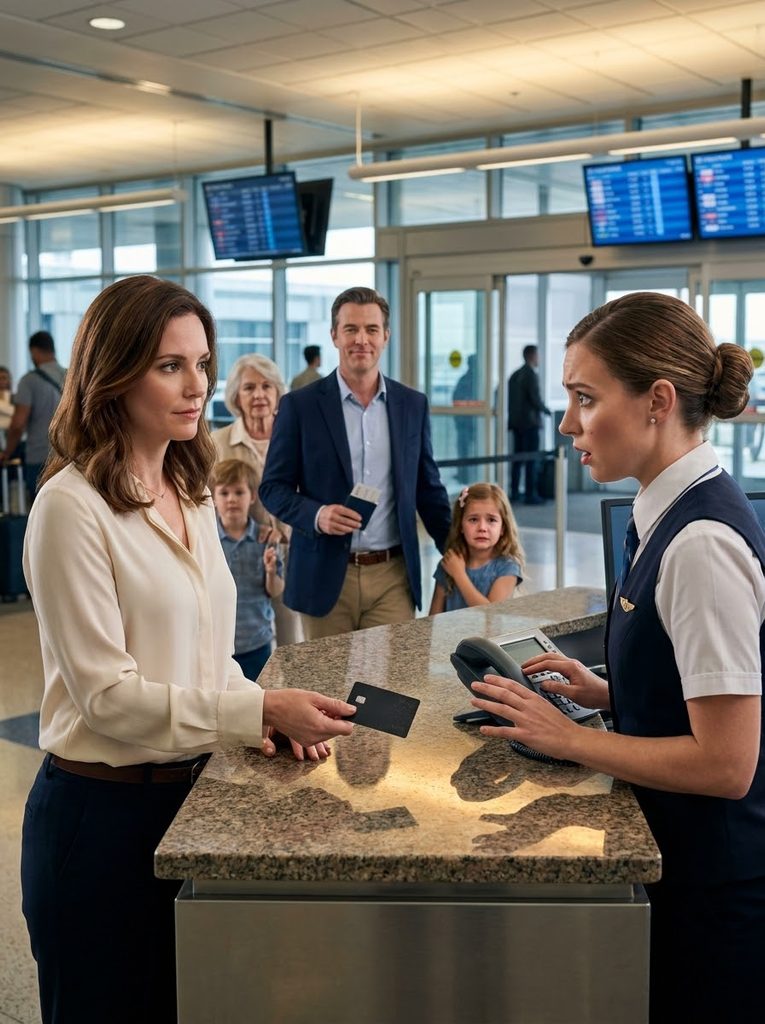
A business traveler in a charcoal trench coat paused five feet away, pretending to check his wristwatch while his ears tilted toward us. A gate agent glanced up from her terminal, her eyes darting between Trevor’s outstretched hand and my bare ones.
“What are you saying, Trevor?” My voice sounded strange to me—dry, stripped of timbre, like paper rubbing together in an autumn wind.
“Mom thought it would be healthy for us,” he continued, smoothly slipping the four slips of cardstock into the breast pocket of his tailored travel jacket. “Some real family time. Just the core unit. A chance for the kids to bond with their grandmother without… well, without the usual professional friction. You’ve been so wound up with the clinic anyway. We figured you’d appreciate a quiet week at home to catch up on your charts.”
Beside him, Marlene did not flinch. At sixty-seven, she was an imposing monument to midwestern country-club propriety: silver hair blown out into an immovable helmet, a pastel cashmere cardigan draped across her shoulders despite the airport draft, and a gaze that had spent twelve years assessing me and finding me deficient.
That morning, however, Marlene was not offering her customary disdain. She was radiant. She looked like a woman who had spent months engineering a delicate siege, only to watch the fortress gates swing open without a single shot fired.
She leaned down, her gold charm bracelets chiming softly against her manicured wrist, and placed one hand on Micah’s shoulder. With the other, she enveloped June’s small fingers.
“Come along, darlings,” Marlene murmured, her voice dripping with counterfeit sugar. “The line is moving. Nana will buy you those macadamia cookies as soon as we clear security.”
She didn’t look back at me. She simply turned her back and began guiding my children toward the TSA checkpoint, her stride brisk, proprietary, and absolute. She walked like someone who was not merely taking a flight, but reclaiming property that had temporarily fallen into the wrong hands.
Micah hesitated. At nine, he possessed that hyper-vigilant radar common to children who live in houses where the cold between their parents is never acknowledged aloud. He dug the heels of his sneakers into the industrial carpet, his brow furrowing as he craned his neck over his shoulder.
“Mom?” he called out, his voice thin against the ambient roar of the terminal. “Aren’t you coming with us to the gate?”
Before I could answer, June twisted in Marlene’s iron grip. My little girl was wearing the daffodil-yellow sundress I had stayed up until midnight washing and pressing so she would look like the sun itself when we landed in Honolulu. Her lower lip began to tremble. She reached out with her free hand, her small fingers clutching at the empty air between us.
“Mommy!” she cried, the word sharp with that sudden, piercing terror children feel when the boundaries of their universe warp without warning. “Mommy, you have to hold my backpack!”
Every biological wire in my body caught fire.
My lungs seized. The impulse to lunge forward, to physically rip my daughter from Marlene’s grip, to slap the smug, rehearsed detachment off my husband’s face until the airport police dragged us all down to the concrete, clawed at my ribs like a wild animal. The scream was there, sitting hot and metallic at the back of my tongue.
I looked at June’s widening brown eyes.
I looked at the tourists filming the flight boards on their smartphones. I looked at the security guards resting their thumbs on their belts thirty feet away.
If I break, I thought, the realization descending like a sheet of lead, they win the narrative forever.
If I screamed, Marlene would have her proof. Trevor would have his documentation. They would turn to my terrified children and say, See? Look at how unstable she is. Look at what your mother does in public. They would board that plane to paradise as martyrs, leaving behind a woman whose grief had been weaponized to destroy her custody.
I dropped to my knees on the carpet. The synthetic fibers bit into my shins, but I kept my spine straight.
“June, baby,” I called out, forcing the air out of my diaphragm in a steady, melodic beam. “Look at me, sweetheart.”
My daughter stopped pulling. She looked back at me, tears gathering on her lower lashes.
“Mommy has some very important business to take care of right here in the city,” I said, offering her a smile that felt like it was tearing the muscles of my cheeks. “Nana and Daddy are taking you ahead. You eat those cookies, okay? You look out the window when you cross the ocean. And remember what I told you about the sea turtles.”
“Are you coming?” she whispered.
“I will see you very soon,” I said, holding her gaze with every shred of will I possessed. “I promise you, June. Mommy is right behind you. I always am.”
She sniffed, wiping her nose with the sleeve of her yellow dress, and nodded because at six, a mother’s promise is still more solid than stone. Micah gave me one long, searching look—a look that said he understood this was a lie, but he would protect his sister anyway—and allowed Marlene to steer them into the serpentine security ropes.
I stayed on my knees until they rounded the partition.
Only then did I stand. My joints gave a sharp, dry pop.
Trevor was still standing two paces away, hovering with his hands shoved casually into his trouser pockets. He stepped closer, leaning in until I could smell his mint chewing gum and the citrus cologne I had bought him for his thirty-eighth birthday.
“Don’t make this a thing, Renee,” he whispered, his tone tight, warning, and utterly devoid of remorse. “Don’t embarrass yourself. Go home, feed your strays, and we’ll figure out how to talk about this when I get back.”
I looked at him. I looked at the bridge of his nose, the neat trim of his beard, the eyes I had once looked into while promising for better or for worse.
“I’m not making it a thing, Trevor,” I said.
His lips twitched with faint, triumphant amusement. He assumed my quietness was the same surrender he had spent twelve years cultivating. He assumed I was going to walk out to the short-term parking lot, climb into my mud-splattered Subaru, and weep into the steering wheel until my chest went numb.
He gave me a perfunctory pat on the arm—the kind of touch a master gives a well-trained retriever—turned on his heel, and walked briskly toward the priority security lane.
I did not move toward the exits.
I turned ninety degrees to my left, away from the glass doors leading to the curb, and fixed my eyes on the heavy mahogany and brushed-steel facade of the Meridian Airlines executive customer counter, tucked discreetly behind the primary ticketing concourse.
I reached into the interior pocket of my leather tote bag. My fingers bypassed the car keys, bypassed the clinic’s appointment ledger, and closed around a slim, matte-black card tucked into a forgotten slit of my wallet.
It was time to stop being the wife Trevor thought he had married.
Chapter 2: The Architecture of Shrinking
Before I was the woman abandoned on the linoleum of Terminal 3, I was simply Dr. Renee Hargrove.
To the people of Oak Creek, that meant the tired woman in ceil-blue scrubs who smelled of chlorhexidine and wet dog, whose fingernails were cut short and clean, and who spent twelve hours a day coaxing dying terriers through renal failure. I was the person people called when their horses colicked at three in the morning, driving out through freezing sleet with a vet box rattling in the bed of my truck.
I loved that work. I loved the unvarnished reality of it. Animals do not lie. They do not manufacture polite social cruelty. If a dog bites you, it is because he is terrified or broken; he does not smile at you across a mahogany dining table while quietly slipping arsenic into your tea.
My husband, however, viewed my life’s work as a distasteful inconvenience.
To Trevor, who worked as a senior commercial real estate broker, appearance was the only currency that held real value. He moved through the world in bespoke charcoal wool, leasing European sedans every twenty-four months, obsessing over golf handicaps and club memberships.
“She plays with kittens all day,” Marlene would announce at her quarterly dinner parties, waving her linen napkin like a surrender flag while her friends laughed over their Chardonnay. “We keep telling her she could at least transition into administrative consulting. Something that doesn’t involve… bodily fluids.”
For twelve years, I took it.
I took it because I believed in the covenant of marriage. I took it because my mother had died when I was nineteen, leaving me with an acute, aching terror of fractured families. But mostly, I took it because of my father.
My father was Walter Ashford.
If you look at the history of American commercial aviation between the years of 1974 and 2005, his name is written into the foundation of every runway between Chicago and Seattle. He had been an aerospace engineer who partnered with three wartime pilots to buy four surplus turboprops, building what would eventually become Meridian Airlines—a carrier that now moved twenty-two million passengers a year across three continents.
Yet, despite his empire, my father wore wool work shirts with frayed collars until the day he died. He drove a ten-year-old Ford pickup with a dent in the tailgate. When I was ten, he walked me out onto the freezing tarmac at O’Hare at four in the morning, holding my small gloved hand while the turbine engines shrieked in the pre-dawn dark.
“Renee,” he told me, pointing his wrench at the line mechanics shivering in their grease-stained jumpsuits, “the world is full of men who peacock around in gold watches they bought with other people’s labor. Don’t you ever become one of them. Money is not who you are. It’s just fuel. What matters is the engine you build with your own hands.”
When my father succumbed to pancreatic cancer three years ago, he left fifty-one percent of his estate to my older brother, Nolan Ashford, and forty-nine percent to me. That inheritance included an irrevocable seat on the governing board of directors for Meridian, vast industrial land holdings, and a controlling voting trust that neither Trevor nor his mother even knew existed.
I had kept it quiet on purpose.
When I met Trevor twelve years ago, I was twenty-six, freshly graduated from veterinary school, and terrified of being sought after for my father’s balance sheets. I introduced myself as Renee Ashford, but when we married, I took the name Hargrove with a sense of profound relief. I wrapped that name around myself like a canvas smock. I wanted to be loved for the way I stayed up all night nursing an orphaned calf, not for the corporate portfolio that bore my family’s crest.
I thought I was being noble. I thought I was keeping our marriage pure.
I didn’t realize that in hiding my teeth, I was inviting them to feed on me.
Over the years, Trevor’s demands grew from subtle suggestions to open disdain. He wanted a larger home in Oakridge Estates; the trust quietly arranged for the purchase through an anonymous LLC, with me providing the down payment while Trevor bragged at the country club that his quarterly commissions had secured the mortgage. He wanted to fund his mother’s lavish European river cruises; I quietly diverted my dividend payments into our joint checking account, letting him hand her the tickets as though he were the generous patriarch.
And Marlene took every cent, using the very comfort I funded to sharpen the knives she used against me.
“A real woman,” Marlene had told me last Christmas, staring down her thin nose at my calloused knuckles while I scrubbed her crystal roasting pan, “knows how to keep her husband inspired. Trevor is destined for regional executive partner, Renee. He needs a social asset, not someone who looks like she just stepped out of a barn.”
Trevor had been standing three feet away, uncorking a vintage Bordeaux. He hadn’t defended me. He hadn’t said, Mother, stop. He had simply smiled into his glass and said, “Mom’s just being traditional, Ren. You shouldn’t be so sensitive.”
The trap had been set over years, but the final execution had taken three weeks.
When Trevor came home twenty-one days ago, announcing that he had booked a private villa in Oahu for the five of us, I had broken down and cried in our pantry. I thought he was trying. I thought the quiet distance between us was finally melting. I spent two weeks rearranging the clinic’s surgical schedule, paying relief vets double rates out of my own pocket, packing little June’s bags with sunblock and matching swimsuits.
All of it—every single second of my hope—had been designed to bring me to this terminal, to strip me naked in front of strangers, and to walk away with my babies while I stood paralyzed by my own shame.
I stopped in front of the Meridian executive counter.
The polished black granite caught the harsh overhead fluorescent lighting. Behind the desk stood an agent in a crisp navy blazer, her gold lapel pin catching the glow. Her name tag read Denise.
She looked at me with the weary, guarded expression of an airport employee who had seen every possible iteration of human grief, fury, and entitlement, and had long since developed an immunity to all three.
“Good morning, ma’am,” Denise said, her voice mechanical, polite, and firmly walled off. “How can I direct you today?”
I did not clear my throat. I did not speak.
I opened my hand, revealing the matte-black card, and slid it gently across the cold granite counter until it rested directly under her fingers.
Chapter 3: The Weight of an Unspoken Name
Denise’s eyes dropped to the counter with professional indifference.
The card was not an ordinary frequent-flyer credential. It wasn’t gold, platinum, or even the diamond tier that high-spending corporate executives waved around to demand free upgrades to first class.
It was solid carbon-composite, unadorned by logos or bank numbers. It bore only two things: an inlaid platinum compass rose in the upper left quadrant, and a single line of laser-engraved typography along the bottom:
R. ASHFORD — BOARD OF DIRECTORS / FOUNDING GOVERNANCE
Denise’s hand froze.
For two full seconds, her fingers remained hovering an inch above the card. The ambient roar of the terminal—the announcements for boarding calls to Atlanta, the crying infants, the clatter of luggage carts—seemed to drop away into an eerie, pressurized vacuum.
Her gaze lifted from the black plastic to my face.
She took in my faded Barbour jacket, my practical leather boots with the faint watermarks along the welt, my hair pulled back into a hasty knot with a tortoiseshell clip, and my eyes—dry, unblinking, and dead-calm.
Her posture did not just straighten; it locked. The slight slump of an eight-hour shift evaporated from her spine as if an electric current had surged through the granite.
“Ma’am,” Denise whispered, her voice dropping all corporate cadence, replaced by something taut and intensely careful. “Please… give me one moment.”
She didn’t use the standard keyboard shortcut. She pulled an internal red-banded telephone from beneath the counter, shielded her mouth with her left hand, and spoke four low, urgent sentences into the receiver. I caught only fragments: “…terminal three executive… credential Alpha-One… yes, standing right here.”
Behind me, thirty paces back near the entrance to the TSA screening lanes, I heard the heavy, rhythmic tread of men’s dress shoes on tile.
Trevor had not cleared security.
Of course he hadn’t. He had lingered near the velvet ropes, pretending to inspect his mobile boarding pass, waiting for the show. He wanted to watch me break down. He wanted to see me approach the customer service desk in tears, plead for an empty middle seat in row 38, and be turned away by a bureaucratic refusal so he could board his flight to Hawaii with his conscience scrubbed clean.
Instead, he saw the agent reach for a priority landline with both hands.
I didn’t turn around to acknowledge him, but I saw his reflection in the dark, mirrored glass of the flight display boards behind Denise. He was frowning, his head tilted, his stride slowing as he edged closer to the counter, driven by that morbid curiosity common to predators when their prey doesn’t bleed on schedule.
A door in the paneled wall behind the counter clicked open with a heavy magnetic release.
A man stepped out. He was in his late fifties, his hair an iron-gray crew cut, wearing the tailored dark-navy suit of a station director. His name tag read Pruitt. He moved with the quiet, deliberate authority of someone who had spent thirty years managing aviation crises—de-icing failures, wildcat strikes, emergency belly landings—and had forgotten how to look surprised.
Denise handed him the black card without a word.
Pruitt took it between two fingers. He did not look at me first. He looked down at the matte composite, his thumb tracing the inlaid platinum compass. Then he tapped five keys on the specialized terminal mounted beside the station master’s console.
The screen reflected across his wire-rimmed glasses in a wash of amber code.
He read for six seconds.
Then, very slowly, Pruitt set the card down on the desk, treating the piece of plastic as if it were a high-explosive detonator that had been armed forty years ago and forgotten in the walls.
He looked at me. His gaze was searching, respectful, and intensely solemn.
Then his eyes drifted past my left shoulder, tracking the man in the designer travel coat who was now standing less than twelve feet away, his eyebrows drawn together in mounting, suspicious confusion.
Pruitt looked back at me. He leaned forward over the counter, his voice dropping into a register so quiet that not even the passengers waiting at the adjacent gate could hear it.
“Ms. Ashford,” Pruitt said. He paused, his jaw working once. “Does your husband know who you are?”
The question did not pierce me; it anchored me.
In those seven words, Pruitt had summarized twelve years of my existence. He had recognized, with the clinical perception of a veteran airport director, the exact anatomy of the farce playing out on his concourse. He saw the tickets Trevor held. He saw the children who had been led away. And he saw the woman holding the master key to the very kingdom they were trying to lock her out of.
“No,” I replied softly. “He doesn’t. He never thought it was important enough to ask.”
Behind me, the sound of leather soles stopped dead.
“Renee?”
Trevor’s voice had lost its smooth, executive timber. It sounded brittle, thin, and snagged on the edges of something he couldn’t categorize.
He stepped up beside me, his eyes darting between Pruitt’s frozen, deferential posture and the black card resting on the granite.
“What’s going on here?” Trevor demanded, trying to re-inflate his customary boardroom tone, though it came out an octave too high. “Look, officer, or supervisor—whatever you are—my wife isn’t traveling today. There’s been a miscommunication on her end. She’s just heading back out to the parking structure.”
Pruitt did not look at Trevor. He didn’t even blink. He kept his eyes locked on mine, waiting for a directive that he was legally and contractually obligated to obey above the authority of anyone else in that terminal.
“Ms. Ashford,” Pruitt said, his tone flat, formal, and devastating in its courtesy. “Flight 412 to Honolulu is currently at Gate B12. Boarding has just commenced for group one. Your aircraft is a Boeing 777-300ER, tail number November-Eight-Zero-Four-Alpha.”
Pruitt picked up the black card, holding it flat between his palms.
“This aircraft belongs to the Ashford Trust portfolio. If you wish, I can hold the departure indefinitely. I can have your children brought back to this counter under supervisory escort within four minutes. Or, if it is your preference, I can have Mr. Hargrove and his mother removed from the passenger manifest and escorted off the property by airport security.”
The silence that followed was heavy enough to crush bone.
Trevor’s mouth fell open. His hand, still clutching his boarding passes, dropped two inches. The color didn’t just leave his face; it evacuated, leaving his skin the shade of wet flour under the fluorescent tubes.
“What…” Trevor croaked, his gaze dropping to the card, reading the name R. Ashford as if the letters were shifting into a language he had never learned to speak. “What did he just call you?”
Chapter 4: The Sound of the Floor Breaking
I did not turn to face my husband immediately.
I took three seconds to breathe. The air in the terminal felt different now—no longer toxic with my own subjugation, but clean, cold, and clear.
When I finally turned my head toward Trevor, I saw a stranger.
I saw a man who had built an entire persona out of unearned confidence, whose arrogance had always relied entirely on my willingness to stay small. The handsome, dismissive broker who had told me don’t make this a thing ten minutes ago was gone. In his place was an exposed, trembling clerk who had suddenly realized that the ground he had been stamping on for twelve years was not dirt, but the roof of my glass house.
“Renee,” he stammered, his fingers twitching against the seam of his trousers. “What is this? Is this some kind of sick joke? Who is Ashford? Your father was… your father was a retired mechanic from Iowa.”
“My father built the wings you’re about to fly on, Trevor,” I said. My voice was neither loud nor angry; it possessed that absolute, terrifying clarity of a surgeon explaining a terminal prognosis. “He owned the company that owns your mortgage. He owned the debt on your firm’s commercial building on Michigan Avenue. And when he died, he left that seat—and forty-nine percent of the voting shares of this airline—to me.”
Trevor shook his head, a wild, jerky spasm of denial. “No. No, that’s impossible. You’re an animal doctor. You work out of a strip mall. You drive a ten-year-old wagon!”
“Because I wanted to work,” I said, stepping half an inch closer to him, watching his pupils dilate in genuine, primal panic. “Because I believed that what a person does with their hands matters more than what they inherit. And because, God help me, Trevor, I wanted to believe that you loved me for who I was, not for what my father could buy you.”
Beyond the security checkpoint, through the reinforced plate glass separating the ticket counters from the sterile concourse, I saw Marlene.
She had stopped near the moving walkway. She was holding June by the hand, but her neck was craned back toward us. She could not hear a single syllable through the soundproof glass, but she could see the way Pruitt was standing. She could see two uniformed port authority supervisors who had quietly moved into position five yards behind Trevor, their hands folded formally in front of them, eyes forward, flanking the scene like sentinels.
I watched Marlene’s face through the glass.
The triumphant, cat-like smirk she had worn for twelve years—the look that had accompanied every dinner where she mocked my clothes, every holiday where she diminished my work, every subtle campaign to alienate my children—began to disintegrate. It unraveled into an expression of sheer, bewildered dread. She raised one hand to her throat, her fingers clutching her gold necklace, realizing that the play she had spent months directing had just run off the edge of a cliff.
Trevor reached out, his hand trembling as he attempted to grab my wrist. “Renee, listen to me. Let’s… let’s just step into the lounge. Let’s talk about this. Mom didn’t mean anything by it, she was just—”
“Do not touch me, Trevor,” I said.
The command was so quiet, so devoid of theatrics, that his hand stopped mid-air as if he had encountered an invisible wall of iron.
Pruitt stepped forward, clearing his throat once. “Ms. Ashford. Your orders?”
I looked through the glass again.
I saw June. My sweet, beautiful six-year-old in her bright yellow dress, standing beside her grandmother, clutching her little canvas backpack, looking up at the flight monitors with that innocent, unblemished wonder that only children have.
If I gave the order right now, Pruitt would make a call. Airport police would march through that gate, pull Marlene out of line, seize the children, and frog-march my husband through the exit turnstiles while hundreds of vacationers filmed the spectacle on TikTok.
My husband would be ruined. Marlene would be publicly destroyed.
And my children would be traumatized for the rest of their lives.
June would remember her yellow dress as the uniform of a nightmare. Micah would never walk through an airport again without feeling the ice of that humiliation in his chest.
The people who need to shout have already lost, my father’s voice whispered in my head, clear and steady as the morning wind over the prairie. Real power never has to raise its voice.
I looked back at Pruitt.
“Let the flight depart on schedule, Mr. Pruitt,” I said smoothly.
Trevor let out a ragged, wheezing breath of relief. “Thank God. Renee, thank you. When we get to the hotel, I’ll call you immediately—”
“You misunderstand me, Trevor,” I interrupted, my eyes locking onto his with the finality of a closing coffin lid. “You are getting on that plane. You and your mother are going to take my children to Honolulu. You are going to take them to the beach. You are going to buy June every single cookie she asks for. You are going to smile, you are going to be attentive, and you are going to give them the exact vacation I spent three weeks planning for them.”
Trevor blinked, utterly lost. “And… and you?”
“I am going to dismantle your life,” I said.
The words did not echo; they landed like lead sinkers in deep water.
“Every lease you hold under the Ashford corporate guarantee is being terminated at noon,” I told him, counting the points off on my fingers with clinical precision. “The line of credit funding your brokerage partnership will be frozen before your plane reaches its cruising altitude. The mortgage on the Oakridge house—which was underwritten by my family’s private trust—is entering immediate foreclosure for breach of covenant.”
“Renee, you can’t do that!” he hissed, his voice cracking into panic. “That’s our home! That’s my firm!”
“It was never your home, Trevor. It was my shelter, and you spent twelve years mocking the roof.”
I picked up the black card from the granite counter and slid it back into my leather wallet.
“Go to Hawaii, Trevor. Enjoy your family time. Because when your flight touches down at O’Hare next Sunday, you will not have a house, you will not have an office, and you will speak to me only through the most ruthless matrimonial litigation firm in the state of Illinois.”
I turned my back on him.
I walked toward the glass partition where June was still watching. I lifted my right hand, held it steady against the glass, and smiled at my daughter. A real smile this time—not the desperate grin of a hostage, but the radiant, unshakeable promise of a mother who had just reclaimed the world for her children.
June saw me. Her little face lit up, and she pressed her palm against the glass from the other side, matching mine through the pane. She waved, her daffodil dress catching the morning light, and turned toward the boarding jetway with her head high.
I watched them disappear down the tunnel.
Then, I turned and walked out of Terminal 3 on my own two feet.
Chapter 5: The Architecture of Fire
The November air outside the lower-level baggage claim was bitter, carrying the scent of damp pavement and jet fuel. It felt magnificent against my skin. It felt like oxygen after twelve years in a decompression chamber.
I pulled my phone from my bag and dialed a number I had not called since my father’s funeral.
It rang twice.
“Renee?”
The voice was deep, rasping, and sharp. Nolan Ashford was forty-two, spent his days running our family’s heavy manufacturing subsidiaries in Gary, and possessed all the blunt, terrifying efficiency our father had left behind.
“Nolan,” I said, leaning my head against the cold concrete pillar of the terminal pickup zone. “I need Eleanor Vance.”
There was a three-second silence on the line. I heard the sound of blueprints rustling, followed by the heavy clunk of a coffee mug hitting a drafting table.
“What did he do?” Nolan asked, his voice dropping into that dark, quiet register that made corporate boardrooms sweat.
“He left me at the gate,” I said. “He booked four tickets to Hawaii for him, Marlene, and the kids. None for me. He wanted to leave me on the curb.”
Nolan didn’t swear. He didn’t raise his voice. He simply let out a long, slow breath through his teeth.
“Is he in the air yet?”
“Boarding right now.”
“Good,” Nolan said, and I could hear the cold machinery of the Ashford family legacy grinding into gear behind his words. “That gives us nine hours over the Pacific before he has cell service. Do you want me to handle the commercial paper, or do you want the pleasure?”
“Both,” I said. “Freeze every corporate account tied to the Hargrove brokerage LLC. Revoke the personal guarantees on the country club and the vehicles. And call Eleanor. Tell her I want the emergency custody petition drafted and signed before Flight 412 crosses the California coast.”
“Done,” Nolan said. “And Renee?”
“Yes?”
“Welcome back to the family.”
The next seven days were a masterclass in silent, surgical demolition.
While Trevor and Marlene sat on the lanai of a five-star resort in Wailea, completely unaware that their luxury was being underwritten by an account that was hemorrhaging authority by the hour, I moved through our home in Oakridge Estates with an inventory team and three private security guards.
We didn’t throw things out the windows. We didn’t burn his clothes on the lawn.
I had his tailored suits, his golf clubs, his watch collection, and his imported leather luggage neatly packed into sixty-four corrugated boxes and delivered to his mother’s three-bedroom condo across town. I transferred all of Micah and June’s belongings—their books, their toys, their school uniforms—into the guest house of my father’s old farm in St. Charles, thirty acres of rolling timber and horse pastures that had belonged to the Ashfords since 1952.
By Wednesday, Trevor’s credit cards began to fail.
The first frantic text message came at 2:00 PM Chicago time:
Renee, the Amex was declined at the resort restaurant. What the hell is going on? Fix this immediately. The concierge is looking at me like I’m a criminal.
I didn’t reply.
At 4:30 PM, another:
Renee, answer your damn phone! Mom’s card was declined at the spa too. The front desk says our room reservation has been flagged for audit. Call the bank!
At 6:00 PM, a text from his managing partner at the real estate firm:
Trevor, where are you? The Ashford Trust just pulled their liquidity backing from our mezzanine debt facility. Our lines of credit are frozen. We have forty-eight hours before the state receivers step in. What did you do?
I spent that Thursday morning in the quiet exam room of my veterinary clinic.
I spayed a six-month-old golden retriever, set the pinned femur of a barn cat that had been hit by a tractor, and sat on the floor of the waiting room with an elderly widow whose cocker spaniel had reached the end of his road. I held the dog’s paw, looked into the woman’s eyes, and spoke the gentle, difficult truths that my profession demanded.
My hands never shook once.
When Sunday afternoon arrived, I did not wait at the airport.
I sent a private livery car to collect my children at the international terminal arrival gate. When Trevor, haggard, sunburned, and frantic, attempted to climb into the vehicle with them, two off-duty Cook County sheriffs stepped between him and the door, handing him a seventy-page temporary restraining order and an emergency custody decree issued by the Circuit Court of Cook County.
The car brought Micah and June straight to the farm in St. Charles.
When the heavy iron gates swung open and the sedan rolled up the gravel drive, I was standing on the porch in a wool sweater and jeans, the late autumn sun filtering through the oak trees like honey.
June jumped out of the car before it had even fully stopped, her little sneakers crunching on the gravel, her daffodil dress replaced by a warm fleece jacket. She sprinted across the lawn and threw her entire six-year-old body into my arms, burying her face into my neck.
“Mommy!” she sobbed, holding on with that ferocious, desperate strength of a child who had finally come home from the dark. “You were right behind us! You were right there!”
“I told you I would be, sweetheart,” I whispered, kissing her hair, breathing in the scent of coconut sunblock and fresh pine. “Mommy is always right behind you.”
Micah walked up the steps more slowly. He looked at the vast timber barns, the horses grazing in the paddocks, the three trucks parked near the machine shed, and then he looked at me.
“Dad was really scared on the plane, Mom,” he said quietly, his hazel eyes serious and steady. “He kept looking at his phone and yelling at Nana. Nana was crying the whole way from San Francisco.”
I reached out and pulled my son into the circle of my arms, resting my cheek against the top of his head.
“You don’t have to worry about Dad or Nana anymore, Micah,” I told him. “Everything is going to be quiet now. Everything is going to be safe.”
Chapter 6: The Unbroken Horizon
Three months later.
The winter had settled deep into northern Illinois, blanketing the pastures of St. Charles in sixteen inches of pristine, powdery snow. The world was white, still, and magnificent.
I stood in the clinic’s small surgical prep room at 6:00 AM, the steam from my porcelain mug rising toward the fluorescent fixtures. The coffee was strong, black, and bitter. On the stainless-steel exam table, a three-year-old border collie was recovering smoothly from an emergency gastric torsion surgery I had performed at midnight. His breathing was deep, rhythmic, and clear.
My phone chimed on the desk.
It was an email from Eleanor Vance’s senior associate:
Renee — The final decree was entered by Judge Thornton twenty minutes ago. Trevor has signed the full waiver of equity. The Oakridge property has been liquidated and the proceeds transferred entirely into the children’s education trust. He has accepted supervised visitation once a month at the court facility in Skokie. Marlene has vacated her condo and relocated to her sister’s home in Indiana. It is finished.
I read the words once. Then I locked the screen and set the phone face-down on the counter.
I felt no wild burst of triumph. I felt no urge to laugh or toast the cold morning with champagne.
Revenge, as I had realized on the linoleum of Terminal 3, is a cheap, noisy thing. It belongs to people like Marlene and Trevor—people who have to scheme, diminish, and orchestrate cruelty in public terminals because they possess nothing of real substance inside themselves. They live their entire lives trying to snatch boarding passes out of other people’s hands because they don’t know how to build their own wings.
What I had was not revenge.
It was restoration.
I walked to the clinic door, unlocked the deadbolt, and stepped out onto the small wooden porch to watch the sunrise. The sky over the frozen fields was turning the color of bruised plums and liquid copper.
My father had been right all along.
The people who need to shout have already lost. True power doesn’t demand an audience; it doesn’t fan its tickets in a crowded terminal; it doesn’t need to make other people feel small to prove its own height. True power is the quiet knowledge of who you are, what you can survive, and the unshakeable certainty that you can rebuild everything they took from you with your own two hands.
I took a slow, deep breath of the freezing morning air, feeling it fill my lungs, clean and sharp.
I had spent twelve years making myself small enough to fit inside another person’s pocket.
I would never shrink again.