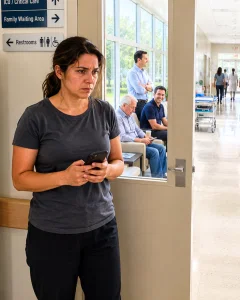
My husband called me at midnight, crying so hard I could barely understand him.
His father, he said, was dy:ing from a stroke. He needed me to transfer three hundred thousand dollars immediately, and under no circumstances was I supposed to come to the hospital.
That money belonged to me.
It was a fixed-term deposit I had opened just one month earlier, protected by a password only I was supposed to know.
But he recited that password from memory.
Better than I could.
I ended the call, and my mouth went dry.
I didn’t transfer a single cent.
I grabbed my keys and drove straight to the hospital.
And from the fifth-floor hallway, I heard my father-in-law—the man who was supposedly “intubated in intensive care”—laughing with his mouth full of apple.
I had been married for five years.
Five entire years.
Evan had seemed like the gentlest man alive.
On our wedding day, my father placed my hand in his and cried as he said, “Take care of her, son.” Evan said yes with a face so sincere I believed every inch of it.
My mother used to say, every time we came over for dinner, that her son-in-law was more thoughtful than any son, that I had won the lottery.
I gave him everything.
I gave up my apartment so we could live together.
I put the company under my name when he asked.
I gave him access to my accounts during our first year of marriage because I thought that was what trust looked like.
What was the point of being married, I told myself, if you were still hiding money?
At least, that was what I believed then.
The only person in his family I truly loved was my mother-in-law, Nora.
She taught me how to make Evan’s favorite roast.
She defended me whenever Warren made sharp little comments across the dinner table.
She called me “daughter” like she meant it.
When I was sick, she was the one who brought soup to my room.
Once, while we were washing dishes alone in her kitchen, she said something quietly without looking at me.
“Always keep something that belongs only to you, sweetheart. An account. A key. Anything. Even if you love him with your whole soul.”
I thought it was just advice from an older woman.
I thought she was speaking about life in general.
I thanked her and kept rinsing plates.
Standing in that hospital hallway, with my hands freezing before I even realized they had gone cold, every piece suddenly began to fall into place.
He knew my password because I had given it to him.
Every number.
The company was in my name because “his credit history wasn’t good”—that was what he had sworn—and because I wanted to help, I signed everything.
I became the legal owner.
The majority shareholder.
The legal representative.
The person responsible if the debts ever exploded.
The house I grew up in, the one my father left me before I got married, was also in my name.
It was the only thing in the world that still truly belonged to me.
I walked toward the room.
The door was cracked open, maybe four inches.
Everyone was inside.
Warren was sitting comfortably on the bed, pink-cheeked and perfectly healthy, peeling another apple with a pocketknife.
Nora sat beside him, silent.
Evan leaned against the window with his hands in his pockets.
And Tyler, my brother-in-law, was sprawled across the visitor chair, flicking a lighter open and shut with his usual smug grin.
“Dad, do you really think she believed it?” Tyler asked.
“Of course she believed it,” Warren said between bites. “She believes anything Evan tells her. Five years. Dumber than a mule.”
My throat closed.
I couldn’t swallow.
Nora sighed.
“Warren, don’t be so cruel. The girl is a good person…”
“Good for what?” he snapped without even turning toward her. “The house still isn’t in our name. Evan needs to get her signature on the mortgage, and then she can sleep on the sidewalk for all I care. What use is she after that?”
Then he turned toward Nora and said something that split me open.
“And don’t start acting holy. Your chemo on Monday is being paid with her credit card. If this plan fails, your treatment stops. So keep quiet and let us work.”
Evan, still by the window, hadn’t said anything.
Until he finally spoke, calm as if discussing the weather.
“Keep your voices down. I already had the house appraised. Almost three million. I’ll tell her the company needs urgent capital, get her to sign the mortgage with me, and that’ll be the end of it. One month. Maybe two.”
Tyler laughed and spun the lighter around his finger.
“Brother, you’re an unbelievable actor. I could never fake affection for five years toward someone I’d already sold out on my wedding day.”
That was when I understood I had spent five years sleeping beside a stranger.
In the hallway, my phone was already against my ear, calling the bank.
My hand shook so badly my finger kept slipping on the screen.
“I want every account frozen. Today. Right now. My personal accounts and the joint account. And report every credit card as lost.”
I entered my customer number wrong three times before my voice finally steadied.
Then I hung up.
I wiped my face with the sleeve of my sweater.
Took one deep breath.
And texted Evan, choosing each word carefully.
“I already made the transfer, my love. Don’t worry. Kiss your dad for me and keep me updated.”
I pressed send and walked toward the parking lot with stiff legs, thinking only one thing:
This time, I was going to be the one acting.
And they had no idea who they had really been lying to all these years.
Once I was inside the car, with the accounts frozen and my heart perfectly still from rage, a message arrived from Nora.
No words.
Just a photo.
A folded medical prescription with her full name on it and a diagnosis I wouldn’t wish on anyone.
Warren’s hospital bed had no illness in it.
Hers did.
The cancer was hers.
And it was real.
And Monday’s chemotherapy was being paid from the exact account I had frozen ten minutes earlier.
I stared at that picture for a long time without blinking.
Then I remembered her voice in the kitchen:
“Always keep something that belongs only to you, sweetheart.”
She hadn’t been advising me.
She had been warning me.
She knew.
She had known everything for years.
And she had stayed silent through every dinner, every insult from her husband, every scheme.
Tonight, yes, she had defended me in the smallest possible way.
But only when she had no choice left.
Because the only lifeline she had in that family…
was me.
I had two messages ready on my phone.
My finger hovered over both.
One was for the bank, keeping every account frozen down to the last cent, letting the whole family rot with empty hands, exactly as they deserved after five years of theater.
Including Nora, who had used me just like the others, only with soup and soft words.
The other would release just one thing:
Monday’s chemotherapy for the only person in that house who, in her own cowardly way, had tried to warn me before it was too late.
I only had time to send one.
I didn’t send the one you probably expect.
My finger was resting on the message that would keep everything frozen down to the last cent.
I swear on my mother.
And right before I pressed it, my screen lit up.
Nora was calling me from the fifth floor.
I didn’t answer.
I couldn’t.
Ten seconds later, her name appeared again, followed by a four-second voice message.
I played it.
Her voice was soft, with the hiss of oxygen behind it—the sound I had spent five years believing was asthma.
“Don’t send anything yet, sweetheart. Come downstairs. I’m in the hospital chapel. Before you do something you’ll regret, let me tell you the truth. All of it.”
My hands stayed glued to the steering wheel.
I could have driven away.
I had frozen the accounts.
I had the house.
I had the company in my name.
I had everything I needed to destroy them and never see their faces again.
But I went downstairs.
Because she was the only person in that family who had called me “daughter” for five years, and I had believed her.
And because—God forgive me—a part of me wanted to hear her beg.
The chapel was empty.
It smelled like bleach and dying flowers.
She sat in the last pew wearing a hospital gown over her clothes, looking smaller than I remembered, as if she had shrunk in a single night.
“Sit,” she said. “And don’t interrupt. I don’t have enough breath to repeat myself.”
I sat.
“Your father owed Warren money,” she said. “A lot of money. From when his furniture store collapsed seven years ago. Nearly two million.”
The bench seemed to shift beneath me.
“That house you think your father left you,” she continued, “was being held by us as collateral. Warren could have taken it whenever he wanted. With your father inside. With your mother inside.”
“You’re lying,” I said.
But I already knew she wasn’t.
“The day Warren told him he’d erase the debt if you married Evan, your father got down on his knees. Do you remember how he cried at the wedding? You thought it was emotion.”
I said nothing.
I remembered his red eyes as he walked me down the aisle.
“Take care of her, son.”
I had cried too.
I thought I was watching the most loving father in the world give away his only daughter.
He wasn’t giving me to a husband.
He was handing me over as payment.
“Your father sold you, sweetheart,” Nora said, lowering her head. “And I let him.”
That should have been the moment I stood up and left.
I didn’t.
I stayed frozen on that pew, staring at the plastic crucifix on the wall, feeling everything and nothing at once.
And while she breathed with that familiar wheeze, the ugliest truth of all crossed my mind.
Uglier than the money.
Uglier than the house.
I remembered my wedding.
The moment my father and Warren shook hands behind the reception hall.
A long, serious handshake.
Not the kind used to celebrate a marriage.
The kind used to close a deal.
I saw it.
I was twenty-six years old, and I saw it.
I remember thinking, That’s strange.
Then I turned around and kept dancing.
I remembered that in five years, Evan had never once asked me how my day was.
Not once.
And I kept telling myself that was just how serious men behaved.
The worst part wasn’t discovering I had been sold.
The worst part was realizing, sitting in that chapel, that deep down I had known something was wrong from the beginning—
and it had been easier not to know.
I had a handsome husband.
A growing company.
A mother-in-law who brought me soup when I was sick.
I had the life people say you should want.
Why turn over the rock?
I had benefited from the lie too.
That is my part in it.
The part I don’t tell people.
Then I remembered the soup.
All those times Nora brought it upstairs when I had the flu and sat at the edge of the bed watching me eat.
I thought it was love.
It was a jailer making sure the prisoner didn’t d!e too soon.
“Why did you warn me?” I finally asked. “In the kitchen. ‘Always keep something that belongs only to you.’ Why say that if you were part of all this?”
Nora stayed quiet.
A stretcher rolled by outside.
“Because I chose you,” she said.
I turned to look at her.
“It wasn’t Evan who chose you. It was me. I told Warren: that girl. Only child. No siblings to protect her. A father drowning in debt. A valuable house. Her.”
Every word h!t me like a stone.
“Do you understand what you’re telling me?”
“I’m dy:ing, sweetheart. I was already dy:ing before your wedding. I already had cancer. Chemo cost more than you earned in a month. Warren couldn’t pay for it. Your father could—without knowing it.”
She took another breath.
“I needed you alive, working, in love, and blind. That’s what you were to me. Five more years of life. Five years.”
I stood up.
My legs barely obeyed, but I stood.
“You’re worse than he is,” I said. “Warren hated me out loud. You fed me with your own hands.”
“Yes,” she said, without defending herself. “I am worse. But listen to the only thing I have left.”
She straightened with heartbreaking effort.
“In that whole house, I was the only one who left you a door. No one else was ever going to tell you to keep something of your own. Not your husband. Not my husband. Not even your own father. I built the cage. And I left you the key. Make sense of that if you can, because I don’t have time anymore.”
I know that sentence by heart.
I repeat it at night.
“I built the cage, and I left you the key.”
I still don’t know whether it was the cruelest thing anyone ever said to me or the kindest.
Maybe both.
At the same time.
That is what I still can’t understand.
I left the chapel without saying goodbye.
—
For the next three days, I didn’t sleep.
But I didn’t cry either.
I say that because when people hear this story, they expect tears.
I did something else.
I called the company attorney, a stern woman my “blind” husband had hired himself.
As legal representative and majority shareholder, I froze the company accounts.
I stopped the mortgage plan before it could breathe.
Without my signature, the house couldn’t be touched.
And my signature was never coming.
I withdrew the three hundred thousand dollars from the fixed-term account—my money—and moved it into a new account neither Evan nor God knew existed.
Then I left Evan and Warren exposed.
Because the company they had been quietly operating had problems.
Problems that became very serious once the legal representative stopped protecting them and started standing against them.
I signed every document myself.
With my own hand.
And this time, it didn’t shake.
There was one more account.
A small one.
The one that paid for Nora’s chemotherapy every Monday.
That account was frozen too.
And I left it frozen.
I told myself I could only send one message that night in the car.
That it was either them or her.
That life had placed two roads in front of me, and I had chosen justice.
I told myself that story so well I almost still believe it.
—
Nora d!ed three weeks later.
There was no chemotherapy that Monday.
Or the next.
Or the one after that.
Without treatment, the body moved fast.
Faster than she had probably calculated.
She, who calculated everything.
I went to the funeral.
Don’t ask me why.
I still don’t really know.
Warren sat in a chair in the corner, hunched over.
Not peeling anything.
Not laughing at anyone.
The man who had eaten an entire apple while pretending to be dy:ing was now genuinely an old man whose wife had d!ed.
He cried ugly.
Mouth open.
Not caring who saw him.
He loved her.
In his own rotten way, he loved her.
And that disturbed me more than anything.
The monster was burying someone.
Tyler didn’t pretend.
He didn’t greet me.
He didn’t curse me.
He looked at me from across the room and simply lowered his head, as if to say, neither you nor me.
At least he never faked affection.
That is the only decent thing I can say about Tyler.
Evan searched for me with his eyes all night.
At one point, he came close.
“You left the door open,” I said before he could speak. “At the hospital. Four inches. Was that on purpose?”
He didn’t answer.
He only held my gaze and walked away.
To this day, I don’t know whether that man loved me even a little, or whether the open door was an accident.
Not knowing torments me more than anything else.
Because if he left it open on purpose, then even the worst person in this story had one tiny ounce of humanity in him—
and I gave him none.
—
A nurse handed me the letter as I was leaving the funeral.
Nora had left instructions that it be given “to her, personally, into her hands.”
It was short.
Her handwriting trembled.
It said not to forgive her because she didn’t deserve forgiveness.
That if she had been in my place, she would have done exactly the same thing: frozen everything, let her d!e, and not lost a minute of sleep over it.
That was why she had chosen me from the beginning.
Because even at my wedding, she had seen someone who would someday stop being foolish.
And at the bottom, again, in that thin shaking handwriting:
“You kept something of your own, sweetheart. Good for you.”
I keep that letter in a drawer.
The drawer where I keep the only thing that truly belongs to me.
And here is the part I had never told anyone until now.
A week after the funeral, my attorney was reviewing the accounts during the company restructuring.
She said something casually, with no cruelty at all.
“It’s good you froze everything, because you could have released only your mother-in-law’s treatment account and kept the rest locked. Most people don’t realize those can be separated.”
They can be separated.
I’m an accountant.
I managed that company for five years.
I knew perfectly well they could be separated.
That night in the car, I didn’t actually have to choose between them and her.
I could have destroyed all of them and, with one extra click, still paid for the chemotherapy of a dy:ing old woman.
I could have had my justice completely—
and still not let the only person who warned me d!e.
I knew it in that moment.
And I told myself, I can only send one.
Because the truth was uglier.
I didn’t want to save her.
Not even the version of her that had left me the key.
I let her d!e because I could.
Because after five years of paying for everyone else, it was finally my turn to decide who got nothing.
When my mother learned everything, she called me a m:rderer in a business suit.
She said I let a sick woman d!e when I could have saved her with one finger.
My best friend says Nora built my cage, sold me like livestock, and that I didn’t owe her even the air she breathed.
Both of them speak with absolute certainty.
Both think the answer is obvious.
And I have that letter in my drawer, with its trembling “Good for you, sweetheart” on the last line.
And there are nights when I don’t know whether I protected the only thing I had left that was truly mine…
or whether I k!lled an old woman and wrapped it in a ribbon labeled justice.