My husband gave my dead father’s safe to his mother. He didn’t ask me. He didn’t broach the subject over dinner, nor did he suggest it as a passing thought. He just decided.
He stood in my father’s oak-paneled study, a room that still smelled faintly of pipe tobacco and old, crackling ledger paper, and he stared at that heavy, imposing iron box. It had sat bolted to the floorboards in the corner for thirty years, an immovable anchor in my life. It was the very safe my father, Walter Hollis, left to me when he took his last breath.
Derek nudged the heavy steel door with the toe of his Italian leather loafer—shoes paid for by my father’s estate, though Derek would never admit it. He looked at me, his eyes gleaming with an unearned authority, and said, “Whatever’s inside belongs to Mom now.”
He said it as if my father’s life, his secrets, and his possessions were cheap party favors he could casually distribute to his own bloodline. And his mother, Judith, didn’t waste a single fraction of a second. The very next day, while I was commuting to my office, she called a master locksmith to crack it open.
Here is the part that nobody in my social circle understands until I force them to sit down and listen. I knew she was doing it. Derek told me that morning, standing in our marble-tiled kitchen, holding a ceramic mug of coffee, almost daring me to spark a war over it.
“Mom’s having a guy come look at the safe today,” he murmured, his eyes tracking my face, waiting for the panic, waiting for the desperate scramble to protect my territory.
I could have stopped it. It would have been effortless. I could have dialed a vicious estate lawyer. I could have changed the locks on the front doors, hauled the safe to a bank vault, or simply screamed until the windows rattled. Legally, completely, unquestionably—that iron box was mine.
I didn’t do any of it. I methodically buttoned my coat, picked up my leather tote bag, walked out into the crisp morning air, and I let them open it.
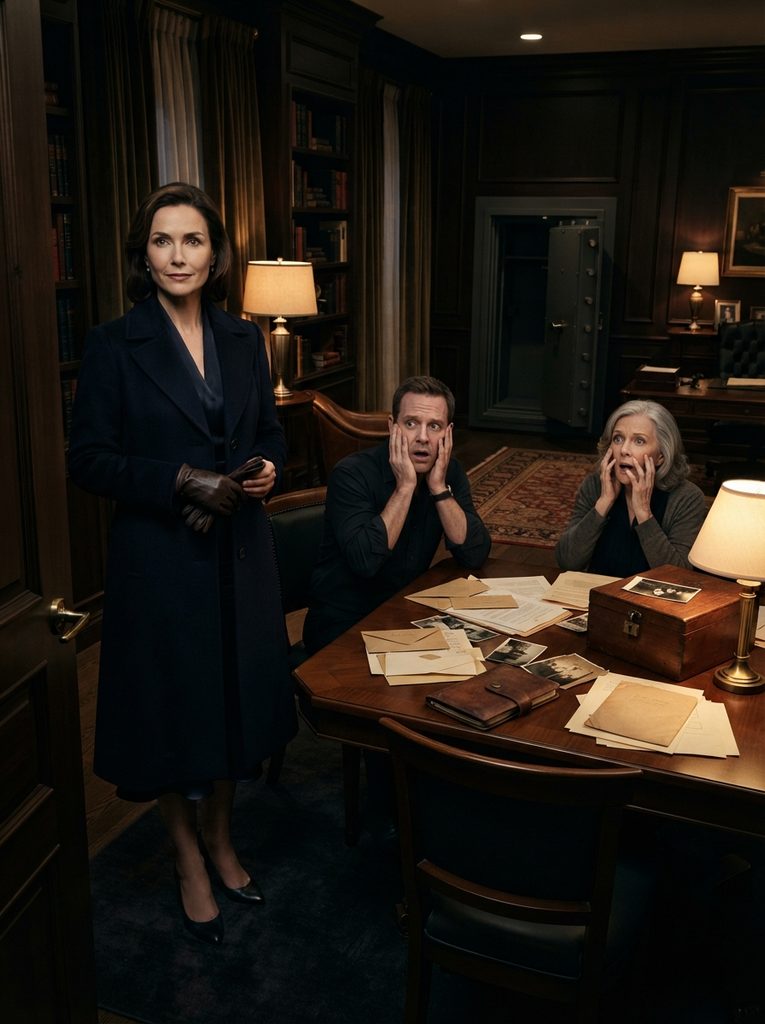
That evening, I returned home. The house was unnervingly silent. I walked down the hallway, the soles of my shoes clicking against the hardwood, and I stepped into the kitchen. I found my husband and his mother sitting at the long dining table. There were no champagne flutes. There was no celebratory laughter.
They were just sitting there in a suffocating, total silence. Both of them were the color of wet ash, their faces slack, staring at absolutely nothing. In the adjacent study, my father’s safe stood violently open on the floor, its iron belly hollowed out, and everything that had been kept inside it was now spread across the table between them like a coroner’s report.
Derek slowly lifted his head. He didn’t yell. He didn’t accuse me of a setup. He looked like a man who had just stepped off a cliff in the dark. He asked me one question, his voice barely a raspy whisper.
“How long have you known?”
Because what Derek and Judith had spent the entire afternoon so feverishly thrilled to break into—the legendary safe they were violently certain would be overflowing with my dead father’s hidden fortune—held no money at all.
It held something my father had curated and locked away for one singular reason, for this exact, devastating moment. And it ended their entire world in a single afternoon.
But I’m not going to reveal what was in that safe just yet. Because to understand the trap, you have to understand the architect. You have to understand my father.
My name is Mary Ann, and my father was the smartest, most terrifyingly careful man I have ever known. He wasn’t rich in the loud, flashy way that screams for attention on social media. He was wealthy in the quiet, tectonic way—the way men who measure every word and every dollar become unshakable over a long life. He built a logistics business from a single borrowed truck into a regional empire over forty years. He saved. He invested with surgical precision. He never spent a single dime he didn’t intentionally mean to spend.
People underestimated Walter constantly. He encouraged it. He learned early in his hardscrabble youth that being underestimated is its own impenetrable armor. He was incredibly soft-spoken, unassuming, and he wore the same three tweed jackets for a decade. I used to watch slick men in tailored, five-thousand-dollar suits talk down to him in boardrooms, treating him like a relic of a bygone era. They would smirk, right up until the freezing moment they realized—always too late—that my father had memorized every line of the spreadsheet better than they had, and had been playing chess while they were playing checkers.
He taught me that methodology without ever formally lecturing me.
“Let them think you’re simple, Mary Ann,” he would say, stirring his black coffee. “Let them think you’re not paying attention. The loud people, the ones who show off how remarkably smart they are, are almost always hiding how little they’ve actually checked the fine print.”
As a teenager, it used to embarrass me that my father was so relentlessly plain, so painfully careful. Now? It is the thing I revere most about him. He was the most dangerous person in nearly every room he entered, and nobody noticed until the trap snapped shut.
When I bought my first car at twenty-two, he insisted on coming. We sat in a fluorescent-lit dealership for three agonizing hours. The salesman, a slick guy with too much cologne, tried to rush us. My father ignored him. He read every single line of the fifty-page contract. He found two hidden clauses buried on page forty-one that would have quietly bled me dry over five years. He took a red pen and struck them out, one at a time, politely, without ever raising his voice. The salesman was sweating through his shirt by the time we left.
My father didn’t distrust people loudly. He distrusted them quietly, thoroughly, and systematically. And he was almost never wrong.
“A lock only keeps out the people who were never going to steal from you anyway,” he told me once, tracing the rim of his glass. “The ones you really have to watch, sweetheart? They walk right in the front door, flashing a brilliant smile, and they patiently wait until you hand them the keys yourself.”
I heard variations of that warning my entire life. I just never, in my wildest nightmares, imagined I would marry the exact monster he was describing.
He raised me alone after my mother passed away when I was seven. It was just the two of us against the world. We were a strange, quiet little team. He was never a warm man on the outside; he didn’t dole out hugs or say “I love you” with reckless abandon. But he showed his love the way careful people do: by paying relentless attention. By quietly standing in the dark, making sure the people he cared about were shielded from predators they couldn’t yet see.
My father loved me in paperwork, in legal precautions, and in iron locks. It took me until after he was buried in the cold earth to learn how to fluently read the language he’d been speaking to me my whole life.
And right before he died, as the cancer hollowed him out, he grabbed my wrist with a sudden, shocking strength. His eyes, clouded by morphine, suddenly went laser-clear.
“The safe, Mary Ann,” he rasped, his breath rattling in his chest. “Don’t let anyone else touch the safe. That one is yours. Only yours.”
I thought it was the fever talking. I had no idea he was handing me a loaded gun.