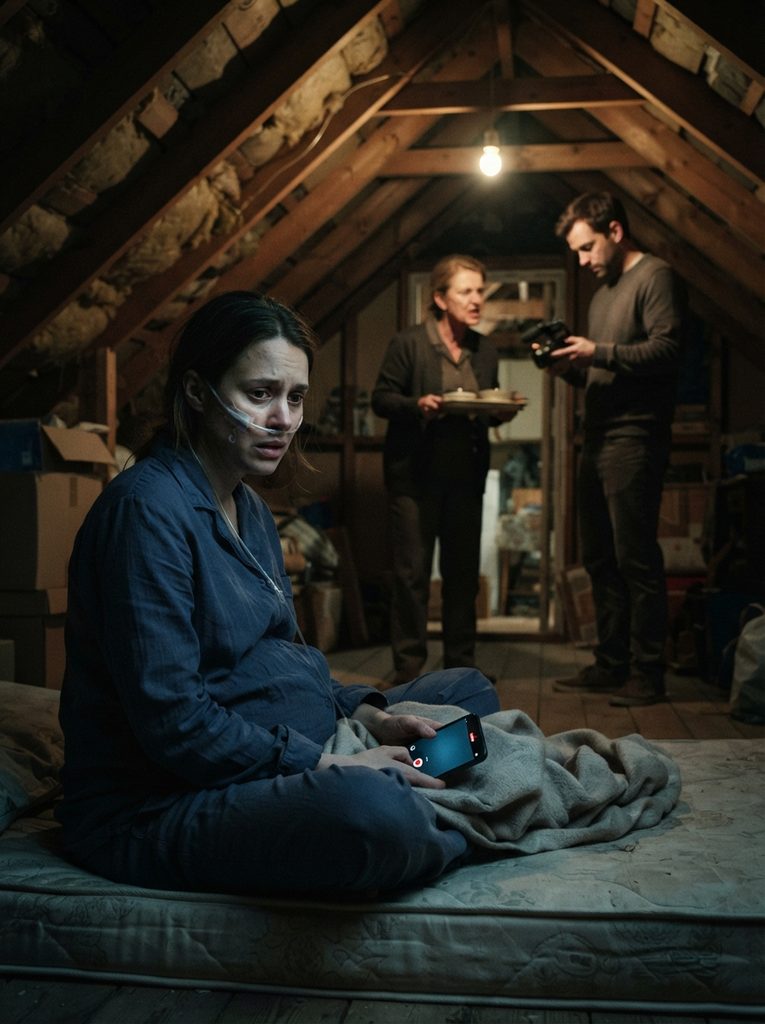
The attic door moved beneath my hand.
For several seconds, I couldn’t make myself push it any farther.
Seven months of confinement had taught me to expect punishment whenever I tried to resist.
Now the only barrier between me and the rest of the house had moved.
I listened.
Downstairs, my husband and his mother were still arguing.
I couldn’t make out every word, but I recognized their voices.
My husband was angry about the recording.
His mother was angry with him.
Neither sounded concerned about me.
I pressed my free hand against my body, checking that the hidden phone was secure.
The last recording was still there.
So were the earlier clips I’d collected whenever I could.
I remembered whispering dates into the microphone, terrified that even the smallest sound would expose me.
I remembered my mother-in-law telling my husband to use the same substance as the previous day.
And I remembered his response.
“Just make sure I can see her face.”
Those words had made me understand that I couldn’t wait for either of them to help me.
Now I had an opportunity neither had intended to give me.
I pushed the door a little farther.
The opening widened.
I stopped again, listening for footsteps.
My body was exhausted, and I couldn’t afford to fall or make enough noise to draw their attention.
I looked back into the attic.
For seven months, that room had been the center of everything I feared.
My husband had treated my suffering as entertainment.
His mother had controlled my days.
And I’d survived by keeping one secret from both of them.
I looked toward the stairs.
The unlocked door was an opportunity, not a guarantee of escape.
But I had already decided I wasn’t going to surrender it without trying.
I remembered how I’d learned to recognize the footsteps on those stairs.
At first, every sound had frightened me equally.
A creaking floorboard could mean someone was bringing food, coming to check on me, or preparing to hurt me again.
Eventually, I began noticing differences.
My mother-in-law usually climbed slowly when she wanted to talk.
She had a habit of speaking while she hurt me, as though an ordinary conversation could somehow make what she was doing less cruel.
My husband moved differently.
When he was eager to record, his footsteps came quickly.
I could often hear him before he reached the attic door.
Those sounds became part of my daily existence.
I hated that I’d learned them.
But understanding their routines was one of the few things I could control.
I’d spent seven months pregnant and confined in that attic.
The air smelled of hot dust and sour food.
The floorboards were old.
The space felt smaller each time they entered it.
And every day, I wondered how much longer my body could endure what they were doing.
My mother-in-law used a feeding tube to force substances into me.
Some of the food was spoiled.
There were drugs I couldn’t identify.
Sometimes I became violently ill.
They laughed even when I vomited blood.
My husband filmed the abuse for their private humiliation channel.
I couldn’t understand how two people could watch someone suffer and treat it as entertainment.
For a long time, I tried to appeal to whatever compassion they might still have.
I begged.
I asked them to stop.
I tried to make my husband understand that I was pregnant and frightened.
But pleading only seemed to encourage them.
My fear gave them another reaction to record.
Eventually, I stopped begging.
Not because I’d accepted what was happening.
Not because it hurt any less.
I stopped because I understood that my reactions were part of what they wanted.
If I couldn’t persuade them to stop, I needed another way to survive.
So I began watching them.
I studied the moments when my mother-in-law became distracted.
I noticed how my husband concentrated on framing his recordings.
I learned when they were paying attention to me and when they were more interested in each other’s reactions.
It was exhausting.
Even on the nights when they weren’t actively hurting me, I couldn’t relax.
I was constantly listening.
Constantly anticipating.
Constantly trying to understand what might happen next.
But observing them taught me something important.
They were careless when they believed they had complete control.
They watched my face.
They watched the tube.
They watched each other.
They didn’t pay enough attention to my hands.
That was how I managed to keep the smuggled phone hidden.
The phone became the most important possession I had.
I couldn’t use it openly.
I couldn’t allow them to discover it.
And I couldn’t assume that simply possessing recordings would be enough to protect me.
But it offered something I hadn’t had before.
Evidence.
At first, I recorded because I was frightened that nobody would believe my account of what had happened.
The situation was so terrible that I sometimes struggled to comprehend it myself.
My own husband was participating.
His mother controlled nearly every hour of my day.
They treated my suffering as something to film and share privately.
I imagined trying to explain those circumstances to someone who had never met them.
I imagined my husband denying everything.
I imagined his mother describing me as confused or unstable.
And I realized that my memories alone might not be enough.
So I began recording whenever I could do so without being discovered.
The first recordings weren’t particularly organized.
I was frightened.
My hands shook.
I couldn’t always position the phone where I wanted it.
Sometimes I captured more sound than video.
But I kept going.
Gradually, I became more deliberate.
At the beginning of each recording, I whispered the date.
I tried to capture their voices clearly.
Whenever possible, I recorded what they were doing.
I wanted the evidence to reflect what actually happened rather than what I might later struggle to remember.
There was one important thing I refused to do.
I wouldn’t pretend I knew exactly which drugs my mother-in-law was administering.
I couldn’t identify them reliably.
Guessing would only create uncertainty.
Instead, I concentrated on documenting their behavior and recording their own statements.
I needed their words.
I needed proof that they understood what they were doing.
And eventually, one particular recording gave me exactly that.
My mother-in-law had entered the attic and begun another session.
My husband was already filming.
I kept my movements controlled.
The hidden phone was recording nearby.
I was terrified that one of them would notice it.
Then my mother-in-law leaned over me.
“Use the same stuff as yesterday.”
My husband didn’t lower his phone.
“Fine,” he answered.
Then he added something I’ll never forget.
“Just make sure I can see her face.”
I kept my own face turned away from the hidden phone.
My hands were shaking.
I worried that the recording might be unusable.
But I knew the audio had captured their exchange.
That moment changed something in me.
Until then, I’d still been thinking about the situation partly as a terrible secret inside my marriage.
Some part of me had continued hoping that my husband might recognize the cruelty of his actions.
Perhaps he’d become frightened by how sick I was.
Perhaps he’d realize what his mother was doing.
Perhaps he’d finally stop recording.
But his words made his priorities unmistakable.
He wanted my face visible.
He wanted the footage.
My suffering mattered to him because he considered it entertainment.
I understood then that waiting for him to change was not a survival plan.
Neither was trying to reason with his mother.
They had repeatedly demonstrated that my distress wouldn’t stop them.
I needed to preserve the evidence and wait for an opportunity to get away.
That realization didn’t make me suddenly brave.
I was still frightened.
I was still physically exhausted.
And I was still pregnant.
Some days, simply remaining alert felt like more than I could manage.
But I began thinking differently about every interaction.
Instead of asking myself what I could say to persuade them, I asked what I could observe.
Instead of trying to confront them, I concentrated on remembering their routines.
And instead of imagining that someone would eventually discover what was happening and rescue me, I focused on the limited choices still available.
I couldn’t overpower my husband.
My mother-in-law controlled too much of my daily life.
If either of them discovered the hidden phone, I could lose the only evidence I’d managed to preserve.
I knew I had to be careful.
There were moments when I wanted to abandon that caution.
Sometimes, after another session, I felt so desperate that I considered confronting them immediately.
I wanted to tell them that I’d recorded their voices.
I wanted to see whether they would finally become frightened.
But every time I imagined doing that, I remembered how vulnerable I was.
They controlled the attic.
They controlled my access to the rest of the house.
And I had no reason to believe they would respond peacefully if they discovered what I’d done.
So I waited.
Waiting was miserable.
It meant enduring more of their cruelty.
It meant continuing to record while pretending I had no way to challenge them.
It meant listening to their laughter and resisting the urge to reveal that I was collecting evidence.
But I knew that acting too soon could destroy my chance.
As the days passed, I became increasingly aware of how often my husband and his mother argued.
They were united in their treatment of me, but they didn’t always agree with each other.
My husband cared about the recordings.
He wanted footage he considered suitable for their private channel.
His mother was more concerned with controlling me.
Their priorities sometimes conflicted.
I noticed those disagreements.
I remembered them.
And I wondered whether their arguments might eventually create an opening.
Then one night, something changed.
There was nothing particularly unusual about the evening when it began.
I was still in the attic.
I was still frightened.
I was still listening for footsteps.
But my mother-in-law sounded irritated before she even reached the door.
I heard her approaching.
Then I heard my husband’s voice.
They were already arguing.
He complained that she was blocking his shot.
She snapped at him.
She accused him of caring more about their channel than keeping me under control.
I listened carefully.
Their argument continued as they entered.
Normally, I was the center of their attention.
They watched my face for signs of distress.
They monitored my reactions.
My husband concentrated on recording me.
But that night, they were distracted by each other.
Their disagreement continued through much of the session.
My husband kept complaining.
My mother-in-law answered angrily.
They spoke over one another.
I remained as still as I could.
I knew better than to assume that their distraction meant I was safe.
They were still hurting me.
They were still in control of the room.
But I noticed that they weren’t watching me as carefully as usual.
I also noticed how impatient they were becoming.
Neither seemed interested in prolonging the session once their argument had escalated.
Eventually, they finished.
My husband gathered his belongings hurriedly.
His mother followed him toward the stairs, still complaining.
He shoved the attic door closed.
I heard their footsteps moving away.
Then I waited for the sound that always followed.
The metallic click of the lock.
I knew that sound intimately.
It was the noise that told me another session was over and I was once again confined to the attic.
But that night, I didn’t hear it.
I listened harder.
Their voices continued downstairs.
I waited.
Still no click.
For a moment, I wondered whether I’d simply missed it.
Perhaps their argument had covered the sound.
Perhaps I was so exhausted that I hadn’t registered it.
I couldn’t afford to assume anything.
If I approached the door while they were still nearby, I might alert them.
If I tried to open it and discovered it was locked, I might make enough noise to bring them back.
And if they returned unexpectedly while I was holding the hidden phone, they could discover everything.
I stayed where I was.
My heart was pounding.
I could feel the urge to move becoming almost unbearable.
For seven months, I’d imagined finding an opportunity to escape.
Now I might have one.
But I forced myself to listen.
Their voices moved farther downstairs.
I could still hear the argument.
My husband sounded angry.
His mother continued responding.
I waited until they sounded distant enough that I believed I could move without immediately drawing their attention.
Then I retrieved the phone.
I checked the last recording.
I needed to know whether the distraction that had created this opportunity had also allowed me to capture usable evidence.
Their voices were there.
Clear.
My husband’s face appeared briefly when he crossed in front of the lens.
My mother-in-law’s words had been recorded.
I stared at the screen.
For months, I’d been afraid that the recordings wouldn’t show enough.
I’d worried that my trembling hands would make them unusable.
I’d worried that the audio wouldn’t capture the statements I needed.
But the latest recording contained their voices.
It showed my husband’s face.
And it preserved what they’d said while they believed I was helpless.
I thought about the earlier recording.
“Use the same stuff as yesterday.”
“Just make sure I can see her face.”
Those statements were no longer trapped inside my memory.
I’d captured them.
I still didn’t know exactly what substances my mother-in-law had used.
I still didn’t know whether every recording would be clear enough to help me.
But I had evidence of their actions and their words.
And I knew that evidence mattered.
I tucked the phone against my body.
Then I tried to stand.
My legs felt unreliable.
Seven months of abuse, illness, pregnancy, and confinement had left me exhausted.
I couldn’t move as quickly as I wanted.
I had to concentrate on maintaining my balance.
For a moment, I stood still and listened again.
Their voices were still downstairs.
I took a step.
The old floorboards creaked beneath my feet.
I stopped immediately.
I listened for a response.
Nothing changed.
I took another step.
I couldn’t stop thinking about the attic door.
I had imagined it opening so many times that the possibility almost frightened me.
What if I’d misunderstood the sound?
What if the lock was still secured?
What if my husband came back upstairs before I reached it?
I couldn’t answer those questions.
I could only continue moving.
I crossed the attic carefully.
Every sound seemed louder than it should have been.
The floorboards.
My breathing.
The distant argument downstairs.
I reached the door.
I stood in front of it for a moment.
Then I placed my hand against the wood.
I thought about the phone hidden against my body.
I thought about the recordings I’d collected.
I thought about the months I’d spent learning their routines while pretending I was too weak to notice anything.
And I thought about the baby I was carrying.
I couldn’t know what would happen once I opened the door.
I didn’t know whether I’d be able to reach the stairs.
I didn’t know whether my husband and his mother would hear me.
But I knew I couldn’t remain in the attic simply because I was frightened of what might happen next.
I pressed my hand against the door.
Then I pushed.
It moved.
For a moment, I couldn’t believe it.
The door was opening.
I had been right.
In their rush to leave the attic while arguing, they’d failed to secure it.
Their carelessness had given me the opportunity I’d spent months waiting for.
I pushed a little farther.
Then I stopped.
I listened again.
The argument continued downstairs.
Neither of them seemed to have noticed.
I looked toward the opening.
Beyond it was the staircase I’d heard them climb so many times.
I knew every familiar creak.
I’d listened to those steps when I was terrified.
I’d listened when I was sick.
I’d listened while secretly recording the people who believed they controlled every part of my life.
Now I was standing at the top of those same stairs with the door open.
I couldn’t pretend that meant I was safe.
I hadn’t escaped the house.
I hadn’t reached anyone who could help me.
And I was still physically vulnerable.
But the situation had changed.
For the first time in seven months, the attic door was no longer locked.
I looked back at the room.
The place where I’d stopped begging.
The place where I’d learned to observe.
The place where I’d hidden my phone and collected evidence while my husband and his mother laughed at my suffering.
I had no intention of leaving that evidence behind.
I checked that the phone was still secure.
Then I turned toward the staircase.
My hand remained against the open door.
I listened to the distant voices one more time.
And I prepared to take the next step.