The text notification chimed at exactly 2:13 in the morning. I was already wide awake, staring at the rhythmic rotation of the ceiling fan and listening to the house settle around me, those familiar creaks sounding like a language I was finally beginning to understand.
My phone screen flickered to life on the bedside table and for one brief, delirious moment, I hoped it might be Jaxon who had decided to check in from his trip across the pond.
Perhaps something had gone sideways with his travels or maybe he had simply remembered that I was back here waiting.
The message read, “Be gone by the time we arrive home because I loathe outdated things and I work hard enough to deserve a fresh start.”
I read the words twice, then a third time just to make sure the cruelty had actually registered.
Then the second message pinged, sounding almost chipper as it hit my screen.
“Do not make a spectacle of yourself because the children are coming back with us.”
I placed the phone face down on the nightstand and stared into the darkness for what felt like an eternity.
The ceiling fan continued its slow spin and the house seemed to exhale a heavy breath of relief.
Somewhere across the vast expanse of the Atlantic, the man who had been my husband for nineteen years was likely sleeping with the untroubled conscience of a villain.
Jaxon West had always possessed a terrifying talent for masking malice as mere efficiency.
He preferred short sentences without any softening edges or apologies tucked between the lines.
He delivered directives like a man who had already cast the final vote and was merely notifying the losing party of their inevitable fate.
I used to mistake that trait for genuine confidence and I once found it magnetic, the way he moved through life with such immovable certainty.
It took me nearly two decades to finally grasp the chasm of difference between a man who is sure of himself and a man who simply refuses to entertain the possibility that he might be wrong.
Three weeks prior to that text, he had broken the news about Blair while standing at our kitchen island on a Tuesday morning.
I watched as my coffee grew cold and bitter while he sat across from me without a shred of shame on his face.
He laced his fingers together on the granite countertop as if he were preparing to present quarterly earnings rather than dismantling a marriage.
He explained that he was starting over with a woman named Blair who was twenty six years old and worked as a junior associate at his legal firm.
He told me she made him feel alive in a way he had forgotten existed and he spoke with such practiced conviction that it was obvious he had rehearsed the speech several times.
I kept my gaze fixed on my ceramic coffee mug, the one our daughter had painted for me when she was in middle school with its crooked lettering and the flower that looked more like a lopsided sun.
I stared at that painted sun while he continued to justify his abandonment.
He insisted that he had already handled everything, using that phrase as if the end of a two decade marriage were nothing more than a logistics problem to be solved.
He spoke as if nineteen years of shared history and two children and a house filled with memories were just bullet points on an agenda he had crossed off between conference calls.
The destination wedding in a tropical paradise was entirely his design, complete with turquoise waves, imported floral arrangements, an open bar, and a DJ playing music for everyone he desperately wanted to impress.
He invited his parents and all our mutual acquaintances who had sat at my table, drank my wine, and offered their condolences at my father’s funeral.
He even invited our teenagers, including seventeen year old Parker who already moved through the world with his father’s rigid jaw and arrogant certainty.
He also invited our fifteen year old daughter Hazel, who had spent the last three weeks barely acknowledging my existence as if I were personally to blame for the inconvenience of their travel plans.
He explicitly did not invite me, informing me that my attendance was neither required nor requested.
He then booked the flights and sent a digital calendar invitation to every guest, adding condescending notes about luggage weight restrictions and formal dress codes.
The night after he sent that middle of the night text, I did not find a single moment of sleep.
I sat in the dark living room with a glass of water that I never touched, reflecting on the long road of choices that had brought me to this specific, desolate moment.
I thought about the early years when we were broke and ate cereal for dinner and genuinely laughed about the absurdity of being young and poor.
Then I thought about the middle years when the money started rolling in and something inside him fundamentally shifted.
He began correcting me in front of our guests and stopped asking for my opinion on anything of substance.
He started treating our home like a luxury hotel and treated me like the housekeeping staff.
I found myself thinking about my father who had passed away six years ago after living a quiet life that never demanded anything from anyone.
Before he passed, when his mind was as sharp as a razor, he had sat with a notary and signed the deed to our estate over to me alone.
It was not signed to Jaxon and Ruby, nor to our family unit, but solely to me.
When Jaxon found out about it after the funeral, he had simply laughed and called it my father’s little bout of paranoia.
He would often bring it up at dinner parties as a quirky anecdote about his eccentric father in law who supposedly could not trust his own son in law even after fifteen years of marriage.
Everyone at the table would offer a polite, rehearsed smile while I would join them and say something dismissive like, “You know how protective fathers can be,” before quickly moving to the next course.
My father never said a word about it, but sitting there in the dark, I finally understood what he had been doing all along.
He had been holding a door open for me, waiting for the day I would finally be ready to walk through it.
The following morning, I drove to a nondescript strip mall office on the edge of town that smelled faintly of dry ink and peppermint gum.
The attorney waiting for me was named Miriam Freeman, a woman in her fifties with steel gray hair and reading glasses hanging from a silver chain around her neck.
She carried herself like a person who had witnessed every possible iteration of human betrayal and was entirely unimpressed by the drama of it all.
I silently handed her my phone and let her scroll through the series of texts.
She read them with deliberate slowness before setting the device down and looking at me with piercing clarity over the rim of her glasses.
“I assume you want him evicted from your life,” she stated, making it a declaration rather than a question.
“I want him to feel the exact weight of this,” I replied.
She nodded just once as if I had confirmed a suspicion she had formed the moment I walked through the door.
“Then we proceed with absolute clinical precision because we will use paperwork and timing, but you must avoid all displays of drama as he will provide plenty of that himself,” she instructed.
We moved with a speed that Jaxon would have deemed impossible for someone he considered slow and overly cautious.
He had spent years operating under the arrogant assumption that I was the one who needed every detail explained twice.
It never crossed his mind that I had been patiently waiting for the right reason to finally outmaneuver him.
I filed the formal papers within forty eight hours of that text, froze our shared lines of credit, and opened a private account at a bank across town where he had no standing.
I printed and organized every piece of evidence, including his most contemptuous emails and dismissive texts from the past six months.
There was far more documentation than I had initially realized, as he had put his complete disregard for me in writing with the careless confidence of a man who never once imagined his own words would be turned against him.
That specific brand of hubris was precisely what would be his undoing.
He had carelessly forwarded his entire itinerary to our shared email account, an account he had clearly forgotten that I still monitored daily.
It provided me with the exact timing of their departure, their return flight, and the precise window of opportunity I possessed.
Miriam filed an emergency motion for temporary exclusive possession of the property, citing documented abandonment and emotional harassment.
The judge reviewed Jaxon’s texts and saw them for what they were, meaning that the man who had signed his own name to his cruelty at 2:00 in the morning had essentially written the legal argument for me.
Then I made the phone call that I had been contemplating for three days.
The relocation specialist was a man named Mendez who ran a small, efficient operation and specialized in lifting structures from their original foundations for permanent relocation.
He arrived on a Wednesday morning driving a truck that looked like it had survived a dozen lifetimes.
He walked the perimeter of the house with his hands buried in his pockets, knocking on the walls and inspecting the crawl space with a practiced eye.
“The foundation is standard concrete block,” he said while crouching down with a heavy duty flashlight. “That makes the logistics much simpler, so do you want the entire lot cleared completely?”
“I want it to look as though nothing of substance ever existed here,” I answered firmly.
He stood up and gave me a long look that held no judgment, only a deep sense of professional evaluation.
“We can certainly make that happen for you,” he assured me.
We solidified the date and I arranged for professional movers to handle the furniture and personal items I had been packing quietly for an entire week.
I called my former college roommate, Elise, who lived nearly an hour away and possessed a guest room and a dog named Buster and absolutely zero patience for men who acted like Jaxon.
She told me to get there as fast as I could without asking a single prying question.
During the week that Jaxon was getting married on a beach surrounded by turquoise water, I packed my life into a large transport truck.
I took everything that legally belonged to me along with some shared items, but I left behind absolutely everything that bore his mark.
I packed the painted coffee mug from my daughter and the framed photograph from our first tiny apartment where we were both slightly blurry and genuinely laughing.
I do not know why I kept that one, perhaps because I needed the empirical proof that a “before” had existed and that the entire nineteen years had not been an elaborate deception from the very start.
Mendez and his crew arrived on a Thursday morning.
I stood in the driveway and watched as they worked with methodical, unhurried precision.
They slid industrial steel beams under the structure, ran the hydraulic lines, and checked the levels with focused intensity.
The house gave a low, haunting groan as it first lifted, a deep structural sound that seemed to vibrate through my very chest before it rose slow and steady away from the earth it had occupied for thirty one years.
The porch light swung once like a tiny, solitary farewell as the house ascended into the air.
It took the better part of the day to secure it onto the flatbed transport system.
By the time evening arrived, the lot had been raked and scraped perfectly clean.
Mendez’s crew picked up every single nail and stray scrap of lumber before packing their equipment away.
When their convoy finally drove away, there was nothing left but flat, barren ground and an expansive, empty sky.
I stood there for a few minutes in the absolute quiet of the evening.
Then I drove to Elise’s home where Buster barked at the door and Elise handed me a glass of wine without saying a word because she understood that there were no words sufficient for this moment.
We sat on her back porch until midnight listening to the wind chimes, and for the first time in as long as I could remember, I fell asleep without waiting for something to go wrong.
Jaxon’s flight touched down on a Sunday morning.
I knew this because I had memorized every detail of his itinerary.
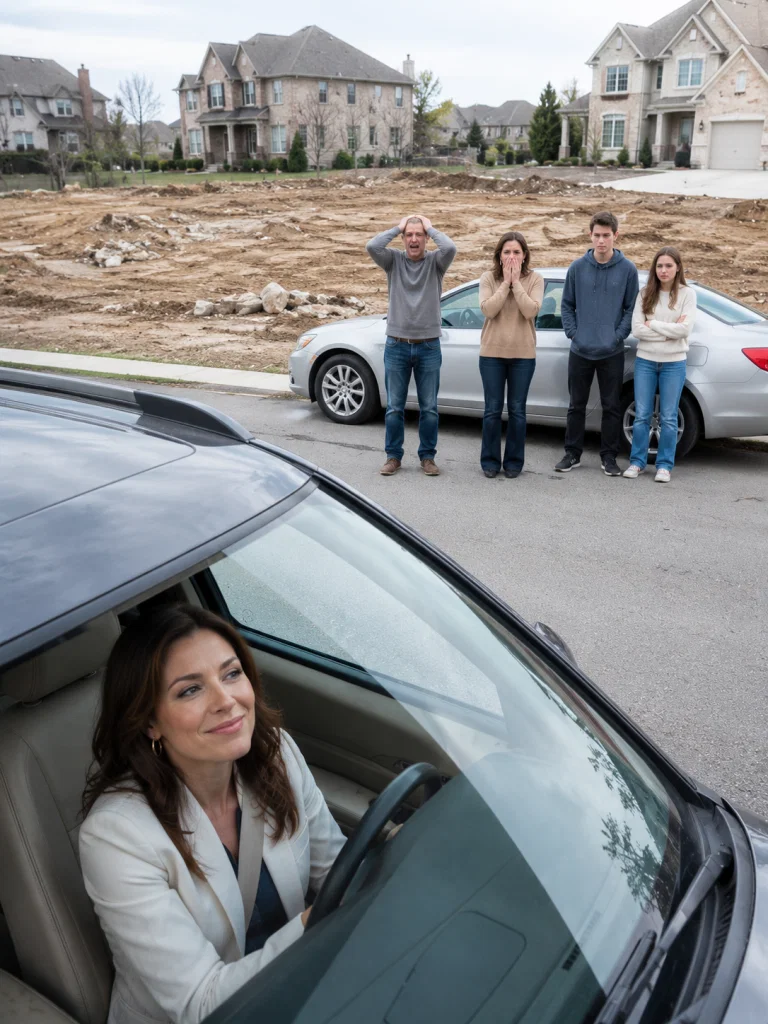
I drove to our old street in Elise’s car because I did not want him to recognize my vehicle, and I parked far enough back to watch without being seen.
I held a travel mug of coffee and realized I had absolutely nowhere else to be.
The taxi pulled up to the curb at exactly 11:24 a.m.
Jaxon stepped out first, rolling his suitcase onto the sidewalk with the entitled confidence of a man returning from a successful holiday.
He was deeply tanned and wearing expensive designer sunglasses.
Blair slid out behind him looking perfectly polished despite the long flight, carrying a designer bag that likely cost more than my first car.
She reached over to touch his arm and he gave her that specific, charming smile that I used to believe was reserved exclusively for me.
Parker stepped out next while scrolling through his phone.
Hazel climbed out last in her comfortable hoodie, looking exhausted by the journey.
They all stopped in their tracks at the exact same moment.
Jaxon’s suitcase handle slipped from his grip as if he had suddenly forgotten he was even holding it.
His head turned in a slow, disbelieving arc, scanning left to right while he took in the flat, empty lot where a three bedroom house with a beautiful wraparound porch had stood only forty eight hours earlier.
His mouth hung open in shock.
Blair made a sharp, panicked sound, something that wasn’t quite a word but rather a sudden intake of air.
She stepped forward as if she intended to walk to where the front door had been, but she stopped abruptly because there was simply no place left to walk.
Hazel whispered, “Dad?”
My phone began to ring three minutes later.
I watched him dial the number from my vantage point across the street.
I watched his hand reflexively go up to his hair in the exact gesture he made whenever he felt the world tilting off its axis.
I let the phone ring four times before I finally answered.
“Where is it?” his voice demanded, the polished, confident memo writer replaced by something significantly rawer. “Ruby, where in the hell is the house?”
“It is gone,” I replied, the words feeling clean and refreshing in my mouth.
“You cannot just do that to a property,” he sputtered before stopping and trying again. “That is my home.”
“It was my land,” I said calmly. “You have always known that.”
There was a long silence on the line.
I could hear the wind whistling through the phone, the same wind I could see moving through the empty, desolate lot from where I was parked.
He turned in a slow circle and even from that distance, I could see the exact moment the full weight of the reality crashed down on him.
It wasn’t just the missing house, but the realization of what it signified.
He finally understood the paperwork, the planning, and the cold, calculated effort it took to pull this off.
He realized this hadn’t just happened to him, but had been actively done to him by a woman he had spent years dismissing as incapable of such a feat.
“You are going to regret this,” he said, his voice dropping into a flat, quiet register.
“Perhaps,” I conceded.
I thought back to the 2:13 a.m. text.
I thought about the kitchen island and the cold coffee and his arrogant declaration that he had handled everything.
I thought about every single dinner party where he had laughed about my father’s paranoia while I smiled and passed the bread.
“But not today,” I said firmly.
I ended the call.
I placed the phone in the cupholder and sipped my coffee while watching them stand in the middle of all that empty air.
Blair had her arms crossed tightly now and her posture had completely collapsed.
Parker had finally put his phone away and was standing absolutely still.
Hazel had walked a few feet toward the lot and was staring at the ground, and I felt a sharp pang of sympathy for her, standing there in the cold wind where her childhood home used to be.
That part of this was not simple and it would undoubtedly take a long time to heal.
But I was not the one who had put her in this position.
I had not been the one to send a cold text at two in the morning.
I had not been the one to book a flight and leave my family behind in the dark.
I started the engine.
In the rearview mirror, I watched Jaxon make another urgent phone call and pace the sidewalk.
I watched Blair reach for her phone and I watched Parker pick up the heavy suitcase his father had dropped.
Then I turned the corner and they were gone from my sight.
Elise had fresh waffles waiting when I returned.
Buster was asleep on the couch in a patch of afternoon sunlight, twitching through the remnants of a canine dream.
The coffee was hot and the kitchen smelled like warm maple syrup, and I sat down at the table and marveled at the fact that for the first time in nineteen years, not a single corner of my day would be shaped by the desires of Jaxon West.
The legal process was far from over and it certainly would not be simple.
There would be endless filings, hearings, and tense arguments about assets and custody arrangements that would require me to sit in sterile rooms with him while lawyers translated our failed marriage into cold, hard legal documents.
I was not naive about the challenges ahead.
But that morning in the kitchen with the waffles and the quiet, that moment belonged entirely to me.
Miriam called that afternoon to check in.
“How did the encounter go?” she asked.
“He called me,” I said.
“And how did he sound?”
“He sounded like a man who had suddenly realized he did not actually own the ground he was standing on,” I answered.
She made a dry, sharp sound that might have been a laugh.
“Get some rest this week because we have a mountain of paperwork to get through on Thursday.”
I promised I would.
I hung up and took Buster for a long walk around the neighborhood in the golden light of the late afternoon.
He sniffed every single mailbox post with enormous enthusiasm, and I let him take as long as he wanted because we had absolutely nowhere to be and all the time in the world.
The land is still in my name.
It is clean and flat and waiting for whatever comes next.
I have not yet decided what I will do with it, but perhaps I will sell it or maybe I will build something new, something smaller that has only ever been mine.
Maybe I will plant a garden there just so something beautiful grows out of all that disturbed earth.
My father would have had an opinion on that, and he would have sat across from me and talked it through for hours until I arrived at my own conclusion.
He was good at that, and he was clearly very good at knowing when to leave his daughter a door.
I keep that memory in my pocket, the image of him signing that deed with steady, unshakeable hands, not making a speech about wisdom or what love was supposed to look like.
He simply signed his name and ensured mine was on something that could never be taken away.
Whenever the path ahead looks difficult or uncertain, I take that thought out and look at it.
Some things in this world cannot be moved, but some things can.
Sometimes the most powerful thing a person can do is to know the difference and act on it while someone else is busy celebrating on a beach, foolishly assuming the world is standing still just where they left it.
It wasn’t. It never really was.
THE END.