Chapter 1: The Smoldering Legacy
The air inside my historic Charleston townhouse was thick, not just with the oppressive South Carolina humidity that always managed to seep through the antique window frames, but with a suffocating, manufactured grief.
I was twenty-nine years old, a historic preservationist who spent my days carefully brushing dust off forgotten centuries, trying to save the soul of a city that was rapidly selling it to the highest bidder. But for the past three weeks, since the sudden, shocking death of my father, George Hayes, my world had shrunk to the stifling confines of this mahogany-paneled dining room.
My father hadn’t just left me with a broken heart; he had left me with a multi-million-dollar portfolio of prime waterfront commercial properties. They were the culmination of his life’s work—brick-and-mortar testaments to his belief that history was something you preserved, not something you bulldozed for a quick profit.
My husband, Garrett Palmer, fundamentally disagreed.
Garrett was a charismatic stockbroker whose charm usually functioned like a master key, opening doors his actual talent could never unlock. Lately, however, the market had turned on him. His firm was bleeding, his margins were called, and the water was rising above his perfectly tailored collar.
Under the guise of “helping me grieve,” Garrett had moved his mother, Sylvia Palmer, into our home. Sylvia was an overbearing, status-obsessed matriarch whose perfume smelled of stale gin and predatory ambition. Together, they had turned my mourning period into an unrelenting psychological siege.
At the dinner table that evening, the tension finally snapped the brittle air.
Sylvia slammed her crystal wine glass onto the mahogany table, the dark red liquid sloshing over the rim and staining the lace runner.
“You are being selfish, Audrey,” Sylvia hissed, her heavily lined eyes narrowing as she gestured dramatically toward Garrett. “My son is drowning in market debts while you sit on millions in stagnant brick and mortar left by your father. A good wife surrenders her assets to protect her husband’s dignity.”
I stared at the red stain spreading across the white lace. “They aren’t just assets, Sylvia. They are historical landmarks. My father spent thirty years restoring the waterfront. I am not liquidating his life’s work to cover Garrett’s bad trades.”
Garrett reached across the table, covering my hand. What should have been a comforting touch was a threat. His fingers locked around mine with a grip that felt less like affection and more like an iron vice, grinding my knuckles together.
“Sign the deed transfer papers tonight, Audrey,” Garrett whispered, leaning in close. His usual golden-boy facade melted away, revealing a cold, ominous hollow underneath. “Or you’ll quickly find out how lonely this big house can get.”
I pulled my hand free, my pulse hammering against my ribs. I reached out and firmly pushed the stack of legal documents back across the polished wood toward him. “My answer is no, Garrett. It will always be no.”
For a long, agonizing second, absolute silence descended upon the room. The only sound was the rhythmic ticking of the grandfather clock in the hallway.
Then, Sylvia exchanged a silent, chilling look with Garrett. It wasn’t a look of defeat; it was an unspoken agreement. A tactical pivot.
Without another word, Sylvia quietly stood up. She smoothed the front of her silk blouse and walked methodically toward the kitchen. I could hear the sharp hiss of the gas burner igniting. Through the arched doorway, I watched her stand over the stove, where a heavy, cast-iron skillet filled with cooking oil had been heating over a high flame for over twenty minutes, silently smoking in the dim light.
Chapter 2: The Baptism of Fire
My throat was parched from the adrenaline coursing through my veins. Wanting nothing more than to escape the suffocating atmosphere of the dining room, I stood up and walked toward the kitchen to pour myself a glass of ice water.
I crossed the threshold just as Sylvia turned around.
She didn’t say a word. Her face was completely devoid of emotion—a terrifying, blank slate. With a sharp, practiced twist of her wrists, she hurled the heavy cast-iron skillet forward.
The searing heat tore through my skin like liquid fire before I could even raise my hands to defend myself.
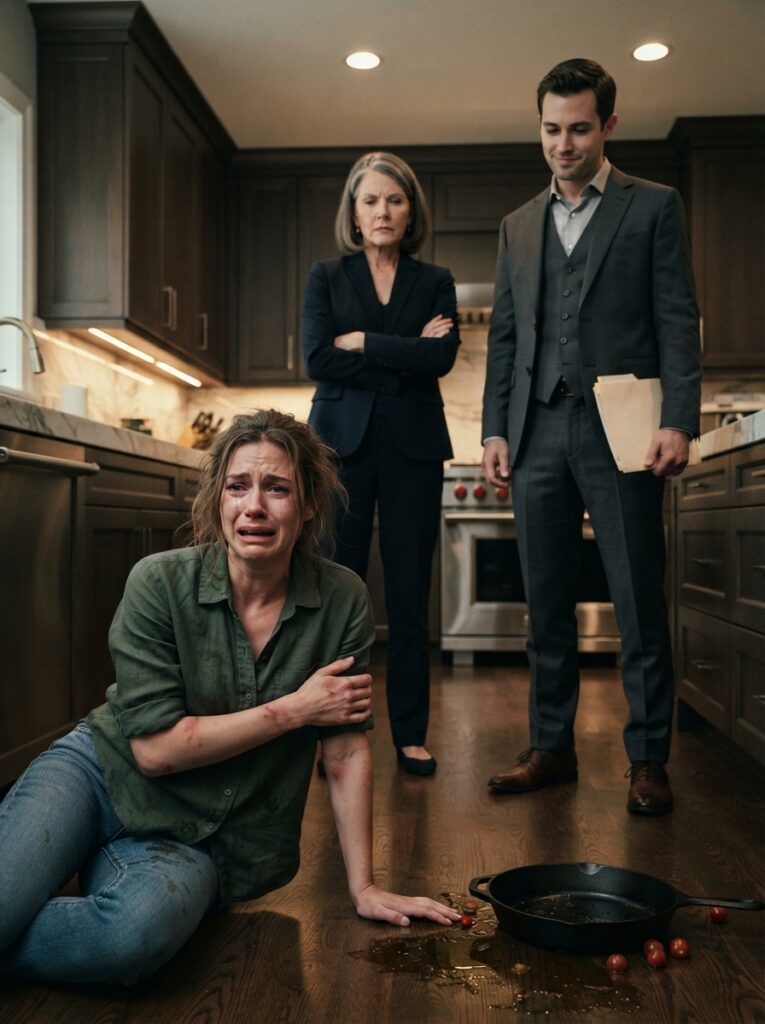
The boiling oil splashed across the left side of my face, trailing down my neck, and soaking into the collar of my cotton blouse. I screamed. It was a raw, guttural sound of unimaginable agony, a primal noise that felt like it was ripping my vocal cords apart. I collapsed onto the hardwood floor, my body convulsing as blisters instantly erupted across my jaw and collarbone. The air smelled sickeningly of scorched fabric and burning flesh.
Through a haze of blinding, white-hot pain and streaming tears, I writhed on the floor, my vision swimming. I heard the heavy, rhythmic thud of footsteps.
Garrett stepped into the kitchen.
He didn’t rush to the sink for cold water. He didn’t pull out his phone. Instead, he calmly walked past my thrashing body to the side door. I heard the deadbolt click into place. He intentionally locked it.
“Garrett… please… 911…” I gasped, my voice reduced to a wet, ragged wheeze. I reached out a trembling, blistering hand toward his expensive leather dress shoes.
Garrett didn’t move to help me. He stood over me with his hands casually slipped into his pockets. Slowly, a malicious, satisfied grin spread across his handsome face. He crouched down, the crisp fabric of his trousers pulling tight over his knees, and leaned in close. His breath was warm against my unburnt ear, smelling faintly of the wine he had just been drinking.
He reached into his breast pocket and casually dropped a folded stack of papers onto the floor, right beside my pool of agony. Unsigned divorce papers.
“I’m divorcing you, Audrey,” he whispered with sickening delight, his eyes tracing the ruin of my face. “I refuse to spend another day married to this ugly monster. Let’s see how much those properties are worth when you can’t even look in a mirror.”
He stood up, adjusted his cuffs, and stepped back.
For the next forty minutes, as I faded in and out of consciousness on the floor, my mind slipping into the dark, merciful edges of shock, they didn’t call an ambulance. I could hear the faucet running. I could hear the squeak of a mop. They were cleaning the kitchen, dousing the surrounding floor with water to dilute the oil, carefully crafting a scene.
“She tripped while frying chicken,” Sylvia’s voice echoed from somewhere far away, rehearsing the lie. “Just pure clumsiness. A tragic accident.”
The darkness finally swallowed me whole.
I don’t know how much later it was when I floated back into awareness. The smell of burning had been replaced by the sharp, sterile sting of iodine and bleach. I was lying in a bed in the Burn Intensive Care Unit, wrapped tight in heavy, damp bandages. The steady beep of a heart monitor was the only anchor keeping me tethered to the physical world. I couldn’t move my neck. My left eye was swollen shut.
But my right ear was clear. And the door to my room was slightly ajar.
“…the sedation is heavy,” I heard Garrett whispering in the hallway outside. “The doctors say she’ll be out of it for days. I have fifty thousand dollars in cash for you. I need you to forge her signature on a full power-of-attorney form tonight, before she wakes up and tries to talk.”
Chapter 3: The Ghost in the Smoke
Pain is an extraordinary teacher. It strips away the unnecessary, the trivial, and the naive. As I lay in that dim hospital room, the morphine dripping through my IV tried to pull me into a dreamless void, but I fought it. I anchored my consciousness to the burning sensation radiating from my jaw and chest.
I didn’t cry. The tears would only sting the raw skin. Instead, a profound, terrifying clarity washed over me. Garrett and Sylvia thought the fire had destroyed me. They thought they had burned away the stubborn, grieving daughter and left behind a broken, compliant victim.
They had no idea they had just forged a weapon.
Two days later, a man in a rumpled gray suit managed to bypass Garrett’s strict “family-only” visitor restrictions. It was Dominic Ross, my late father’s long-time corporate attorney and one of his closest friends. Dominic looked at the mummified state of my upper body, his jaw tightening, his eyes shining with unshed tears.
“They think you’re broken, Audrey,” Dominic murmured, pulling up a chair and opening a heavily encrypted laptop. “Garrett filed for emergency guardianship this morning. He’s claiming you’re mentally incompetent from the trauma and the pain medication. He wants full control of the estate by Friday.”
I turned my head a fraction of an inch. My right eye met his.
“Let him think I’m broken,” I said, my voice raspy, sounding like dry leaves dragging across concrete, but utterly steady.
Using my uninjured right hand, I reached beneath the thin fabric of my hospital gown. Taped securely to the inside of my bra—hidden there by my own frantic fingers in the ambulance while the EMTs were distracted hooking up my IV—was a small, black micro-SD card.
I held it out to Dominic. “My father didn’t just collect historic buildings, Dominic. He collected antique silver. And he trusted no one.”
Dominic took the card, his brow furrowing in confusion.
“Two weeks before the attack,” I explained, “Dad showed me the new security system he installed in the townhouse to protect his collection. Hidden, cloud-synced cameras. Disguised as smoke detectors. There’s one directly above the kitchen island.”
Dominic’s eyes widened. He immediately slotted the card into an adapter and pushed it into his laptop. His fingers flew across the keyboard.
“This card contains the cloud server backup key I pulled from his home office before the paramedics carried me out,” I said, the memory of that desperate, pain-fueled crawl to the office flashing in my mind. “It has forty-two minutes of 4K video showing Sylvia heating that oil, Garrett locking the door, and both of them discussing how to dispose of my body if my heart gave out from shock.”
Dominic watched the screen, his face draining of color as the silent, high-definition horror played out in front of him. He let out a slow, shaking breath. “My God, Audrey… this is attempted murder. It’s premeditated.”
“Keep digging, Dominic,” I whispered, the exhaustion threatening to pull me under again. “Check my father’s business accounts from the last twelve months. I noticed discrepancies in the ledger right before he died. I think Garrett has been stealing from him.”
Dominic nodded, minimizing the video and opening a secure terminal to access the Hayes estate financial records. The room fell silent, save for the rhythmic clicking of his keys. An hour passed.
“You were right,” Dominic said, his voice hard. “Garrett and Sylvia have been systematically forging checks from George’s subsidiary accounts for over a year. They’ve siphoned nearly six hundred thousand dollars. They accumulated grand larceny and wire fraud charges long before they ever picked up that skillet.”
He paused, a deep frown creasing his forehead as he clicked back to the security footage database. “Wait. The camera in the kitchen… it recorded audio, too. There are motion-triggered files going back thirty days.”
Dominic clicked on an audio file timestamped the night before the attack. The sound of clinking glasses filled the hospital room, followed by the muffled, distinctive voices of my husband and mother-in-law sitting at the kitchen island.
“She won’t sign, Garrett,” Sylvia’s voice crackled through the laptop speakers. “She’s too much like George. Stubborn to a fault.”
“I’ll break her down,” Garrett replied. “I just need more time.”
“We don’t have time!” Sylvia hissed, her voice dropping into a sinister, conspiratorial whisper. “Do you think I crushed up those digitalis pills and mixed them into George’s heart medication six months ago just to watch you lose the inheritance to margin calls? I took care of the old man. Now you need to take care of the girl.”
The hospital room went dead silent. The beep of my heart monitor spiked.
My father’s massive, sudden heart attack hadn’t been natural. Sylvia Palmer had murdered him.
Chapter 4: The Executioner’s Block
The air in the Charleston County Courthouse smelled of lemon polish, old paper, and desperation.
It was a Friday morning. Garrett and Sylvia entered the courtroom triumphantly, flanked by a high-priced defense team funded by the money Garrett had likely stolen from my father’s accounts. Garrett wore a navy bespoke suit, looking every inch the grieving, overwhelmed husband. Sylvia sat behind him in the gallery, wearing a conservative black dress, dabbing at dry eyes with a silk handkerchief.
They fully expected the judge to grant Garrett temporary legal conservatorship over my multi-million-dollar estate. After all, according to their narrative, I was lying in a hospital bed, physically ruined and psychologically shattered.
They didn’t expect the heavy oak doors at the back of the courtroom to swing open.
The murmurs in the gallery died instantly. I walked down the center aisle. I wasn’t wearing a hospital gown or concealing bandages. I wore a tailored, razor-sharp black suit. My posture was immaculate, my spine a rod of steel. I carried no cane. I offered no tears.
The left side of my jaw and neck were exposed, the angry, red, blistering burn scars stark against my pale skin. I could feel the eyes of the gallery lingering on the disfigurement, but I didn’t flinch. I held my chin high. I walked past Garrett, feeling his sudden, panicked intake of breath, and took my seat beside Dominic Ross at the plaintiff’s table.
Garrett looked like he had seen a ghost. His smug confidence fractured, leaving a pale, sweating mask in its wake.
The judge, a stern woman with sharp eyes, banged her gavel. “Mr. Palmer, you are seeking emergency conservatorship. You may take the stand.”
Garrett swallowed hard, adjusting his tie as he walked to the witness box. He tried to reclaim his rhythm, smiling smirkingly at the judge as he took his oath. “Your Honor,” he testified smoothly, his voice dripping with faux sorrow, “my wife’s tragic kitchen accident has left her emotionally unstable and unable to manage her father’s complex real estate portfolio. I am simply trying to protect her legacy while she… recovers.”
Dominic Ross stood up. He didn’t raise his voice. He didn’t posture. He simply pressed a button on the small remote in his hand.
“Objection, Your Honor,” Dominic said calmly. “The defense presents an emergency motion to introduce newly authenticated forensic digital evidence, as well as criminal indictments certified by the State Prosecutor’s Office mere minutes ago.”
Before Garrett’s high-priced lawyer could even formulate an objection, the courtroom projector screen flickered to life.
The crystal-clear, 4K video filled the room. There was Sylvia, her face devoid of emotion, hurling the boiling oil. The courtroom erupted in collective, horrified gasps as my recorded screams filled the air.
On the stand, Garrett gripped the wooden rail, his knuckles white, his mouth opening and closing like a suffocating fish. In the gallery, Sylvia turned as pale as marble, slamming her hands on the wooden bench in sheer panic.
The video continued. It showed Garrett locking the door. It showed him smiling.
Then, the audio boomed through the room’s speakers, echoing off the wood-paneled walls, crisp and undeniable:
“I’m divorcing you… I refuse to spend another day married to this ugly monster.”
The judge’s face contorted in absolute disgust.
“Turn it off,” Garrett whispered into the microphone, his voice trembling. “That… that’s doctored! That’s a deepfake!”
“We aren’t finished, Your Honor,” Dominic said coldly. He clicked to the next file.
The audio of Sylvia and Garrett in the kitchen played next. Sylvia’s arrogant confession rang out like a gunshot: “Do you think I crushed up those digitalis pills and mixed them into George’s heart medication… I took care of the old man.”
Absolute chaos descended upon the courtroom. The gavel banged repeatedly, but the noise barely registered over the shouting reporters and gasping spectators. Sylvia scrambled out of her seat, trying to push her way toward the exit, but the bailiffs were already moving.
Garrett collapsed back into the witness chair. He stared at the blank projector screen, his golden-boy illusion shattered into a million unfixable pieces.
“Bailiff, secure the doors!” the judge roared, her voice cutting through the din. She pointed a trembling finger at the witness stand. “Garrett Palmer and Sylvia Palmer, you are remanded into custody immediately. I am signing the warrants for attempted pre-meditated murder, grand larceny, and first-degree murder.”
As the bailiffs clamped heavy iron handcuffs onto Garrett’s wrists, the back doors of the courtroom swung open again. Four federal agents in tactical windbreakers stepped through the frame.
“Garrett Palmer,” the lead agent announced, holding up a thick folder. “We have a federal warrant to seize all financial assets, brokerage accounts, and offshore holdings connected to your name under the RICO act.”
Garrett was dragged past my table, his legs giving out, forcing the bailiffs to carry him by his armpits. He looked at me, his eyes wide with terror and pleading.
I didn’t smile. I didn’t gloat. I simply reached up, my fingers gently tracing the rough, scarred tissue of my jawline, and I held his gaze until the heavy courtroom doors swung shut behind him.
Chapter 5: The Phoenix Protocol
There is a unique kind of silence that exists inside a state penitentiary. It is thick, heavy, and smells of despair and industrial floor cleaner.
Six months after the trial, I stood outside the visiting room glass. On the other side sat Garrett. He was wearing an oversized orange jumpsuit. His perfectly styled hair was unkempt and greasy, his face hollowed out by the chronic stress and visceral fear of his new reality. He had lost twenty pounds. The charm was entirely gone; only the pathetic, fragile core remained.
He picked up the heavy black telephone receiver, his hands trembling violently. I picked up mine.
“Audrey, please,” Garrett sobbed, pressing his palms against the thick, smudged partition. Tears streamed down his gaunt cheeks. “I was manipulated! My mother controlled everything. She made me do it. I still love you… please, talk to the prosecutor. Tell them I was coerced. Tell them to reduce my sentence.”
In the months leading up to the trial, the unbreakable mother-son bond had dissolved like sugar in water. Denied bail and facing life, they had turned on each other like starving wolves. Sylvia had attempted to pin the financial fraud entirely on Garrett, claiming ignorance. In retaliation, Garrett had offered to testify against his mother regarding my father’s murder in exchange for a lighter sentence.
It hadn’t worked. The evidence was too absolute.
I looked at him through the reinforced glass, my expression entirely neutral. The raw burns had healed over the last six months, thanks to a grueling regimen of advanced reconstructive laser surgeries. The trauma surgeons had offered to try and erase the marks completely, but I had refused.
I slowly reached up, my fingers brushing against the faint, silver, branching scar that ran along my jawline and down my neck. It looked like lightning trapped beneath my skin. A mark that once represented torture, but now represented absolute, undeniable liberation.
“You called me a monster, Garrett,” I said softly into the receiver, my voice steady and cold. “But as I look at you behind this glass, begging for scraps of mercy you never showed anyone else, I finally see who the real monster was all along.”
“Audrey, wait!” he screamed, his voice cracking through the cheap plastic speaker.
I hung up the phone. I turned on my heel and walked away, the sound of his hysterical, muffled screams fading as I stepped out into the bright, warm South Carolina sun.
Garrett was sentenced to thirty-five years without the possibility of parole. Sylvia received a life sentence. Neither would ever see the Charleston waterfront again.
I drove straight from the prison to my father’s newly renovated corporate office downtown. I had officially assumed full control over the Hayes estate. The historic properties weren’t just going to be preserved; they were going to serve a purpose. I had already begun converting three of our largest residential buildings into high-security community centers and safe houses for survivors of domestic abuse.
I walked into my father’s old private study, breathing in the scent of aged leather and pipe tobacco that still lingered in the upholstery. Dominic Ross was waiting for me. Sitting on the large mahogany desk was a heavy, steel master vault, brought over from my father’s private bank that morning.
“It requires your biometric scan, Audrey,” Dominic said, stepping back. “George instructed the bank that this was only to be opened if you took full control of the estate.”
I pressed my thumb against the cool glass of the scanner. The heavy locking mechanisms clicked and whirred, and the thick steel door swung open.
Inside wasn’t gold, or cash, or more property deeds. It was a single, leather-bound ledger.
I opened it, scanning the densely packed numbers and international routing codes. My breath caught in my throat.
My father hadn’t just been preserving local history. For twenty years, he had been quietly filtering the profits from his real estate empire into a secretly established, international philanthropic foundation. It was shielded in an offshore trust, entirely untouchable by Garrett’s financial snooping.
I looked at the total valuation at the bottom of the page. It was staggering. It was valued at three times his entire real estate portfolio.
And the sole beneficiary and active director named on the trust?
Audrey Hayes.
Chapter 6: The Steel
Three Years Later.
The lights in the auditorium were blinding, but I didn’t shield my eyes. I stood at the center of the massive stage at the National Summit for Female Empowerment in Washington D.C., looking out at a sea of thousands of faces.
I wore an elegant, tailored burgundy dress. I hadn’t used heavy foundation or concealer. My hair was pinned back elegantly, deliberately revealing the faint, beautiful silver line that branched across my jaw and traced its way down my collarbone.
“They believed that by scarring my skin, they would destroy my confidence,” I said into the microphone, my voice echoing clearly and powerfully throughout the cavernous hall. “They believed that fear would make me compliant. That pain would make me surrender my legacy and my voice.”
I paused, letting the silence hang in the air, feeling the absolute, rapt attention of every person in the room.
“What they didn’t realize,” I continued, a warm, confident smile spreading across my face, “was that the fire they threw at me didn’t burn me away. It forged me.”
I ran the Hayes Foundation for Survivor Justice now. Using the immense secret wealth my father had left me, I had built an empire of defense. I employed a small army of the country’s top forensic accountants, private investigators, and ruthless attorneys. We didn’t just provide safe houses anymore. We hunted. We actively sought out vulnerable heirs, trapped spouses, and abuse survivors, tearing apart the financial webs of their abusers and bringing them to total ruin.
“Never let anyone define your worth by your scars,” I projected to the crowd, my voice ringing with unshakeable conviction. “Because your scars are not signs of weakness. They are not proof of your victimization. They are simply proof that you were stronger than whatever tried to destroy you.”
The auditorium erupted. The sound was deafening—a standing ovation of thousands of people rising to their feet, clapping, wiping away tears, and cheering. I stood in the center of the stage, letting the wave of energy wash over me, feeling a profound, deep-seated peace that I hadn’t known was possible three years ago.
I looked up toward the VIP balcony.
Standing in the shadows near the exit was Dominic Ross. He wasn’t clapping. He was watching me with a look of immense, fatherly pride. As our eyes met, he reached into his briefcase and held up a thick, manila case file.
Even from the stage, I could read the bold, black letters stamped across the front: Project Beacon.
It was the dossier on a new target. A corrupt tech mogul in Silicon Valley who was currently attempting to violently silence his wife and steal her shares.
I nodded subtly at Dominic. The smile on my face hardened into something sharp, dangerous, and ready. The fire had touched me once, and now, I was the one who brought the heat.
I turned back to the cheering crowd, took one final, deep bow, and walked off the stage. I had an empire to run, and monsters to hunt.