My name is Natalie Brooks, and I am twenty-nine years old.
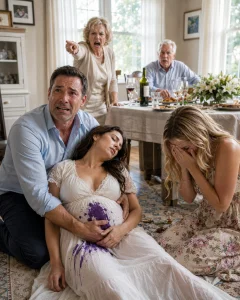
The night I finally found the courage to tell my family I was pregnant, my own mother came around the dining table and drove her fist directly into my stomach.
She was screaming that the first grandchild belonged to my older sister.
I was eleven weeks pregnant.
The rest of that night was spent beneath the ruthless white lights of an emergency room, lying motionless on a paper-covered bed while a tiny heartbeat flickered across a gray ultrasound monitor.
I watched that pulse.
And I learned exactly how violently my hands could shake.
But the punch wasn’t what finally broke my mother’s reality.
That happened twenty minutes later, when the front doorbell rang.
A woman stood on my parents’ porch wearing my face.
Everything that followed eventually ended in a county courtroom.
And what my mother offered me there, in front of the people who knew our family best, was somehow crueler than the fist.
To understand my mother, you have to understand the morning inspection.
Every day in our house began with an evaluation.
My mother stood beneath the oak staircase holding black coffee while my sister, Lauren, and I came downstairs.
Her eyes moved over us like a jeweler sorting stones.
Quick.
Professional.
Cold.
Lauren always received adjustments.
A ribbon straightened.
A collar smoothed.
A loose strand of blonde hair tucked behind one ear.
From a distance, the gestures looked loving.
They weren’t.
They were maintenance.
I received one glance.
Head to toe.
Then dismissal.
My mother’s attention immediately moved elsewhere, and I remained in the hallway feeling like a package someone had weighed and marked insufficient postage.
There was a yellow measuring tape in the top kitchen drawer.
Every Sunday evening, my mother removed it and wrapped it around Lauren’s waist.
She wrote the number inside a small notebook shaped like a wedding cake.
She never measured me.
For years, I thought that meant freedom.
Lauren ate celery while I finished my Halloween candy.
I assumed I was the lucky daughter.
I wasn’t.
You don’t measure inventory you’ve already decided not to display.
I survived childhood by studying my mother’s emotional weather.
The faint tension in her jaw.
The precise angle of her crystal water glass.
The difference between her musical public laugh and her real one, a dry, ugly sound I heard only a handful of times.
Learning to detect danger before danger recognized itself was the most useful thing my childhood gave me.
It has saved my life more than once.
My mother only makes complete sense inside her bridal boutique.
Marilyn’s Bridal opened in 1998 on Market Street in Ridgefield, Indiana.
The store is genuinely beautiful.
My mother possesses an extraordinary eye for appearance.
Cream carpet.
Gold-framed antique mirrors.
Rows of silk gowns displayed under warm lights like religious objects.
She had been Miss Warren County in 1986.
Her fading pageant sash still hung behind the register in a custom frame.
Women drove from several counties away because being personally styled by Marilyn Porter still meant something socially.
Lauren began modeling for the shop when she was six.
Flower girl catalogs.
Junior bridesmaid photographs.
Eventually, couture bridal samples.
Lauren had our mother’s face.
The same high cheekbones.
Wide green eyes.
The same photogenic symmetry.
Strangers constantly commented on it.
As a child, I thought it was sweet.
Later, I found it frightening.
I worked at the boutique too.
In the stockroom.
I opened boxes, moved inventory, steamed endless yards of tulle, and remained invisible to customers.
When I was nine, I crouched behind a rack of cathedral veils while a wealthy client admired Lauren on the velvet fitting platform.
The woman asked my mother how she had gotten so lucky to have such a beautiful daughter.
My mother’s bright showroom laugh rang through the boutique.
“Oh, believe me, we work at it. In this family, pretty is the rent.”
The customers laughed.
I stayed hidden among plastic garment covers and did the quiet arithmetic that shaped the next twenty years of my life.
If beauty was rent, I was permanently behind.
According to the family ledger, I had inherited the wrong face.
Once, I asked my mother whose face I had.
Clearly, it wasn’t hers.
She stared at me for one second too long.
“Not anyone from my side,” she said sharply.
Then her mouth closed.
Remember that.
My father, David, was a pharmacist.
For two decades, he voluntarily worked overnight shifts.
I understood why before I knew how to explain it.
Our house at seven in the evening was a controlled stage run by one director.
My father found an exit that didn’t require openly challenging her.
He loved us quietly.
A slice of cherry pie would appear in the refrigerator with my name on a sticky note.
A broken bicycle chain would somehow be repaired before sunrise.
When my mother’s criticism became especially sharp, Dad occasionally appeared in the doorway jingling his keys.
Sometimes his presence softened her.
Sometimes it didn’t.
Either way, he left.
I want to be fair to him.
I also want to tell the truth.
Those are different things.
He never hit me.
Never shouted at me.
Never participated in Mother’s cruelty.
He also never stepped between us.
My father existed in our house like a heavy antique cabinet.
Dependable.
Familiar.
Entirely useless during a fire.
There was one strange exception.
When I was twelve, I came downstairs near midnight for water.
Dad sat alone at the kitchen table.
His old green fishing tackle box was open.
He was pushing a thick envelope into the locked compartment.
I saw red-and-blue airmail stripes.
Elegant handwriting I didn’t recognize.
Dad noticed me.
He didn’t explain.
He raised one finger to his lips.
I nodded.
Silence was our family profession.
I had been trained in the stockroom.
Seventeen years passed before I learned what was inside that box.
The answer came after the dinner that ended with me bleeding on my mother’s carpet.
I escaped home the way unwanted daughters often do.
I became valuable somewhere else.
I studied nursing in Indianapolis and eventually joined a high-acuity pediatric unit in South Bend.
Hospital work rewarded the exact skills my childhood created.
Observation.
Alertness.
Nobody in a pediatric intensive care unit cares whether you have elegant cheekbones.
They care that you notice a fever climbing at two in the morning.
They care that you recognize a premature infant’s cry has changed before the monitor catches up.
For the first time in my life, being watchful mattered more than being watched.
I met my husband, Luke, when his ancient Honda Civic died in the hospital garage after my double shift.
I diagnosed the battery problem in freezing rain and connected jumper cables.
Luke leaned over the hood and grinned.
“Are you this terrifyingly calm about every disaster?”
Luke teaches high school environmental science.
He laughs loudly.
He keeps a list on our refrigerator titled Things Natalie Was Right About.
When my mother first met him, she gave him the familiar jeweler’s glance.
Then she called him “nice.”
In Marilyn’s language, that meant worthless socially.
Luke and I married in 2023.
Small outdoor wedding.
Simple.
My mother arrived wearing pale ivory silk, cheerfully ignoring the obvious etiquette problem.
I heard her explain to our photographer that my dress was “unfortunately ready-made, but Natalie has always valued practicality.”
I ignored her.
Twenty-six years of training and champagne helped.
But I remember something Lauren did during the reception.
While people gave speeches, she reached beneath the tablecloth and grabbed my hand.
Hard.
Her fingers locked around mine like a drowning person gripping a railing.
At the time, I thought my sister was emotional about my wedding.
I didn’t understand the golden daughter was barely surviving her own life.
Lauren was thirty-three.
She had spent three years and four rounds of IVF trying to produce what Mother constantly called “the first Porter grandbaby.”
Mother paid for two treatments.
She announced that fact at Easter dinner with the pride of a corporation unveiling a major sponsorship.
My mother’s money always had conditions.
Every Sunday, she discussed Lauren’s fertility.
“By next Christmas, God willing, we’ll finally have a gorgeous bassinet by the bay window.”
She occasionally referred to Lauren’s imaginary child as “the future face of the boutique.”
I watched my sister suffocate beneath the attention.
And I am ashamed to admit that part of me felt relieved.
The spotlight was still facing her.
Then one rainy afternoon, I finally saw what existed beneath Lauren’s polished pedestal.
I drove her to a fertility appointment because her husband, Eric, was attending a mandatory conference.
Mother met us outside the clinic.
Before Lauren entered for her blood test, Mother held her shoulders and kissed her cheek.
Then, with an intense smile, she whispered loudly enough for only us to hear:
“Don’t disappoint me again, darling.”
Again.
I sat in the waiting room with my novel upside down.
Lauren wasn’t the lucky child.
Lauren was the product line.
Her body was a delayed launch.
And our mother was an impatient investor.
My nurse brain quietly produced one thought.
If the next round fails, someone is going to get hurt.
I just assumed it wouldn’t be me.
Eight weeks later, two pink lines appeared on a pregnancy test in my bathroom.
Luke cried first.
He slid down the wall until he was sitting on the tile beside the bathtub.
He laughed and cried simultaneously.
“Okay. Okay. Okay.”
He repeated it like he was counting something precious.
I stood there holding the test.
Two feelings arrived together.
Joy.
And threat assessment.
Because I knew what this pregnancy meant inside my mother’s accounting system.
This was not simply our baby.
It was an unauthorized first grandchild growing inside the wrong sister.
I planned the announcement like a dangerous medication administration.
Carefully.
Defensively.
We waited for the first ultrasound.
Eleven weeks.
Strong heartbeat.
Tiny gray shape.
Luke claimed the blurry image already had his chin.
We waited until after Mother’s birthday.
Nothing was permitted to compete with Marilyn Porter.
I chose Sunday dinner.
Dad would be there.
Lauren and Eric would be there.
An audience usually made Mother more careful.
I even prepared a sentence to redirect attention immediately after the announcement.
I wrote it on an index card.
And we can’t wait for our baby to have a cousin soon afterward.
I expected coldness.
Silence.
Maybe tears.
I planned for everything except the one thing I couldn’t know.
Three hours before dinner, Lauren called Mother from the fertility clinic parking lot.
Her fourth IVF round had failed.
When Luke and I entered my parents’ house, I immediately knew something was wrong.
Reading that house was my native language.
Lauren’s eyes were swollen beneath concealer.
Eric sat close beside her with one arm stretched stiffly behind her chair like a guardrail.
Dad carved roast beef with extraordinary concentration.
And Mother was radiant.
That was the warning sign I had learned much too late.
The brighter my mother appeared externally, the worse the storm underneath.
She poured expensive wine.
Complimented everyone’s clothes.
Told an animated story about a demanding bride from Lafayette.
But her knife and fork touched her plate slightly too hard.
Click.
Click.
Click.
A countdown.
Every instinct in my body screamed at me.
Under the table, I squeezed Luke’s knee.
Our private signal.
Abort.
Not tonight.
But Luke had carried our secret for eleven weeks.
He was proud.
And proud people sometimes miss incoming storms.
Mother turned her brilliant smile toward us.
“And what about you two? You both look positively glowing. What’s going on?”
Luke was already smiling.
“Well, Marilyn, actually, we have some wonderful news.”
I watched the disaster happen slowly.
Lauren looked up.
Dad’s carving knife stopped.
Mother’s face went completely still.
For the first time in twenty-nine years, I watched her mask disappear.
“I am pregnant,” I said.
There was no stopping it now.
“Eleven weeks. We heard the heartbeat Tuesday.”
Silence.
Then everyone reacted in the wrong order.
Lauren stood first.
My sister had learned hours earlier that her fourth IVF attempt had failed.
She walked around the table.
And hugged me.
Before anyone else.
Her wet cheek touched mine.
“Oh, Nat,” she whispered.
That voice contained grief and joy so tightly combined that even a nurse couldn’t separate them.
I will love my sister for that hug for the rest of my life.
Dad put down the carving knife.
His eyes filled.
He nodded at me.
Then Mother stood.
Slowly.
Like a storm rising off black water.
“Today,” she whispered.
The softness of her voice terrified me.
“You deliberately chose today.”
I tried to explain.
I hadn’t known about Lauren’s call.
It was true.
Mother couldn’t hear me anymore.
Her voice rose.
She screamed about the failed rounds.
The treatments she’d paid for.
The bassinet.
Three years of planning.
Then she pointed at my stomach.
“The first grandchild was supposed to be Lauren’s!”
Her voice broke into something wild.
“It has to be hers! The first grandchild must be hers!”
Then she came around the table.
I will describe this exactly as I later described it to police.
Mother moved quickly.
Luke began standing.
Eric moved too.
Nobody reacted fast enough because none of us understood what we were seeing.
My mother grabbed my left shoulder.
Held me in place.
Then struck my abdomen with her right fist.
Low.
Intentional.
Exactly where she believed the baby was.
“Get rid of it!”
One strike.
Only one.
It emptied my lungs.
I folded over the chair arm.
The chair moved.
I fell onto my knees.
My arms closed around my stomach while I struggled to breathe.
The room exploded.
Luke stepped between us.
Lauren screamed, “Mom! Oh my God!”
Eric wrapped both arms around Mother and dragged her backward.
She kept fighting.
Kept shouting.
“My grandchild!”
“Hers!”
Then my father’s voice shook the chandelier.
“MARILYN, ENOUGH!”
I’d never heard him sound like that.
Everything stopped.
Mother stood in Eric’s arms.
Her hair had loosened.
Her chest rose violently.
She stared down at me.
For one second, horror crossed her face.
I still don’t know whether she was horrified by what she’d done or by the fact that everyone had witnessed it.
Then the doorbell rang.
Two cheerful chimes.
Nobody moved.
The bell rang again.
Dad walked toward the foyer like a man moving underwater.
He opened the door.
A woman stood outside beneath the porch light.
Early sixties.
Tall.
Short silver hair.
Gray trench coat.
Canvas bag over one shoulder.
Completely calm.
And she had my face.
Not a vague resemblance.
My face.
My jaw.
My wide green eyes.
My stubborn chin.
She was thirty years older than me, but looking at her felt like seeing my own reflection from the future.
Luke inhaled sharply.
My mother turned white.
Then Marilyn Porter began to shake.
The woman looked into the dining room.
Overturned chair.
Me on my knees.
Mother restrained by Eric.
She studied the room with one slow pass of her eyes.
The same jeweler’s pass.
“Hello, Marilyn,” she said.
Her voice was low.
“Thirty-six years, and you’re still performing the same violent show.”
She looked directly at Mother.
“Who gave you permission to touch that girl?”
Dad’s voice cracked.
“Natalie, this is your Aunt Claire.”
And then I felt warmth beneath my knees.
I looked down.
Blood.
The following six hours exist in hospital records.
South Bend Regional ER.
A trauma bay where I’d delivered handoffs dozens of times.
Except this time, I was wearing the paper gown.
I watched the ultrasound from the patient’s side.
Medical knowledge becomes cruel when you’re the one on the table.
You understand every possible disaster.
And control none of them.
The bleeding slowed.
The ultrasound wand moved.
Then I saw it.
A flicker.
Heart rate 164.
Steady.
Mine was 118.
Dr. Patel sat beside me.
“Small subchorionic hematoma. Essentially a bruise between tissue layers. We’ll monitor it closely. Pelvic rest. Take things very easy. Return immediately if the bleeding increases.”
At eleven weeks, the uterus remains low behind the pelvic bone.
Anatomy had protected my child.
My mother’s fist caused bruising and terror.
But the baby remained alive.
Then Dr. Patel changed her tone.
I knew the tone.
I’d used it with frightened patients.
“Natalie, I need to ask how the blunt-force injury occurred.”
My entire upbringing prepared me to lie.
I fell.
Family problems remain private.
Don’t embarrass your mother.
The lie sat in my mouth.
Then I looked at the screen.
My baby couldn’t speak.
I was her entire world.
“My mother hit me,” I said.
“Closed fist. Once. Directly in the abdomen. Approximately 7:40 PM.”
No decoration.
No excuses.
Dr. Patel nodded and entered the statement into my record.
The truth became part of a permanent chart.
Charts don’t become frightened and change their stories.
My father came to our duplex early the next morning.
Luke opened the door.
Dad stood outside looking like a man reporting for a job he expected not to get.
He brought scrambled eggs in a glass baking dish.
That was Dad’s language for love.
And he brought the green fishing tackle box.
He placed it on our kitchen table.
His fingers trembled as he unlocked the brass compartment.
Inside were envelopes.
Dozens.
Grouped by decade.
Red-and-blue airmail borders.
Elegant handwriting.
Postmarks from Albuquerque and Santa Fe.
Thirty-six years of Christmas cards.
All from the sister my mother had forbidden anyone to mention.
Every card had been opened.
Every card saved.
“Claire,” Dad said.
“Your mother cut her out in 1990. She literally removed Claire from family pictures. We weren’t allowed to say her name.”
He touched one envelope.
“But Claire kept writing to me. Once every year. Always asking about you girls.”
He looked ashamed.
“I never answered properly. I never challenged your mother.”
A pause.
“But I couldn’t throw the letters away.”
Then Dad explained the doorbell.
The week before dinner, I’d mentioned bringing “important news.”
Dad knew Marilyn had become dangerously obsessed with Lauren’s fertility treatments.
So he located Claire.
She happened to be traveling through the Midwest.
Dad asked her to stop for dessert.
He thought Claire’s presence might keep Mother under control.
“I expected screaming,” Dad whispered.
“I didn’t expect a fist.”
His jaw shook.
Then he said the most truthful thing I’d ever heard from him.
“I spent thirty years believing silence kept this family together.”
He looked at me.
“I was really just protecting my chair.”
Claire came to our house that afternoon.
Watching a sixty-one-year-old version of my face pour tea was deeply disorienting.
Luke kept glancing between us.
Then Claire removed an old photograph from her canvas bag.
A Polaroid.
Two women standing beside an old Chevrolet.
My mother was twenty-one.
Perfect hair.
Perfect posture.
Smile aimed directly at the camera.
And she was visibly leaning away from the woman beside her.
The other woman wore denim.
She was laughing at something beyond the photograph.
She had my face.
“This was the last photograph of us together,” Claire said.
“I was the oldest.”
She tapped the picture.
“The one who didn’t photograph well. Those were the exact words.”
Claire explained that their mother evaluated them every morning.
Skin.
Weight.
Posture.
Waist.
“I was the rough copy. Marilyn was the finished version.”
Claire left in 1990.
Twenty-five years old.
Mother told the town she’d developed a drug problem.
The truth?
Claire moved to Santa Fe and built a successful ceramics studio.
“The show needed a broken sister,” Claire said dryly.
“And Marilyn needed to be the beautiful one who survived.”
Then she looked at me.
Her eyes were my eyes.
“You have my face, sweetheart.”
Her voice softened.
“Don’t accept her script.”
I held the Polaroid.
My hands weren’t shaking anymore.
You might imagine that a woman who deliberately struck her pregnant daughter would disappear from public view.
You don’t know my mother.
By Wednesday, Marilyn had created a new story.
Natalie became dizzy.
Pregnancy hormones.
She fell against the dining table.
Now, because she’d always been jealous of Lauren, she was making a terrible accusation.
My mother spread that version through the bridal shop.
Church.
Relatives.
Clients.
Neighbors.
My great-aunt texted:
“Please don’t destroy such a beautiful family over a misunderstanding.”
A woman at the grocery store grabbed my arm and loudly said she was praying for my “situation.”
That’s what happens when your mother has dressed half the brides in the county.
Her version arrived tailored.
Mine remained untouched on the rack.
I didn’t start a public war.
No social media posts.
No family-group arguments.
The daughter raised in the stockroom knew the value of quiet paperwork.
I requested every hospital record.
Imaging.
Nursing notes.
The doctor’s documentation.
I printed three copies.
Two went into our fire safe.
The third went inside a folder beside the telephone number of a domestic violence legal advocate.
Luke wrote on the cover:
WHEN YOU’RE READY.
Nine days after the attack, Mother arrived uninvited.
She carried a designer garment bag.
Through the screen door, I saw her perfect hair.
Pearls.
The costume of a gracious mother seeking reconciliation.
“I brought you something.”
She opened the bag.
Cream silk maternity dress.
Beautiful.
Expensive.
“You need to look presentable for whatever happens next. People are talking, sweetheart.”
Every word was calculated.
She never apologized.
The closest she came was:
“Things got so out of hand at dinner, and I hate that for us.”
Things got out of hand.
As though a fist had appeared by itself.
“I don’t want the dress, Mom.”
Silence.
One blink.
Her expression froze.
“I see Claire has poisoned you.”
There she was.
The real Marilyn.
“She has always been toxic.”
Mother walked away.
Her posture remained perfect.
And she never asked about the baby.
Not once.
Luke found me at the kitchen table at one in the morning.
My laptop was open to a protection-order application.
I had stopped at one field.
Relationship of respondent to petitioner:
Mother.
The cursor blinked.
Luke sat beside me.
“What do you need before you press file?”
“A witness who isn’t you or Dad.”
I explained what the town would say.
Husband is biased.
Father is weak.
Estranged aunt is bitter.
“I need the one person everyone believes Mother loves.”
Lauren.
The thought felt impossible.
My sister was grieving four failed IVF rounds.
She’d spent thirty-three years surviving on the pedestal.
“I can’t ask Lauren to destroy her life for me.”
Luke looked at me.
“Maybe stop making choices for her. Your family already does enough of that.”
My phone illuminated.
1:14 AM.
Lauren.
Three messages.
File it, Nat.
I’ll testify.
You have no idea how tired I am.
Lauren came over the following evening.
For the first time as adults, we actually spoke honestly.
I believed she’d grown up in sunlight.
She’d been trapped beneath a heat lamp.
The Sunday measuring tape had never really stopped.
At thirty-three, Mother still commented on Lauren’s waist inside the boutique.
Always with laughter.
Always disguised as a joke.
Mother had even arranged two embryo-transfer dates around bridal marketing events because Lauren needed to remain “photographable” during promotional weeks.
When Lauren protested, Mother reminded her who paid the fertility bills.
“Don’t disappoint me again” wasn’t one cruel sentence.
Lauren heard versions of it constantly.
“You thought I was the princess,” she said.
Her hands rotated a coffee mug.
“I was the mannequin, Nat.”
She looked at me.
“Mannequins aren’t loved. They’re dressed.”
Her voice cracked.
“At least you became a real person in the stockroom. Nobody measured your body against the store’s profit margin.”
We cried quietly.
No dramatic screaming.
We were too tired.
Then Lauren opened my hospital folder.
She read every page.
When she finished, she placed it on the table.
“She hit the wrong daughter.”
I looked at her.
“And she’s going to stand before a judge and call what she did love.”
Lauren’s eyes hardened.
“She’s called it love my entire life.”
She touched the hospital report.
“I’ll tell the judge exactly that.”
We filed the petition on Tuesday.
Hospital records.
Ben’s—Luke’s—statement.
Lauren’s statement.
And Dad’s.
Dad wrote his at our kitchen table in tiny pharmacist handwriting.
His hands shook.
When he signed, he leaned backward.
“Thirty-five years married.”
He looked at the paper.
“First time I’ve officially testified against her.”
Then he squared the pages carefully.
“I should’ve done it before the rot spread.”
The court approved a temporary protection order that afternoon.
A deputy served Mother at Marilyn’s Bridal on a crowded Saturday.
I wasn’t present.
I heard she accepted the papers while helping a bride from Bloomington.
Mother smiled at the deputy.
Thanked him politely.
Then finished adjusting the bride’s gown.
The show continued.
People later asked whether it felt like victory.
It didn’t.
I stood in my kitchen when I heard she’d been served.
One hand on my stomach.
Fourteen weeks.
Heartbeat strong.
For the first time, a legal document stood between Mother and my body.
I hadn’t won.
I’d simply stopped losing.
Our hearing was scheduled eleven days later.
My attorney, Rebecca Shaw, was forty-seven and wore gray courthouse suits.
Her handshake felt like a deadbolt locking.
She prepared me clinically.
No emotional speeches.
Answer the question asked.
Records.
Witnesses.
Sequence.
At the end of our final meeting, she removed her glasses.
“Her lawyer is going to offer settlement before the hearing.”
I said nothing.
“They’ll suggest family counseling and supervised contact. It will sound reasonable.”
Rebecca leaned forward.
“And Natalie, the offer will contain the thing you’ve wanted your whole life.”
I honestly asked, “What do I want?”
Rebecca studied me.
“You know.”
That night, I sat on my bed holding Claire’s Polaroid.
I looked at my aunt laughing in 1989.
Then I looked at my young mother.
Beautiful.
Perfectly posed.
And strangely alone.
I said the answer aloud.
I wanted my mother to tell me she loved me.
Twenty-nine years.
One sentence.
Some lawyer was probably putting a price on it.
The night before court, Mother violated the protection order.
She stood on my porch.
I should have called police immediately.
Instead, I looked through the screen.
My mother looked undone.
No pearls.
Hair loose.
Gray cardigan buttoned incorrectly.
For Marilyn, that was practically nakedness.
“Two minutes,” she begged.
“I’ll remain outside.”
Then Mother told me something true about herself.
“My mother weighed me every Monday.”
Her eyes remained on the porch railing.
“Cold bathroom scale. Before breakfast. The number determined whether I deserved kindness that week.”
She swallowed.
“When I was fifteen, before the county pageant, she locked the pantry for three days.”
My stomach tightened.
“I competed dizzy.”
A small, bitter smile.
“I won.”
She looked at me.
“She framed the sash and hung it exactly where the pantry key had been.”
My chest broke for the starving fifteen-year-old girl my mother used to be.
The wound was real.
The cycle was real.
And then Marilyn used that truth as currency.
“So you understand I don’t mean what happens when I’m under pressure.”
Her voice became smoother.
“Withdraw the petition. We’ll attend counseling.”
A pause.
“And I’ll say it, Natalie.”
My entire body went still.
“I’ll tell you I love you.”
She took a breath.
“I’ve never said it to your father. Not to Lauren.”
Her eyes found mine.
“You’ll be the first.”
The sentence I’d waited my entire life to hear.
Presented in advance like merchandise with a price tag.
“Good night, Mom.”
Her face changed.
“I’ll see you tomorrow.”
I closed the door.
Then I sat with my back against it and sobbed until breathing hurt.
Because I had almost opened it.
St. Joseph County Superior Court.
8:40 AM.
The courtroom smelled like floor cleaner and old coffee.
Luke sat in the gallery wearing his funeral tie.
Dad wore his church suit.
Lauren arrived in a plain navy dress.
I knew the simplicity was intentional.
The mannequin had taken the day off.
Claire flew in from Santa Fe.
She sat near the aisle with her silver hair and my face.
My mother entered at 8:50.
Deep green suit.
Perfect makeup.
Expensive attorney.
The most beautiful fifty-eight-year-old woman in the county.
Her eyes scanned the room.
One jeweler’s pass.
Then she saw Claire.
For half a second, Mother slowed.
She saw the sister erased from every album sitting publicly in the courtroom.
Her chin lifted slightly higher.
She never looked at me.
The bailiff read the case.
Natalie Brooks versus Marilyn Porter.
My name and my mother’s joined forever by one word.
Versus.
The hospital evidence was devastating precisely because it was boring.
Clinical reports.
Imaging.
The intake record.
Patient states mother struck her once in the abdomen with a closed fist.
No adjectives.
Nothing for Mother’s attorney to reshape.
Luke testified.
Calm.
Precise.
Then Lauren took the stand.
People knew her.
The boutique model.
Marilyn’s beautiful daughter.
Mother’s girl.
Lauren folded her hands.
“My mother didn’t lose control.”
The courtroom became quieter.
“She lost possession.”
Her voice stayed steady.
“My sister had something that was supposed to belong to me, because everything about me was supposed to belong to my mother.”
She looked toward Marilyn.
“I understand that because I’ve belonged to her for thirty-three years.”
Then she said what she’d promised.
“She hit the wrong daughter, and now she’s going to call it love.”
Lauren’s chin lifted.
“She has called it love my entire life.”
Mother’s lawyer barely cross-examined her.
There was nowhere useful to go.
During recess, the settlement offer arrived.
Withdraw the petition.
Structured family counseling.
Supervised contact.
And Marilyn Porter would make a personal statement of reconciliation in open court.
We declined.
Then Rebecca called Claire.
Claire hadn’t seen the punch.
She testified about the pattern.
Morning body evaluations.
Measurements.
Photo albums cut apart.
Daughters treated like inventory.
Then Claire described the fifteen-year-old Marilyn being denied food for three days before a pageant.
“My sister was the first product of our mother’s system,” Claire said.
Her voice finally bent.
“And I was the daughter who escaped.”
Claire looked directly at Marilyn.
“In our family, pretty was the rent before Marilyn ever repeated the words.”
She took a breath.
“I don’t hate my sister.”
The courtroom was silent.
“I know what she’ll do to Natalie’s child because it’s the only language she learned.”
I looked at Mother.
Her eyes were wet.
Her posture remained perfect.
And during the public examination of her deepest wounds, I watched Marilyn glance briefly at her own reflection in the glossy table.
Two truths existed together.
She had once been the starving girl.
And she had grown into the scale.
Before ruling, the judge asked whether Mother wanted to speak.
Her lawyer started to answer.
Mother stood.
Smoothed her emerald jacket.
Then turned toward me.
“Natalie.”
Her voice caught.
“I love you.”
There it was.
Twenty-nine years.
The sentence arrived inside a courtroom.
Recorded permanently.
“I love you, Natalie. I never say it because I was raised in a family where we didn’t.”
Her hand moved helplessly.
For one moment, she stood at the edge of genuine truth.
Closer than I’d ever seen her.
Then she stepped backward.
“So withdraw this order.”
My chest went cold.
“Come home.”
Her voice softened.
“We can be a family again.”
Then the final offer.
“You get what you’ve always wanted, sweetheart.”
She looked at me.
“All you have to do is take it back.”
The Polaroid rested inside my blazer pocket.
My baby moved.
Seventeen weeks.
The first delicate flutter.
The judge turned toward me.
“Ms. Brooks?”
I stood.
One hand rested on my daughter.
“I believe you, Mom.”
Mother’s face brightened.
Victory.
And I had to speak the rest directly into it.
“That’s the saddest thing in this courtroom.”
Her smile disappeared.
“I believe you love me right now, when love can purchase something you need.”
I breathed slowly.
“That’s the only love your mother taught you. Love with a receipt.”
Mother stared at me.
“You are offering me the sentence I’ve wanted for twenty-nine years.”
My voice remained quiet.
“And you’re offering it as payment.”
I touched my stomach.
“I will not purchase my safety with it.”
My daughter moved again.
“Because my daughter is listening.”
I looked at Mother.
“Love isn’t rent.”
A pause.
“And nobody owes you money, obedience, or pain for the face they were born with.”
I turned toward the judge.
“I request a two-year protection order.”
The judge granted it.
Four calm sentences.
Effective immediately.
I remember the gavel.
Then Mother’s heels.
She gathered her handbag and left at pageant speed.
Chin raised.
Click.
Click.
Click.
The same rhythm I’d heard against dinner plates my whole childhood.
She never looked back.
That is the last sound of my mother I remember.
I sat down.
My legs shook.
The little person they’d held upright all morning weighed only a few ounces and already had my chin.
I had traded the sentence I’d wanted my entire life for her safety.
Outside the courtroom, the family that had chosen me closed around me.
Dad hugged me first.
I couldn’t remember the last time he’d initiated a hug.
“Thirty years late,” he whispered.
“I know, Nat.”
His voice broke.
“I know.”
Lauren grabbed my hand.
The same desperate grip she’d used at my wedding.
This time, I understood.
I held her just as tightly.
“So,” she said through tears, “I suppose I have to learn how to be a real sister.”
I smiled.
Lauren wiped her face.
“I hear it’s similar to being a mannequin, except apparently you’re allowed to move occasionally.”
Claire placed the Polaroid into my palm.
“Keep it somewhere you’ll see it.”
She folded my fingers around the photograph.
“Not so you remember what Marilyn did.”
Her eyes met mine.
“So you remember where the script stopped.”
Claire smiled faintly.
“It ends with the first person who refuses the role.”
My daughter was born in November.
Seven pounds exactly.
Loud enough to terrify half the maternity floor.
Completely healthy.
The waiting room contained our chosen family.
Luke’s parents.
Dad holding gas-station flowers he’d clearly panicked while selecting.
Lauren with a ridiculous silver balloon.
And something else.
Hope.
Her fifth IVF round—the one she and Eric paid for themselves and scheduled without the boutique’s permission—had reached nine weeks.
Claire joined through FaceTime from Santa Fe, crying beside a glowing pottery kiln.
There was no empty chair for my mother.
Because we didn’t place one.
Marilyn heard about the birth through town gossip.
She answered in her preferred language.
Merchandise.
A package arrived through Lauren.
Perfect boutique wrapping.
Inside was a white silk newborn gown.
Probably two hundred dollars.
The card contained no action.
No apology.
No I miss you.
Only:
Blessings, Marilyn.
I held the gown.
It was soft.
Beautiful.
It carried three generations of weight.
Then I drove it to the hospital charity closet.
Someday, another baby will wear it.
Hopefully, one whose grandmother’s love doesn’t require a dress code.
A year has passed.
This is what I understand now.
Sometimes you have to mourn a mother who remains alive.
Breaking a generational cycle doesn’t feel like victory music.
Most days, it’s quieter than that.
It’s choosing your child’s face over your mother’s mirror.
Every morning.
Especially before breakfast.
My daughter has my chin.
Which means she has Claire’s.
I hope she keeps it.
Nobody in this house will ever measure it.