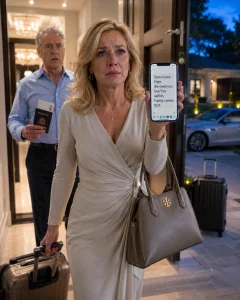
“Cancel your flight, Mom. We need you here.”
My son Michael didn’t ask.
He commanded.
It was 9:47 that night, exactly eleven hours before my husband Robert and I were supposed to board our flight to Charleston for the trip we had dreamed about for five years. It wasn’t just a vacation. It was our 32nd wedding anniversary, a week by the coast on Hilton Head Island, in a small rental cottage with a porch, morning coffee, and slow dinners with no one rushing us.
Five years of saving.
Five years of saying, “Maybe later.”
Five years of watching grandchildren, lending money, canceling plans, postponing doctor’s visits, birthdays, little getaways, and even quiet moments that belonged only to us.
I was in our bedroom in Phoenix with two dresses spread across the bed, trying to decide whether to pack the navy one or the cream one. Robert was checking the reservation, smiling like a boy holding tickets to the county fair.
Then my phone rang.
Michael.
I answered, thinking he might be calling to wish us a safe trip.
“Mom,” he said, barely greeting me, “Ashley starts training Monday. We need you to watch the kids all week.”
I froze.
“Michael, our flight leaves tomorrow at eight.”
“Yeah, I know when your flight leaves.”
That hurt more than shouting.
He knew.
My daughter-in-law Ashley had sent me her training schedule two weeks earlier, but no one had asked for help then. They waited until the night before, when my suitcase was already open, because they knew exactly which button to press.
Guilt.
“Son, we’ve already paid for everything.”
“Then cancel it. Family comes first.”
A second later, his text appeared.
“Don’t be selfish. Family comes first. Cancel your trip.”
I read it twice.
And I felt something inside me—something old, tired, and trained to obey—break silently.
Robert took off his glasses.
“Everything okay?”
I looked at the cream dress on the bed. I looked at my half-packed suitcase. I looked at my husband, the man who had waited for years while I ran to solve emergencies that were almost never real emergencies.
“No,” I said softly. “But I think I finally understand something.”
Michael called again at 10:22.
This time, he talked longer. The babysitter was too expensive. Their mortgage had gone up. Ashley couldn’t miss the training because it could lead to a promotion. Emma had homework. Noah kept waking up at night. I was the only one who knew how to calm them.
Everything he said was true.
And that was what made saying no so hard.
Because my grandchildren were the light of my life. Because Michael was my son. Because part of me still believed a good mother was supposed to bend until she broke and never complain.
But that night, I couldn’t.
“Michael,” I said when he finished, “I understand things are difficult. I understand you need help. But I am not canceling my trip.”
Silence.
Then his voice turned cold.
Hard.
“Fine. Then remember this when you need something from us someday.”
For thirty years, those words would have destroyed me.
I would have hung up crying. I would have apologized. I would have woken Robert and told him that, once again, we couldn’t go. I would have called the airline with a lump in my throat.
But that night, I only said,
“I’ll remember that you said it.”
And I hung up.
Robert stayed quiet for a moment. Then he closed the folder with our itinerary.
“So… we’re really going?”
My phone buzzed again on the bed.
I didn’t touch it.
“Yes,” I said. “We’re going.”
At 11:18, Ashley sent one message. Then another. Then another.
“It would only be two days.”
“Michael is really stressed.”
“The kids keep asking about you.”
“I thought we could count on you.”
I turned the screen off.
But at 5:22 the next morning, while bitter coffee filled the kitchen with its smell, I saw Michael’s final message:
“If you get on that plane, don’t ever call us again.”
Robert looked at me from across the table.
“Linda… we can still stay.”
I slipped my phone into my purse.
My hands hurt. My chest hurt. It hurt to be a mother and choose myself at the same time.
But I picked up my suitcase.
“No. We’re going.”
And when we closed the front door behind us, my phone started ringing again.
For the first time in decades, I didn’t answer.
I had no idea what Michael would do when he realized his threat had not stopped me.
The Phoenix airport was cold and almost empty when we arrived.
I walked beside Robert feeling like I was committing a crime. Not a real crime, of course. Something worse for a mother who had spent her whole life making herself available: the crime of having a life of her own.
My phone vibrated inside my purse like a trapped animal.
I didn’t take it out.
As we waited in the security line, Robert took my hand.
“You don’t have anything to prove to me,” he said. “If you truly want to go back, we’ll go back.”
I looked at him.
He had dark circles under his eyes. He had been awake all night too. Not because of the trip.
Because of me.
For years, Robert had never forbidden me from helping Michael. He had never complained directly. He simply canceled things with me. He put away his good shirt. He folded the tickets and placed them in a drawer. He always said, “Don’t worry about it,” with such quiet sadness that I pretended not to hear it.
“I want to go,” I told him. “Even if I’m scared.”
At the gate, right before boarding, I made the mistake of checking my phone.
Nineteen messages.
Michael had written:
“So you’re really abandoning us?”
Ashley:
“The kids aren’t the ones at fault.”
Then Michael again:
“Good to know who you really are.”
The last message hurt the worst.
“Emma asked why Grandma chose the beach.”
I felt myself sinking.
Emma was seven. Noah was four.
They should never have been dragged into this. They should never have been made to carry adult words sharpened like knives.
I stood up.
“I’m going to the restroom,” I lied.
I locked myself in a stall. With rolling suitcases outside and flight announcements echoing overhead, I cried without making a sound.
I wanted to answer.
I wanted to explain.
I wanted to send a voice message saying I loved them, that I wasn’t abandoning anyone, that one week away did not erase seven years of school pickups, homemade soup, school uniforms, pediatrician visits, and sleepless nights whenever Michael and Ashley “just couldn’t do it anymore.”
But I sent nothing.
Because I realized something frightening:
If I answered from guilt, I would walk straight back into the cage.
When boarding was announced, Robert was waiting for me.
“Ready?”
I looked at the airplane door.
Then I looked at my phone.
And I switched it to airplane mode.
When the plane lifted into the sky, I expected guilt to steal the breath from my lungs.
It didn’t.
What came instead was silence.
A strange, unfamiliar, almost uncomfortable silence. As if, after so many years, my life had stopped making noise for everyone else, and I could finally hear myself.
We landed in Charleston under bright afternoon sun.
The moment I turned my phone back on, more messages appeared. Michael was no longer pleading.
He was attacking.
Ashley was no longer explaining.
She was making pointed remarks.
But hidden among all those messages was one that made me freeze.
It was from my neighbor, Karen.
“Linda, I don’t know if I should tell you this, but Michael came to your house about an hour ago. He had keys. He went inside with Ashley. They left carrying a folder and something from your desk. Is everything okay?”
I felt the blood leave my face.
Robert read the message over my shoulder.
“What folder?”
I knew.
The red folder.
The one with our bank papers, extra credit cards, copies of our property deeds, and the account where Michael had been listed as an authorized user “just in case something ever happened.”
My son had not only wanted me to cancel my trip.
He had used my absence to enter my home.
And in that moment, I understood the real emergency had only just begun.
We did not go to the cottage first.
We sat in a coffee shop at the Charleston airport, our suitcases at our feet and two untouched cups of coffee cooling on the table. Robert’s jaw was tight. I couldn’t stop staring at Karen’s message.
Michael had entered my house with his key.
For years, that would not have felt serious to me.
He was my son.
He had a copy “because we trusted him.”
He knew where we kept things “for safety.”
He was authorized on one account “in case we got sick.”
Each thing sounded reasonable when said alone.
But together, that morning, they had another name.
Habit.
Abuse dressed up as family.
Robert spoke first.
“We need to call the bank.”
“From here,” I said.
My voice sounded steadier than I felt.
I called.
Verified my identity.
Asked them to freeze all temporary access.
Removed his authorization.
Canceled the extra cards.
Changed passwords.
The bank representative asked twice if I was sure.
Yes.
I was sure.
Then I called Karen.
“Did they force their way in?”
“No, Linda. They just walked right in. But they were rushing. Ashley had a large bag. Michael looked furious.”
I closed my eyes.
“Thank you for telling me.”
“You did the right thing by leaving,” she said softly. “I’m sorry to say this, but sometimes children get used to believing their mother doesn’t have a door.”
That sentence stayed with me.
A mother doesn’t have a door.
For the next several days, we did not go back home.
That was the hardest part—and the most important.
My instinct was to run home, confront Michael, search every drawer, cry, shout, and demand answers.
But Robert held my hand and said,
“If we go back now, he gets exactly what he wanted. The trip ends. And we go right back to obeying.”
So we went to Hilton Head Island.
It was not a perfect vacation.
No ocean can wash away thirty-two years of habits overnight.
We would walk along the beach, and suddenly I would think about Emma.
We would eat fresh seafood, and I would wonder whether Noah had slept through the night.
I would see older couples laughing at nearby tables and feel a strange sadness, because I had deserved that too—I had just never known how to protect it.
But each morning, I breathed a little easier.
Robert started telling jokes again.
I started laughing without checking the time.
We walked along the shoreline at sunset, drank coffee on the porch, I bought a white dress I didn’t need, and a blue notebook where I began writing things I had never dared say out loud.
“I am not a bad mother because I rest.”
“My children can have problems without me automatically becoming the solution.”
“Love does not mean disappearing.”
On the third day, Michael called six times.
I didn’t answer.
He sent a message.
“I need to talk to you about the house.”
I didn’t respond.
Then another message came.
“You’re acting like a stranger.”
I read those words over and over.
And I thought:
Maybe I was.
Maybe I seemed like a stranger to him because he had never seen his mother set a boundary before.
On the fifth day, Ashley wrote:
“The kids are fine. We found a woman my sister recommended. She was expensive, but everything is handled now.”
I stared at the screen.
Expensive.
That was all.
The crisis that was supposedly going to ruin our anniversary had been solved with planning and money.
Not with my sacrifice.
Not with my guilt.
Not with my life being paused.
That evening, sitting on the porch with the sound of the ocean in the distance, I showed the message to Robert.
He sighed.
“How do you feel?”
So many answers came to me.
Sad.
Angry.
Free.
Guilty.
Lighter.
“Like I walked away from a pot boiling over… and realized it wasn’t even mine.”
Robert smiled.
When we returned to Phoenix, we did not enter the house the way we always had.
We called a locksmith.
Changed every lock.
Checked the study.
The red folder had been moved.
Copies of bank statements were missing.
So was an extra credit card I was certain had been inside.
I didn’t want to imagine why.
I called Michael.
He answered on the second ring.
“Finally.”
“Michael, I need you to come tomorrow at five. You and Ashley. Without the kids.”
“So now you’re making appointments?”
“Yes.”
Silence.
“Mom, you’re overreacting.”
“Tomorrow at five.”
And I hung up.
They arrived late, as if even that was meant to prove they still had control.
Ashley walked in with her arms crossed.
Michael didn’t even greet Robert.
“What is all this?” he asked.
On the table, I placed the now-blocked extra card.
The red folder.
A printed copy of Karen’s message.
And a handwritten sheet of paper.
Michael’s face went pale.
“We went in because I needed to look at some paperwork. I’m your son.”
“You are my son,” I said. “Not the owner of my house.”
Ashley gave a nervous laugh.
“Linda, let’s not turn this into some huge drama. This all started because you didn’t want to help with the kids.”
“No,” I replied. “This started years ago, when you confused help with obligation.”
Michael slammed his palm on the table.
“We’re your family!”
Robert stood up.
“And so am I.”
The room went silent.
Those four words, spoken without raising his voice, carried more weight than any accusation.
Michael looked at his father as if he had just remembered he existed.
I continued.
“Starting today, the keys you had no longer work. I removed your access to our account. I canceled the cards. I changed the beneficiaries and emergency contacts. Not out of revenge, Michael.
Out of clarity.”
“So you’re punishing me?”
“No.
I am simply done rewarding your threats.”
Ashley lowered her eyes.
Michael opened his mouth, but no sentence came out that made him sound innocent.
Then I said the hardest thing of all.
“I love you. I love Ashley. I love my grandchildren. I will keep helping when I can. But from now on, if you need us to watch Emma and Noah, you will ask at least two weeks in advance. If we can, we’ll say yes. If we can’t, you’ll make other arrangements. And if you ever use the children to hurt me again, the conversation ends.”
For the first time, my son did not answer immediately.
I watched anger, shame, surprise—maybe fear—move across his face.
Or maybe it was the slow understanding that a mother can close the door without ever stopping loving her child.
Ashley spoke first.
“Okay,” she said quietly. “We should have asked sooner.”
Michael shot her an irritated look.
But he didn’t argue.
They left twenty minutes later.
There were no hugs.
No dramatic apology.
No perfect movie ending.
Real life rarely arranges emotions that neatly.
For three weeks, Michael barely spoke to me.
Neither did I.
I didn’t chase him.
I didn’t send long messages.
I didn’t try to repair in one afternoon what had taken years to break.
Then, one Tuesday at 7:14 in the evening, a message came.
“Mom, could you and Dad watch the kids next Saturday? If you already have plans, that’s okay.”
I read it three times.
Robert was outside watering the patio plants.
“What happened?” he asked.
I smiled slowly.
“He asked.”
That single word seemed so small.
But in my house, it sounded enormous.
They came that Saturday.
Emma ran into my arms, and Noah proudly showed me a little red toy truck.
Michael brought a bag of sweet rolls.
“I wasn’t sure what to bring,” he said.
“Sweet rolls are always a good choice,” Robert replied.
We ate together.
It wasn’t perfect.
But it was different.
After lunch, Emma climbed onto my lap.
“Grandma, will you show me pictures of the ocean?”
I showed her the beach, the porch, the white dress, the dark waves beneath the pink evening sky.
“Is that why you didn’t come?” she asked.
Michael stiffened.
I gently stroked my granddaughter’s hair.
“Yes, sweetheart. Grandpa and I had a very important trip. But that doesn’t mean I don’t love you.”
Emma thought for a moment.
“My mom says people need to rest too.”
Ashley lowered her eyes.
Michael said nothing, but something shifted in his expression.
As if he finally understood—too late, but still understood—that I had not chosen the beach over my family.
I had chosen to remain a person inside it.
That night, I taped a drawing Emma made to the refrigerator.
She had drawn two small figures holding hands in front of a giant wave.
“That’s you and Grandpa,” she told me.
I looked at it for a long time.
For years, I believed a good mother was someone who was always available.
Now I know a mother also teaches by closing the door, packing her suitcase, silencing her phone, and standing firm even when her heart is trembling.
I still help.
I still love.
I still answer when there is a real emergency.
But I no longer confuse love with making myself available so other people never have to plan ahead.
The plane didn’t wait.
And there was no reason my life should have kept waiting either.