Chapter 1: The Facade at the Threshold
Treachery, as I have learned through decades of examining the darkest, most labyrinthine corners of human nature, almost never announces itself with a feral roar. It does not kick down your front door wielding a weapon. Instead, it slithers into your life draped in expensive, meticulously pressed fabric. It approaches wearing a highly practiced, sympathetic smile, offering you a cup of tea while it discreetly calculates the fastest way to sever your throat.
My son-in-law, Daniel Hart, stood perfectly framed within the grand, neoclassical entryway of my daughter’s sprawling suburban estate. His dark, pomade-slicked hair was impeccably dry, his manicured hands were entirely devoid of dirt, and suspended from a heavy silver chain around his neck rested my daughter’s custom-cut diamond wedding band. It caught the dull, bruised-gray light of the autumn storm raging behind me, swaying slightly against the starched collar of his azure button-down shirt like a captured, hypnotic pendulum.
“Emily has departed for a sudden, holistic silence retreat,” Daniel announced. His voice was an auditory masterpiece—smooth, rhythmically practiced, and entirely devoid of any genuine, human concern. “No cellular devices are permitted on the premises. No external drama, no toxic familial entanglements. She specifically requested, just before she boarded the shuttle, that I convey her absolute need for you to respect her privacy during this critical healing process.”
Behind me, the torrential November rain battered the heavy copper awning of the porch. It sounded like a thousand frantic, skeletal fingers drumming out a desperate, unheeded warning against the metal. The wind howled through the skeletal branches of the neighborhood oaks, but the chill that settled deep into the marrow of my bones had nothing to do with the weather.
I did not immediately offer him a reply. Instead, I let my gaze drift past his broad, athletically sculpted shoulders, sweeping the expansive interior of the grand foyer.
The house was immaculate. Disturbingly, surgically so.
The sharp, abrasive scent of industrial-strength lemon bleach aggressively masked the usual warm, inviting aroma of Madagascar vanilla and dark roast coffee that always, without fail, lingered in Emily’s home. The antique brass hook by the mahogany front door—the hook she had purchased at a flea market in Paris—was empty. Her favorite navy-blue, wool-lined trench coat was noticeably absent.
Yet, tucked beneath the deep shadow of the bottom step of the sweeping oak staircase, sat her faded, gray running shoes.
They were caked in fresh, wet, heavy clay mud.
My daughter, since her grueling, sleep-deprived days at university, possessed a deeply ingrained, almost superstitious attachment to those worn sneakers. She absolutely refused to pack a suitcase for even a trivial overnight business trip without placing them at the bottom of her bag. She was fundamentally convinced they were her personal talisman against misfortune. Seeing them abandoned, soiled, and shoved hastily under a stairwell was akin to seeing a ghost.
“A holistic silence retreat,” I echoed, keeping the cadence of my tone entirely neutral, flat, and unreadable. I did not let my eyes linger on the mud for more than a fraction of a second.
Daniel shifted his considerable weight, folding his muscular arms across his chest in a theatrical posture of forced, long-suffering patience. For the four excruciating years of their marriage, he had continuously, fatally mistaken my quiet, deliberate demeanor for intellectual fragility. At countless forced Thanksgiving dinners and suffocating Sunday brunches, he possessed a chronic habit of speaking over me, eagerly correcting my deeply researched opinions, and condescendingly labeling me as “quaintly, delightfully old-fashioned” whenever my quiet observations cut a little too close to the bone of his manufactured reality.
“Precisely, Margaret,” he sighed, emphasizing my name with a patronizing, elongated lilt. “A specialized retreat. You are tangentially aware of the modern concepts of trauma healing, aren’t you? The vital importance of establishing firm boundaries? These are complex psychological necessities that, frankly, your generation often struggles to comprehend. She needs space from your overbearing influence.”
A fluid, predatory shadow detached itself from the hallway wall behind him. His mother, Patricia, glided smoothly into the ambient light of the foyer chandelier. She clutched an oversized crystal goblet filled to the brim with blood-red Pinot Noir. Her lips, painted a severe crimson, curled into a smile that was sharp enough to slice through glass.
“The poor, fragile girl simply required an isolated sanctuary from your incessant, neurotic hovering, Margaret,” Patricia chimed in, taking a slow, deliberate sip of her wine, her eyes glittering with malice. “She confided in me just yesterday that she felt utterly suffocated. She wept on my shoulder, claiming she could barely draw a single, independent breath under your constant, judgmental surveillance.”
My heart performed a slow, agonizingly painful contraction against my ribs. It felt as if a physical fault line had suddenly cracked open right through the center of my chest.
Exactly forty-eight hours prior, at 2:14 in the morning, Emily had dialed my private, unlisted number. The digital connection had been terrible, filled with a heavy, trembling static that sounded like the ocean. She had not offered a lengthy monologue or an explanation. She had simply whispered, her voice fractured with absolute terror: “Mom? If the atmosphere here… if things turn worse than before… can I come back to my old room?”
I had answered with a single, immediate word: “Always.”
Then, there was a sharp, violent click, and the line had gone dead. I had driven slowly past her sprawling house the following morning under the guise of running errands, but Daniel’s massive black SUV had been aggressively blocking the driveway, and the heavy blackout curtains across the entire first floor were tightly, uncharacteristically drawn.
Now, this man stood before me, wearing the ultimate symbol of my daughter’s marital devotion around his neck like a grotesque trophy claimed in a bitter, unrecorded war.
“I require direct, verbal communication with her immediately. Let me step inside and speak to my daughter,” I stated, allowing my voice to drop an entire octave, stripping away the polite veneer of a visiting mother-in-law.
His artificial, practiced smile vanished instantly, replaced by a thin, cruel, entirely bloodless line.
“You do not possess the legal or moral authority to micromanage my wife, Margaret,” he hissed, his mask slipping just enough to reveal the tyrant beneath. “She is not your property. She is mine to care for. Now, remove yourself from my porch.”
Patricia let out a soft, mocking chuckle, swirling the dark wine in her glass. “Do yourself a massive favor and drive back to your dusty little house, Margaret, before you make a hysterical spectacle of yourself on our front lawn. The neighbors are already looking.”
I looked at the diamond ring resting against his chest. I looked at the aggressively bleach-clean floors. And finally, I looked directly into Daniel’s cold, unyielding, obsidian eyes.
He thinks I am merely a grieving, powerless old woman, I thought, a strange, absolute calm settling over my violently trembling nervous system. He has absolutely no idea what I am capable of.
I offered a single, curt, conceding nod.
The abruptness of my apparent surrender clearly caught them both off guard. Daniel blinked, his aggressive, defensive posture loosening a fraction of an inch as confusion flickered across his face. Without uttering another single syllable, I pivoted sharply on my heel and descended the wet, slippery brick steps into the freezing downpour. I climbed into the damp driver’s seat of my unassuming, ancient sedan, started the sputtering engine, and eased out of their driveway. I maintained a painfully slow, defeated pace, ensuring that if Daniel was monitoring my departure through the frosted glass of the front door, he would see exactly what he expected to see: a broken, submissive old woman retreating into the storm.
I drove exactly two blocks until the grand estate was entirely obscured from view by the twisting suburban roads. Then, I sharply cranked the steering wheel, easing the car off the pavement and behind a towering, impenetrable row of overgrown, prickly cedar hedges belonging to a vacant, foreclosed property.
I killed the engine. I extinguished the headlights. I sat in the suffocating darkness of the car, listening to the rain hammer against the roof.
For thirty-one consecutive years, polite society, including my own late husband, had referred to me simply, dismissively, as a “librarian.”
They were not technically incorrect. I had indeed spent three decades surrounded by towering stacks of paper, the smell of decaying binding glue, and absolute, mandated silence.
What the general public, and most certainly Daniel Hart, failed to comprehend was that prior to my quiet, early retirement, my official county title was Chief Evidence Archivist for the district prosecutor’s office. I was the invisible, silent ghost the senior district attorneys summoned in a panic at 3:00 AM when a high-profile homicide or a complex corporate fraud case was crumbling to dust due to one missing, infinitesimal detail.
My entire professional existence had been ruthlessly dedicated to the meticulous categorization, preservation, and analysis of human deception. I knew the precise, halting cadence of a fabricated alibi. I understood exactly how sheer terror disguised itself in the microscopic spaces between spoken words. I had spent my life reading the ledgers of monsters.
Most importantly, I knew the soul of my own child.
I aggressively zipped my heavy raincoat all the way up to my chin and stepped back out into the violent storm. I did not walk down the illuminated, paved sidewalks. Instead, I navigated stealthily through the muddy, treacherous back alleys and soaking, overgrown backyards of the neighborhood, allowing the deafening deluge to mask the sound of my squelching footsteps.
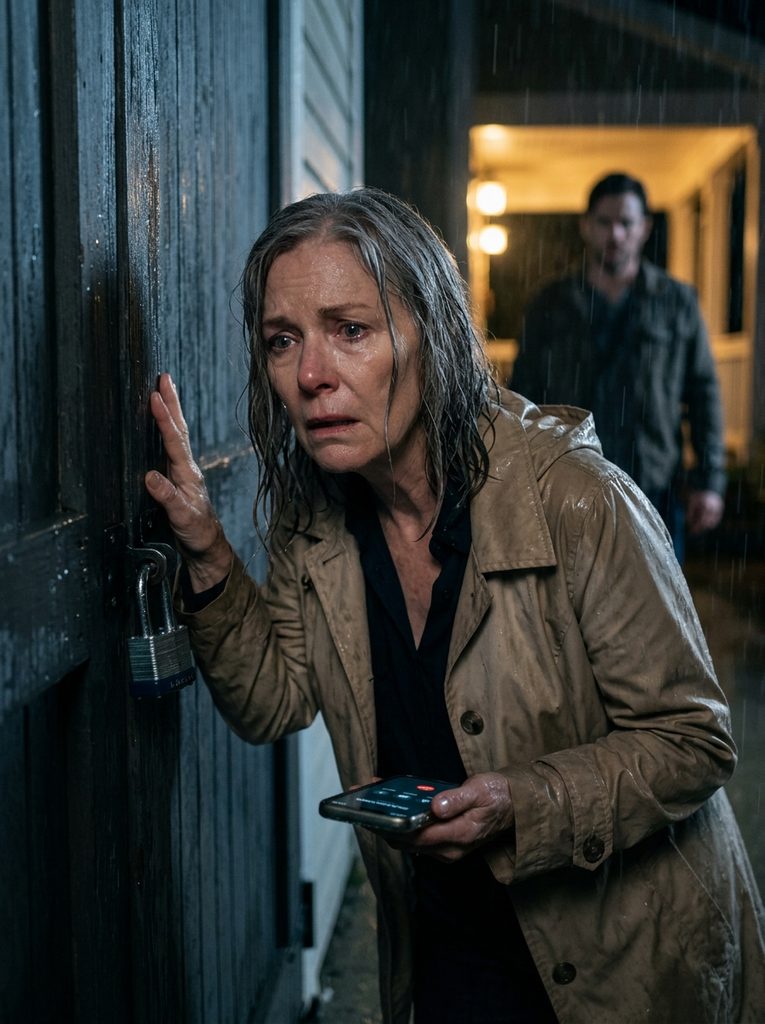
As I crested the rotting wooden fence at the very rear of Emily’s expansive property, I slipped undetected into the deep, pooling shadow of their detached, aging garage.
That was when I noticed the glaring, terrifying anomaly.
Affixed securely to the heavy, reinforced side-entry door of the wooden outbuilding was a gleaming, heavy-duty titanium padlock. It was completely pristine, reflecting the distant streetlights. It was entirely devoid of any rust, dirt, or scratches—a glaringly modern, violent addition completely out of place on the weathered, peeling wood.
The air instantly vanished from my lungs. A cold, serpentine dread, far more chilling than the autumn rain soaking through my clothes, coiled deep within my gut.
I stepped closer, ignoring the mud ruining my slacks, and pressed my cheek directly against the rough, splintering surface of the heavy door. The wood was freezing against my skin.
“Emily,” I breathed into the microscopic gap between the heavy door and the warped frame, my voice barely a whisper against the wind. “If you are in there… if that is you… knock.”
For one agonizing, suffocating second, there was absolutely nothing but the relentless drumming of the storm against the asphalt roof. My analytical mind began to violently race with a hundred catastrophic, bloody possibilities.
Then, cutting faintly through the ambient, roaring noise of the rain, came the sound.
Thud.
A long, terrifying pause.
Thud.
Another agonizing, breathless pause.
Thud.
Three distinct knocks. They were painfully slow. Desperately, heartbreakingly weak.
But they were alive.
Cliffhanger: The sheer, overwhelming wave of relief was instantly swallowed by a terrifying, paralyzing realization. I was a sixty-year-old woman standing entirely alone in a dark storm, and the powerful, volatile man who had caged my only child was sitting twenty yards away, likely watching the backyard monitors from a warm room. If I made a single wrong move, Emily would pay the price with her life.
Chapter 2: The Architecture of Confinement
I fiercely, violently denied my own biology the right to panic. I ruthlessly suppressed the primal, burning maternal urge to scream her name into the darkness, to claw at the titanium lock until my fingernails splintered and bled.
Hysteria is a fragile luxury afforded only to those who do not intimately understand the lethal mechanics of danger. As an archivist, I knew that acting on emotion was the fastest way to lose the war. I could not, under any circumstances, give Daniel the strategic, tactical gift of an early warning.
Moving with deliberate, ghostly silence, I slowly retreated from the massive garage door, backing away step by agonizing step until the thick, drooping canopy of a massive weeping willow tree completely concealed my silhouette from the windows of the main house. With trembling, rain-slicked fingers that felt like blocks of ice, I retrieved my encrypted cellular phone from the deepest interior pocket of my coat and dialed 911.
“County Emergency Services, what is your exact location and the nature of your emergency?” the dispatcher’s professional, detached voice crackled softly into my earpiece.
“My name is Margaret Hale. My daughter, Emily Hart, is currently locked inside a detached, reinforced garage against her will at 442 Elmwood Drive,” I articulated with a chilling, clipped precision that I hadn’t used since my days in the prosecutor’s basement. “I am reporting an active, unlawful confinement and potential domestic kidnapping. The primary perpetrator, her husband, is currently inside the main residence. I have just established physical, auditory contact with the victim through the barricaded door.”
The rapid sound of the dispatcher’s typing abruptly paused. The professional detachment slipped slightly. “Ma’am, are you currently in a safe, concealed location?”
“No,” I replied, wiping a blinding stream of freezing rainwater and sweat from my brow. “But I assure you, I am entirely calm and in control of my faculties. Dispatch your tactical units immediately, but approach without sirens until they turn onto Elmwood. He is a massive flight risk, and he is highly volatile. If he hears you coming, he may attempt to destroy the evidence—or the victim.”
I ended the connection abruptly before she could offer standard, useless platitudes about staying calm. I immediately initiated a second, far more crucial call. It rang four agonizing times before a gruff, deeply familiar, sleep-heavy voice answered.
“Whitaker,” the voice growled into the receiver.
“Judge Whitaker, it has been a few long years. It is Margaret Hale,” I said, keeping my voice hushed, shielding the phone from the wind with my body. “I require an emergency, expedited welfare response to be officially documented and authorized in the county judicial system, effective immediately.”
A heavy, absolute silence fell over the encrypted line. Judge Marcus Whitaker and I had built a dozen airtight, flawless convictions together in our younger, highly stressful days. He knew intimately that I did not traffic in exaggerations, hysteria, or false alarms. If I called his personal line at this hour, the world was on fire.
“Margaret,” he breathed softly, the sleep entirely gone from his voice. “Is it… is it Emily?”
“Yes.”
“I am activating the duty magistrate and the on-call precinct captain right this second. I’m on it. Keep your head down and do exactly what you do best: document everything.”
Daniel had profoundly, perhaps fatally, miscalculated the specific breed of woman he had chosen to belittle and dismiss.
Three years prior, during a sweltering heatwave in mid-July, Emily had arrived at my house wearing a thick, heavy wool turtleneck. When she bent over to pet my dog, the collar slipped, revealing a ring of horrific, purplish-black bruises blooming around her delicate throat like a morbid necklace.
I had not immediately driven to their house to confront him. Confrontation without absolute, undeniable leverage is merely a tantrum that ultimately punishes the victim. Instead, I had gently packed my sobbing, terrified daughter into my car and driven her to a highly private, specialized legal clinic two counties over, far out of Daniel’s sphere of influence.
There, shivering violently in an air-conditioned room, deeply humiliated by her own enduring, tragic love for a monster, she had signed a sealed, legally binding domestic safety and proxy protocol. It legally, irrevocably designated me as her primary emergency contact, her sole medical proxy, and granted me immediate, temporary power of attorney in the event of her sudden incapacitation, injury, or unexplained disappearance.
I vividly recalled holding her trembling, ice-cold hands across that sterile conference table. I had wiped a single, silent tear from her bruised cheek and murmured, “Emily, signing this document is not a betrayal of your sacred marriage vows. It is the installation of a hidden, fireproof door. Should you ever find yourself trapped in a burning room, you will have a way out. And I will be the one holding the key.”
Now, standing ankle-deep in mud in the torrential downpour, I watched the dark street through the swaying willow branches.
That hidden door was finally, violently swinging open.
Exactly twelve excruciating minutes later, the strobing, aggressive reflection of red and blue tactical lights fractured the darkness of the rain-slicked street. Two heavy patrol cruisers slid to a halt at the curb, their sirens mercifully muted, their tires hissing against the wet asphalt.
The heavy oak front door of the house swung open so violently it cracked against the exterior wall. Daniel stormed out onto the porch, barefoot, his face twisted into a mask of manufactured outrage and exaggerated, theatrical confusion.
“What is the meaning of this blatant harassment?!” he bellowed, throwing his muscular arms wide as two uniformed, heavily armed officers stepped aggressively onto his pristine lawn. “Margaret, what in God’s name have you done now? Have you entirely, finally lost your fragile grip on reality?”
Patricia scrambled out of the house behind him, clutching a silk designer robe tightly around her neck, bizarrely still shielding her wine glass from the driving rain. “Officers, you must ignore this deranged woman! She is psychologically unstable! She has harbored a toxic, deeply unnatural obsession with our private family dynamic since the wedding day! She needs psychiatric evaluation, not police assistance!”
A young, broad-shouldered officer, whose polished silver name tag read VANCE, approached me with a highly cautious, skeptical expression. His hand hovered nervously near his radio, his eyes darting between my soaked figure and the irate homeowners.
But from the passenger side of the second vehicle emerged a much older, gray-haired sergeant. He stepped heavily under the flickering streetlamp, squinting through the sheets of rain at my face. He froze mid-step.
“Mrs. Hale?” Sergeant Miller asked, his hardened voice softening with immediate, profound recognition. He explicitly remembered the quiet evidence archivist who had helped him secure a seemingly impossible conviction on a complex triple homicide ten years ago by locating a single, misplaced, oil-stained tollbooth receipt buried in a box of thousands.
“Good evening, Sergeant,” I said, my voice as steady as bedrock. “It is good to see you again under terrible circumstances.”
Miller instantly turned his broad back on Daniel’s theatrical, screaming outrage. He didn’t even acknowledge the man’s presence. “Show us exactly what you found, Margaret.”
I watched Daniel’s face in the harsh glare of the porch light. The smugness fractured. The arrogant confidence dissolved into a tight, panicked, chaotic geometry. He realized, in that split second, that the police were not here to manage a crazy mother-in-law. They were here as my personal army.
It wasn’t a total psychological collapse yet. But for a man whose entire source of power relied on total narrative control, it was the beginning of the end.
Cliffhanger: “Let’s take a walk to the backyard, gentlemen,” I instructed, turning toward the shadows. Behind me, I heard the wet thud of bare feet hitting the mud. Daniel had vaulted over the porch railing, sprinting desperately through the rain to intercept us before we reached the dark outbuilding.
Chapter 3: The Siege of Elmwood Drive
Daniel landed heavily in the soaked grass, his bare feet slipping in the mud as he sprinted to cut us off. He practically threw his body across the narrow, paved pathway leading to the rear of the property, blocking the officers’ advance.
“You are trespassing on private property!” he screamed, his voice pitching upward into a hysterical, shrill register that entirely lacked his usual practiced baritone. “You absolutely cannot search my estate without a signed, notarized warrant! I know my constitutional rights! You take one more step, and I will have all of your badges by morning!”
Sergeant Miller stopped, squaring his shoulders, and leveled a cold, unblinking, utterly unimpressed stare at the younger man. “Mr. Hart, we have received a highly credible, highly specific emergency report from a vetted source regarding a civilian in imminent, life-threatening distress on these premises. Exigent circumstances absolutely apply here. Step aside immediately, or I will arrest you for obstructing a lawful investigation.”
“That is a geographical and physical impossibility!” Daniel snapped, spit flying from his lips, mixing with the rain on his face. “My wife is two hundred miles away on a spiritual retreat in the mountains! I can show you the credit card receipts for the booking!”
I stopped walking and turned to face him directly, allowing the freezing rain to wash over my face, letting him see the absolute lack of mercy in my eyes.
“If she is truly two hundred miles away, Daniel,” I said softly, my voice carrying clearly over the storm, “then you shouldn’t have the slightest, most microscopic objection to us inspecting an empty, decaying garage. Unless, of course, you are hiding something else.”
His jaw locked so tightly I could hear the cartilage pop. The veins in his neck bulged against his skin. For a terrifying second, I thought he was going to physically strike me in front of the police. But Officer Vance casually rested his hand on his duty belt, and Daniel slowly, agonizingly stepped aside.
We reached the rear structure. The atmosphere in the backyard shifted, growing incredibly heavy and suffocating. Officer Vance unclipped a heavy tactical flashlight from his vest, shining a blinding, brilliant white beam directly onto the pristine titanium padlock.
Vance stepped up to the rotting wooden panels and rapped his knuckles against it heavily, the sound echoing dully in the night.
“Emily Hart? This is the County Police Department. If you are inside this structure, can you hear my voice? Please respond!”
The backyard fell into a deathly, terrifying silence, save for the relentless patter of rain on the dying autumn leaves. Patricia, who had followed us holding a massive black umbrella, stopped breathing. Her face was chalk-white in the flashlight’s spill.
From the dark, suffocating, pitch-black interior of the garage, the desperate response came.
Thud.
Thud.
Thud.
“That could be absolutely anything!” Daniel lunged forward, his eyes wild and feral, trying to aggressively wedge his body between Officer Vance and the door. “It’s the old plumbing system backing up! It’s raccoons! The structural integrity of the roof is compromised and the wind is banging the joists! You cannot break my property based on a noise!”
Without breaking unbroken eye contact with my son-in-law, I smoothly retrieved my encrypted phone from my pocket. I navigated flawlessly to my securely saved audio files, found the recording from forty-eight hours ago, set the volume to maximum, and pressed play.
My daughter’s terrified, trembling, exhausted voice echoed through the wet darkness of the yard, rendering everyone instantly motionless.
“Mom… if I disappear… if I suddenly stop answering my phone… please, God, don’t believe Daniel. Do not listen to a word he says. He told me today that no one would ever bother looking for me because he’s convinced everyone I know that I’m just dramatic and mentally unstable. Mom, I’m so scared. He’s looking at me differently…”
Daniel stared at the glowing rectangular screen in the palm of my hand as if I were holding a live fragmentation grenade with the pin already pulled. His chest heaved. The architecture of his meticulously constructed lies was collapsing in real-time.
“Vance,” Sergeant Miller barked, his voice laced with sudden, cold, lethal authority. “Get the heavy bolt cutters from the trunk of the cruiser. Now. And call for an EMT unit.”
Cliffhanger: Daniel let out a primal roar of frustration and lunged not at the police, but directly at me, his hands outstretched toward my throat, desperate to silence the woman who had finally cornered him.
Chapter 4: The Vault of Horrors
Before Daniel’s violently outstretched hands could even graze the fabric of my raincoat, Sergeant Miller moved with shocking, brutal speed. He grabbed the back of Daniel’s expensive shirt, twisted viciously, and slammed the younger man face-first into the muddy exterior wall of the garage.
“Do not move a muscle,” Miller growled, his knee pressed deeply into the small of Daniel’s back.
A moment later, Officer Vance returned, sprinting through the mud with the massive, bright red bolt cutters. He wedged the heavy steel jaws around the pristine titanium shackle. The metallic CRACK of the lock snapping sounded like a gunshot in the quiet, affluent neighborhood.
Vance kicked the heavy wooden door. It groaned loudly in protest on its rusted hinges and swung outward, revealing a cavernous, pitch-black space. A horrific wave of stale air washed over us—a nauseating olfactory cocktail smelling of spilled gasoline, damp, decaying earth, and the undeniable, metallic tang of human terror.
Officer Vance swept his blinding flashlight beam slowly into the void.
The beam of light illuminated a chaotic pile of dusty, oil-stained moving blankets shoved into the far corner beneath a workbench.
The pile shifted.
My daughter collapsed forward, dragging herself desperately across the filthy concrete floor, crawling agonizingly into the perimeter of the flashlight’s beam.
For the first time that entire evening, my impenetrable professional facade utterly crumbled. I was no longer an evidence archivist analyzing a crime scene. I was a mother whose soul had just fractured into a million jagged pieces. A shattered, guttural, animalistic sound tore its way up my throat and escaped into the cold night air.
Emily’s lips were terribly chapped, split, and bleeding sluggishly. Her beautiful, expressive face was marred by a vicious, blooming, purple-and-yellow contusion stretched tightly across her left cheekbone, swelling her eye completely shut. Her frail hands shook with violent, uncontrollable, full-body tremors. Trailing from her right wrist were torn, sticky, ragged strips of heavy-duty silver duct tape.
I fell to my knees in the mud, completely disregarding the filthy water soaking into my skin, and pulled her frail, freezing, shivering body fiercely against my chest. She smelled heavily of stale motor oil, urine, and dried tears.
“He took my phone,” she whimpered, her voice a fragile, raspy, broken thread vibrating against my collarbone. “Mom… he dragged me out here by my hair. He said… he said he needed me to be completely dead to the world until Friday so I would finally give up and sign the property transfer documents.”
Daniel, still pinned aggressively against the wall by Sergeant Miller, turned his head, spitting mud from his mouth, pointing a frantic, trembling finger. “She’s hallucinating! She is lying to you! She did this to herself to ruin my reputation! She taped her own wrists to frame me! She’s a lunatic!”
Patricia dropped her umbrella, stepping forward into the rain with a loudly manufactured, theatrical sob, her hands flying to her face. “Officers, please! Look at her eyes! She’s experiencing a severe manic episode! She’s always been fundamentally mentally unstable! We locked her in there temporarily to protect her from harming herself! We were going to call a private doctor in the morning!”
Emily, still shivering violently in my desperate embrace, slowly turned her bruised, swollen face to look at the man she had once vowed to love, honor, and cherish until the end of time. A faint, ghostly, incredibly powerful smile touched her cracked lips. It was the smile of a woman who had survived the fire and emerged as forged steel.
“No, Daniel,” she whispered, her voice gaining a fraction of strength. “I recorded you.”
Daniel went entirely, rigidly still. The frantic, fighting energy instantly drained from his body, leaving a hollow, terrified shell.
Patricia’s complexion shifted rapidly from chalk-white to a sickly, ashen gray. She stumbled backward, clutching her chest.
Officer Vance stepped carefully into the foul-smelling garage. Following Emily’s trembling, pointed finger, he crouched beside an overturned, heavily rusted red toolbox near the door. Reaching carefully beneath it, hidden perfectly from casual sight, he retrieved a black, rubberized AeroFit smart watch.
The tiny, pinprick red light on the side of the digital face was still blinking steadily. It was still actively recording high-definition audio.
More importantly, as I knew full well, it was still seamlessly, silently synchronized via cellular data to the hidden, heavily encrypted cloud server I had personally established for her three years ago—right after Daniel had begun a convenient pattern of “accidentally” dropping her smartphones into the bathtub or backing over them with his heavy SUV whenever she threatened to leave.
The rain continued its relentless, cleansing descent, washing the mud slowly from Emily’s lucky gray running shoes.
Cliffhanger: But looking at Daniel’s vacant, terrified eyes as the handcuffs ratcheted tightly around his wrists, biting into his skin, I knew the absolute truth. His carefully constructed kingdom of tyranny, gaslighting, and abuse hadn’t just begun to burn to ashes; it had just been hit by a nuclear strike.
Chapter 5: The Illusion of Ownership
The wailing sirens of the paramedics finally pierced the neighborhood’s shocked silence, arriving precisely three minutes later. They swarmed the backyard, wrapping a thick, foil thermal blanket tightly around Emily’s shivering shoulders, treating her injuries with the utmost gentleness and respect before carefully loading her onto a stretcher.
I watched as Sergeant Miller officially, forcefully pulled Daniel’s arms behind his back.
That specific, procedural sequence of events mattered to me on a profound, deeply personal level.
For the first time in four agonizing years, my daughter was finally being treated like a precious, invaluable human being entirely worthy of protection, and Daniel Hart was finally being handled like the dangerous, predatory, criminal threat he truly was.
As the cold stainless metal clicked decisively around his wrists, Daniel’s shock violently dissolved into desperate, thrashing fury. He fought against Sergeant Miller, digging his bare heels into the wet, ruined grass, his face contorted in rage.
“You simpletons don’t understand the complex legalities of this situation!” he roared, his voice echoing off the expensive brick facades of the neighboring houses. “She was actively planning to financially ruin me! I am the head of this household! That sprawling estate is legally mine! I paid the property taxes! She owes me that house!”
Emily, sitting on the edge of the ambulance bumper, buried her face in my shoulder, her body racking with sobs so violent I could feel the sharp edges of her prominent collarbones knocking against my sternum.
“No, Daniel,” I projected my voice, making absolute certain it carried clearly over the rain, the idling engine of the ambulance, and his pathetic, desperate shouting. “That entire estate was purchased completely in cash using Emily’s private trust fund—the massive inheritance from my late husband, Thomas. A heavily protected trust fund that I personally structured with a team of corporate lawyers before he passed.”
Daniel suddenly stopped fighting. He froze against the side of the police cruiser, his eyes widening to comical proportions with the sudden, crushing realization of his own utter ruin.
“Your name was never legally affixed to the primary deed,” I continued, savoring every single syllable. “You were never a co-owner. You were, legally speaking, merely a glorified, non-paying tenant living in her shadow.”
Patricia, standing abandoned and soaked on the lawn, her silk robe plastered to her shivering frame, whispered in absolute horror, “Inheritance? A multi-million dollar trust fund? You told me she was broke!”
I turned my piercing gaze to the older woman, letting decades of carefully cultivated disdain bleed freely into my words. “Oh, dear Patricia. Didn’t he tell you the truth? Your arrogant, sociopathic son mistakenly thought he married quiet, malleable, easily controllable money. Then, when he finally realized the ironclad legal truth—that he couldn’t ever access the principal without her notarized signature—he attempted to steal it through brute force, isolation, and physical coercion. And he executed his amateur plan with remarkable, laughable incompetence.”
With Emily’s raspy, legally binding verbal consent, the police executed an immediate, thorough preliminary search of the primary residence while we rode to the hospital. It was a veritable treasure trove of criminal arrogance.
On the massive marble kitchen island, resting casually in plain sight next to a bowl of decorative lemons, they discovered the fraudulent house transfer documents, completely filled out, lacking only Emily’s forced signature. Tucked securely inside a velvet-lined drawer in the master bedroom, buried beneath Daniel’s passport and a stack of cash, they recovered her missing, powered-down smartphone.
But the most damning, inescapable piece of evidence was the unencrypted text message thread between Daniel and his mother, discovered on Patricia’s unlocked tablet in the guest room.
Daniel (Tuesday, 11:42 PM): I have her secured in the outbuilding. Keep her quiet and away from the windows until Friday. I don’t care how cold it gets out there. She needs to break.
Patricia (Tuesday, 11:45 PM): Just make absolutely sure she signs the addendum before you let her out. If Margaret calls sniffing around, tell her the dramatic girl went to a retreat to clear her head. The old library woman won’t notice a thing.
Patricia collapsed heavily into a wrought-iron patio chair as Officer Vance read the messages aloud to her on the porch. She looked as though all the calcium in her bones had suddenly liquefied.
“You… you cannot definitively prove the contextual meaning of those text messages in a court of law,” Patricia stammered weakly, her voice shaking with desperate, pathetic delusion. “It could mean anything.”
I smiled. It was the first genuine, warmth-filled expression of joy I had permitted myself all night.
“Patricia,” I said softly, stepping directly into her line of sight, blocking out the streetlights. “Establishing damning, inescapable context from fragmented evidence is my life’s absolute specialty.”
Cliffhanger: By the time the sun breached the horizon, painting the storm clouds a bruised purple, the massive, unforgiving bureaucratic machinery of the justice system—the very machine I had spent my entire life servicing—roared to life, and its crosshairs were locked entirely on Daniel Hart.
Chapter 6: The Weight of the Record
The speed at which a man’s life can be legally and financially dismantled, when orchestrated by a motivated expert, is a terrifying and beautiful thing to behold.
By dawn, Judge Whitaker had not only signed an emergency, ironclad, no-contact protective order, but he had personally walked it down to the clerk’s office to oversee its immediate, permanent filing in the county system.
By noon, Emily’s aggressive, highly-paid corporate attorney—a shark of a woman I had recommended—had heavily leveraged the horrific police report and the pending felony charges to temporarily, but totally, freeze every joint bank account, credit line, and investment portfolio Daniel had ever breathed on. His credit cards were instantly declined when his lawyer attempted to post his initial, exorbitant bail.
By Monday morning, the district attorney’s office—my former, highly loyal colleagues who remembered exactly who had saved their careers on multiple occasions—had assembled an impenetrable fortress of prosecutorial evidence.
They possessed the crystal-clear, cloud-synced garage recording from the AeroFit smart watch. They had the time-stamped text messages. They had the fraudulent property transfer documents bearing Daniel’s forged notary stamp. They had the extensive, deeply disturbing physician’s report detailing the severe blunt force trauma to Emily’s face and the lacerations on her wrists.
And, most hilariously, they possessed a legally recorded phone call Daniel had frantically made from the county jail holding cell over the weekend.
In that panicked call, entirely oblivious to the loud, automated robotic warning that the line was monitored and recorded by the facility, Daniel had screamed at his weeping mother, “You promised me that stupid old library woman wouldn’t possess the mental capacity to notice she was gone! You said she was just a pathetic bookworm!”
Stupid old library woman.
I formally requested that specific, certified transcript be elegantly framed in mahogany for my home office.
Six agonizing months later, the preliminary hearing finally commenced. The county courthouse smelled heavily of sharp lemon polish, ancient dust, and old, lacquered wood—a specific, comforting scent that felt like an embrace to my soul.
Daniel sat at the heavy oak defense table wearing a custom-tailored, charcoal Italian suit that was far too expensive for a man whose total liquid assets were currently locked behind a federal financial injunction. His arrogance, however, had not entirely evaporated. Despite his highly precarious legal situation, he slowly turned his head and stared directly at Emily, who sat rigidly beside me in the crowded gallery. He utilized the same dark, commanding, psychological glare he had weaponized for years, attempting a final, desperate play to bend her will through sheer, silent intimidation.
My daughter did not avert her eyes. She did not shrink into her chair. She stared back at him, her chin raised proudly, her gaze forged from absolute, unyielding steel.
When the lead prosecutor, a sharp young woman I had mentored years ago, formally entered the audio file extracted from the watch into evidence and pressed play, the densely packed courtroom plunged into a horrified, breathless silence.
Daniel’s own voice, slightly distorted by the garage acoustics but entirely, unmistakably his, hissed venomously from the heavy wooden speakers mounted high on the walls.
“Just sign the damn property over, Emily, and this all ends tonight. Nobody is coming for you. Your pathetic mother certainly won’t save you. She’s just a retired, invisible nobody with decades of library dust in her lungs. She doesn’t have the guts.”
Then came the agonizing, gut-wrenching sound of Emily’s weak, terrified weeping: “Please, Daniel… it’s freezing… I can’t feel my fingers… please let me out.”
Then, the secondary, damning voice. Patricia’s voice, shockingly cold and completely detached, echoing from the background of the recording: “Leave her in the dark, Daniel. Don’t give her the blanket. Not until she finally learns her place in this family.”
Cliffhanger: The presiding judge did not even wait for the pale, sweating defense attorney to stand and speak. He slammed his heavy wooden gavel down with the force of a gunshot, denying bail on the spot, citing an extreme, proven flight risk and a clear, documented, lethal threat to the victim’s life.
Chapter 7: Sunlight on Lake Oconee
Daniel’s perfectly maintained face entirely emptied of color. The arrogant, practiced sneer vanished instantly, replaced by the hollow, gaping, utterly terrified look of a man watching the earth physically open up to swallow him whole.
Patricia attempted to stand from her seat in the front row of the gallery to protest the judge’s ruling. Her knees completely buckled beneath her. She collapsed heavily back onto the unforgiving wooden bench, burying her face in her trembling hands, her narrow shoulders heaving with ugly, gasping, entirely unpitied sobs.
In the end, there was no drawn-out, dramatic jury trial. Faced with a mountainous, insurmountable pile of undeniable, chronologically archived, ironclad evidence, Daniel’s legal counsel forced him to accept reality. He pleaded guilty to unlawful restraint in the first degree, felony coercion, aggravated domestic assault, and attempted high-level financial exploitation of a vulnerable person. He was sentenced to twelve years in a state penitentiary, without the possibility of early parole.
Patricia, who had actively, maliciously helped plan the confinement and attempted to conceal the ongoing abuse, took a desperate, groveling plea deal of her own to avoid a lengthy prison sentence, accepting five years of strict house arrest and massive punitive fines.
The professional fallout was absolute and devastating. Daniel was permanently, publicly stripped of his state license as a financial adviser. Patricia, following a swift, ruthless investigation by the state medical board, permanently lost her nursing certification. The investigators had been particularly disgusted and appalled by her calculated use of clinical psychological terminology to systematically paint a genuine victim of domestic abuse as mentally unstable.
The sprawling, oppressive suburban house on Elmwood Drive was immediately put on the market. It sold to a lovely, vibrant young family with a golden retriever within a week.
Emily had made that financial decision without a single second thought.
“I don’t want to live inside walls that still possess the toxic memories of his voice,” she told me, signing the massive stack of closing documents with a completely steady, unwavering hand.
So, utilizing her newly reclaimed, fiercely protected trust fund, we purchased a much smaller, incredibly beautiful property nestled right along the quiet, pine-lined shores of Lake Oconee. It featured expansive, floor-to-ceiling windows that let in massive amounts of natural light and a bright, sun-drenched yellow kitchen that smelled only of fresh air and pine needles.
On the very first morning in our new sanctuary, I walked slowly downstairs, wrapped in a comfortable robe, to find Emily standing at the marble kitchen island. She was carefully making pour-over coffee. She was entirely barefoot, save for her lucky, permanently mud-stained gray running shoes.
The horrific bruise on her cheek had entirely faded into a distant, yellowish memory, leaving behind only the vibrant, beautiful face of the daughter I had always known.
She poured a steaming, fragrant mug of dark roast coffee and slid it gently across the cool marble counter toward me.
“You came back for me,” she said softly, her bright eyes shining with unshed, happy tears. “Even when he stood there and told you to leave. Even when he lied right to your face and made you feel small.”
I took the warm ceramic mug in my hands, letting the heat seep into my palms, looking at my remarkable, resilient daughter, entirely alive and bathed in the golden, pure morning sunlight.
“I am an archivist, Emily,” I replied, taking a slow, deeply satisfying sip of the coffee. “I have spent my entire life learning exactly how to look for the hidden things that desperate people try to bury in the dark. But more importantly, my darling…” I reached out and gently touched her hand, “…I heard three knocks in the dark. And for a mother, that was the only piece of evidence I ever needed.”
Outside, the autumn rain began to fall once more, drumming a soft, rhythmic, entirely peaceful lullaby against the reinforced glass of the wide, beautiful windows.
This time, hearing the storm approach, neither of us flinched.