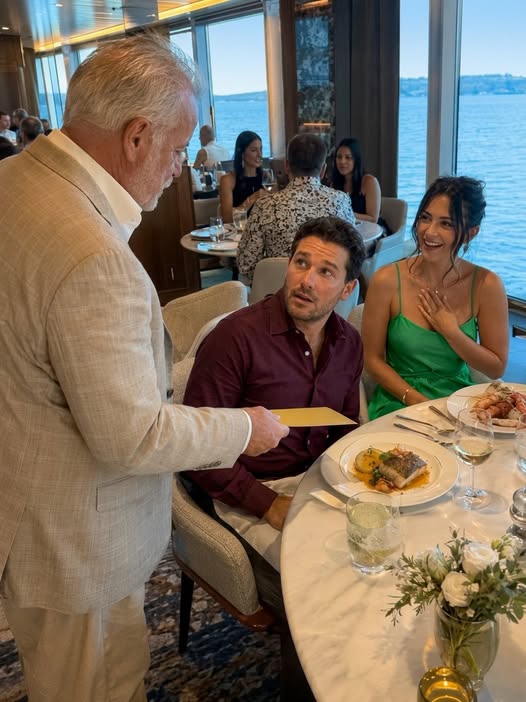
My son and his wife posted a photo drinking mimosas on the deck of the world’s largest cruise ship. The caption read, “Family vacation, just the three of us.”
They were right about the number. Three. They took their biological son. They took their luggage. And they left my eight-year-old adopted granddaughter locked in a dark house with a loaf of moldy bread and a note that said, “Be good.”
They thought I was just a retired old man who wouldn’t notice. They forgot that before I was a grandfather, I was a logistics commander for the United States Army.
And I do not leave people behind.
The red numbers on my alarm clock read 2:03 a.m. In the work I used to do, sleep was a luxury, not a right. You learn to wake up instantly. No grogginess, no rubbing your eyes. When the phone on my nightstand vibrated against the wood, I was awake before my hand touched it.
I expected a wrong number, maybe a robocall. I did not expect the sound of a child trying not to cry.
“Grandpa.” It was a whisper so quiet I almost missed it. Mia, my eight-year-old granddaughter, her voice shaking so hard the syllables vibrated.
“Mia.” I sat up, the sheets falling to my waist. “Why are you whispering? Is everything okay?”
“Grandpa, I’m thirsty.”
The confusion hit me first. Thirsty? Why was she calling at two in the morning because she was thirsty? Her bedroom was just down the hall from her parents’ room. Austin and Monica were heavy sleepers, but they weren’t deaf.
“Honey, go ask your daddy for water. It’s late.”
“I can’t.” Her voice cracked, a tiny splintering sound that made the hair on the back of my neck stand up. “The door is locked, Grandpa. The big door. The front door, and the back door, and the garage door. I knocked on Mommy and Daddy’s room, but nobody answered. I think they’re gone. It’s really dark, and I heard a noise in the basement, and I’m scared.”
My blood ran cold. A physical sensation, like someone had injected ice water directly into my veins. I didn’t ask another question. I didn’t ask her to check again. A man knows when something is wrong. It’s an instinct I survived thirty years in the military by listening to, and right now it was screaming.
“Listen to me, Mia.” I was already out of bed, pulling on my trousers one-handed. “I want you to go into your closet, take your blanket, close the door, and sit there. Do not come out until you hear my voice. Do you understand?”
“Yes, Grandpa.”
“Stay on the line if you want. But don’t make a sound.”
I shoved my feet into my boots, grabbed my keys, and paused. I opened the top drawer of my nightstand and took out my Sig Sauer. Checked the chamber. Loaded. I didn’t know what was waiting for me at Austin’s house. Maybe a break-in. Maybe they were hurt. But if someone was in that house frightening my granddaughter, I wasn’t going to greet them with a handshake.
I drove the twenty-minute route in twelve, tearing through the suburban silence, running stop signs at empty intersections. The phone lay on the passenger seat, the line open but silent. And every mile, my mind worked. Austin was my son, and Austin was soft. He’d always been soft, too worried about what people thought of him. But Monica, my daughter-in-law, was different. She was cold in a way that pretended to be warm.
I pulled into their driveway and my headlights swept the front of the house. Dark. Completely dark, not even the porch light on. And the driveway was empty. Austin’s SUV, gone. Monica’s sedan, gone.
I killed the engine, grabbed the spare key from my glove box, and ran to the front door, my grip tightening on the pistol in my pocket. “Mia,” I called into the entryway. Silence. I flipped the light switch. Nothing. The power wasn’t out. It had been shut off. I could see the breakers flipped in the panel by the kitchen.
Who shuts off the power when they leave a child home alone?
I used my phone flashlight and took the stairs two at a time, straight to Mia’s room, the smallest room in the house. The guest room was bigger. The office was bigger. Leo’s room, the biological son’s, was twice the size and stuffed with every toy imaginable. Mia’s room held a bed and a dresser. That was all.
“Mia, it’s Grandpa.”
The closet door creaked open and a tiny figure emerged, clutching a teddy bear with a torn ear, the stuffing coming out. I recognized it. I’d bought it for her the day the adoption was finalized three years ago. It was the only toy I could see in the room.
She launched herself at me, trembling so violently her teeth chattered. I holstered my weapon and scooped her up, and she felt light. Too light, like a bird that hadn’t eaten in days.
“I’ve got you,” I murmured into her hair. “You’re safe now.”
I carried her downstairs because I needed to understand. People don’t just vanish. In the kitchen, my flashlight swept across the marble countertops Monica was so proud of, and that’s when I saw it. A piece of yellow notebook paper taped to the refrigerator.
My hand shook as I pulled it off and read Monica’s looping script.
Mia, we’ve taken Leo to a special training camp for his baseball team. Last minute. We’ll be gone two weeks. There’s bread on the counter. Do not go outside. The neighbors will call the police if they see you, and they’ll take you away to a bad place. Be good. We’re watching you on the cameras.
I looked at the counter. A loaf of white bread sat there. I touched the bag. It was hard. Green mold bloomed across the crust.
A rage so pure and hot it almost blinded me rose in my chest. This wasn’t negligence. This was malice. Calculated cruelty. They’d left an eight-year-old alone for two weeks with moldy bread and a threat that the police would steal her away if she sought help.
Then I tried to open the refrigerator, and it wouldn’t budge. My flashlight found the reason: a heavy-duty bicycle chain wrapped around the French door handles, secured with a padlock.
“Why is the fridge locked, honey?” I asked, fighting to keep my voice steady.
“Mommy said I steal food,” she whispered. “She said I eat too much and that’s why groceries are expensive. She said the food inside is for Leo because he’s a growing boy, and I’m just lucky to have a roof.”
I set her on a barstool. “Stay here, baby.” I went to my truck, got the bolt cutters from my toolbox, and came back. The metal snapped with a crack that echoed through the empty house. The chain rattled to the floor, and I pulled the doors open.
The flashlight revealed the truth. Fully stocked. Steaks. Fresh fruit. Milk, juice, rows of yogurt. A birthday cake that said Happy Vacation. They hadn’t chained it to save food. They’d chained it to starve her, while a cake sat inside she could see but never touch.
I cracked open a bottle of water and handed it to her. She drank it in one long gulp, gasping when she finished.
“We’re leaving,” I told her. “Don’t pack anything. We’ll buy you new clothes. Better clothes. Leave everything here.”
At my house, I made her tomato soup and a grilled cheese, and she ate like it was the finest meal of her life. I watched her, and every bite was another nail in the coffin of my relationship with my son. After she fell asleep in the guest room, wrapped in a clean duvet, I went to my study and I did not sleep.
Training camp was a lie. Austin hated baseball, and Leo was terrible at it. I logged into Facebook. Austin’s page was quiet. He was smart enough for that. But Monica couldn’t breathe without posting. Her Instagram was public, and there it was, four hours old. The three of them. Austin in linen, Leo holding a game controller, Monica in a designer bikini with a champagne glass. The water slides, the ocean behind them.
Finally, some peace. Royal Caribbean, Icon of the Seas. 15 days of bliss with my boys. No distractions, just us. #familyfirst #blessed.
No distractions. That’s what she called Mia.
I called the airline. I’ve been a platinum member for twenty years; I know how to get information. I told the tired agent I was Austin’s father, confirming their return flight to pick them up, and gave his date of birth. “Yes, Mr. Slater,” she said. “Tickets for Austin, Monica, and Leo Slater. Booked six months ago. Round trip to Miami, first class.”
Six months.
This was not last-minute. For half a year they had sat at the dinner table with Mia, knowing they were going to leave her behind like unwanted furniture. They had saved. They had planned. They had probably bought that bicycle chain weeks in advance.
The ship had left Miami yesterday. First stop, Nassau, tomorrow.
I looked at the photo of my son one more time. He had my eyes, my chin. But he didn’t have my spine. He was a coward who let his wife abuse a child because it was easier than fighting her.
The sad grandfather who wanted everyone to get along died in that cold, dark kitchen. Bill Slater, logistics commander, was back.
I opened my safe, moved past the bonds and the deed to my house, and reached to the back for my war chest, a thick stack of hundreds wrapped in a rubber band. I counted out ten thousand. Then another ten.
“I’m not just going to rescue Mia,” I whispered to the empty room. “I’m going to crash their vacation. And then I’m going to take my granddaughter back forever.”
I booked two one-way tickets to Nassau. Outside, the sun was coming up blood red. Fitting. I was coming for blood.
The next morning, Mia and I stood in the check-in line at the airport, her small hand sweating in mine. She wore a slightly-too-big pink T-shirt I’d bought at a twenty-four-hour superstore on the way, because we’d left everything behind in that house of horrors.
“Grandpa, are you sure we can go?” she whispered. “Mommy said tickets cost a million dollars.”
“Mommy lies, Mia. We’re going.”
The agent’s name tag read Sarah, and she looked like she’d already been yelled at five times that morning. I gave my most diplomatic smile. “Two one-way tickets to Nassau, please. First class if you have it.” I handed over my passport, Mia’s birth certificate, which I keep in my own safe deposit box, and my platinum metal card, the one with a limit higher than most people’s salary.
Sarah swiped it. Waited. I watched the micro-expression cross her face before she spoke. “I’m sorry, sir. The card was declined.”
Behind me, a man in a suit sighed loudly.
“Try it again, please,” I said calmly. “I carry a zero balance on that card.”
She typed it manually. A long pause. Then she looked up with something worse than annoyance. Pity. “Declined again, sir. It says ‘do not honor.’ You might want to call your bank.”
I stepped to the side and dialed the priority number on the back of the card. “This is William Slater. Authorization code Zulu Tango Niner. Why is my card rejected?”
“Mr. Slater, we froze the account due to suspicious activity. A large cash withdrawal at a branch counter yesterday drained your available liquid limit. Since it was in-person, we assumed it was you, but the travel purchase flagged our fraud algorithm.”
“I didn’t make a withdrawal,” I said, my voice dropping an octave. “How much?”
“Twenty-five thousand dollars, sir. At the Main Street branch. The teller verified the signature on file.”
I closed my eyes. Main Street. Where Austin worked. He wasn’t just a customer there. He was the branch manager. He knew the tellers, the protocols. And he knew exactly how to forge my signature, because he’d spent his whole life practicing it on report cards.
The betrayal hit harder than the money. He had cleaned me out to fund his paradise, making sure that even if I discovered Mia, I’d be too broke to do anything about it. He thought he’d cut my supply lines.
He forgot who he was dealing with.
“Sir,” Sarah said gently, already glancing at the businessman behind me, “if the card’s declined, there’s nothing I can do.”
I didn’t argue. I knelt down on one knee, right there on the polished floor. The businessman snickered. “Look at this, the old guy’s praying.”
I ignored him and reached into my left boot. A habit from my first tour in the seventies. You never trust a bank in a war zone. You never trust a pocket that can be picked. You trust your boots. I unlaced the leather, reached past the ankle support into a lining I’d sewn myself, and pulled out a thick envelope wrapped in plastic.
I stood and set it on the counter. The thud silenced the businessman. I tore the plastic and counted out crisp hundreds, one thousand, two thousand, until the pile looked like something from a drug bust.
“I believe this is legal tender,” I said flatly. “Two first-class tickets to Nassau. Window seats.”
Sarah’s hands shook as she counted. The man behind me had gone silent and was suddenly fascinated by the ceiling.
“Grandpa,” Mia whispered, “why do you have money in your shoe?”
“Because banks make mistakes, Mia,” I said, loud enough for the people around us. “And because sometimes the people you trust most are the ones who steal from you. But you never let them stop the mission. Understand?”
She nodded solemnly. Austin thought he’d disarmed me. All he’d done was force me back to my roots. I wasn’t just a grandfather anymore. I was a soldier deploying to a hostile theater, and I had just secured transport.
At thirty thousand feet, the flight attendant came down the aisle, an older woman with silver hair and a real smile. “Can I get you something to drink, young lady? We have juice, soda, hot chocolate, and warm chocolate chip cookies coming out of the oven.”
I expected Mia’s eyes to light up. Instead, she flinched and shrank back into the leather seat. “No thank you,” she whispered.
“Honey, you haven’t eaten since that grilled cheese. Have some juice.”
She shook her head hard. Then her stomach growled, loud and undeniable. The attendant, kind, left a bowl of warm nuts and a glass of apple juice on the tray table and moved on.
I turned to face my granddaughter and covered her small cold hand with mine. “Mia. Why are you lying to me? I know you’re hungry.”
She picked at a thread on her jeans. “Because it costs money, Grandpa. Mommy said nothing is free. She said when we go places, I have to be careful, because I’m expensive. She said they can’t buy a boat like the neighbors because my adoption fees cost so much. She said every time I ask for juice or a snack, I’m taking money from the family. She said if I’m not careful, the lights will go out, and it’ll be my fault.”
The air left my lungs. Harder than any punch I’d ever taken. This wasn’t just physical neglect. This was psychological warfare. Monica hadn’t only starved her body. She’d poisoned her mind, building a world where an eight-year-old was responsible for the family’s finances.
I thought about the receipts I’d seen helping Austin with his taxes. Monica’s three-thousand-dollar handbags. Austin’s golf membership. The luxury cars, the imported wine. And they’d looked this child in the eye and told her a three-dollar soda was why they were struggling.
I took both her hands and waited until she looked up. “Mia, listen to me very closely. Grandpa used to be in charge of moving supplies for thousands of soldiers. I managed millions of dollars of equipment. I know what things cost. And your mother lied to you. You are not expensive. You are not a burden. The reason they complain about bills has nothing to do with you. You eating a cookie does not make the lights go out. Do you understand?”
“But Mommy said—”
“Mommy is wrong. And right now, Mommy is not here. I am here.” I picked up the apple juice and held it out. “See this seat? This juice? I already paid for it. If you drink it, it’s paid for. If you pour it on the floor, it’s paid for. You cannot waste my money, because I already spent it on you, and I spent it happily. I have enough money to buy this whole plane full of cookies.”
A tiny ghost of a smile touched her lips. “The whole plane?”
“The whole plane. So here’s the new rule. For the next two weeks, you don’t look at price tags. You don’t worry about bills. Your only job is to be eight years old. Eat when you’re hungry, sleep when you’re tired, play when you’re bored. I’ll handle the rest.”
I held out the glass. “Drink it.”
She hesitated one second longer, then thirst won, and she drank the whole thing without stopping. When the cookies and the ice cream came, she ate with a focus that broke my heart, and with every bite I watched her shoulders come down a little more, the terrified little prisoner fading and a child starting to surface.
“Mia,” I said. “Remember this feeling. Being full. Being safe. Because this is how it’s going to be from now on. No one is ever going to lock a fridge on you again. No one is ever going to tell you that you’re too expensive to love. Not while I’m breathing.”
She studied my face for a long moment, searching for the lie. Then she nodded slowly. “Okay, Grandpa.”
The Icon of the Seas wasn’t a ship. It was a floating city, twenty decks high, blocking out the sun, water slides coiling around the top like colorful intestines. Massive, loud, arrogant. Exactly the kind of place Austin would love, a place where you could pretend the real world didn’t exist.
But you cannot just walk onto a cruise ship. It’s a floating fortress. The first guard at the gate told me day passes sold out months ago, that the ship was at capacity, that I should step aside. I didn’t. I’d handled checkpoints in Baghdad and border crossings in Germany. Every barrier has a key, and usually that key is confidence backed by leverage. I pressed five hundred dollars into his palm and asked who handled late additions to the VIP list. He pointed me to a blue tent and a young man named Henderson, who found a loophole the moment I set two thousand in cash on his desk.
“These are valid until four-thirty,” he warned, handing over two lanyards. “If you’re not off by then, you’re sailing to Mexico.”
We had until four-thirty. It was twelve-fifteen.
The Windjammer Marketplace on deck fifteen was a cathedral of gluttony. Pyramids of chilled shrimp. Carving stations slicing prime rib. Towers of dessert. And everywhere, the waste, people abandoning half-eaten steaks because they were too full. Mia walked through it staring at the floor, a child who had rationed moldy bread two days ago now surrounded by mountains of discarded food.
I found them by looking for the center of attention. The ring light gave it away first, a halo of white LED clamped to a table by the floor-to-ceiling windows, the best seat in the house. Monica sat behind it in white linen, rose wine in hand, performing for her phone. Austin sat across from her, sunburnt and soft, a massive lobster steaming on a platter in front of him. And at the end of the table, slumped over a tablet in noise-canceling headphones, sat Leo, my ten-year-old grandson, with a plate of cold chicken nuggets and a look of pure loneliness.
“We’re just so blessed, you guys,” Monica was saying to the camera. “Austin and I really needed this time to reconnect. It’s so important to prioritize self-care.”
“Is that Daddy?” Mia whispered, her lip trembling.
I knelt in front of her. “He has lost the right to be mad, Mia. He has lost the right to be anything but ashamed. Stay behind me. Don’t say a word. Just watch.”
I moved up behind Austin’s chair. Monica was still talking. “We miss the little ones, of course, but sometimes you just have to—” Her eyes drifted past the phone and landed on me, and her smile froze into a rictus of confusion. Her brain couldn’t process it. Bill Slater was in Florida. Bill Slater was not standing on the deck of the Icon of the Seas looking like the angel of death.
“Dad,” Austin choked, dropping the lobster claw.
I didn’t speak. Words were too easy. I wanted an action they couldn’t edit out of the video. I reached into my breast pocket and pulled out the yellow note, tape still on the corners, edges still jagged from the refrigerator. I smoothed it out and slapped it down in the center of Austin’s plate, right on top of the lobster tail. The butter soaked through it, turning the paper translucent, but the words held.
Be good.
The table went silent. Even Leo looked up, pulling off one side of his headphones.
I leaned in, placing my hands on the edge of the table, towering over my son. “I hope the lobster is good,” I said, my voice low but carrying the weight of a sledgehammer. “I hope it tastes better than the moldy bread you left for your daughter.”
Monica scrambled for her phone to kill the stream, but her hands shook and it dropped to the table, still broadcasting. “What are you doing here? Security! Someone call security!”
I laughed, cold and dark. “Go ahead, Monica. Call them. Because I have a video of you chaining a refrigerator shut. And I think the Bahamian police, and the thousands of people watching your little stream, would be very interested to see it.”
Austin stood, knocking over his chair. “Dad, please, people are watching. Let’s not do this here.”
“Sit down.” It was the voice I used to command battalions, and Austin collapsed back into his seat as if his strings had been cut.
I beckoned Mia forward. She stepped out from behind me, clutching her bear, small against the ocean behind her, and stood her ground.
“Look at her, Austin. Look at your daughter. You told her she was too expensive to bring. You left her in the dark to rot while you cracked claws and drank wine.”
He couldn’t look. He stared at the tablecloth. “I didn’t know, Dad. Monica said she hired a nanny.”
“Liar.” I slammed my hand on the table and the silverware jumped. “I saw the bank withdrawal you made forging my signature. You knew exactly what you were doing.”
What happened next, I’d half expected. Monica realized her perfect-vacation narrative was dissolving in front of her audience, so she chose the only role left that kept her innocent. The victim. “Help!” she shrieked, theatrical and piercing. “He’s taking them! He’s kidnapping my children!” She grabbed Leo’s arm and turned to the crowd, tears appearing on command. “He has dementia! He thinks it’s twenty years ago! He broke into our house!”
The room turned against me in an instant. A sunburned tourist stood and blocked my path. “Let the kids go, buddy.” Other men rose, emboldened. Phones lifted. I could see the headline writing itself: Deranged Veteran Terrorizes Family on Cruise Ship.
“Austin,” I barked. “Tell them who I am. Tell them what you did.”
My son looked at the angry mob, looked at his wife’s performance, and chose the path of least resistance. “Dad, please,” he said, voice trembling just enough to sound heartbroken. “Just put the kids down. We can get you help. I told you we’d pay for the facility.”
The same lie he’d once tried to use to steal my house, now deployed to discredit me. The crowd murmured sympathy. And when the ship’s tactical security team arrived, four men with tasers and zip ties, they saw exactly what Monica had staged: a screaming mother, crying children, and a rigid old man with clenched fists in the center of it all.
“Sir, release the minors and step away from the family.”
It was a tactical checkmate. If I resisted, I’d be tased and arrested and lose all standing. If I let go, they’d drag Mia back to that cabin. So I made a calculation. I had to de-escalate physically to escalate legally.
“It’s okay, Mia,” I said softly, kneeling. “I’m not leaving you. I promise. Go stand by Leo.” I let go of her hand and raised my open palms. “I’m complying. I’m unarmed. I have tickets to be on this ship.”
The officer spun me against the buffet counter, and cold zip ties bit into my wrists.
“You’re hurting him!” Leo shouted, throwing his tablet down. “Stop it! Grandpa didn’t do anything. Mom is lying!”
The voice of a child cuts through noise. The crowd went quiet.
“Leo, baby—” Monica rushed to hug him.
“She’s lying!” He shoved his own mother away with a force that surprised everyone. “We left Mia! We left her at home with no food! Grandpa came to save her!”
Monica’s face went pale.
“Officer,” I said, cheek pressed to the cold counter. “Check my breast pocket.”
He hesitated. “Do it,” I commanded. “Unless you want to be sued for unlawful arrest when this unravels.”
He pulled out the butter-stained note and read it aloud. “Mia, we’ve taken Leo to a special training camp. Be good. We’re watching you on the cameras.” He frowned and looked at Monica. “Ma’am, is this your handwriting?”
“No—I mean yes, but he made me write it, he forced me—”
It was a weak, desperate lie, and for the first time the crowd wasn’t buying it. You don’t go on a luxury cruise to escape an abuser while leaving your child behind in his reach.
“I have hard evidence,” I said. “Security footage from inside their house, timestamped. The bank records of the money they stole from me. And a recording of my granddaughter calling me at two in the morning begging for water because they locked the fridge. I want the captain. And I want the FBI contact in Miami on the line, because this is not a family dispute. This is a federal crime scene.”
The officer looked at the note. At the terrified little girl clinging to her brother. At the woman in the expensive dress who had gone very quiet.
“Uncuff him,” he said. “But keep eyes on him. We’re going to the captain’s office. All of us.”
Captain Johansson watched the security footage in his office without blinking. The chain threading through the refrigerator handles. Monica’s voice, clear and casual. She is not going to starve. There is bread on the counter. That is more than she deserves. The padlock clicking shut.
When it finished, he handed the phone back and looked at my son and daughter-in-law, his face carved from granite. “In thirty years at sea, I have seen smugglers. I have seen brawls. I have never seen anything as cowardly as this.” He turned to his team. “Escort Mr. and Mrs. Slater to the brig. Separate cells. Confiscate their devices. They are not guests anymore. They are liabilities.”
“But we paid for a suite,” Austin protested weakly. “We paid twenty thousand dollars.”
“Your refund will be processed by the prison system,” the captain said. “Get them out of my sight.”
Monica screamed about lawsuits and followers the whole way out. Austin went limp, head bowed. And then the captain knelt down to Mia’s level and asked if she liked cheeseburgers, and promised her the biggest one on the ship, with a milkshake.
She gave him a real smile. “Yes, please.”
They put us in a secure guest cabin near the bridge, and that night I built a fort out of pillows and mattresses on the floor, and the three of us, Mia, Leo, and I, crawled inside it together. Because somewhere in those hours, Leo had come to my door in his pajamas, fleeing a mother who was throwing lamps and calling him a traitor for telling the truth. He confessed everything in the dark, how Monica had bought his silence with his PlayStation, how she’d told him I was dangerous, how he’d wanted to believe her because he just wanted to go on the big boat with the slides.
“How can it be okay?” he wept. “I left you. You were in the dark.”
“But you came back,” Mia said simply, crawling across the carpet to put her hand on his shoulder. “You told the truth to the policeman.”
And watching them hold each other, two survivors clinging to the same piece of driftwood, I understood that my mission had changed. I’d boarded that ship to rescue one child. But Leo wasn’t a clone of his parents. He was a hostage, fed a diet of materialism and emotional blackmail the way Mia had been starved of food. Both of them abused, just in different directions. I could not leave him behind to be crushed into another spineless Austin.
“Listen to me,” I told them both in the dark, finding their hands. “I’m not just your grandfather anymore. I’m your guardian. And I don’t care what lawyers your parents hire or how much it costs. You are a package deal now. Team Slater. And no one gets left behind. Not ever again.”
“Promise?” Mia whispered.
“I promise.”
But after they fell asleep, I called Rachel Stein, my lawyer, on the captain’s satellite phone, and the war got worse before it got better. Because Austin’s theft of my twenty-five thousand was only the tip of it. He’d been drowning for eighteen months, credit cards and private loans and a forged power of attorney he’d used to take three hundred thousand dollars in equity out of my house, the house my late wife Sarah and I built, gambling it all on a crypto scheme that collapsed. He’d stolen the children’s home along with everything else.
Rachel laid out the two choices. Option A: I absorb the debt, liquidate my retirement, sell the land, bankrupt myself and the children to save Austin from prison. Option B: I file a sworn affidavit proving he forged my signature, the bank eats the fraudulent loan, I keep the house, and my son goes to federal prison for ten years, maybe fifteen.
I sat in that cold cabin bathroom, a single tear tracking through my stubble, and thought about the children sleeping in a pillow fort, believing Grandpa could fix anything. Austin had made his choice when he picked up the pen to forge my name. Now I had to make mine.
“File the charges, Rachel,” I said. “He stole my house. He stole my grandchildren’s future. He’s not my son anymore. He’s a liability. Cut him loose.”
When the Icon of the Seas docked in Miami, there were no taxis waiting for the Slaters. There were three black government SUVs and four FBI agents with the bold yellow letters across their backs, and Rachel standing in front of them like a statue carved from ice, holding the folder that would end two lives. Monica fought the whole way, screaming about her followers, her brand, the conspiracy against her. Austin offered his wrists without a word and mouthed I’m sorry over the agent’s shoulder. I didn’t respond. Apologies without restitution are just noise, and Austin had nothing left but noise.
The custody hearing was almost an afterthought. Rachel revealed the final cruelty in open court, that the twenty-five thousand they’d spent on the royal suite had been withdrawn from the protected trust fund I’d built for my grandchildren’s education, the withdrawal slip listing the reason as emergency surgery for Mia, the signature forged. They hadn’t just left Mia behind. They’d used her own college fund to pay for the vacation that excluded her.
Judge Vance didn’t hesitate. Full permanent custody to me. Parental rights terminated. No contact until the children turn eighteen, and only then if they choose to find the two people who chained a refrigerator shut. Monica had to be dragged out screaming about her image. Austin went limp, a dead weight of shame.
We bought a farmhouse on four acres in the quiet hills of North Carolina. Simple place. The floors creak and the wind whistles through the chimney on stormy nights, but it’s ours, and it’s paid for, and it’s safe.
Six months later, I stood at the kitchen island kneading sourdough while Leo threw a tennis ball for the two shelter dogs we’d adopted, laughing a deep belly laugh across the yard, his jeans grass-stained, no longer worried whether his shoes were expensive enough. Mia sat at the table filling her third sketchbook, drawing the three of us in front of the house, a little sun in the corner wearing sunglasses. The refrigerator that had once been a symbol of her torture was covered in her art now. Never locked. She opens it sometimes just to look at the food, smiles, and closes it again. Her way of grounding herself.
That afternoon, a letter came. Federal Correctional Institution. Austin’s messy, desperate handwriting. I read it by the fire that night after the children were asleep. There was no remorse in it. No question about how Mia was doing in school or whether Leo was happy. Just complaints about the food and the guards, news that Monica was divorcing him and pinning everything on him, a demand for commissary money, and a claim that he’d found God, who had apparently told him I would forgive him. It ended: You owe me this, Dad. You raised me. You can’t leave your son to rot in here.
I read the line about finding God and almost laughed. Austin hadn’t found God. He’d found a new angle.
“I owe you nothing,” I whispered to the empty room. “I gave you life. I gave you love. I gave you every opportunity, and you gave me betrayal. I owe my loyalty to the people sleeping safely upstairs.”
I leaned forward and tossed the letter into the fire. The corner curled black. The words Austin Slater burned first, then the complaints, then the false prayers, until it was nothing but a flake of gray ash drifting up the chimney into the night.
People tell you family is everything. That blood is thicker than water. That you should always forgive and forget. They’re wrong. Family isn’t about whose DNA you share. It’s about who would bleed for you, and who is holding the knife.
I had to cut off a limb to save the body. It was the hardest thing I have ever done. But listening to the silence of this house, a silence no longer filled with lies, I know I made the only trade that ever mattered. I traded a comfortable lie for a painful truth, and the truth, it turns out, is the only thing solid enough to build a home on.
I’m Bill Slater. I’m a father. I’m a grandfather.
And we don’t leave people behind.
The Ash of the Fallen
The ash of Austin’s letter was still warm in the fireplace when the first shadow of the past breached our sanctuary.
It did not arrive in a police cruiser or with FBI warrants. It arrived in a silver sedan with tinted windows, parked silently at the edge of our gravel driveway just as dawn was breaking over the North Carolina pine trees.
I was on the porch, a mug of black coffee resting against my palm, watching the morning mist cling to the high grass. Leo was still asleep upstairs; Mia was in the kitchen, carefully buttering a piece of toast—a morning ritual she performed with meticulous, almost reverent precision.
A woman stepped out of the car. She wore an expensive charcoal suit that looked entirely out of place against the mud of our driveway. Her posture was rigid, her expression carefully calculated to convey absolute authority.
“Mr. Slater,” she said, her voice carrying across the quiet morning. She didn’t offer a hand. “I’m Evelyn Vance. No relation to the judge, though I assure you I operate in the same circles. I represent the estate of Austin and Monica Slater—or what remains of it.”
“They don’t have an estate,” I said, not moving from my spot on the porch steps. “They have federal public defenders and a mountain of fraudulent debt. If you’re looking for money, you’re trespassing.”
“I’m not here for money, Mr. Slater. I’m here for the counter-suit.”
She pulled a thick manila envelope from her briefcase and held it out. I didn’t reach for it. She set it gently on the wooden railing.
“Monica’s civil team has filed for emergency injunctive relief,” Evelyn said, her voice dropping into that smooth, rehearsed cadence common to lawyers who believe tone can replace truth. “They are challenging the validity of the custody order on the grounds of severe emotional distress, parental alienation, and procedural bias. Furthermore, Monica has signed a lucrative media rights deal for a documentary series detailing her ‘wrongful prosecution’ and the ‘militarized abduction’ of her children by an estranged relative.”
I took a slow sip of coffee. The liquid was hot, bitter, and clean. “She locked a six-year-old child in a house with no food for five days while she drank champagne on a ocean liner. The Bahamas footage is sealed evidence in a federal criminal proceeding.”
“The footage is contested,” Evelyn replied smoothly. “Monica claims it was staged. She claims you set up the cameras, that you coerced the children, and that Austin was operating under your severe psychological manipulation due to your history of military command.”
A sharp, familiar sensation flared behind my ribs—the cold, tactical clarity that used to settle over me before an insertion. They weren’t just defending themselves. They were attempting to rewrite history.
“Get off my land, Ms. Vance,” I said softly.
“You have twenty-one days to respond to the summons,” she said, turning back toward her car. “And Mr. Slater? The media team arrives in town tomorrow. They intend to interview the locals. They intend to ask about your military record, your discharge, and the mental health evaluation you took after your wife passed. You might have won the first round on a cruise ship, but this is a court of public opinion. You are an old man living in the woods with two stolen children. Think about how that looks on a screen.”
She drove away, leaving behind the smell of exhaust and a thin cloud of dust over the gravel.
I picked up the manila envelope. Inside were seventy pages of legal filings, declarations signed by Monica from her remand cell, and a draft of a motion to compel emergency psychological evaluations for both Mia and Leo.
From inside the house, the front screen door creaked open. Mia stood there, holding her half-eaten toast, her eyes wide as she looked down the empty driveway.
“Grandpa?” she whispered. “Is that lady taking us back?”
I set the coffee down, folded the envelope in half, and walked up the steps. I crouched down until I was eye level with her, putting my hands on her shoulders.
“No one is taking you anywhere, Mia,” I said. “Not today. Not ever.”
“She had a dress like Mom’s,” Mia said, her voice trembling. “The hard kind. The kind that doesn’t feel soft when you touch it.”
“I know,” I said. “But we have work to do today. Go wake up Leo. We’re going into town.”
Our battle had not ended on the deck of the Icon of the Seas. It had simply shifted terrain. Austin and Monica were behind bars, but the system that allowed them to thrive—the network of PR managers, predatory civil attorneys, and hungry media outlets—was still very much alive.
I drove the old Ford truck into the small town of Black Mountain. Our first stop was not a lawyer’s office, but the local hardware store owned by Thomas Miller, a man I’d served with in the 82nd Airborne thirty years ago.
Thomas was behind the counter, greasing a chainsaw chain, when we walked in. He looked up, his weathered face breaking into a wide grin as he saw the kids.
“Bill,” Thomas said, setting the tool down. “Kids. What brings the Slater squad to town on a Tuesday?”
“I need perimeter security, Tom,” I said, keeping my voice low so Leo and Mia, who were looking at the fishing lures, couldn’t hear. “High-definition trail cams. Motion sensors. A landline backup for the property security system. And I need a local firm to run a background check on a defense attorney named Evelyn Vance.”
Thomas stopped wiping his hands. His smile vanished, replaced by the sharp, intense focus of a soldier who recognizes a threat.
“They’re coming at you?” he asked.
“They’re trying to,” I said. “They’re launching a media campaign to claim I framed them. They’re going after the custody order.”
Thomas looked past me at Mia, who was holding up a yellow plastic bobber for Leo to see. “That little girl weighed forty pounds when you brought her back from Florida, Bill. I saw her. The whole town saw her.”
“The court saw it too,” I said. “But court orders can be challenged if you throw enough money and noise at them. Monica signed a streaming deal from jail.”
Thomas spat into a trash can. “Disgusting. Alright. I’ve got the cameras in the back—military grade, encrypted storage, uploads straight to a secure cloud server. As for Vance… I know a guy who does private investigation out of Asheville. Ex-CID. He’ll find out who’s funding her.”
“Thanks, Tom.”
“Don’t thank me,” Thomas said, leaning over the counter. “You brought those kids out of the dark, Bill. We aren’t going to let anyone drag them back into it.”
When we returned to the farm that afternoon, I spent three hours installing the cameras along the fence line and near the front gate. Leo helped me run the wire for the external motion sensors, his small hands surprisingly quick with the zip ties.
“Grandpa?” Leo asked, tightening a strap around an oak branch.
“Yeah, son?”
“Is Dad ever coming out of prison?”
I paused, wire cutters in hand. I looked at him directly. “He was sentenced to twelve years, Leo. He won’t be eligible for parole for at least seven.”
Leo looked down at his sneakers. “Do you think he misses us?”
It was the hardest question he had ever asked me. The honest answer was no—Austin missed his freedom, his lifestyle, and his status, but he had viewed his children as accessories at best and burdens at worst. But looking at the ten-year-old boy standing before me, holding a roll of electrical tape, I knew I had to balance truth with mercy.
“I think your father lost his way a long time ago, Leo,” I said carefully. “I think he forgot how to care about anything other than himself. Whether he misses you or not doesn’t change what he did. But it means you don’t have to carry his mistakes on your shoulders.”
Leo swallowed hard and nodded. “Okay. Can we set up the sensor by the creek next?”
“Let’s do it.”
That evening, Rachel Stein called. Her tone was clipped, professional, and urgent.
“Bill, Vance filed the motion this afternoon,” Rachel said. “They’ve requested an ex parte hearing in Buncombe County District Court for Friday morning. They’re asking for temporary placement of the children in a state-monitored foster facility pending a full psychological review of your home.”
My hand tightened around the receiver until the plastic groaned. “On what grounds?”
“They’re alleging that your home is an unvetted environment, that your age and military background make you prone to instability, and that the children are suffering from ‘induced trauma’ caused by your interference in their parents’ marriage.”
“It’s a holding action,” I said, recognizing the tactic instantly. “They don’t expect to win long-term. They just want the kids out of my house so they can control the narrative for their documentary.”
“Precisely,” Rachel said. “If the children are in state custody, Monica’s team gets access to them for court-appointed evaluations. They can control what gets said. We have to stop that motion cold on Friday.”
“What do we need?”
“We need a ironclad wall of evidence,” Rachel said. “Not just the Bahamas footage—we need pediatric records, school reports, statements from neighbors, and a comprehensive psychological clearance for yourself. And Bill? You need to be prepared to stand on that witness stand and tell the judge every single detail of what you found in that house in Florida. No holding back to protect your son’s dignity.”
“Austin lost his dignity when he locked the fridge,” I said cold. “Tell me where to be on Friday.”
After hanging up, I went into the living room. Mia was sitting on the rug, surrounded by her colored pencils. She had drawn the farmhouse again, but this time she had added a high wooden fence around the garden, painted bright red.
“What’s the fence for, Mia?” I asked softly, sitting down in the armchair beside her.
She looked up, her dark eyes clear and solemn. “To keep the dark out,” she said. “So the bread stays inside.”
I looked at the drawing, at the thick red lines protecting the little house.
“The fence is already built, sweetheart,” I told her, looking toward the window where the perimeter lights threw long beams of white across the driveway. “And nothing is getting past it.”
The Deposition
The county courthouse in Asheville was an imposing limestone structure built in the 1930s, its high arched windows casting long, shadowy beams across the marble floors.
We arrived at eight in the morning on Friday. Rachel Stein met us in the lobby, carrying two thick leather briefcases packed with medical charts, bank statements, and sworn affidavits.
Evelyn Vance was already there, seated at the defense table inside Courtroom 3B. Beside her sat an associate holding a laptop, and behind them sat a woman I didn’t recognize—a sleek, well-dressed TV producer with a notepad in her lap and a lanyard around her neck reading Apex Media Group.
Judge Marcus Ridley presided. He was an older man with silver hair, sharp blue eyes, and a reputation for showing zero tolerance for courtroom theatricality.
“This is an emergency hearing regarding the temporary custody status of Leo and Mia Slater,” Judge Ridley announced, tapping his gavel once. “Ms. Vance, you brought this motion. You have fifteen minutes to explain why this court should overturn a federal custody determination made six months ago.”
Evelyn Vance stood up, smoothing her jacket.
“Thank you, Your Honor,” Vance began, her voice ringing clearly through the empty gallery. “We are not seeking to overturn the final custody order today. We are asking for a temporary protective placement. The children are currently residing with their paternal grandfather, William Slater. While Mr. Slater is a decorated military veteran, he is also an individual who took the law into his own hands. He executed a unauthorized, high-risk intervention on a commercial vessel in international waters, resulting in severe public humiliation and emotional trauma for these minors.”
She gestured toward the producer sitting behind her.
“Furthermore, Mr. Slater has isolated the children from their extended family and refused to allow court-certified child psychologists to assess their condition. We have submitted affidavits from leading trauma specialists suggesting that Mr. Slater may be suffering from unmanaged Post-Traumatic Stress Disorder, creating an hyper-vigilant, oppressive home environment.”
Judge Ridley looked over his glasses at Vance. “Ms. Vance, is it not true that both parents are currently incarcerated in federal facilities awaiting trial on charges of child endangerment, grand larceny, and wire fraud?”
“They are currently detained, Your Honor,” Vance admitted without flinching. “However, the criminal proceedings are ongoing. My clients maintain their innocence. The core issue today is whether Mr. Slater’s home is the appropriate environment for two highly traumatized children, or if neutral state care is required while these complex legal issues are resolved.”
“Thank you, Ms. Vance,” Ridley said dryly. “Ms. Stein?”
Rachel stood up slowly, opening her primary ledger.
“Your Honor,” Rachel said, her voice calm, steady, and utterly devoid of drama. “Ms. Vance speaks of ‘public humiliation’ and ‘oppressive environments.’ Let us speak of facts.”
She pulled a series of glossy photographs from her folder and laid them on the bench before the judge.
“Exhibit A: The kitchen of Austin and Monica Slater’s residence in West Palm Beach, Florida, on the morning of June 14th. You will observe a heavy steel bicycle chain secured with a Master Lock, threaded through the handles of the primary refrigerator and pantry cabinets.”
Vance jumped up. “Objection! This evidence was gathered without a warrant—”
“This evidence was gathered by Mr. Slater when he entered the home using his own key to check on his granddaughter after receiving a distress call,” Ridley snapped. “Overruled. Continue, Ms. Stein.”
“Exhibit B,” Rachel continued, placing another document down. “The pediatric medical report from Mission Children’s Hospital dated three days after the cruise ship incident. Mia Slater, aged six, presented with severe acute dehydration, early-stage malnutrition, and chemical burns on her wrists consistent with prolonged contact with industrial plastic zip ties.”
A cold silence descended on the courtroom. The media producer in the back row stopped taking notes.
“Exhibit C,” Rachel said, laying down a thick stack of financial records. “Bank statements showing that over a twelve-month period, Austin Slater systematically transferred $320,000 out of his children’s trust accounts and his father’s personal equity lines. These funds were not used for household expenses or childcare. They were spent on private jet charters, high-end resort stays, and luxury retail purchases—all documented on Monica Slater’s public social media accounts.”
Rachel turned around and faced Evelyn Vance directly.
“Ms. Vance claims Mr. Slater created a hyper-vigilant environment. I submit to this court that Mr. Slater created the only safe environment these children have ever known. He provided food when they were left to starve. He provided shelter when their home was leveraged for fraudulent loans. And he provided truth when their parents fed them lies.”
Judge Ridley looked down at the photographs, then at the financial ledgers, his jaw tight. He looked at Evelyn Vance.
“Ms. Vance,” Ridley said, his voice dropping an octave. “Where is your client Monica Slater currently residing?”
“She is at the Federal Detention Center in Tallahassee, Your Honor,” Vance said, her confidence visibly faltering.
“And where is Austin Slater?”
“FCI Coleman.”
“And you are asking me,” Ridley said, leaning forward over his bench, “to take two children out of a safe, stable home with their legal guardian, who stepped in when their parents abandoned them, and place them into state foster care based on the theoretical concerns of a media production company?”
“We are asking for an independent evaluation—”
“Denied,” Judge Ridley barked, slamming his gavel down with a crack that echoed off the high walls. “Motion denied in its entirety. The existing custody order remains in full force. Furthermore, I am issuing a permanent restraining order against Apex Media Group, its agents, and representatives. You are forbidden from contacting, approaching, or filming Mia and Leo Slater or entering within one thousand yards of Mr. Slater’s property.”
Ridley looked at Evelyn Vance with cold fury.
“If I see you or any representative of your clients in this courtroom again attempting to weaponize the child welfare system to bolster a television show, I will hold you in personal contempt and refer your conduct to the State Bar. Court is adjourned.”
The judge stood up and walked into his chambers, the heavy oak door shutting behind him.
Rachel began packing her briefcases. Evelyn Vance gathered her papers in absolute silence, refusing to look at us as she rushed out the side door with the producer close behind her.
I walked out into the bright morning sunlight on the courthouse steps. The air was cool and crisp.
“That was a decisive win, Bill,” Rachel said, stepping up beside me. “They won’t try that angle again.”
“They’ll try something else,” I said, looking down at the city below. “People like Monica don’t stop until they’ve burned everything down. What’s the status of the criminal trial?”
“Austin’s public defender is trying to negotiate a plea deal,” Rachel revealed. “Eight years in medium security, full restitution ordered, though he has no assets left to pay it. Monica is fighting. She’s insisting on a trial. Her defense is going to be that Austin abused her and forced her to go along with the neglect.”
“She locked the chain herself,” I said. “I have the footage.”
“And the prosecutors have it too,” Rachel said. “She’s going to lose, Bill. But it’s going to get loud before it’s over.”
“Let it get loud,” I said, turning toward my truck. “We’re ready.”
The Shadow of the Past
Winter came early to the Blue Ridge Mountains. By November, the trees had shed their orange and crimson leaves, leaving bare grey branches against pale, icy skies.
Our life on the farm had settled into a steady, comforting rhythm. Every morning at six, I cleared the driveway, checked the woodstove, and started breakfast. Leo had joined the middle school cross-country team, finding a natural outlet for his energy in long, hard runs through the mountain trails. Mia had enrolled in a local art class, her drawings gradually expanding from simple house diagrams to vibrant, colorful landscapes filled with mountains, rivers, and wild horses.
The house was safe. But memory is a persistent stalker.
It happened on a Tuesday night. A heavy sleet was falling, clicking rhythmically against the glass of the living room windows. The fire was roaring in the hearth, throwing warm orange light across the braided rug.
Leo was sitting at the dining table working on an algebra worksheet, while Mia sat on the floor near the fire, playing with her shelter dogs, Barnaby and Bear.
Suddenly, the landline phone on the wall rang.
In our house, the landline was an anomaly—installed purely for emergency security routing. Very few people had the number.
I stood up from my chair and walked to the kitchen, picking up the receiver. “Slater.”
There was a long silence on the line. Only the faint, static-hiss of an operator connection, followed by the muffled sound of breathing.
“Dad?”
The voice was hollow, raspy, and stripped of the arrogance it once carried. It was Austin.
I held the receiver tight, my knuckles turning white. “This line is monitored, Austin. You aren’t supposed to call this number.”
“I know,” he whispered. His voice trembled, punctuated by the background noise of a prison call center—shouted conversations, slamming doors, the dull hum of fluorescent lights. “I used another inmate’s PIN. I only have three minutes before they shut it off.”
“What do you want?”
“I… I just wanted to hear their voices, Dad. Please. Just put Leo on for a second. Just one second.”
“No,” I said flatly.
“Dad, please!” Austin begged, his tone suddenly cracking into desperation. “They’re transferring me to a facility in Mississippi next week. It’s bad down here, Dad. You don’t know what it’s like. I’m doing hard time. Monica won’t take my calls. Her lawyer wiped my accounts. I have nothing left. I’m your son!”
“You ceased being my son when you left Mia in that dark house,” I said, keeping my voice low and steady so the kids couldn’t hear the emotion tearing through me. “You didn’t care about their voices when you were drinking wine on deck fifteen. You didn’t care when you forged my name to steal their future.”
“I made a mistake!” Austin sobbed. “I got caught up in her world! She controlled everything, Dad! You don’t know what she’s like—she threatened to leave me, she threatened to take the kids away if I didn’t get her the money for that cruise! I did it for her!”
“You did it for yourself,” I corrected him cold. “Because you were too weak to stand up and be a father. You chose a lie over your own flesh and blood.”
“Dad… please…”
“Listen to me, Austin,” I said, leaning closer to the wall. “Do your time. Serve your sentence. Learn what it means to take responsibility for your actions. But do not call this house again. If you call again, I will report the PIN violation to your caseworker and have your phone privileges permanently revoked.”
“You’re a monster,” Austin hissed, his sorrow instantly curdling into venom. “You always were. You operated our family like a military unit. You never loved me!”
“I loved you enough to build a life for you,” I said softly. “And I love my grandchildren enough to protect them from you.”
I hung up the phone.
I stood in the quiet kitchen for a long moment, staring at the black receiver resting in its cradle. My chest felt tight, the old wound from thirty years of fatherhood bleeding afresh in the quiet dark of the room.
When I turned around, Leo was standing in the doorway of the kitchen. He had his algebra book held against his chest.
“Was that him?” Leo asked quietly.
I didn’t lie to him. “Yes.”
Leo looked at the phone, his face unreadable for a long second. “What did he say?”
“He wanted to talk to you,” I said. “He asked how you were doing.”
“Did he ask about Mia?”
I paused, the truth weighing heavy on my tongue. “No, Leo. He didn’t.”
Leo looked down at the linoleum floor. He didn’t cry. He didn’t slam his book down. He simply nodded, a slow, mature gesture that no ten-year-old boy should ever have to make.
“Good,” Leo said softly. “Because I don’t have anything to say to him anyway.”
He turned and walked back to the table, sat down, and picked up his pencil.
That night, after the children were asleep, I walked out onto the back porch. The sleet had turned into a soft, quiet snow, dusting the fields in pristine white. The mountain air was frigid, burning my lungs with every breath.
I thought about the night Austin was born. It had been a blizzard in Fort Bragg, thirty-two years ago. I had driven through three feet of snow to get Sarah to the hospital, holding her hand while the tires spun on the ice. When I first held that tiny boy in my arms, I had sworn an oath to protect him from every danger in the world.
I had spent thirty years trying to fulfill that oath. I had paid his tuition, bailed out his failed business ventures, bought his first car, and forgiven his endless broken promises.
And in doing so, I had raised a coward.
By protecting him from the consequences of his choices, I had taught him that consequences didn’t exist. I had allowed the rot to grow until it threatened to consume the innocent children he brought into the world.
The snowfall grew thicker, covering the gravel drive, covering the tire tracks, covering the quiet earth.
I pulled my collar up against the cold. The past was dead. The boy I had held in that hospital thirty-two years ago was gone, replaced by a ghost serving time in a federal cell.
My duty was here. In this house. With the two children who still had a chance to grow up honest, strong, and brave.
The Trial of Monica Slater
Spring arrived in Western North Carolina with a sudden explosion of green. The dogwood trees bloomed along the ridges, and the mountain streams ran fast and clear with snowmelt.
In May, the criminal trial of The United States v. Monica Slater began at the federal courthouse in Miami.
Austin had taken a plea deal two weeks prior: guilty to grand larceny, child neglect, and wire fraud. He had been sentenced to seven years in federal prison with three years of supervised release, testifying as a state witness against his wife in exchange for a slightly reduced sentence.
Monica refused every deal. She hired a high-profile defense attorney from Miami named Richard Sterling, known for representing celebrities and high-net-worth individuals in scandalous trials.
Rachel Stein and I flew to Miami for the trial. The children remained in North Carolina under the care of Thomas Miller and his wife, Martha, tucked safely away on our secure farm.
The Miami courtroom was packed with press. Television cameras weren’t allowed inside the federal building, but sketch artists sat in the front rows, their charcoal pencils flying across paper pads to capture Monica’s entrance.
She looked dramatically different from the woman on the cruise ship. Her designer linen dresses were gone, replaced by a conservative grey navy pantsuit. Her blonde hair was pulled back into a simple bun, and she wore no makeup, attempting to present herself as a fragile, broken victim of circumstances.
Assistant U.S. Attorney Marcus Chen led the prosecution. He was sharp, methodical, and relentless.
“Ladies and gentlemen of the jury,” Chen said during his opening statement, walking slowly along the jury box. “This case is not about a bad vacation. It is not about a family disagreement. It is about calculated, cold-blooded cruelty executed for monetary gain and social media metrics.”
Chen pointed directly at Monica.
“The evidence will show that Monica Slater systematically abused six-year-old Mia Slater, using food deprivation as a tool of psychological control, while embezzling hundreds of thousands of dollars from her father-in-law and her own children’s educational funds. And when she went on a twenty-thousand-dollar luxury cruise, she didn’t just leave her daughter behind—she chained the food away to ensure the child could not help herself.”
When it was time for the defense opening, Richard Sterling stood up, adopting a warm, paternal posture.
“Members of the jury,” Sterling said softly. “Monica Slater is a victim. She was trapped in a marriage with an unstable, financially desperate man—Austin Slater—who was under the thumb of his domineering, militaristic father, William Slater. Monica didn’t lock that refrigerator. Austin did. Monica didn’t steal that money. Austin did. Monica was terrified of her husband and her father-in-law. She went on that cruise because she was desperate for a moment of peace, believing Austin had arranged proper care for Mia.”
I sat in the second row of the gallery, my expression unreadable, watching them try to weave a web of lies out of whole cloth.
On the third day of the trial, I was called to the witness stand.
I walked up to the box, raised my right hand, and swore to tell the truth. As I sat down, Monica looked at me from the defense table, her eyes narrow and filled with cold hatred.
Prosecutor Chen approached the podium. “State your name for the record.”
“William Joseph Slater.”
“Mr. Slater, what is your relationship to the defendant?”
“She is my daughter-in-law. Or was.”
“Cast your mind back to the night of June 14th,” Chen said. “Describe for the jury what happened.”
For the next two hours, I took the jury step-by-step through that night.
I described the middle-of-the-night phone call from Mia. I described driving three hours through a torrential rainstorm to reach their house in Palm Beach. I described breaking through the back door, finding the kitchen locked down like a prison, and finding my six-year-old granddaughter hiding under her bed, weak, shivering, and clutching a crust of moldy bread.
“Objection!” Sterling called out. “Irrelevant and inflammatory!”
“Overruled,” the judge snapped. “The witness is describing the crime scene.”
Chen held up a thumb drive. “Your Honor, we request permission to play Exhibit 4B—the security video recovered from the Slater home network.”
The lights in the courtroom dimmed. A large flat-screen monitor mounted on the wall flickered to life.
The video recorded by the kitchen camera played in high definition.
There was Monica, wearing an expensive silk robe, holding a heavy steel chain. The jury watched in complete silence as she wrapped the chain through the handles of the double-door refrigerator.
Then came her voice, captured crystal-clear by the room’s microphone:
“She is not going to starve, Austin. There is bread on the counter. That is more than she deserves after spilling her milk this morning. Stop being soft. We have a flight at seven AM.”
The camera captured Austin standing by the kitchen island, looking nervous, but doing nothing to stop her as she snapped the Master Lock shut.
In the courtroom gallery, several jurors gasped. One woman put her hand over her mouth.
Monica stared straight ahead at the defense table, her jaw clenched, her hands trembling slightly in her lap.
Chen turned off the screen and looked at me. “Mr. Slater, when you saw this footage, what did you do?”
“I booked a flight to Nassau,” I said, my voice echoing off the courtroom walls. “I took Mia with me, and I boarded the ship to recover my grandson and hold the people responsible to account.”
“No further questions, Your Honor.”
Richard Sterling stood up for the cross-examination. He adjusted his tie and walked toward me with a sharp, aggressive stride.
“Mr. Slater,” Sterling began. “You were in the United States Army for twenty-eight years, correct?”
“Twenty-eight years, four months.”
“You commanded troops in combat zones?”
“I did.”
“Would you describe yourself as a stern man, Mr. Slater? A man who demands strict obedience?”
“I describe myself as a man who values duty, discipline, and accountability,” I replied smoothly.
“Isn’t it true,” Sterling pressed, leaning over the podium, “that your son Austin was terrified of you? Isn’t it true that he forged those checks because he was terrified you would disown him if his investments failed?”
“Austin was an adult man in his thirties,” I said calmly. “He chose to commit fraud. Fear didn’t drive him to buy a luxury suite on a cruise ship. Greed did.”
“And what about Monica?” Sterling shouted, pointing a finger at her. “Did you ever like her, Mr. Slater? Did you ever accept her into your family? Or did you treat her like an intruder from the very first day?”
I looked directly at Monica, then turned my gaze back to her lawyer.
“I accepted her when she married my son,” I said. “I welcomed her into my home. I helped pay for their wedding. I gave them the down payment for their house. I judged her by her actions. And her actions proved that she was a predator who viewed children as props and family as an ATM.”
Sterling opened his mouth to object to his own question’s answer, but caught himself. He realized instantly that he had given me the stage, and I had taken it.
“No further questions,” Sterling muttered, walking back to his seat.
The jury deliberated for less than three hours.
When they returned to the courtroom on Friday morning, the foreperson delivered the verdict:
Guilty on all counts. Guilty of felony child abuse. Guilty of grand larceny. Guilty of wire fraud.
Monica sat motionless as the verdict was read. When the judge ordered her immediately remanded into custody without bail pending sentencing, officers stepped forward with handcuffs.
As they led her toward the side door, she turned and looked at me across the wooden railing. The polish, the victim act, the social-media facade—all of it was stripped away, leaving only raw, ugly malice.
“You ruined my life, Bill!” she shrieked, struggling against the guards’ grip as they pulled her toward the holding cells. “You ruined everything! You took my kids! You took my life!”
I didn’t answer. I stood up, buttoned my suit jacket, and walked out of the courtroom into the warm Florida air.
She hadn’t understood it on the ship, and she didn’t understand it now. I hadn’t ruined her life. She had built a house of cards out of cruelty and vanity, and when the wind blew, it collapsed under its own weight.
I caught the evening flight back to North Carolina.
The Long Road Home
Sentencing took place two months later. Monica was awarded twelve years in a federal correctional facility, with no possibility of parole before ten. The judge ordered full restitution, though between bank foreclosures and legal fees, there was virtually nothing left of her assets. Their Palm Beach house was sold at auction by the bank to cover the fraudulent mortgage Austin had taken out.
The legal war was over. The physical recovery had begun long ago. But the psychological recovery was a slow, daily battle fought in quiet moments.
By autumn of that year, Mia was seven and Leo was eleven.
Mia had made tremendous progress. Her weight was back in the normal percentile, her cheeks were rosy, and her laughter had returned to our home. But the memory of that dark kitchen lingered like a quiet ghost in her subconscious.
I noticed it in small ways. She would never eat the last bite of food on her plate, always saving a tiny piece of crust or fruit, as if secretly building a reserve. If a cupboard door was left closed too hard, she would flinch.
One evening, a severe autumn storm knocked out the power across our ridge.
The lights went out instantly at seven PM, plunging the farmhouse into pitch blackness. Outside, the wind howled through the pines, and rain battered the roof like gravel.
I immediately reached for the emergency flashlight on the kitchen counter, turning it on to cast a warm glow across the room.
“Leo, get the candles from the pantry,” I called out calmly. “Mia, stay right where you are.”
There was no answer from Mia.
I walked into the living room, directing the light beam across the floor.
Mia was crouched in the tight corner between the sofa and the bookcase, her knees pulled tight to her chest, her arms wrapped around her head. She was shivering violently, hyperventilating in the dark.
“Mia,” I said softly, dropping to my knees and setting the flashlight on the floor facing the ceiling, illuminating the room in soft, indirect light. “It’s just the storm, baby. The power lines blew down on the ridge.”
“The… the door,” she gasped, her voice tiny and terrified. “Grandpa, the dark is locked.”
My heart broke right there on the rug. The power outage had instantly triggered the memory of that locked house in Florida—the dark, the cold, the feeling of absolute abandonment.
I didn’t touch her right away. I sat down on the floor two feet from her, crossing my legs, giving her space while letting her feel my presence.
“Look at me, Mia,” I said, my voice low, warm, and steady as an anchor.
Slowly, she unshielded her face and looked at me with wide, tear-filled eyes.
“Is the fridge locked?” she whispered.
“No,” I said. “Let’s go check together.”
I reached out my hand. She hesitated for a second, then reached out her small hand and gripped my fingers tightly.
I led her into the dark kitchen, the flashlight beam guiding our steps. We walked right up to the big silver refrigerator.
“Open it,” I told her gently.
She reached out with a trembling hand, grabbed the handle, and pulled.
The door swung wide open. The internal light was off because of the power outage, but the shelves were visible—stacked high with milk, fresh apples, cheese, roast beef, and a big bowl of strawberries we had picked from the garden that morning.
“Touch the food, Mia,” I said. “It’s all right there.”
She reached in and touched a cold apple, then took a piece of cheese from a plate and held it in her palm.
“No chains,” she said, her breathing beginning to slow down.
“No chains,” I agreed. “There are no chains in this house. There will never be chains in this house. And even when the lights go out, Grandpa is right here in the room with you. Understand?”
Leo walked into the kitchen carrying three lit glass candles, setting them on the island. The golden candlelight filled the room, chasing away every shadow.
“I brought the strawberry jam too,” Leo said, offering a small smile to his sister. “Want to make a night sandwich?”
Mia looked at the candles, looked at the food on the counter, and then looked up at me. The terror in her eyes slowly melted away, replaced by the profound, quiet relief of a child who realizes she is truly safe.
“Yes, please,” she whispered. “With extra jam.”
We sat at the kitchen island by candlelight, eating peanut butter and jam sandwiches while the storm raged outside against the glass.
That night, I realized that healing wasn’t a single moment of rescue on a cruise ship. It was a thousand small moments of reassurance. It was standing by them in the dark until they realized the dark had no power over them anymore.
The Letters
Three years passed.
The farm flourished. We added a small greenhouse behind the barn where Mia grew tomatoes and sunflowers, and Leo built a wooden ramp for his mountain bike with Thomas Miller’s help.
The children grew taller, stronger, and more confident with every passing season. Leo had entered high school, a broad-shouldered fifteen-year-old who ran varsity track and spent his weekends helping me rebuild the engine of the old Ford truck. Mia was ten, an avid reader whose artwork had been selected for a regional youth exhibition in Asheville.
We rarely spoke of Austin and Monica. Their names had become faint footprints left behind in a muddy field, dried up and washed away by time.
Then, on a sunny afternoon in October, the mail carrier left a thick brown parcel in our box.
It was addressed to William Slater, stamped with the seal of the Federal Bureau of Prisons. Inside were two sealed envelopes and a formal letter from a prison chaplain in Mississippi.
I sat down at the heavy oak desk in my study to read the chaplain’s note.
Dear Mr. Slater,I am writing to inform you that inmate Austin Slater has completed three years of his sentence at FCI Yazoo City. As part of our restorative justice and rehabilitation curriculum, inmates are encouraged to compose letters of accountability to those they have harmed. Inmate Slater has written the enclosed letters for your grandchildren, Leo and Mia. Per prison regulations, these documents are forwarded to you as their legal guardian to review, deliver, or destroy at your discretion.
I set the chaplain’s letter aside and picked up the two envelopes.
Austin’s handwriting had changed. The hasty, frantic scrawl I remembered from his past notes was gone, replaced by slow, deliberate block lettering.
I sat there for an hour, holding the envelopes in my hand, staring out the window at the autumn light filtering through the yellow leaves of the maple tree.
Part of me wanted to toss them straight into the woodstove, just as I had burned his desperate letter three years ago. I wanted to protect the peace we had fought so hard to build.
But as I looked at the names on the envelopes—Leo and Mia—I realized I no longer had the right to make that choice alone. They were not infants anymore. They were growing into young people who deserved truth, agency, and the opportunity to decide how to handle their own past.
That evening after dinner, I called Leo and Mia into the study.
They sat on the leather sofa opposite my desk. Barnaby, now an old dog with grey around his muzzle, lay down across their feet.
“I received something in the mail today,” I said, placing the two brown envelopes on the coffee table between us. “They are from your father.”
The room went completely still.
Mia looked at the envelope with her name on it, her fingers twitching slightly against her denim skirt. Leo stared at his envelope, his jaw tightening just like his father’s used to, but with a firm, grounded strength Austin never possessed.
“You don’t have to read them,” I told them calmly. “You can burn them right now in the fireplace. You can leave them in a drawer. Or you can open them. It is entirely your choice. I haven’t read what’s inside.”
Mia looked up at me. “Is he asking for money again?”
“I don’t know, sweetheart,” I said truthfully. “The letter came through a prison chaplain program for accountability.”
Leo reached out first. He picked up his envelope, slid his finger under the seal, and pulled out two sheets of lined yellow paper. Mia waited, watching her brother carefully before reaching out to take hers.
For ten minutes, the only sound in the study was the soft rustle of paper and the ticking of the grandfather clock in the corner.
I watched their faces as they read.
Leo’s expression remained guarded, analyzing every word like a soldier reviewing an intelligence report. Mia read slowly, tears welling in her eyes, but her posture remained straight and firm.
Finally, Leo folded his letter back up and placed it on the table.
“He says he’s sorry,” Leo said, his voice flat, devoid of anger or excitement. “He says he understands now what he did. He says he thinks about the cruise ship every day and wishes he had stopped Mom.”
“Do you believe him?” I asked softly.
Leo looked out the window at the darkening hills. “It doesn’t really matter if I believe him, Grandpa. Saying sorry from a prison cell five years later doesn’t change the fact that he chose her over us. It doesn’t change the fact that he let Mia starve.”
He looked down at his hands, strong, calloused hands that had spent three years working the land, building fences, and running trails.
“I don’t hate him anymore,” Leo said quietly. “Hating him feels like carrying a heavy bag of rocks up a mountain. But I don’t need him either. My life is here.”
Mia finished her letter, wiping a tear from her cheek with the back of her sleeve.
“What does yours say, Mia?” I asked gently.
“He said he saved my drawings,” Mia whispered. “He said he has a picture of me in his cell. And he wants me to write back.”
She looked at me, her big dark eyes clear and questioning. “Do I have to write back, Grandpa?”
I leaned forward and took both of her hands in mine. “You don’t owe him a single word, Mia. Not a single letter. Not a single thought. You only do what brings peace to your own heart.”
Mia looked at the yellow paper in her lap for a long moment. Then, she picked it up, walked over to the hearth, and tossed it into the glowing embers of the fire.
We watched the yellow paper curl, turn black, and burst into a bright white flame, illuminating the room before dissolving into harmless grey ash.
She didn’t cry. She turned around, smiled at her brother, and sat back down on the sofa.
“I don’t need to write back,” Mia said simply. “Everything I want to say is already here in this room.”
The Legacy of Sarah’s Land
The following summer, on a bright July afternoon, we held a small gathering on the high ridge behind the farmhouse—the highest point on our four acres, overlooking the valley where the mist hung like white silk between the mountains.
It was the fifth anniversary of the day I brought Mia and Leo to North Carolina.
Thomas Miller and his wife Martha were there, along with Rachel Stein, who had driven up from Charlotte with her family. We had set up wooden picnic tables under the shade of a massive white oak tree, laden with smoked brisket, fresh corn, homemade cornbread, and bowls of potato salad.
It was a celebration not of survival, but of life fully reclaimed.
Leo had spent the morning working with Thomas, mounting a heavy wooden sign above the front gate of the property. Carved deep into the thick heart-pine wood were the words:
SLATER RIDGE — FOUNDED ON TRUTH
As the afternoon sun began to dip toward the western peaks, turning the sky into a canvas of deep violet and gold, I walked up to the edge of the ridge away from the noise of the party.
I stood beside the stone bench I had built three years ago in memory of my wife, Sarah.
Sarah had loved this mountain. Before she passed, when Austin was still a promising young man and the world seemed quiet and predictable, she had sat on this exact spot and told me that land was the only thing that truly remembered who you were. “Houses burn, Bill,” she had said, holding my hand. “Money vanishes. But land holds your roots if you tend it with love.”
I reached down and touched the cool slate of the bench.
“We saved them, Sarah,” I whispered into the evening breeze. “They’re safe. They’re whole.”
A soft footsteps sounded on the grass behind me. I turned to see Leo and Mia walking up the path.
Leo was almost as tall as I was now, carrying himself with a quiet, confident posture that reminded me so much of the young men I used to train in the Airborne. Mia walked beside him, holding a sketchbook under her arm, her long brown hair tying back in a simple ribbon.
“What are you looking at, Grandpa?” Mia asked, leaning against my arm.
“Just watching the sun go down over Sarah’s mountain,” I said, putting my arm around her shoulders.
Leo sat down on the stone bench, looking out over the valley where the lights of the small town below were beginning to flicker on one by one.
“Rachel told me something earlier,” Leo said, looking up at me. “She said Dad’s parole hearing is coming up next spring.”
I nodded slowly. “That’s true. He’s served his minimum sentence.”
“Is he going to come here?” Mia asked, a tiny note of concern entering her voice.
“No,” I assured her firmly. “The conditions of his release will strictly prohibit him from entering this county or contacting either of you without a court order, which Rachel will ensure is never granted. He will have to build his own life somewhere else, far away from here.”
Leo looked down at his boots, then looked up at the horizon. “I hope he does build a life,” he said quietly. “I hope he finds something real this time. But it won’t be with us.”
“That is his burden to carry, Leo,” I said. “Not yours. You have your own trail to break.”
Mia opened her sketchbook and turned to a fresh page. She sat down beside Leo on the bench and began to draw the outline of the mountains against the setting sun.
“Look, Grandpa,” she said, holding up the rough outline a few minutes later.
In the foreground of the drawing were three figures standing on the ridge under the big oak tree—an old man, a tall boy, and a little girl—looking out over a wide, safe valley filled with light.
There were no fences in the drawing. There were no locks. There were no shadow-filled corners. There was only the open mountain, the endless sky, and the deep, unbreakable roots of the trees anchored in the earth.
The Trial of Time
Ten years after the day I stepped onto the deck of the Icon of the Seas, I sat on the front porch of the farmhouse in a high-backed rocking chair.
My hair was entirely silver now, and my joints throbbed with the quiet, familiar ache of eighty years of hard living. But my eyes were clear, and my hands were steady.
It was a crisp Saturday morning in May.
Down in the driveway, a modern blue sedan pulled up, the gravel crunching softly under its tires.
The door opened, and Leo stepped out. At twenty-one, he was a graduate of the North Carolina State University School of Forestry, wearing a crisp dark green uniform of the State Forest Service. He was broad-shouldered, sharp-eyed, and carried himself with an effortless, natural authority.
From the passenger side stepped Mia. She was seventeen now, preparing to start her freshman year at the Asheville Institute of Art on a full academic scholarship. She was tall, radiant, her face lit with a bright, unfettered confidence that had long since erased the shadowy memories of her childhood.
“Grandpa!” Mia called out, running up the porch steps two at a time and throwing her arms around my neck. “Did you see the news? Leo got assigned to the Pisgah District! He’s going to be managing the mountain watershed right here!”
I hugged her tight, then looked up as Leo walked up the steps, carrying a box of fresh groceries from town.
“Congratulations, son,” I said, standing up to shake his hand, pulling him into a brief, strong embrace. “Chief Forester in your home county. Your grandmother would have been very proud.”
“I learned how to read the land from you, Grandpa,” Leo said, setting the box down on the porch table. “I’m just keeping the water clean.”
We spent the afternoon working together around the property—clearing the brush along the creek, tuning up the tractor, and setting out fresh timber for the woodstove.
As the sun began to dip behind the ridge, setting the sky ablaze in deep gold and orange, a yellow taxicab pulled up at the end of the long driveway.
It didn’t drive up to the house. It simply stopped at the gate, by the wooden sign that read SLATER RIDGE.
We all stopped working.
Leo lowered his chainsaw. Mia set down her paintbrush by the porch railing. I stood by the truck, wiping my hands on an old grease rag.
A man stepped out of the back of the cab.
He was thin, stooped, his hair streaked with premature grey, wearing a plain grey jacket and worn jeans. He carried a single canvas duffel bag over his shoulder.
It was Austin.
He had been released from federal supervision two months ago, after serving seven years in prison and three years in a half-way house in Atlanta.
He didn’t cross the property line. He stood by the gate, looking up the long gravel drive at the farmhouse, at the high ridge, and at the three people standing in the golden afternoon light.
He didn’t yell. He didn’t wave. He didn’t demand to be heard.
He simply stood there, a ghost looking into a sanctuary he had surrendered long ago.
Leo walked slowly down the drive, stopping ten yards inside the gate. He didn’t open it. He stood tall, his Forest Service uniform sharp against the green backdrop of the trees, his hands resting easily at his sides.
Austin looked at his son—a man now, strong, whole, and completely independent.
Austin bowed his head slowly. It was not a gesture of defeat, but a silent acknowledgment of the truth. He recognized that the boy he had abandoned was gone, replaced by a man he did not know, built by a father he had betrayed.
Austin lifted his hand in a quiet, brief gesture of farewell. He turned, stepped back into the taxi, and closed the door.
The cab backed out of the gravel turnout, turned onto the main road, and drove away down the mountain, disappearing into the shadows of the pines.
Leo watched the car go until the sound of its engine faded into the quiet hum of the forest. Then he turned around and walked back up the driveway toward the house.
His face was calm. His step was firm. There was no anger in his eyes, no regret, and no doubt.
“Is he gone?” Mia asked softly as Leo reached the porch steps.
“He’s gone,” Leo said. He reached out and squeezed his sister’s shoulder, then looked at me. “He’s finding his own way now.”
“Yes,” I said softly. “He is.”
The Unbroken Line
That night, after the sun had fully set and the mountain sky opened up into a vast canopy of brilliant, cold stars, we built a bonfire in the stone pit on the high ridge.
The flames leaped high into the night, throwing bright orange light across our faces and sending showers of golden sparks floating up toward the Milky Way.
Barnaby’s son, a young black hound named Shadow, lay at Mia’s feet, chewing contentedly on a pinecone.
Mia sat on the stone bench, her sketchbook in her lap, sketching the firelight as it danced across the dark trees. Leo sat beside her, whittling a piece of cedar wood with his pocketknife, the fragrant smell of shavings rising in the cool air.
I sat in my chair between them, a mug of warm cider in my hands, watching the two of them in the firelight.
I thought about the journey that had brought us to this high, quiet place.
I thought about the dark house in West Palm Beach. I thought about the cold bicycle chain locked around the refrigerator doors. I thought about the windjammer buffet on the Icon of the Seas, surrounded by luxury and gluttony while a child starved in the dark.
I thought about the legal battles, the media storms, the prison calls, and the long, silent nights of winter when the only thing keeping the dark at bay was a single candle and a grandfather’s promise.
We had survived it all. Not by seeking vengeance, but by standing firm upon the truth. We had stripped away the lies, severed the dead branches, and guarded the roots until new life could bloom.
“Grandpa?” Mia asked, looking up from her pad, the firelight reflecting in her bright, clear eyes.
“Yes, sweetheart?”
“What are you thinking about?”
I looked at her, then looked at Leo, then out over the dark, quiet valley of North Carolina, where the land stretched out safe, free, and eternal under the stars.
“I’m thinking about promises,” I said softly.
“What kind of promises?”
“The kind you keep,” I said. “The kind that don’t break when the storm comes. The kind that hold when everything else falls apart.”
Leo stopped whittling. He looked at the cedar wood in his hand, then looked up at me with a warm, steady smile.
“We kept it, Grandpa,” Leo said. “Team Slater.”
“Team Slater,” Mia repeated softly, leaning her head against her brother’s shoulder.
I took a slow, deep breath of the mountain air. It was cold, clean, and filled with the scent of pine and woodsmoke. My work was done. The mission was complete. The legacy was secure.
I leaned back in my chair, listening to the crackle of the fire, the whisper of the wind through the tall oak trees, and the soft, quiet breathing of my grandchildren beside me in the dark.
We are Bill, Leo, and Mia Slater.
We are bound not by weakness or greed, but by honor, love, and truth.
And on this mountain, under these stars, no one gets left behind. Not ever again.
THE END…!