I knew Chloe was sick when we met. I knew she had a rare autoimmune disease, and I knew there were hospital visits, treatments, medications, and days when she could barely get out of bed. What I didn’t understand was how bad it really was. We were 27 when we met during a hot summer in Minneapolis, and at that age, I honestly believed people like us didn’t die. Not yet, not people who still had plans, and certainly not people who laughed too loudly, made stupid jokes, and argued over what to order for dinner. At least, not in my world.
Chloe had a way of making me believe that too. She joked about hospital gowns, named her IV pole Barney, and whenever nurses asked her to rate her pain from one to ten, she’d look them straight in the eye and ask, “Emotionally or physically?” Three weeks into dating, I accidentally typed “Clover” instead of “Chloe” in a text message, and she never let me forget it.
“You realize clover is literally just lawn weed?” she complained over the phone.
“Neither is your attitude very polite,” I replied with a grin.
“I’m seriously reconsidering this relationship,” she teased.
“You’d miss me too much,” I said.
“Unfortunately, you might be right,” she muttered.
I loved her before I fully understood how frightened I was of losing her. As the months passed, Chloe’s condition gradually became worse, but I stayed. I drove her to treatments, sat beside her during appointments, and held her hand when she was scared. Eventually, hospital cafeterias became more familiar to me than actual restaurants. I knew which parking garage elevator was always broken, and I learned how to sleep sitting upright in uncomfortable chairs.
I learned that when Chloe was nauseated, she wanted silence, but when she was in pain, she wanted conversation. So I learned how to talk about absolutely nothing, including movies, food, people we’d seen in the hallway, and the weather. Anything that could make the minutes move a little faster worked wonders. Eighteen months after we met, I proposed. It wasn’t elaborate, without a fancy restaurant or a carefully planned surprise. We were sitting on the floor of my apartment eating takeout from a local diner because Chloe had been discharged from the hospital that afternoon and didn’t have enough energy to sit at the table.
I pulled out a ring from my pocket. She stared at it, looked at me, and then started crying uncontrollably. I thought that meant yes, but it didn’t.
“No,” she said through her tears.
I actually laughed out loud in confusion. “No?”
“I can’t marry you, Lucas,” she cried, wiping her cheeks.
“You can,” I told her gently. “I checked the law, and it’s completely legal.”
“Lucas, listen to me,” she said, shaking her head.
“What is it?” I asked.
She pushed the ring box back toward me across the carpet. “I love you too much to do this.”
“That is an extremely confusing reason to reject someone,” I told her softly.
But she explained her reasoning. She didn’t want to make me a widower, and more than that, she was terrified that marrying her would leave me buried under medical bills and debt after she was gone. I told her we’d talk to lawyers, but she firmly refused. Six months later, I proposed again, and she said no. I asked again on our third anniversary, and she said no. Once, I even proposed jokingly in the frozen food aisle of a grocery store, and she threw a bag of frozen peas straight at my chest.
Eventually, I stopped asking. I didn’t stop because I stopped wanting Chloe to be my wife, but because I understood something important. Loving Chloe meant learning that sometimes pushing wasn’t devotion, and sometimes it was just pushing.
Part 2
By the time I was 31, our entire life revolved around her illness. There were good months, bad months, and eventually, there were months I stopped trying to describe to anyone. I reduced my hours at work, we canceled trips, and I drained most of my savings without telling Chloe. I didn’t do it because she asked me to, but because there was always something to pay for. There was always a medication insurance wouldn’t fully cover, a hotel near a specialist, transportation, food, lost work, or unexpected bills.
I had once planned to use that money as a down payment on a house, and Chloe knew that. She hated knowing it with every fiber of her being.
“You’re spending your whole future on me,” she told me one evening.
“You are in my future,” I answered without hesitation.
“You know what I mean, Lucas,” she whispered.
I did, but I just didn’t want to admit it. Then, four years after we met, doctors recommended a major surgery. It was complicated, and while experimental wasn’t quite the right word, reassuring definitely wasn’t either. There was a chance the procedure could dramatically improve Chloe’s condition, but there was also a chance her body wouldn’t tolerate it. The week before the operation, I noticed something different about her because she was unusually quiet.
I was sitting beside her hospital bed, absentmindedly peeling the label from a water bottle, when she reached for my hand.
“Lucas,” she called softly.
“Hmm?” I looked up.
“Marry me,” she said.
She was completely serious. I blinked in disbelief.
“Yes, I just got proposed to by a woman,” I joked, trying to lighten the heavy mood.
She rolled her eyes at me. “That’s your response?”
“I’m processing the moment,” I said.
“Process faster, please,” she requested.
I leaned closer to her bed. “Clover, I’ve asked you approximately 400 times.”
“Five times,” she corrected.
“You counted them?” I asked, surprised.
“Obviously I did,” she replied.
“What changed your mind?” I asked gently.
She looked down at our joined hands. “Look, I might not make it out of this surgery,” she said honestly.
My heart dropped to the floor. “Don’t say that.”
“Lucas, listen to me,” she insisted.
“You’re coming out of surgery,” I asserted firmly.
“Probably,” she allowed.
“You will,” I insisted.
“And if I don’t, I want to die as your wife, not your girlfriend,” she whispered, looking into my eyes.
Something inside me broke at those words. “Don’t talk like that, Chloe.”
“And if I do survive, we’ll have gotten married anyway, which seems efficient,” she added with a small smile.
I laughed, then I started crying, and so did she.
“Is that a yes?” she asked softly.
“You’ve made me wait four years, so I need time to think,” I teased through my tears.
She stared at me intensely. I lasted about three seconds before folding.
“Yes,” I said.
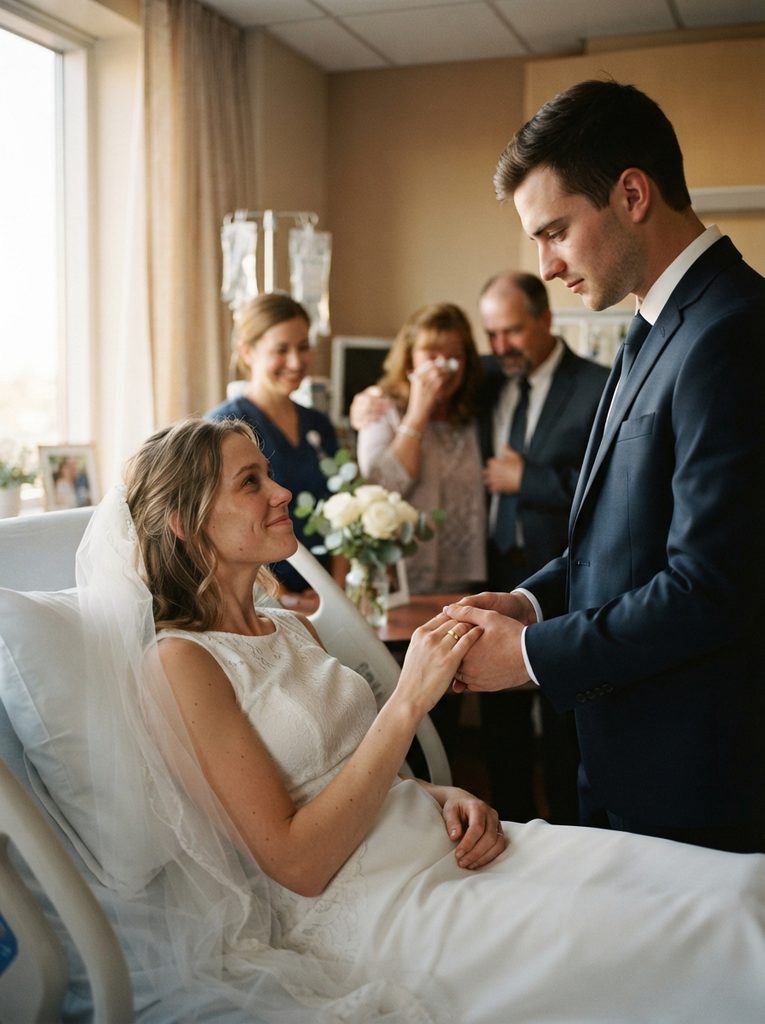
And that was how we got married. We threw the lamest, most beautiful hospital wedding imaginable. Our parents came, a few close friends came, and even a couple of doctors and nurses we’d grown close to over the years stood there with us. There were no expensive flowers, no ballroom, no elaborate decorations, and no first dance. One nurse found a white ribbon in the gift shop and tied it around Chloe’s bed rail, while my mother brought a grocery store cake. Across the top, in bright blue icing, were the words: “CONGRATULATIONS CHLOE AND LUCAS.”
The icing was so bright it practically stained everyone’s teeth blue. Chloe wore a simple white cardigan over her hospital gown, and I wore the only suit I owned. When I saw her, I started crying before the ceremony had even begun.
“Oh, stop crying,” she whispered smilingly.
“You’re beautiful,” I managed to say.
“I have compression socks on underneath,” she pointed out.
“Very bridal,” I countered.
“Shut up,” she chuckled softly.
Everyone laughed at our exchange, and then we promised ourselves to each other in front of about twenty people. When it was time for the rings, Chloe’s hands were swollen from medication, so the nurse helped us choose a slightly larger band. I slipped it onto her finger, and she stared at it for a long moment before looking up at me.
“My husband,” she said softly.
“My wife,” I replied.
She smiled brightly. “Clover.”
“Don’t ruin this moment,” I warned playfully.
Everyone laughed again, and for maybe twenty minutes, something extraordinary happened. Chloe wasn’t a patient, I wasn’t a caregiver, and we weren’t thinking about medications, doctors, surgeries, hospital rooms, or possible outcomes. We were newlyweds, and that was all that mattered.
Part 3
Six days later, Chloe went into surgery wearing that ring. I kissed her gently on the forehead before they wheeled her away down the hallway.
“I’ll see you afterward,” I told her firmly.
“You better,” she replied with a weak grin.
“I mean it,” I added.
“So do I,” she said.
Those were the last words we ever said to each other. The surgery didn’t go the way we’d prayed it would, as there were complications, followed by even more complications. There are hours from that day I still can’t reconstruct properly in my mind. I remember a doctor speaking, I remember Chloe’s mother screaming in pain, I remember my father holding my shoulders, and I remember someone putting a cup of water into my hand. I remember staring at a clock on the wall and wondering how it could possibly keep moving while my entire life had stopped completely.
Chloe was 31, and she had been my wife for exactly six days. She was buried wearing our wedding ring. The following weeks are difficult for me to remember clearly. People brought casseroles, but I forgot to eat them. Friends called, but I just watched the phone ring on the table. I slept on the couch because our bed still smelled like her shampoo, and everything in the house reminded me of her presence, including her favorite mug, her clothes, her books, and the little things she’d left in random places without thinking.
Then, one afternoon, Chloe’s family lawyer called me unexpectedly. He wanted to talk to me about a will she’d written before she died. His name was Mr. Harrison, an older gentleman with a warm tone over the phone.
“I think you should sit down, Lucas,” he said gently.
So I obeyed his advice. If a sad old lawyer tells you to sit down before reading your dead wife’s will, you sit down immediately. I perched on the edge of my kitchen counter, holding an unopened packet of instant ramen in one hand and my phone in the other. There was a long pause on the line before Mr. Harrison sighed deeply.
“I guess it makes sense now why she wanted to marry you,” he said with a sad little chuckle.
My stomach tightened instantly. “What do you mean by that?”
I heard papers rustling on his end of the call. Then he spoke quietly into the receiver.
“Here’s what she wrote in her own words,” he explained. He cleared his throat before reading aloud. “To my husband, Lucas, who spent years trying to give me more time when there was none left to give, I leave everything that remains of mine. And before he gets angry with me for keeping this from him, please tell him to keep reading.”
I stood up straight. “What is this?”
“Keep listening, Lucas,” Mr. Harrison urged gently.
He then explained something I had never known about her family background. Chloe’s grandfather had created a family trust decades earlier, and while it wasn’t enormous, it wasn’t small either. Chloe had inherited an interest in it when her grandfather died, but she had barely touched the money. I hadn’t even known it existed at all.
“How much are we talking about?” I asked nervously.
Mr. Harrison hesitated for a second before answering. “After taxes, existing distributions, and other obligations, Chloe’s share and a spousal survivorship benefit came to a little over $400,000.”
I nearly dropped the phone on the floor. “No way.”
“Lucas, listen,” he said.
“No, that’s impossible,” I argued. “She didn’t have $400,000.”
“Not personally,” he corrected. “Most of it remained inside the trust structure.”
My deep grief suddenly found room for a new emotion, which was overwhelming anger.
“She watched me empty my savings,” I said bitterly.
“Lucas, please,” he tried to calm me.
“She watched me worry endlessly about rent every month,” I continued, my voice shaking.
“Keep listening to the letter,” he advised.
“I sold my car to pay for her care!” I yelled into the phone.
“I know you did,” he answered softly.
“How could she keep this secret?” I demanded.
“Because she couldn’t simply access all of it whenever she wanted,” he explained carefully.
That sentence stopped my tirade immediately. Mr. Harrison explained that the trust had strict distribution rules attached to it. Chloe received limited payments for specific purposes, but the principal remained strictly protected by the trustees. Her medical expenses didn’t qualify for unrestricted withdrawals under the terms, and if she died unmarried, her remaining interest would automatically revert to other family members. However, the trust contained an old survivorship provision where a legal spouse could inherit her remaining share entirely.
I slowly sat back down on the counter stool. “So she married me just for the trust?”
Mr. Harrison was quiet for a moment. “No,” he finally said. “I think she married you because she loved you deeply. But I think the trust explains why she finally allowed herself to accept your proposal.”
He resumed reading her written words to me. “You’re angry now, aren’t you?”
I laughed once, though it was a horrible, bitter little sound.
Mr. Harrison continued reading. “I can see your face right now, Lucas. You’re probably doing that thing where your jaw moves before you start arguing. Please don’t argue with a dead woman because it’s embarrassing for both of us.”
I covered my mouth with my hand. That was Chloe, completely and unapologetically herself.
“I didn’t tell you about the trust because you would have done something stupid and noble,” her letter continued. “You would have tried to find a way to use it for another experimental treatment. You would have spent another year fighting paperwork instead of sleeping, and you would have turned every dollar into another way to keep me here.”
I closed my eyes tightly. She was right, and she had known exactly what I would have done.
Part 4
Mr. Harrison read the next section of the letter in his calm voice. “You sold your car, you emptied the house fund, and you turned down the promotion in San Diego because I couldn’t move away from my doctors. You kept telling me none of that mattered because we’d do those things later.”
I lowered my forehead into my hand as tears welled up. San Diego was my dream job, and I had turned it down in less than an hour without hesitation. Chloe had cried for two straight days afterward because of my decision.
The letter continued reading. “There is no later for me, but there is still a later for you.”
Mr. Harrison’s voice became noticeably quieter as he read the next instructions. “Buy the house. Not some sensible condo you secretly hate, but buy the stupid old house with the wrap-around porch you’ve been talking about since we first met. Fix the wooden floors, get the dog I said we couldn’t have because I was allergic, take the job if another opportunity comes, and travel somewhere that doesn’t have a hospital cafeteria.”
I laughed softly through my tears at her list. Then came the line that only Chloe could have written.
“And please eat something that isn’t instant ramen,” he read.
I looked down at my hand, where the unopened packet of instant ramen was still sitting. That detail nearly destroyed me emotionally.
Mr. Harrison laughed softly over the phone line. “She truly knew you well, Lucas.”
“Yeah, she really did,” I whispered back.
He continued reading her letter aloud. “I said no every time you proposed because I thought refusing was how I protected you from my reality. Then I realized I had spent years deciding what sacrifices you were allowed to make, just as you spent years deciding which sacrifices were worth making for me. We were both stubborn, but you were just louder about it.”
I wiped my face with my sleeve as he continued.
“So yes, I wanted to die as your wife, and that part was completely true,” he read. “It was the truest thing I’ve ever wanted in my life. But I also wanted my last decision to give something back to the man who gave me everything he could.”
Mr. Harrison’s voice broke slightly before he read the final paragraph. “Six days isn’t much of a marriage, Lucas. But you were my family long before somebody signed an official certificate saying so. Use what I left you to build the life I couldn’t stay for, because that’s not abandoning me, that’s taking me with you somewhere better. I love you, I’m sorry, and yes, Clover still isn’t funny.”
Mr. Harrison stopped reading, and neither of us spoke for a long while.
“There’s more formal legal language, but that’s the personal message she wanted you to hear,” he said gently.
I stared at the ramen packet in my hand, then threw it across the kitchen floor. I didn’t throw it because of the ramen, but because she had planned all of this in secret. She had arranged the appointment with Mr. Harrison, written the will, and finally accepted the marriage. She had been lying in a hospital bed preparing for a dangerous surgery, yet she was still thinking about whether I would ever buy a house.
I was furious with her for days afterward, because grief does strange things to anger. I yelled at her while driving down the highway, and I argued with her in the shower.
“You should’ve told me!” I shouted at the empty room.
Silence was my only response.
“You don’t get to decide what’s best for my life!” I yelled.
More silence followed. Eventually, I remembered that Chloe had said essentially the same thing about my choices. Slowly, I understood her perspective. She hadn’t hidden a fortune while I struggled, because most of that money had never been accessible to us during her care. The part that mattered only became mine because I officially became her husband. She hadn’t married me to make me rich, but because becoming my wife no longer felt to her like leaving me with a heavy burden. It meant she could leave me with a future instead.
I didn’t touch the inherited money for almost a full year. Then, one Sunday afternoon, I drove past an old house that was listed for sale in a quiet neighborhood. It had peeling paint, crooked shutters, and a massive porch that wrapped around the entire front side. I pulled my car over to the curb, and I could almost hear Chloe’s voice in my head saying that it was too much maintenance, too much work, and too much money.
I bought the house three months later anyway. I fixed the hardwood floors, painted the kitchen walls, and eventually got a shelter dog with one floppy ear. He immediately destroyed a sofa cushion that Chloe would have loved, and I named him Barney after her IV pole.
It’s been four years now since she passed. Her wedding ring sits beside mine in a small wooden box in my bedroom. Sometimes people hear that Chloe and I were married for only six days, and I can see their faces change with pity. They don’t know what to say to me, but I know what to say. We weren’t together for only six days, we were married for six days, and there is a massive difference between the two. The ceremony didn’t create what we shared, but simply gave Chloe one final way to name our bond.
For years, I thought I was the only one taking care of her by driving to appointments, waiting in hospital rooms, paying bills, and holding her hand. But that hospital wedding taught me something I didn’t understand until Mr. Harrison read her words aloud. Chloe had been taking care of me too, even while she was dying, and even when I couldn’t see it.
The last thing my wife gave me wasn’t money, a house, or six days of marriage. It was permission to stop measuring my love for her by how miserable I remained without her, and permission to have a future without pretending that having a future meant I had forgotten our past. I still talk to her sometimes, usually when something breaks around the house.
“You wanted me to buy this place,” I’ll say while staring at a leaking pipe.
And somewhere in my mind, I can hear her clear response. “No, you wanted the stupid porch.”
She’s right about that, just like she usually was.
THE END.