Chapter 1: The Gilded Cage
This is the chronicle of my own coup d’état.
The grand ballroom of the Ashkam Hotel had been meticulously curated to defy any specific era. Above us, authentic gold leaf clung to vaulted ceilings, while hundreds of beeswax candles wept slowly into iron sconces. The centerpieces were mountains of white peonies, stacked with such absurd extravagance that they shivered whenever the string quartet leaned into a heavy vibrato. Every square inch of the architecture had been weaponized to communicate a single, undeniable syllable to the three hundred guests breathing its perfumed air: Wealth.
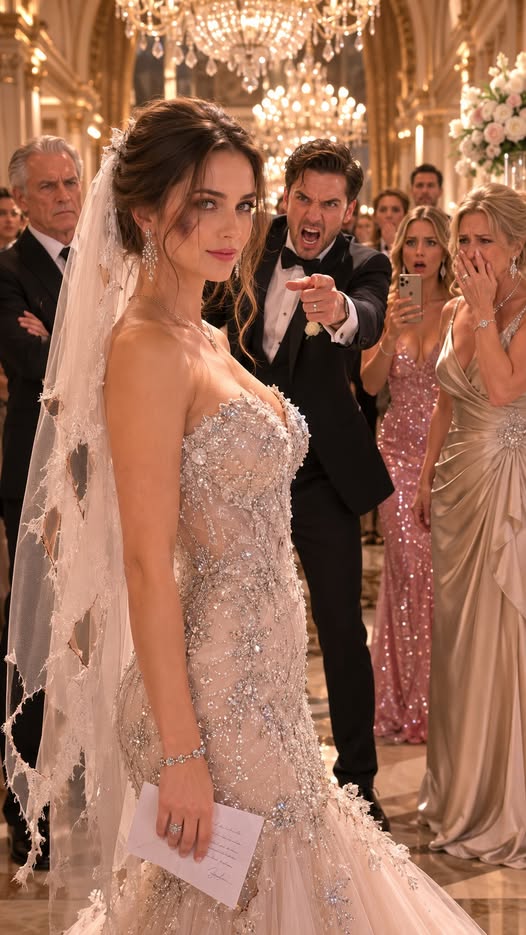
I walked through that cavernous space in a silk gown that had commanded four agonizing fittings to lay perfectly against my collarbones. Yet, I navigated the room exactly as I navigated hostile courtrooms—spine a rigid rod of steel, chin leveled parallel to the floor, my eyes darting just a fraction of a second faster than anyone expected a radiant bride’s to move. The assembled elite smiled at me as I glided past. After eleven months of playing the fiancée to Julian Voss, I had fluently decoded the subtext of those gleaming, perfectly veneered grins. She actually pulled it off, they were thinking. The scrappy girl from a cramped two-bedroom ranch in Marsh Hollow had successfully infiltrated the Voss dynasty. Now, I was permitted to stand beneath crystal chandeliers that retailed for more than my father’s entire municipal pension.
I smiled back. It was the required choreography. But internally, my litigator’s brain was already cataloging their expressions, filing them away with mental timestamps, waiting to observe which of these fawning sycophants would still be lingering in my orbit a year down the line.
Julian was hovering three feet to my left, distributing handshakes exactly as his father, Reginald Voss, had programmed him to. He held on a beat too long, squeezed a millimeter too hard—the aggressive, proprietary grip of a man who inherently believed he was owed a return on his investment. He traded hollow laughter with state senators, old-money patriarchs, and the CEOs whose legal fiascos I digested every morning over black coffee. When his gaze cut through the crowd and locked onto mine, his features executed a familiar micro-shift. It was a softening, a curated gentleness that effortlessly masqueraded as love. But beneath that practiced warmth lay something utterly still and cold. It was the unblinking patience of an apex predator.
I was not some naive debutante. I had bled through six grueling years as a corporate litigator, clawing my way into boardrooms that actively conspired to keep me out. I had dismantled firms triple the size of the one that finally took a gamble on me. I achieved this by always looking for the thing beneath the thing: the anxious flutter in a hostile witness’s fingers, the micro-hesitation preceding a perjury. I had logged Julian’s tells, too. I noticed how he spoke of Voss Industrial using language entirely devoid of substance—all gleaming facade and zero structural integrity. I watched Reginald scan every room as if calculating the liquidation value of the people inside it. I had seen the red flags, and like a fool standing on a questionable bridge because a crowd was already crossing it, I had consciously chosen to trust the engineering.
The structural collapse didn’t begin with a deafening roar. It began with a severely anxious catering captain slipping a folded sheet of heavy-stock paper into my hand, mistaking a bridal clutch for the final seating arrangements.
I popped it open, intending only to verify my mother’s table number. Instead, my eyes snagged on a dense thicket of wire transfer routing codes. Beneath them sat three obscure shell companies I had never encountered in any of Julian’s briefings, all authenticated by the embossed stamp of the Voss Industrial seal.
This was no clerical hiccup. It was a forensic map.
The sheer volume of the ballroom instantly compressed, shrinking to the claustrophobic dimensions of that single page. The quartet kept playing. Champagne flutes kept clinking. But the blood in my veins turned to glacial ice. I recognized the financial anatomy staring back at me; it was the identical, putrid architecture of fraud I had spent half a decade dissecting in depositions. Exorbitant consulting fees hemorrhaged into entities possessing no tax footprint. Vague invoices for phantom labor.
And there, halfway down the margin, faintly double-underlined in graphite, was the linchpin: Pharaoh Chemical.
It was the exact same Pharaoh Chemical inextricably linked to a catastrophic warehouse inferno six months prior. Two night-shift laborers had burned alive, and the catastrophe had been swiftly, surgically classified as an “unfortunate accident.” When the headlines first broke, Julian had stroked my hair and sworn Voss Industrial merely maintained a trivial supply chain overlap with them. I had swallowed the lie because, for the first time in my fiercely guarded life, I was desperate to believe a man without subpoenaing him first.
Now, that desperate hope curdled into something acidic in my mouth.
I scanned the room and located him lingering by the terrace thresholds, locked in a tense, hushed dialogue with Reginald. Neither appeared celebratory. Reginald’s hand was a vice on his son’s tuxedo shoulder, his lips barely parting as he issued commands. When Julian’s eyes flicked up and found me staring, the mask evaporated. His expression hardened into a brittle, terrifying topography I had never been permitted to see. He knew precisely what had been misdelivered.
I folded the paper with surgical precision and slipped it into the silk clutch at my wrist. I did not run. I did not hyperventilate. I traversed the ballroom with the deliberate, lethal pacing of a prosecutor approaching a jury box for closing arguments. As I passed the head table, my mother, Diane Bellamy, reached out, her eyes swimming with a potent cocktail of maternal pride and intuitive dread. I merely squeezed her fingers once and kept moving. Diane knew the cadence of my silence. She knew this icy composure wasn’t tranquility; it was the deafening vacuum before a gavel strikes.
Julian intercepted me two paces before the terrace. His public-facing smile was violently reattached, but his voice, pitched low and serrated, bled venom. “What the hell do you think you’re doing?” he hissed, treating the mere act of my approach as a declaration of treason.
I requested, my tone eerily gentle, that we step outside to speak in private. His jaw clenched so hard I thought I heard enamel grind. In his warped architecture of marriage, a wife was a decorative asset programmed for devotion, not a sentient variable capable of interrupting his coronation.
We slipped into the dim, heavy-draped corridor behind the terrace. The string quartet muffled into a dull, thumping heartbeat. The suffocating aroma of white peonies rushed into the enclosed space. I slid the paper from my clutch and held it up to the dim wall sconce.
Julian’s eyes darted to the transfer codes, then ripped back to my face. For a fractured second, sheer panic bled through the fury.
“Give me that,” he demanded, thrusting an open palm forward, his voice cracking like a whip. A passing busboy flinched violently, nearly dropping a tray of empties, and scurried away.
I kept my grip firm. “Why is Voss Industrial funneling black-book payouts to Pharaoh Chemical, Julian?”
His breathing turned ragged, shallow. “It’s archaic business, Norah. Internal restructuring. Things you absolutely do not need to understand tonight.”
Do not need to understand. The phrase scraped against a raw, ancient nerve inside me—the generational trauma of brilliant women being aggressively managed by mediocre men.
“I understand it perfectly,” I replied, my voice a quiet razor. “That is precisely why I am asking.”
The heavy mahogany door behind us swung open, sucking the remaining oxygen from the hall. Reginald Voss glided in, flanked by two anonymous men in pale, expensive suits who moved with the synchronized silence of undertakers. The ambient temperature seemed to plummet. Reginald evaluated me with the dead, reptilian gaze he usually reserved for a bloated balance sheet.
“Weddings always breed chaos, Norah,” Reginald murmured. His tone was buttery, paternal, and laced with absolute lethality. “Papers get shuffled. Contexts twist. Give it to me.”
I slid the folded map of their sins back into my silk clutch. “Any internal chaos can be easily rectified with a fully independent audit,” I said, holding his dead stare.
The silence that slammed down on the corridor was physical. It felt like being buried alive. One of the pale-suited men shifted his weight, looking at the floor. Julian stepped into my personal space, his eyes ignited with a violent, chaotic energy he had sworn he didn’t possess.
And then, with the muffled strains of Vivaldi playing through the wall, with three hundred of the city’s elite eating caviar fifty feet away, Julian Voss drew his arm back. The motion felt entirely unmoored from reality. He brought his open hand across my jaw with a sickening, wet crack.
He hit me in front of his father. He hit me in front of the catering staff. He hit me with the absolute certainty of a man who believed consequences were a tax applied only to the poor.
The concussive sound of the strike seemed to bleed through the walls. For one agonizing, suspended breath, the universe paused. Waiters froze mid-stride. My head had snapped violently to the side, the ornate pins tearing loose from my veil. I raised one silk-gloved hand, pressing it against the radioactive heat blossoming across my cheekbone.
I did not scream. I did not weep. The physical pain was a jagged, electric shock, but beneath it, an old, familiar survival instinct was rapidly assembling itself. It was the identical, predatory clarity I felt the moment an opposing counsel made a fatal procedural error.
I slowly turned my face back to Julian. The man I had shared hushed, candlelit dinners with was gone, replaced by a pathetic, terrified creature who had just brutally articulated his definition of matrimony. Reginald didn’t blink. He didn’t reprimand his son. He merely calculated the collateral damage to the Voss brand in real-time. That sociopathic indifference told me everything.
Julian opened his mouth, his vocal cords already tuning to the frequency of the gaslighter. “Norah, the stress… you’re hysterical, you pushed me—”
I didn’t grant him the oxygen. With a stillness that forced the two pale-suited men to instinctively step backward, I reached to my left hand. I twisted the massive, flawless diamond off my finger. It slid over my knuckle with pathetic ease; it had never truly belonged there. I held it over the silver tray of the trembling busboy who had frozen against the wallpaper.
I didn’t hurl it at him. I simply opened my fingers and let gravity reclaim it. The metallic ping of the platinum hitting the silver tray was deafening.
“The marriage is over,” I stated, my voice completely devoid of tremor. “I am keeping the paper. And I am keeping the memory of what you just did.”
Reginald finally lunged forward, his mask slipping. “Norah Voss—”
“I am still a Bellamy,” I cut him off, the syllables slicing the air like a guillotine.
My mother burst through the doors, shoving past Reginald with a feral ferocity. Tears of absolute terror shone in Diane’s eyes, but she didn’t let them fall. She flanked me.
I turned my back on the Voss empire and walked out. The ballroom was a graveyard of staring eyes, rapid whispers, and frantic social arithmetic as the elite calculated who to alienate. At the grand entrance, my oldest friend, Priya Anand, was waiting. A former litigator turned investigative journalist, Priya already had her phone gripped like a weapon. She didn’t ask questions; the red handprint on my face was a full press release. She fell into step beside me, her presence a reinforced concrete wall against the staring crowd.
We reached the idling black cars. The night air was biting and wonderfully clean. I paused, my hand on the door handle, looking back at the towering, illuminated monolith of the Ashkam Hotel.
“What was on the paper, Norah?” Priya finally whispered, the engine humming against the silence.
I pulled the folded document from my clutch and smoothed it over the center console. I watched Priya’s sharp eyes scan the routing numbers, watched her breath hitch as she hit the words Pharaoh Chemical.
“Two men died in that fire,” she breathed, her voice trembling with the gravity of the realization.
“Yes,” I replied, staring back at the hotel, realizing the Voss family wasn’t just trying to cover up a bad investment. They were covering up manslaughter. And now, I had the only map.
I looked at Priya in the dim light of the car, the adrenaline finally giving way to a cold, creeping dread as a black SUV abruptly peeled out from the hotel parking garage, its headlights locking onto our bumper.
Chapter 2: The Blueprint of Betrayal
The black SUV tailed us for four agonizing miles before peeling off onto the interstate, a silent, psychological warning shot. By the time we reached the modest brick brownstone I had stubbornly refused to sell—despite Julian’s relentless, passive-aggressive campaigns to upgrade me to his penthouse—my nervous system was a frayed live wire. The night doorman, a retired cop named Sal, took one look at my torn veil, the bruising on my face, and Priya’s lethal glare, and simply buzzed us through without a syllable.
Upstairs, the apartment was a tomb. It still smelled faintly of the French roast I had brewed that morning, a lifetime ago when I still believed in fairy tales.
Priya bypassed the liquor cabinet and immediately filled the electric kettle. It was an old law school reflex; caffeine was for warfare, alcohol was for surrender. I stepped into the cramped bathroom and peeled away the silk gloves. They felt utterly grotesque now, the costume of a captive. I stared at the mirror. The welt on my cheekbone had deepened to an angry, mottled plum. I traced the perimeter of it with my index finger, not out of trauma, but to memorize it. It was Exhibit A.
I stripped off the gown, leaving it in a crumpled white heap on the tile, and pulled on faded sweatpants and an oversized college hoodie. When I returned to the living room, the psychological metamorphosis was complete.
Priya recognized the terrifyingly blank expression on my face. It was the same dead-eyed focus I utilized right before shredding an expert witness on the stand.
I cleared the coffee table with a sweep of my arm. I placed the Pharaoh Chemical document in the dead center. Beside it, my phone. Beside that, a battered black Moleskine notebook I’d carried since passing the bar. I uncapped a fine-tip pen and wrote three names at the summit of a blank page, the ink biting into the paper:
Julian Voss.
Reginald Voss.
Pharaoh Chemical.
At 12:47 AM, the digital assault began. My phone erupted into a chaotic symphony of vibrations. Texts from distant cousins. Links from gossip blogs Priya monitored. The Voss PR machine had not slept; it had immediately gone to war. The first narrative planted was that I had suffered a “stress-induced psychological break.” The second, far more insidious rumor claimed the dispute was over a prenuptial financial demand I had aggressively made in the hallway.
“They’re moving fast,” Priya muttered, reading the headlines aloud.
“A machine that wakes up this quickly is a machine terrified of what the light will expose,” I noted, logging the timestamps of the articles into my notebook.
Julian called eleven times in rapid succession. I let them all bleed into voicemail. On the twelfth ring, I tapped the screen and engaged the speakerphone, signaling Priya with a nod. She instantly activated a digital audio recorder, entirely legal under our state’s one-party consent statute for documenting ongoing harassment.
“Norah,” Julian’s voice drifted from the speaker. It was heavily polished, wrapped in the synthetic sorrow of an actor reading a cue card. “This entire evening has been a catastrophic overreaction on your part. You are humiliating two families over a private, emotional misunderstanding.”
I said nothing, letting the silence force him to fill the void.
“Listen to me,” he shifted, the velvet slipping to reveal the steel beneath. “No one is going to weigh the word of a hysterical bride against the Voss family legacy. That document is highly classified corporate property. Retaining it constitutes industrial theft. You will regret turning one difficult night into a public execution.”
I waited three seconds, letting the threat hang suspended in the digital recording. “Are you formally admitting to striking me in the face, Julian?”
The hesitation on his end was infinitesimal, but to a trained litigator, it was a thunderclap. He couldn’t deny it, not with thirty witnesses, but his ego refused to apologize on tape. “You need to be managed, Norah. You always have.”
“This conversation is terminated,” I said, my voice eerily calm. “Any further communication goes through my legal counsel.”
I severed the connection before he could scramble for footing. I immediately encrypted the audio file, backed it up to a secure offshore cloud server, and air-dropped a redundancy to Priya.
Then, I dialed a number I hadn’t touched in eighteen months. Wesley Okafor was a brilliant, dangerously cynical forensic accountant I had partnered with on a bloodbath of a securities fraud case. Wesley famously claimed that families obsessed with importing Italian marble were usually just looking for heavier stones to bury their skeletons beneath.
He answered on the fifth ring, his voice thick with sleep. “Bellamy, if someone isn’t dead or indicted, I’m hanging up.”
“Pharaoh Chemical,” I said.
The line went dead silent. I heard the rustle of sheets as Wesley sat bolt upright. “Say absolutely nothing else on an open cellular network,” he commanded, all traces of sleep eradicated. “Dump whatever you have into the encrypted Proton drive. I’m making coffee.”
By the time the bleak, grey dawn bled through the apartment blinds, my notebook was crammed with flowcharts, dates, and intersecting arrows. The folded paper remained in the center of the table, radiating the quiet, lethal energy of an unpinned grenade. The throbbing in my face had faded into a dull background ache, eclipsed by the intoxicating clarity of purpose. Julian Voss believed he could dismiss me as collateral damage. He was about to learn that I was the blast wave.
At exactly 10:04 AM, three sharp, frantic knocks rattled the frosted glass of the apartment door. Priya and I froze. Sal the doorman hadn’t buzzed anyone up. I slid a heavy brass paperweight off my desk, my pulse hammering in my throat, and crept toward the peephole to see the ghost waiting on the other side.
Chapter 3: Paper Trails and Phantoms
I peered through the distorted glass lens. It wasn’t Julian’s pale-suited thugs. It was a slight, trembling woman in her mid-forties, drowning in a trench coat three sizes too large, her knuckles white-knuckling a plastic grocery bag as if it contained a live explosive.
I disengaged the deadbolt and swung the door open. She flinched violently, taking a half-step back toward the stairwell.
“Norah Bellamy?” she stammered, her eyes darting frantically down the hallway. “I… I used to work in the administrative pool at Pharaoh Chemical. My name is Marisol Fen.”
I ushered her inside immediately, locking three deadbolts behind her. Marisol didn’t sit on the offered sofa; she hovered on the edge of the armchair, her eyes locked on the fading bruise on my cheek.
“Is it true?” she whispered, her voice cracking. “Did you really walk away from the Voss family? Did he… did he hit you?”
“Yes,” I answered, keeping my voice steady and devoid of shame.
Something in Marisol’s rigid posture collapsed. The single confirmation seemed to act as a valve release for a year’s worth of suppressed terror. She reached into the plastic grocery bag, bypassed a carton of eggs and a loaf of bread, and pulled out a sealed box of saltine crackers. She tore the cardboard open, retrieved a small, black USB flash drive buried in the sleeves, and placed it on my coffee table.
“I kept backups,” Marisol breathed, tears finally spilling over her lashes. “I was terrified they were going to frame the admin staff when the safety inspectors started asking questions. It’s all in there. The falsified purchase orders. The emails. And… and the memo.”
Priya had her laptop open before Marisol finished her sentence. As the encrypted files populated the screen, Wesley Okafor’s voice crackled through the secure video link on my secondary monitor.
The evidence was a masterclass in sociopathic negligence. Marisol had meticulously documented a digital paper trail where Voss Industrial funneled millions into Pharaoh Chemical under the guise of “logistical consulting.” But the kill shot was an internal message chain. A Pharaoh site manager had flagged catastrophic flaws in the warehouse’s electrical grid, explicitly requesting a delay in operations.
Below it was a forwarded reply from Reginald Voss’s executive assistant: Mr. Voss mandates the expansion schedule is maintained. Bypass the external inspection. Handle it internally.
“They burned two men alive to save a quarter-end profit margin,” Priya snarled, her knuckles white on the keyboard.
“It’s an expensive rope,” Wesley noted grimly through the speakers, his eyes scanning the ledgers. “But we need to tie it directly to Julian to shatter their united front.”
By three o’clock that afternoon, the Voss counter-offensive escalated from digital whispers to a full-frontal legal assault. A bonded courier hammered on my door, delivering a cease-and-desist packet thick enough to choke a horse. Julian’s white-shoe attorneys formally accused me of “unlawfully retaining highly confidential corporate blueprints” and threatened a multi-million dollar defamation suit if I didn’t issue a public retraction and apologize within forty-eight hours.
I read the threat twice, uncapped a red pen, and circled their exact phrasing. Highly confidential corporate blueprints.
“Fools,” I whispered, a dark smile pulling at my lips. “In their desperation to intimidate me, they just legally admitted the document isn’t a fake. They authenticated our primary exhibit.”
But Reginald Voss did not build an empire by solely relying on lawyers. The next morning, a high-society publication known for being comfortably nestled in Reginald’s back pocket ran a vicious hit piece. They published heavily doctored, out-of-context photos from my law school days, insinuating severe ethical breaches and financial desperation. Worse, a separate legal filing hit the public docket: a “Cohabitation and Confidentiality Agreement,” allegedly signed by me a month before the wedding, waiving all rights to speak on Voss family matters under penalty of financial ruin.
Priya pulled the PDF of the contract onto the screen. I stared at the signature at the bottom. It was an unnervingly pristine forgery. The loop of the ‘N’ was immaculate. But my eyes zeroed in on the final ‘h’.
“It’s a fake,” I said, pointing at the screen. “Whenever I sign legal documents, I unconsciously drag the tail of the ‘h’ downward, a habit from using fountain pens in grad school. This ends in a perfect upward flourish. It’s a digital stamp.”
Wesley immediately patched in his trusted digital forensics contact. Within two hours, they stripped the metadata from the PDF. The signature had been digitally lifted from a charity gala RSVP card and layered onto the contract.
We had them. They were bleeding out, fabricating evidence in a blind panic.
Then, my cell phone vibrated. It wasn’t a text from Julian. It was an automated alert from the cheap security camera I had installed above my mother’s front door in Marsh Hollow. I pulled up the live feed and my blood ran ice cold. Standing on Diane Bellamy’s dilapidated wooden porch, flanked by his two undertakers, was Reginald Voss. And he was smiling as he reached for the doorbell.
Chapter 4: The Strike
I watched the security footage in suffocating silence, my fingernails digging half-moons into my palms. Diane had opened the door only as far as the brass chain lock permitted. Reginald, holding a grotesque bouquet of white lilies, leaned into the crack, his voice dripping with weaponized grief.
“Diane,” he purred, the audio crackling through my phone. “Your daughter is spiraling. Decent families settle their pain behind closed doors. If she continues this hysteria, the legal fees alone will take this charming little house from you.”
My mother, a woman who had spent thirty years surviving men who underestimated her, didn’t flinch. “A house is no place to hide a crime, Reginald,” Diane spat back. “And true love doesn’t require a hush-money contract to look clean. Get off my porch before I call the sheriff.” She slammed the door so hard the camera shook.
Watching my mother stand in the fire solidified the final layer of my resolve. The Voss family had crossed the Rubicon. It was time to drown them in it.
The formal hearing before the Corporate Ethics and Compliance Board convened on a bleak, rain-swept Tuesday. The media circus had already pitched its tents on the courthouse steps, drawn by the scent of blood in the water. I walked through the flashbulbs in a razor-sharp charcoal suit, my posture impeccable, the fading bruise on my cheek practically glowing under the overcast sky.
Inside the cavernous, mahogany-paneled boardroom, Julian sat at the defense table, his jaw freshly shaven, wearing the practiced, solemn remorse of a man who had rehearsed his empathy in a mirror. Reginald sat one pace behind him, an immovable gargoyle of corporate power, surrounded by a legal team so bloated it practically screamed guilt.
When I took the floor, I bypassed theatrics entirely. I didn’t raise my voice. I didn’t perform the role of the hysterical, scorned woman they desperately wanted me to be. I laid out the timeline like stones on a path they could not avoid walking down.
I presented the misdelivered Pharaoh document. I played the audio of Julian implicitly admitting to the assault. I submitted the metadata proving their NDA was a desperate forgery. And finally, Wesley Okafor played a devastating piece of audio he had captured two days prior in a parking garage—Reginald’s primary fixer offering Wesley a half-million-dollar “consulting retainer” to quietly shred our financial analysis.
The room grew so quiet you could hear the rain lashing against the floor-to-ceiling windows.
Julian’s lead counsel, sweating profusely, attempted to compartmentalize the disasters. “These are disparate, unrelated personal disputes,” he stammered.
I turned my gaze directly to Julian. “If it is unrelated, Mr. Voss, how do you explain the routing numbers matching the phantom payouts authorized by your own signature?”
Julian cracked. The pressure of the room, the undeniable paper trail, the public humiliation—it fractured his pristine facade. “I didn’t authorize the secondary routing on the Pharaoh accounts!” he blurted out, his voice shrill. “I only signed off on the logistics shell, the rest was—”
He slammed his mouth shut, realizing a second too late what he had done. He had just publicly admitted to possessing intimate, granular knowledge of the fraudulent shell companies he had sworn, under oath, he knew nothing about.
A collective, stunned gasp rippled through the board members. I looked past Julian to Reginald.
Reginald did not offer his son a lifeline. He didn’t even blink. He slowly turned his head, assessing Julian with the flat, dead eyes of a butcher examining spoiled meat. It was the look of a man surgically severing a necrotic limb to save the host body. Reginald was preparing to throw his own flesh and blood into the incinerator.
During the fifteen-minute recess, Julian ambushed me in the corridor near the restrooms. His composure was shattered. He looked small, frantic, the bespoke tailoring suddenly hanging off him like a borrowed suit.
“Norah, please,” he begged, his voice a frantic whisper, stepping into my path. “My father… he manipulated the ledgers. I didn’t know the extent of the safety violations, I swear it. We can settle this. I can make you a partner at any firm in the city. But if you put Marisol Fen on that stand, my father will destroy her. He will bankrupt Priya. He will bury your mother in litigation until she dies.”
The old, primal fear flared in my chest for a microsecond, instantly extinguished by a colder, infinitely more powerful resolve.
“Julian,” I said softly, looking at the man I almost chained myself to. “You just explicitly confirmed exactly why you both need to be eradicated from this earth.”
I walked around him, leaving him trembling in the hallway.
When court resumed, I called Marisol Fen. She was terrified, her hands shaking as she gripped the microphone, but her voice held the undeniable resonance of truth. She laid out the cost-cutting memos, the ignored safety protocols, the prioritization of the Voss profit margin over the lives of two human beings.
The Chairwoman of the board, a severe woman in a grey blazer, didn’t even wait for deliberation. She lowered her reading glasses and stared at the Voss table.
“Pending a full criminal referral to the Department of Justice,” she announced, her gavel hovering, “this board recommends the immediate, indefinite freeze of all Voss Industrial public contracts and subsidies.”
Julian’s face drained of all blood, turning the color of wet ash.
Reginald stood up, buttoned his suit jacket, and walked out of the room without looking at his son once. The empire was devouring itself from the inside out, but as I packed my briefcase, my phone buzzed with an encrypted message from an unknown number: “They burned the warehouse. What makes you think they won’t burn you?”
Chapter 5: The Ashes and the Architecture
The board’s ruling didn’t detonate with cinematic fireworks; it arrived in the dry, sterile legalese that always accompanies the death of titans. Yet, the moment the Chairwoman struck her gavel, the gravitational pull of the city shifted.
The criminal referral moved with agonizing bureaucratic lethality. Voss Industrial’s governmental contracts evaporated overnight. Two of the phantom shell companies were frozen mid-wire-transfer by federal regulators. Marisol Fen was swiftly granted federal whistleblower immunity, and months later, she received a quiet, tear-stained letter of profound gratitude from the widow of one of the men who had perished in the Pharaoh inferno.
Julian’s attempts at damage control were pathetic. He granted one disastrous, overly-coached television interview where he sweated through his collar, alternating between blaming rogue subordinates and aggressively implying his father had brainwashed him. Each desperate syllable he uttered chipped away another piece of his humanity until nothing remained but a hollow suit. Reginald, cornered by Marisol’s airtight paper trail, retreated into cowardly corporate jargon, claiming he was “appalled by the lack of oversight” in his lower management tiers.
There was no grand confession. Evil rarely grants you the satisfaction of an apology; it merely runs out of places to hide.
I did not celebrate. When a vulture-like reporter cornered me on the courthouse steps and shoved a microphone in my face, aggressively asking if this entire crusade was simply the ultimate, vindictive revenge of a jilted bride, I stopped. I looked directly into the camera lens, knowing Julian was likely watching from some dark room.
“Revenge is obsessed with inflicting pain,” I said, my voice cutting through the clamor of the press pool. “Justice is obsessed with enforcing limits. A single act of violence in a hotel hallway forced me to look closer at the architecture of the men who built it. What I found were the graves of men who never made your headlines. This was never about a wedding ring. It was about an autopsy.”
The absolute, chilling calm of that soundbite did more terminal damage to the Voss legacy than any subpoena ever could.
In the ensuing months, a contingent of my old, conservative corporate clients quietly migrated away from me, terrified of my proximity to radioactive scandal. I found, to my immense relief, that I didn’t miss their billable hours for a second. In their place came a different breed of clientele—people who specifically sought out a litigator who wouldn’t trade her spine for a corner office.
Six months after the wedding that never was, I stood in a newly leased, sun-drenched loft space in the financial district. The smell of fresh paint and ozone hung in the air. Wesley Okafor was already complaining about the Wi-Fi router, hauling boxes of redacted files into a glass-walled conference room. Priya sat on a desk, grinning like a feral cat as she scanned the morning papers detailing the ongoing DOJ raids on Voss properties.
My mother arrived last, carrying a massive, vibrant bouquet of yellow sunflowers.
“Never white again,” Diane commanded, placing them on my desk. “Not for a long, long time.”
I traced the stenciled lettering on the frosted glass of my new door: Bellamy and Associates. No partners. No compromises. A firm dedicated exclusively to corporate accountability and shielding whistleblowers.
Later that afternoon, my first official client sat across from me. Her name was Talia Reyes, a brilliant, terrified structural engineer whose hands trembled as she described the catastrophic safety shortcuts her firm was taking on a new municipal bridge project. I recognized the exact geometry of her fear. It was the same terror that had lived in Marisol’s eyes.
I didn’t offer Talia platitudes or promise her an easy martyrdom. I opened my notepad, handed her a cup of black coffee, and calmly walked her through the brutal, necessary mechanics of taking down giants. By the time she left, the tremor in her hands had ceased, and her spine was a fraction straighter. In my line of work, that was the ultimate metric of salvation.
As dusk bled over the skyline, turning the city into a grid of glowing embers, I remained alone in the office. I reached into my desk drawer and pulled out the battered black Moleskine notebook. I flipped past the flowcharts, the routing numbers, the sins of Julian and Reginald Voss.
On the final blank page, I uncapped my pen and wrote a single, concluding sentence to the darkest chapter of my life:
Never again build a sanctuary for someone who requires you to shrink to fit inside it.
I closed the book. The Voss empire was currently being reduced to ashes in federal courts, but as I looked out the window at the glittering, towering skyline of the city, I knew there were a thousand other well-dressed monsters hiding behind the reinforced glass, counting their money in the dark.
I turned off the desk lamp, perfectly comfortable in the shadows, knowing my pen was fully loaded for the next war.