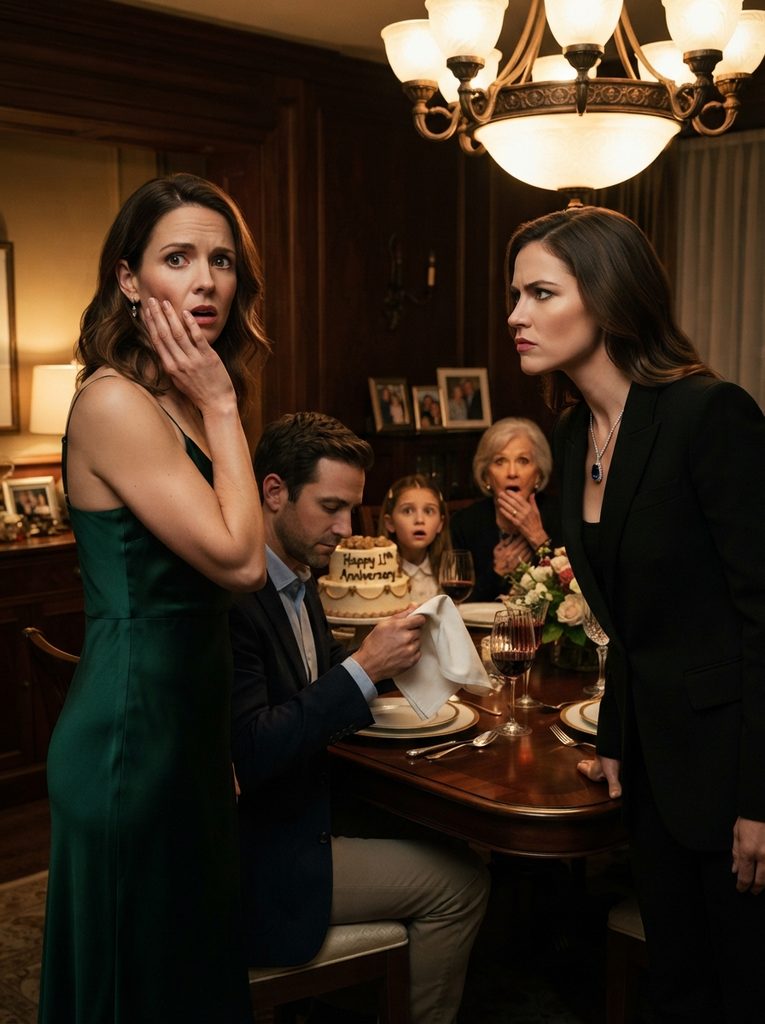
My sister-in-law slapped me across the face during my own eleventh-anniversary dinner, in front of my two young children, simply because I dared to serve myself a portion of roasted chicken before filling her plate.
“You seem to have forgotten your place in this family,” Chloe hissed, her voice vibrating with a venom that had been brewing for over a decade.
Her hand remained raised, suspended in the heavy, rosemary-scented air of my dining room. Triumph flickered across her perfectly contoured face—as though striking me at my own meticulously set table had restored some natural, divine order she genuinely believed I had violated.
I didn’t immediately look at her. The stinging heat radiating across my left cheek was entirely secondary to the sudden, suffocating silence in the room. I looked at my husband, Greg.
He did not rise from his mahogany chair. He did not ask whether my cheek, now burning with a fierce, throbbing intensity, was hurt. He did not speak a single syllable in my defense. Instead, he let out a heavy, irritated sigh, reached across the table, and picked up a spare linen napkin.
He didn’t offer it to me. He handed it to his sister.
“Here, Chloe, you spilled a drop of wine on your cuff,” Greg muttered, avoiding my eyes entirely. Then, with a tone so flat and devoid of affection it made my stomach physically drop, he finally looked at me. “Jessica, apologize to her. You know she’s been under a lot of stress. Stop making a scene.”
A scene. I was bleeding dignity on my own dining room rug, and my husband was worried about his sister’s silk cuff.
As the sheer audacity of his betrayal settled into my skin, my eyes drifted back to Chloe. She was dabbing at her wrist, a smug, victorious smile playing on her lips. But my gaze didn’t stay on her face. It dropped to her throat. Resting against her collarbone was a heavy, vintage sapphire pendant, surrounded by a halo of crushed diamonds. It caught the light of the crystal chandelier I had installed myself, glittering with an arrogant, mocking kind of malice.
My breath caught in my throat. A cold, sharp realization pierced through the shock of the physical blow, freezing the blood in my veins.
Exactly three weeks ago, I had noticed an uncharacteristic withdrawal of $6,500 from our joint household account. But it wasn’t just any account. It was the high-yield savings account explicitly designated for our seven-year-old daughter Mia and five-year-old son Leo’s future college tuition.
When I asked Greg about it, he had nervously rubbed the back of his neck, his eyes darting to the floor, and claimed it was a one-time, emergency loan to an old college fraternity brother facing sudden, devastating legal fees. I had let it go. Eleven years of marriage to a man whose family demanded absolute submission had conditioned me to choose peace over interrogation. I had convinced myself he would replace it with his next quarterly bonus.
I am a senior interior designer. My entire life, my entire career, is built on recognizing patterns, authenticating textures, and knowing the precise, unyielding value of beautiful things. I had seen that exact sapphire pendant at an estate auction in the arts district a month prior. The closing bid? Exactly $6,500.
I slowly placed my silver fork beside my plate. It made a quiet clink that echoed like a gunshot in the silent room.
The house I had spent years transforming into a sanctuary suddenly felt like a beautifully decorated cage built entirely on a foundation of lies. I wiped my trembling hands on my napkin, moving with a strange, icy calm. I felt a fundamental shift within my chest. A door slamming shut on the woman I had been just five minutes prior.
Then, before eleven years of conditioned subservience could restrain my arm, I leaned across the centerpieces I had arranged at dawn, planted my hand firmly, and returned the slap.
Crack.
It was a single, sharp, and brutally final sound. It carried the weight of a decade of condescension, of ignored boundaries, and of stolen futures.
My mother-in-law, Eleanor, gasped loudly from the head of the table, clutching her pearls as if she were the one who had been struck by lightning. Chloe stumbled back, her chair scraping violently against the hardwood floor. Her hand flew to her rapidly reddening cheek, the stolen sapphire swinging wildly against her chest.
They reacted as though I had desecrated a holy altar. Chloe’s strike against me had been viewed as necessary discipline; mine was an act of unforgivable rebellion.
I stood up. I didn’t bother looking at the women. I locked eyes with the man I had loved since I was twenty-two, a man who was now sitting before me as an absolute stranger.
“A husband who cannot defend his wife in a room full of people does not deserve to remain her husband,” I said, my voice eerily steady, devoid of the tears they were desperately waiting for me to shed. “And a man who steals his own children’s college fund to buy jewelry for his spoiled sister is nothing but a coward.”
Greg’s head snapped up, the blood instantly draining from his face, leaving him a sickly, ashen gray. He opened his mouth, but no sound came out. He knew that I knew.
I reached down, taking Mia’s trembling hand in my left, and Leo’s small, sticky fingers in my right.
“Come on, kids,” I whispered, keeping my eyes fixed on the front door. “We are leaving.”
Still wearing the emerald silk dress I had specifically chosen for our eleventh anniversary, I walked out of the front door, leaving the roasted chicken, the stunned silence, and the shattered illusion of my marriage behind. I loaded the kids into the back of my SUV, my hands gripping the leather steering wheel so tightly my knuckles turned a bruised shade of white.
As I pulled out of the driveway, the warm glow of the porch light faded in the rearview mirror, but a sickening, invasive thought bloomed in the dark corners of my mind. The sapphire was just what I could see. If Greg was willing to steal thousands from his own flesh and blood to buy his sister a necklace, and lie to my face about it with zero hesitation… what else was he hiding in the dark?
Chapter 2: The Ghosts in the Ledger
The drive to my parents’ house was a blur of highway lights and the rhythmic, comforting breathing of my children falling asleep in the back seat. When my mother opened the door, she took one look at my flushed, swollen cheek and the rigid, unyielding set of my jaw, and she didn’t ask a single question. She simply pulled me inside. My childhood home was a fortress, not designed to keep people obedient, but to keep them safe.
By Tuesday morning, the tears had dried, replaced by a cold, calculating fury. I was sitting in the mahogany-paneled office of Arthur, my father’s trusted corporate attorney. Arthur was a silver-haired man whose sharp gray eyes missed absolutely nothing. He was a bulldog in a bespoke suit.
“I want full physical and legal custody, the house I paid the down payment for, and a forensic audit of every single dime that has moved through our accounts in the last five years,” I told him, dropping a thick stack of printed bank statements onto the center of his desk.
Arthur adjusted his wire-rimmed glasses, his expression unreadable. “Consider it done, Jessica. But you need to prepare yourself. Financial audits in a messy divorce often turn up ghosts you didn’t know were haunting you.”
He had no idea how prophetically right he was.
Two weeks later, the ghosts didn’t just materialize; they kicked the door down. Arthur called me into his office on a rainy Thursday afternoon. A heavy, unmarked manila folder rested ominously in the exact center of his desk.
“The $6,500 for the sapphire necklace was just the tip of the iceberg, Jessica,” Arthur said, his tone devoid of its usual warm, grandfatherly cadence. “Over the past four years, Greg has systematically siphoned over $60,000 from your joint accounts and equity lines. Small transfers, irregular dates, carefully hidden. Always categorized as ‘home maintenance,’ ‘consulting fees,’ or ‘tax prep’.”
“Where did it go?” I asked, a tight, cold knot forming in the pit of my stomach.
“To Chloe’s business account. The Golden Spoon Catering.”
I scoffed, shaking my head, desperate for it to be a misunderstanding. “He told me he occasionally helped her out with marketing expenses because the business was expanding so rapidly. Eleanor always bragged at the country club about how incredibly successful Chloe was.”
Arthur leaned forward, tenting his fingers together. “Jessica, there is no business. The Golden Spoon filed for Chapter 7 bankruptcy three years ago.”
The room seemed to violently tilt on its axis. “What? But they still have the storefront downtown. They still have the branded delivery vans parked outside.”
“A shell,” Arthur replied grimly, tapping the folder. “An empty stage set designed for socialites. Three years ago, Chloe catered a massive, high-society wedding for a local politician. There was a catastrophic salmonella outbreak due to severe negligence in her refrigeration protocols. Dozens of people were hospitalized. One elderly guest—a VIP—nearly died. Chloe was facing a crippling negligence lawsuit and potential criminal charges.”
I stared at him, the horrifying math clicking into place in my head, making me nauseous. “The $60,000…”
“Was hush money,” Arthur confirmed, his voice low. “Payments to the victims who signed iron-clad Non-Disclosure Agreements, exorbitant legal fees, and the ongoing cost of keeping the lights on at a dead storefront so Eleanor’s precious high-society image wouldn’t be tarnished by a public, humiliating bankruptcy.”
My own husband had been secretly bleeding my hard-earned income to subsidize his family’s grotesque vanity and criminal negligence. The betrayal was so deep, so invasive, it felt physical, like a bruised rib throbbing every time I drew a breath.
“We have him dead to rights on financial infidelity. A judge will crucify him for depleting marital assets,” Arthur said, flipping to the very last page of the thick folder. “But unfortunately, Jessica, that isn’t the worst of it. Not by a long shot.”
He slid a single, crisp sheet of paper across the polished mahogany desk.
It was a notarized quitclaim deed, dated eighteen months ago. The legal jargon was dense, but the core message was horrifyingly clear. It authorized the transfer of a ten-percent ownership interest in my home—the home my father had helped me buy, the home I had renovated with my own blood, sweat, and sleepless nights—directly to Eleanor. It was designed as a lien, a way to use my house as collateral for a private, predatory loan Greg had taken out to cover the rest of the hush money.
At the bottom of the page, resting on the signature line, was my name.
“I never signed this,” I whispered, reaching out to touch the blue ink. It was a flawless, terrifying forgery, right down to the slight, idiosyncratic loop on my ‘J’.
Arthur’s face was a mask of stone. “I know you didn’t. The county recorder flagged the document for a missing secondary form of ID, so the transfer thankfully never finalized. But they tried to steal your house right out from under you, Jessica. This isn’t just divorce territory anymore. This is a felony.”
I looked at the date stamped next to the forged signature by the notary public. October 14th.
A chill violently ripped down my spine, freezing the blood in my veins. I remembered exactly where I was on October 14th of last year. I remembered the exhaustion. I remembered the tea. And as the memory flooded back, I realized exactly how my husband had pulled off the perfect crime.
Chapter 3: The Sleep Cure
I drove home from Arthur’s office in absolute, suffocating silence. When I parked in my parents’ driveway, I didn’t turn off the engine. I just sat behind the wheel, the windshield wipers rhythmically slicing through the rain, my mind forcefully pulled back to the second week of October from the previous year.
Greg had surprised me. It was so out of character, so seemingly thoughtful, that I had actually cried in his arms.
“You’ve been working yourself to the bone managing the firm, Jess,” he had said, standing in our kitchen, presenting me with a beautifully printed itinerary in a linen envelope. “I booked you a four-day solo retreat at Whispering Pines Resort up in the mountains. No kids. No demanding clients. Just you, deep tissue massages, and total silence. I’ll hold down the fort here. You deserve this.”
I had been so exhausted, so deeply starved for his appreciation and care, that I had blindly accepted it as a grand gesture of marital love.
Whispering Pines was notoriously exclusive, catering to executives and minor celebrities. But more importantly, it had a strict, non-negotiable “digital detox” policy. Upon check-in, guests were required to surrender their cell phones, laptops, and smartwatches to the concierge in a locked velvet box to ensure “total psychological relaxation.”
For four days, I was completely unreachable. Cut off from my business. Cut off from my bank accounts.
Cut off from my home.
I rested my forehead against the cold steering wheel, bile rising in my throat as the darker details of that trip snapped into sharp, horrifying focus. I hadn’t just been relaxed at Whispering Pines; I had been essentially comatose.
Every evening after dinner, the resort staff delivered a complimentary pot of special “herbal relaxation tea” to my cabin. I remembered drinking a cup the first night. The taste was sharp, strangely bitter beneath the honey. Within twenty minutes, my limbs had turned to lead. I couldn’t keep my eyes open. I slept for fourteen hours straight, waking up groggy, confused, and unable to string a coherent thought together. The same thing happened the second night. And the third. I had assumed it was just my body finally crashing from years of accumulated stress.
It wasn’t stress. It was sedatives.
Eleanor’s sister was on the board of investors for Whispering Pines.
He hadn’t sent me away to rest. He had sent me away to a controlled environment, ensuring I had no alibi, no way to receive fraud alerts from the bank, and no way to intercept the certified mail while he and his mother forged my signature and attempted to carve away a piece of my sanctuary. The man I shared a bed with had weaponized my exhaustion—and possibly drugged me—to facilitate a felony.
The next morning, the rain had cleared, but the storm inside me had only intensified into a hurricane. I was back in Arthur’s office before his receptionist had even finished making the coffee, slamming my fist onto his desk.
“He sent me away,” I said, my voice trembling with a rage so pure and concentrated it felt like ultimate clarity. “He booked the trip. I can pull the credit card receipts. Eleanor’s family is connected to the resort. I was isolated. I was… I think I was heavily medicated. This wasn’t just Eleanor’s opportunistic idea. Greg was the architect.”
Arthur stopped writing, his pen hovering over his legal pad. He took off his glasses, rubbing the bridge of his nose. “That proves severe premeditation. It upgrades the severity of the fraud exponentially. But to nail them criminally, to put them in handcuffs, we need to know exactly who helped them execute the paperwork locally. The notary stamp on the forged deed belongs to a woman named Sarah Jenkins.”
“Have you spoken to her?” I demanded.
“My private investigator tried,” Arthur sighed. “She refused to open her door. She wouldn’t answer her phone. The investigator said she was terrified, Jessica. She looked like she hadn’t slept in a week, peering through the blinds like a hunted animal. Whatever leverage Eleanor has over her, it’s ironclad.”
I looked down at the photocopy of the deed on the desk. Sarah Jenkins. I pulled out my phone and did a quick, targeted search of local business registries and social media. It didn’t take long for my trained eye to find her digital footprint. She was a single mother, running a small freelance mobile notary service out of her car to make ends meet. And, according to a proud, smiling photo posted on her Facebook page from three years ago, her son attended St. Jude’s Academy—the ultra-exclusive private preschool where Eleanor sat on the admissions and, crucially, the financial aid scholarship board.
“Eleanor is blackmailing her,” I said softly, the puzzle pieces locking together with sickening, devastating precision. “If Sarah talks to us, Eleanor will yank her kid’s scholarship, ruin his future, and likely use her influence to get Sarah’s notary license revoked.”
“If we subpoena her officially, she might perjure herself on the stand out of sheer terror,” Arthur warned, his tone grave. “If she lies under oath to protect Eleanor, our forgery case becomes significantly harder to prove. We need her to testify willingly.”
“Cancel the investigator. Leave her to me,” I said, standing up, smoothing the wrinkles from my blazer. I was done waiting for the slow, grinding wheels of the legal system to tip the scales. I was going to force them.
Chapter 4: The Midnight Extraction
That evening, a heavy, oppressive fog rolled in off the river, cloaking the suburbs in a damp, gray shroud. I parked my car two blocks away and walked silently toward a modest, single-story house in a working-class neighborhood.
As I approached Sarah Jenkins’ property, the hair on the back of my neck stood up. Parked diagonally across the street, engine idling quietly, was a massive, black SUV with heavily tinted windows. It didn’t belong in this neighborhood. It was a watcher.
I kept to the shadows of the large oak trees lining the sidewalk. When I reached Sarah’s front porch, my heart hammered against my ribs. The front living room window was shattered. A jagged hole the size of a baseball had spider-webbed across the glass, the shards glittering dangerously in the glow of the streetlamp.
I didn’t knock. I pressed my ear to the heavy wooden door. Inside, I could hear the frantic, muffled sounds of drawers being yanked open and zippers being aggressively pulled shut.
She was running.
I pounded on the door, hard and fast. “Sarah! Sarah, it’s Jessica. Open the door!”
The frantic shuffling inside instantly stopped. Dead silence.
“Sarah, I know about the black SUV outside. I know about the broken window,” I called out, keeping my voice loud enough for her to hear, but low enough not to alert the watchers. “Eleanor’s goons are out there. If you run now, they will follow you. Open the door and let me help you.”
A agonizing minute passed. Then, the deadbolt clicked.
The door cracked open on a chain. A tired-looking woman in her early thirties peered out, clutching a baseball bat. Her face was pale, her eyes rimmed with red. The moment she recognized my face from the ID copy attached to the fraudulent deed she had stamped, her eyes went wide with pure, unfiltered terror.
She tried to slam the door, but I slammed my leather boot firmly into the jamb, ignoring the sharp pain shooting up my ankle.
“Sarah,” I said gently, lowering the weapon of my voice so my tone was not a threat, but a lifeline. “I’m not here to hurt you. I’m here to save you. But I know what Eleanor Thorn is doing to you. And I know they threw a rock through your window tonight.”
Sarah froze, a jagged sob escaping her throat as a tear spilled over her lashes. “How… how did you know she called me?”
I didn’t know. But the look of sheer, hunted panic on her face confirmed everything. Eleanor knew the walls were closing in, the divorce discovery phase was looming, and she was violently tying up loose ends.
“Because she’s a desperate cornered animal,” I said, pushing the door open slightly. “And desperate people will throw you under the bus to save themselves. The people in that SUV aren’t here to protect you. Let me in, Sarah. Let me protect you before she destroys your life and your son’s.”
Sarah dropped the baseball bat. It clattered against the cheap linoleum floor. She stepped back, letting me into a living room that smelled of cheap lavender air freshener, dust, and raw fear. Two large suitcases were lying open on the sofa, half-filled with children’s clothes and scattered paperwork.
She collapsed into a worn armchair, her hands trembling so badly she couldn’t clasp them together. “She called me this afternoon,” Sarah whispered, her voice breaking. “Mrs. Thorn. She told me the district attorney might be sniffing around regarding an ‘administrative error’ on a deed. She said if I didn’t stick to the story that you were physically present in my office with your ID that day, she’d have my notary license permanently revoked for gross incompetence. And then…”
“And St. Jude’s? Your son’s scholarship?” I prompted gently, kneeling in front of her.
Sarah squeezed her eyes shut, a fresh wave of tears tracking down her cheeks. “She reminded me that the board reviews financial aid renewals next week. I can’t afford that school, Jessica. My boy… he has severe developmental delays. St. Jude’s is the only place in the county that gives him the specialized behavioral support he desperately requires. If I lose it, I lose everything. And then tonight, the window broke. A brick wrapped in a printed copy of my son’s school schedule.”
I felt a surge of absolute, murderous disgust. Eleanor wasn’t just a snob; she was a predator. She found the delicate pressure points in vulnerable women and squeezed them with diamond-encrusted pliers until they broke. For eleven years, I had been one of those women. Today, the cycle ended.
“Sarah, look at me,” I commanded, my voice carrying the steady authority I usually reserved for commanding construction crews. She opened her bloodshot eyes. “Eleanor is a sinking ship. She doesn’t have the power she pretends to have. The family catering business is dead. Her son is about to be financially wiped out in my divorce settlement. If you lie to a grand jury for her, you will go to federal prison for real estate fraud. Who takes care of your son when you’re behind bars?”
A strangled cry ripped from her throat. She buried her face in her hands, her shoulders shaking violently.
“I didn’t want to do it,” she sobbed into her palms. “Greg brought the paperwork to my car. He already had the signature drawn on it. He said you were waiting in your car across the street, sick and vomiting with a migraine, and begged me to just stamp it as a quick favor so you could go home and rest. Eleanor was on speakerphone, reminding me how much she ‘championed’ my son’s application to the board. I was so scared of her. I just stamped it. I’m so sorry.”
“I know,” I said softly, handing her a tissue from my purse. “I’m not going to let you go down for their crimes. My lawyer is Arthur Vance. He is the most ruthless litigator in the state. If you write down everything you just told me right now, sign a sworn affidavit, and agree to testify, Arthur will have his firm legally protect your license. As for the school, if Eleanor tries to touch a single hair on your son’s scholarship, we will drag her extortion into the harsh light of the press, and the school board will expel her, not him.”
She looked at me, searching my face for any trace of the manipulation and deceit she was so used to from the Thorn family. She found absolutely none. I was a fortress of resolve.
“Pack your bags,” I said, standing up and pulling out my phone. “You aren’t staying here tonight. I’m calling my lawyer to send a private security escort. We’re moving you and your son to a secure hotel downtown.”
For the next two hours, the reality of the situation shifted. While Arthur’s security team secured the perimeter and chased off the SUV, Sarah and I sat at her small, wobbly kitchen table. I dictated, and she wrote. She detailed the exact time Greg arrived, the speakerphone conversation with Eleanor, the fake migraine alibi, and the explicit, undeniable pressure applied regarding the scholarship.
When she finished, we found a 24-hour, neutral, third-party notary downtown. I watched as the heavy metal stamp came down, certifying her confession.
I held the sealed manila envelope in my hands. It felt incredibly heavy. It wasn’t just a legal document; it was a loaded gun, safety off, pointed squarely at the Thorn family’s legacy.
As I walked out of the brightly lit pharmacy into the cool night air, my phone buzzed aggressively in my purse. I pulled it out to see a text message illuminating the screen. It was from Eleanor.
Jessica, this childish, dramatic tantrum of yours has gone on long enough. Greg is an absolute mess and the children need their father. You are threatening to tear this prominent family apart over a petty argument about a plate of food. Meet Chloe and me for lunch tomorrow at Le Petit Château. 1 PM sharp. It’s time to act like an adult and come home where you belong.
I stared at the glowing screen, the raindrops splattering against the glass. A slow, dangerous, utterly ruthless smile spread across my face. They still thought I was the obedient, terrified girl who just needed a firm scolding from her betters to fall back into line. They thought they still held the leash.
I’ll be there, I typed back, hitting send.
I had a reservation to keep. And I was bringing hell with me.
Chapter 5: Checkmate at Le Petit Château
Le Petit Château was the kind of ultra-exclusive French restaurant where the menus didn’t bother listing prices, the lighting was perpetually dim, and the waiters spoke in hushed, reverent whispers. It was Eleanor’s favorite battleground. She loved resolving “unpleasantness” in highly public, affluent places where strict social decorum would force her opponents to keep their voices down, swallow their pride, and submit quietly to avoid a scene.
When I arrived at exactly 1:00 PM, they were already seated at the best corner booth, flanked by potted orchids. Eleanor wore a rigid, beige Chanel suit, her posture impeccable, her hair lacquered into place. Chloe sat beside her, sipping a mimosa, scrolling boredly through her phone. She wasn’t wearing the stolen sapphire necklace today, but the bruised, entitled ego on her face was just as visible.
I didn’t come alone. Arthur walked a half-step behind me, carrying a sleek, black leather briefcase.
Eleanor’s perfectly sculpted eyebrows narrowed into sharp slits as we approached the table. “Jessica, I explicitly asked for a private family lunch. Who is this man?”
“This is Arthur Vance, my legal counsel,” I said smoothly, sliding into the plush velvet booth opposite them. I didn’t touch the sparkling water the waiter had poured for me. “And we aren’t family anymore, Eleanor. We are opposing parties.”
Chloe scoffed loudly, rolling her eyes and setting her mimosa down with a thud. “Oh, please, god. Spare us the legal theatrics, Jess. You threw a fit. You slapped me. We’re willing to be the bigger people and forgive you if you just drop this ridiculous, embarrassing divorce and go back to Greg.”
“Forgive me?” I asked, keeping my voice pleasantly, terrifyingly low.
I nodded to Arthur. Without a word, he unlatched his briefcase. He produced three distinct, slender red folders, placing them deliberately face-down on the pristine white tablecloth.
“Let’s talk about forgiveness,” I said, tapping the first red folder. I flipped it open. Inside was a blown-up, high-resolution photograph of Chloe wearing the sapphire necklace at the dinner table, placed side-by-side with the bank transfer records showing the exact $6,500 leaving my children’s college fund.
Chloe’s jaw snapped shut. The color drained from her face. The mimosa glass suddenly trembled in her manicured hand.
“That’s grand theft,” I noted softly, the words cutting through the air like a scalpel. I flipped the second folder open. It contained the grim, detailed Chapter 7 bankruptcy filings for The Golden Spoon, alongside copies of the signed NDAs from the victims of the salmonella outbreak, and the records of the $60,000 Greg had funneled to them.
Eleanor’s perfect, porcelain face finally cracked. The aristocratic composure shattered, leaving a sickly, grayish pallor in its wake. Her eyes darted around the restaurant, terrified someone might be listening. “Where did you get those?” she hissed, her voice venomous.
“Your fake empire is built on the bones of my labor,” I continued, ignoring her question entirely, leaning forward. “Sixty thousand dollars of my income went to bury your criminal negligence, Chloe. You paraded around this city looking down on me, treating me like the help, while my hard work kept you out of a courtroom and out of jail.”
Eleanor gripped the edge of the table, her knuckles white. She rallied, attempting one last, desperate bluff. “You can’t prove Greg didn’t authorize that money, Jessica. He was a joint account holder. He can spend his money however he sees fit. You have nothing but a bitter grievance.”
“You’re right,” I agreed smoothly, a terrifying calm washing over me. “Joint account holders can move liquid cash. But they absolutely cannot forge property deeds to secure illegal loans.”
I reached for the third folder. This was the kill shot. I opened it to reveal a blown-up copy of the forged quitclaim deed, and right beneath it, Sarah Jenkins’ signed, stamped, and legally binding affidavit.
I watched closely as Eleanor read the first paragraph. I watched the exact second her brain processed what she was looking at. I watched her realize that her leverage over the notary was gone, her midnight intimidation tactics had failed, and her crimes were fully, undeniably documented. The illusion of her invincibility shattered right there over the white linen.
But Eleanor Thorn was a creature of toxic pride. Instead of crumbling, she chose to detonate.
She slammed her hands on the table, her face contorting into an ugly, hateful mask. “You think you can intimidate me? Me?” she spat, reaching into her designer handbag and pulling out her phone. She dialed three digits without breaking eye contact. “I am calling the police. I am reporting you for attempting to extort a senior citizen with fabricated documents.”
Chloe looked frantic. “Mom, wait, what are you doing?”
“Shut up, Chloe,” Eleanor snapped. She brought the phone to her ear. “Yes, operator? I need police at Le Petit Château immediately. A woman is threatening my life and trying to extort money from me.”
She hung up, a sickeningly smug smile returning to her lips. “Let’s see how your fancy lawyer handles an arrest warrant for blackmail, you ungrateful little bitch.”
I didn’t blink. Arthur simply checked his gold pocket watch and took a sip of his water.
Ten excruciating minutes passed in silence. The hushed whispers in the restaurant grew louder as patrons noticed the tension at our table. Then, the heavy glass doors of the restaurant swung open. Two uniformed police officers walked in, accompanied by a man in a sharp gray suit flashing a detective’s badge.
Eleanor stood up immediately, playing the part of the frail, terrified victim to perfection. “Officers! Thank god you’re here. This woman,” she pointed a trembling, manicured finger at me, “is trying to—”
“Eleanor Thorn?” the detective in the suit interrupted, his voice booming over the quiet dining room.
Eleanor blinked, confused. “Yes. I am the one who called.”
Arthur stood up smoothly. He reached into his breast pocket and handed the detective the original, sealed copy of Sarah Jenkins’ affidavit. “Detective Miller. Arthur Vance. As we discussed on the phone an hour ago, here is the sworn testimony regarding the felony forgery and witness intimidation.”
The detective nodded, taking the envelope. He turned his gaze to Eleanor, whose arm was still extended, pointing at me.
“Eleanor Thorn,” the detective said, pulling a pair of heavy steel handcuffs from his belt. The metallic clinking sound echoed off the crystal chandeliers. “You are under arrest for conspiracy to commit real estate fraud, forgery of a federal document, and felony witness tampering.”
The entire restaurant went dead silent. Forks paused halfway to mouths. Prominent socialites, women Eleanor had played tennis with for decades, stared in absolute, unblinking shock.
Eleanor couldn’t breathe. Her mouth opened and closed like a fish suffocating on dry land. “No. No, this is a mistake. I am Eleanor Thorn. You can’t do this here!”
“Turn around, ma’am,” the uniformed officer ordered, grabbing her arm firmly and spinning her around.
Chloe screamed, jumping out of the booth, hysterical tears ruining her makeup. “Mom! Stop! You can’t take her!”
They clamped the cuffs onto Eleanor’s wrists over her expensive beige silk suit. The humiliation radiating from her was palpable. She looked at me, her eyes filled with a terror so deep it was almost pitiful. But I felt no pity. Only the cold, satisfying weight of justice.
“You once told me I needed to remember my place in this family, Chloe,” I said, standing up and smoothing the front of my blazer, my voice carrying clearly over the chaos of the arrest. “Thank you for the reminder. My place is not beneath you. My place is the one holding the gavel.”
I threw a fifty-dollar bill onto the table to cover the untouched water.
“Pay for your own lunch,” I whispered to a sobbing Chloe. “With your own money—if you have any left.”
I turned on my heel and walked out of the restaurant, following Arthur, the sunlight hitting my face as I pushed through the heavy glass doors. I heard the sirens of the squad car pulling up to the curb. For the first time in eleven years, I took a breath that filled my lungs completely. I had never felt lighter.
The divorce became official on a gray Tuesday morning, six months later.
I walked out of the towering stone courthouse holding Mia and Leo’s hands, much like I had walked them out of the dining room that fateful night. But this time, we weren’t fleeing in the dark. We were walking out into the bright morning, toward the rest of our lives.
The fallout had been swift, devastating, and merciless for the Thorns. Faced with the mountain of undeniable evidence and his mother facing actual prison time, Greg folded immediately. He signed the divorce settlement exactly as Arthur drafted it, terrified of a public trial. He moved into a small, dreary, one-bedroom apartment across town, his wages heavily garnished by the court to repay the restitution he owed my children’s college fund.
Without my money to float their charade, the facade of Eleanor and Chloe’s high-society life violently collapsed. Eleanor, desperate to avoid a lengthy prison sentence, pled guilty to lesser felony charges, resulting in a crushing fine, five years of strict probation, and total excommunication from her country club and social circles. Humiliated, she rarely left her house. Chloe was forced to shutter the empty storefront of The Golden Spoon permanently. The last I heard, she had taken a job as an assistant shift manager at a suburban chain bakery, wearing a polyester uniform instead of stolen sapphires.
They had tried to steal my sanctuary. Instead, they lost absolutely everything.
My interior design firm, meanwhile, exploded with new business. Clients started commenting that my new designs felt bolder, more decisive, completely unshackled from the need to please everyone. They were right. When I stopped erasing myself to accommodate the comfort of my abusers, my true, authentic talent finally had the space to breathe and dominate.
A week after the ink dried on the divorce papers, my business partner Maya hosted a small dinner to celebrate our firm’s most profitable quarter yet.
There was no crystal glassware. There were no perfectly ironed linen napkins. There was no unspoken, suffocating tension ruining the meal. We sat around Maya’s worn, scarred farmhouse table, eating thick slices of pepperoni pizza off paper plates. My parents were there, laughing loudly at a joke Leo had told. Mia was happily showing Maya a chaotic, colorful drawing she had made.
When the next pizza box was popped open, I casually reached forward, grabbed a hot slice, and put it on my paper plate before anyone else.
Nobody gasped. Nobody stared. Nobody treated the simple, human act of feeding myself as an act of treason.
My mother looked across the table at me, a soft, incredibly knowing smile playing on her lips. “I haven’t seen you look this at peace in a decade, Jess.”
I smiled back, taking a large bite. She was absolutely right.
I used to believe that keeping a family together meant absorbing every insult, paying every secret debt, and shrinking myself so small that others could feel tall. I thought my place was wherever they generously allowed me to sit.
I know better now.
My home is mine. My business bears my name. My children know a mother who refuses to be disrespected, a woman who walked through the fire and burned the house down on her way out.
When I sit at my dining table now, no chair holds greater importance or authority than another. But if a head of the table must exist, it belongs to me. Not because I need to lord power over anyone, but because I finally learned the hardest lesson of all: respect purchased through silence is just subjugation in an expensive disguise.
And a seat at the wrong table is never, ever worth losing your soul.