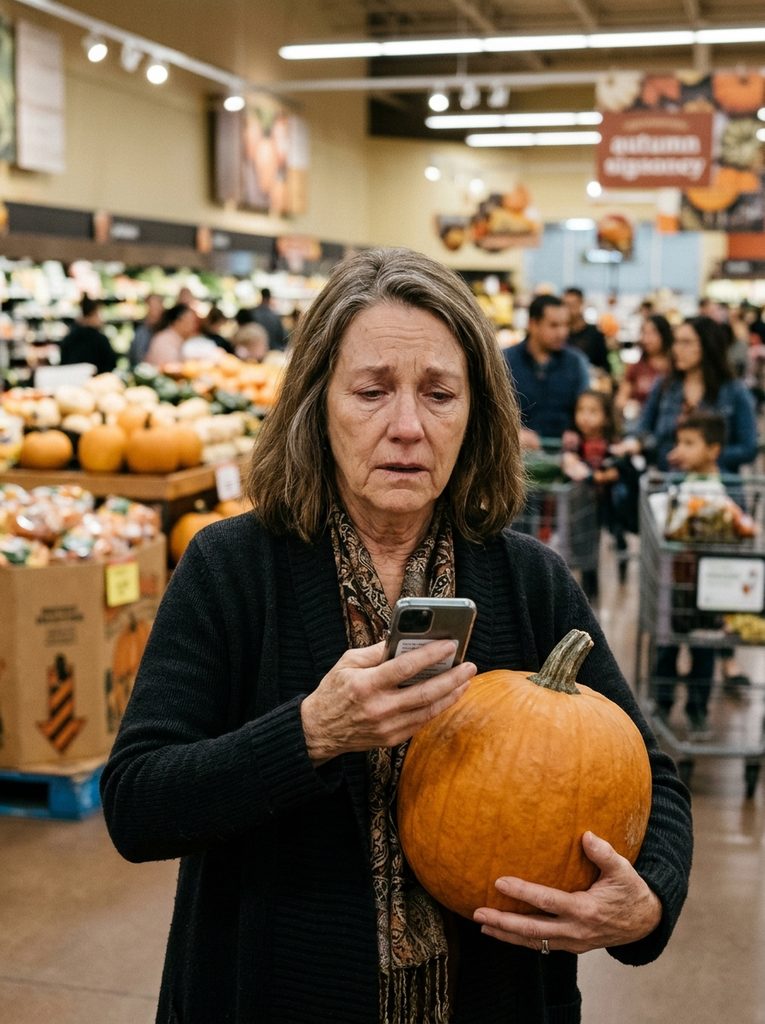
The text came while I was holding a pumpkin.
I was standing in the produce aisle of the Fry’s on Oak Avenue, three days before Thanksgiving, turning a small sugar pumpkin over in my hands to check for soft spots. My cart had a bag of cranberries in it. Two sticks of butter. A can of evaporated milk. A bunch of fresh sage for the stuffing.
My phone buzzed in my coat pocket.
I balanced the pumpkin in the crook of my arm and pulled the phone out. It was from Danny. My son.
“Hey Mom. So Sarah’s dad says he’d rather you didn’t come to Thanksgiving this year. Sarah thinks it’s better this way. Sorry. We’ll catch up after the holidays.”
I read it once.
Then I read it again, slowly, the way you read a word you’re not sure you’re spelling right.
A few feet away, a little girl in a shopping cart was singing a song about a turkey. Something she’d learned at school. Gobble gobble, the turkey’s in the oven, gobble gobble, the turkey’s getting hot. Her mother was laughing and picking out sweet potatoes.
I stood there between the squash and the cranberries with a pumpkin in my arm.
I typed a reply. A whole paragraph.
“Danny, I don’t understand. I’ve never even met Richard more than twice. What did I do? I bought you a house three weeks ago. I was going to bring the pie. I always bring the pie.”
I read it over. I deleted it.
I typed another one.
“Is this what you want, too? Or is this what Sarah’s father wants?”
I deleted that one too.
Then I wrote the only word I could actually stand behind.
“Okay.”
I pressed send.
I set the pumpkin back on the pile, very carefully, so it wouldn’t roll off. I left my cart right there in the aisle, with the cranberries and the butter and the sage still in it. And I walked out through the automatic doors into the white glare of the parking lot.
I sat in my car. A 2006 Camry. It has a new door handle now. The old one came off in my hand last spring.
I didn’t cry.
I just sat there with both hands on the steering wheel for a long time, watching people push carts full of Thanksgiving groceries across the parking lot.
Then I drove home.
My name is Margaret Gray. I’m sixty years old.
I’m a retired school administrative assistant. For thirty-one years, I worked the front office at Desert Willow Elementary in Phoenix. I was the person who knew where everything was kept.
The spare key to the gym. The fire drill schedule. The number for the plumber who’d come out on a Saturday. Which child’s mother had a court order and was not, under any circumstances, allowed to pick him up in the afternoon.
Principals came and went. Seven of them, in thirty-one years. Every one of them came to me on their first day and said, “Margaret, where do we keep the…” and I always knew.
I’m good with paper. Forms. Files. Fine print. It’s the one thing in my life I’ve always trusted.
Danny is my only son.
His father, my husband Walt, died when Danny was fifteen. A heart attack, on a Tuesday afternoon. In the car. In the pickup line outside Danny’s high school, waiting to drive him to a dentist appointment.
The school called me at work. I remember the principal’s voice. I remember dropping a stack of attendance cards all over the office floor.
I was thirty-six years old.
After that, I took a second job. Evenings and Saturdays, answering phones at a dentist’s office in Tempe. For the next twenty years, I stretched one salary and a half like bread dough. Thinner and thinner, to cover more and more.
I want to say this plainly, because it matters.
I was never wealthy. Not even close.
I drove that Camry until the door handle came off in my hand. I bought my clothes at the resale shop at St. Mark’s. I clipped coupons. I brought my lunch to school every day for thirty-one years in the same blue lunch box.
And for six years before I retired, I had a savings account at the credit union that I named HOUSE.
That’s what it said on the statement. HOUSE.
I put every dollar into it I didn’t absolutely need. Forty dollars here. Two hundred there. My tax refund every April. A small inheritance from my aunt Rose in Tucson when she passed.
I wanted Danny to have the one thing I never had.
A start.
Danny married Sarah eleven years ago.
She’s a sweet girl. A dental hygienist, actually. They met at the dentist’s office where I worked Saturdays. I introduced them. I always thought that was funny. Me, the matchmaker.
Last spring, they sat at my kitchen table and told me they’d been turned down for a mortgage. Three banks. Danny’s credit wasn’t good enough. Too much debt. Sarah’s student loans.
“We’re never going to get a house, Mom,” Danny said. “We’re thirty-four and we’re still renting a two-bedroom apartment next to the freeway.”
Sarah was crying quietly into a paper napkin.
That night, after they left, I sat down at the kitchen table and logged into the credit union website.
I looked at the balance in my HOUSE account.
Three hundred and fifty thousand dollars.
I sat back in my chair and stared at that number for a long time.
It was enough. Enough to buy a modest three-bedroom house in a decent neighborhood. Outright. No mortgage. No bank.
The next Sunday, I told them.
They both cried. Sarah jumped up from the table and hugged me so hard my glasses went crooked.
Danny took both of my hands in his.
“Mom,” he said. “I will never, ever forget this.”
I believed him.
The way you believe a thing you need to.
We found the house in September. A little stucco ranch in Glendale with a lemon tree in the backyard and a covered patio. Three bedrooms. Two baths. A kitchen with new countertops.
We closed on it at the end of October. In a conference room at a title company, with a big bowl of peppermints on the table and a nice young woman sliding papers in front of me one after another.
“Sign here, Mrs. Gray. And here. Initial here. And here.”
Danny had his arm around my shoulders the whole time. Sarah kept taking pictures on her phone.
I signed everything she put in front of me.
I didn’t read a single page.
Me. Margaret Gray. Thirty-one years of fine print.
I didn’t read one word.
I haven’t told you the part before the house.
Over eleven years, I had given Danny and Sarah a hundred and eighty-five thousand dollars.
I know that exact number because I added it up. At two o’clock in the morning, the night after the produce aisle. With Walt’s old calculator. The one with the big green buttons that he used for our taxes every year.
The wedding. Twenty-eight thousand dollars. They wanted the venue in Scottsdale with the fountain.
A car for Sarah, when her old Honda died. Twelve thousand.
Furniture for their apartment. Ten thousand.
Six thousand dollars for what Danny called “an emergency.” He never said what the emergency was. I never asked.
And then all the smaller amounts. Five hundred. Two thousand. Eight hundred. A transmission repair. A dental bill. A late rent payment. Christmas presents for Sarah’s family.
“Mom, we hate to ask.”
They always said that. Mom, we hate to ask.
And they always thanked me.
At first, they thanked me with visits. Sunday dinners at my house. Photographs on my refrigerator. Long phone calls on Sunday afternoons, where Danny would tell me all about his job, and I’d tell him about the kids at school.
Then the calls got shorter.
Then they only came when there was a need. A bill. A repair. An emergency.
I noticed the pattern. Of course I noticed. I’m a woman who notices patterns. I noticed it the way you notice a leak in your ceiling. First a stain. Then a drip. Then a sound in the night you can’t stop hearing.
And I told myself it was just what mothers do.
What I didn’t understand, until I was standing in that produce aisle with a pumpkin in my arm, was this.
I’d taught them it was free.
All of it. The money. The help. Me.
I’d taught them I was free.
When I got home from the grocery store that afternoon, I made the good tea.
The Darjeeling. In the tin with the elephants on it. I only make it for occasions. Christmas morning. Danny’s birthday. The day I retired.
I don’t know why I made it that day. Maybe because it felt like an occasion. Just not a good one.
I sat down at my kitchen table with my cup.
And there, on the corner of the table, was a purple folder.
It was from the title company. They’d given it to me at the closing. All the documents from that afternoon, every page I’d signed, neatly organized with little colored tabs.
It had been sitting on the corner of my kitchen table for three weeks.
I’d been too happy to read it.
I opened it.
And I read every single page.
I’m a woman who reads fine print. That’s the thing I need you to understand about me. It’s what I did for thirty-one years. Field trip permission slips. Custody orders. District policy memos. Insurance forms.
So I read it the way I used to read everything at Desert Willow. With a pencil in my hand and a legal pad beside me.
I read the purchase agreement. I read the closing instructions. I read the title commitment. I read the riders and the addendums and the acknowledgments.
It took me until almost midnight.
And by midnight, I’d found three things that made my stomach go tight.
The first one was on page nineteen.
The closing had happened. The money had moved. But the deed had not been recorded with the county.
There was one line, in small print, in the middle of a paragraph of legal language. The title company had issued its commitment, and then paused the transfer of title “pending receipt of grantee’s executed acknowledgment.”
I read that line four times.
As far as I could tell, it meant the house I’d paid for didn’t legally belong to Danny and Sarah.
Not yet.
It was sitting in escrow. With my money.
The second thing was a form I’d signed near the end of the closing.
I remembered it. Vaguely. The young woman had slid it in front of me right as Danny was hugging me and Sarah was saying “Smile, Margaret!” and holding up her phone.
It was called a Funding Acknowledgment.
It said the money for the house had been provided by me, Margaret A. Gray, “as a loan or gift, to be designated by grantor in writing prior to recording.”
Prior to recording.
I sat there with my pencil.
Nobody had designated anything. Not me. Not Danny. Not the title company.
Nobody had ever asked me in writing whether it was a loan or a gift.
The third thing was in a rider attached to the back of the folder. Two pages, stapled. And it was the one I read four times. Then five.
“Grantor retains the right to direct title in her own name, or in the name of any person she designates, until the acknowledgment is executed.”
I set down my pencil.
I sat back in my chair.
My tea had gone completely cold.
For thirty-one years, I sat at a front desk and watched principals sign things without reading them. Contracts. Budgets. Purchase orders. I’d always shake my head after they left.
And I’d spent one afternoon doing exactly the same thing myself.
I sat at that kitchen table until two in the morning.
That’s when I got out Walt’s calculator and started adding up the hundred and eighty-five thousand dollars.
I called Linda Martinez the next morning at nine o’clock sharp.
Linda is fifty-four. A small, dark-haired attorney with a voice like cool water. Her office is on the second floor above a flower shop on Camelback Road. You walk up a narrow staircase, and the whole way up, it smells like roses and eucalyptus.
She handled Walt’s estate, back when Danny was fifteen. She handled my mother’s, too, eight years ago.
In all that time, I have never once seen Linda Martinez hurry.
“Margaret,” she said on the phone. “How are you?”
“I’m not sure,” I said. “Can I come see you?”
“Today at two.”
I carried the purple folder to her office in a canvas tote bag from the library. Along with my legal pad. And Walt’s calculator.
She listened to me for forty minutes without saying a single word.
I told her everything. The HOUSE account. The hundred and eighty-five thousand dollars. The closing. The produce aisle. The text.
“Sarah’s dad says he’d rather you didn’t come.”
When I finally finished, she took off her reading glasses and set them down on the desk.
“Margaret,” she said. “May I say something? And I’d like you to hear all of it. Not just the first part.”
“Please.”
“Being treated badly by your family does not give you a legal right to take back a gift,” she said. “If you gave them that house, and it closes in their names, it’s theirs. A court is not going to undo it because of one hurtful text message. No matter how hurtful.”
“I understand.”
“And Arizona has no law that lets you cancel a completed gift just because the relationship has gone sour.”
My shoulders sank. I looked down at my hands in my lap.
“But,” Linda said.
She put her glasses back on. She turned a page in the purple folder.
“That isn’t where you are.”
She put her finger on page nineteen.
“This deed hasn’t recorded, Margaret. And you haven’t designated. You never told anybody in writing whether this was a gift or a loan. And this rider, right here, gives you the right to direct the title until that acknowledgment is signed.”
I stared at her.
“So until you make that designation,” Linda said, “you have a legal choice. You can direct the title to Danny and Sarah, the way everybody assumed you would. You can put the house into a trust. You can take the title in your own name. Or you can ask the escrow company to return your funds entirely.”
I stared at the page under her finger.
“Which one is right?” I asked.
Linda smiled at me. A small, kind smile.
“That isn’t a legal question, Margaret,” she said. “That’s the one I can’t answer for you.”
We spent the next three days going through everything.
Linda took my legal pad, with all my two-in-the-morning arithmetic on it, and she sorted every single item into piles on her big wooden desk.
The wedding money. Twenty-eight thousand. That was a gift. Clearly. There was a thank-you card from Sarah, in her loopy handwriting. “Thank you for giving us the wedding of our dreams.”
The car. A gift.
The furniture. The six-thousand-dollar emergency. Those were ambiguous. Nobody had said anything either way.
And then the smaller ones. The repairs. The bills. The late rent.
Those came with text messages. I’d saved all of them. I save everything.
“Mom, I promise I’ll pay you back by spring.”
“I’ll Venmo you on the first of the month, I swear.”
“Can you spot me $2K for the transmission? I’ll pay it back with my bonus.”
“This is just a loan Mom, I’ll get it back to you by Christmas.”
There were nine of them. Over four years.
Linda added them up on Walt’s calculator.
“Twenty-three thousand dollars,” she said. “Supported by messages where your son uses the words ‘pay back’ or ‘loan.’ In his own words.”
None of it had ever been repaid. Not one dollar.
“These are loans, Margaret,” Linda said. “Documented loans.”
“I don’t want to sue my son,” I said.
“Nobody said anything about suing.”
“Then what?”
“A letter,” Linda said. “A polite one. With the dates and the totals, asking him to acknowledge the debt. That’s all.”
She tapped the stack of text messages with one finger.
“Margaret. You’ve been rescuing that boy without any terms for over a decade. Terms aren’t cruelty. Terms are how you keep loving someone without losing yourself.”
I laughed. It came out shaky.
“That sounds like something Walt would have said.”
“Was he a reader?” Linda asked. “Of fine print?”
“He read the backs of cereal boxes,” I said. “Every morning. Out loud.”
Linda smiled.
“Then he’d have approved.”
I want to tell you what Danny did next.
But first I have to tell you what I did. Because I almost got it wrong.
On the fourth night, I sat at my kitchen table with a fresh legal pad and a pen. And I wrote my son a letter.
It was a good letter. I’ll admit that. It was sharp and precise. It was written in the voice of a woman who’d spent thirty-one years handling angry parents at a front desk.
It listed every one of the nine loans. Dates. Amounts. His exact words.
It stated that, unless he and Sarah acknowledged the debt in writing within fourteen days, I would direct the title of the house to myself.
And that they would then have thirty days to move out of a house they had never actually closed on.
I read it over twice.
It was cold. It was logical.
And every word of it was true.
Then I thought about Walt.
I thought about a boy of fifteen sitting in a hospital waiting room with his backpack still on his shoulders. Asking the nurse over and over, “Is my dad okay? Is my dad okay?”
And I tore that letter right in half.
Then in half again.
I sat there looking at the torn pieces on the table.
And I understood something about myself.
I’d wanted to punish him.
Under all that careful arithmetic, under all those dates and totals and his own words, I wanted Danny to feel what I’d felt in that produce aisle. Small. Unwanted. Sent home.
That’s not what Linda meant.
Terms aren’t cruelty. That’s what she said.
But a letter written out of hurt isn’t a term. It’s a slap. With a lawyer’s stamp on it.
So I got out a clean sheet of paper. And I wrote a second letter. A much shorter one.
And I didn’t send that one either.
I put it in the purple folder. And I waited for him to call.
He called on Thursday night.
It was eight-thirty. I was sitting in my reading chair under Walt’s old lamp with a library book I wasn’t really reading.
The phone rang. His name on the screen.
“Mom. Hey.”
His voice was strange. Tight.
“So, um. The title company called Sarah today. They said something about the deed? That it’s not recorded or something? That they’re waiting on some form?” He took a breath. “Mom, does this mean the house might not be ours yet?”
“Danny,” I said. “Before I answer that, I’d like you to tell me something.”
“Okay.”
“When you texted me about Thanksgiving. Did you ever ask Sarah’s father why he didn’t want me there?”
The line went quiet.
Behind him, I could hear a television. A dishwasher running. And Sarah’s voice in the background. Low and urgent.
“Just ask her. Danny. Just ask her.”
“Mom,” Danny said. “That’s not really the point right now.”
“It’s the only point I have, honey.”
“I don’t… Richard just said…” He stopped. Started again. “He said there’d be tension. About the house.”
“What about the house?”
A long breath on the other end of the phone.
“He thinks it’s strange. That you’d pay for the whole thing. He said it gives you… he said people who pay for everything always expect a say.”
I looked across the room at the purple folder on my kitchen table. At the kettle on the stove. At Walt’s old reading lamp, throwing its little yellow circle on the rug.
I’d been alone in that house for nine years. Since Danny moved out.
And I had never felt the shape of the room so clearly.
“Danny,” I said gently. “I didn’t ask for a say. I asked to come to dinner.”
He didn’t say anything.
“Now. About the house. I’m going to tell you the truth.”
“Okay.”
“The deed hasn’t been recorded with the county. The title company has been waiting for a form from you and Sarah. And in the meantime, the house is legally sitting in escrow. Which means I still have a decision to make.”
“What decision?” His voice was small.
“Whose house it is.”
Silence. A long one.
When he spoke again, his voice was hoarse.
“Mom. You wouldn’t.”
“I haven’t decided anything yet.”
“You’d take it back? Over Thanksgiving?”
“Not over Thanksgiving, Danny,” I said. “Over a pattern.”
“What pattern?”
I got up out of my reading chair and sat down on the arm of the sofa instead. I needed to be closer to the lamp.
“Danny. When was the last time you called me without needing something?”
He didn’t answer.
“I’m not asking to hurt you,” I said. “I’m asking because I’d honestly like to know.”
“I… it was… I don’t know, Mom. I’ve been busy.”
“I know you have.”
“Work’s been crazy.”
“I know.”
I took a breath.
“Danny. I’d like you and Sarah to come see me. This Saturday. Just the two of you. No lawyers. No papers. I’d like to make you lunch.”
They came at noon on Saturday.
I’d spent all morning cooking. Butternut squash soup. Cornbread in the cast-iron skillet. And a pumpkin pie, made with a real pumpkin. A small one I’d bought at a farm stand out in Queen Creek, from an old man who’d grown it himself.
The house smelled like cinnamon and nutmeg and brown butter.
I’d set the table with the good plates. My mother’s china, the white ones with the gold rim. And a mason jar of dried flowers from my backyard in the middle.
Danny stood on my front porch for a full minute before he rang the bell.
I saw him through the window. Standing there with his hands in his pockets. Looking at the door like it might bite him.
When I finally opened it, I saw what I’d expected. And something I hadn’t.
He looked thin. Thinner than I’d ever seen him. His shoulders had a stoop to them. He was thirty-four years old, with his father’s long jaw and his father’s dark eyes.
And he had the dark circles under them of a man who hasn’t been sleeping.
Sarah stood one step behind him. She was wearing a plain gray sweater and no makeup. She was hugging a canvas bag to her chest with both arms. All the polish she usually had was gone.
She looked young. And frightened.
“Mom,” Danny said.
“Come in,” I said. “Lunch is ready.”
We ate in near silence.
I asked Danny about his job. He sells HVAC systems for a company in Chandler. He said it was fine.
Sarah praised the cornbread. “This is really good, Margaret.” Then, five minutes later, “Margaret, this cornbread is so good.” I could hear her searching for something else to say. Anything.
The clock in the hallway ticked. Walt’s grandmother’s clock. It’s been ticking in that hallway since 1988.
When I’d cut the pie and set a slice in front of each of them, I sat down. I laid both of my hands flat on the table.
“I’d like to tell you what I found,” I said.
I told them all of it.
The deed that hadn’t recorded. The Funding Acknowledgment form. The rider with my right to direct the title. The nine text messages. The twenty-three thousand dollars, in Danny’s own words.
I didn’t raise my voice. I just told them. The same way I used to tell parents at Desert Willow that their child had a lice check.
Danny’s face had gone gray.
Sarah had one hand pressed over her mouth.
“I’m not telling you this to frighten you,” I said. “I’m telling you because I think you’ve been living as if something is finished. When it isn’t. And I think I’ve let you.”
“Margaret,” Sarah whispered. “We didn’t know. I swear we didn’t know.”
“I believe you.”
“We thought it closed. The lady at the title company said congratulations. We thought we were on the deed.”
“You’re not, honey.”
“Then who…?”
“Me.” I smiled. Thinly. “Technically. Still. Until I designate.”
Danny put his head down in his hands.
“I need to ask you both something,” I said. “And I want an honest answer. From both of you.”
They waited.
“Did you want me at Thanksgiving?”
I’d braced myself for a speech. An explanation. Excuses.
What I got was a silence so long I could hear Walt’s grandmother’s clock ticking in the hall. Tick. Tick. Tick.
Sarah spoke first.
Her voice was very small.
“Margaret. Can I tell you what really happened?”
“Please.”
“My dad called,” Sarah said. “About two weeks ago. He’s been really difficult since my mom died in March. He gets… he’s…”
She twisted her hands together on the table.
“I think he’s jealous,” she said. “He said, ‘That woman bought you a house, and now she’s going to be sitting at the table carving the turkey like she owns the place.’ He said, ‘People like that make you owe them forever, Sarah.’”
“And you agreed with him,” I said.
“I didn’t agree.”
The tears came then. They spilled right over.
“I just didn’t say anything. I let it happen. I let Danny send that text. Because if I fought my dad on it, he wouldn’t have come either. And he’s… Margaret, he’s so alone. My mom was everything to him. He just sits in that house by himself and watches the Weather Channel.”
I looked at her. A young woman in a gray sweater, thin and crying. Whose father’s grief had turned into a wedge between all of us.
“I see,” I said.
“I’m so sorry.”
“Sarah,” I said. “I lost my husband when I was thirty-six. I know exactly what grief does to a person. What it turns them into.”
I took a breath.
“But I’d rather you’d told me.”
“I know.”
“I’d have sent the pie with Danny. I’d have said, ‘Of course. Give your father the head of the table. Tell him I said hello.’”
“I know,” she sobbed. “That’s exactly what I was afraid of. That you’d be so kind about it. And then I’d feel even worse.”
Danny finally lifted his head out of his hands.
His eyes were red. And wet. And so ashamed.
For one second, he looked exactly fifteen years old again. Sitting in that hospital waiting room with his backpack on.
“Mom,” he said. “I’d like to say something.”
“Go on.”
“I texted you. I wrote it. Sarah didn’t. I did.”
His voice was shaking.
“I typed it out. And I read it. And I thought, this is cruel. This is really cruel. And I sent it anyway.”
“Why?”
“Because it was easier.”
He laughed. A cracked, broken sound.
“That’s the truth, Mom. It’s always easier. Richard was on the phone yelling. Sarah was crying in the bedroom. And you… you were never going to fight. You never fight. You never have. So I thought, ‘She’ll just say okay.’”
“I did,” I said.
“I know you did.” He pressed the heels of his hands against his eyes. “And I felt relieved, Mom. God help me. When I saw your text come back, I felt relieved.”
I sat very, very still.
“That’s the part I can’t get past,” Danny said. “I’ve been sick about it for two weeks. I can’t eat. I can’t sleep. Not because of the house. Because I knew you’d just take it. Absorb it. Like you always do. And I’d come to count on that.”
His voice broke right in half.
“You taught me that, Mom. By never once saying no to me. Not once in thirty-four years. I didn’t think you could.”
“I couldn’t,” I said quietly.
“And now?”
I thought about that question. Honestly. The way he deserved.
The pie sat on the table between us, cooling. Outside the kitchen window, a mourning dove was calling from the power line. That low, sad sound they make.
“I can,” I said. “I’m learning how.”
Here’s what I decided.
I’ll tell you in order. Because I made the decisions in order. Right there at the kitchen table. With pie.
First. The loans.
Twenty-three thousand dollars.
“I’m not forgiving any of it,” I said. “And I’m not collecting any of it. Not until the three of us sit down together, with a pen, and write out terms. Real terms.”
Danny nodded.
“Four hundred dollars a month,” I said. “Starting in January. Until it’s paid.”
Sarah did the math in her head. I watched her do it.
“That’s almost five years,” she said.
“Fifty-eight months,” I said. “Yes.”
“We can do that,” Danny whispered. “We can do four hundred.”
“I know you can,” I said. “That’s exactly why I picked it.”
Second. The house.
I looked at the two of them. My son and his wife. Sitting in my kitchen that smelled like cinnamon. Both of them with red eyes.
“I’m going to direct the title to you,” I said.
Sarah gasped out loud.
Danny’s mouth fell open.
“On conditions,” I said.
They waited. Neither of them breathed.
“One. The house goes into a trust. Both of your names on it. You’ll both be trustees. But if the house is ever sold, or borrowed against, or refinanced, it requires a signed letter from me. Or from my estate, after I’m gone. Saying yes.”
“Mom,” Danny breathed.
“That’s not control, Danny,” I said. “It’s a signature. One signature.”
I smiled at him.
“Think of it as a seatbelt.”
“Two.”
I turned to Sarah.
“You’ll invite your father to dinner. A Sunday dinner. At your new house. With me there too.”
She stared at me.
“I’d like to meet him properly,” I said. “Without a turkey between us.”
She laughed. A startled, wet little sound. She covered her mouth.
“And three.”
I looked at my son.
“You call me. Once a week. For no reason at all. For one year.”
“Mom…”
“For no reason, Danny. Not because you need something. About a book you’re reading. A bird you saw. A funny thing a customer said. A ballgame. Anything.”
I held his eyes.
“And I’ll be able to tell, Danny. Don’t think I won’t. I was a school secretary for thirty-one years. I know when a child is reading from a card.”
He put his face in his hands again.
And this time, he laughed. Helplessly. And cried at the same time. His shoulders were shaking.
Sarah put her arm around him. She leaned her head on his shoulder.
And I got up and got the coffee pot. Because somebody had to. And because I needed to turn around for a minute so they wouldn’t see my face.
It took five weeks to close properly.
Linda drew up the trust. She read me every single clause out loud, in that cool, calm voice of hers. Sitting across from me at her big wooden desk, with a little bowl of butterscotch candies between us and the smell of roses coming up the stairs from the flower shop.
Danny and Sarah signed the Funding Acknowledgment. This time, it said “gift” on the line. In my handwriting.
Danny signed the loan agreement too. Twenty-three thousand dollars. Four hundred a month. First payment due January first.
He read every page before he signed. I watched him do it.
I signed my part with the same pen I’d used for thirty-one years at Desert Willow Elementary. A green Pilot. Nearly out of ink. I’d taken it home on my last day of work and never used it since.
It ran out right after the last letter of my last name.
When the deed finally recorded, a clerk at the Maricopa County Recorder’s Office stamped it in blue ink. A few days later, I got a certified copy in the mail.
I framed it.
Well. Not the deed. I framed the envelope it came in.
It had a stamp on it. A little gray bird. A mourning dove, I think.
It hangs in my kitchen now, right next to the window. Right where I can see the real ones on the power line.
Richard came to dinner in January.
The second Sunday. At Danny and Sarah’s new house, with the lemon tree in the back.
I’d been dreading it. I’ll admit that.
In my head, I’d built him up into some kind of tyrant. A big, loud, angry man who’d look me up and down and decide I wasn’t good enough.
He turned out to be a stooped, silver-haired man of sixty-five. A retired land surveyor. With big, careful hands, a plaid flannel shirt buttoned all the way to the top, and a hearing aid in his left ear.
He was standing on the front porch when I pulled up. He’d gotten there early. He was holding a bottle of red wine in front of his chest with both hands. Like a shield.
He watched me get out of my Camry. He watched me walk up the path with my pie.
When I got to the porch, he cleared his throat.
“Mrs. Gray,” he said. “I owe you an apology.”
“Please,” I said. “Call me Margaret.”
“Margaret.” He looked down at his shoes. “My wife passed in March. Diane. Thirty-nine years. And I’ve been… I’ve been a real bear about everything since. To everybody. To Sarah, most of all.”
“I know what that’s like,” I said. “I was a bear for about two years after Walt.”
He looked up.
“I thought you’d… I assumed…” He stopped. “A woman who pays for a whole house…”
“Wants the house?” I said.
“Wants them,” he said quietly. He swallowed hard. “I thought, she’s got a son and a daughter-in-law now, and a house to hold over them. And I’ve only got my daughter left. And I’m going to lose her too.”
I shifted the pie to one arm. I reached out and took the bottle of wine from him with the other.
“Richard,” I said. “There’s room.”
He lifted his eyes to mine. They were wet.
“At the table,” I said. “There’s always been room. For everybody.”
We ate pot roast. Sarah made it, from her mother’s recipe. It was very good.
Richard told a long, funny story about a survey crew in 1987 and a goat that kept eating their stakes. Danny laughed so hard he got the hiccups.
By dessert, Richard was calling me “Maggie.”
Nobody has called me Maggie since Walt.
I let him.
It’s been a year now.
Danny calls me on Sundays. Every Sunday. For no reason.
Last week, it was about a red-tailed hawk he saw sitting on a power line on the way to work. Just sitting there, watching the traffic, like it was waiting for a bus.
The week before that, it was a book he was reading about Antarctica. About the men who went down there on wooden ships a hundred years ago. He read me a whole paragraph over the phone.
The first few months, I could tell when he was reading from a card. When he’d made a little list of things to say, so the call would last long enough.
He’s stopped doing that now.
I can hear the difference. His voice is easier. He laughs more. Sometimes we talk for an hour. Sometimes ten minutes. Sometimes he just says, “Hi, Mom. Nothing new. Just wanted to hear your voice.”
Those are my favorites.
The four hundred dollars comes on the first of every month. By Venmo. Never late. Not once. The memo line always says the same thing.
“Thanks, Mom.”
Sarah stopped by on a Tuesday afternoon last month. Alone. With two bags of groceries I hadn’t asked for.
She stood in my kitchen in a gray cardigan, putting eggs away in my refrigerator. She knew exactly where they went.
“Margaret?”
“Yes, honey?”
“Can I ask you something?”
“Anything.”
“Why did you do it? Give us the house. In the end. After everything. You had every right not to.”
I thought about it. I was drying a coffee cup with a dish towel. I kept drying it long after it was dry.
“Because a house is only a house, Sarah,” I said. “It’s what you do inside it that decides whether it’s a gift.”
She nodded slowly.
“And because,” I said, “I’d rather be a mother who asks for terms than a woman who gets sent home from the produce aisle.”
She laughed. And then she cried. Both at once.
I handed her the dish towel.
Thanksgiving came around again.
This year, I hosted.
In my own small house. With the leaf put in the kitchen table, and twelve folding chairs borrowed from the fellowship hall at St. Mark’s.
Danny and Sarah came early to help. Richard came with two pies he’d bought at Costco, and apologized for both of them. My next-door neighbor, Eleanor, a widow too, came over with her famous green bean casserole. Two of Walt’s old coworkers from the water department came, with their wives. And the Hernandez boy from across the street was home from the Army for the holiday, so his mother brought him along.
I made the pie. The real pumpkin. From the old man’s farm stand out in Queen Creek. He remembered me.
At the head of the table, I set a plate for myself. With a little card Sarah had made. Gold letters. MAGGIE.
Richard carved the turkey. He was very serious about it. A surveyor’s precision.
Danny said grace. He did it badly. He forgot how it ends and just said, “And, uh, thanks for Mom. Amen.” Everybody laughed. Richard laughed hardest.
Later, after the pie, when everybody was full and loud and the Hernandez boy was telling army stories, I looked up.
Across the room, in the kitchen doorway, my son was standing with a dish towel over his shoulder. Watching me.
He caught my eye. And he mouthed something.
I couldn’t hear it. Not over all the noise.
But I didn’t need to.
I mouthed back.
“I know.”
The purple folder sits in my desk drawer now. It’s a little frayed at the corners. A little faded.
Sometimes, in the evening, I take it out and open it up under Walt’s old lamp. I read the first page.
Funding Acknowledgment.
A small, boring document. Two paragraphs of legal language. The kind of thing most people sign without looking at.
The kind of thing I signed without looking at.
It wasn’t the paper that mattered, in the end.
It was that I finally sat down and read it.
THE END.!