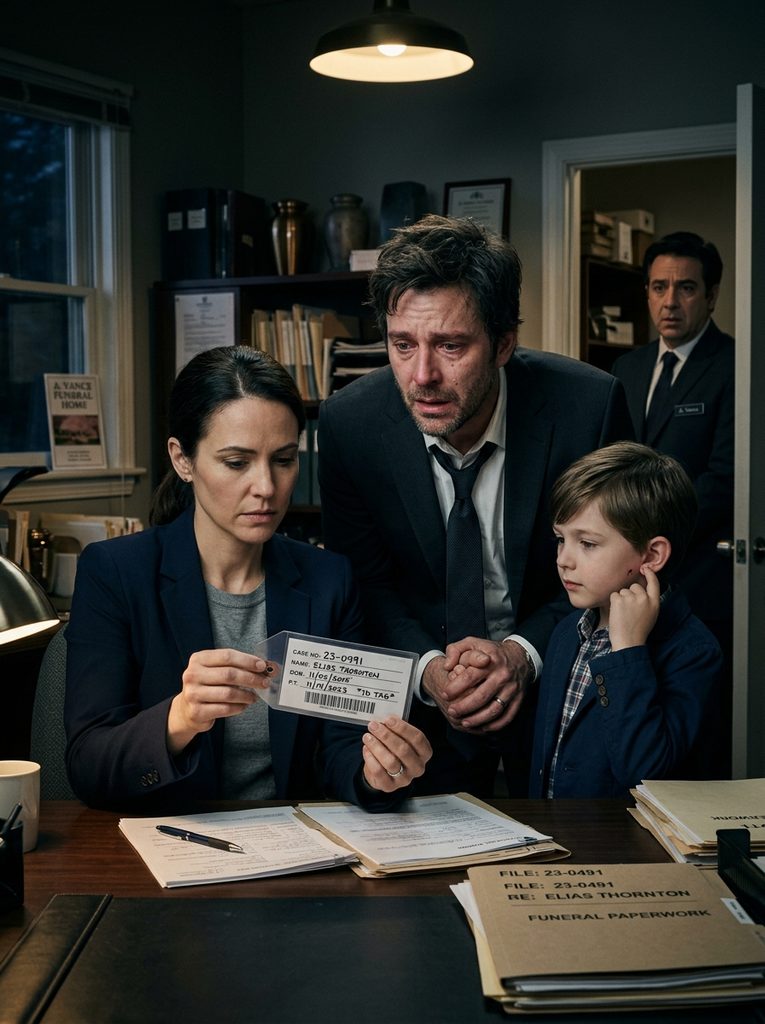
The day after my wife’s funeral, my eight-year-old son pulled me aside and told me that the woman in the coffin was not his mother. I thought grief was making him say impossible things until he pointed out one tiny detail about her left ear. I immediately called the funeral home, and then I called the detective in charge of our case.
My son Leo had barely spoken a word since my wife, Clara, died in that terrible accident. That morning, he sat at our kitchen table in yesterday’s oversized T-shirt, quietly pushing dry cereal around a bowl while I stood beside a mug of coffee that had gone completely cold long before sunrise. His blue school backpack was still hanging over the back of the wooden chair, and the little red fabric tag Clara had sewn inside it was visible through a half-open zipper. She had always labeled everything he owned because he could lose a warm sweatshirt in the short walk between the kitchen and the car.
I folded the printed funeral program in half, opened it again, and softly asked Leo what he meant. He rubbed one bare foot against the wooden leg of the chair and looked up at me.
“Mom’s ear was wrong,” Leo whispered, his voice trembling slightly.
I almost told him that the embalming process could make people look a little different, because that was the exact phrase everyone had been repeating to me since the viewing. Instead, I took a deep breath and asked him which ear he was talking about.
“It was her left ear,” Leo said firmly, looking directly into my eyes.
Clara’s left earlobe had a narrow split near the bottom from a bad earring accident when she was sixteen years old, and Leo knew it well because he used to gently touch that notch whenever she carried him half-asleep from the living room couch to his bed. The woman laying in the silver coffin had a completely smooth earlobe with no split and no scar whatsoever.
I had not noticed it at all during the entire service. I had spent the viewing staring at Clara’s closed eyes, the unfamiliar thick powder dusted over her cheeks, and her hands neatly arranged over the dark green dress her sister and I had carefully chosen together. Leo, however, had looked closely at her ear.
I called Pinecrest Funeral Home at eight seventeen in the morning and asked to speak directly with Brenda Lawson, the director who had personally handled Clara’s arrangements. When I explained what my son had noticed, Brenda lowered her voice and tried to soothe me in a measured tone.
“David, you and your little boy have been through something truly unimaginable,” Brenda said softly over the line. “Grief can often cause our minds to focus on ordinary physical differences and make them feel alarming.”
“Do not move the remains, do not authorize anything else, and do not touch her file until I arrive,” I told her firmly, refusing to let her brush me off.
There was a long, heavy pause on the other end of the line.
“David, the burial has already taken place,” Brenda said carefully.
“I know that because I was standing right there,” I replied, feeling my pulse quicken. “What I want right now is the complete chain of identification from the county facility to your preparation room.”
Brenda assured me that she possessed a signed release form, a official transport receipt, and all the identification paperwork required by state procedure. As soon as I hung up, I called Detective Nora Vance, who had been assigned to investigate Clara’s fatal traffic collision, and I gave her the exact same detail without adding a single word I could not prove. Detective Vance initially reminded me that the county facility had confirmed the body’s identity before releasing it, making a funeral home mix-up extremely unlikely.
“Please just come and look at the paperwork anyway,” I begged her.
By ten o’clock that morning, Detective Vance met me outside the stone building of Pinecrest Funeral Home in downtown Columbus. The lobby was uncomfortably warm, and someone had left a glass bowl of wrapped peppermints sitting right beside a tall stack of sympathy cards. I took one wrapped candy, slipped it into my coat pocket, and never actually opened it because I had not eaten a single bite of food all day.
Detective Vance asked Brenda for the original intake packet rather than a scanned copy. Brenda quickly brought out a thick gray folder that contained Clara’s full name, date of birth, county case number, and a transport receipt stamped at four eighteen in the morning. Detective Vance read through every single page twice, stopping abruptly when her eyes hit the transport receipt.
“Where did the physical identification tag from the transport bag go after arrival?” Detective Vance asked, looking up from the folder.
“It should have been discarded right after the preparation was completed,” Brenda answered smoothly.
“I need you to go check the back room for it right now,” Detective Vance requested firmly.
Brenda stood behind the polished front desk for several tense seconds before walking through a heavy wooden door marked with a sign that read AUTHORIZED PERSONNEL ONLY. I followed her as far as the threshold, stopping the moment Detective Vance put a gentle hand on my arm to hold me back. A large office printer hummed somewhere in the back office, but otherwise the entire building was dead silent.
A few minutes later, Brenda returned carrying a shallow plastic tray filled with metal clips, old wristbands, spare keys, and folded inventory slips, which she set down on the table between us. Detective Vance immediately began separating the items without saying a word to either of us. I caught a brief glimpse of Clara’s last name printed on a white photocopy before it was hidden beneath another sheet as Brenda nervously shifted the pile.
I reflexively reached my hand toward the pile to grab the paper.
“David, please do not touch anything on this table,” Detective Vance warned me quietly.
I immediately put both of my hands deep into my coat pockets and waited in total silence. Brenda reached underneath the plastic tray, pulled out a stiff white tag encased in a clear plastic sleeve, and placed it directly into Detective Vance’s open palm.
PART 2
The tag sitting in Detective Vance’s hand did not have my wife’s name written on it at all. It read Samantha Price, age sixty-three, and displayed a county case number that differed from Clara’s official number by only a single digit. On the back of the cardboard tag, someone had written REID in thick black marker and crossed it out with a single dark line.
Detective Vance instantly stopped treating my questions like the wild suspicions of a grieving husband. She took out her camera to photograph the tag from every angle, sealed it inside a secure evidence bag, and strictly informed Brenda that no one at Pinecrest was permitted to destroy or alter any record connected to Clara’s transfer.
“There simply has to be a completely innocent explanation for this clerical mistake,” Brenda stammered, her face turning pale.
“Why was a tag belonging to Samantha Price stored directly inside my wife’s official folder?” I asked, stepping forward.
Brenda could not give me an answer to that question. Instead, she explained that the overnight body had arrived inside a sealed black transport pouch, and her night staff had relied entirely on the county release packet attached to the outside zipper.
Detective Vance opened the gray folder once again to compare the handwritten numbers beside the four eighteen morning transfer stamp. She quickly noticed that one of the digits on the carbon paper had been heavily overwritten with a ballpoint pen. She picked up her phone, called the county records desk, gave them both case numbers, and listened intently without interrupting the clerk on the line.
When she finally hung up the phone, Detective Vance removed the county transfer sheet from the folder and placed it directly into my hands.
“Look closely at the signature at the bottom of this page,” Detective Vance instructed me softly.
PART 3
The transfer sheet looked completely ordinary at first glance until Detective Vance pointed her finger at the exact spot I needed to examine. At the bottom of the form, directly beneath Clara’s printed name, was a dark ink transport signature that did not belong to Brenda Lawson or anyone else employed by Pinecrest Funeral Home. A man had personally signed the county release form at four eighteen that morning, writing the full name Marcus Cole.
“I have never heard that name before in my life,” I said after reading it three times.
Detective Vance did not answer me right away. Instead, she pointed her pen toward the line labeled RECEIVING FACILITY, where someone had originally written PINECREST FUNERAL HOME. Beneath the thick blue ink, pressed hard enough into the paper to leave a deep physical indentation, I could easily trace the faint outlines of a completely different word.
Detective Vance tilted the white paper toward the bright overhead lobby light so we could read the hidden impression.
“It says Reid,” Detective Vance read aloud.
My eyes immediately shot back to the evidence bag holding the tag that belonged to Samantha Price, where the word REID had been written on the back and crossed out. The warm lobby suddenly felt suffocatingly small, and Brenda looked back and forth between the paper and the detective with wide, terrified eyes.
“I swear to you that I have never heard the name Marcus Cole in my entire life,” Brenda said, her voice shaking uncontrollably.
“Who was working your intake desk at four eighteen this morning?” Detective Vance asked directly.
“Our night technician, Frank,” Brenda swallowed hard before continuing. “Frank Miller.”
“Where is Frank right now?” Detective Vance pressed.
“He called in sick yesterday morning right before the service,” Brenda admitted softly.
“He called in sick on the exact day of the funeral?” Detective Vance asked, her brow furrowing. “Is he at home today?”
“I tried calling him twice this morning, but he did not answer his phone,” Brenda replied, wringing her hands together.
Detective Vance immediately pulled out her mobile phone and began dialing her precinct. Everything about her posture changed in an instant, as she stopped asking casual questions and started issuing direct orders to her team.
Within twenty minutes, two uniformed police officers arrived at the funeral home to secure the scene. They meticulously photographed Pinecrest’s intake room, seized the office computer that stored overnight transfer logs, took the entire plastic tray of tags, and bagged the original gray folder as evidence.
“Brenda, I need you to show us your security camera footage from the morning my wife’s body arrived,” Detective Vance demanded.
Brenda hesitated for two brief seconds before speaking, but both the detective and I caught the subtle delay.
“Our security cameras automatically overwrite all recorded footage every seventy-two hours,” Brenda explained nervously.
“You do not automatically archive your video files?” Detective Vance asked, her jaw tightening in frustration.
“We only manually archive footage if there is an official incident reported,” Brenda replied defenselessly. “We had no idea that an incident had occurred here.”
“Well, you have a major incident now,” Detective Vance said, stepping closer to her. “Do you have a secure cloud backup system?”
Brenda glanced nervously down the long hallway toward her private office, and that silent tell was all the answer we needed. Thirty minutes later, the three of us were sitting inside Brenda’s cramped office watching grainy black-and-white footage recorded at four eleven that morning.
On the monitor, a plain white transport van backed slowly toward the rear loading entrance of the building. The timestamp on the screen jumped forward to four thirteen as a tall man wearing a dark jacket, leather gloves, and a low baseball cap stepped out of the driver’s side door.
Frank Miller walked out from the funeral home’s back door to meet him on the pavement. The two men spoke for less than a minute before they pulled a heavy, sealed transport pouch off a metal stretcher inside the van. I leaned forward toward the computer screen, searching for any recognizable feature, but there was no way to see the person hidden inside the thick material.
I could see a bright white tag attached directly to the zipper of the bag. Frank checked a wooden clipboard in his hands, and the driver pointed toward a line on the paper. Frank laughed at something the man said, and then the driver reached into his coat and handed him a thick white envelope.
Detective Vance immediately hit the spacebar to freeze the video frame on her screen.
“What did he just hand your employee?” Detective Vance asked, turning her head toward Brenda.
“I have no idea,” Brenda whispered, her face completely drained of color.
“You know your own employee, Brenda,” Detective Vance pushed hard. “What was inside that envelope?”
“I know Frank, but I swear I do not know what that man gave him,” Brenda insisted, squeezing her eyes shut.
Detective Vance zoomed in on the frozen image until the pixels broke into tiny squares, but the shape of the envelope remained unmistakable. Frank carefully slid the thick envelope into the inside pocket of his heavy jacket before helping the driver wheel the stretcher inside the building.
The driver climbed back into the white van and drove away from the property at four twenty-one in the morning. Detective Vance quickly rewound the footage and paused it on the driver’s face.
“Brenda, does the county medical examiner normally use private transport contractors for overnight transfers?” Detective Vance asked.
“They do when their primary fleet is overwhelmed,” Brenda answered softly.
“Was Marcus Cole an authorized contractor for the county this morning?” Detective Vance queried.
Brenda checked her computer database and shook her head, confirming that he was not on the approved list. The registered driver who had been scheduled to deliver Clara to Pinecrest that morning was actually a woman named Teresa Young.
Detective Vance immediately dialed Teresa’s official number to ask why she had not completed the run. What Teresa told us over the speakerphone made Brenda sit down heavily in her office chair.
Teresa explained that her scheduled transport run had been abruptly canceled at three forty-two that morning when someone claiming to be from the county supervisor’s office called to inform her that the transfer had been reassigned to another unit. Teresa had logged the incoming call, but the caller’s number was completely blocked on her screen. When Detective Vance asked if that kind of last-minute reassignment happened often, Teresa stated that it had never happened to her before in her ten years on the job.
“Which specific case number are we discussing right now, Detective?” Teresa asked over the line.
“We are investigating the transfer of Clara Reid,” Detective Vance answered clearly.
There was a long pause on the line before Teresa spoke again.
“Detective, my original pickup sheet was not for Clara Reid,” Teresa stated, her voice sounding confused. “I was dispatched to pick up Samantha Price.”
Detective Vance straightened her back instantly.
“What did you just say?” Detective Vance demanded.
“I was assigned to pick up Samantha Price from Bay Seven,” Teresa repeated clearly.
Teresa checked her digital log logs and confirmed that Clara Reid had been held right next door in Bay Six. They were located one door apart, assigned case numbers separated by a single digit, and logged into the system at almost the exact same time.
It sounded like a catastrophic clerical error, and for thirty precious seconds, I desperately wanted it to be one. I wanted it to be a terrible, unforgivable mistake made by tired technicians working an overnight shift.
“Was Samantha Price scheduled to be delivered here to Pinecrest Funeral Home?” Detective Vance asked.
“No, she was not,” Teresa answered without hesitation.
“Where was she supposed to be taken?” Detective Vance pressed.
“She was scheduled for delivery to Reid Cremation Services,” Teresa revealed.
No one inside the office spoke a word, and even Brenda seemed to stop breathing entirely. Detective Vance asked the driver to repeat the full name of the destination to ensure there was no misunderstanding.
“Reid Cremation Services,” Teresa confirmed. “It is an independent facility located about twenty miles east of the city, owned by a family named Reid.”
The word written on the back of the tag was not my wife’s last name at all. It was the intended destination of the body. Someone had written REID on the tag, crossed it out, and written Pinecrest over the official paperwork.
Two women had been placed in adjacent bays at the county facility, their case numbers separated by a single digit. Someone had deliberately switched their destinations, and the terrifying question was why anyone would do such a thing.
Detective Vance left me waiting in the lobby of Pinecrest while she drove directly to the county medical facility to inspect the holding area. I called Leo’s elementary school to inform them that he would not be attending classes for the rest of the week, and my sister agreed to stay with him at our house.
I did not tell my son what we had uncovered at the funeral home. Instead, I simply asked him over the phone if he remembered noticing any other unusual details during the viewing.
“Mom was not wearing her wedding ring,” Leo answered quietly after thinking for a moment.
I closed my eyes and took a deep breath, remembering the inventory sheet from the crash site. Clara’s gold wedding band had been removed by paramedics after the collision and listed with her personal effects, which the police had already returned to me in a plastic bag.
“That is normal, buddy,” I explained gently. “The police gave her ring back to me.”
“And her pinky finger was completely straight,” Leo added innocent.
My eyes snapped open in an instant.
“What did you say about her finger?” I asked, my heart hammering against my ribs.
“Her pinky finger was straight,” Leo repeated firmly. “Mom’s finger was always bent.”
Clara had broken her left pinky finger playing volleyball during her senior year of high school, and the bone had never healed completely straight. I had held that hand every single day for thirteen years, kissed those exact fingers on our wedding day, and watched those hands button Leo’s winter coat every morning. Yet, I had stood beside a coffin for two hours without realizing that the hand resting inside belonged to a completely different woman.
Grief had rendered me blind and careless, while my eight-year-old son had been remarkably precise. At one thirty-six that afternoon, Detective Vance called my phone and told me to come down to the county medical facility immediately.
When I arrived at the facility, Detective Vance met me near a heavy steel security door alongside another investigator, Detective Marcus Hill. Neither of them looked hopeful as they led me into a small, windowless conference room.
On the metal table in the center of the room lay two enlarged photographs. The first photo showed the exterior barcode label from Clara’s original transport pouch, while the second photo showed Samantha Price’s label.
“Both of these original labels were printed correctly by our automated system,” Detective Vance explained, tapping the photos.
“Then where is my wife?” I demanded, gripping the edge of the table.
“At three fifty-one this morning, both stretchers were moved out of their holding bays for official release,” Detective Vance said softly. “The county corridor camera captured an employee wearing a surgical cap and mask pulling both stretchers into a hallway nook beyond the camera’s view. Three minutes later, he returned with only one.”
“Who was the employee?” I asked frantically. “Identify him and find him right now!”
“The security badge used during that shift belonged to a morgue technician named Arthur Pendelton,” Detective Vance revealed grimly. “Arthur Pendelton died eleven months ago.”
I stared at her in complete disbelief as she explained that the badge had been reactivated at three forty-six that morning for exactly twenty-three minutes before being disabled again. Such an access change required high-level administrator credentials, which were held by only four living people in the entire department.
Furthermore, the name Marcus Cole did not match any licensed driver or contractor in the state system, meaning the identity was entirely fabricated. However, traffic cameras had managed to track the white transport van, revealing that its license plate belonged to a commercial vehicle reported stolen two days before Clara’s accident.
This was no longer a tragic funeral home mix-up. Someone had meticulously planned this swap long before my wife died in that car crash.
“Then the crash was not an accident at all,” I said, my voice rising as I stood up so quickly my chair scraped loudly against the floor. “Someone murdered my wife!”
“We are currently reviewing every piece of physical evidence from the collision site,” Detective Vance answered carefully.
“You told me the other driver crossed the center line and hit her head-on!” I shouted, feeling a wave of intense heat rise behind my face.
“That is what the preliminary evidence indicated at the scene,” Detective Vance explained calmly. “The driver fled on foot before officers arrived, and the vehicle he was driving turned out to be stolen.”
“Why did nobody tell me that the other car was stolen?” I demanded, clenching my fists.
“At the time, that detail did not change the immediate cause of death,” Detective Vance replied defensively. “It changes everything for us now.”
She paused for a long moment, looking down at her notes before meeting my eyes with a heavy expression.
“David, there is a very real possibility that Clara was not the woman who died in that car crash,” Detective Vance revealed quietly.
I froze in my tracks, unable to process the words coming out of her mouth.
Detective Vance opened a thick manila file and explained that the woman recovered from Clara’s burning vehicle had suffered severe facial trauma, possessed no wallet or phone, and wore clothing largely destroyed by fire. The victim’s initial identification had been made using the car’s registration and a dental record comparison sent electronically later that morning.
“The dental office informed us that the request for records did not come through our official police portal,” Detective Vance noted. “Someone called them claiming to be an investigator and requested that they upload Clara’s most recent X-rays to a secure external link. A second set of falsified files was then uploaded directly under Clara’s case number.”
She then showed me a photograph of a small silver bracelet recovered from the floorboard of the wrecked car, bearing the engraved initials S.P. Samantha Price had been in Clara’s car during the crash, not my wife.
The timeline was sickeningly complex. A severely injured woman was pronounced dead at the crash scene at eleven forty-eight at night and brought into county custody. At three fifty-one in the morning, the bodies were swapped in the hallway, and by four eighteen, a body was delivered to Pinecrest under Clara’s name while another was dispatched to Reid Cremation Services under Samantha’s name.
Detective Vance informed me that Reid Cremation Services had received a body labeled Samantha Price at four forty-nine that morning, but the direct cremation had been delayed because a lawyer representing her estate requested a twenty-four-hour hold.
We immediately drove to Reid Cremation Services to conduct an emergency forensic examination of the body stored in their refrigerated unit. A forensic pathologist named Dr. Aris Thorne met us in the cold corridor and warned me that the body had already undergone partial preparation, but I insisted on seeing her with my own eyes.
When Dr. Thorne pulled back the white sheet, my heart surged with a sudden, violent wave of hope, only to shatter completely a second later. The woman lying on the table was in her late fifties, with graying roots and a peaceful face that made me feel physically ill. It was Samantha Price, and her medical records confirmed the presence of surgical hardware in her right knee that matched her file perfectly.
This meant Samantha Price had never been inside Clara’s coffin at Pinecrest Funeral Home. The woman buried under Clara’s name in our family plot was a third, completely unknown victim.
Detective Vance immediately obtained an emergency exhumation order from a local judge, and by late afternoon, a crew returned to the cemetery under heavy police supervision to raise the coffin from the ground. I could not bring myself to watch them dig, so I went straight home to be with my son.
I found Leo sitting quietly on the living room floor surrounded by Clara’s old photo albums. When I walked through the door, he looked up at me with wide, anxious eyes.
“Was I right, Dad?” Leo asked softly.
I knelt down beside him on the carpet and pulled him close.
“Yes, buddy, you were completely right,” I told him, my voice breaking.
Instead of looking relieved, Leo looked utterly terrified as fresh tears began streaming down his face.
“Then where is Mom?” Leo sobbed, burying his face in my chest.
“I do not know yet, but I promise you I am going to find her,” I whispered, holding him tight until he eventually cried himself to sleep.
At eleven fourteen that night, Detective Vance called me with the forensic results from the exhumed coffin. The woman buried as Clara was identified through fingerprints within an hour as Teresa Young, the missing transport driver who had spoken to the detective on the phone earlier that morning.
“The real Teresa Young was reported missing by her sister four days ago in another county,” Detective Vance explained, her voice tight with anger. “The woman who spoke to us on the phone this morning was an imposter using Teresa’s cell phone number.”
Whoever was behind this elaborate plot was actively monitoring every step of the police investigation. Someone had murdered Teresa Young, placed her inside the county morgue system under Clara’s paperwork, put Samantha Price in Clara’s wrecked car, and made my wife completely vanish into thin air.
Detective Vance dispatched two armed patrol officers to guard my house overnight, instructing me not to leave the property or answer any calls from unknown numbers. At twelve twenty-nine in the morning, my cell phone vibrated on the coffee table with an incoming call from an unlisted number.
The officer sitting in my living room instructed me not to answer it, but a seven-second voicemail notification appeared on my screen a moment later. I pressed the speakerphone button, and after a few seconds of heavy static breathing, a faint woman’s voice whispered a single word into the microphone.
“David,” the voice breathed softly before the line disconnected.
It was Clara’s voice. I knew that voice instantly after hearing it every day for thirteen years in dark bedrooms, noisy grocery store aisles, and quiet home evenings.
Detective Vance arrived at my house twenty minutes later with a team of technicians who extracted the raw audio file from my phone. By isolating the background noise in the recording, they detected the distinct, rhythmic clanking of a heavy freight train passing nearby, accompanied by the loud blast of a train horn.
At two forty-one in the morning, a text message arrived on my phone display reading: COME ALONE, followed by a street address in an old industrial zone near the city’s active rail spur. Detective Vance refused to let me go alone, sending a tactical entry team ahead to surround the property.
The address led to an abandoned packaging warehouse surrounded by rusted chain-link fencing. Police officers breached the building at three seventeen in the morning, and twelve minutes later, Detective Vance called me to enter the facility with an escort.
Inside the dark warehouse, portable work lights illuminated a makeshift living space enclosed by heavy plastic sheeting. There was a folding table covered in medical supplies, bottled water, a portable battery bank, and a small cot set up in the corner.
A man was bound tightly to a wooden chair near the cot, his hands tied behind his back and heavy duct tape covering his mouth. It was Frank Miller, the night technician from Pinecrest Funeral Home.
Paramedics quickly worked to stabilize Frank, who had been heavily drugged by his captors. When he regained enough consciousness to speak, his first frantic question was whether his teenage daughter was safe at home.
“Frank, where is Clara Reid?” Detective Vance demanded, leaning over his stretcher.
Frank began shaking uncontrollably, tears spilling down his cheeks as he swore that he never intended for anyone to get hurt or killed. He explained that a stranger had approached him three weeks prior, offering him twenty thousand dollars in cash to accept an overnight transfer without checking the physical identification tag attached to the body pouch.
When Frank initially refused the bribe, the man sent detailed photographs of Frank’s sixteen-year-old daughter leaving her high school, forcing him to comply out of sheer terror. His instructions were to sign the transfer sheet at four eighteen, discard the original county tag, attach the funeral home folder, and keep his mouth shut.
“The man gave me an envelope with five thousand dollars and another photo of my daughter as a warning,” Frank sobbed. “I called in sick on the day of the funeral because I could not bear to face David at the service.”
That night, someone kidnapped Frank from his apartment and brought him to the warehouse. When Detective Vance showed him a security frame of the transport driver, Frank immediately identified him as Marcus Cole.
“Did Marcus Cole ever mention anyone else involved in this?” Detective Vance asked firmly.
“He made a phone call to a woman from the loading bay right after I signed the paperwork,” Frank recalled, closing his eyes tightly. “I heard him say, ‘It is done. David will bury her tomorrow morning.’”
“What did the woman say back to him?” I demanded, leaning over the stretcher.
“She said, ‘Good. Once he believes she is dead and buried, he will stop looking for her,’” Frank revealed softly.
By sunrise, forensic investigators searching the warehouse office recovered a partially wiped laptop computer. A technical specialist managed to restore a deleted folder containing hundreds of surveillance photographs of my house, Leo’s elementary school, Clara leaving her office, and Clara meeting a woman outside a downtown coffee shop ten days before the crash.
The woman sitting across from Clara in the photograph was Brenda Lawson, the director of Pinecrest Funeral Home.
When police officers rushed back to Pinecrest Funeral Home to arrest Brenda, she was already gone. Her car had been abandoned at a nearby transit terminal, and security footage showed her entering a public restroom and exiting through a rear service door into an unmonitored alleyway.
Investigators digging deeper into the recovered laptop found a complex financial spreadsheet detailing massive cash payments labeled with initials, including A.C., F.M., B.L., and C.R. My wife’s initials, C.R., appeared beside six separate bank deposits totaling forty-two thousand dollars.
“Clara was never part of this criminal scheme,” I insisted to Detective Vance as we stared at the screen. “Someone opened an account in her name to frame her!”
Detective Vance checked state financial databases and discovered that Clara had actually contacted the state financial crimes unit six weeks prior to her disappearance to request a confidential meeting. In the investigator’s preserved notes, Clara explained that she had discovered someone at her medical billing firm was using the identities of recently deceased patients to launder millions of dollars through fraudulent accounts.
Clara had secretly copied internal files to expose the ring, explicitly telling the state investigator that she was keeping the discovery secret from me and Leo to protect our safety.
The financial unit linked the shell companies directly to Brenda Lawson, who had been using Pinecrest Funeral Home to bill insurance policies and state programs for deceased individuals while stealing their legal identities. The criminal ring depended on swapping unclaimed bodies, manipulating medical records, and forging death certificates.
When Clara uncovered the vast operation, Brenda and her accomplices decided to eliminate her by staging the fatal car crash, swapping the bodies, and forcing me to bury a stranger so everyone would assume Clara was dead.
“They needed to keep Clara alive long enough to force her to reveal where she hid her copied digital evidence,” Detective Vance realized aloud. “Once they had the files, they planned to dispose of her permanently.”
At four fifty-two that afternoon, police officers located and arrested Brenda Lawson at Reid Cremation Services as she attempted to break into the refrigerated storage unit using a stolen key. She was desperately searching for Samantha Price’s body because Samantha had worked for thirty-one years as a senior county records clerk before discovering the fraudulent death certificates.
Samantha had been secretly helping Clara gather evidence against Brenda’s network, and the coffee shop photo actually showed Clara meeting with Samantha, who looked strikingly similar to Brenda from behind.
“Where are the files Clara copied?” Detective Vance asked me as we searched through our house later that day.
I suddenly remembered the little red fabric tag Clara had sewn inside Leo’s school backpack. Clara had never hand-sewn tags into his bags before, always using quick iron-on labels instead.
I ran to the kitchen chair, grabbed Leo’s blue backpack, and brought it to Detective Vance. She carefully cut the red stitches along the inner seam, revealing a tiny microSD card wrapped tightly in protective plastic.
The memory card contained complete bank ledgers, forged death certificates, internal emails, and a terrifying audio recording of Brenda and Marcus Cole discussing their plan to abduct Clara.
“She will talk once we make her believe her family is next,” Brenda’s voice said clearly on the recording.
A text document on the card contained a short note from Clara reading: IF I CANNOT COME HOME, CHECK SAMANTHA’S MAP.
We drove to Samantha Price’s vacant home, where officers discovered a large wall map of old county transit routes. A single isolated location was marked in red pencil: an abandoned medical record storage facility located five miles outside the city, owned by one of Brenda’s shell companies.
Heavy police units quietly surrounded the rural property just before dark. Detective Vance insisted that I wait near the outer gate while tactical officers breached the main entrance of the concrete building.
At seven twenty-six in the evening, an emergency ambulance drove through the security gate with its lights flashing. I ran toward the vehicle, my heart pounding wildly against my chest as Detective Vance stepped out of the building with a warm smile on her face.
“David, she is alive,” Detective Vance called out to me.
They brought Clara out on a heavy stretcher, her body bruised, thin, and exhausted, but her eyes immediately locked onto mine as soon as she saw me standing under the floodlights.
“David,” she whispered weakly, reaching her hand out toward me.
I fell to my knees beside the stretcher, gently taking her hand in mine and pressing my forehead against her knuckles as tears streamed down my face. Her left pinky finger was bent slightly outward, exactly the way it had been for thirteen years, and her left earlobe bore the tiny split from her childhood accident.
“Is Leo safe at home?” Clara asked, her voice trembling with emotion.
“He is safe, and he is waiting for you,” I sobbed, laughing through my tears. “He knew it was not you in that coffin before any of us.”
Clara spent six agonizing days held captive in that dark facility, stubbornly refusing to reveal the location of her hidden evidence card despite relentless threats. Brenda had even shown her a photograph of me standing beside the grave at the funeral to convince her that I believed she was dead and that all hope was lost.
However, when Clara looked closely at the photograph, she noticed that Leo was not looking at the face in the coffin, but was staring directly at the woman’s left earlobe. Knowing our son’s sharp attention to detail, Clara realized he would tell me about the missing scar, giving her the strength to hold out until we found her.
The brief voicemail message she sent me had been accomplished when Marcus Cole briefly left his cell phone unattended on a table while arguing with Frank in the nearby warehouse corridor.
Marcus Cole was captured nine days later by state troopers near the border, carrying forged passports, cash, and documents implicating the entire identity theft network.
Months later, Clara was fully recovered and back home with us. Leo slept on a mattress beside our bed for several weeks, and none of us ever complained about the arrangement.
One morning, Clara found the old printed funeral program sitting inside a kitchen drawer, picked it up, and looked at her own photograph on the front cover before closing it firmly.
“I do not want this object inside our home for another second,” Clara said softly.
I took the program into the backyard and burned it inside a metal drum while Leo stood silently beside me on the porch. As the black paper curled into ashes, Leo looked up at me with a serious expression on his face.
“Dad, if I had not noticed Mom’s ear, would everyone have stopped looking for her?” Leo asked quietly.
I looked through the clean kitchen window at Clara, who was standing at the counter making fresh pancakes for breakfast, completely healthy, safe, and home where she belonged.
“Yes, buddy, I think we probably would have,” I admitted honestly, placing a hand on his shoulder.
“Adults really need to pay better attention to the little things,” Leo said thoughtfully.
I smiled softly and agreed with him, knowing he was entirely right. Everyone else had looked at paperwork, legal forms, case numbers, and grief, while my eight-year-old son had looked closely at the one tiny detail that mattered most. Because of a childhood scar no bigger than a fingernail, we exposed a deadly criminal network and brought my wife back home alive.