Chapter 1: The Gathering Storm
The silence in our Madison apartment had not been peaceful for a very long time; it was the kind of heavy, suffocating quiet that precedes a devastating storm. It was nearly eleven at night, and spread across the scarred oak of our dining table lay the culmination of eight years of relentless sacrifice. My printed dissertation, thick and formidable, sat beside two encrypted flash drives containing my presentation and a battered, coffee-stained notebook packed with handwritten observations from my time in the Biological Sciences lab.
Tomorrow morning, I was scheduled to stand before the doctoral committee. I had played out this eve in my mind countless times—imagining a quiet celebration with my husband, perhaps a glass of champagne, a tender reassurance that the hardest part was over. I had never, in my darkest nightmares, imagined the night unfolding as it did.
The air in the apartment was tainted by the lingering scent of floral perfume and judgment. Barbara, my mother-in-law, had descended upon us from Ohio two days prior. There had been no invitation, no warning. She simply arrived with her rigid, practiced smile and her exhausting, chronic habit of loudly critiquing every facet of my existence.
From the very second her sensible leather pumps crossed our threshold, the psychological siege began. She paced our small living room, repeatedly declaring that a married woman had absolutely nothing left to prove inside the hallowed halls of a university.
“A wife’s true degree is earned in the warmth of her home,” she had announced that afternoon, her voice carrying a chillingly sweet cadence. “Higher education only pumps a woman’s mind full of dangerous, unnatural pride.”
For forty-eight hours, I had weaponized my silence. I spent hours locked in my study, pretending the thick wooden door could filter out her archaic venom. I focused on my data, my charts, the intricate web of my research.
Until that night.
A parched throat forced me from my sanctuary. I walked softly down the hallway, intending only to grab a glass of ice water and retreat. But as I neared the kitchen, the fluorescent light spilling onto the hallway floor was accompanied by the sound of intense, urgent whispering.
I paused, my bare feet silent on the cold hardwood. I leaned slightly around the doorframe. Hunter, the man I had married four years ago, was leaning against the granite counter, his jaw locked so tight the muscles twitched beneath his skin. Beside him stood Barbara. She looked oddly serene, radiating a bizarre, composed energy, as though she had been eagerly anticipating this exact hour for decades.
They both snapped their mouths shut the instant my shadow fell across the room. The silence that followed was dense enough to choke on.
“You are not going to that defense tomorrow,” Barbara stated. It wasn’t a suggestion. It wasn’t a plea. It was a flat, cold command that bounced off the subway tile backsplash like a physical blow. “It is finally time to stop embarrassing this entire family with your ridiculous, selfish academic obsession.”
I felt a sudden, icy knot pull tight in my stomach, but beneath the shock, a stubborn ember of defiance flared to life. I lifted my chin, refusing to shrink under her glare.
“Tomorrow morning, I am going to defend eight years of rigorous, peer-reviewed research,” I replied, my voice remarkably steady. “And that is exactly what is going to happen, whether you approve or not.”
Hunter pushed off the counter. He released a dry, hollow laugh that sliced through the kitchen’s heavy air. “You have become completely unbearable over these past few years, Selena,” he sneered, his eyes dark with a resentment I was only just beginning to truly fathom. “Always studying, always writing, always acting like your little project matters so much more than our marriage.”
I stared at him, my heart breaking in a strange, slow rhythm. I felt as though I were looking into the face of a stranger who had merely stolen my husband’s features. He had known me since I was twenty-two. Back then, a doctorate was nothing but a distant, shimmering fantasy. I had honestly believed he had cheered for my scholarships, my first published papers, my grueling late-night study sessions.
But standing there, under the harsh kitchen lights, a sickening realization washed over me. He had never truly been celebrating my professional growth. He had only been tolerating it, quietly biding his time, waiting for the inevitable day I would collapse from exhaustion and surrender to the domestic cage he and his mother deemed appropriate.
“I am not going to argue about this with you tonight,” I said, a profound exhaustion settling into my bones. “I need to sleep.”
I turned on my heel, intending to walk past them and return to the safety of my work.
I did not make it two steps.
The sound of heavy footsteps lunging across the linoleum warned me a fraction of a second too late. As a shadow eclipsed the kitchen light, I realized the man I loved was no longer merely complaining—he was preparing to strike.
Chapter 2: The Severing
Hunter moved with a sudden, terrifying agility. He stepped directly into my path, his large frame entirely blocking the narrow exit of the kitchen.
Before I could demand he move, his hands shot out, his fingers wrapping around my upper arms like steel clamps. The sheer force of his grip sent a jolt of pain radiating up to my shoulders. He shoved me backward, pinning me roughly against the edge of the kitchen island.
“Hunter, what are you doing?” I gasped, the first true spike of adrenaline flooding my veins. I thought—I prayed—it was just a foolish, impulsive flare of temper. A pathetic attempt to assert dominance.
But his eyes were vacant, stripped of any warmth or familiarity. His grip tightened, his thumbs pressing bruisingly into my skin.
“You need to let me go. Right now,” I demanded, my voice trembling, caught somewhere between rising panic and boiling rage.
He didn’t blink. He didn’t loosen his hold. He held me there, breathing heavily, acting as a physical barricade.
That was when I heard the metallic slide behind me.
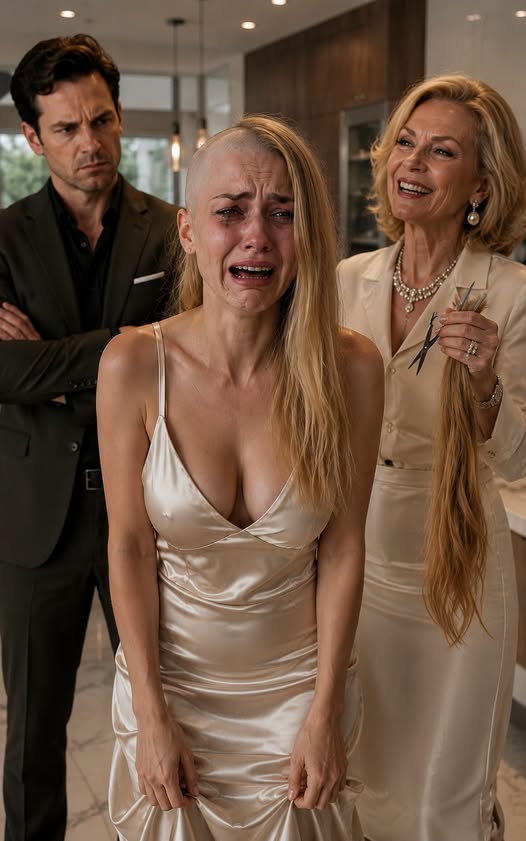
From the corner of my eye, I saw Barbara stepping out from the shadows near the knife block. In her right hand, she held the heavy, silver poultry shears—the heavy-duty kitchen scissors we used for cutting through bone.
A primal, instinctual terror seized me. “Hunter, stop! Get off me!” I thrashed against his grip, kicking my feet, but he shifted his weight, using his broader frame to trap me completely against the counter.
I felt the cold, blunt metal of the scissors graze the sensitive skin at the nape of my neck. My brain struggled to process the sheer absurdity and horror of the moment.
Then came the sound. A wet, thick snick.
The first long, dark lock of my hair slid down my shoulder and pooled lifelessly on the white kitchen floor.
A scream ripped from my throat—a sound so raw, guttural, and unfamiliar I hardly recognized it as my own. It wasn’t just hair; it was an assault on my dignity, a violent stripping of my autonomy.
“Let us see if this helps you finally understand your place in this house,” Barbara whispered near my ear. Her breath smelled faintly of peppermint, a sickening contrast to the malice in her voice.
Snick. Snick.
Another heavy clump dropped to the tiles. Then another. Hunter held me relentlessly, his face set in a grim mask of righteous justification, as if he were restraining a frantic, sick animal for its own good.
“You’re sick! Both of you are out of your minds!” I sobbed, fighting wildly, scraping my heels against the floorboards. But months of sleep deprivation, anxiety, and the sheer physical disparity between us made my struggles futile. The tugging burned my scalp. The rough, grating sound of the thick blades slicing through my hair felt as though it were cutting directly into my soul.
Barbara didn’t flinch. Her hands were terrifyingly steady. “No serious academic committee is ever going to take you seriously looking like a mental patient,” she declared, her tone conversational, as if she were discussing the weather. “So tomorrow, you are going to stay locked up in this apartment. Exactly where you belong.”
When she was finally satisfied with her butchery, she tapped Hunter on the shoulder. He released me so abruptly I stumbled forward, my knees hitting the hard floor with a sickening thud.
I was gasping for air, choking on my own tears. I didn’t look at them. I scrambled backward, my hands slipping on the smooth tiles, and crawled frantically toward the hallway bathroom. I slammed the heavy wooden door shut, turned the deadbolt, and collapsed against it, my chest heaving.
I sat in the dark for what felt like hours, listening to the muffled sounds of them moving around the apartment, calmly making tea as if they hadn’t just committed an atrocity.
Eventually, with trembling hands, I reached up and flipped the light switch.
I forced myself to look into the mirror above the sink. The reflection made my stomach violently rebel.
My long, carefully maintained dark hair was gone. In its place were crooked, jagged patches. On the left side, the shears had cut so close to the scalp that a pale, uneven bald spot shone through. On the right, strange, uneven clumps jutted out at odd angles. My face was mottled red, my eyes swollen and bloodshot. I looked like a woman who had been dragged through a warzone. I looked like a victim.
I slid down the wall and hugged my knees to my chest, shaking uncontrollably. The tears fell silently, hot and fast. I mourned my safety. I mourned the illusion of the man I thought I had married.
But as I sat there on the cold porcelain tiles, staring at the discarded tufts of my own hair scattered around my feet, the despair began to shift. The shattering inside my chest stopped. The fractured pieces of my spirit began to grind together, hardening into something dense, cold, and utterly unbreakable.
They thought they had stripped me of my power. They thought they had chained me to my shame.
I slowly reached into my pocket, my fingers closing around the smooth glass of my phone. I unlocked the screen, the blue light illuminating the ruined landscape of my face, and made a choice that would burn my old life to the ground.
Chapter 3: The Escape and the Dawn
My fingers flew across the screen, bypassing the temptation to call the police right then. A police presence meant delays, questions, and an emotional circus that would guarantee I missed my defense. Vengeance would have to wait for the law; my immediate survival required strategy.
I ordered a rideshare, watching the little digital car inch toward my address.
Moving with a silent, robotic efficiency, I unlocked the bathroom door and slipped out. The apartment was quiet now. Hunter and Barbara had retreated to their respective bedrooms, arrogant in their belief that I was thoroughly broken.
I crept into the study. I bypassed the clothes, the jewelry, the remnants of my married life. I grabbed my leather backpack and shoved my dissertation inside. I packed my research journals, the flash drives, and a simple navy-blue suit I had left hanging on the back of the door.
I walked out the front door, not bothering to leave a note.
As the heavy door clicked shut, the sound must have echoed. I heard the sudden muffled shout of Barbara from the guest room, followed by Hunter’s heavy footsteps rushing toward the foyer. His voice drifted through the wood, furious and demanding, ordering me to come back.
I didn’t turn around. I took the stairs two at a time, bursting out into the freezing midnight air just as the rideshare pulled up to the curb.
I checked into the Starlight Motel, a dingy, forgotten establishment on the far edge of the city. The room smelled of stale tobacco and industrial bleach. I threw the deadbolt, chained the door, and collapsed onto the sagging mattress. I slept for barely three hours, a fractured, nightmare-laced slumber.
Before the first hints of sunrise bruised the sky purple, I was awake. I walked down to the front desk, where a sleepy, piercing-eyed clerk was drinking black coffee. Without a word of explanation, I asked to borrow the heavy pair of paper scissors sitting next to his register. He looked at my head, swallowed whatever comment he had prepared, and slid them across the counter.
Back in the harsh, flickering light of the motel bathroom, I went to work. I couldn’t fix the damage, but I could tame the chaos. I snipped away the longest, most jagged pieces, evening out the butchery as best as I could until I was left with a severe, uneven pixie cut that clung desperately to my scalp.
I washed my face until it felt raw. I put on the Navy-Blue Suit. It fit like armor. I took all the burning anger, all the betrayal, and all the profound sorrow, and I folded them neatly into the corner of my heart where fear used to reside.
When I stepped out of the motel, the morning air on the university campus was sharp and clear, as though the city had not fully awakened from its long, dreamless sleep.
I crossed the main esplanade. My heavy backpack dug into my shoulder, but I pressed my dissertation tightly against my chest.
As I neared the entrance to the Humanities Building, I stepped into the women’s restroom to splash water on my wrists. When I turned around, I nearly collided with Maya, a brilliant first-year master’s student I had mentored the previous semester.
Maya stopped dead in her tracks. Her eyes widened, dropping from my face to the butchered state of my hair. Horror, followed instantly by pure, unadulterated concern, washed over her youthful features.
“Doctor… well, you aren’t quite there yet, but you are almost,” Maya stammered, her voice thick with a tenderness that threatened to undo the stoic dam I had built overnight.
Before I could speak, she reached into her tote bag and pulled out a wide, luxurious, Wine-Colored Silk Scarf.
“You spent three weeks helping me rewrite my thesis proposal so I wouldn’t drop out of the program last year,” Maya said softly, stepping forward and gently offering the fabric. “Please. Let me help you today.”
Pride urged me to decline, to wear my scars openly. But pragmatism won. I knew the conservative nature of the academic committee; Barbara hadn’t been entirely wrong about their judgment. I needed them focused on my brain, not my trauma.
“Thank you, Maya,” I whispered, my voice tight. I took the soft silk, skillfully wrapping it around my head, covering the worst of the bald patches and jagged edges, tying it elegantly at the nape of my neck.
At exactly eight-nineteen, as I walked down the silent hallway toward the auditorium, my phone vibrated in my pocket.
It was Hunter. His digital tone sounded like a gunshot in the quiet corridor.
“Do not do this. Just come back home, Selena. We can talk. We can fix everything.”
I stared at the screen, a bitter taste in my mouth. A second message popped up, pivoting instantly from pleading to manipulative.
“Mom didn’t want to go that far, but you pushed us into a corner, and you know it. You were being hysterical.”
And then, the final text. The true face of the man I married.
“If you go into that room looking like a freak, they are going to tear your research apart. Nobody respects a woman who looks mentally unstable. If you do this, you can forget you are my wife.”
I stopped walking. I took a deep breath, feeling the cool silk against my ruined hair, feeling the heavy weight of my life’s work in my bag. I pressed the power button, holding it down until the screen went entirely black. I slipped the dead phone into my pocket.
I stood before the heavy oak doors of Auditorium B. I placed my hand on the cold brass handle, closed my eyes, and prepared to face the firing squad. I pushed the door open, entirely unprepared for the ghost waiting for me in the front row.
Chapter 4: The Defense and the Unexpected Ally
The small departmental auditorium smelled of old wood, floor wax, and the metallic tang of percolating coffee.
My thesis advisor, Dr. Rebecca Tran, was arranging papers near the podium when I walked in. She was a formidable woman, known for her brilliant mind and her absolute lack of patience for mediocrity.
She looked up with a welcoming smile that instantly curdled into sheer horror before she could mask it with professionalism.
“Selena,” Rebecca gasped, abandoning her papers and rushing over to me. Her eyes darted from the silk scarf to the visible, jagged edges of hair near my ears, and finally to the exhausted, bruised look in my eyes. “Good heavens, what on earth did they do to you?”
For the first time since the shears had touched my skin, my legs truly weakened. It felt as if the polished floor might open up and swallow me.
“My husband,” I whispered, the words tasting like ash. “My husband and his mother thought that if they humiliated me enough… if they made me look ugly enough… I would be too ashamed to show up.”
Rebecca closed her eyes. She took a slow, deep breath, and when she opened them again, the academic mentor was gone. In her place stood a fiercely protective warrior.
“We are postponing,” Rebecca stated, her voice leaving absolutely no room for debate. “I will speak to the committee. No one, absolutely no one, expects you to stand up there and defend a dissertation hours after surviving a traumatic assault. We will do this next month.”
I looked at her, feeling the temptation of surrender. How easy it would be to go back to the motel, to hide under the covers and weep.
But I shook my head, rejecting the offer with a cold certainty that surprised us both.
“No, Rebecca,” I said, gripping the podium to steady my hands. “If I walk out of this room, they win. They win today, and they win forever. I am doing this.”
Rebecca stared at me for a long moment, assessing the steel in my posture. She stepped closer and placed her hands firmly on my shoulders, grounding me.
“Then you are going to go up there and you are going to dazzle them,” she commanded quietly. “And the second you are finished, I am driving you to the precinct, and we are reporting those monsters to the authorities.”
By eight fifty-five, the room began to fill. The panel took their seats. There was Dr. Dominic, an aging scholar famous for dismantling eight years of work with a single, carefully weaponized question. Next to him was Dr. Samira, brilliant, sharp, and mercilessly demanding of methodological perfection.
Other academics, graduate students, and department colleagues filed in, taking their seats. I kept my eyes glued to my notes, avoiding the crowd, focusing only on breathing in a steady rhythm. I just needed to reach the microphone before my body remembered it had the right to shake.
I finally lifted my head to address the room.
And the breath was violently stolen from my lungs.
Standing in the very front row, wearing a dark, impeccably tailored gray suit, was a tall man with silvering hair. He was watching me with an expression I could not read.
It was my father. Carson.
I hadn’t spoken to him in three years. Our relationship had shattered during a brutal, screaming argument shortly after Hunter and I got engaged. Carson had looked me in the eye and told me that marrying Hunter meant settling for a man who would eventually resent my light. I, fueled by the rebellious indignation of youth, had accused my father of only loving me when I was a trophy he could brag about to his golf buddies.
We had not exchanged a single syllable since that night.
Yet, here he was. He didn’t smile. He didn’t offer a small wave.
As I stared at him in shock, Carson slowly, deliberately rose from his seat.
And then, the impossible happened. Behind him, like a silent, unstoppable wave rolling across the sea, the entire department began to stand.
Dr. Rebecca Tran stood. Maya and the students in the back rows stood. Even the notoriously rigid Dr. Samira pushed her chair back and rose to her feet.
They didn’t know about the scissors. They didn’t know about the kitchen, or the motel, or the threats. They weren’t standing out of pity. They were standing out of profound, hard-earned, academic respect.
A lump the size of a stone formed in my throat. I took a deep, shuddering breath, looked directly at the committee, and leaned into the microphone.
“Good morning,” I said, my voice rough at first, but gaining volume with every syllable. “My name is Selena Herrera, and today I will be presenting my research…”
For two hours, I forgot the trauma. The data became my shield. I described the archives, defended my complicated, layered methodology, and connected years of exhaustive biological data with a surgical precision I didn’t know I possessed. Every slide I advanced felt like a physical blow against the box Hunter had tried to shove me into. Every articulate answer I provided to Dr. Dominic’s grueling questions felt like a door slamming in Barbara’s smug face.
When the final question was answered, the committee requested private deliberation. The room cleared out, leaving me standing in the hallway with icy hands and a racing heart.
Rebecca squeezed my arm and walked away to give me space. Maya gave me a fleeting, tearful smile.
Then, Carson approached. He stopped two feet in front of me, his tall frame blocking out the fluorescent hallway lights.
“Hunter called me last night,” Carson said. His voice was gravelly, carrying the weight of a thousand unspoken apologies. “He tracked down my number. He tried to convince me not to come today. He told me you had suffered a mental breakdown. He said you were unstable, hysterical, and completely out of your mind.”
The ground tilted beneath my feet. My heart hammered against my ribs like a trapped bird. Hunter had tried to sever my final lifeline.
“And did you?” I asked, my voice barely a whisper, bracing myself for the final rejection. “Did you actually believe him?”
Carson swallowed hard. The stoic, unmovable patriarch looked suddenly old, his eyes carrying a deep, agonizing realization. “No, Selena,” he said softly. “I didn’t. Because after I hung up with him, I went digging. And I discovered something Hunter doesn’t even imagine I know.”
Chapter 5: Vindication and Severance
Carson was not a man who trafficked in apologies. He was a man of action, of silent expectations, and rigid pride. I had never, in my thirty years of life, heard his voice tremble.
But standing there in the quiet corridor, he looked like a man who had finally opened his eyes after a long, dark blindness.
“I didn’t believe him because the phone call sounded entirely too rehearsed,” Carson continued, stepping closer, lowering his voice. “He spoke like a lawyer trying to establish a narrative before the opposing counsel could speak. A few hours later, his mother called me. Barbara. She put on a weeping act, claiming you had taken scissors to your own hair in a fit of manic rage.”
I went entirely still. The sheer audacity of their lie made my blood run cold. “Did you go to the apartment?”
“I did,” Carson admitted, looking down at his polished shoes before meeting my eyes again. “I drove over at midnight. The doorman recognized me. He told me he saw you running out of the building with a backpack, crying, jumping into a rideshare. I paid him to check the destination logs.”
Carson reached out, hesitating for a fraction of a second before gently placing his large, warm hand over mine.
“I drove to that awful motel, Selena. I didn’t knock on your door because I figured you needed to focus. But I spoke to the night clerk. He told me you had come down at three in the morning, looking like you’d survived a train wreck, asking to borrow paper scissors.”
I looked down. Not out of shame, but because the profound relief of being completely, unequivocally understood was almost too heavy to bear. I didn’t have to explain. I didn’t have to defend my sanity. My father had seen the truth.
“I didn’t need anyone to explain the rest to me,” Carson said, his voice thickening with regret. “I knew what that boy was the day you brought him home. I just didn’t know how far he would go. I should have been on your side, Selena. I should have fought harder for you, instead of just walking away.”
Hot tears finally breached my defenses, spilling over my lashes. “Yes,” I replied, my voice breaking under the weight of three lost years. “You really should have been.”
Carson nodded slowly. He didn’t offer a weak excuse. He accepted the reprimand, absorbing the pain he had caused. In his own quiet way, standing there beside me, acting as my shield, it was the truest form of repentance he could offer.
The heavy wooden door of the auditorium creaked open. The committee was ready.
We filed back into the room. The atmosphere was charged with a solemn heaviness—the kind of gravity that accompanies a moment destined to alter the trajectory of a life.
I stood behind the podium. Dr. Dominic adjusted his reading glasses, looked down at the neatly typed papers in front of him, and cleared his throat.
“Candidate Selena Herrera,” he began, his voice echoing in the silent room. “You have successfully defended what this committee considers an outstanding, groundbreaking doctoral thesis.”
A collective breath hitched in the room.
“The committee’s recommendation is unanimous approval,” Dominic continued, a rare, genuine smile cracking his stern face. “Furthermore, it is our distinct pleasure to award this defense an honorable mention, accompanied by an immediate nomination for the university’s prestigious annual research grant. Congratulations, Doctor Herrera.”
For one suspended second, the words floated in the air, surreal and detached. And then, the room erupted.
The applause began like distant rain, rapidly swelling into a deafening roar. Rebecca rushed forward, throwing her arms around me. Maya was jumping up and down in the back. Someone shouted the word “Doctor,” and then another voice echoed it, until it felt as though the entire room was spinning around that one, hard-earned title. A title no man, no mother-in-law, and no pair of scissors could ever sever from my name.
I had won. Despite the kitchen floor, despite the terror, despite the cheap motel and the borrowed silk scarf, I had survived the cruelest night of my life and emerged victorious.
And then, through the crowd of cheering academics, I saw him.
Hunter was standing near the side entrance of the auditorium. He was pale, his shoulders hunched, looking entirely frozen. He wore the hollow, terrified expression of a man who firmly believed he controlled the universe, only to watch the universe rise up and crush him.
He must have arrived late, hoping to witness my collapse. He hadn’t seen Carson. He hadn’t seen the standing ovation. All he saw was a room full of brilliant, respected people celebrating the woman he had tried to erase.
He caught my eye. He took one hesitant, uncertain step toward me, his hands raised in a pathetic gesture of pleading.
But before I could even flinch, Carson moved.
My father intercepted him with terrifying speed. Carson positioned his large frame directly between Hunter and me. He didn’t raise his voice. He didn’t throw a punch. He simply radiated a calm, immovable, lethal authority.
“Do not even think about taking another step toward my daughter,” Carson warned, his voice a low, icy rumble that carried perfectly over the fading applause.
Hunter stopped dead. His bravado evaporated. His face collapsed as he looked from Carson’s furious glare to the cold, unyielding expression on my face. The game was over. The illusion was dead.
I stepped out from behind my father. I walked right up to Hunter. I didn’t shout. I didn’t shake. There was absolutely no trace of fear or pleading left in my soul.
“It’s over, Hunter,” I said, my voice ringing with a terrifying clarity.
“Selena, please, just step outside with me. Listen to me. My mom was only trying to—”
“Your mother butchered me like an animal,” I cut him off, my words dropping like anvils. “And you pinned me against the wall so she could do it.”
A few people nearby gasped, the horrific reality of the night before finally clicking into place for the onlookers. Hunter opened his mouth, his eyes darting frantically around the room, desperately searching for an explanation that wouldn’t expose him as a monster. But there was nowhere left to hide.
“Do not ever contact me again,” I said, leaning in just slightly. “Do not ever say my name as if it belongs to you. You are nothing to me now.”
He dropped his gaze. For the first time since I had met him, he was entirely powerless. He had no authority to wield, no guilt to twist into a weapon, and no marriage to hide his insecurities behind. He turned, looking small and pathetic, and practically ran out the side door.
That afternoon, still wearing my navy suit and the wine-colored scarf, I walked into the local police precinct with Rebecca and my father flanking me like sentinels. I filed a comprehensive report for domestic assault and coercive control. An hour later, sitting in my father’s lawyer’s office, I signed the preliminary divorce filings.
When I finally stepped out of the high-rise building and onto the bustling city sidewalk, I held the sealed copy of my approved dissertation against my chest. It felt like a shield.
The crisp autumn air kissed my face, carrying the sweet, terrifying scent of absolute freedom.
The night before, they had tried to cut me down. They had used violence and humiliation to try and convince me that a woman’s love is synonymous with obedience.
But they forgot one crucial detail. In this world, there are women who will let you break their hearts, who will let you steal their comfort, and who will even let you cut off their hair. But if you try to take their fire, they will use the very embers you scatter to burn down the cages you built for them.
No house, no man, and no family would ever dictate the volume of my voice again. I was Dr. Selena Herrera, and my story was only just beginning.
If you found this story of resilience and overcoming toxic control inspiring, please LIKE and SHARE this post! Let’s remind everyone that true strength cannot be cut away.