I didn’t waste time arguing. I called 911 and grabbed her soaking-wet backpack. But when I discovered a hidden note inside at the hospital, I realized this wasn’t the first time he had hurt her…
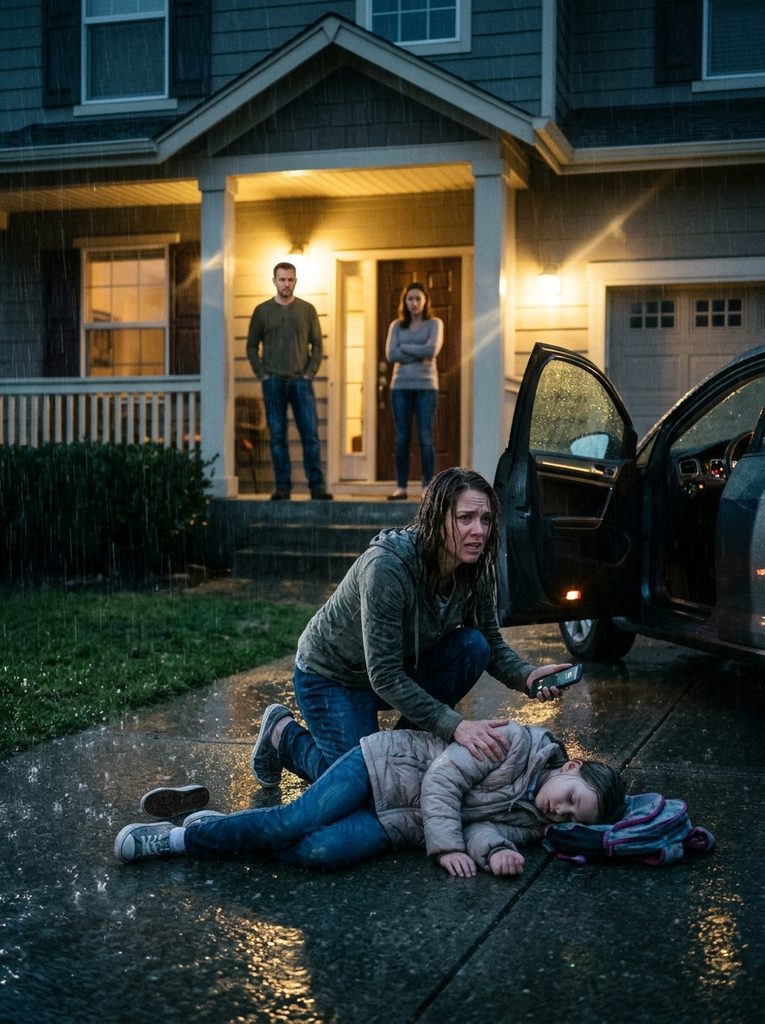
“If she passed out, she can learn not to defy me again.”
Those were the very first words my ex-husband said to me when I found our nine-year-old daughter lying motionless on the pavement outside his front door, soaked in the cold rain.
It was 7:10 PM. I had just driven back from an out-of-town work training and wanted nothing more than to pick up Ivy, take her home, and make us some dinner. I had texted Calvin earlier that afternoon: “I’ll be there to pick her up between 7:00 and 7:15.” He had simply replied: “K.”
Ever since our divorce four years ago, I did everything in my power to avoid conflict. My single priority was ensuring Ivy felt she still had two supportive parents.
When I pulled up to Calvin’s house, the driveway was dark, the porch light was on, and then I saw my daughter.
She was curled on her side on the wet concrete. Her backpack lay a few feet away, and she was missing one of her sneakers.
I sprinted out of the car. “Ivy! Ivy, baby!”
No response.
Calvin stepped onto the porch. Behind him stood his wife, Lorna, her arms crossed over her chest.
“What happened?!” I cried out, kneeling beside my daughter.
Calvin didn’t even step down off the porch. “She’s grounded.”
“She’s unconscious, Calvin!”
“Don’t be dramatic, Annette,” he scoffed. “She threw a tantrum because we took away her tablet.”
My hands shook as I dialed 911.
“Don’t make a scene,” Calvin warned. “She’s just throwing a fit. She’ll snap out of it.”
“How long has she been lying out here in the rain?!”
He didn’t answer.
The paramedics arrived within minutes. As they checked Ivy’s vitals, one of them, a man named Pete, glanced up at Calvin with a sharp, discerning look. “Sir, did you place a call to emergency services earlier tonight?”
“No,” Calvin said flatly.
Pete stared at him for a long beat before turning his attention back to Ivy. As they loaded her onto the stretcher, Pete stepped over to me. “Ma’am, is he your husband?”
“My ex-husband.”
“I’ve been called out to this address before,” Pete said quietly.
A cold weight dropped into my stomach. “For Ivy?”
Before Pete could answer, his partner called him over to the ambulance.
Calvin caught up to me as I hurried toward my car. “Don’t you dare try to use this to mess with my custody arrangement, Annette.”
“I’m not trying to start anything, Calvin,” I said, my voice trembling with rage. “I am trying to figure out what you two did to my daughter.”
In the ER, Ivy finally woke up, pale and disoriented. She looked around frantically. “Is… is Daddy here?”
“No, sweetie. It’s just me.”
She let out a long breath and closed her eyes, visibly relieved.
“Ivy, what happened?” I asked gently, stroking her hair.
“Lorna said I was being disrespectful because I rolled my eyes,” Ivy whispered, her voice raspy. “They took my tablet and told me I couldn’t come back inside until I learned some respect.”
“How long were you out there?”
“I don’t know. It started raining, and then… they left.”
“They left?!”
She nodded weakly. “Mommy… please don’t make me go back there. Please.”
Later that night, after Ivy finally drifted off to sleep, a nurse handed me her damp backpack. Tucked into the small back pocket, I found a piece of notebook paper folded into a tight square.
Written in Ivy’s careful, round handwriting were dates and short notes:
Tuesday: Wouldn’t let me inside after school. Friday: Sent to room without dinner. Sunday: Took my tablet so I couldn’t call Mommy. Wednesday: Lorna told me Mommy wouldn’t believe me anyway.
At the bottom of the page, one final line was written:
If they do it again, I just have to wait outside until someone sees me.
I stood frozen in the quiet hospital room.
This night hadn’t been an isolated incident. It was a pattern.
And I had no idea that Calvin had left behind evidence of something far worse.
I remembered every single time Ivy had gone quiet whenever her father’s name came up over the past year. I had brushed off her silence as the stress of switching between two households with different rules. Suddenly, every comfortable excuse I had made for Calvin felt like a warning sign I had willfully ignored.
At seven the next morning, I called Francesca Doyle, the family law attorney who had handled my divorce. I walked her through everything.
“Do not go over to Calvin’s house,” Francesca instructed firmly. “Do not threaten him, do not blast this on social media, and do not send him twenty angry text messages. If this ends up in front of a family court judge, we need documented facts, not a shouting match.”
Her advice was hard to hear, but I knew she was right.
Two hours later, while Ivy was resting, Francesca called me back. “Annette, something else came up. The paramedic from last night, Pete, contacted Child Protective Services. He remembered a prior service call to that house.”
“For Ivy?”
“Yes. About three months ago.”
I felt the air leave my lungs.
Part 3
“Tell me exactly what he said,” I managed.
“I don’t have the full report,” Francesca said. “But Pete remembered the call because it stuck with him. A neighbor reported a small child sitting alone on the porch steps after dark in near-freezing weather. When the crew arrived, Calvin answered the door and said Ivy had locked herself out by accident, and that he’d been in the shower. He was polite. He thanked them. They wrote it up as a welfare check with no finding, and left.”
“Nobody told me.”
“Nobody was required to tell you. You weren’t the one who called, and the report didn’t name you.” She paused. “But CPS is opening a case now, and an intake worker will come to the hospital this afternoon. I’d like to be there. Don’t talk to Calvin, and don’t let Ivy talk to anyone about the details until she’s with a trained interviewer.”
“She’s nine, Francesca.”
“I know. That’s why it has to be done properly.”
I hung up and stood outside Ivy’s room with my forehead against the cool wall. Through the narrow window, I could see her asleep, one hand curled beneath her cheek, her stuffed rabbit tucked under her chin. A nurse had found it in the pocket of her jacket.
Dr. Okafor, the pediatrician on duty, found me there a few minutes later.
“Mrs. Hartley,” she said. “May I talk with you about Ivy’s condition?”
“Please.”
“Her core temperature was 94 degrees when she arrived. That’s mild hypothermia. She was also dehydrated and hadn’t eaten in a long while. She’ll recover fully, and we’ll keep her another night for observation.” She hesitated. “I also have to tell you that I’ve made a report of my own. Not because I’m accusing anyone, but because what I see doesn’t match the story I was given.”
“I understand,” I whispered. “Thank you.”
“You’re welcome to stay as long as you like,” she said gently. “She’ll want her mother when she wakes.”
The CPS caseworker was a woman in her fifties named Beverly Oduya, with reading glasses on a chain and the unhurried manner of someone who had sat in a great many hospital rooms.
She met with Francesca and me first, then asked to see Ivy alone for twenty minutes with a child-interview specialist. I waited in the hallway, counting ceiling tiles and failing.
When Ms. Oduya came out, her face was composed, but her eyes were tired.
“She’s a very brave girl,” she said. “She told us a lot. I won’t repeat all of it to you here, but I’ll tell you this: your daughter described what was on that paper. She said it had happened more than once, and that she’d stopped telling anyone because she thought no one would believe her.”
“Who told her that?”
“She said Lorna did.” Ms. Oduya let the sentence stand. “She also said she wrote the dates in her backpack so that someone would find them if something happened. She’s a smart child, Mrs. Hartley. She made a plan.”
I covered my mouth.
“I’m going to recommend an emergency protective order, effective today,” she said. “Ivy will be released into your care only. Calvin and Lorna will have no contact with her until a judge reviews the case. Do you have a safe place to take her?”
“My house. My sister is already driving in from Dayton.”
“Good. I’ll need you to make sure she isn’t alone for the next few weeks. And I’d like to arrange a therapist.”
I nodded, unable to speak.
Francesca, standing beside me, put a hand lightly on my shoulder.
“There’s one more thing,” Ms. Oduya said. “Mr. Hartley’s house has a doorbell camera. The neighbor who called three months ago mentioned it. We’re requesting the footage from the manufacturer. If it was backed up to the cloud, we may have everything.”
It had been backed up.
Calvin, who had always liked gadgets, had installed the camera himself the previous spring. He’d shown it off to everyone, including me, at a school event. “You can watch the whole porch from your phone,” he’d said, with that proud, easy smile. He had never thought about the fact that the footage would be stored on a server outside his control.
The investigator, a quiet detective named Soto, called me a week later and asked me to come to the station with Francesca.
“I need to warn you,” he said, in a small conference room. “It’s difficult to watch. You don’t have to. I can describe it.”
“I want to know what happened to my daughter.”
He nodded and started the video.
It showed the porch of Calvin’s house on the night of the rain, from a camera mounted above the door. At 4:52 PM, Ivy appeared, coming up the walk from the school bus with her backpack. She rang the bell. Lorna opened the door, said something we couldn’t hear, and pointed down the steps. Ivy shook her head. Lorna shut the door.
The recording went on.
For two hours and forty minutes, Ivy sat on the porch step, then on the walk, then, when the rain started, huddled against the front door with her arms around her knees. She knocked, twice, and nobody answered. At 6:30 she took off one sneaker, apparently because it was soaked, and left it beside her. At 6:41 she slid sideways onto the concrete and lay still.
At 6:44, the porch light flicked on. The door opened a crack. Lorna looked out, said something over her shoulder to Calvin, and shut it again.
Neither of them came out until my car pulled into the driveway at 7:10.
I don’t remember the next few minutes. Francesca said later that I made a sound. Detective Soto stopped the video, and someone brought me water.
“There’s more,” he said gently, when I could hear him. “The cloud account has footage from the last six months. We’ve found six other incidents. The shortest is forty minutes. The longest is three and a half hours. On two occasions, the weather was below freezing.”
“Did anyone ever…” I could hardly breathe. “Did anyone ever call?”
“Once. The neighbor, in January. Pete’s crew. After that, Calvin changed the camera’s notification settings so he’d get an alert if anyone approached the house during the day.” Soto paused. “He knew what the camera recorded. I think he thought the footage would only be seen if he chose to show it.”
Calvin was arrested on a Monday morning, at his office, in front of two of his coworkers. Lorna was arrested the same hour at the house.
The charges were child endangerment and child neglect. Because of the repeated incidents and the medical findings, the prosecutor added an enhancement for a pattern of abuse. Calvin pleaded not guilty at the arraignment, with the confident, aggrieved expression I remembered from our marriage.
He stopped looking confident three weeks later, when his own lawyer sat him down and played the video.
I heard about that from Francesca, who heard it from the prosecutor, who said the lawyer had asked to pause the tape twice.
The custody hearing took place two months after that. Calvin’s attorney argued that Ivy was a strong-willed child, that the discipline had been extreme but well-intentioned, that Calvin loved his daughter and had been under stress at work. Calvin sat beside him in a gray suit, silent, not looking at me.
The judge, a woman in her sixties with silver hair and a very quiet voice, listened for two days.
On the second afternoon, she asked that the porch footage be played in open court. The courtroom was silent. Somewhere in the middle of it, I heard Lorna begin to cry.
When it ended, the judge took off her glasses and spoke directly to Calvin.
“Mr. Hartley, I’ve sat on this bench for twenty-three years. I have rarely watched a recording that was harder to see. You told the emergency crew, three months ago, that your daughter had locked herself out by accident. You looked at a nine-year-old child lying on the ground in the rain, and you went back inside.”
“Your Honor,” Calvin began.
“I’m not finished.”
He stopped.
“Full legal and physical custody is awarded to the mother. Mr. Hartley’s parenting time is suspended indefinitely, pending completion of a court-ordered evaluation and counseling, and any future contact will be supervised. A permanent protective order will be entered as to both defendants.”
She looked at Ivy’s school photo on the evidence table, a gap-toothed smile and a crooked ponytail.
“That child wrote down the dates,” she said quietly. “She did what no adult around her was willing to do. I’d like the record to reflect that.”
Calvin accepted a plea agreement in the spring. He was sentenced to four years in state prison, with probation to follow. Lorna received eighteen months, and a requirement to complete a parenting and anger-management program. Neither of them contested the protective order.
I didn’t go to the sentencing. I took Ivy to the zoo.
She sat on a bench near the penguin exhibit, eating a soft pretzel, swinging her legs. She had stopped flinching when it rained. She had stopped sleeping with the hallway light on, though she still liked the door open. Dr. Ames, the therapist she saw every Thursday, a gentle woman with a bowl of smooth stones on her desk, said she was doing remarkably well.
“Mommy?” she said.
“Yes, sweetie?”
“Am I allowed to still love Daddy?”
I had been preparing for that question for months, and I still wasn’t ready.
I put my arm around her.
“You’re allowed to feel whatever you feel,” I said. “You can love him. You can be angry. You can feel both at the same time. None of those feelings is wrong.”
She thought about that with the seriousness she brings to everything.
“I think I’m mostly sad,” she said. “And a little mad.”
“That sounds about right.”
“Dr. Ames says it’s okay if it takes a long time.”
“It is.”
She leaned against my side. A penguin plunged into the water, and she giggled, small and bright, and the sound went straight through me.
That evening, I found her at the kitchen table, working with a pencil on a piece of lined paper. She covered it with her arm when I came in.
“What are you writing?”
“A list.”
“Of what?”
She hesitated, then slid it across the table.
Things I want to do when I am ten:
1. Learn to ride a bike without training wheels.
2. Get a dog.
3. Have a sleepover.
4. Tell Mommy everything. Always.
I read it twice. Then I took the pencil and, beneath her list, I wrote my own.
Things Mommy promises:
1. To always listen.
2. To always believe you.
3. To always come.
I turned the page around so she could read it. She did, slowly, moving her lips. Then she took the pencil back, drew a very careful star at the bottom of the page, and slid it into the drawer by the refrigerator, where we keep the things that matter.
In June, we got the dog, a scruffy, ridiculous mutt named Biscuit, who ate one of my shoes within a week. That summer, Ivy learned to ride her bike. I ran behind her down the street, holding the seat, then letting go, and she rode forty feet on her own before she looked back and saw me standing, hands empty, and wobbled, and laughed, and kept going.
Pete, the paramedic, came to her tenth birthday party. I had written to thank him, and he had written back, a short, shy note, and I’d invited him on impulse. He arrived with a cupcake and a stuffed bear and stood at the edge of the yard, awkward in a polo shirt, until Ivy marched up to him.
“You’re the one who came in the ambulance,” she said.
“That’s right.”
“Thank you for noticing.”
Pete’s eyes went bright. He crouched to her level.
“I should have noticed sooner,” he said. “I’m sorry I didn’t.”
“You noticed on the second time,” said Ivy, with the generosity of a child. “That counts.”
He laughed, a little wetly. “I’ll take it.”
Later, when the guests had gone and the sun was slanting orange across the lawn, Ivy climbed into my lap on the porch swing. Biscuit sprawled across our feet.
“Mommy?”
“Yes?”
“It’s raining a little.”
I looked up. A soft, warm summer rain had started, speckling the porch rail, drumming gently on the roof.
“Do you want to go inside?”
She thought about it. Then she shook her head.
“No,” she said. “It’s okay. I like it when I’m out here with you.”
I held her closer. The rain fell on the grass and the garden and the yellow porch light, and I listened to it, and for the first time in a long while it was only rain.
I didn’t know how long I stood there holding that piece of notebook paper, staring at my daughter’s careful, rounded handwriting until the ink blurred. Every word felt like a physical blow. Tuesday: Wouldn’t let me inside after school. Friday: Sent to room without dinner. Sunday: Took my tablet so I couldn’t call Mommy. Wednesday: Lorna told me Mommy wouldn’t believe me anyway.
My hands trembled so violently the paper rattled in the quiet hospital room. I looked over at the bed, where Ivy lay beneath a stack of warmed blankets, an IV line taped to the back of her small hand. Her face was still pale against the white pillow, dark smudges of exhaustion beneath her eyes. For a full year, I had convinced myself that her sudden silences, her reluctance to pack her overnight bag on Fridays, and the quiet, guarded way she acted whenever Calvin’s name came up were just normal growing pains. I had told myself she was simply adjusting to two different households, two different sets of rules. I had bent over backward to be the accommodating ex-wife, the reasonable co-parent who didn’t rock the boat, because I believed a child needed both parents in her life.
The realization that my desire to keep the peace had left my daughter defenseless made me physically sick. I walked quietly into the small en-suite bathroom, turned on the faucet so she wouldn’t hear me, and threw up into the sink. Afterward, I splashed cold water on my face, stared at my reflection in the harsh fluorescent light, and felt something inside me harden into unbreakable steel. The polite, accommodating Annette was gone.
I carefully folded the note and slipped it into my wallet, then took a clear, well-lit photograph of it with my phone, backing it up immediately to my cloud drive and emailing a copy to myself. Then I pulled up my contacts and dialed Francesca Doyle, the family law attorney who had handled my divorce four years earlier. It was 7:00 AM, and I didn’t care if I woke her.
Francesca answered on the third ring, her voice thick with sleep that vanished the second she heard the tremor in mine. I walked out into the hospital corridor, leaning against the wall outside Ivy’s door so I could keep her in sight through the narrow glass window while I told Francesca everything—the rain, the missing sneaker, Calvin’s cold dismissal, Pete the paramedic’s warning, and the note hidden in the backpack.
“Listen to me very carefully, Annette,” Francesca said, her voice crisp and commanding. “Do not go over to Calvin’s house. Do not call him, do not threaten him, do not blast this on social media, and do not send him twenty angry text messages. Right now, he thinks he can bully you into sweeping this under the rug like a minor parenting disagreement. Let him think you’re rattled. If this ends up in front of a family court judge—and it will—we need documented facts, medical records, and official reports, not a shouting match.”
“He left her outside in the rain until she passed out, Francesca,” I whispered, fighting to keep my voice down. “They left the house while she was locked out.”
“I know. And you are going to bury him with the truth, step by step, by the book,” she replied firmly. “Stay at the hospital. Get copies of her admission records, her vitals when she arrived, and the attending physician’s notes. I’m going to start drafting an emergency motion right now, and I’m going to make a few calls.”
Two hours later, while Ivy was sleeping soundly, my phone buzzed. It was Francesca.
“Annette, something else just came up,” she said. “The paramedic from last night, Pete, contacted Child Protective Services on his own initiative. He remembered a prior service call to Calvin’s address.”
“For Ivy?” I asked, though I already knew the answer.
“Yes. About three months ago.”
The air seemed to rush out of my lungs, leaving my chest hollow.
Part 3
“Tell me exactly what he said,” I managed, gripping the edge of the corridor handrail to steady myself.
“I don’t have the full incident report yet—I’m filing a subpoena for the EMS dispatch logs today,” Francesca said. “But Pete remembered the call because something about it didn’t sit right with him. Back in January, a neighbor called 911 to report a small child sitting alone on the porch steps after dark in near-freezing temperatures. When the ambulance and a patrol car arrived, Calvin answered the door in a bathrobe. He told them Ivy had stepped outside to look for a stray cat and accidentally locked herself out while he was in the shower. He was charming, polite, and thanked them profusely for checking in. Because Ivy was back inside and appeared unharmed, they wrote it up as a routine welfare check with no finding, and cleared the scene.”
“Nobody told me,” I said, my voice cracking. “I’m her mother. Why didn’t anyone call me?”
“Because there was no finding of abuse or neglect at the time, and Calvin was the custodial parent on duty,” Francesca explained gently. “They had no legal obligation to notify the non-present parent. Until last night, it was just an isolated note in a dispatch log. Now, with her in the ER and that note in her backpack, it’s corroboration.”
She paused, letting the weight of that sink in. “CPS is opening a formal investigation this morning. An intake caseworker is coming to the hospital this afternoon. I’m going to meet her there so I’m beside you the whole time. Until then, do not talk to Calvin, and do not question Ivy further about the details. Let the forensic interviewer handle it so Calvin’s lawyers can never claim you coached her.”
“She’s nine, Francesca.”
“I know. That’s why we have to protect her testimony from every angle.”
After we hung up, I stood outside Ivy’s room with my forehead pressed against the cool painted drywall. Through the window, I watched her chest rise and fall beneath the hospital blanket. One small hand was curled beneath her cheek, and her worn stuffed rabbit—the one she had slept with since she was three—was tucked tightly under her chin. A kind night nurse had found it stuffed deep inside the pocket of Ivy’s soaked jacket and had run it through a hospital dryer so it would be warm when she woke up.
Footsteps approached down the hall, and Dr. Okafor, the attending pediatrician on the morning shift, stopped beside me, holding a tablet.
“Mrs. Hartley,” she said quietly. “May I speak with you for a moment about Ivy’s condition?”
“Of course. Is she okay?”
“She’s going to make a full physical recovery,” Dr. Okafor assured me, offering a warm, steady look. “Her labs look much better this morning. However, when she arrived via ambulance last night, her core body temperature was 94 degrees. That puts her squarely in mild hypothermia. She was also significantly dehydrated and her blood glucose was low, indicating she hadn’t eaten since at least midday. We’re going to keep her on fluids and observe her through tonight just to be entirely certain there are no secondary complications.”
She hesitated, lowering her tablet slightly. “I also need to inform you, as a matter of protocol and transparency, that I have filed a mandated reporter notice with state child services. What I observed clinically last night does not align with a child simply having a brief tantrum on a porch.”
“I understand,” I whispered, relief and grief tangling in my throat. “Thank you, Doctor. Truly.”
“You’re doing everything right, Mom,” she said softly. “Go sit with her. She’ll want you there when she opens her eyes.”
At two o’clock that afternoon, Francesca arrived at the hospital alongside a woman in her late fifties named Beverly Oduya. Ms. Oduya wore reading glasses on a silver chain and carried a thick leather portfolio with the unhurried, grounded demeanor of someone who had spent decades navigating the darkest corners of family crises without losing her humanity.
After reviewing the hospital records and the photograph of Ivy’s note with Francesca and me in a private family consultation room, Ms. Oduya asked permission to speak with Ivy alongside a certified child-interview specialist from the hospital’s advocacy unit. I agreed immediately, though waiting out in the hallway for those twenty-five minutes was pure agony. I paced the length of the corridor, staring at my watch, praying my daughter wouldn’t feel interrogated or frightened.
When the door finally opened and Ms. Oduya stepped out, her expression was composed, though a muscle ticked faintly in her jaw.
“She is a remarkably brave, articulate little girl, Mrs. Hartley,” Ms. Oduya said, lowering her voice as we stepped away from the door. “I won’t breach the confidentiality of the interview by repeating every detail, because that recording belongs to the investigation now. What I can tell you is that she corroborated every single line on that piece of notebook paper. She told the specialist that locking her outside had happened multiple times over the past several months, sometimes when she forgot a chore, sometimes when Lorna felt she had an attitude.”
“Why didn’t she tell me?” I asked, tears finally spilling over onto my cheeks. “She comes home to me every Sunday evening. Why didn’t she say a word?”
“Because Lorna convinced her that you were tired of dealing with her, and that if she complained, you would take their side and punish her too,” Ms. Oduya said plainly. “When you’re nine years old and an authority figure repeats a lie often enough, it starts to sound like the truth. So Ivy did the only thing she felt she could do—she kept a log in her backpack so that if she ever got hurt, someone would find proof.”
I pressed a hand over my mouth to stifle a sob. My nine-year-old had been quietly preparing her own evidence file because she thought nobody would believe her word against two adults.
“Based on the medical findings, the prior EMS call, and her interview today, I am filing for an immediate emergency protective hold,” Ms. Oduya continued. “When Ivy is discharged tomorrow, she will be released solely into your custody. Neither Calvin Hartley nor Lorna Vance-Hartley will be permitted any contact—in person, by phone, or electronically—until a judge rules on the emergency petition. Do you have a safe place to stay where you won’t be alone?”
“My house,” I said, wiping my face. “And my younger sister, Claire, already took the week off work and is driving in from Dayton. She’ll be here by six.”
“Good. Keep the doors locked, keep your phone charged, and let me know immediately if Calvin attempts to approach your home or Ivy’s school. We will notify the school administration first thing tomorrow morning.” Ms. Oduya paused, adjusting her glasses. “There is one more avenue we’re pursuing. The neighbor who called 911 in January mentioned that Mr. Hartley has a smart doorbell camera mounted beside his front entrance. We’ve already coordinated with local law enforcement to serve a preservation request on the manufacturer. If that camera backs up to a cloud server, it may have recorded everything.”
Part 4
It had been backed up.
Calvin had always been obsessed with smart-home gadgets. He had bought and installed that exact video doorbell himself the previous spring, back when he was still trying to impress people with how modern and put-together his new life with Lorna was. I vividly remembered him standing by the bleachers at Ivy’s spring soccer game, holding up his phone and boasting to two other dads about the high-definition night vision and wide-angle lens. “You can see every inch of the porch and the whole driveway right from your phone,” he had said with that easy, self-satisfied grin.
What Calvin hadn’t bothered to think through was how cloud subscriptions worked. He had set up automatic monthly billing on his credit card and had never realized that deleting clips from his phone app only hid them from his local feed—the encrypted server logs remained intact for six months unless a user manually purged the account through a desktop portal.
Six days after Ivy was discharged from the hospital, Detective Marcus Soto from the Special Victims Unit called Francesca’s office and asked if I would come down to the precinct. Francesca drove me herself, holding my arm as we walked past the front desk into a quiet, windowless conference room on the second floor.
Detective Soto was in his forties, soft-spoken, with tired eyes and a neat stack of folders on the table beside a laptop.
“Mrs. Hartley, thank you for coming in,” Soto said, pulling out a chair for me. “Before I open this file, I want to be completely transparent. I’m going to show you footage recovered via search warrant from the doorbell camera at 418 Sycamore Lane. You are under no legal obligation to watch it. I can summarize the timestamps for you and Ms. Doyle, and save you the trauma.”
“I need to see it,” I said, my voice steady despite the hammering of my heart. “If my daughter had to live through it, the least I can do is watch.”
Francesca squeezed my hand once beneath the table. Detective Soto gave a slow nod, turned the laptop slightly toward us, and pressed play.
The video was crisp, wide-angle, and timestamped in the upper right corner. It was dated the night of the storm.
At 4:52 PM, the yellow school bus pulled up at the end of the driveway. Ivy hopped down the steps, adjusting the straps of her purple backpack, and walked briskly up the concrete path toward the porch. She looked happy, swinging her lunchbox in one hand. She reached the porch and pressed the doorbell.
Ten seconds later, the front door swung open. Lorna stood in the threshold holding a mug. She didn’t say hello. Even without crystal-clear audio, the body language was unmistakable—Lorna’s face tightened, she pointed sharply at Ivy’s muddy sneakers, and she barked something. Ivy looked down at her shoes, said a few words, and shook her head slightly. Lorna reached out, grabbed the strap of Ivy’s backpack, shoved her backward off the welcome mat, and slammed the deadbolt shut.
Ivy stood frozen on the porch for nearly a minute, staring at the closed door. Then she quietly took off her muddy sneakers, placed them neatly beside the planter, and knocked softly on the wood. Nobody answered.
Detective Soto fast-forwarded the timeline in five-minute increments, stopping periodically to let the footage play at normal speed.
At 5:15 PM, Ivy sat down on the top concrete step, hugging her knees to her chest to block the wind. At 5:38 PM, a silver sedan pulled into the driveway. Calvin stepped out, carrying a dry-cleaning bag. He walked right past Ivy sitting on the step. He didn’t touch her shoulder; he didn’t ask why she was outside. He simply unlocked the door, stepped inside, and locked it behind him.
At 5:54 PM, the sky darkened and a cold, driving rain began to fall, blowing sideways under the shallow porch overhang. Ivy pressed herself flat against the front door, trying to stay out of the spray, shivering visibly in her thin spring cardigan. She knocked twice—polite, hesitant taps. Through the frosted glass sidelight, a shadow moved past, and the hallway light clicked off.
At 6:19 PM, Calvin and Lorna walked out of the front door together, dressed in coats, holding an umbrella. Ivy stood up quickly, reaching out toward her father’s sleeve. Calvin stepped around her as if she were a piece of patio furniture, spoke sharply over his shoulder, and walked down to his SUV. Lorna didn’t even glance in Ivy’s direction. They backed out of the driveway and drove away, leaving a nine-year-old child locked outside in a thunderstorm.
At 6:31 PM, soaked through and trembling uncontrollably, Ivy slipped one sneaker back onto her foot, tried the doorknob one more time, and then sank down onto the wet concrete. At 6:42 PM, she curled onto her side, tucked her hands under her chin, and stopped moving.
At 6:48 PM, Calvin’s SUV pulled back into the driveway. They walked up the steps with takeout bags. Lorna stepped directly over Ivy’s outstretched legs to unlock the door. Calvin paused for two seconds, nudged Ivy’s hip gently with the toe of his boot, muttered something, and followed Lorna inside. They left her lying motionless on the concrete for another twenty-two minutes until my headlights swept across the driveway at 7:10 PM.
I didn’t cry while the video was playing. I couldn’t. My throat felt locked shut, every muscle in my body rigid as stone. Only when Detective Soto closed the laptop lid did a low, ragged sound escape me, and Francesca immediately pulled a tissue box across the table while Soto stepped out to bring me a cup of water.
“There is more you need to know,” Soto said quietly once he returned and closed the door. “The cloud server retained six months of motion-triggered clips. My team spent the past forty-eight hours logging every single file. That night wasn’t the first time, and it wasn’t the second. We documented six prior incidents dating back to October. On six separate occasions, Ivy was locked out of that house for periods ranging from forty-five minutes to three hours and forty minutes. Twice, the ambient temperature was below thirty degrees.”
“How did nobody else see her?” I asked, my voice barely audible.
“The porch has a privacy lattice on the left side facing the street, and the bushes block the steps from the sidewalk,” Soto explained. “After the neighbor called 911 in January, our digital forensics unit saw that Calvin went into his app settings and disabled audible chime alerts for daytime motion, while leaving silent phone notifications on. He knew the camera was recording. He just assumed that because he owned the account, nobody else would ever have access to the footage.”
Part 5
Calvin and Lorna were arrested the following Monday morning.
Detective Soto coordinated the arrests carefully so there would be no chance of them fleeing or destroying devices. Two plainclothes officers walked into the lobby of Calvin’s logistics firm at 9:15 AM, asked the receptionist to call him down to a conference room, and placed him in handcuffs in front of two regional managers who happened to be walking out of the elevator. At the exact same minute, patrol units arrived at 418 Sycamore Lane and arrested Lorna in the kitchen while she was still in her pajamas.
By Tuesday afternoon, the district attorney’s office had formally filed felony charges of child endangerment and reckless child neglect against both of them. Because Dr. Okafor’s medical report documented mild hypothermia and Detective Soto’s timeline established six prior incidents over half a year, the senior prosecutor added a statutory enhancement for a continuing pattern of abuse—a classification that carried mandatory minimum sentencing guidelines and prevented them from qualifying for a simple misdemeanor diversion.
At their arraignment on Wednesday morning, Calvin posted bail using a home equity line and walked out of the courthouse wearing a tailored navy suit, flanked by a high-priced criminal defense attorney he had hired the day before. A local court reporter caught him on the courthouse steps, and Calvin stared straight into the camera with that familiar, aggrieved, self-righteous expression I had seen a hundred times during our marriage whenever he was caught in a lie. “This is a tragic misunderstanding fueled by a bitter custody dispute,” he told the microphone smoothly. “I love my daughter more than life itself, and the truth will come out in court.”
Seeing that clip on the evening news nearly made me throw my remote through the television, until Francesca called me ten minutes later, sounding almost amused.
“Let him talk to the cameras,” Francesca said briskly. “The DA hadn’t turned over the discovery packet yet when he gave that quote. His attorney is going to receive the cloud doorbell footage tomorrow morning at nine.”
Three weeks later, Francesca called me with an update from the pre-trial conference. According to the prosecutor, Calvin’s defense attorney had requested a private sidebar after watching the surveillance files in his office. The lawyer had reportedly paused the video twice, taken off his glasses, and asked the prosecutor what kind of plea terms were on the table before the footage ever reached a jury. When Calvin walked into the courtroom for the status hearing that afternoon, all of his confident swagger had evaporated. He looked ten years older, gaunt and gray-faced, staring rigidly at the tabletop so he wouldn’t have to meet anyone’s eyes.
Meanwhile, back at our house, my entire focus was on putting Ivy back together.
For the first two weeks after the hospital, my daughter was like a shadow moving through our home. She jumped whenever the front door clicked shut. She refused to go out onto the back deck by herself, even to grab a forgotten toy, and every night at bedtime she checked the deadbolt three times before asking me to leave the hallway light on and her bedroom door wide open.
My sister Claire stayed with us for ten days, cooking Ivy’s favorite meals, braiding her hair, and sleeping on the pull-out couch in the living room so I could finally get a few hours of uninterrupted sleep. Whenever Ivy woke up from a nightmare, gasping and disoriented, I was at her bedside within seconds, holding her until her breathing slowed and she remembered where she was.
On Thursdays, I drove her across town to see Dr. Evelyn Ames, a pediatric trauma therapist recommended by Ms. Oduya. Dr. Ames didn’t have a sterile clinical office; her room looked like a cozy sunroom filled with potted ferns, soft rugs, and a low wooden table holding a large ceramic bowl of smooth river stones. During their first few sessions, Ivy barely spoke, simply sorting the stones by color while Dr. Ames talked quietly about ordinary things—dogs, books, clouds. Slowly, week by week, the walls Ivy had built around herself began to soften.
Two months after the arrest, the family court held the permanent custody hearing.
Calvin’s family lawyer tried every angle imaginable to salvage partial visitation. He argued that Ivy was a stubborn, strong-willed nine-year-old who pushed boundaries; that Calvin and Lorna had been under immense financial and workplace stress; that locking a child outside was “misguided, old-fashioned discipline” rather than malice; and that severing a father’s relationship with his daughter would cause long-term emotional harm. Calvin sat beside him in a charcoal suit, hands folded neatly on the table, projecting quiet remorse.
Judge Helen Mercer, a silver-haired jurist who had presided over family court for twenty-three years, listened patiently to every witness—Dr. Okafor, Pete the paramedic, Ms. Oduya, and me. Then, on the second afternoon of the hearing, Judge Mercer turned to the bailiff and asked for the courtroom monitors to be switched on.
“I want the surveillance compilation entered as Exhibit 14 played in open court,” Judge Mercer said softly.
Calvin’s attorney objected immediately, citing prejudice and emotional distress. Judge Mercer overruled him without raising her voice. “Counsel, you spent two hours arguing that your client’s actions were misguided discipline. The court intends to see what that discipline looked like.”
For twelve minutes, the entire courtroom watched the edited timestamps from the doorbell camera in dead silence. We watched Ivy sitting alone in the dark; we watched Calvin walk past her with his dry cleaning; we watched them drive away into the storm; we watched Lorna step over Ivy’s motionless body on the wet concrete. Halfway through the footage, a muffled, ragged sob broke out from the gallery behind Calvin—Lorna, sitting beside her own attorney, had buried her face in her hands.
When the screen went black, nobody moved for several seconds. Judge Mercer removed her reading glasses, folded them carefully, and looked directly at Calvin.
“Mr. Hartley, I have sat on this bench for twenty-three years,” she said, her quiet voice carrying to every corner of the room. “I have heard thousands of custody disputes, and I have rarely watched a recording harder to stomach than what this court just witnessed. Three months prior to this incident, you looked emergency responders in the eye and lied to them, claiming your child had locked herself out by accident. On the night of April fourteenth, you stepped over your nine-year-old daughter lying unconscious in the cold rain, went inside your warm house, and ate your dinner.”
“Your Honor, if I could just explain—” Calvin began, half-rising from his chair.
“Sit down, Mr. Hartley. I am not finished.”
Calvin sank back into his seat, his face flushing dark red.
“Sole legal and physical custody of Ivy Hartley is hereby awarded permanently to her mother, Annette Hartley,” Judge Mercer declared. “Mr. Hartley’s parenting time is suspended indefinitely. Any future request for supervised therapeutic contact will not even be entertained by this court for a minimum of twenty-four months, and only upon proof of completed residential psychological evaluation and court-approved parenting intervention. Furthermore, a permanent protective order is entered barring both Calvin Hartley and Lorna Vance-Hartley from coming within five hundred yards of the child, her residence, or her school.”
Judge Mercer paused, looking down at the evidence table where Ivy’s third-grade school portrait lay beside the notebook paper from her backpack. In the photo, Ivy had a crooked ponytail and a bright, gap-toothed smile.
“That little girl wrote down the dates,” Judge Mercer said, her voice softening just slightly. “She had the presence of mind to create a record when every adult in that house failed her. I want the official court transcript to reflect that.”
Part 6
Three weeks after the custody ruling, facing the certainty of a jury trial where the doorbell footage would be played on a ten-foot screen, Calvin accepted a plea agreement from the district attorney’s office. In exchange for pleading guilty to felony child endangerment with the pattern-of-abuse enhancement, he was sentenced to four years in state prison, followed by three years of strict supervised probation. Lorna accepted a separate plea deal for reckless endangerment and child neglect, receiving eighteen months in county jail and mandatory enrollment in a state-certified anger management and behavioral intervention program. Neither of them contested the permanent protective order.
The morning their formal sentencing took place, I didn’t go to the courthouse. Francesca attended on my behalf and promised to text me the moment the gavel came down. Instead, I packed a thermos of apple juice, a bag of sliced strawberries, and a light rain jacket, and drove Ivy to the city zoo.
It was a cool, breezy Tuesday in late May, and the zoo was nearly empty. Ivy wore her favorite yellow sneakers—we had thrown the other pair away the night she came home from the hospital—and held my hand tightly as we wandered past the red pandas and the sea lions. At noon, we bought a warm soft pretzel and sat together on a wooden bench overlooking the penguin habitat.
Ivy swung her legs beneath the bench, nibbling the edge of the pretzel. For the first time in months, the pinched, watchful tension around her eyes was gone. She had stopped flinching when thunder rolled across the neighborhood. Two nights earlier, she had asked me to turn off the hallway light before she went to sleep, leaving only a small star-shaped nightlight plugged in beside her bookshelf.
As we sat watching three penguins waddle along the rocks, Ivy grew quiet, staring down at the pretzel in her lap.
“Mommy?” she asked softly.
“Yes, sweetie?”
“Am I allowed to still love Daddy?”
I felt a sharp, familiar ache tighten in my chest. I had been preparing myself for that exact question since the night in the ER, rehearsing gentle, thoughtful answers in the shower, yet hearing it in her small, earnest voice still caught me off guard.
I set my water bottle down and wrapped my arm securely around her shoulders, pulling her close against my side.
“You are allowed to feel whatever you feel, Ivy,” I told her, choosing every word with care. “You can still love him. You can also be really angry at him, and hurt by what he did. You can even feel all of those things at the exact same time. None of your feelings are wrong, and you never have to hide them from me.”
She leaned her head against my shoulder, thinking that over with the quiet, solemn seriousness she brought to everything.
“I think I’m mostly sad,” she said after a moment. “And a little bit mad.”
“That makes complete sense, baby. Anybody in your shoes would feel the exact same way.”
“Dr. Ames says it’s okay if it takes a long time for the mad part to get smaller.”
“Dr. Ames is very smart,” I smiled, kissing the top of her head. “Take all the time you need. There’s no rush.”
Down in the exhibit below us, one of the penguins belly-flopped dramatically off a ledge into the water, sending up a splash that soaked a zookeeper standing nearby. Ivy let out a sudden, bright giggle that bubbled straight up from her chest—the first real, unguarded laugh I had heard from her since winter. The sound went right through me like sunlight breaking through clouds.
That evening, after dinner and a warm bath, I walked into the kitchen to put the kettle on and found Ivy sitting at the table in her pajamas. She was hunched over a piece of lined notebook paper, working intently with a yellow pencil. When she heard my footsteps, she instinctively laid her forearm across the page to cover it—then paused, looked up at me, and slowly lifted her arm away.
“What are you working on?” I asked gently, pulling out the chair beside her.
“A list,” she said, a little shyly.
“What kind of list?”
She hesitated for half a second, then turned the paper around and slid it across the tabletop toward me.
At the top, in her neat, round handwriting, she had written:
Things I want to do when I am ten:1. Learn to ride a bike without training wheels.2. Get a dog.3. Have a sleepover with Maya.4. Tell Mommy everything. Always.
I read those four lines twice, blinking back the sudden heat behind my eyes so I wouldn’t cry in front of her. Number four sat there on the page like a bridge being rebuilt plank by plank.
“This is a pretty great list,” I said, keeping my voice steady. “Mind if I add a section at the bottom?”
Ivy nodded, handing me the pencil.
Beneath her fourth item, I drew a neat line and wrote:
Things Mommy promises:1. To always listen.2. To always believe you.3. To always come.
I slid the notebook paper back across the table. Ivy read every word slowly, her lips moving silently as she traced the sentences with her finger. When she reached the end, she took the pencil back, drew a careful, slightly lopsided five-pointed star beside my name, and stood up. She walked over to the kitchen counter, opened the wooden drawer beside the refrigerator where we kept birthday candles, spare keys, and school awards, and tucked the paper neatly inside.
Part 7
June arrived warm and golden, bringing the end of third grade and the beginning of a summer that felt like a second chance at breathing.
True to item number two on Ivy’s list, we spent the second Saturday of June at the county animal shelter. We walked past rows of barking kennels until we reached the last enclosure, where a scruffy, terrier-mix puppy with one floppy ear and eyebrows like an old man was sitting quietly, thumping his tail against the concrete floor. The moment Ivy crouched down and pressed her fingers against the wire mesh, the puppy trotted over and licked her knuckles through the gap.
We named him Biscuit. Within forty-eight hours of coming home, Biscuit had chewed the heel off one of my work flats, dug a crater in my hydrangea bed, and claimed the foot of Ivy’s bed as his permanent post. Whenever Ivy went into the backyard, Biscuit trotted faithfully at her heels like a furry bodyguard, and at night, instead of checking the front deadbolt three times, Ivy simply tucked her hand into Biscuit’s warm fur and fell asleep within minutes.
By July, we tackled item number one. Every evening after dinner, while the neighborhood cooled down and fireflies began blinking above the hedges, we wheeled Ivy’s purple bicycle out onto the quiet cul-de-sac in front of our house. I unbolted the training wheels, tossed them into the garage, and spent five straight evenings jogging beside her, one hand steadying the back of her seat while Biscuit barked excitedly from the curb.
On the sixth evening, Ivy pushed off from the driveway, pedaling harder than usual. I ran behind her for twenty feet, felt the bike find its own steady balance beneath her, and quietly let go. She rode forty feet down the asphalt entirely on her own before glancing back over her shoulder, realizing my hands were empty in the air, wobbling wildly, and bursting into triumphant laughter as she coasted all the way to the neighbor’s mailbox without falling.
When her tenth birthday arrived in August, Ivy didn’t want a big party at a trampoline park or a bowling alley. She wanted a backyard barbecue with her three closest friends from school, string lights hung across the patio, and strawberry shortcake.
Two weeks before the party, while I was clearing out a stack of mail on the kitchen counter, I found the discharge folder from the hospital and spotted the business card Pete the paramedic had tucked inside my discharge papers along with a short note wishing Ivy a speedy recovery. On a sudden impulse, I sat down and wrote him a letter, thanking him for trusting his instincts that night, for remembering the January call, and for making sure Ivy wasn’t forgotten. I slipped an invitation to her tenth birthday cookout inside the envelope and dropped it in the mailbox.
I honestly didn’t expect him to come, knowing how unpredictable emergency shift schedules were. Yet at two o’clock on Saturday afternoon, while burgers were sizzling on the grill and the kids were chasing Biscuit through the sprinkler, the side gate clicked open.
Pete stood there in a neat navy polo shirt and khaki shorts, holding a bakery box tied with string and a small plush bear wearing a red ribbon. He looked slightly awkward, shifting his weight from foot to foot at the edge of the patio as if unsure whether he had overstepped by showing up.
Before I could even set down the spatula, Ivy spotted him. She ran straight across the grass, dripping wet from the sprinkler, and stopped right in front of him, hands on her hips.
“You’re the man who came in the ambulance,” she said matter-of-factly.
Pete blinked, then broke into a warm, genuine smile. “That’s right. Happy tenth birthday, Ivy.”
“Thank you for noticing me,” Ivy said seriously.
Pete’s eyes went bright, and his throat worked for a second before he crouched down on the grass so he was at eye level with her.
“I should have noticed sooner, kiddo,” he said quietly. “I’m really sorry I didn’t.”
Ivy tilted her head, considering his apology with her usual gravity. “You noticed on the second time,” she replied with the effortless grace only a child possesses. “That counts.”
Pete let out a short, slightly watery laugh and wiped the corner of his eye with the back of his wrist. “Well, if you say it counts, I’ll take it.”
He stayed for an hour, eating a burger on the patio steps, letting Biscuit steal the last bite of his bun, and watching Ivy blow out ten sparkler candles on her cake surrounded by friends who laughed and cheered for her.
Part 8
Later that evening, after the last parents had picked up their kids and the paper plates had been cleared away, the sky turned a deep, bruised shade of violet as dusk settled over the neighborhood.
I walked out onto the covered front porch, carrying a mug of chamomile tea, and sat down on the wooden porch swing. A moment later, the screen door creaked open and Ivy padded out in her fuzzy socks, carrying her worn stuffed rabbit under one arm. Biscuit trotted out behind her, flopping down with a heavy sigh across the welcome mat.
Ivy climbed onto the swing beside me and tucked herself right into the crook of my arm, resting her head against my chest. I set my mug on the side table and began gently rocking us back and forth, the chains creaking softly in the quiet evening air.
A warm summer breeze rustled the maple leaves in the front yard, carrying the scent of damp earth and cut grass. Fat, scattered drops began tapping against the porch roof, quickly thickening into a steady, gentle summer rain that speckled the wooden railing and shimmered under the warm yellow glow of the porch light.
I felt Ivy go still for just a fraction of a second as the rain picked up. My arm tightened instinctively around her shoulders, ready to carry her straight back inside the moment she wanted to go.
“Mommy?” she murmured against my sweater.
“Yes, sweetie?”
“It’s raining.”
I looked down at her, brushing a stray lock of hair behind her ear. “It sure is. Do you want to go inside and watch a movie?”
Ivy looked out past the porch steps at the rain falling steadily onto the lawn and the garden. She sat quietly for a long moment, listening to the soft drumming on the shingles overhead. Then, slowly, she shook her head and snuggled closer against my side.
“No,” she said softly. “It’s okay. I like it out here when I’m with you.”
I kissed the top of her head, rested my cheek against her hair, and kept the swing moving gently back and forth. Out beyond the porch light, the rain washed the driveway clean, cooled the summer air, and whispered through the trees—and for the first time in a very long while, it was nothing more than rain.
Part 9
Autumn returned to our street quietly, painting the maple trees in shades of amber and rust, and bringing a rhythm to our days that felt steady and unhurried.
Fourth grade turned out to be Ivy’s favorite year yet. Her teacher, Mr. Alvarez, sent home glowing notes about how eagerly she raised her hand during reading discussions and how quickly she volunteered to help new students find their way around the cafeteria. On Tuesday afternoons, she started taking beginner pottery classes at the community arts center down the road, coming home with gray clay smudged across her nose and proud, slightly crooked bowls that I lined up along the kitchen windowsill like museum pieces.
In October, Francesca called to let me know that the final administrative steps of the court orders had been processed cleanly. Calvin’s appeals attorney had attempted to file a motion requesting a reduction in his sentence based on his lack of prior criminal history, and the appellate court had denied it without even scheduling oral arguments. The permanent protective order had been entered into the statewide law enforcement registry, and Ivy’s school district had updated her permanent file so that only I—or my sister Claire in an emergency—was authorized to sign her out.
“You can close the binder, Annette,” Francesca told me warmly over the phone. “Put it in the back of a closet and forget where the key is. You did everything right, and your daughter is safe.”
That evening, I took the thick manila folder containing the court transcripts, the medical discharge papers, and the copies of Detective Soto’s reports, slid it into a storage box on the top shelf of my hall closet, and shut the door.
The following week, Dr. Ames suggested that Ivy was ready to transition from weekly therapy sessions to monthly check-ins. When we walked out of the sunroom office after her last weekly appointment, Ivy carried a small, smooth blue river stone Dr. Ames had let her pick from the wooden bowl on her desk.
“She said it’s a pocket stone,” Ivy explained as we buckled our seatbelts in the car. “If I ever feel worried or mad, I can hold it and remember I’m already safe.”
“That’s a very good stone,” I agreed, starting the engine. “Where are you going to keep it?”
“In my backpack,” she said simply. “Right in the small back pocket where I used to keep the paper.”
I paused with my hand on the gearshift, looking over at her. She smiled at me—clear-eyed, calm, and completely unafraid—and zipped the little pocket shut.
Part 10
By the time the first snow dusted the rooftops in December, our house felt fuller and warmer than it had in years.
On the Saturday before winter break, my sister Claire drove in from Dayton with bags of baking supplies, and the three of us spent the afternoon covering the kitchen counters in flour and red-and-green sprinkles while Biscuit patrolled the floor beneath our feet, hoping a sugar cookie would drop.
At dusk, after the cookies were cooling on wire racks and Christmas music was playing softly from the living room speaker, Ivy pulled on her snow boots and winter coat and asked if we could take Biscuit for a walk around the block to look at the holiday lights.
We stepped out onto the front porch together. The air was crisp and cold, our breath rising in tiny white clouds beneath the porch light, and snow was falling in big, slow, silent flakes that blanketed the front lawn and sparkled on the hedges.
Ivy reached out her mittened hand to catch a snowflake, then slipped her warm, padded fingers securely into mine as Biscuit bounded ahead down the steps, burying his nose in the fresh snow.
We walked down the driveway and turned onto the sidewalk, moving past glowing wreaths, illuminated snowmen, and neighbors waving from warm living room windows. Ivy skipped ahead a few paces, laughed as Biscuit leaped after a falling flake, and then circled right back to walk beside me, leaning her shoulder against my coat.
Looking at her bright cheeks, her effortless laugh, and the complete trust in the way she held my hand, I realized the weight I had carried since that rainy April night had finally lifted. We hadn’t just survived what happened—we had built a life where she never had to hide, never had to keep secret notes in her backpack, and never had to wonder if someone would come for her.
She had her voice back. She had her childhood back. And whatever seasons came next, we were walking into them together.
THE END