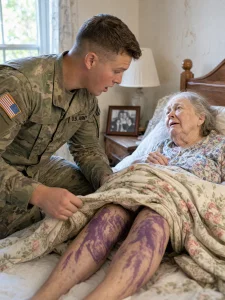
The deep, steady thunder of the C-17 transport plane’s engines had been vibrating through my bones for sixteen brutal hours.
For six months, deployed across the dry, unforgiving stretches of the Middle East, I had survived by holding on to one picture in my mind: home. I imagined the smell of garlic roasting in the kitchen, the quiet comfort of my living room, and the warm smile of my wife, Megan.
But more than anything, I thought about my mother, Margaret.
My father had died two years earlier, leaving my seventy-eight-year-old mother alone and fragile in ways she never wanted to admit. When my deployment orders came through, Megan offered—actually, she insisted—that Mom move into our large suburban house.
“I’ll take care of her, Ryan,” she promised at the airport, squeezing my hand. “That’s what family does. She shouldn’t be alone.”
I kissed her goodbye, filled with a gratitude so deep it blinded me. I had no idea I was leaving my mother in the care of a woman who would become her jailer.
When the taxi dropped me in the driveway, the pavement was damp and perfectly trimmed lawns glistened in the late afternoon light. I lifted my olive duffel bag onto my shoulder, exhausted but smiling for the first time in months.
Then I reached the front steps.
The first thing I heard was not a welcome.
It was Megan’s voice.
She was on the front porch in a spotless cream sundress, holding a cup of tea and speaking to Mrs. Ellis, the nosy elderly neighbor from across the street.
“She gets so confused, Helen,” Megan said softly, her voice dripping with that sweet, saintly sadness people use when they want to be admired for suffering. “The dementia is getting worse so fast. She wanders at night. Sometimes she even hurts herself. Daniel and I—well, Ryan and I—are already looking into full-time care for her. For her own safety, of course.”
My boots froze on the walkway.
Dementia?
My mother did not have dementia. Before I deployed, she was doing crossword puzzles every morning, managing her own investments, and organizing the neighborhood garden.
Before I could even understand the lie coming out of my wife’s mouth, I heard another sound.
A dull, muffled thud.
Then another.
It came from upstairs.
A fist against wood.
Then I heard a voice, faint and terrified.
“Ryan… please. Please don’t leave me in here.”
The air left my lungs.
In that moment, the tired husband who had come home hoping for peace vanished. Four years of military intelligence training and combat discipline snapped into place so fast it felt physical.
My mother was locked in a room.
Megan turned and saw me.
For one tiny second, her face broke. Her eyes widened with real panic. I was not supposed to be home until the next day. My flight had arrived early.
Then the mask returned.
“Ryan!” she cried, setting down her tea and rushing toward me. She wrapped her arms around my neck, pressing herself against me. Her perfume—vanilla and amber—was thick enough to choke on.
I did not hug her back.
I did not drop my bag.
I only looked up toward the second-floor window, where the blackout curtain shifted slightly.
“Why is Mom’s room locked, Megan?” I asked calmly.
Her smile flickered. “Sweetheart, I didn’t want to worry you while you were deployed. She’s gotten so much worse. She gets violent when she’s confused. It’s for her own safety. I promise. Let’s talk inside.”
Deployment teaches you how to recognize an ambush. Panic gets you killed. Anger tells the enemy where you are. If I kicked the door down and started yelling, Megan could call the police, say I had PTSD, and use that to finish whatever plan she had already started.
So I smiled.
“Of course,” I said. “I trust you. Let’s go inside. I’m exhausted.”
I carried my bag into the house and played my role perfectly: the tired, grateful husband who believed everything.
The house was spotless. It smelled like expensive candles.
“I’ll make you something to eat,” Megan said, heading for the kitchen. “I’m just so glad you’re home.”
“Thanks. I’m going to unpack and check on Mom.”
“Ryan, wait—she might be agitated.”
“I’ll just say hello,” I called back, already walking upstairs.
At the guest bedroom door, I saw the truth immediately. The old knob had been replaced with a heavy double-cylinder deadbolt.
It was not a bedroom anymore.
It was a cell.
I found the key in Megan’s jewelry box, hidden beneath her necklaces. Then I returned to the door, unlocked it, and pushed it open.
The room was dark and stale. The curtains were drawn tight. The antique furniture I had moved in for Mom was gone. The mattress was bare on the floor. No sheets. No blankets. No books. No television.
My mother sat on the floor against the far wall.
Margaret, who had taught English for forty years and could still quote Shakespeare from memory, wore a stained blouse that looked days old. Beside her sat a plastic cup of warm, dusty water.
Then I saw her wrists.
Dark purple bruises circled both of them.
I dropped to my knees.
“Mom.”
She looked up at me. Her hair was tangled, her cheeks hollow, but her eyes were clear—sharp, bright, furious, and completely sane.
“Ryan,” she whispered.
I pulled her into my arms. She felt impossibly light.
“I’m here,” I said, my voice breaking. “I’m here.”
She gripped my forearms.
“I am not losing my mind,” she whispered fiercely. “She is doing this on purpose. She takes my phone. She locks me in when she leaves. She tells everyone I’m crazy.”
“I know,” I whispered. “I know you’re not.”
Then we heard Megan’s heels on the stairs.
Mom’s eyes filled with terror.
“Lock the door,” she hissed. “If she knows you believe me, she’ll hide the paperwork. She has paperwork, Ryan. Lock it.”
It was the hardest thing I had ever done.
But I understood. My mother was not broken. She was holding her position behind enemy lines.
I stepped out, pulled the door shut, and locked it again.
Megan reached the landing carrying a plate of food.
“Is she asleep?” she asked.
I leaned against the wall and forced a weary smile.
“Yeah,” I lied. “She was mumbling. Didn’t recognize me. You were right. It’s worse than I thought.”
Relief spread across Megan’s face.
“I know it’s hard, baby,” she said gently. “But I have everything handled. We’re seeing a doctor tomorrow. It’ll all be okay.”
I looked at the woman I had married and understood I had been sleeping beside a monster.
“I know,” I said softly. “I know you do.”
That night, Megan slept peacefully beside me, convinced she had calmed my suspicions with dinner, wine, and fake tears.
She thought my uniform meant I only knew how to follow orders.
She forgot that before the military, I had spent years as a senior financial fraud investigator for the State Attorney General’s Office.
At 1:00 a.m., I slipped out of bed and went downstairs.
Megan’s MacBook sat on the kitchen island.
Her password was our wedding anniversary.
I opened it in seconds.
I did not start with her messages. I went straight to the money.
She was logged into our joint banking account. She had also left tabs open for my mother’s checking and retirement accounts.
What I found made my blood turn cold.
For months, Megan had been draining Mom’s retirement fund into a new LLC registered only in Megan’s name. Each transfer was just small enough to avoid triggering bank alerts.
Then I found the pending wire transfer.
Eighty thousand dollars.
Mom’s remaining savings.
Destination: an offshore account in the Cayman Islands.
All it needed was one final document: a notarized Power of Attorney.
I found the PDF on her desktop.
The plan became horrifyingly clear.
The psychiatric appointment scheduled for 10:00 the next morning was not about care.
It was the final step.
Megan had spent months isolating my mother, starving her, depriving her of sleep, locking her in darkness, and making her look weak and unstable. Once a doctor declared Mom legally incompetent, Megan would gain control of everything.
Then she would send the money offshore and put Mom in some cheap facility where she would disappear.
I did not break the laptop.
I copied everything.
Bank ledgers. Draft documents. IP logs. Cloud records.
Then I recovered deleted security footage from the cloud archive. Megan had erased the dashboard files, but she had not erased the deep backups.
I downloaded footage of her yelling at my mother, withholding food, shoving her into the room, and locking the deadbolt.
At sunrise, I put the laptop back exactly where it had been.
Then I took a tiny military-grade audio recorder from my go-bag and taped it under the kitchen table.
At 7:00, Megan came downstairs in a silk robe, smelling like lavender.
“Good morning, baby,” she said. “Did you sleep well?”
“Like the dead,” I replied, handing her coffee.
I sat across from her. I needed one more thing: intent in her own words.
“Megan,” I sighed, rubbing my face, pretending to be overwhelmed. “I’m worried about the appointment. What if Mom makes a scene? What if she says wild things? The neighbors are already watching us.”
Megan sipped her coffee.
Then her sweet mask faded.
“Let her scream,” she said calmly. “It only proves she’s unstable. The bruises came from her thrashing around. The doctor will see exactly what I’ve been dealing with.”
She leaned closer.
“I have the paperwork ready. Once he signs off that she’s incompetent, we control the accounts. We can get her out of this house and put her in a facility. No one is going to believe that crazy old woman over me. We’re finally going to be free, Ryan.”
I smiled.
“You’re right,” I said. “We’re going to be free.”
I had her.
The drive to Dr. Harris’s psychiatric clinic felt like a battlefield wrapped in silence.
Mom sat in the back seat, perfectly playing her part. She stared out the window, mumbled softly, and clutched her purse as if confused.
I had spoken to her for one minute that morning while Megan was upstairs. I unlocked the door, gave her water and a granola bar, and whispered, “Play the part, Mom. Let her dig the grave.”
She understood immediately.
Megan sat beside me in an expensive blazer, looking like the devoted caregiver.
At the clinic, we were taken into Dr. Harris’s office. He was a serious man in his late fifties, seated behind a heavy oak desk.
Megan took control immediately.
She placed a thick binder on the desk.
“Doctor, thank you for seeing us so quickly,” she said, her voice shaking with fake exhaustion. “It’s gotten so much worse since Ryan deployed. I’m at my breaking point.”
Dr. Harris opened the binder.
“I see you’ve kept detailed records.”
“She wanders,” Megan said. “She’s combative. She forgets to eat. I found her locked in a room yesterday, terrified and confused. She has bruises from hitting herself against the doorframe.”
Then she wiped a dry eye.
“For her safety, Ryan and I agree she needs to be declared legally incompetent. We need to manage her care and her finances before she hurts herself or gives her money to a scammer.”
Dr. Harris nodded gravely and reached for his pen.
That was when I stood.
“Actually, Doctor.”
Megan looked up sharply.
“Ryan, sweetheart, what are you doing?”
I ignored her.
I pulled a black folder from my jacket and placed it directly on top of Megan’s binder.
“My wife’s file is incomplete,” I said. “This is the updated version.”
Dr. Harris opened it.
Within seconds, his face changed.
The first page showed a time-stamped image from our security system: my mother locked in a stripped room, curled in the corner. Beside it was the electronic deadbolt log showing the door had been locked from the outside for sixteen hours.
“It’s fake!” Megan shrieked, lunging for the folder. “Doctor, don’t look at that! He has PTSD! He’s paranoid!”
I pulled out my phone and pressed play.
Megan’s own voice filled the room.
“Once the doctor signs off on her incompetence, we control the accounts. We can get her out of this house and put her in a facility. No one is going to believe that crazy old woman over me.”
Megan froze.
Dr. Harris stared at her in disgust.
Then he pressed a red button under his desk.
Ten seconds later, two police officers entered, followed by Detective Brooks from the Elder Abuse Task Force—the man I had contacted at 3:00 a.m.
“Megan Walker,” Detective Brooks said, “we have reviewed the evidence of wire fraud, attempted financial exploitation, and elder abuse.”
At that moment, Mom sat up straight. The confused old woman disappeared.
She smoothed her skirt and looked at Megan.
“I believe those handcuffs are for you, dear,” she said.
Megan backed into the wall.
“Ryan, please!” she sobbed. “I love you! I was stressed! She was too much work! Tell them to stop!”
I watched the officers pull her arms behind her.
“You’re not stressed, Megan,” I said. “You’re under arrest.”
As they dragged her out, I called after her.
“And Megan? The bank canceled your offshore transfer. You’re broke.”
Her screams faded down the clinic hallway.
The silence afterward was beautiful.
Mom stood, walked past the stunned doctor, and wrapped her arms around me.
The nightmare was over.
Six months later, Megan’s name had gone from respected neighborhood wife to cautionary tale.
The case was fast and brutal.
The recovered video, banking records, IP logs, pending wire transfer, and audio recording made the evidence impossible to fight. Megan was denied bail because of the offshore account. Facing years in prison, she took a plea deal and was sentenced to fifteen years.
I filed for divorce immediately.
Because she had committed financial crimes against my immediate family, the judge denied her access to my pension, savings, and our home equity.
She ended up trapped in the very kind of powerless confinement she had planned for my mother.
I left the military and took a senior investigator position with the state Elder Abuse Task Force.
I had the house cleaned from top to bottom. I removed the deadbolt, the door, and the frame from Mom’s room. I replaced the entrance with open arches. I burned the mattress she had slept on and bought her a beautiful new bed.
Every trace of Megan disappeared.
Mom came back to life.
Her bruises faded. Her fear left. Her posture straightened. Her voice returned. The house filled again with her sharp humor, her warmth, and her stubborn, brilliant spirit.
We spent autumn mornings on the porch, drinking coffee. Mrs. Ellis brought casseroles and apologized again and again for believing Megan’s lies.
One morning, I looked at Mom as she watched birds cross the sky.
People think the elderly are weak because their bodies change. They mistake frailty for surrender.
But my mother had not surrendered in that locked room.
She had waited.
And when the cavalry came, it burned the enemy’s kingdom down.
A year later, a letter arrived at my office at the state capitol.
The return address belonged to the State Women’s Correctional Facility.
Megan’s handwriting was shaky and desperate.
I knew what it was without opening it—excuses, pleas, blame, memories, maybe a request for money.
A year earlier, I might have felt anger.
That day, I felt nothing.
I dropped the envelope into the cross-cut shredder and listened as her words became confetti.
Three years later, I stood at a podium in the grand ballroom of the state capitol, receiving the state’s highest award for my task force’s work exposing one of the largest elder financial fraud rings in the Midwest.
In the front row, wearing a bright floral dress, sat my mother.
She was eighty-three years old, healthy, glowing, and clapping louder than anyone in the room.
I smiled at her.
People think loyalty means keeping peace at home. Ignoring warning signs. Believing the pretty lie because it is easier than facing the ugly truth.
But monsters like Megan never understand real loyalty.
When you lock the woman who gave me life in the dark and try to starve her while smiling in my face, you do not win.
You teach me how to turn discipline into a weapon.
I stepped down from the podium and walked into the bright light of the future with my mother’s applause still ringing in my ears.
Because the greatest revenge is not destroying the monster in your house.
The greatest revenge is dragging them into the light, locking the door behind them, and building a life they will never be allowed to enter.