The doorbell rang just as Miriam poured herself another glass of wine.
“That must be the caterer,” she said, dabbing her lips with a cloth napkin. “The board should be sending something special to celebrate Garrick’s big night.”
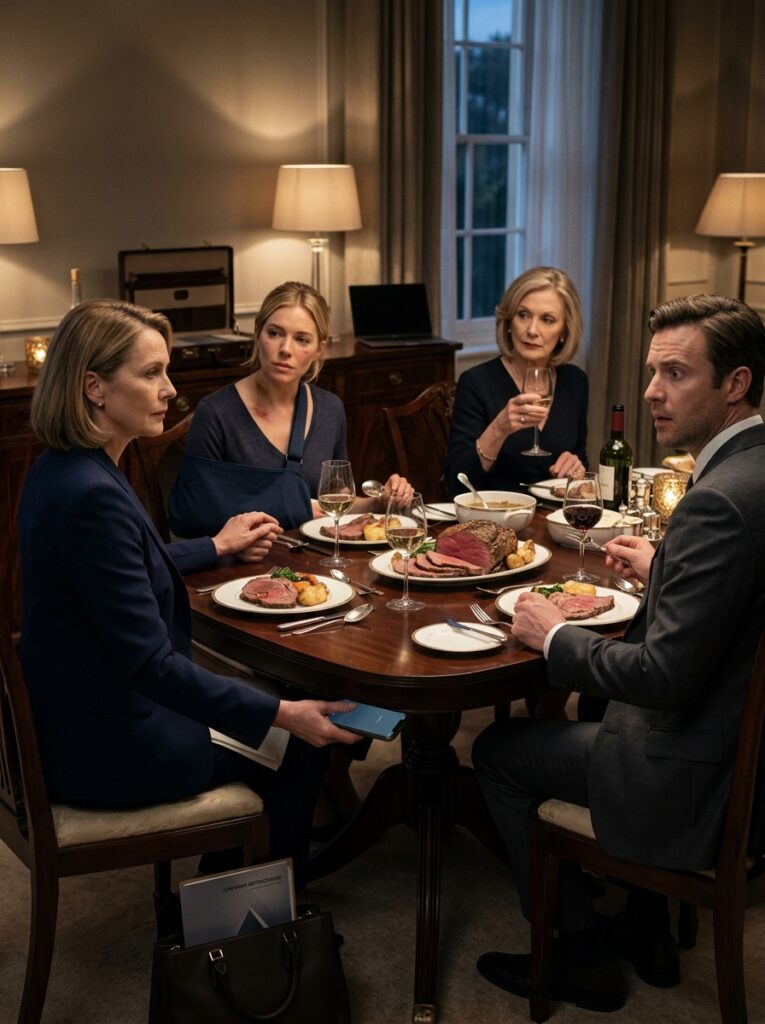
Garrick pushed his chair back with unnecessary force and straightened his tie. He glanced at Sienna’s sling as though it were a minor inconvenience, not the visible consequence of whatever “lesson” he’d decided to teach her.
“Try not to look like you’re about to cry,” he said quietly. “This is a happy occasion.”
I watched him walk down the hallway toward the front door, my phone resting facedown on the table, the last message I’d sent still visible in my mind.
Come immediately. Bring every board member you can reach. Ask Commissioner Raymond Fletcher to join you if possible.
He opened the door with his usual confident smile.
It vanished immediately.
Standing beneath the porch light were three people he recognized instantly: Director Helen Park, Director Omar Lewis, and Commissioner Raymond Fletcher, head of the state regulatory body that oversaw Ashford Industries’ primary contracts.
Beside them stood Dr. Anna Chen, the company’s occupational health physician, carrying a small medical bag.
“Garrick,” Helen said, her tone cool and professional. “We received an urgent message from Ms. Bennett this evening. We thought it wise to respond in person, given the nature of the concern.”
“Concern?” Garrick repeated, forcing a laugh. “This is a private family dinner. I’m sure whatever Claire told you—”
“She told us your future was being jeopardized by your treatment of your wife,” Omar said. “We decided that was relevant to the company.”
Raymond stepped forward. “When a senior executive at a regulated entity is accused of domestic violence on the eve of a promotion, that falls squarely within my remit, Garrick. I’m here to determine whether Ashford Industries has a character problem in its leadership.”
Garrick’s jaw tightened. “Character problem? This is insane. She has always disliked my family. This is personal.”
“It became professional,” I said, appearing in the doorway behind him, “the moment your mother called breaking my daughter’s arm ‘teaching her how a proper wife behaves,’ and you called it ‘discipline’ in front of a woman who has prosecuted men like you for thirty years.”
Sienna had gone pale, her hand trembling around the serving spoon, but she hadn’t moved from the table. Miriam, suddenly aware this was no longer a cozy family dinner, stood too quickly and knocked her wineglass over, red liquid spreading across the tablecloth like spilled evidence.
“Claire,” Helen said, nodding once. “May we see your daughter?”
I stepped aside.
Dr. Chen entered the dining room with the practiced calm of someone who had seen far too many injuries labelled “accidents” in corporate families.
“Sienna,” she said gently, pulling a chair closer so they were eye-level. “I’m Anna. I’m here to examine your arm and make sure you’re safe.”
Sienna’s eyes flicked toward Garrick, who stood frozen in the doorway, suddenly aware that every move he made was being watched.
“You don’t have to speak if you’re not ready,” Anna continued. “But I need to know exactly how this happened.”
“I tripped,” Sienna said automatically, the practiced line arriving on cue.
Miriam nodded quickly. “See? She fell. She always has been clumsy. My son simply—”
“Don’t,” I said quietly, and Miriam actually stopped.
Anna studied the sling, then gently loosened it enough to see the bruising beneath. The pattern around Sienna’s upper arm wasn’t consistent with a fall. It was consistent with fingers.
She looked up at me, then at Raymond, giving a tiny shake of her head meant only for people who’ve spent too long translating injuries into plain language.
“This doesn’t look like a fall,” Anna said, still gentle. “It looks like someone grabbed your arm very hard.”
Sienna’s composure cracked. Her lower lip trembled, and for a moment I thought she’d retreat behind the same silence I’d seen when I first arrived.
Instead, she whispered, “He shoved me into the wall.”
“Who?” Raymond asked, though everyone in the room already knew the answer.
“My husband,” Sienna said.
The words seemed to physically strike Garrick. “I was restraining her,” he said quickly. “She was hysterical. She was screaming about leaving, taking the children, ruining everything. I—”
“You grabbed her arm, shoved her into a wall, and fractured it,” I said. “Three days before your promotion to COO, in a house your future employer helped you pay for.”
Miriam tried to regain control. “This is still a private matter. Couples argue. My son is under tremendous stress. You people have no right to storm into our home over one incident.”
“One incident?” Helen repeated. “Sienna, has this happened before?”
Sienna looked down at her plate.
“Yes,” she said finally. “Not this bad. Bruises. Shouting. Broken things. He always apologized afterward. He said stress made him do it.”
Anna resumed her examination, noting Sienna’s elevated heart rate and the anxiety that surfaced with every question.
“She needs a full evaluation at the hospital,” Anna said. “We also need to document this injury properly for any protective orders Claire chooses to pursue.”
Garrick’s attorney would later argue that Ashford Industries had overstepped by involving itself in a domestic dispute. The board would later note, in their written response, that a man entrusted with operational control over thousands of employees could not be trusted with that responsibility if he viewed physical coercion as an appropriate solution to emotional disagreement, whether at home or at work.
The next morning, instead of a simple promotion ceremony, Ashford Industries convened an emergency board meeting.
I attended as the representative of the Bennett Family Trust, holding thirty-eight percent of the voting shares. Helen and Omar attended as directors, Raymond joined in an advisory capacity, and Garrick arrived with his attorney, visibly shaken but still clinging to the belief that corporate procedure would save him.
“This is my promotion review,” he protested. “This is supposed to be a formality. My record speaks for itself.”
“Your record now includes a documented domestic violence incident witnessed by multiple individuals,” Helen said. “It includes a medical report from Dr. Chen, photographs of Sienna’s injury, and a sworn statement from Ms. Bennett regarding Miriam Ashford’s comments about ‘teaching her a lesson.’”
Garrick’s attorney attempted to frame the incident as a “regrettable but isolated family matter,” insisting that Garrick’s professional performance remained exemplary.
Omar leaned forward. “You want us to entrust operational control of Ashford Industries to a man whose judgment was so impaired three days before his promotion that he assaulted his wife in front of his children and then boasted about ‘teaching her the rules’ at dinner?”
“This is character,” Raymond added. “And character is not something that exists in separate compartments. If he believes force is an acceptable tool at home, we have to assume he’ll carry that belief into his leadership decisions here.”
Garrick looked toward me, perhaps expecting some last-minute mercy born of maternal instinct.
“The trust will be voting against your promotion,” I said. “I can’t, in good conscience, authorize that power for someone who treats my daughter as collateral damage for his ambition.”
The board voted.
The promotion was rescinded.
Instead, Garrick was placed on immediate administrative leave pending a full review of his conduct, both at home and within the company, and Ashford’s HR department opened a formal investigation into any prior complaints related to his behavior.
Sienna, meanwhile, had moved into my home the night before, protective order paperwork already in progress with the help of an attorney I’d worked alongside on previous domestic cases.
It took months for everything to settle.
The divorce proceedings were painful, but straightforward, given the documented injury, the protective order, and the formal reports filed by Dr. Chen and the board members who’d witnessed Garrick’s reaction at dinner. Sienna retained primary custody of the children, with Garrick granted supervised visitation initially, contingent on completion of an anger management program.
Ashford Industries quietly announced a “restructuring” of its leadership team, positioning another executive as COO while publicly thanking Garrick for his “past contributions” without mentioning the reasons for his removal. Privately, they revised their executive screening procedures to include more robust character assessments.
Sienna attended therapy for over a year, working through the steady erosion of her confidence that had begun long before the broken arm, built over countless small comments and controlling decisions she hadn’t recognized as dangerous until they culminated in physical harm.
“You didn’t shout,” she said once, sitting across from me at my kitchen table. “You didn’t throw anything. You didn’t demand anything. You just picked up your phone.”
“I’ve spent my entire career watching anger make bad men look stronger than they are,” I said. “The only thing that actually breaks their power is documentation. I knew that long before I ever had to use it for my own child.”
She looked at me for a long moment. “You knew about Ashford before I married Garrick,” she said. “You knew about the trust. Why didn’t you tell him? Why didn’t you tell me?”
“Because I never wanted you to feel obligated to stay with someone because he believed you were his key to power,” I said. “I wanted you to choose your marriage for you, not for what it meant to his career. I didn’t anticipate he’d decide bruises were an acceptable way to protect that career.”
Sienna now works part-time with Ashford’s legal department, helping review internal complaints and flag patterns that look too familiar for comfort. She says she wants to make sure no one else inside that company is ever told their fear is “exaggerating little inconveniences,” the way Miriam once told her at that dinner table.
I still hold thirty-eight percent of the votes for Ashford Industries. I still attend board meetings, still review promotions, still quietly watch for signs that a man with too much power might be hiding the same kind of cruelty I spent thirty years prosecuting outside those walls.
When people ask what happened that Sunday, they always imagine something explosive — shouting matches, slammed doors, dramatic ultimatums.
The truth is quieter.
I walked into a dining room, saw my daughter’s arm in a sling, heard a man talk about promotions while his mother called broken bones “discipline,” and simply did what I’d spent my life training to do.
I sat down, took her hand, and made one quiet phone call.
Everything loud that came after belonged to them.