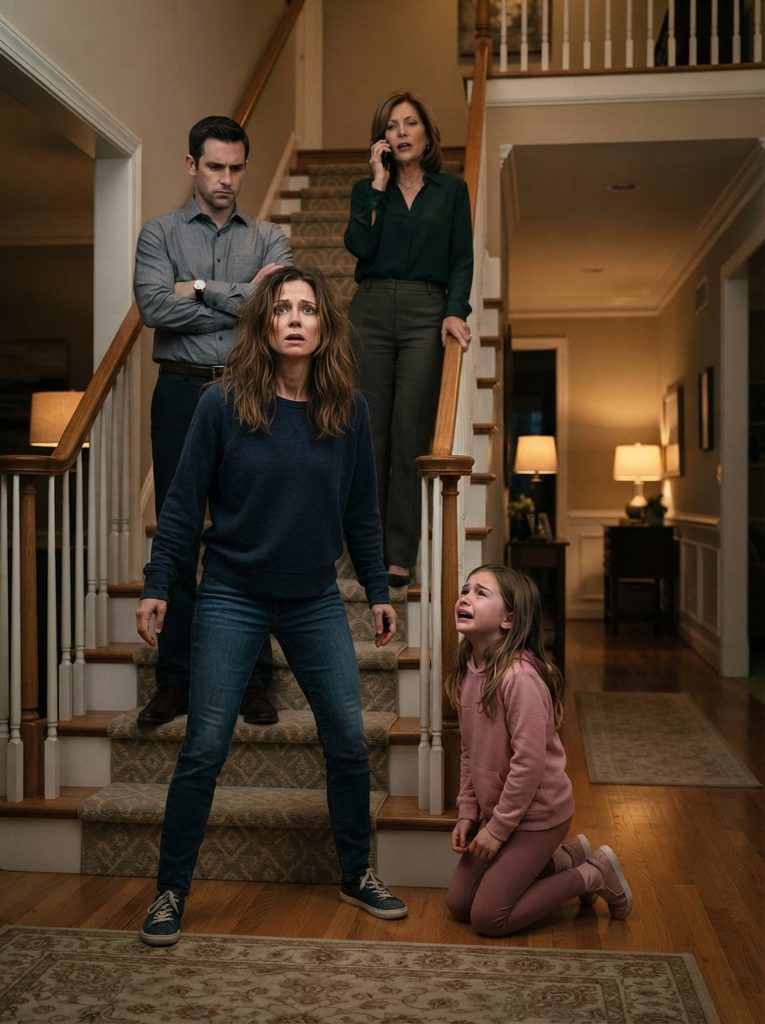
When My Husband Threw Me Down The Stairs, My Mother-In-Law Called My Father And Said, “Come Take Your Worthless Daughter Back.” My Father Replied, “If She Has Even One Scratch, Your Family Will Answer For It.” They Laughed… Until They Realized Who My Father Was.
My daughter’s scream was the last thing I heard before I hit the stairs. While I lay there trying to breathe, my mother-in-law didn’t call an ambulance—she called my father and told him to “come take your worthless daughter back.” My husband actually laughed when Dad calmly warned them that if I had been hurt, there would be consequences. They thought he was an ordinary retired man. The truth was, even I had no idea who my father had once been—or why men like my husband should never have underestimated him.
### Part 1
The first thing I remember clearly is my eight-year-old daughter screaming, “Mom!” Then the hallway tilted beneath me, my shoulder struck the wall, and the staircase seemed to vanish all at once. By the time I stopped moving, I was twisted against the bottom step with pain spreading through my back, while Aaron stood above me breathing hard and Lily cried somewhere near the landing. I could hear my own heartbeat pounding in my ears, but Aaron’s voice came through perfectly: “You should have listened to me.”
His mother, Denise, was standing three steps behind him with one hand pressed dramatically against her chest. For one desperate second, I thought she was reaching for her phone to call 911, but instead she stared down at me with the irritated expression of someone whose dinner had been interrupted. “Look what you’ve done now,” she muttered, although I couldn’t tell whether she meant Aaron or me. Then she unlocked her phone and said, “I’m calling your father.”
I tried to lift myself, but a sharp bolt of pain forced me back against the carpet. “Denise, call an ambulance,” I whispered. She ignored me, found my father’s number, and put the call on speaker as Aaron stood with his arms crossed. When my father answered, Denise said, “Thomas, come take your worthless daughter back before she destroys this family completely.”
Silence filled the hallway. My father had always been a quiet man, but I had never heard quiet sound so dangerous as it did when he finally said, “Is Natalie hurt?” Denise glanced at Aaron and smirked. “She took a little tumble because she wouldn’t stop causing problems.”
My father didn’t raise his voice. “If my daughter has even one injury because someone put their hands on her, your family is going to answer for it.” Denise covered the phone and laughed, while Aaron shook his head as though my father had just told a joke. Neither of them understood that their laughter was the first crack in the life they thought they controlled.
Three weeks earlier, I still believed my marriage could be repaired. My name is Natalie Carter, and I had spent eleven years telling myself that every marriage had difficult seasons, that stress could change people temporarily, and that the man I married still existed somewhere beneath Aaron’s suspicion and anger. It was easier to believe that than to admit I had slowly become afraid of the person sleeping beside me.
Aaron and I met when I was twenty-four. He was charming, quick-witted, ambitious, and attentive in a way that made me feel like the only person in every room. When we married two years later, my mother cried through half the ceremony and my father shook Aaron’s hand for a long moment before saying, “Take care of each other.”
For years, we did. We bought a modest two-story home outside Columbus, Ohio, had Lily, complained about property taxes, argued about where to order pizza, and spent Saturdays at parks or school events. I worked as an operations director for a healthcare services company, while Aaron supervised regional sales for a building-supply distributor, and from the outside we looked painfully ordinary.
The changes came so gradually that I could always explain away the newest one. Aaron wanted to know why a meeting ended fifteen minutes late, why a male coworker had texted me about a schedule change, why I needed lunch with my sister without him, or why I bought Lily new soccer cleats before discussing the price with him. At first, I answered because I had nothing to hide; later, I answered because refusing to answer created a bigger argument.
Denise made everything worse. Whenever Aaron complained about me, she found some elegant way to make his behavior sound reasonable. “Marriage requires reassurance,” she would say, or, “Aaron has a stressful job, Natalie. A wife should know when to stop pushing.”
Eventually, I learned that saying nothing was easier than defending myself. That silence became its own kind of prison because the quieter I became, the more Aaron treated my silence as proof that he was right. By the time I understood the pattern, I had already spent years adjusting my life around his moods.
One Thursday evening, I came home twenty minutes later than expected because our scheduling software had crashed. Aaron was sitting at the kitchen table in the dark except for the light above the stove. “Where were you?” he asked.
“At work. I texted you.”
“You said you’d be home at six.”
“There was a system problem.”
He leaned back slowly. “There’s always a system problem, a meeting, traffic, somebody needing you. You always have a reason.”
I set my purse down and lowered my voice because Lily was upstairs. “Aaron, I’m exhausted. Can we please talk tomorrow?” His jaw tightened, and for a second he looked like a stranger wearing my husband’s face. “You don’t get to decide when I’m allowed to ask questions.”
I glanced toward the staircase. “Please don’t do this where Lily can hear us.”
“You’re always worried about what Lily hears.”
“Because she’s our daughter.”
Something changed in his expression. He didn’t shout or threaten me, which somehow frightened me more; he simply stared for several seconds and walked away. That night, after he fell asleep, I went downstairs and called my father.
Thomas answered almost immediately. “Hey, sweetheart.”
“Hi, Dad.”
He heard something in my voice because he didn’t waste time on small talk. “Are you safe?”
I closed my eyes. “Yes.”
It was a lie, and we both knew it. My father had been asking me that question for months, but he never demanded an explanation or told me what to do. He simply said, “You don’t have to solve your whole life tonight, Natalie. Just make sure you and Lily are safe tonight.”
.
Two days later, Aaron brought flowers home. He apologized for being suspicious, blamed stress, kissed my forehead, and promised he would never let his temper get the better of him. I wanted to believe him so badly that I accepted the apology before I had even decided whether I believed it.
I didn’t know that the flowers would still be sitting on our kitchen counter when everything finally broke apart.
And I definitely didn’t know that my father had already begun paying attention to details everyone else had missed.
### Part 2
Aaron became more careful after that argument, but careful wasn’t the same thing as kinder. He learned to package accusations inside concern, so that if I complained about his questions he could say, “I’m worried about our marriage,” and if I asked for privacy he could answer, “Married people shouldn’t need secrets.” Every conversation became a maze where the exit somehow led back to me apologizing.
The first time I seriously thought about leaving, I didn’t say the words out loud. Aaron must have sensed something anyway because one night, while we were folding laundry, he suddenly said, “You wouldn’t take Lily away from me.” I stopped with one of her T-shirts in my hands.
“I never said I was going anywhere.”
“You didn’t have to.”
The certainty in his voice stayed with me. Aaron wasn’t afraid of losing our marriage nearly as much as he was afraid of losing control over what happened inside it. That realization scared me enough to begin documenting things.
I kept notes on my phone: dates, arguments, threatening messages, occasions when he stood in a doorway so I couldn’t leave a room, and calls from Denise telling me to “stop provoking” her son. I didn’t think of the notes as evidence because admitting I needed evidence would have forced me to admit what kind of marriage I was in. I told myself I was only keeping a record so I would know I wasn’t imagining things.
A week later, I took Lily to my parents’ house for Sunday lunch. My father was watering the lawn in an old Cleveland Guardians cap when she ran toward him yelling, “Grandpa!” and he dropped the hose before opening his arms. Watching Lily disappear into his hug made something inside my chest loosen for the first time in days.
Dad looked over her shoulder at me. “You all right?”
“I’m fine.”
He studied my face but didn’t challenge the answer. “Come inside when you’re ready.”
Later, while Lily helped my mother bake cookies upstairs, Dad and I sat across from each other at the kitchen table. I wrapped both hands around my coffee cup and finally asked, “Have you ever regretted staying quiet when someone needed help?” He didn’t answer immediately.
.
“That depends,” he said. “Did they need help, or did they need somebody else to make their decision for them?”
I stared into my coffee. “I think I need help.”
His expression changed instantly, but his voice stayed gentle. “Then I’m here.”
I told him more than I had ever told anyone. I described Aaron’s questions, the monitoring, the blocked doorways, the way he increasingly checked my phone, and the comments Denise made whenever I pushed back. Dad listened without interrupting until I finally said, “I’m scared about what will happen to Lily if I leave.”
“That fear makes sense.”
“What if I make everything worse?”
He reached across the table and put his hand over mine. “Natalie, you are not responsible for controlling another adult’s behavior.”
The sentence should have been obvious, yet I felt as though someone had opened a window in a room where I had forgotten fresh air existed. I still wasn’t ready to leave, though. There was our mortgage, Lily’s school, our insurance, our routines, and eleven years of memories that didn’t magically become worthless simply because the present had become painful.
That was the part people rarely understood. I wasn’t choosing between a bad husband and an empty road; I was choosing between the life I knew and a future I couldn’t see. Aaron had once held my hand when Lily was born, stayed awake with me through fevers, and driven two hours to bring me my forgotten laptop before an important presentation.
My father seemed to understand that contradiction. He never said, “Leave him now,” and he never made me feel foolish for hesitating. Instead, he said, “If you decide you need somewhere to go, this house is yours.”
Then he added, “And if Aaron ever convinces you nobody will believe you, remember something. Facts do not need permission to be true.”
I gave him a tired smile. “What does that even mean?”
He shrugged. “Old-man advice.”
I thought that was all it was. My father had been retired for years, lived in the same modest brick house where I grew up, drove an aging SUV, and still argued with store coupons as though every dollar were personally offending him. Whenever anyone asked what he had done before retiring, he usually said, “Government work. Mostly paperwork.”
Nothing about him looked powerful. He never name-dropped, boasted, or acted impressed with expensive people, yet I had always noticed one strange thing about him: intimidation made him quieter. The louder someone became, the calmer my father seemed to get.
A week after our kitchen conversation, Aaron found my notes. I came into the bedroom and saw him standing beside the dresser with my phone in his hand. His face was completely expressionless.
“What is this?”
My stomach tightened. “Give me my phone.”
He read aloud, “March 6. Aaron stood in the doorway and would not let me leave the bedroom.”
“Aaron.”
He scrolled farther. “March 11. Denise called and said a good wife doesn’t embarrass her husband.”
I reached for the phone, but he stepped away. “You’ve been documenting me?”
“I’ve been trying to understand what’s happening.”
“No.” His voice sharpened. “You’ve been building a case.”
Then he found the messages between Dad and me.
His eyes hardened. “You told your father.”
“He’s my father.”
“You’re making me look like some kind of monster.”
“I didn’t make you do any of those things.”
For a few seconds, the room became frighteningly quiet. Aaron’s hand tightened around my phone, and I wondered whether this was the moment he would finally hit me. Instead, he threw it onto the bed and said, “You’re going to regret turning people against me.”
Less than an hour later, Denise arrived. I locked the bedroom door and heard their voices through the floorboards below. Most of the conversation was muffled, but one sentence came through clearly.
Denise said, “Maybe you need to make her understand what happens when she threatens this family.”
I didn’t sleep that night.
The following morning, I called Dad and whispered, “I think I’m in trouble.”
His response was immediate. “Take Lily and leave the house.”
I started packing.
Then, before I could zip the first suitcase, I heard Aaron’s key turning in the front door.
### Part 3
Lily stood in my bedroom doorway holding her backpack while I shoved two pairs of jeans into a suitcase. “Mom, are we going somewhere?” she asked, and I forced myself to smile even though my hands were shaking. “We’re going to Grandma and Grandpa’s for a little while.”
The front door closed downstairs. Aaron’s footsteps moved through the foyer, then stopped when he saw the bags at the bottom of the staircase. By the time I reached the landing, he was staring up at me.
“What are you doing?”
“We’re staying with my parents for a few days.”
“No, you’re not.”
Lily moved closer to my side. I kept my voice calm because I had finally understood that my daughter was learning from every second of what happened next. “Aaron, I’m not arguing. We need space.”
“You think you can just take my daughter?”
“Our daughter.”
He gave a short, humorless laugh. “You’ve been talking to your father again.”
I picked up Lily’s backpack. “We’re leaving.”
Aaron moved directly in front of the door. My heartbeat accelerated so quickly I could feel it in my fingertips, but then Lily whispered, “Daddy, please.” Something in her voice broke through whatever was happening inside him, and he stepped aside.
We left without another word.
Dad was already standing at the curb when I pulled into my parents’ driveway. He opened Lily’s door before I turned off the engine, looked at her carefully, then came around to me. “Are you hurt?”
“No.”
“Are you sure?”
I nodded.
He didn’t demand details. He carried our bags inside, made Lily hot chocolate, and told my mother enough to prevent a hundred frightened questions. That evening, after Lily fell asleep in my childhood bedroom, Dad made tea and sat with me at the kitchen table.
“How much do you know about Aaron?” I asked.
“Enough.”
“What does that mean?”
“It means I’ve paid attention.”
“You barely see him.”
Dad looked toward the staircase. “You’ve been telling me about your marriage for years, Natalie. You just didn’t realize you were telling me.”
I thought about every canceled dinner I had blamed on Aaron’s work, every joke I had made about him checking receipts, every time I had explained that visiting my parents was “complicated.” I had thought I was hiding the truth. My father had simply been listening to the pieces.
“Why didn’t you tell me to leave?”
“Because I couldn’t make that choice for you.”
“But you suspected.”
“Yes.”
The answer hurt, but not because I blamed him. It hurt because it confirmed how visible my unhappiness had apparently become.
That night, a family-law attorney named Marcus Reed called me. Dad had arranged a consultation, and Marcus spoke in the controlled, practical tone of someone accustomed to frightened people asking impossible questions. He explained protective orders, temporary custody, medical documentation, police reports, digital evidence, and the importance of preserving messages exactly as they were.
“Do not edit anything,” he told me. “Do not delete anything, even if it makes you uncomfortable. Facts are going to matter more than perfect wording.”
After the call, I looked at Dad. “How do you know Marcus?”
“We’ve known each other a long time.”
“How long?”
Dad smiled faintly. “Long enough.”
“You’re being weird.”
“I’ve been accused of worse.”
I laughed for the first time in days.
The following morning, the laugh disappeared when Marcus called again. Aaron had filed for temporary emergency custody, claiming I had taken Lily from the marital home without justification and was interfering with his relationship with her. Reading those accusations made me physically nauseated.
“He hurt me, and now he’s telling people I’m the danger.”
Marcus nodded during our video call. “Family proceedings are not decided by whoever sounds most outraged. We focus on evidence, consistency, and Lily’s welfare.”
“What if they believe him?”
“Then we give the court the clearest factual record we can.”
That afternoon, Denise called repeatedly until I finally answered. She didn’t say hello. “You’re destroying my son.”
“I’m not discussing this with you.”
“Your father filled your head with nonsense.”
“My father didn’t make Aaron threaten me.”
“You have always been selfish.”
I hung up.
Dad returned from an errand that evening carrying a thin folder. He placed it on the kitchen table and slid it toward me.
“What’s this?”
“Public information.”
“About what?”
“Aaron’s business and his family’s companies.”
I opened the folder and found corporate registrations, property records, archived business articles, and court filings. Nothing suggested criminal activity, but the documents explained something I had always sensed about the Blakes: their family had deep commercial connections throughout the county, and Denise had spent years surrounded by people who returned her calls quickly.
I looked up. “Did you investigate them?”
“I read public records.”
“Why?”
“Because I wanted to understand the people my daughter married into.”
Then I asked a question I had asked him in smaller ways since childhood. “Dad, what did you actually do before you retired?”
For once, he didn’t give the usual answer.
He sat down slowly. “Why are you asking now?”
“Because Marcus listens to you like you used to be his boss, and you read legal filings for fun, and apparently you know how to pull half the county into a folder before dinner.”
The corner of his mouth moved, but he didn’t smile. “I worked for the federal government.”
“I know.”
“No. You know the sentence I always gave you. You don’t know much beyond it.”
“Then tell me.”
He looked at the folder for several seconds. “Not tonight.”
I stared at him. “Why?”
“Because right now, my past is less important than your present.”
Before I could push, Marcus called again.
“Natalie, Aaron’s attorney contacted us.”
“What now?”
“They’re alleging your father is trying to intimidate their family.”
Dad’s expression didn’t change.
I put the phone on speaker. Marcus repeated the allegation, then added, “Thomas, they appear extremely interested in your background.”
My father folded his hands.
“Then document everything they say,” he replied.
Marcus hesitated. “They may not understand who they’re dealing with.”
Dad’s voice became firmer. “They don’t need to know who I am.”
He looked directly at me.
“They only need to know what happened.”
For reasons I could not explain, that answer frightened me more than any threat could have.
### Part 4
The next two days were filled with paperwork, phone calls, and the strange exhaustion of being required to describe painful events in clean chronological order. Marcus brought in another attorney, Evelyn Hart, who specialized in custody disputes involving domestic abuse, and together they began turning months of confusion into a timeline. Seeing everything arranged by date made my marriage look different.
There had been the evening Aaron smashed my phone against a kitchen counter, the afternoon he blocked the garage door because I wanted to leave an argument, the messages demanding photographs to prove where I was, and the calls from Denise insisting that “good wives don’t threaten families with divorce.” Each event had seemed survivable in isolation. Together, they looked like a pattern I could no longer explain away.
Evelyn tapped the folder. “You don’t have to make this dramatic, Natalie.”
“I don’t want to.”
“Good. Tell the truth, including the parts you’re uncertain about. Credibility is stronger when people admit what they don’t remember.”
The police interviewed me again. I described the night on the stairs as carefully as I could, including where Aaron had been standing, where Lily was, what I remembered hearing, and the moments I could not reconstruct. When the detective asked why I hadn’t reported earlier threats, I said the only honest thing I could.
“I kept hoping they wouldn’t become anything worse.”
Afterward, I sat in my car and cried. Not because I felt weak, but because I finally understood how much energy I had spent surviving quietly. I had become so skilled at minimizing what frightened me that telling the simple truth felt almost disloyal.
That afternoon, Denise drove to my parents’ house without warning. I saw her from the living-room window, climbed halfway up the stairs, and stopped where she couldn’t see me. Dad opened the door but did not invite her inside.
“You’re ruining my family,” Denise said.
“No.”
“You’re using your connections to threaten Aaron.”
“No.”
“Then what exactly do you want?”
“My daughter safe.”
Denise scoffed. “Natalie has manipulated everyone.”
Dad’s voice remained flat. “Aaron’s actions created his problem.”
“You think you’re powerful because you used to work for the government?”
There was a pause.
“No,” Dad said. “I think facts are powerful.”
“You can’t destroy my son.”
“I have no intention of destroying anyone.”
“Then why are you doing this?”
“Because Natalie was hurt, Lily was frightened, and your son has choices to make about what kind of man he intends to be.”
Denise sounded almost disappointed. “You’re not even going to threaten me?”
“No.”
“Why not?”
“Because threats are one of the reasons we’re standing here.”
She left minutes later.
That night, Aaron called from a number I didn’t recognize. I almost ended the call the instant I heard his voice, but something made me stay silent.
“Natalie.”
“What do you want?”
“I made a mistake.”
“You pushed me down a staircase.”
“I know.”
“You told people I fell.”
“I panicked.”
“You let your mother call me worthless while I was lying on the floor.”
Silence.
“I said I’m sorry.”
“No, Aaron. You’re scared of consequences. That isn’t the same thing.”
His breathing changed. “You’re not the woman I married.”
I looked through the kitchen window toward my father’s backyard. “Neither are you.”
The next morning, Aaron filed another motion claiming I was unstable and that Dad was controlling my decisions. Marcus wasn’t surprised. He spread the new filing across the table while Evelyn began matching each allegation against messages, dates, and witnesses.
Then Marcus placed a statement in front of me.
“What’s this?”
“Aaron’s account from the night you were injured.”
I read it carefully. Aaron admitted we had argued and that he had physically tried to stop me from walking away, but he claimed my fall had been accidental. He also claimed Lily had already been upstairs when everything happened.
Marcus pointed to one paragraph. “That creates a problem for him.”
“Why?”
“Because we have a neighbor’s exterior camera capturing part of the hallway through your open front door.”
I stared at him. “What?”
“Aaron apparently forgot the door was open after Denise arrived.”
The footage wasn’t perfect, and Marcus warned me not to imagine some television-style smoking gun. It showed only portions of the foyer and hallway, but it established a timeline, showed me moving toward the staircase, showed Aaron following me, and captured Lily near the lower landing when he claimed she had been upstairs.
His own words were beginning to undermine him.
Dad watched me read the report. “That’s why details matter.”
I looked at him. “You say things like a lawyer.”
He gave me a tired smile. “There’s a reason.”
This time, I refused to let him change the subject.
“Tell me.”
Dad leaned back and looked toward the doorway to make sure Lily wasn’t nearby.
“I was a federal prosecutor.”
I thought I had misheard him.
“You were what?”
“For almost twenty-nine years.”
My mouth went dry. “You told me you did paperwork.”
“There was a remarkable amount of paperwork.”
I stared at him until he almost smiled.
“What kind of prosecutor?”
“Public corruption, complex fraud, organized financial crime. Mostly cases involving people who believed money, reputation, or intimidation placed them beyond accountability.”
Suddenly, a hundred childhood memories rearranged themselves in my mind: men in dark suits shaking his hand at airports, judges sending Christmas cards, strangers recognizing him at restaurants, his refusal to discuss certain years of his career. “Why didn’t you ever tell me?”
“Because I didn’t want my job to become your identity.”
“You let me think you spent thirty years in an office processing forms.”
“I did spend a lot of time in an office.”
“Dad.”
He became serious. “Natalie, listen to me. My old job is not a weapon for you to use against Aaron.”
“I wasn’t planning to.”
“I know. But his side may try to make this case about me instead of what happened to you.”
As if summoned by the warning, Marcus’s phone rang.
He answered, listened, and slowly looked toward Dad.
When the call ended, he said, “They just learned exactly who Thomas Carter used to be.”
For the first time since all of this began, my father looked concerned.
Not afraid.
Concerned.
And I realized Aaron’s family was about to make a second mistake: they were going to assume that my father’s former power mattered more than the evidence he had spent weeks insisting we preserve.
### Part 5
By the following morning, Aaron’s attorney had shifted strategies almost completely. Instead of focusing on whether Aaron had hurt me, their filings emphasized my father’s former career and suggested that his reputation could “improperly influence” local proceedings. The accusation would have been almost funny if Lily’s future had not been sitting beneath it.
Dad read the filing once and handed it back to Marcus. “No direct contact with their side unless absolutely necessary.”
Marcus nodded. “Agreed.”
“You should also document every allegation involving me separately from Natalie’s case.”
“Already started.”
I looked between them. “You two sound like you’ve done this before.”
Marcus gave Dad a sideways glance. “Your father trained half the lawyers in my first federal office to write like somebody hostile would someday read every sentence.”
Dad sipped his coffee. “Because somebody hostile usually does.”
For the first time, I understood what his former career actually meant. He wasn’t powerful because he could make phone calls to important people; he was powerful because he had spent decades refusing to depend on favors. His instincts were built around records, procedures, and the uncomfortable assumption that every claim should survive scrutiny.
That realization changed something in me. For weeks I had fantasized, sometimes shamefully, about Dad revealing himself and terrifying the Blakes into surrender. Instead, he repeatedly removed himself from decisions, refused direct confrontation, and told Marcus and Evelyn to build the case as though he were nobody.
“Wouldn’t it be easier if you called someone?” I asked him once.
“Yes.”
The answer surprised me. “Then why don’t you?”
“Because easy and right are not synonyms.”
He folded the newspaper in his lap. “If I use an old relationship to force an outcome, Aaron gets to claim this happened because of me. If you rely on the evidence, the outcome belongs to the evidence.”
Two days later, the custody hearing was scheduled.
The night before court, I barely slept. I kept imagining Aaron standing in front of a judge describing me as unstable, vindictive, manipulative, or hysterical, words he had used privately for years whenever I disagreed with him. At three in the morning, I went downstairs and found Dad sitting at the kitchen table reading.
“You never sleep.”
“Old habits.”
I sat across from him. “What if the judge believes him?”
“Then your lawyers respond.”
“That isn’t reassuring.”
“It isn’t supposed to be reassuring. It’s supposed to be true.”
I stared at the table. “I wish I wasn’t scared.”
Dad closed the book. “You don’t need to be fearless tomorrow.”
“What do I need?”
“To remember what matters more than your fear.”
The answer was Lily.
We arrived at the courthouse shortly after eight. There was nothing cinematic about it: fluorescent lighting, vending machines, families whispering near elevators, attorneys balancing coffee and binders, and deputies calling names. The ordinary setting somehow made the stakes feel heavier.
Aaron stood across the hallway with Denise and his attorney. He looked thinner than he had weeks earlier, and when he saw Dad, his shoulders tightened. Denise leaned toward him and whispered something.
Marcus touched my elbow. “Ignore them. Today is about Lily.”
The hearing began with Aaron’s attorney describing me as emotionally volatile and suggesting that I had taken Lily impulsively after a marital argument. He emphasized Dad’s career, repeatedly using phrases like “federal prosecutor” and “extensive government connections.” I could feel anger rising, but Evelyn had prepared me for this.
Then Marcus stood.
“Your Honor, we are prepared to address every allegation with documented evidence.”
There was no dramatic speech. He started with dates.
My medical records showed injuries consistent with the fall. Photographs documented bruising without exaggeration. Messages established that Aaron had repeatedly warned me not to “embarrass” him or speak negatively about him to my father.
Then came the camera footage.
I stared down at my hands while the video played. I had already lived the moment once and had no desire to watch it from another angle. The courtroom became nearly silent.
The recording didn’t capture the entire staircase. It showed me backing toward the hallway, Aaron following, his arm moving toward me, and my body disappearing abruptly beyond the camera’s view. Seconds later, Lily ran into frame.
The judge replayed it.
Then she turned toward Aaron. “Mr. Blake, did you put your hands on your wife?”
Aaron swallowed. “I tried to stop her from walking away.”
“Did she fall immediately afterward?”
“Yes.”
“Did you later tell anyone that she fell without physical contact from you?”
“Yes.”
“Why?”
“I was scared.”
“Of what?”
He didn’t answer.
The judge asked where Lily had been.
“Upstairs.”
Marcus responded carefully. “The footage appears to show the child entering the camera frame from the lower hallway within seconds.”
Aaron’s attorney objected to assumptions about what Lily had witnessed, and the judge agreed that nobody should speculate beyond the evidence. Ironically, that restraint helped me. We didn’t need to claim more than the video showed.
The judge reviewed professionally obtained statements concerning Lily without bringing her into the courtroom. She emphasized that the child would not be used as a weapon between parents. Hearing those words made me realize how terrified I had been that saving myself might somehow damage my daughter.
When the judge finally issued temporary orders, she restricted Aaron’s contact with Lily to structured arrangements while the case continued. Communication with me would occur only through approved channels, and both parties were ordered to follow further evaluations and court requirements.
I didn’t feel triumphant.
I felt exhausted.
Outside the courtroom, Aaron approached before Marcus could intercept him. “Natalie.”
I stopped several feet away.
“I never wanted this.”
“You wanted me afraid.”
He shook his head. “I was angry.”
“So was I.”
His eyes filled with tears. “I’m sorry.”
For years, those two words would have been enough to make me soften. This time, I believed he might genuinely be sorry and still understood that remorse did not rebuild trust automatically.
“I hope you mean that,” I said.
He looked at me almost hopefully.
Then I added, “But I’m not coming back.”
His face changed.
And I finally understood that walking away without hatred could hurt a controlling person more than any revenge I could have invented.
### Part 6
Dad was waiting outside the courthouse when I came through the doors. I expected him to ask about the ruling or Aaron’s testimony, but instead he held up his car keys and said, “Coffee?” The ridiculous normality of the question made me laugh so hard I almost cried.
We crossed the street to a small café and sat near the window. After everything that had happened, I finally asked, “Were you ever tempted to make one phone call and scare them into leaving me alone?” Dad stirred his coffee slowly.
“No.”
“Not even once?”
“I was tempted to do many things. That doesn’t make them right.”
“You spent decades putting powerful people in prison.”
“I spent decades presenting evidence and asking courts to apply laws. That is not the same as personally deciding what people deserve.”
I watched pedestrians move beyond the glass. “So all you did for me was find Marcus and Evelyn?”
“I helped you find competent people. I helped you understand what questions to ask. The rest belongs to you.”
For years, I had imagined strength as the power to control outcomes. My father’s version was almost the opposite: having influence and deliberately refusing to abuse it. That difference stayed with me.
Denise approached me in the parking lot when we returned to collect some documents. She stopped several feet away as though unsure whether she had permission to come closer. For the first time since I had known her, she looked tired rather than superior.
“Natalie.”
I waited.
“I don’t know what to say.”
“Then don’t say anything.”
She nodded slowly. “I thought I was protecting Aaron.”
“You were protecting him from consequences.”
Her eyes filled. “I know that now.”
I didn’t forgive her. I also didn’t insult her or enjoy her discomfort the way I once imagined I would. I simply said, “I hope you remember that the next time he asks you to explain away something he did.”
Three months passed.
The divorce moved forward, court requirements became routine, and my life became paperwork, school lunches, therapy appointments, grocery lists, attorney calls, and dozens of ordinary Tuesdays. I rented a smaller house ten minutes from Lily’s school, with old hardwood floors and a backyard barely large enough for a picnic table.
The first night we slept there, I lay awake waiting for a sound I couldn’t identify. Eventually, I realized what was missing. Nobody was walking through the house checking whether I was awake, reading my phone, asking why I had arrived ten minutes later than expected, or demanding explanations from another room.
Silence had once frightened me.
Now it felt luxurious.
Lily adjusted slowly. She began sleeping through the night, returned to soccer practice, and stopped asking whether we were “going home” because the new house gradually became home. Sometimes she asked about Aaron, and I refused to make her carry my anger.
“Adults can make harmful choices,” I told her. “You are allowed to love somebody and still need boundaries.”
“Is Daddy bad?”
The question broke my heart.
“Your dad did something very wrong. People are more complicated than one word.”
“Can he change?”
“He can choose to work on changing.”
She considered that. “Does that mean we go back?”
“No.”
Her shoulders visibly relaxed.
That reaction told me more than any courtroom document ever could.
Aaron eventually began complying with the court’s requirements. He entered counseling, stopped contesting basic facts about what had happened on the staircase, and communicated through the approved system without the insults that had filled his earlier messages. I didn’t follow his progress closely because I had finally accepted that repairing Aaron was not my responsibility.
One afternoon, Marcus called.
“Natalie, there’s been a development.”
My stomach tightened. “You attorneys really need a less terrifying opening sentence.”
He laughed. “Fair criticism. This one isn’t bad.”
Aaron’s legal team had informed him that they no longer intended to dispute his responsibility for the physical confrontation preceding my fall. He still had rights and ongoing obligations as Lily’s father, but the narrative that I had simply fallen was finished.
I sat alone in my kitchen after the call and expected satisfaction.
Instead, I cried.
I wasn’t mourning the marriage I wanted back. I was mourning the version of Aaron I had spent years believing would eventually return if I became patient enough, quiet enough, loving enough, agreeable enough, or forgiving enough.
That man might once have existed.
But I could not build my future around waiting for him.
A few weeks later, an envelope arrived with Denise’s handwriting on the front. I recognized it before I saw the return address and left it on the counter for nearly an hour.
The first sentence inside said, “Natalie, I don’t expect you to forgive me.”
I almost stopped reading.
She wrote that protecting family had always meant loyalty to her, and loyalty had gradually become an excuse never to question Aaron. When he told her I was difficult, she believed him; when I told her I was afraid, she assumed I was exaggerating; and when she saw me injured at the bottom of the stairs, her first instinct was still to protect her son.
Then I reached the paragraph that made my hands shake.
“I called your father because I wanted him to be embarrassed by you. I thought you were the problem he needed to remove from our family. I called you worthless because I wanted you to feel small enough to leave quietly. I was wrong.”
For months, I had fantasized about forcing Denise to understand exactly how cruel she had been.
Now that she finally did, revenge felt strangely empty.
I folded the letter and called Dad.
“Denise apologized.”
He was silent for a moment.
“How do you feel?”
“I don’t know.”
“That’s allowed.”
“I thought I’d feel better.”
“You don’t owe anybody a specific emotional reaction.”
I smiled despite the tears in my eyes. “More old-man advice?”
“The supply is unlimited.”
I placed Denise’s letter in a drawer.
What I didn’t know yet was that she would soon ask to see me face-to-face.
And I would have to decide whether understanding someone’s regret required giving them another place in my life.
### Part 7
I nearly refused Denise’s invitation. The version of me who had lived in Aaron’s house would have agreed automatically because avoiding conflict had once felt safer than creating boundaries. The woman sitting in my new kitchen understood that “no” was not cruelty.
Still, I agreed to meet her at a coffee shop across town. I chose the place, the time, and my own table near the front window. That mattered to me more than I expected.
Denise arrived early and stood when I walked in. “Thank you for coming.”
I sat down. “You said you wanted to talk.”
She wrapped both hands around her cup. “I wanted to apologize without asking you to forgive me.”
That surprised me.
She looked down. “When I called your father that night, I said something horrible.”
“I remember.”
“I told him to take his worthless daughter home.”
I said nothing.
“I think about that sentence every day.”
Part of me wanted to tell her she deserved to. Another part no longer wanted to spend emotional energy punishing a woman who had finally begun doing the work I had begged her to do years earlier.
Denise continued, “You weren’t worthless.”
“I know.”
Her eyes filled with tears. “I wish I had known it then.”
“I tried to tell you.”
“I know.”
“You didn’t believe me.”
“I know that too.”
The repetition was strangely calming. For once, Denise wasn’t defending Aaron, redefining events, or explaining why her intentions should matter more than the harm she caused.
“I can understand why a mother wants to protect her son,” I said. “Understanding it does not make what you did acceptable.”
“I understand.”
“I may never trust you.”
“That’s fair.”
“And I don’t know whether you’ll have a relationship with me at all.”
She nodded. “I’ll accept whatever you decide.”
I believed her, or at least I believed she meant it in that moment. We did not hug when we left. There was no cinematic reconciliation, no sudden restoration of family bonds, and no promise that everything would someday feel normal.
I drove home feeling lighter precisely because I hadn’t promised anything.
Dad was sitting on my porch with Lily when I arrived, and she was holding up a drawing while he listened with the seriousness of a man reviewing architectural plans. “Grandpa brought ice cream,” she announced before I reached the steps.
“Of course he did.”
Dad lifted the grocery bag beside him. “I was invited.”
“By an eight-year-old.”
“The highest authority in the family.”
That evening, after Lily went to bed, we sat outside while the neighborhood settled into darkness. Somewhere down the block, a dog barked, a sprinkler clicked rhythmically, and someone closed a garage door.
“Dad?”
“Hm?”
“Were you really important?”
He sighed. “Define important.”
“You prosecuted major federal cases for almost thirty years.”
“I had a job.”
“That is the most Thomas Carter answer imaginable.”
He smiled.
“Why didn’t you tell me?”
He looked toward the street. “Because I didn’t want you growing up thinking your last name could solve problems for you.”
“You could have protected me sooner.”
“I could have interfered sooner.”
“That isn’t the same thing?”
“No.”
I thought about it.
Dad leaned forward. “Protecting you does not mean controlling your life, Natalie. Aaron controlled you because he believed his fear gave him the right to make choices for you. If I had decided that my fear gave me the right to run your marriage, I would have been using a different justification for the same basic disrespect.”
The comparison startled me. “You’re saying helping someone can become control.”
“Very easily.”
“So when I told you I was scared…”
“I offered you a place to go, information, and people who could help.”
“You still saved me.”
He shook his head. “No.”
“Dad.”
“You packed the bag. You took Lily out the door. You told the police what happened. You sat in that courtroom. You built the new home.”
“You found Marcus.”
“I opened a door. You walked through it.”
Tears rose before I could stop them. I had spent months believing my father’s hidden career was the great twist in my story, the secret weapon that finally frightened Aaron’s family.
But that wasn’t what happened.
His past explained his discipline, his understanding of evidence, and the network of professionals he trusted, but he had never used his reputation to crush anyone. The real change occurred because I finally stopped protecting the people hurting me from the consequences of their own actions.
Aaron and I finalized our divorce that fall.
The agreement was not a fantasy of total destruction. He kept his career, maintained structured involvement in Lily’s life according to professional recommendations and court orders, and continued counseling. I received my share of the marital assets and enough financial stability to build forward without remaining tied to him beyond the responsibilities we still shared as parents.
When the paperwork was signed, Aaron asked whether he could speak to me briefly.
Marcus stayed nearby while I agreed.
Aaron looked older than the man in our wedding photographs. “I’m sorry,” he said. “I know I’ve said that before.”
“Yes.”
“I kept thinking if I explained myself correctly, you’d understand why I acted the way I did.”
I waited.
“But there isn’t an explanation that makes it okay.”
“No.”
He swallowed. “I really did love you.”
The old me would have answered automatically.
The new me took several seconds.
“I think you did, in the way you understood love.”
His face tightened.
“But love without respect became something I couldn’t live inside.”
He nodded.
“Do you hate me?”
“No.”
That seemed to hurt him more than if I had said yes.
“I don’t want my life to revolve around hating you either.”
I left the courthouse without looking back.
That winter, Lily and I put up our first Christmas tree in the little house. Half the lights stopped working, our star leaned sideways, and the ornaments looked crowded because the tree was too small.
Lily stepped back and grinned.
“It’s perfect.”
I looked around the room.
For the first time in years, perfect did not mean appearing normal to everyone outside.
It meant peaceful.
### Part 8
By spring, the backyard behind our rental had become Lily’s project. She wanted flowers along the fence, herbs beside the patio, and strawberries in a planter even though neither of us knew what we were doing. Dad arrived one Saturday with gardening gloves, a bag of soil, and enough unsolicited advice to qualify as a municipal service.
Lily handed me a small yellow flower. “Where should this one go?”
I pointed toward the brightest corner. “Right there.”
We knelt together and dug into the soil. For a moment, I thought about the night on the staircase and how certain I had been that my life had collapsed with me.
It hadn’t.
The life I knew had ended, but that was not the same thing.
The difference took me months to understand.
I had once believed revenge would mean watching Aaron lose everything. In my angriest moments, I imagined Denise being humiliated, their friends abandoning them, their family reputation collapsing, and my father revealing some hidden power that would make them terrified of ever saying my name again.
None of those fantasies became my ending.
Aaron faced consequences, but he also remained Lily’s father and had the responsibility to become safer if he wanted a healthier relationship with her. Denise lost my trust and much of her influence over my life, but she eventually stopped excusing what her son had done.
My father never destroyed anybody.
He simply refused to help them hide from facts.
The strangest part was that this felt more satisfying than revenge.
Denise and I never returned to the relationship we once had. She occasionally attended events involving Lily when circumstances and boundaries made it appropriate, but she no longer called me for private conversations unless invited. She seemed to understand that an apology did not purchase access.
One afternoon after a soccer game, she approached me while Lily was laughing with teammates near the field.
“You seem happy,” Denise said.
“I am.”
She nodded. “I’m glad.”
There had been a time when I would have searched her face for judgment, approval, manipulation, or hidden criticism. Now her opinion simply passed through the moment without deciding anything inside me.
“Thank you,” I said.
That was all.
Aaron changed in ways I could observe from a distance, though I refused to build expectations around them. His communication became more respectful, his visits with Lily became steadier, and eventually professionals recommended gradually expanded contact.
I never told Lily she had to forgive her father.
I also never taught her to hate him.
One evening she asked me, “Mom, if somebody says sorry, do you have to let them back?”
I stopped washing dishes.
“No.”
“Why?”
“Because forgiveness and access are different things.”
She frowned thoughtfully.
“You can hope someone becomes better,” I said, “and still decide what boundaries you need.”
“Did you forgive Dad?”
I dried my hands.
“I stopped carrying around the wish that he would hurt the way I hurt.”
“Is that forgiveness?”
“For me, maybe.”
“Are you going back?”
“No.”
She nodded as if that answered the important part.
It did.
My own counseling taught me to recognize signs I had once dismissed as normal marital tension. Control rarely announced itself dramatically at the beginning. In my marriage, it arrived disguised as concern, constant questions, jealousy framed as love, criticism framed as protection, financial pressure framed as responsibility, and isolation framed as devotion.
By the time fear became obvious, I had already learned to distrust my own reactions.
Rebuilding that trust in myself was harder than signing divorce papers.
I had to stop apologizing automatically whenever someone looked disappointed. I had to learn that silence in a room did not necessarily mean anger was coming, that I could buy something without explaining the receipt, that I could let a phone notification sit unanswered while I finished dinner.
Some victories were embarrassingly small.
The first time I stayed twenty minutes late at work and drove home without feeling panic, I sat in my driveway and cried.
The first time Lily asked whether a friend could sleep over and I answered without wondering how Aaron would react, I almost laughed.
The first time I changed the furniture simply because I wanted the couch near the window, I stood back and admired it as though I had renovated an entire house.
Freedom was not one huge moment.
It was hundreds of ordinary choices returning to me.
Dad remained exactly the same annoying, patient, understated man he had always been. He still mowed his own lawn, still refused to replace his ancient coffee maker, and still described nearly thirty years of federal prosecution as “a government job.”
One Sunday, I finally asked whether he missed it.
“Sometimes.”
“The courtroom?”
“No.”
“The investigations?”
“Not really.”
“Then what?”
He thought for a moment. “Watching somebody who had been intimidated for years realize they were allowed to tell the truth.”
I smiled. “That sounds familiar.”
He looked at me.
“Maybe.”
I still keep Denise’s letter in a drawer. I don’t keep it because I need proof that she regrets what she did, and I don’t read it when I’m angry.
I keep it because of the woman I was when it arrived.
That woman finally understood that another person recognizing her worth was not what made her worthy.
Aaron couldn’t take my worth when he tried to control me.
Denise couldn’t erase it when she called me worthless.
My father couldn’t give it back to me through his reputation or connections.
It had always belonged to me.
That was the truth hidden underneath everything else.
People sometimes hear what happened and focus on my father. They want the dramatic version where the quiet retired man turns out to have powerful connections and crushes the family who hurt his daughter.
I understand why.
That version feels satisfying.
But it misses the lesson he actually taught me.
Power is not proving that you can frighten the people who frightened you.
Strength is not gaining enough leverage to control the person who controlled you.
Justice is not automatically cruelty in the opposite direction.
Sometimes the strongest answer is documentation, boundaries, accountability, and the decision to build a life where the people who harmed you no longer determine your choices.
If someone had told me that while I was lying at the bottom of the stairs, I probably wouldn’t have believed them.
At that moment, I felt broken.
I thought I had failed at marriage, failed my daughter, ignored too many warning signs, and waited too long to leave.
I know differently now.
Survival does not have an expiration date.
You are allowed to recognize the truth late.
You are allowed to ask for help after years of insisting you don’t need it.
You are allowed to love the person someone used to be and still refuse to live with the person they became.
And you are allowed to hear an apology without reopening the door.
One evening, nearly a year after I left Aaron, Lily and I sat on the back steps watching the flowers move in the breeze. Dad had gone home after dinner, leaving behind half a container of ice cream and three separate reminders about watering the tomatoes.
Lily rested her head against my shoulder.
“Mom?”
“Yeah?”
“Are you happy?”
The question caught me off guard.
I looked at our small yard, the crooked planter boxes, the kitchen window glowing behind us, and the flower she had planted months earlier now spreading beside the fence.
“Yes,” I said.
“Really?”
I kissed the top of her head.
“Really.”
There was no courtroom waiting for us the next morning. No emergency hearing, no threatening message, no phone call from Denise, no lawyer explaining the next crisis.
There was only Monday.
School.
Work.
Soccer practice.
Dinner.
A normal life.
I once thought normal was what Aaron and I had before everything fell apart.
Now I understood that normal had been something I performed.
Peace was different.
Peace did not require pretending.
Before we went inside, Lily picked one of the small yellow flowers and handed it to me.
“For your room.”
I smiled. “Thank you.”
She ran toward the door.
I stayed outside for another moment and remembered my father’s voice from the years when I didn’t understand him.
Facts do not need permission to be true.
Neither, I realized, does your worth.
And once I understood that, nobody could ever convince me I was worthless again.
THE END!