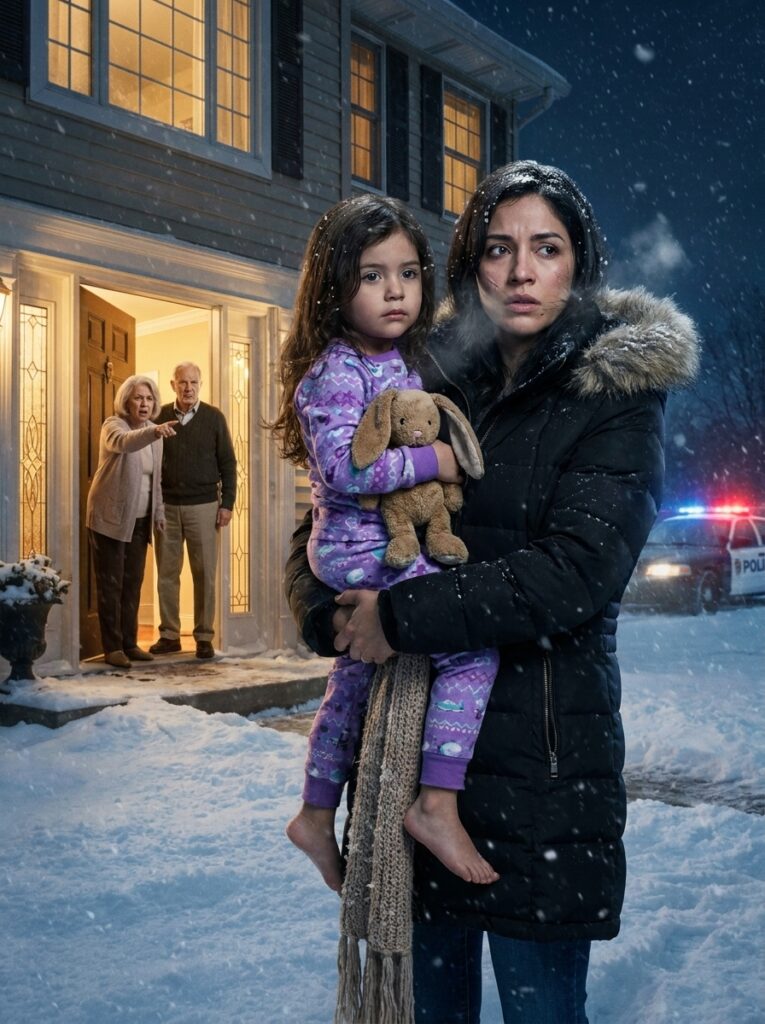
My parents called my five-year-old daughter “your mistake” and pushed us into a Wisconsin snowstorm because I refused to hand over her child-support money. I didn’t scream. I wrapped my scarf around Lily’s bare feet and walked into the snow. Three hours later, police knocked on my parents’ door with my attorney and the brother they had disowned years ago. My mother started screaming before she even understood the worst part: the papers weren’t just about what they did that night. They were about what they had been stealing for five years.
My mother did not even lower her voice when she ended our relationship.
“We’re done taking care of your mistake,” she said. “Leave this house and never come back.”
My five-year-old daughter, Lily, stood only a few feet away in purple winter pajamas, holding a stuffed rabbit by one ear.
For one second, I waited for Mom to hear herself.
To realize what she had just called her own granddaughter.
She did not.
Instead, my father walked to the front door of their Madison, Wisconsin, house and pulled it open.
Snow rushed across the porch in white sheets.
Every weather report that afternoon had warned the storm would get worse after dark. The temperature had already dropped below twenty degrees.
“Dad,” I said, “Lily doesn’t even have her boots on.”
He looked at me like that was my failure.
“You should have thought about that before disrespecting us.”
Disrespecting them.
That was what they called it when I refused to give them control of Lily’s child-support money.
For five years, Lily’s father had sent support every month. My parents insisted the money should go into an account they controlled because I was “too young,” “too emotional,” and “bad with long-term decisions.”
I was twenty-five.
I had a job.
I paid for Lily’s food, clothes, daycare costs, doctor visits, and every little thing children need that nobody includes in a family speech.
But my parents believed money that entered their house should eventually belong to them.
That night, they demanded I transfer the child-support account by morning.
I said no.
That was my entire crime.
Mom yanked my coat from the rack and threw it at me.
Dad grabbed Lily’s small backpack and tossed it straight into the snow.
Then he pointed outside.
“Go.”
So I did.
I did not beg.
I did not scream back.
I did not waste one more second trying to convince them that forcing a child into a snowstorm was wrong.
I pulled on my coat, tucked Lily inside it against my body, and wrapped my scarf around her bare feet.
Then I picked up her backpack from the snow and stepped off the porch.
The door slammed behind us.
Lily buried her face against my chest as I carried her down the street.
“Mommy,” she whispered, “are Grandma and Grandpa mad at us?”
“Yes, sweetheart.”
She was quiet for a few seconds.
Then she asked the question that nearly broke me.
“Are we bad?”
I held her tighter.
“No, Lily. We are not bad.”
“Then where are we going?”
I looked ahead into the storm.
“We’re leaving.”
What my parents did not know was that I had been preparing for this moment for six weeks.
Not because I expected them to throw us into snow.
Even I had not believed they would go that far.
But their control had been tightening for months, and something inside me finally began to listen to the warning.
They had started asking about Lily’s account every day.
Then demanding to see statements.
Then telling relatives I was irresponsible.
Then telling me I should be grateful they “allowed” me and Lily to live under their roof.
The house at 2418 Blackhawk Circle had been my childhood home.
At least, I thought it had.
I slept in a basement bedroom while my parents kept the upstairs rooms “for guests.”
They measured groceries.
Complained about heating costs.
Told me Lily’s daycare was selfish because Mom could “watch her,” though watching her mostly meant criticizing everything I did as a mother.
When I pushed back, Dad said I had no idea what sacrifice looked like.
Mom said I owed them obedience.
Six weeks earlier, Dad texted:
Transfer the child-support account, or start finding somewhere else to live.
That was when I called someone they believed I had stopped speaking to years ago.
My older brother Ethan.
My parents had called him dead to the family after he refused to sign papers taking responsibility for debts he said were never his. I had been young then. Too young to understand the whole story. Old enough to remember the way Mom cried in public and smirked in private whenever his name came up.
I found him in Minneapolis.
He answered on the fourth ring.
For a moment, neither of us spoke.
Then he said, “Maya?”
I started crying before I could stop myself.
Over the next six weeks, Ethan taught me to document everything.
Threatening texts.
Financial statements.
Credit reports.
The child-support records I could access.
Any mail addressed to me that my parents “accidentally” opened.
He also connected me with Claire Vance, a forensic family attorney in Dane County who asked questions so calmly they made panic feel less powerful.
“Do not confront them until we understand what they’ve done,” Claire told me.
“What if I’m overreacting?”
“You’re not calling me because one thing happened, Maya. You’re calling because the pattern finally became visible.”
So I waited.
Collected records.
Took screenshots.
Changed passwords.
Saved Dad’s texts.
And prayed I would never need them.
Then my parents pushed Lily into the snow.
We had walked about four blocks when headlights appeared through the storm.
A police cruiser slowed beside us.
Officer Daniel Hayes took one look at Lily wrapped inside my coat and opened the door.
“Get inside.”
Twenty minutes later, we were in a warming center.
Within an hour, Lily had dry clothes, a warm blanket, and hot chocolate clutched between both hands.
Within two hours, I had given Officer Hayes a complete statement.
Then I took out my phone and made one call.
At exactly 10:17 that night, someone knocked on my parents’ front door.
Dad opened it.
Two police officers stood on the porch.
Beside them was a woman in a dark wool coat holding a thick legal folder.
Behind them stood Ethan.
My brother.
The son my parents had erased.
Mom came to the door.
First, she saw Ethan.
Then the officers.
Then the documents in Claire Vance’s hands.
That was when she started screaming.
“Get off my porch!”
Claire did not raise her voice.
“Richard and Patricia Miller, I represent your daughter, Maya Miller, and your granddaughter, Lily.”
Dad’s face turned red.
“Maya abandoned this house voluntarily tonight.”
Officer Hayes stepped forward.
“I picked up your daughter and five-year-old granddaughter walking in nineteen-degree weather with no proper footwear for the child. Maya gave a sworn statement.”
“She lies!” Mom snapped. “She has lived under our roof for five years on our charity!”
Claire opened the folder.
“You may want to be careful with that word.”
Mom’s eyes narrowed.
Claire placed the first document in front of them.
It was not about the storm.
It was about Ethan.
Eight years earlier, when Ethan was in graduate school, two credit accounts and a secondary lien had been opened under his identity. The debt was later blamed on him publicly. My parents had told everyone he stole from them.
He had not.
They had used him.
Ethan looked at Dad.
“You said I destroyed this family. You used my Social Security number while I was in Milwaukee and made me choose between silence and exile.”
Dad gripped the doorframe.
“We were facing bankruptcy.”
“No,” Ethan said. “You were facing embarrassment.”
Claire turned to the next section.
“And then there is Lily’s child support.”
Mom’s breath caught.
For sixty months, Lily’s biological father, Dr. Jonathan Vance, had sent $4,200 on the first of each month through official support channels.
I had received only $400 monthly.
The rest had been redirected into an account my mother controlled.
Two hundred twenty-eight thousand dollars.
Country club dues.
A leased Lexus.
Renovations.
Credit cards.
Private accounts.
All while Mom called Lily a burden and told me I should be grateful for a basement room.
Mom shouted, “That was room and board!”
Claire looked at her.
“You can’t charge rent by stealing from a child-support account.”
Then she removed the final property document.
Dad went still before she finished speaking.
Because the house they had used to control me did not belong to them anymore.
Five years earlier, after Dad fell behind on the mortgage, a trust purchased the debt before foreclosure.
The Northstar Family Heritage Trust.
Dad believed it was a private investment group.
It wasn’t.
Ethan had funded it.
And the sole beneficiary was me.
Ethan looked at our parents.
“I bought the mortgage when Maya told me she was pregnant and had nowhere safe to go. I knew what you were. I let you live here because Maya needed a roof until she was ready to leave.”
He pointed toward the storm outside.
“Tonight you threw the beneficiary of that trust and her child into a blizzard.”
Mom’s face collapsed.
Under the trust terms, unlawful eviction or endangerment triggered immediate termination of their occupancy.
The police did not drag them away screaming that night like a movie.
Real law is slower than revenge.
But their accounts were frozen.
The property was secured.
Emergency orders were served.
And my parents learned, for the first time in their lives, that they did not control the story anymore.
Then Claire opened one more envelope.
Her face changed.
Ethan noticed.
“What is it?”
Claire looked from him to me.
“There’s something Maya needs to know.”
Inside was a sealed adoption record from Chicago.
My birth record.
Not the version my parents had shown me.
This one listed my biological mother as Helena Vance-Sterling.
Deceased.
My biological father as Dr. Jonathan Vance.
I stared at the name.
The man sending Lily’s support was not Lily’s father.
He was mine.
Claire’s hands trembled.
“Maya,” she whispered, “you are not Richard and Patricia’s daughter.”
She reached into her coat and pulled out an old silver locket.
Inside was a photograph of a dark-haired woman holding a newborn baby.
“You’re my younger sister.”
For the second time that night, the world tilted beneath me.
Then Claire’s phone rang.
She answered.
Listened.
Went pale.
“Maya,” she said slowly, “Dr. Jonathan Vance is coming to Madison right now.”
“Why?”
Her eyes moved to Lily, asleep under a blanket at the warming center.
“Because Lily has an identical twin sister in Chicago. Her name is Clara. She’s critically ill.”
For a moment, every sound in the room disappeared.
My daughter had a twin.
My parents had not only stolen money.
They had stolen an entire child.
Part 2
The truth came out in pieces that night.
Five years earlier, after Lily was born by emergency C-section, my parents told me I had delivered one baby.
One little girl.
One miracle.
I had been nineteen, terrified, drugged from anesthesia, and so weak that I believed the adults standing beside my hospital bed.
Patricia said I had almost died.
Richard said I should be grateful.
They placed Lily in my arms and let me grieve a trauma I did not yet understand.
There had been two babies.
Lily and Clara.
Patricia contacted Dr. Jonathan Vance in Chicago and told him a horrifying lie: that I was unstable, addicted, and willing to surrender the weaker twin for a private placement fee.
Jonathan believed he was saving Clara.
He took her home.
Raised her.
Sent money every month because Patricia promised Lily would receive the same care and education.
Instead, Lily slept in a basement with me while her support paid for my parents’ lifestyle.
Clara grew up in Chicago not knowing she had a mother or a sister.
Then, forty-eight hours before the snowstorm, Clara collapsed at preschool.
Doctors discovered bone marrow failure.
A genetic search revealed a perfect match.
Lily.
Jonathan confronted Patricia.
That was when she panicked.
Ethan understood before I did.
“They threw you out because they needed you gone before Jonathan reached you.”
I looked at Lily sleeping on the warming-center sofa.
My child had been pushed into a blizzard because my mother wanted to protect a lie.
At 3:15 a.m., we reached the pediatric ICU.
Jonathan Vance stood outside a glass-walled room, silver-haired, exhausted, and shaking.
He looked at me like a man seeing a ghost.
“You look exactly like Helena,” he whispered.
I could not answer.
Inside the room was Clara.
Same dark curls.
Same button nose.
Same tiny crescent birthmark near the collarbone.
Lily woke in my arms and looked through the glass.
“Mommy,” she whispered, “who is that girl?”
I kissed her hair.
“That’s your sister.”
Part 3
Lily was brave in a way no child should have to be.
The doctors explained the donation gently.
A small needle.
A machine.
Cartoons.
Superhero cells helping Clara.
Lily listened seriously.
Then held out her arm.
“Grandma Patricia said I was a mistake,” she said, “but Mommy said I’m a superhero.”
Jonathan turned away to cry.
I stayed beside her through every minute.
When the stem cells began moving through the clear tubing, I looked through the glass at Clara.
For five years, my daughters had lived apart because adults built a prison out of lies.
Now one child’s blood was helping save the other.
By morning, Clara’s numbers began to stabilize.
Not cured.
Not magically restored.
But alive.
Fighting.
That was enough.
While the girls slept, Claire prepared for court.
My parents’ attorneys tried to frame everything as a family misunderstanding: an unstable daughter, disputed finances, overprotective grandparents, emotional confusion after a storm.
Then Jonathan walked into the courtroom.
Not as a rumor.
Not as a checkbook.
As my father.
He brought adoption records, hospital communications, support payments, forged documents, and proof of the private placement fee Patricia had demanded.
Ethan brought the trust records.
Claire brought five years of financial diversion.
I brought Lily’s statement.
My own.
And the text from my father:
Transfer the child-support account tonight or find somewhere else to live.
The judge asked Patricia whether she had knowingly taken child-support funds while telling me I was dependent on her charity.
Patricia cried.
Then blamed me.
Then blamed Jonathan.
Then said she had done everything “for the family.”
Claire replied calmly, “A child is not a funding source. A daughter is not a tenant to evict in a storm. And a twin is not property to place for profit.”
That sentence silenced the room.
The legal process lasted months after that, but the center of the lie broke open that morning.
Richard and Patricia lost access to the house.
Their accounts remained frozen.
Criminal charges followed.
And for the first time in my life, nobody in that courtroom called me the problem.
Part 4
The first year was not simple.
Clara survived the transplant, but recovery came slowly.
She was five years old and had been raised to believe Jonathan was her father, then had to learn he was her grandfather.
Lily had to understand why her mirror image had been missing her whole life.
And I had to become a mother to two daughters when I was still learning how to be someone’s daughter again.
Claire became my sister in the practical way first.
She brought documents.
Called doctors.
Handled school transfers.
Reminded me to eat.
Only later did we learn each other’s favorite coffee, childhood fears, and the strange grief of loving a mother we had lost in different ways.
Jonathan never forced closeness.
That helped.
He apologized often, until one day I told him I could not build a relationship out of his guilt.
He stopped apologizing and started showing up.
School appointments.
Hospital follow-ups.
Late-night fevers.
Pancake mornings.
Slowly, he became Dad.
Ethan moved to Chicago to help run the family real estate trust and remain near us.
For years, he had been the brother my parents called dangerous.
In truth, he had been the only one building a way out.
Richard and Patricia eventually accepted plea agreements involving identity fraud, financial theft, child endangerment, and unlawful document schemes. The harsher accusations around Clara’s placement took longer to resolve because lies built across years rarely collapse neatly.
I did not attend every hearing.
I had daughters to raise.
That became my answer to everything.
Reporters called.
Relatives wanted statements.
Old neighbors wanted details.
I gave them none.
For most of my life, my parents had made my pain public whenever it benefited them.
I refused to do the same with my children’s healing.
Some stories deserve protection after they survive exposure.
Part 5
One year later, on Christmas Eve, Lily and Clara sat on a rug in Jonathan’s Lincoln Park townhouse, building a gingerbread house that leaned dangerously to the left.
Clara’s cheeks were full again.
Her curls had grown wild.
Lily kept stealing frosting and pretending it was structural engineering.
Ethan stood by the fireplace laughing while Claire argued that the gingerbread roof violated basic zoning principles.
Jonathan carved roast chicken in the dining room and looked happier than any man with a carving knife should look.
I stood in the doorway watching them.
For years, I thought family meant whoever had legal authority over you.
Who signed school forms.
Who claimed you at holidays.
Who controlled the roof over your head.
Richard and Patricia taught me how false that could be.
They called me daughter while stealing from my child.
They called Lily a mistake while living on her support.
They called Ethan dead to the family while he quietly protected the house that became my escape.
They called themselves grandparents while separating twins for money.
That was not family.
That was ownership wearing family’s clothes.
Clara ran to me holding a crooked gingerbread star.
“Mommy, this one is for you.”
Lily followed.
“You’re queen of the house.”
I laughed, then cried.
They both hugged my waist.
Jonathan came up beside me and set a warm hand on my shoulder.
“Are you happy, Maya?”
I looked at my daughters.
My brother.
My sister.
My father.
The people who had found me in the ruins and never once asked me to be grateful for being rescued.
“Yes,” I said. “We’re finally home.”
Later that night, after the girls fell asleep in matching pajamas, I stood by the window looking toward Lake Michigan.
The water was dark, wide, and free.
I thought of the storm in Madison.
Lily’s bare feet wrapped in my scarf.
My father’s door slamming behind us.
I had believed that was the night my family threw me away.
I was wrong.
That was the night they lost the last piece of control they had over me.
That was the night Ethan came back.
Claire found me.
Jonathan learned the truth.
Clara came home.
And Lily, the child they called a mistake, became the reason every lie finally broke.
I used to think survival meant enduring what people did to you.
Now I know better.
Survival is not staying in the cold because someone calls the house behind you home.
Survival is carrying your child into the storm because somewhere beyond it, truth is waiting with a door open.
My parents pushed me out into the snow.
They thought they were getting rid of a burden.
Instead, they pushed me straight into the life they had stolen.
The End.