I Called Mom While I Was Shopping. “Should I Bring Chocolate Cake Or Apple Pie For Christmas?” She Went Silent. Then She Said, “Oh… We Did Christmas Yesterday.” I Thought She Was Joking. Dad Took The Phone And Said, “Everything Was Easier Without You There.” I Gave The Cake To A Homeless Little Girl And Asked, “Do You Want To Change Your Life?” Three Hours Later, Mom Called Back Screaming.
### Part 1
I was standing under the fluorescent lights of a grocery store outside Columbus, Ohio, with a chocolate cake balanced in one hand and an apple pie in the other when I called my mother.
“Which one should I bring for Christmas?”
For several seconds, Diane said nothing.
I shifted the phone against my ear and looked at the screen, wondering if the call had dropped.
Then she said quietly, “Oh… we did Christmas yesterday.”
I laughed.
Not because it was funny.
Because my brain refused to understand the sentence.
“What do you mean, you did Christmas yesterday?”
“You know,” she said carefully. “Everyone was already together, so we decided to do dinner and gifts last night.”
The cardboard edge of the cake box pressed into my thumb.
“Everyone?”
Another silence.
Then I heard my father in the background.
“Give me the phone.”
A second later, Richard’s voice replaced hers.
“What exactly is the problem, Claire?”
“The problem is that I thought Christmas dinner was today.”
Dad exhaled loudly.
“Everything was easier without you there.”
I stopped moving.
Around me, carts rattled over tile. A little boy begged his mother for frosted cookies. Someone dropped a jar several aisles away, followed by the sharp sound of glass and an employee calling for cleanup.
Dad kept talking.
Apparently, I had become difficult.
I “questioned everything.”
I “corrected people.”
I “made everyone watch what they said.”
Two weeks earlier, Dad had made one of his usual jokes at my younger sister Emily’s expense. She had stared at her dinner plate while everyone offered the quick, uncomfortable laughter that kept Dad from having to wonder whether he had gone too far.
I hadn’t laughed.
I had simply said, “She clearly doesn’t think that’s funny.”
Three seconds of silence had followed.
Three seconds.
Apparently those three seconds had become evidence that Christmas would be more peaceful without me.
“I wanted one holiday where everybody could relax,” Dad said.
I didn’t argue.
That surprised even me.
Normally, I would have explained myself until my throat hurt. I would have reminded him how many holidays I had organized, how many arguments I had smoothed over, how many birthdays I had rescued after somebody forgot a reservation, gift, cake, or phone call.
Instead, I listened.
When he finished, I said, “Okay.”
Then I hung up.
I carefully returned the apple pie to the display.
I kept the chocolate cake.
Dad loved chocolate cake.
Twenty minutes earlier, that had been why I chose it.
Now I had absolutely no idea what I was going to do with it.
I paid, thanked the cashier when she wished me Merry Christmas, and carried my bags into the brittle Ohio cold.
Inside my trunk were wrapped gifts for Mom, Dad, Emily, and Aunt Susan.
Inside my purse was another gift.
An envelope.
That envelope represented a one-story bungalow I had purchased two months earlier for $285,000.
For my parents.
I had paid cash after years of saving bonuses, profit-sharing checks, and money I could have spent on larger apartments, newer cars, and expensive vacations.
The house was close to their doctor, grocery stores, and a level walking trail Mom loved.
Dad had already picked the corner where he wanted his reading chair.
Mom had measured the living-room windows for curtains.
They thought I was officially transferring ownership after Christmas.
But there was one detail they apparently had forgotten.
The deed was still entirely in my name.
I sat behind the wheel for several minutes staring at the cake on the passenger seat.
The gifts in my trunk suddenly felt ridiculous.
So did the envelope in my purse.
I started driving.
I had no destination.
About fifteen minutes later, I passed a community center with a banner advertising a Christmas meal for families in temporary housing.
I had seen the place before because my company had supported one of its winter donation drives.
I drove another block.
Then stopped.
I looked at the cake.
I made a U-turn.
Inside the center, the air smelled like roasted turkey, coffee, and industrial cleaner. Handmade paper snowflakes covered one wall.
A volunteer checked that the cake box was unopened and carried it toward several folding tables.
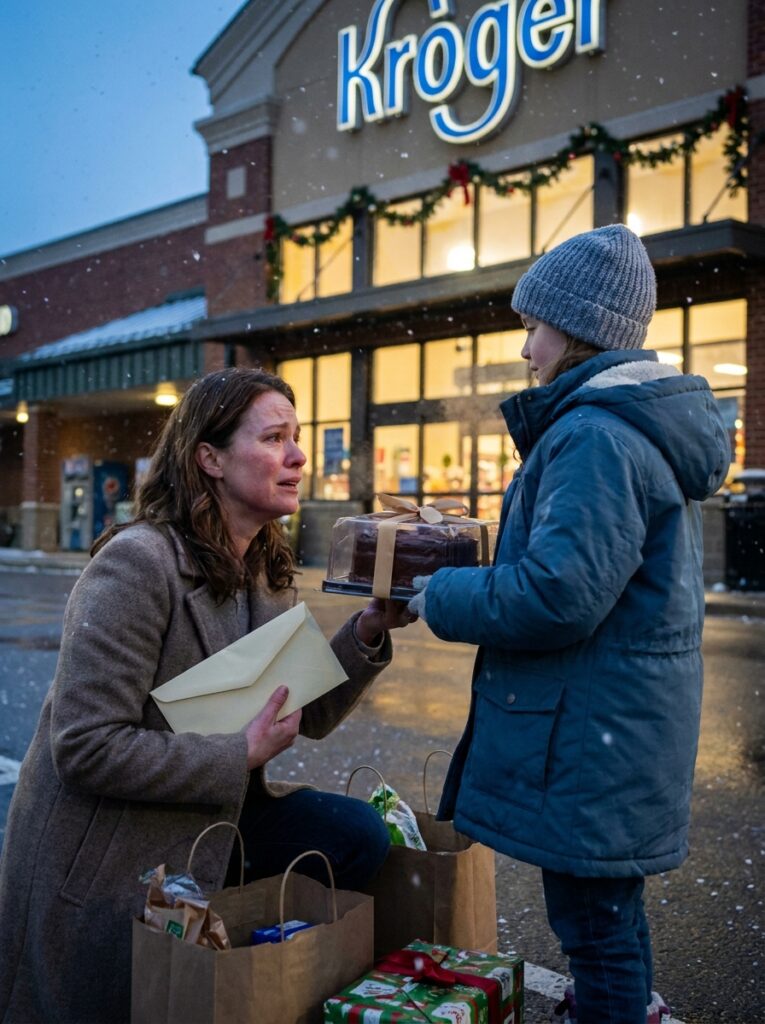
That was when I saw a little girl staring at it.
She was maybe nine, with brown hair pulled into a loose ponytail and a sweater whose sleeves covered part of her hands.
She looked at the cake, then at me.
“Is that whole cake really for us?”
Something inside me cracked.
“Yes,” I said. “The whole thing.”
Her face lit up.
And for the first time that Christmas, something I had brought somewhere seemed wanted.
I didn’t know yet that her name was Sophie.
I didn’t know her mother, Rachel, was standing only a few feet away.
And I definitely didn’t know that within three hours, my mother would call screaming about a house she had already started calling hers.
### Part 2
Rachel Morales didn’t tell me her story all at once.
That was one reason I believed her.
She never approached me asking for money, housing, or rescue.
We simply ended up standing near the same folding table while volunteers prepared Christmas dinner.
Rachel looked exhausted but put together, wearing a plain blouse beneath an inexpensive winter coat. One hand held a bag of donated clothes.
She thanked me for the cake.
Not extravagantly.
Just sincerely.
Sophie hovered nearby, pretending not to watch the volunteers open the box.
Eventually, conversation became easy enough that Rachel explained why they were there.
She had worked in payroll for years. That fall, her employer abruptly closed.
She had savings.
She had expected to find another job quickly.
Then her apartment building was sold.
Suddenly she needed a security deposit, first month’s rent, moving costs, and proof of current income at exactly the moment she had lost her paycheck.
One problem had collided with another until there was no cushion left.
Now she and Sophie were staying in temporary family housing while Rachel interviewed for new jobs.
“Mom says we just need one good break,” Sophie announced while trying to press a loose paper snowflake back onto the wall.
Rachel gave her a look.
Sophie shrugged.
“What? You do.”
One good break.
I thought about the bungalow.
I thought about Mom measuring windows.
Dad claiming his reading corner.
I thought about my father saying Christmas had been easier without me.
And suddenly I was almost embarrassed by how much effort I had spent proving my love to people who believed the proof belonged to them regardless of how they treated me.
Still, I didn’t offer Rachel my house.
That would have been impulsive, inappropriate, and more about my emotions than her needs.
Instead, I told her I knew my company had worked with housing organizations before.
“If you want,” I said, “I can find out whether there are programs that help families move from shelters into longer-term transitional housing.”
Rachel’s first response was not excitement.
It was questions.
“Would that interfere with what the shelter is already helping me with?”
“I don’t know.”
“Would I apply through someone?”
“Probably, but I don’t know that either.”
“Is there some kind of income requirement?”
“I’ll find out.”
She nodded.
That exchange mattered.
She didn’t want promises.
She wanted information.
When I finally walked back outside, the passenger seat of my car was empty.
The cake was inside.
Someone wanted it.
I sat behind the wheel while frost feathered the edges of the windshield.
Then I opened my email.
The attorney handling the bungalow transfer wouldn’t be working on Christmas Day, obviously. Nothing could be formally processed until the office reopened.
But I could make my wishes clear.
I wrote:
Please consider this notice that I am withdrawing authorization to proceed with the planned gift transfer of the property. Do not prepare, deliver, record, or process any deed transferring ownership when the office reopens.
I sent it.
Then I left a voicemail saying the same thing.
My heart pounded afterward.
Not because I doubted that the house belonged to me.
Because I knew what came next.
I called Mom.
“I’ve decided not to transfer the bungalow to you and Dad.”
Silence.
I continued before she could interrupt.
“The transfer hasn’t happened, and I’ve told my attorney not to proceed. I’m considering making the property available through an established transitional housing organization instead.”
“Claire—”
“Nothing has been finalized. I’m telling you so you don’t make more plans around owning it.”
Then I ended the call.
I went home.
I put away groceries for a dinner I no longer needed to attend.
I placed the wrapped gifts in my hall closet.
I made coffee.
Forgot about it.
Made another cup.
Forgot that one too.
My phone kept lighting up.
Mom.
Dad.
Emily.
Mom again.
I could imagine exactly what was happening.
They thought I was angry.
Then I would calm down.
Then I would apologize for overreacting.
Then I would still give them the house.
Because that was what I always did.
I came back.
About three hours later, Mom called again.
I answered.
She was shouting before I could say hello.
“You can’t give our house to strangers!”
I slowly looked toward the symbolic transfer envelope lying beside my purse.
“Our house?”
Mom stopped.
“I mean—the house you promised us.”
“No,” I said. “You said exactly what you meant.”
Then something even more important slipped out.
While defending the decision to exclude me, Mom said, “We decided last weekend. We thought you’d get over it.”
My stomach dropped.
“Last weekend?”
She went quiet.
This hadn’t been an accidental Christmas Eve gathering.
They had planned it days in advance.
And my mother had known the entire time.
### Part 3
The attorney’s email arrived Monday morning.
The transfer had never been completed.
The bungalow remained entirely mine.
Legally, the situation required one paragraph.
Emotionally, I was still staring into a hole that seemed to deepen every time someone explained themselves.
Dad left a message accusing me of using money to punish the family.
Mom texted that nobody intended to “exclude me permanently.”
Emily wrote that she thought I already knew Christmas had been moved.
That one made me pause.
If Emily genuinely believed I had other plans, then someone had told her that.
I didn’t answer anyone.
Instead, I went to work and buried myself in year-end reports.
The office was nearly empty. Fluorescent lights hummed over silent desks while I worked through spreadsheets until numbers felt safer than people.
That afternoon, Aunt Susan called.
“I need to tell you something,” she said.
Susan sounded embarrassed.
Mom had told the entire family that I had made other Christmas plans.
Not that Christmas had been moved without me.
Not that Dad wanted an easier night.
Not that everyone had decided I was too exhausting to invite.
According to Mom, I was simply “doing my own thing this year.”
Susan had even asked why I wasn’t helping with dinner, since I usually coordinated half of it.
Mom brushed her off.
“She told us not to worry about it,” Susan said. “I thought you knew.”
I thanked her.
Then I asked, “When did you know dinner was happening Christmas Eve?”
“The weekend before.”
There it was again.
A plan.
Not an accident.
After the call, I sat on my sofa looking toward the closet containing Susan’s unopened Christmas gift.
For years, I had treated our family like a machine I was responsible for keeping quiet.
If somebody argued, I moved chairs.
If someone forgot dessert, I bought two.
If Dad offended someone, I changed the subject.
If Mom became overwhelmed, I finished whatever she hadn’t.
I had believed those things proved I belonged.
Now I began remembering when the complaints about me had actually started.
Mom’s birthday the previous year.
I agreed to make the restaurant reservation but refused to also collect money, order flowers, coordinate rides, choose everyone’s meals, and remind grown adults what time dinner started.
Dad said I was making a celebration “complicated.”
A family cookout.
A relative made a cutting remark disguised as a joke.
Instead of laughing, I asked for an apology.
Again, I had apparently created “tension.”
Then came Dad’s joke about Emily two weeks before Christmas.
I had finally understood the pattern.
Tension wasn’t what happened when somebody hurt someone.
Tension was what my family called the moment I stopped absorbing the hurt quickly enough.
Emily came over Tuesday evening.
She looked nervous.
She kept smoothing the sleeve of her coat after sitting down.
Mom had told her exactly what she told Susan—that I had other plans.
“I thought maybe you were with friends,” Emily said.
“And you never texted?”
Her eyes dropped.
“What?”
“If you thought I was somewhere else celebrating Christmas, why didn’t you text me Merry Christmas?”
She had no answer.
That silence hurt differently.
Not everyone had been deliberately cruel.
Some had simply found my disappearance too convenient to question.
“Did you notice I wasn’t there?” I asked.
“Of course.”
“Then why didn’t you ask?”
Emily stared into her coffee.
Finally, she whispered, “I don’t know.”
I believed her.
That was almost worse.
Eventually she returned to the bungalow.
She still thought taking it away was too extreme.
“Christmas is emotional,” she said. “The house is different. Mom and Dad built plans around it.”
I looked at her.
“You’re saying they could exclude me from the family emotionally and still expect me to protect them financially?”
“I didn’t mean it that way.”
“I know.”
She rubbed her forehead.
Then her expression changed.
“Wait.”
“What?”
“Dad said something about the bungalow during dinner.”
I felt my back straighten.
“What did he say?”
“I don’t remember exactly.”
“Then don’t guess.”
She closed her eyes for a moment.
“I remember people raising glasses.”
“To what?”
She shook her head.
“I need to think.”
After she left, I stood by the window and watched her taillights disappear beneath the bare trees.
Until then, I believed the worst thing my family had done was enjoy Christmas without me.
Now I wondered what exactly they had celebrated while I wasn’t there.
### Part 4
The next morning, I drove to the bungalow.
I hadn’t been there since before Christmas.
Frost edged the lawn and thin winter sunlight reflected from the bay window Mom had loved immediately.
Inside, the rooms were empty.
But I could still see my parents everywhere.
Mom stretching a tape measure across the living-room windows.
Dad joking about where his reading chair would go.
Mom standing in the kitchen, imagining a coffee station.
Their excitement had once made me happy.
Now I noticed something I had missed before.
Their language had changed.
During the first visit, Mom called it “the house Claire is giving us.”
Later, it became “our retirement place.”
Then simply “our house.”
Possession had replaced gratitude so gradually that I had mistaken it for excitement.
My phone rang.
Dad.
I answered.
“We need to talk face to face,” he said.
“I’m at the bungalow.”
He arrived twenty minutes later.
The first thing he did was look around.
Not at me.
At the room.
At his imagined reading corner.
At the kitchen.
Like a man checking whether someone had disturbed his property.
Then he started.
“You’re using money to control this family.”
“No.”
“You don’t give people something and take it back because you’re angry.”
“I didn’t give it to you.”
“You promised it.”
“I intended to give it to you.”
He paced across the living room.
“What’s the difference?”
I watched him.
“The difference is you’re standing in a house I own telling me you’re entitled to it.”
His face hardened.
“This is exactly what I’m talking about. Everything becomes an argument with you.”
I almost laughed.
Dad insisted Christmas and the bungalow were separate issues.
That sentence clarified everything.
In his mind, I could be removed from Christmas while my $285,000 gift remained comfortably seated at the table.
He began talking about everything parents did for their children.
Sacrifice.
School.
Family vacations.
Years of support.
Then he said, “A daughter in your position should want to do something like this for her parents.”
I looked toward the window.
“I did want to.”
Dad stopped.
“That is the entire point. I wanted to give you this house. Somewhere along the way, you turned my desire to give into your right to receive.”
He called that word games.
Boundaries.
Wording.
Respect.
All the subjects he claimed had made family gatherings exhausting.
“I wanted one Christmas where people didn’t have to think about every sentence before they said it.”
There it was.
The real complaint.
He didn’t want one Christmas without conflict.
He wanted one Christmas without consequences.
I let a long silence settle.
Then I asked, “Did you talk about this house during Christmas dinner?”
Dad’s gaze moved toward the kitchen.
He started talking about retirement.
Furniture.
Their current mortgage.
Future plans.
He never answered.
So I ended the conversation.
That afternoon, Emily called.
“I remember.”
I sat down.
“What?”
“Dad’s toast.”
My stomach tightened.
She spoke slowly.
“Dinner was already underway. He raised his glass and said something about next year.”
“What exactly?”
Emily swallowed.
“He said, ‘Next Christmas, we’ll all be at our new place.’”
I closed my eyes.
“People toasted?”
“Yes.”
“Everyone?”
“A lot of people.”
I didn’t ask who.
It no longer mattered.
I sat down on the floor beneath the bungalow’s bay window after the call.
The heating system clicked on.
Somewhere outside, tires cracked over ice.
My family had deliberately held Christmas without me.
Mom had told relatives I chose not to attend.
Dad had stood at the table and toasted a future inside the house I was giving them.
People had raised their glasses.
That was the moment something inside me became completely still.
They hadn’t merely decided they could enjoy Christmas without me.
They had decided they could celebrate what I gave them without needing the person who gave it.
And suddenly I no longer wondered whether I would transfer the bungalow.
I knew I wouldn’t.
The only question left was what I wanted the house to mean now.
### Part 5
I didn’t donate the bungalow the next morning.
I didn’t hand Rachel a key.
I didn’t make some dramatic Christmas promise and convince myself anger was the same thing as clarity.
Instead, I waited.
I researched.
I returned to the shelter and asked staff about established transitional housing programs.
One organization stood out.
It placed families in single-family homes for approximately nine to twelve months while case managers helped them maintain employment, build savings, improve rental history, and prepare for permanent housing.
Property owners kept title.
The nonprofit screened families.
The nonprofit handled placements.
That structure mattered to me.
I didn’t want Rachel chosen because I happened to meet Sophie on the worst Christmas of my life.
I wanted the house to help someone because that person qualified through a real program.
When the organization asked whether I wanted access to applicant files, I said no.
When they asked whether I wanted to nominate a family, I said no again.
I could open a door.
I didn’t need to control who walked through it.
Meanwhile, my own family began discovering what life looked like without my invisible labor.
Dad called about a warranty problem with an appliance.
Normally, I would have asked for the model number, found the receipt, called customer service, sat through the hold music, and solved it before dinner.
Instead, I gave him the manufacturer’s phone number.
“You’ve always handled this stuff,” he said.
“I know.”
“So you’re still punishing us?”
That sentence fascinated me.
When I helped, it was generosity.
When I stopped, the absence became punishment.
A few days later, Mom held the family lunch she originally wanted me to arrange.
I told her to pick the restaurant herself.
She gave Susan one start time and Emily another.
Dad thought Mom had made the reservation.
Mom thought Dad had.
Nobody remembered Emily’s food preference.
And yet something remarkable happened.
They survived.
People adjusted.
Susan laughed when she arrived late.
Emily ordered something else.
Dad stopped staring at his watch.
The family did not collapse simply because I refused to carry it.
By early spring, the nonprofit’s agreement for the bungalow was ready.
My attorney reviewed everything.
Insurance changed.
Inspections were completed.
Minor repairs were made.
Then I signed.
The title remained mine.
The purpose changed.
One afternoon, I met program staff at the property while they prepared it for placement.
A secondhand bookshelf stood where Dad’s reading chair was supposed to go.
A small dining table sat near the bay window.
For a moment, grief hit me so hard I had to step onto the porch.
I still loved my parents.
That hadn’t disappeared.
I still wished Christmas had happened differently.
But grieving one future did not mean I had to keep living toward it.
My life changed in quieter ways, too.
I stopped treating free time as an emergency waiting to be filled.
I saw friends I’d postponed for years.
I took a weekend pottery class because I wanted to.
I volunteered occasionally, but deliberately avoided becoming the person everyone depended on.
That part was harder than I expected.
Being useful had been my safest way of knowing I belonged.
Now I was learning how strange it felt to simply exist around people without solving anything.
Mom’s birthday tested me.
Normally, I handled everything.
This year, I bought her a thoughtful gift, called in the morning, and told her I loved her.
Dad arranged dinner.
Nobody ordered the lemon cake Mom liked.
They bought chocolate from a grocery store at the last minute.
Several days later, Mom called.
“My birthday felt different.”
“I imagine it did.”
“You’ve been withholding affection.”
I stopped drying the mug in my hands.
“Mom, I remembered your birthday. I called. I bought you a gift. I told you I loved you.”
“You know what I mean.”
Yes.
I did.
She missed the labor.
The reminders.
Reservations.
Flowers.
Coordination.
Years of invisible work had become so normal that when I stopped performing it, my family mistook the absence of service for the absence of love.
I didn’t argue.
I simply said, “I love you, Mom. But I’m not going back to doing everything.”
For once, I let her disappointment belong to her.
Then, several weeks later, Rachel called me.
She could barely get the words out.
The housing program had finished its screening.
She and Sophie had been selected for the bungalow.
### Part 6
I stood beside my car outside work while Rachel told me.
Spring wind moved through the new leaves along the parking lot.
“I want you to know something,” she said.
“What?”
“I’m not asking you to carry us.”
The sentence hit somewhere deep.
“I know.”
And I did.
The bungalow was a bridge in Rachel’s life.
Not a claim on mine.
She had found a steady payroll job. She was rebuilding savings. Sophie remained in the same school.
The housing program had evaluated them independently.
I hadn’t seen the application.
I hadn’t spoken to the committee.
I hadn’t influenced the decision.
That made the result feel cleaner somehow.
Not less emotional.
Just honest.
That evening, Mom called.
Her voice was unusually quiet.
“Can we meet?”
“About what?”
“Us.”
She asked to meet alone at a coffee shop halfway between our homes.
I agreed.
When I arrived, she was already seated with an untouched cup in front of her.
For months, I had seen my parents mostly at family events or through tense phone calls. Mom looked smaller somehow.
Not physically.
Just less certain.
She began with four words.
“I miss my daughter.”
My throat tightened.
That was what I had wanted her to say for months.
Not “I miss your help.”
Not “I miss the bungalow.”
Not “I miss how Christmas used to work.”
My daughter.
For one dangerous moment, I wanted those words to erase everything.
Then she continued.
She said the situation had “gone too far.”
The distance.
The family tension.
The house.
She and Dad had made genuine retirement plans around the bungalow.
I listened.
Then I said, “Mom, whose idea was Christmas Eve?”
She stared through the front window.
Cars hissed across rain-dark pavement outside.
Finally, she answered.
“Your father suggested it.”
I waited.
“But I agreed.”
There it was.
Dad believed I had become too difficult.
He said everyone was “walking on eggshells” around me.
The dinner two weeks earlier had bothered him more than I’d realized.
Mom had wanted Christmas to be easy.
“So you told everyone I had other plans?”
She lowered her eyes.
“Yes.”
“Dad made you?”
“No.”
“Why did you do it?”
Her fingers moved around her wedding ring.
“Because saying you had other plans was easier than telling everybody we hadn’t invited you.”
I felt something settle inside me.
Not forgiveness.
Not anger.
Truth.
My mother had not been dragged into Dad’s choice.
She participated.
Then she lied because the lie made everyone more comfortable.
“I thought you’d be hurt,” she whispered. “But I thought we’d talk afterward and you’d understand.”
“Understand what?”
“That we needed one peaceful evening.”
“Peace that requires one person to disappear isn’t peace.”
Mom didn’t argue.
For the first time, she simply sat with it.
I told her I still wanted a relationship with her.
But I would not return to the version where I made everyone comfortable no matter what it cost me.
“I don’t want you to miss what I do for you,” I said. “I want you to notice when I’m not in the room.”
Her eyes filled.
Then she asked about the bungalow.
I told her.
Rachel and Sophie had been selected.
The house was operating through the nonprofit.
The decision wasn’t temporary.
Mom pressed her lips together.
For months, some part of her had apparently believed I would calm down and reverse everything.
Now she understood.
The house was gone from her future.
For the first time, I felt sympathy for her without feeling compelled to solve it.
She was allowed to grieve.
I was allowed not to fix that grief.
When we left, Mom hugged me.
Her perfume was the same floral scent she’d worn since I was a teenager.
For a second, I nearly cried.
But the hug didn’t magically rebuild our relationship.
It simply meant we had started telling the truth.
Dad was different.
He had never asked what he had done to me.
He only talked about consequences.
The family wasn’t the same.
Mom was unhappy.
Plans were harder.
The bungalow was gone.
Months later, at a family anniversary dinner, Dad finally asked me to stay behind after everyone began putting on coats.
Emily looked at me.
She didn’t say, “He’s your father.”
She didn’t ask me to forgive him.
She simply nodded.
My choice.
So I stayed.
Dad looked toward the window.
“The family needs to move on.”
I almost smiled.
“From what?”
He sighed.
“Christmas. The house. All of it.”
Then he said something extraordinary.
“I’ve decided I’m willing to let the bungalow issue go.”
I stared at him.
My father was offering to forgive me for not giving him my house.
That was when I realized I had one final question left.
“What exactly are you apologizing for, Dad?”
### Part 7
Dad’s expression tightened.
“I already told you. Christmas wasn’t handled perfectly.”
“That’s not an apology.”
“I said I should’ve talked to you directly.”
“That isn’t what I asked.”
Restaurant employees were clearing tables around us.
Glasses clinked behind the bar.
Dad looked tired.
For months, everyone had been trying to turn what happened into a communication mistake.
Wrong date.
Bad wording.
Misunderstanding.
But none of those things explained why Christmas had happened without me.
So I asked again.
“What do you believe you actually did to me?”
Dad stared through the window.
Then something finally changed.
He stopped talking about the bungalow.
He stopped talking about my reaction.
He stopped talking about how uncomfortable everyone had been since Christmas.
“I didn’t want you there,” he said.
The sentence was quiet.
I felt it anyway.
“Why?”
“Because I was tired.”
“Of me?”
“Of feeling challenged.”
There it was.
The simplest version.
Dad said family gatherings used to be easy.
He could joke without wondering whether I would object.
People could say things without discussions about respect.
Nobody had to think too hard.
Then I changed.
I began asking questions.
I stopped laughing when something wasn’t funny.
I stopped fixing every uncomfortable moment.
Dad said he wanted one evening where nobody had to monitor every sentence.
“You knew I’d be hurt.”
“Yes.”
“And you did it anyway.”
“Yes.”
I waited.
“Why were you so sure I’d get over it?”
His answer came instantly.
“Because you always come back.”
No anger.
No cruelty.
Just certainty.
That was what made it devastating.
Because he was right.
I had always come back.
After birthdays where I was insulted.
After phone calls where Dad hung up on me.
After arguments where nobody apologized.
After Mom asked me to “be the bigger person.”
I returned.
I made reservations.
I brought desserts.
I solved problems.
I convinced myself that forgiving people without requiring anything to change made me kind.
Dad had learned a different lesson.
He learned that hurting me had no lasting cost.
Because Claire always came back.
I sat there for several seconds before answering.
“I used to think coming back proved I loved you.”
Dad’s expression softened slightly.
“I do love you.”
“I know.”
“Then why are you doing this?”
“Because loving you doesn’t mean returning to the same role.”
He shook his head.
“What role?”
“The one where my presence is optional when I’m inconvenient, but my time, money, and labor are mandatory when they’re useful.”
“That isn’t fair.”
“It doesn’t need to feel fair to you.”
He stared at me.
Months earlier, that look would have sent me into explanation mode.
Not anymore.
Dad said family was supposed to forgive.
“I agree.”
“Then forgive us.”
“I can forgive without restoring automatic access.”
He looked genuinely confused.
That told me how much had changed.
For my father, forgiveness had always meant reset.
Everything went back.
Everyone resumed their positions.
Nothing truly changed.
I no longer believed that.
I could stop hating someone.
I could stop wishing they understood.
I could even love them.
And still never return to the relationship they had before.
Dad asked the question he probably thought would frighten me most.
“Do you even consider yourself part of this family anymore?”
A year earlier, I would have panicked.
Now I simply said, “I’m your daughter. That never changed.”
He waited.
“But if being family means you get permanent access to my money, labor, time, and forgiveness regardless of how you treat me, I’m finished with that version.”
Dad didn’t answer.
I put on my coat.
I didn’t hug him.
I didn’t make some final dramatic announcement.
I just left.
Emily was waiting near the entrance.
She held the door open.
Cold air hit my face.
She didn’t ask what Dad said.
Outside, I could see my breath beneath the parking lot lights.
For most of my life, I believed walking away from family meant abandoning them.
That night, for the first time, I understood something else.
Sometimes staying requires you to abandon yourself.
And I wasn’t doing that anymore.
By the following Christmas, my relationship with Mom had become quieter but healthier.
She asked instead of assuming.
Emily and I were closer than we’d been in years.
Dad and I remained distant.
I didn’t hate him.
I simply stopped chasing his approval.
And the bungalow?
It no longer felt like something stolen from my parents.
It felt like what it had finally become.
A home with a purpose.
### Part 8
By December, Rachel had been living in the bungalow with Sophie for several months.
She still had the job she found in spring.
Her savings were growing.
She and her caseworker had begun planning the next step toward permanent housing.
Sophie had stayed at the same school long enough to make close friends.
She was also still deeply offended by mathematics.
One afternoon, I stopped by during a volunteer event and found her glaring at a worksheet.
“This is unnecessary,” she announced.
“Math?”
“All of it.”
Rachel looked at me.
“Please don’t encourage her.”
I laughed.
That was the thing I loved most.
They were no longer “the family from the shelter” in my mind.
Rachel complained about office politics.
Sophie complained about homework.
We talked about grocery prices and weather and the neighbor who somehow started mowing his lawn at the exact moment everyone wanted peace.
Ordinary things.
The nonprofit organized a small year-end volunteer afternoon at the house.
Someone hung a wreath.
Sophie helped with outdoor lights while repeatedly being told not to tie them into knots.
A photograph eventually appeared on the organization’s social page.
No dramatic captions.
No personal history.
Just volunteers, Rachel, Sophie, and me laughing in the yard.
Mom saw it.
She called me on Christmas Eve.
“Merry Christmas.”
“Merry Christmas, Mom.”
She asked about my plans.
Then she hesitated.
“I saw the picture.”
I waited.
“The bungalow looks full of life.”
She didn’t call it her house.
She didn’t ask whether I regretted anything.
She didn’t suggest that someday the decision might be reversed.
That small difference meant more than an apology repeated ten times.
Before we hung up, Mom said, “I hope you’re somewhere you feel wanted.”
A year earlier, she would have asked whether I was coming home.
Now she was asking something better.
“I am,” I said.
And I meant it.
I wasn’t spending Christmas at my parents’ house.
It wasn’t a boycott.
It wasn’t punishment.
Emily was splitting her time between different people.
Mom and I already had plans to see each other later.
Dad knew I would not be there and, for once, no one treated my decision as a problem waiting to be corrected.
That evening, I carried a chocolate cake toward the bungalow.
The box felt familiar in my hands.
For one second, walking up the brick path, I was back in that grocery store aisle.
Cake in one hand.
Pie in the other.
Fluorescent lights.
Mom’s silence.
Dad saying, “Everything was easier without you there.”
I remembered the pressure of the cardboard cutting into my thumb.
I remembered sitting in my car with nowhere to go.
Then the front door opened.
Warm air rolled toward me, carrying the smell of dinner and cinnamon.
Someone had music playing quietly.
Coats were piled near the entrance.
Sophie appeared almost immediately.
She saw the cake.
Her eyes widened.
“Oh, yes.”
Rachel called from the kitchen, “Sophie.”
“What?”
“You aren’t claiming the cake.”
“I’m not claiming the cake. I’m claiming a corner piece.”
“You’re claiming whatever piece lands on your plate.”
Sophie looked at me as if she needed backup.
I lifted both hands.
“I am staying out of this.”
She sighed dramatically.
I carried the cake into the dining room.
Then I stopped.
There was a chair waiting for me.
Nothing special.
No decoration.
No note.
No grand gesture.
Just a chair between two other places.
A napkin.
A plate.
A glass.
Someone had counted me before I arrived.
I stood there longer than I needed to.
A year earlier, I had been desperately trying to carry enough toward people who had already decided I made their Christmas harder.
Now nobody needed me to rescue dinner.
Someone else had bought ice.
Someone else had cooked.
Someone else had checked the plates.
I had been assigned dessert because everyone knew I liked the bakery.
That was it.
My presence wasn’t payment for my usefulness.
Nobody had earned my chair with guilt.
I hadn’t purchased my place with a $285,000 house.
I simply belonged there because someone wanted me there.
Emily arrived later carrying sparkling cider.
She hugged me.
Didn’t ask what needed organizing.
Didn’t hand me a problem.
Rachel eventually cut the cake.
Sophie somehow got the corner piece anyway.
We ate.
We laughed.
Someone burned a tray of rolls.
Nobody died.
The music was slightly too loud after dinner.
Someone forgot coffee until dessert was almost finished.
The evening was imperfect.
And nobody needed saving.
I thought about Dad sometimes.
I still loved him.
Maybe one day he would understand what he lost.
Maybe he wouldn’t.
That was no longer a problem I had appointed myself to solve.
I had forgiven enough of my anger to continue living without carrying it every day.
But I never gave my parents the house.
I never returned to being the daughter who fixed everything because she was afraid her chair would disappear if she stopped being useful.
And I never forgot what Dad had said.
“Because you always come back.”
He had been right about the woman I used to be.
But that woman had confused being needed with being loved.
The Christmas my family excluded me taught me the difference.
A year earlier, I carried a chocolate cake toward a table that had already decided it was easier without me.
This Christmas, I walked into a room where my place had been set before I arrived.
Nobody needed me there.
They wanted me.
And for the first time in my life, I understood that being wanted was enough.
THE END!