My Father Slapped Me Over a First-Class Seat at Atlanta Airport. Then an $18,400 Charge Exposed the Secret My Family Had Been Hiding for Years.
The first thing my mother did after my father slapped me was check whether I was still holding our boarding passes.
Not whether I was hurt.
Not whether I needed medical attention.
Not even whether the strangers watching us might call the police.
She looked at the documents in my hand and said, “Valerie, don’t make this any worse. Just give your sister the seat.”
That was when I realized something that should have been obvious years earlier.
**My family wasn’t afraid of losing me. They were afraid of losing what I paid for.**
And they had no idea how much they were about to lose.
My name is Valerie Castillo. I’m thirty-two years old, and for most of my adult life, I believed that if I worked hard enough, gave generously enough, and never complained, my family would eventually treat me like someone worth loving.
I was wrong.
Three days before everything happened, I was sitting in a hotel room in Dallas, staring at two computer screens and trying to finish one of the largest corporate projects of my career.
It was nearly two in the morning.
My dinner was an untouched sandwich.
My phone had been ringing constantly, and I’d averaged barely four hours of sleep for three nights.
I was exhausted.
But I kept reminding myself that after the project ended, I would finally get a vacation.
Paris.
Six beautiful days with my family.
Or so I thought.
The trip was supposed to celebrate my younger sister Danielle’s graduation.
At twenty-seven, Danielle had just completed her master’s degree.
My parents were ecstatic.
My mother had posted so many graduation photographs that I joked she might need a second Facebook account.
My father told everyone about Danielle’s accomplishment.
They arranged a dinner, bought decorations, and treated the occasion like the greatest achievement in our family history.
I was proud of Danielle, too.
But something about the celebration quietly hurt.
Because **I’d paid nearly half her tuition over the previous two years**, and nobody had acknowledged it.
Not once.
I hadn’t asked for public recognition.
A simple thank-you would have meant the world.
Instead, whenever Danielle talked about how hard she’d worked, my parents nodded proudly while I sat beside them pretending not to notice what was missing.
That was normal in our family.
Danielle was the one who needed things.
I was the one expected to provide them.
When she wanted an expensive graduation dress, my mother called me.
When she struggled with a tuition payment, my father called me.
When she needed extra spending money, I received a text about how stressful graduate school had become.
And whenever I hesitated, my mother used the same argument.
“Valerie, you’re the oldest. You’re established. Your sister is still finding herself.”
Apparently, Danielle had been finding herself at my expense for years.
I had a successful corporate career, a comfortable apartment outside Atlanta, and enough financial stability to live without worrying about every paycheck.
But that stability hadn’t happened accidentally.
I’d worked through holidays.
I’d missed birthdays.
I’d accepted assignments nobody wanted.
I’d spent years building the career my parents now treated like a family-owned bank account.
And somehow, **the better my life became, the more entitled they felt to it.**
When my father fell behind on a debt, I helped.
When the family house needed repairs, I contributed.
When my mother wanted to finance a boutique business for Danielle, I put the startup investment on my credit card.
I remember that conversation vividly.
We were sitting at my parents’ kitchen table.
My mother had spread photographs of a small retail space across the surface.
Danielle was excitedly describing clothing racks, displays, and a sophisticated brand that would carry her into the fashion world.
“It’s going to be beautiful,” she said.
My father nodded.
“Your sister has real entrepreneurial talent.”
My mother reached across the table and squeezed my hand.
“All she needs is someone who believes in her.”
I should have recognized what was coming.
Instead, I asked how much they needed.
The boutique opened with balloons, sparkling cider, and a ribbon-cutting ceremony.
A month later, my mother told me it had collapsed.
“Terrible timing,” she explained. “The overhead was just too high.”
Danielle cried.
I comforted her.
Nobody offered to repay my investment.
A few weeks later, Danielle was shopping for another designer handbag.
I noticed, but I said nothing.
That was my specialty.
Noticing things.
And saying nothing.
A month before our Paris vacation, my mother called while I was driving home from work.
“Valerie, sweetheart, I hate to ask you another favor.”
My stomach tightened.
“What happened?”
“Your father’s waiting for a major client to pay an invoice. It’s taking longer than expected.”
“Okay.”
“We don’t want to disappoint Danielle after she’s worked so hard.”
I already knew where the conversation was heading.
“Mom, how much are we talking about?”
She hesitated.
“Could you put the flights and hotel on your credit card? Your father will reimburse you before we leave.”
“All four flights?”
“Just until the payment arrives.”
I looked through my windshield at the evening traffic.
I’d worked hard for my savings.
I’d also promised myself I would stop financing family emergencies.
But my mother’s voice softened.
“Please, Valerie. This trip means so much to your sister. And I think it could be good for all of us.”
That last sentence caught me.
Good for all of us.
I imagined walking beside the Seine with my parents.
I imagined laughing with Danielle over dinner.
For once, maybe we could be a normal family.
“All right,” I said.
My mother sounded relieved.
“Oh, sweetheart. You’re an angel.”
I booked four round-trip tickets to Paris.
I reserved a charming boutique hotel near the Seine.
I paid for baggage fees, insurance, and airport transportation.
Every confirmation arrived in my email.
And every charge appeared on my credit card.
My mother didn’t mention reimbursement again.
I wasn’t surprised.
But there was one small thing I decided to do for myself.
Because I’d spent years traveling for work, I’d accumulated substantial frequent flyer miles and elite airline status.
I requested an upgrade to Delta One.
Just for me.
After the Dallas project, I desperately wanted a seat where I could stretch out and sleep.
I didn’t tell anyone about the request.
It wasn’t a secret.
It simply never occurred to me that something I’d earned for myself would become a family emergency.
The morning of our departure, I arrived at the Atlanta airport wearing a navy blazer that looked nearly as exhausted as I felt.
My dark hair was pulled into a loose ponytail.
I’d flown back from Dallas before dawn, barely refreshed myself, and hurried to meet my family.
My father wore a charcoal travel jacket.
His graying hair was neatly combed, and his expression suggested that everything around him was a personal inconvenience.
My mother wore a cream cardigan and carried an expensive handbag I’d bought her for Christmas.
Danielle had on a lavender sweater, her long dark hair falling over her shoulders.
She was dragging an unusually large suitcase.
“That’s a lot of luggage for six days,” I said.
She tightened her grip on the handle.
“I have outfits planned.”
My mother quickly changed the subject.
“Valerie, did you bring your passport?”
“Of course.”
“And you still have the booking confirmations?”
“Everything’s on my phone.”
She looked relieved.
At the time, I thought she was simply anxious about traveling internationally.
Looking back, **she seemed far more concerned about my documents than her own.**
We joined the check-in line.
My mother talked about Parisian cafés.
Danielle scrolled through photographs of restaurants.
My father complained about the wait.
I stood quietly, holding a cup of coffee and imagining a few hours of uninterrupted sleep.
Finally, the airline agent called us forward.
He checked our documents, scanned my passport, and smiled.
“Good morning, Ms. Castillo. I’ve got some good news.”
I looked up.
“Really?”
“Your upgrade has cleared. You’ll be flying Delta One today.”
I felt my shoulders relax.
“That’s wonderful. Thank you.”
For the first time in days, I smiled.
Then Danielle turned around.
“Wait. What?”
The agent repeated the information.
Danielle stared at me.
“You’re flying first class?”
“It’s Delta One,” I explained. “My upgrade cleared.”
Her eyes narrowed.
“Seriously?”
I knew that expression.
“Dani, please.”
“This is MY graduation vacation!”
“I know.”
“Then why are YOU sitting up front?”
“Because I used my miles.”
She laughed.
Not because something was funny.
Because she apparently couldn’t believe I’d offered an explanation instead of immediately surrendering.
“Okay, whatever. Give me your boarding pass.”
I shook my head.
“No.”
Danielle blinked.
“What did you say?”
“I’m keeping my seat.”
The change in her expression was immediate.
“You’re kidding.”
“I’m not.”
She looked toward our mother.
“Mom, are you hearing this?”
My mother stepped closer.
“Valerie, honey, don’t make this difficult.”
I stared at her.
“What’s difficult?”
“Your sister worked extremely hard for this degree. Giving her the nicer seat would be a beautiful graduation gesture.”
I felt something tighten inside my chest.
I’d helped pay for the degree.
I’d financed the celebration.
I’d paid for the vacation.
And somehow, none of that counted.
“Mom, I’m exhausted,” I said. “I’ve barely slept. I earned this upgrade, and I’m keeping it.”
Danielle crossed her arms.
“God, you’re so selfish.”
I looked at her.
“Excuse me?”
“You always make everything about money.”
I almost laughed.
“That’s interesting, considering nobody minds my money when they’re spending it.”
My father’s head snapped toward me.
“Watch your mouth.”
I turned.
“Dad, I’m not trying to start an argument.”
“Then stop humiliating your sister.”
“I’m not humiliating anyone.”
“You’re making her feel inferior!”
Danielle stood behind him with a faint smile.
That smile told me everything.
She knew exactly what would happen next.
She’d seen it happen countless times.
Whenever I resisted, my parents pressured me until I surrendered.
Usually, I surrendered quickly.
But that morning, something was different.
Maybe it was exhaustion.
Maybe it was thirty-two years of accumulated disappointment.
Or maybe I’d simply run out of ways to explain why my own needs mattered.
I looked directly at Danielle.
“I’m keeping my seat.”
She sneered.
“You’ve always been jealous of me, Valerie. You can’t stand when I’m the center of attention.”
The words hurt.
Not because they were true.
Because she knew they would hurt.
My father stepped closer.
“You apologize to your sister.”
“For what?”
“Your attitude.”
“I’m not apologizing for keeping something I earned.”
His jaw tightened.
He pointed a finger inches from my face.
“Hand her that seat right now, or I’ll teach you some respect in front of everybody!”
My heartbeat quickened.
But I held my ground.
“I’m thirty-two years old, Dad. You don’t get to threaten me over an airplane seat.”
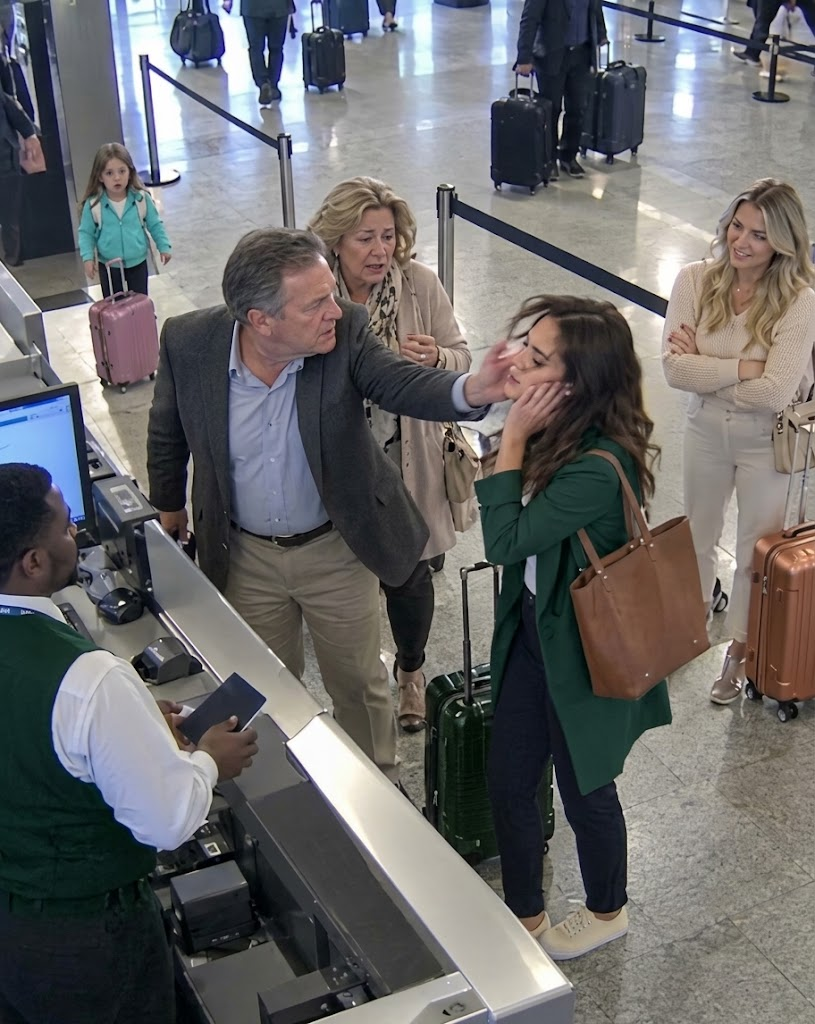
**Then he slapped me.**
The sound cracked through the crowded terminal.
My head jerked sideways.
My coffee fell, splattering across the polished floor.
For a moment, everything seemed strangely distant.
The conversations.
The rolling suitcases.
The airport announcements.
I heard someone gasp.
A little girl gripping a pink suitcase stared at us with wide eyes.
The airline employee stood frozen, my passport still in his hand.
I touched my cheek.
It was burning.
Then I looked at my father.
He wasn’t horrified by what he’d done.
He looked furious that I’d forced him to do it.
I turned toward my mother.
“Mom…”
She shook her head.
“Oh, Valerie. You always make everything so difficult.”
“He just hit me.”
“And you provoked him.”
I couldn’t believe what I was hearing.
Then she said something I’d never forget.
“Ever since you were a little girl, you’ve been nothing but a burden.”
**A burden.**
The word seemed to hang between us.
I thought about the bills I’d paid.
The nights I’d worked.
The times I’d rearranged my life to help them.
I remembered the investment in Danielle’s boutique.
The tuition payments.
The emergency phone calls.
And still, standing in front of hundreds of strangers, my mother called me a burden.
I turned to Danielle.
She glanced at my cheek and shrugged.
“You asked for it.”
Something inside me went completely quiet.
For years, I’d imagined there was a better version of my family hidden underneath their demands.
A version that would appreciate me if I just gave a little more.
But suddenly, I understood.
**There was no amount I could give that would make them respect a boundary.**
My mother held out her hand.
“Enough, Valerie. Give Danielle the boarding pass.”
I stared at her.
Then I reached into my purse.
Danielle immediately straightened, expecting me to surrender.
Instead, I took out my phone.
I opened our travel reservations.
Four airline tickets.
One hotel booking.
Thousands of dollars.
All charged to me.
I looked at the airline agent.
“Excuse me. Before anyone boards, there’s something I need to change.”
My father stepped forward.
“What the hell are you doing?”
Danielle’s smile vanished.
My mother grabbed my wrist.
“Valerie, don’t you dare.”
I gently pulled my wrist free.
Then I looked at the agent.
**”I’d like your supervisor. And I’d like airport police.”**
My father’s face turned crimson.
“You’re calling the police on your own father?”
“You hit me.”
“Because you disrespected me!”
I looked him straight in the eyes.
“No. Because I finally told you no.”
The airline employee quietly reached for his phone.
My mother lowered her voice.
“Valerie, think about what you’re doing to this family.”
For the first time, I had an answer.
“I’m thinking about what this family has been doing to me.”
Danielle made an angry noise.
“Oh my God. You’re being dramatic.”
I turned toward her.
“You’re twenty-seven years old, Danielle. You have a master’s degree. You can pay for your own seat upgrades.”
“That’s not the point!”
“Then what is?”
She opened her mouth.
Nothing came out.
I asked the agent whether my reservation could be separated from the others.
He explained that a supervisor could review the options, although purchasing the tickets didn’t automatically give me the right to cancel travel belonging to other passengers.
That was fine.
**I wasn’t trying to control their lives. I was trying to stop financing them.**
I opened the hotel reservation.
The cancellation deadline had nearly passed, but I could still stop most of the remaining charges.
I selected the cancellation option.
My mother noticed.
“Valerie, what are you doing?”
“Canceling the hotel.”
Her expression changed.
“You can’t!”
“Why not?”
“Because we need somewhere to stay!”
“Then book somewhere.”
Danielle grabbed her arm.
“Mom, tell her to stop!”
My mother’s eyes filled with panic.
And that was strange.
She wasn’t merely angry anymore.
She looked frightened.
Then my phone vibrated.
A fraud notification appeared on the screen.
SUSPICIOUS TRANSACTION.
**Amount: $18,400.**
**Merchant: RUE LENOIR RELOCATION SERVICES, PARIS.**
I stared at it.
I hadn’t authorized an $18,400 payment.
And I’d certainly never hired a relocation company.
“Mom?”
She went still.
“What?”
I turned the screen toward her.
“What’s this?”
Her face drained of color.
My father stopped shouting.
Danielle looked down.
I felt an icy sensation spread through my stomach.
“Mom, what is Rue Lenoir Relocation Services?”
She swallowed.
“Valerie, this isn’t the place.”
“What did you charge to my card?”
“It was supposed to be handled later.”
I stared at her.
“Later?”
She glanced at Danielle.
Then she whispered, almost to herself, “They weren’t supposed to run it until we landed.”
**Until we landed.**
Those words changed everything.
This wasn’t a misunderstanding.
It wasn’t an accidental booking.
My mother knew about the charge.
And she’d expected it to happen after we reached Paris.
I stepped back.
“What exactly is going on?”
Danielle began crying.
Not the loud, angry crying I’d heard whenever she didn’t get her way.
These were frightened tears.
“Mom,” she whispered, “you said she wouldn’t find out yet.”
I felt my heart pound.
“Find out what?”
Danielle covered her mouth.
My mother tried to silence her.
But it was too late.
“Valerie,” Danielle whispered, “you weren’t supposed to know about the apartment.”
For a moment, I couldn’t speak.
“Apartment?”
Nobody answered.
“What apartment?”
My father reached toward my phone.
“Give me that. We’ll discuss this privately.”
I pulled it away.
“No.”
His expression darkened again.
But before he could move closer, two airport police officers approached the counter.
The airline supervisor followed them.
One officer looked at my red cheek.
“Ma’am, are you all right?”
I almost said yes.
It was an automatic response.
The answer I’d given my family for years.
Instead, I took a breath.
“No,” I said. “My father hit me. And I believe someone has been attempting to use my credit card without authorization.”
The officer’s expression changed.
“Let’s talk somewhere quieter.”
My father immediately began explaining that this was a family disagreement.
My mother said I’d been under tremendous work stress.
Danielle claimed everybody was emotional because of the trip.
The officer listened.
Then he asked the airline employee what he’d witnessed.
The employee didn’t hesitate.
“I saw the gentleman strike her.”
A woman waiting nearby spoke up.
“I saw it, too.”
My father fell silent.
The officers separated us and took statements.
I requested an incident report and asked that the relevant security footage be preserved.
Meanwhile, I contacted my credit card company’s fraud department.
The suspicious transaction hadn’t been approved.
The issuer had flagged it for verification before allowing it to proceed.
I confirmed that I hadn’t authorized the payment.
The representative blocked the transaction and helped me freeze the card while we reviewed its recent activity.
That single phone call made me feel something I hadn’t felt all morning.
A tiny amount of control.
The police continued speaking with my father.
The airline supervisor explained that his behavior would also be reviewed under the airline’s passenger safety rules.
My mother approached me once while an officer was nearby.
“Valerie, sweetheart, please don’t destroy your father’s reputation.”
I looked at her.
“He hit me.”
“I know, but—”
“No, Mom. There isn’t a but.”
She lowered her eyes.
Then she said, “We can explain the apartment.”
“Then explain it.”
Her lips trembled.
“Danielle has an opportunity in Paris.”
I waited.
“A professional opportunity. Something that could completely change her future.”
“And?”
“She needs somewhere to live.”
I looked at Danielle across the room.
“She’s moving to Paris?”
My mother nodded.
“Possibly for a year.”
The airport noise seemed to disappear.
We were supposed to be taking a six-day graduation vacation.
I’d booked four round-trip tickets.
Nobody had said a word about Danielle moving overseas.
“And you decided I was paying for her apartment?”
My mother winced.
“That’s not exactly how it happened.”
“Then how did it happen?”
She glanced toward my father.
“We were going to discuss it once everyone was relaxed.”
“Once we landed?”
She didn’t answer.
I understood the implication.
Once we were in another country.
Once the vacation had begun.
Once my money had already paid for everything.
They would present me with another emergency and expect me to solve it.
But an $18,400 relocation charge was something more serious.
“How did that company get my credit card information?” I asked.
My mother looked away.
“Valerie, please…”
**That was the moment I realized this might not have started with the Paris trip.**
The rest of the airport experience passed in a blur.
I gave my statement.
My father was taken aside for further questioning.
I changed my travel plans and separated my booking from the others with the airline’s assistance.
My family still had their tickets, although the airline would decide whether my father could travel following the incident.
I didn’t care what they chose.
I wasn’t going to Paris with them.
I canceled the hotel reservation.
I lost a cancellation fee and some nonrefundable travel costs.
Under ordinary circumstances, I would have been furious about the money.
But at that moment, it felt like the price of finally walking away.
I took a rideshare home.
For the entire journey, my phone buzzed.
My mother called repeatedly.
My father left an angry voicemail.
Danielle sent three messages.
The first said, “You ruined everything.”
The second said, “I hope you’re happy.”
The third arrived twenty minutes later.
“Can we please talk? You don’t understand what’s happening.”
I stared at that last message.
For the first time, I wondered whether I really didn’t understand.
That evening, after washing my face and placing a cold compress against my swollen cheek, I opened my laptop.
I had spent years reviewing complicated corporate contracts.
I could read financial documents.
I could investigate discrepancies.
Yet I’d somehow never thought to examine my own family’s financial arrangements with the same attention.
I started with the attempted $18,400 charge.
The fraud specialist had opened an investigation.
I asked whether the merchant could provide documentation showing who’d authorized it.
The representative explained that the bank would request supporting records.
I also contacted the relocation company using its published customer-service information.
I explained that someone had attempted to charge my card and use my identity without permission.
The employee wouldn’t disclose another person’s private account information.
But after verifying my identity, she confirmed something that made my stomach twist.
**My name appeared on an application connected to the proposed Paris apartment.**
Not simply as the person paying a fee.
As a financial guarantor.
Someone who could be held responsible for obligations connected to the rental agreement.
“I never signed that,” I said.
The woman became very serious.
She told me to send a written statement disputing the authorization and said the matter would be referred to their compliance team.
I did.
Then I filed a fraud report.
The next day, Danielle called.
I answered because I wanted information.
Not because I was ready to forgive her.
“Val,” she said quietly.
“What?”
“Are you okay?”
I almost laughed.
It was the first time she’d asked.
“My face still hurts.”
She went silent.
Then she whispered, “Dad shouldn’t have done that.”
“No. He shouldn’t.”
“Mom said he was under a lot of pressure.”
“Danielle, don’t.”
She began crying.
“I didn’t know everything.”
I sat up.
“What does that mean?”
She hesitated.
“I knew they were going to ask you to help with the apartment.”
“How much help?”
“I thought maybe you’d cover the deposit.”
“Eighteen thousand four hundred dollars?”
Silence.
“Danielle.”
“I didn’t know they’d already tried charging your card.”
I closed my eyes.
“Why didn’t you tell me you were moving?”
“Mom said we should wait until we got there.”
“Why?”
Another pause.
“Because you might say no.”
There it was.
Not an assumption.
Not my interpretation.
The plan had always been to corner me when refusing would feel impossible.
I took a long breath.
“Danielle, what was the name of your boutique?”
She sounded confused.
“What?”
“The business I helped finance. What was its registered name?”
“Why?”
“Answer me.”
She whispered the name.
Maison D.
I remembered the balloons at its opening.
The polished wooden counter.
The clothing displays.
The way Danielle had hugged me and said she couldn’t have done it without me.
Then I remembered how quickly it had supposedly failed.
“Danielle, what happened to the inventory when the boutique closed?”
She hesitated.
“Mom handled that.”
“And the website?”
“It was taken down.”
“Are you sure?”
She didn’t answer.
I looked at my laptop.
I’d already searched the business name.
And I’d found something interesting.
Maison D still had an active online presence.
It wasn’t a large, famous company.
But its website showed new collections, recent customer reviews, and shipments to several countries.
I clicked through its social media pages.
Photographs appeared of expensive handbags, carefully arranged clothing, and smiling customers.
Then I saw Danielle in a promotional photograph.
The post was dated six months earlier.
She stood beside my mother at what appeared to be a private fashion event.
The caption congratulated them on the company’s expansion.
**The boutique that had supposedly collapsed was still doing business.**
“Danielle,” I whispered, “why didn’t you tell me Maison D was still operating?”
She began crying harder.
“Mom said you wouldn’t understand.”
“Understand what?”
“That the storefront failed, but we moved everything online.”
My hands went cold.
“How long ago?”
“Almost right away.”
I stared at the screen.
For two years, I’d believed my investment was gone.
I’d comforted Danielle when she supposedly lost everything.
I’d watched my parents ask me for more financial help.
Meanwhile, their business had continued operating.
“Is Maison D paying for your move to Paris?”
Danielle didn’t answer.
I repeated the question.
Finally, she whispered, “It’s supposed to be our European launch.”
Our.
Not hers.
Not my family’s.
Our.
My mother and Danielle had apparently been running the business together.
And nobody had thought to tell the woman who’d financed its opening.
I ended the call before I said something I regretted.
Then I started documenting everything.
The original investment.
The credit card statements.
The messages asking me for money.
The hotel and flight receipts.
The tuition payments.
The suspicious Paris transaction.
And the screenshots of Maison D’s active business accounts.
I saved copies in a secure folder.
For years, my family had depended on my willingness to handle problems quietly.
**This time, I was going to ask questions they couldn’t silence with guilt.**
Two days later, I met with an attorney.
Her name was Rebecca Hayes.
She was a composed woman in her forties who listened without interrupting as I explained the airport incident and the attempted charge.
When I finished, she looked at the documents spread across her desk.
“Valerie, you need to separate the family issues from the financial issues.”
I nodded.
“The assault is one matter. The attempted unauthorized payment is another. Any misuse of your identity is potentially much more serious.”
She examined the records.
“And the business?”
“I thought it failed.”
“Did you sign an investment agreement?”
“No. I gave them money because they were my family.”
She nodded thoughtfully.
“Then we need to establish what was represented to you and where the funds actually went.”
I looked down at my hands.
“I feel stupid.”
Rebecca’s expression softened.
“You trusted people who were supposed to be trustworthy. Now we need evidence.”
I left her office with a list of practical steps.
Secure my accounts.
Change passwords.
Review credit reports.
Preserve correspondence.
Stop providing financial assistance.
And communicate with my parents in writing.
That last step turned out to be the hardest.
My father left another voicemail that night.
“You’ve embarrassed this family enough. Call me and we’ll settle this like adults.”
I listened to it once.
Then I saved it.
My mother sent a longer message.
She said I’d misunderstood everything.
She said Danielle needed support.
She said families shouldn’t involve lawyers.
Then came the sentence that nearly made me throw my phone.
“After all we’ve done for you, this is how you repay us?”
I stared at those words for a long time.
After all they’d done for me.
I wondered whether my mother even realized how she sounded.
Or whether she’d repeated that story so often she genuinely believed it.
I didn’t reply.
Over the following weeks, pieces of the truth began emerging.
The Paris relocation company provided documentation through the fraud investigation.
The proposed apartment wasn’t a modest student-style rental.
It was an expensive furnished property intended for a lengthy stay.
Danielle was the intended occupant.
My mother had submitted financial information about me.
The application included copies of my identification details.
And attached to it was an electronic signature that appeared to be mine.
It wasn’t.
The signature image resembled one I’d used on family paperwork months earlier.
My attorney believed it had been reused without my permission.
The company halted the application and confirmed that the disputed charge would not proceed.
My credit card issuer maintained the block and worked with me to secure the account.
I felt sick when I read the documents.
They hadn’t merely planned to ask me for help.
**They had already started using my financial identity before asking.**
Then Rebecca uncovered another connection.
The Maison D business filings showed that the physical boutique had indeed closed.
That part of the story was true.
But its inventory, website, customer relationships, and business activities had continued through an online operation controlled by Danielle and my mother.
My original investment had helped purchase goods and equipment that were transferred into the continuing business.
The expansion into Europe wasn’t a last-minute opportunity.
It had been discussed for months.
And my family had apparently been planning the Paris trip around it.
Danielle’s graduation was real.
The celebration was real.
But the vacation was also supposed to provide a convenient way to get me overseas.
Somewhere my mother believed I’d feel too guilty, too embarrassed, or too trapped to refuse another financial commitment.
Then Rebecca discovered something even worse.
The $18,400 charge wasn’t what my parents had claimed it was.
It wasn’t merely a landlord’s security deposit.
The relocation paperwork listed separate apartment expenses.
The suspicious charge was described as an advance package for relocation services, business setup assistance, and furnishings.
But the proposed services were tied to a newly established operation working with Maison D’s European expansion.
The money was supposed to support **Danielle’s business launch**, not simply her personal housing.
I’d already financed the American boutique.
Now they expected me to finance its expansion.
Without discussing repayment.
Without offering ownership.
Without even asking my permission.
For the first time, my anger felt clear rather than overwhelming.
I didn’t want revenge.
I wanted the truth documented.
I wanted my financial identity protected.
And I wanted my family to understand that they couldn’t simply decide my money belonged to them.
A month after the airport incident, my mother asked to meet.
I agreed to speak with her in Rebecca’s office.
My father wasn’t invited.
Danielle came with her.
My mother looked older than I remembered.
She sat across the conference table with her hands folded tightly around her purse.
Danielle avoided my eyes.
Rebecca placed copies of the relevant documents on the table.
My mother stared at them.
Then she said, “We were trying to help Danielle build a future.”
I nodded.
“I know.”
“She’s your sister.”
“I know that, too.”
“You’ve always had so much more than she has.”
I looked at her.
“Mom, did you ever consider that maybe I have more because I’ve worked hard, saved carefully, and made sacrifices?”
She didn’t answer.
I continued.
“I helped pay Danielle’s tuition. I financed her boutique. I paid for your debts and emergencies. I booked the Paris trip.”
My voice began shaking.
“And Dad slapped me because I wanted to keep one seat.”
My mother looked down.
“That shouldn’t have happened.”
“No. It shouldn’t.”
She wiped her eyes.
“But we didn’t know how else to get your help with Paris.”
I stared at her.
“You could have asked.”
She shook her head.
“You’d already started saying no to things.”
**There it was.**
The truth beneath everything.
They hadn’t hidden their plans because asking was impossible.
They’d hidden them because I might refuse.
I leaned back.
“So you decided my consent didn’t matter.”
My mother started crying.
Danielle looked toward her.
For once, I didn’t feel compelled to comfort either of them.
Rebecca explained that all further financial disputes would be addressed through proper channels.
I told them I would no longer pay their bills.
I would not guarantee their debts.
I would not permit anyone to use my identity.
And I would not continue any relationship with my father unless he acknowledged what he’d done and respected my safety.
My mother whispered, “You’re tearing this family apart.”
I looked directly at her.
“No, Mom. I’m finally refusing to let this family tear me apart.”
Danielle began crying.
“Valerie, I’m sorry.”
I studied her face.
For years, I’d wanted those words.
Now that she’d said them, they weren’t enough.
“Are you sorry you treated me that way?” I asked. “Or sorry the plan failed?”
She lowered her eyes.
I had my answer.
The months that followed weren’t simple.
The airport assault complaint moved through the appropriate process.
My father eventually accepted responsibility for striking me, though it took much longer for him to offer anything resembling an apology.
I kept my distance.
The unauthorized financial application was formally disputed.
The attempted payment never became a completed charge.
My attorney helped me negotiate a resolution concerning the business funds and the representations made about the failed boutique.
It didn’t recover every dollar I’d ever spent on my family.
But it addressed part of the documented investment and protected me from further obligations.
More important, I stopped allowing their financial emergencies to become mine.
I changed my passwords.
I secured my accounts.
I reviewed every recurring payment.
I stopped answering calls that began with threats, insults, or guilt.
My parents called that abandonment.
I called it adulthood.
And for the first time in years, my bank account began reflecting the money I actually earned.
Not the money my family believed they deserved.
I started taking weekends off.
I visited friends I’d neglected.
I slept without keeping my phone beside my pillow.
Gradually, the constant sense that someone was about to need something from me began to fade.
Then, almost four months after the airport incident, Rebecca called.
“Valerie, I need you to come in. We received the final documents from the payment investigation.”
Something in her voice made me sit down.
“What is it?”
“There’s a detail about that relocation charge you need to see.”
I went to her office the next morning.
She placed a document in front of me.
It contained the payment processor’s information relating to the proposed $18,400 transaction.
At first, I didn’t understand what I was looking at.
Then Rebecca pointed toward the merchant ownership records.
“Read that section.”
I leaned closer.
The business name was familiar.
Rue Lenoir Relocation Services.
But the legal ownership information beneath it made me feel as though the floor had disappeared.
**Danielle Castillo was listed as a controlling owner of the newly established company associated with the attempted charge.**
My mother’s name appeared in related business paperwork.
I stared at Rebecca.
“What does that mean?”
“It means this wasn’t just a payment to an independent company arranging your sister’s move.”
She paused.
“Based on these records, the transaction would have directed money into a business your sister helped control.”
I looked down again.
The amount was still there.
$18,400.
A transaction I’d never authorized.
A company I’d never hired.
An overseas expansion I’d never agreed to finance.
And the people behind it were my own family.
Suddenly, everything became clear.
Why my mother had been terrified when the fraud notification arrived early.
Why Danielle had panicked about the apartment.
Why my father had insisted I surrender the seat instead of letting the argument end.
Why they’d wanted me on that plane, exhausted and surrounded by family, before discussing anything.
They hadn’t been preparing to ask me for help.
**They’d been preparing to make me pay a company Danielle herself stood to benefit from.**
The apartment was real.
The relocation plans were real.
But the suspicious service charge was not the innocent expense my mother had pretended it was.
It was another way to move my money into their plans.
And they’d intended to do it while telling me I was selfish for wanting one comfortable seat on an airplane.
I sat silently for several minutes.
Then I started laughing.
Not because anything was funny.
Because I’d spent years wondering what I could do to finally earn their appreciation.
I’d believed every financial sacrifice brought me closer to being accepted.
But the truth had been written in their actions all along.
They had enough ambition to build businesses.
Enough resourcefulness to organize an international expansion.
Enough confidence to create companies, arrange housing, and plan a move across the ocean.
What they apparently didn’t have was any willingness to risk their own money when they thought they could use mine.
Rebecca waited until I was quiet.
“What would you like to do?”
I looked at the papers.
Then I looked toward the window.
Outside, Atlanta traffic moved through the bright morning sunshine.
People were going to work.
Taking children to school.
Buying coffee.
Living ordinary lives.
I thought about the little girl with the pink suitcase who’d watched my father slap me.
I wondered what she’d understood from that moment.
I hoped she’d seen something beyond the violence.
I hoped she’d seen a woman stand up, say no, and refuse to keep participating in her own mistreatment.
“Document everything,” I told Rebecca.
Then I added, “And make sure they never use my name or credit again.”
That evening, I went home and opened my airline account.
My unused miles were still there.
My elite status was still there.
The upgrade that had started the argument was gone, but that didn’t matter anymore.
I didn’t book another trip to Paris right away.
Instead, I sat on my couch with a cup of tea and allowed myself to enjoy the quiet.
There were no urgent calls to answer.
No family debts to resolve.
No expensive promises to make.
My cheek had healed long ago.
But the lesson from that morning stayed with me.
**For thirty-two years, I’d thought love meant giving people whatever they demanded.**
Now I understood that love without respect could become exploitation.
And that refusing to be exploited wasn’t cruelty.
It was self-respect.
A few weeks later, I booked a new vacation.
A small hotel.
A window overlooking the water.
A comfortable flight purchased with my own miles.
One passenger.
One reservation.
One person whose happiness I was finally willing to put first.
Me.
And when the airline confirmation arrived, I smiled.
Because my family had thought the worst thing I could do was refuse to give Danielle my first-class seat.
They never imagined that the real consequence would be losing access to everything else.
**That day, my father thought he was teaching me respect with a slap.**
**Instead, he taught me that the only person in that airport who could finally save me was myself.**
And the most shocking part wasn’t that my family had tried to take $18,400 from me.
It was realizing they had spent years convincing me that saying no made me a bad daughter, while quietly building a future with money they never intended to ask for.
**I didn’t lose my family over an airplane seat.**
**I discovered what kind of family I’d been paying to keep.**
And that was a price I would never pay again.