My husband believed I could not understand German.
For most of our ten-year marriage, that assumption had been useful to his family.
They switched languages when they wanted to criticize my cooking. They used German when Julian’s sister, Marta, wanted to make some comment about my clothes or my job without technically insulting me to my face. At Christmas, his mother, Helga, once looked directly at my homemade apple cake and said something that made the whole table laugh.
When I asked Julian what she had said, he kissed my cheek.
“Nothing important, Claire.”
That sentence became his standard answer.
Nothing important.
For a long time, I let it go.
Then, two years before my marriage ended, I quietly started learning German.
At first, there was nothing dramatic about it. I was tired of being the only person at family gatherings waiting for someone else to translate. I downloaded an app. Then I enrolled in an evening class at a community college twenty minutes from our house.
I practiced in my car after work and listened to German podcasts through earbuds while folding laundry.
Julian never noticed.
When I began understanding enough to follow his family at dinner, I didn’t tell them.
By then, I had learned something useful.
People say very different things when they believe you cannot understand them.
That Sunday afternoon, I learned exactly how different.
Helga and Klaus were hosting one of their regular family dinners at the large brick house where Julian had grown up. Klaus’s parents had immigrated from Germany decades earlier, and German was still the language everyone slipped into when the older relatives were around.
There were twelve people at the table.
I had spent most of the afternoon helping Helga prepare dinner because that was another family tradition nobody had ever formally announced.
The women helped.
Claire helped more.
By seven, the roast was carved, Marta had opened a second bottle of wine, and I was carrying a bowl of potatoes from the kitchen when Julian said something in German that almost made me drop it.
“Sophie is pregnant.”
Nobody answered immediately.
Then Klaus asked, “Are you certain it’s yours?”
Julian took a drink of wine.
“Yes.”
I kept walking.
Three steps to the table.
Set the bowl beside Marta.
Don’t look at Julian.
My husband continued speaking while I reached for the vegetables.
“The timing isn’t ideal, but it’s manageable.”
Marta gave a short laugh.
“Manageable? Your mistress is having a baby.”
“Former mistress,” Julian corrected.
A cousin at the other end of the table glanced toward me.
I was pouring gravy onto my plate.
He lowered his voice.
“What about Claire?”
Helga looked directly at me.
I remember that more clearly than anything else.
She watched me straighten my napkin in my lap. Then she smiled.
“Don’t worry,” she said in German. “We’ll make her raise this child.”
Two people laughed.
Not loudly.
That somehow made it worse.
The laughter sounded like they were discussing an awkward seating arrangement instead of a human life.
I looked up.
“Did I miss something?”
Marta covered her mouth, still smiling.
Julian reached over and touched my wrist.
“Mom was telling a story about one of her neighbors.”
“Oh.”
I gave him the same pleasant smile I had given him a thousand times.
“Do you want more potatoes?”
He relaxed instantly.
“Sure. Thanks, sweetheart.”
I served him another spoonful.
Then I finished dinner.
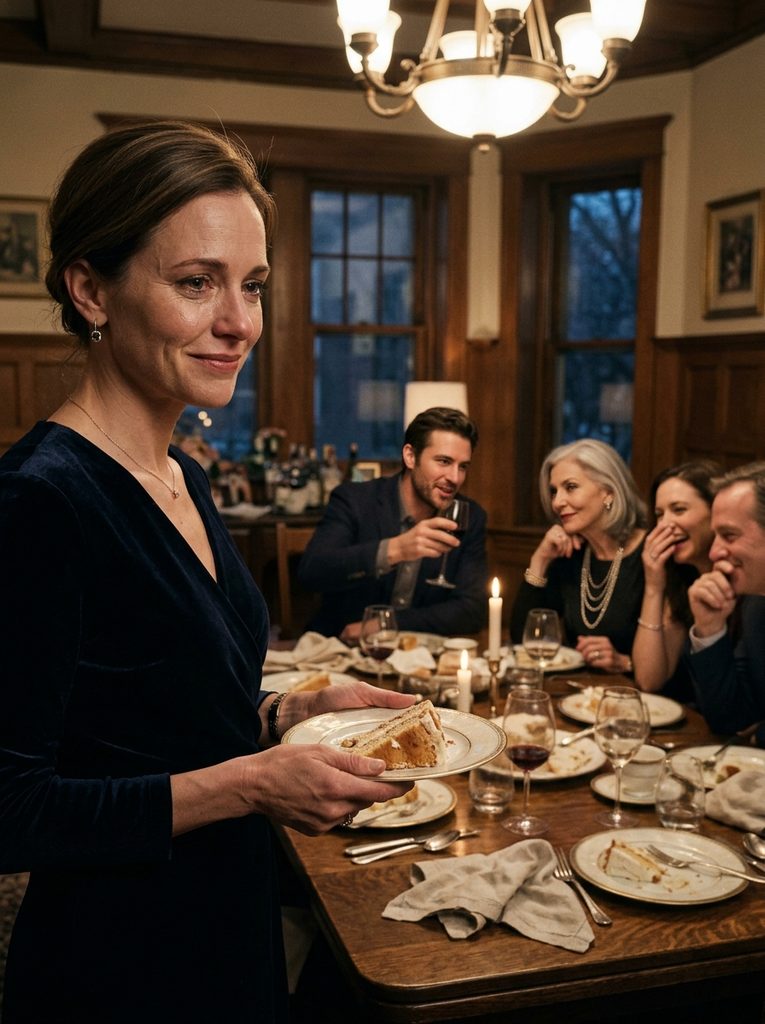
I even helped Helga carry the dessert plates into the dining room.
For the rest of the evening, I listened.
That was the part Julian would never understand later. He believed my silence meant I was weak, stunned, or too dependent on him to react.
The truth was much simpler.
I did not yet know what I was dealing with.
I knew my husband had gotten another woman pregnant.
I knew his parents knew.
I knew at least some members of his family were discussing a plan in which I would somehow raise that baby.
What I did not know was how.
So I waited.
On the drive home, Julian complained about his father changing the subject during dinner and asked if I had remembered to pick up his dry cleaning.
I stared through the windshield at the taillights ahead of us.
“Yes. It’s hanging in the guest room.”
“You’re the best.”
His hand settled on my knee.
I had to force myself not to flinch.
When we got home, he went upstairs and fell asleep within twenty minutes.
I stayed in the kitchen.
Our fertility clinic had called three days earlier to confirm my next appointment.
There was a medication box in the refrigerator.
A folder of test results sat inside a drawer beside the stove because Julian had complained that seeing medical papers on the kitchen counter made the house feel like a doctor’s office.
We had been trying to have a child for years.
Three fertility specialists.
Two failed procedures.
More blood draws than I could count.
Months of injections.
Thousands of dollars in medical bills, some covered by insurance, much of it not.
Julian had sat beside me through almost all of it.
He had held my hand in waiting rooms.
He had kissed my forehead after procedures.
When another treatment failed, he had curled around me in bed and whispered, “We’ll figure it out.”
And somewhere during that same time, he had started sleeping with another woman.
I sat at the kitchen table until nearly two in the morning.
I never woke him.
At 9:14 the next morning, my phone rang while I was standing in line for coffee before work.
The number was unfamiliar.
“Is this Claire Bennett?” a woman asked.
“Yes.”
“My name is Sophie Davis.”
The coffee shop seemed to blur around me.
I stepped away from the counter.
For a moment, neither of us spoke.
Then she said, “I think you know who I am.”
“I do now.”
Her breathing became uneven.
“I need to show you something. Please don’t tell Julian I called.”
I looked through the window at people hurrying toward offices and buses as if it were an ordinary Monday morning.
“Where are you?”
We met an hour later at a small café near the downtown transit center.
Sophie was already sitting in the back when I arrived.
She looked nothing like the woman I had constructed in my imagination during the drive.
She wasn’t glamorous. She wasn’t smiling. She wasn’t waiting to tell me that she had won.
She looked exhausted.
Her dark hair was pulled into a loose ponytail. There were shadows beneath her eyes, and she kept one hand over the small curve of her stomach as if even sitting across from me made her feel the need to protect it.
I remained standing beside the table.
“How did you get my number?”
“Your work website.”
That made sense. I did graphic design for a regional marketing company, and my direct office number was listed on my portfolio page.
Sophie swallowed.
“I wasn’t sure you’d come.”
“Neither was I.”
She pushed a thick manila envelope toward the empty chair across from her.
“I’m sorry, Claire.”
I sat down but left the envelope where it was.
“How long?”
“The relationship ended months ago.”
“That isn’t what I asked.”
Her eyes dropped.
“It started last summer.”
I closed mine.
Almost a year.
A year of fertility appointments.
A year of Julian reminding me to stay optimistic.
A year of him sometimes checking his phone while we sat in clinic waiting rooms and telling me it was his father or someone from work.
“Did you know he was married?”
“Yes.”
At least she didn’t lie.
Sophie rubbed both hands around her coffee cup.
“He told me your marriage was over except on paper. He said you were staying together because of the house and family finances. He said you had separate lives.”
I laughed once.
It wasn’t because anything was funny.
“We shared a bed.”
She went pale.
“I know that now.”
“You knew enough.”
“Yes.”
There was nothing I needed from her apology at that moment, so I didn’t make her give me another one.
“What do you want?”
“I don’t want anything from you.”
“Then why am I here?”
“Because I’m scared.”
She pushed the envelope closer.
I opened it.
The documents inside had been prepared through Klaus’s law firm.
I knew the letterhead immediately. I’d seen it on Christmas cards, charity invitations, and the legal papers Klaus occasionally left in his home office.
The first pages described a proposed financial arrangement between Sophie and Julian.
There was money.
A lot of it.
In exchange, Sophie was being pressured to agree to strict confidentiality, not publicly identify Julian as the baby’s father, and cooperate with a private adoption after the child was born.
The adoption section made my skin turn cold.
It described a married couple already selected as the intended adoptive parents.
I read the paragraph twice.
Then a third time.
“What married couple?”
Sophie stared at me.
“You and Julian.”
The espresso machine hissed behind the counter.
Someone near the front door laughed at something on a phone.
For a few seconds, those ordinary sounds felt unbearably loud.
“He said you wanted a baby more than anything,” Sophie said. “His plan was to tell you he knew a woman who was pregnant and couldn’t raise the child. He was going to say she wanted a private adoption with a stable married couple.”
I looked back down at the document.
“He was going to tell me this was a stranger’s baby?”
“Yes.”
“And I was supposed to adopt her?”
“If I cooperated.”
“Without knowing he was the father.”
She nodded.
The words on the page blurred.
There are betrayals that destroy your trust in another person.
Then there are betrayals that make you question your own memories.
I remembered Julian learning how to give me hormone injections because I couldn’t make myself look at the needle.
I remembered him bringing me crackers after a procedure because the medication made me nauseated.
I remembered sitting on the bathroom floor after another negative pregnancy test while he held me.
I remembered whispering into his shirt, “I would love any child. I just want the chance to be a mother.”
He had remembered that, too.
He simply remembered it differently.
Not as something fragile I had trusted him with.
As something he could use.
“He wanted me to raise his affair baby,” I said quietly.
Sophie nodded.
“He called it the solution.”
I looked at her.
“The solution to what?”
“Everything.”
Her mouth twisted in disgust.
“He could keep his marriage. His parents wouldn’t have to explain a scandal. You’d get the baby you’d wanted. He’d still have his biological child in his life.”
“And you?”
“The payout.”
The way she said it told me she had heard the same explanation enough times to hate every word of it.
“Did you agree?”
“No.”
She leaned forward.
“I considered the money at first. I’m not going to lie to you. I was terrified. Julian told me he wouldn’t leave you. I wasn’t making much, and I had no idea how I was going to raise a baby. Then the conversations changed.”
“Changed how?”
“They stopped asking.”
She pulled out her phone.
At first Julian had offered help.
Then he had reminded her what single-parent life would cost.
Then Helga had called.
Then Klaus.
Sophie had saved texts, voice messages, emails, and two recordings from meetings she had attended.
One message from Julian read:
You need to think about what’s actually best for the baby instead of getting emotional.
Another said:
My family has resources you don’t. Don’t turn this into something ugly.
Klaus had been more careful.
His emails sounded professional.
His meaning did not.
He repeatedly referred to “avoiding unnecessary litigation,” “protecting all parties from reputational damage,” and “the comparative stability available to the child.”
Sophie unlocked an audio file.
“I recorded this because they were starting to scare me.”
She pressed play.
Julian’s voice came first.
“If Claire thinks she’s adopting because the birth mother is desperate, she won’t dig into it. She wants a baby more than she wants to breathe.”
My fingers tightened around the edge of the table.
Then Helga spoke.
“Get the paperwork handled before the birth. Once Sophie is holding the baby, she’ll become difficult.”
Sophie stopped the recording.
I couldn’t speak.
She opened another message.
Helga had warned her that if she made the pregnancy public, people would learn about the affair. Klaus had reminded her that custody disputes were expensive. Julian had suggested that fighting his family would make her life “much harder than it needed to be.”
They had not needed to say, Give us your baby or we’ll ruin you.
They were too educated for that.
They had built the threat out of smaller sentences.
Money.
Lawyers.
Reputation.
Stability.
What a judge might think.
What employers might hear.
What sort of future a single mother could realistically provide.
“I know I did something awful,” Sophie said. “I knew he was married. I believed what I wanted to believe because he made me feel like your marriage was already dead. That’s on me.”
I watched her struggling not to cry.
“But this baby is mine too,” she continued. “And the second I started saying I wanted to raise her, his whole family changed.”
I looked at her stomach.
The child shifted beneath the fabric of her blouse.
For years, I had wanted a baby badly enough that I sometimes couldn’t walk through the infant aisle at a department store without feeling something close inside my chest.
That hadn’t disappeared because Julian betrayed me.
Looking at Sophie still hurt.
But the baby had not betrayed anyone.
“Do you want to keep her?”
“Yes.”
“No hesitation?”
“None.”
“Then don’t sign anything else.”
Sophie stared at me.
“I can’t fight people like them by myself.”
“You won’t.”
I didn’t know exactly what I meant yet.
I only knew I meant it.
That evening, Julian came home with white lilies.
They were my favorite flowers.
“For my gorgeous wife.”
He kissed my forehead.
I took the bouquet because refusing it would have told him something had changed.
“What’s the occasion?”
“Do I need one?”
Apparently not.
I filled a vase while he opened the refrigerator.
“How was your day?” he asked.
“Quiet.”
“Mine was a nightmare.”
He complained about a client for five minutes.
Then, as if nothing about the previous twenty-four hours mattered, he said, “Mom wants us over again Sunday.”
“Of course.”
He smiled.
That smile settled something in me.
He wasn’t tormented.
He wasn’t confused.
He wasn’t a man who had made one terrible mistake and was trying to figure out how to confess it.
He had a plan.
I was part of that plan.
I simply wasn’t supposed to know what my role was.
That night, I stood in our bathroom and removed my wedding ring.
The skin beneath it was lighter than the rest of my finger.
For a long time, I held the ring between my thumb and forefinger.
Then I placed it inside the back of a drawer beneath a stack of washcloths.
I wasn’t ready to confront him.
But I knew I would never put it on again.
The next morning, I met Barbara Hayes.
A colleague had used her during a difficult divorce and described her in three words.
“She doesn’t scare.”
Barbara was in her early sixties, with a silver bob, dark reading glasses, and the kind of calm that made me lower my own voice the moment I sat across from her.
I handed her copies of Sophie’s documents.
Then I told her about the German conversations.
Barbara read for almost forty minutes.
She didn’t gasp.
She didn’t call anyone a monster.
She made notes.
Finally, she looked at me.
“Does Sophie have her own lawyer?”
“No.”
“She needs one. Not me. Her interests and yours overlap right now, but they aren’t identical.”
That sentence was the first thing anyone had said in two days that made me feel I was talking to an adult instead of living inside some horrible family performance.
Barbara gave me the name of a women’s legal advocacy organization that could connect Sophie with independent counsel.
Then she tapped the papers.
“Some of what they’re trying to accomplish here is much less simple than they apparently want Sophie to believe. You don’t erase a child’s rights with clever language, and a pre-birth document does not magically make an adoption happen. But that’s almost beside the point.”
“What is the point?”
“The pressure.”
She removed her glasses.
“They’re trying to convince a frightened pregnant woman that the outcome has already been decided.”
I looked at my hands.
“And me?”
“You need to decide whether you want to stay married.”
“I don’t.”
It came out more quickly than I expected.
Barbara studied me.
“All right. Then don’t announce that decision at dinner tonight. First we make sure you understand your finances.”
Our mortgage.
Joint accounts.
Retirement savings.
Credit cards.
Insurance.
The investment account Klaus had encouraged Julian to open years earlier.
Tax returns I had signed but not studied closely because Julian and his father always handled them.
Barbara did not tell me to empty bank accounts or hide money.
She told me not to do anything dramatic.
“Information first,” she said. “Action second.”
It became my rule.
For the next two weeks, I behaved almost exactly as I always had.
That was harder than confronting Julian would have been.
I went to work.
I bought groceries.
I answered messages from Helga.
I sat beside Julian on the couch while he watched baseball and texted someone he claimed was from his office.
I attended two family meals.
They kept speaking German.
I kept understanding.
At the first dinner, Helga complained that Sophie was “becoming emotional.”
At the second, Klaus warned Julian that he had been careless about what he put in writing.
Marta asked whether I would really accept an adoption without wanting to meet the birth mother.
Julian laughed.
“Claire will be so grateful she won’t want to risk asking questions.”
I was standing three feet away slicing a pie.
They had stopped seeing me as a person in the room.
That turned out to be their biggest mistake.
I did not secretly record anything until Barbara had checked what was legal where we lived and told me exactly what I could preserve as a participant in the conversations.
“No improvising,” she warned me. “No breaking into phones. No guessing passwords. No taking privileged legal files from Klaus’s office. We use what you’re lawfully entitled to have.”
So I followed her instructions.
I saved messages Julian sent me.
I made copies of our household records.
I documented dates and conversations.
When his family spoke openly around me, certain that German gave them privacy, I preserved what Barbara told me I could.
Sophie did the same with her attorney.
Something else happened during those two weeks.
I stopped seeing her as one thing.
The other woman.
That label had been convenient because it gave me a place to put all my anger.
But Sophie was twenty-nine. She worked the front desk at a dental office. Her parents lived several states away. She had a sister she spoke to every Sunday and a car that needed a new transmission she couldn’t afford.
She had made a selfish choice.
She had also discovered that the wealthy married man who claimed his marriage was dead had no intention of leaving it, and his family’s idea of solving the consequences was to remove her from her own child’s future.
We did not become friends.
I did not forgive her because we happened to have the same enemy.
Some days, hearing her voice made my stomach tighten.
But I could separate two truths.
Sophie had helped hurt me.
Julian and his family were trying to do something much worse to both of us.
Barbara noticed that distinction before I did.
“You don’t have to like her to believe she shouldn’t be coerced,” she told me.
“I don’t know if I like anyone right now.”
Barbara almost smiled.
“That’s allowed.”
Near the end of the second week, Helga called.
She wanted everyone at the house Sunday.
Not just immediate family.
Aunts, uncles, cousins.
Klaus was hosting one of his large summer lunches, and Sophie had been told to come because they wanted to “finish discussing the arrangement” afterward in his study.
Sophie told them she would not meet without an advisor present.
Klaus agreed, apparently confident that no one Sophie brought could change the balance of power.
Barbara asked whether I wanted to attend.
“I was invited.”
“That’s not what I asked.”
I thought about the dining room.
About Helga smiling at me while saying they would make me raise the baby.
About Julian asking for more potatoes.
“Yes,” I said. “I want to be there.”
Sunday was bright and warm.
By noon, more than twenty relatives had gathered at Helga and Klaus’s house.
Some knew there was a pregnant woman connected to Julian.
Some had apparently been told she was considering placing her baby for adoption.
I doubt all of them understood the real plan.
That mattered to me.
I didn’t want to turn every person in the room into part of a conspiracy just because they belonged to the same family.
The people who mattered knew exactly what they were doing.
Helga.
Klaus.
Julian.
And, to a lesser degree, Marta.
Sophie arrived shortly after one in a navy dress, carrying the same manila envelope she had brought to our first meeting.
Her attorney and Barbara were shown into the front sitting room because Klaus insisted the “family lunch” happen before any legal discussion.
He still believed he controlled the house, the schedule, and therefore the conversation.
I spent part of the morning helping in the kitchen.
Not because Helga had ordered me to.
Because I wanted the last hour of my old life to look exactly like all the others.
I set glasses on the table.
I carried bread into the dining room.
I wore one of Helga’s aprons over my blouse because she had handed it to me the moment I arrived.
Julian barely acknowledged Sophie.
That told me more about him than any apology later could.
This woman was carrying his daughter.
She was frightened enough to bring a lawyer into his parents’ house.
And Julian’s primary concern was that looking at her too long might make the luncheon uncomfortable.
Helga seated Sophie near the far end of the table.
For the first twenty minutes, conversation stayed harmless.
Travel.
A cousin’s new job.
Klaus’s golf game.
Someone complained about property taxes.
Then Helga turned toward Sophie.
“I hope you’ve had time to think more clearly.”
Sophie put down her fork.
“I’ve had plenty of time to think.”
“A child needs stability.”
“My daughter will have stability.”
Marta glanced at Sophie’s inexpensive purse on the chair beside her.
“Stability costs money.”
The table became quieter.
Julian stared at his plate.
Klaus gave Marta a disapproving look, not because she was wrong, but because she had been too direct in front of relatives who did not know the whole situation.
“We are trying to avoid unnecessary ugliness,” he said. “That’s all.”
Sophie laughed softly.
“You keep using that word whenever I say no.”
I was standing near the sideboard filling a glass pitcher with water.
Julian switched to German.
“She’ll calm down once she understands she isn’t getting more money.”
Helga answered in the same language.
“The bigger problem is Claire.”
My hand tightened around the pitcher.
Marta glanced at me.
“What about her?”
Julian didn’t even lower his voice.
“Once Sophie agrees, I’ll tell Claire the private adoption was her idea. She’ll convince herself it’s fate.”
One of the older uncles looked uncomfortable.
Helga waved a hand.
“After all these barren years, she’ll finally get to play mommy.”
A small laugh came from somewhere near Marta.
I placed the pitcher on the table.
Carefully.
No shattered glass.
No screaming.
Then I untied Helga’s apron.
Julian looked up.
“Claire?”
I folded the apron once and put it beside my plate.
Then I answered Helga in German.
“Do you know what the strangest part is?”
Every conversation at the table stopped.
Marta’s mouth fell open.
Helga stared at me.
Julian’s face changed so quickly I almost felt sorry for him.
Almost.
I continued in German.
“The strangest part is that after listening to you people for two years, I expected at least one of you to eventually wonder whether I understood more than I was saying.”
Nobody moved.
I looked at Marta.
“Your joke about my Christmas cake three years ago was better than the one about my dress at Easter, by the way.”
Her face turned red.
Then I looked at Klaus.
“And I understood what you said last week about making Sophie spend money until she became reasonable.”
Klaus pushed his chair back.
“Claire, that’s enough.”
I switched to English.
“No. I think this is the first time I’ve had enough.”
Julian stood.
“How long have you spoken German?”
“Long enough.”
“Why didn’t you tell me?”
That question actually stunned me.
“Why didn’t I tell you?”
“You let us sit here and talk.”
“I let you?”
“You were spying on my family.”
Sophie made a sound somewhere between a laugh and a gasp.
I looked at my husband.
“You got another woman pregnant. You and your parents planned to pressure her into an adoption so you could put your own baby in my arms and let me believe she belonged to strangers. And your question is why I didn’t warn you that I understood German?”
Helga stood.
“Don’t make a spectacle.”
I turned toward her.
“You discussed my infertility over dessert like it was a weakness you could use. You don’t get to complain about the spectacle.”
Several relatives were now staring at Julian.
One aunt whispered, “What is she talking about?”
Good.
They hadn’t all known.
Klaus looked toward Sophie.
“This discussion was supposed to take place privately.”
Sophie reached into her purse and placed a copy of the proposed agreement on the table.
“Then maybe you shouldn’t have discussed my baby in front of twenty people.”
Julian stepped toward me.
“Claire, come outside.”
“No.”
“Please.”
“No.”
It was the first clean no I had given him in years.
His expression hardened.
“This is our marriage.”
“It was.”
That silenced him.
I took my phone from my pocket.
“I have an attorney.”
Julian stared at me.
“What?”
“Barbara Hayes.”
Klaus knew the name.
I saw it in his face.
His confidence disappeared before anyone else understood why.
At Sophie’s request, her attorney and Barbara came in from the front room.
They did not storm through the door like characters in a courtroom show.
They simply walked into the dining room carrying folders.
That was somehow more satisfying.
Barbara stopped beside me.
Julian looked from her to me.
“You hired a divorce lawyer?”
“Yes.”
Helga grabbed the back of her chair.
“This is insane.”
Barbara did not raise her voice.
“My client will not discuss the details of her divorce here. Sophie will also not sign anything today. Her attorney has already communicated that.”
Klaus stood.
“This is my home.”
Barbara nodded.
“It is. Which is why we won’t stay long.”
He opened his mouth.
She continued.
“But since your son and wife have just discussed the proposed arrangement in front of multiple witnesses, I would advise everyone to stop talking about it.”
For the first time since I had known Klaus, he actually did.
Julian didn’t.
He came around the table toward me.
“Claire, you have this completely twisted.”
“I heard you.”
“You heard pieces.”
“I heard enough.”
“I was trying to solve a terrible situation.”
“For whom?”
“For everyone.”
I looked toward Sophie.
She was standing with one hand over her stomach.
“Was it a solution for her?”
He rubbed both hands over his face.
“She told me she couldn’t afford a baby.”
Sophie stared at him.
“I told you I was scared.”
“You said you didn’t know what you were going to do.”
“That isn’t permission to choose for me.”
Julian turned back to me.
“And you wanted a child. We spent years trying. I thought if there was some way to make one good thing come out of this mess…”
The room went completely quiet.
That was the first time I understood how Julian had justified it to himself.
He had not sat in some dark room thinking, How can I hurt Claire in the worst possible way?
He had done something more human and, to me, more frightening.
He had built a story in which everyone else’s pain became convenient because it protected the life he wanted.
Sophie would get money.
I would get a baby.
He would keep his marriage and his daughter.
His parents would keep their family image.
Therefore, in Julian’s mind, he was not cruel.
He was practical.
I shook my head.
“You still don’t understand.”
“I understand that I made a mistake.”
“The affair was a mistake. This was a plan.”
His face tightened.
“I panicked.”
“For months?”
He had no answer.
I continued.
“You sat beside me at fertility appointments knowing another woman was carrying your child. You listened to me talk about adoption knowing you were arranging one behind my back. You let your mother call me barren while you discussed giving me Sophie’s baby as if she were something you could transfer from one woman to another.”
“Claire…”
“I wanted to be a mother more than anything. You knew that. That’s exactly why this is unforgivable.”
Helga interrupted.
“That baby is Julian’s child too.”
Sophie looked at her.
“Yes. Which means he can deal with his responsibilities as her father. It does not mean you get to remove me.”
Helga’s face hardened.
“You have no idea what raising a child costs.”
“Then your son can pay the child support he owes.”
Klaus muttered something under his breath.
Sophie heard him.
So did I.
For the first time, she didn’t shrink.
“My attorney can discuss that with yours.”
Julian looked as if the room were collapsing around him.
Maybe it was.
Not his career.
Not his money.
Not his entire future.
Just the part he had believed was guaranteed.
A wife who would remain grateful.
A mistress who could be bought off.
Parents who could control the damage.
A baby who could be placed exactly where he wanted her.
I picked up my purse.
Julian followed me into the foyer.
“Claire, please.”
I kept walking.
He followed us outside.
“Can we at least talk at home?”
“I’m not going home with you.”
His face went still.
“What do you mean?”
“I packed what I needed yesterday. I’m staying somewhere else.”
He stared at me as though that was the first part of the afternoon he truly understood.
“You’re leaving me?”
“Yes.”
“After ten years?”
I looked back toward the house.
Through the front windows, I could see silhouettes moving in the dining room.
“Ten years is why I’m leaving.”
“That doesn’t make any sense.”
“It makes perfect sense. I gave you ten years to show me who I was married to.”
His voice cracked.
“You’re throwing our entire marriage away over one affair.”
“No.”
I looked directly at him.
“I’m leaving because when you thought I was too stupid to understand you, you stopped pretending to respect me.”
He didn’t follow me again.
The divorce was not quick.
It wasn’t cinematic either.
There was paperwork.
Financial disclosures.
Meetings.
Arguments over the house.
Arguments over accounts.
Hours in offices that smelled like coffee and printer paper.
Julian’s attorneys initially tried to characterize the German recordings as evidence that I had deliberately deceived his family.
Barbara didn’t seem impressed.
“Learning a language is not marital misconduct,” she said when I told her.
The more serious disputes involved money and credibility.
Julian insisted that his parents’ involvement had been exaggerated. Klaus denied using legal pressure improperly. Helga claimed she had only been trying to find a private family solution to an embarrassing problem.
But their own words were difficult to explain away.
During one deposition, a recording was played in which Julian had said, in German, “Claire is useful. She’ll never leave me.”
I sat across the room from him while the sentence played.
His eyes stayed on the table.
Useful.
There was a strange relief in hearing it again.
The first time, it had hurt.
The second time, it clarified things.
I had spent years trying to understand why I never felt fully accepted by his family.
I wondered whether I was too sensitive.
Whether I should laugh more at their jokes.
Whether my own insecurity about infertility made harmless comments feel cruel.
I had worked hard to become easier to love.
The recording gave me permission to stop.
Sophie pursued her own civil claims with her attorney and the advocacy organization helping her.
I stayed out of the strategy.
That was important.
Supporting her did not make me the owner of her fight.
She moved into a small apartment close to her sister and found work as a receptionist at a medical clinic with better hours for a new mother.
We spoke occasionally.
Some conversations were easy.
Some were not.
Once, when she sent me an ultrasound photograph without thinking, I had to close my office door and cry.
Later that afternoon, she called.
“I’m sorry. I shouldn’t have sent that.”
“No,” I said after I could speak normally. “You should be allowed to be excited about your baby.”
“I don’t want to hurt you.”
“You already did.”
Silence.
I closed my eyes.
“But that doesn’t mean you have to spend the rest of your pregnancy apologizing to me.”
“I wish I could undo it.”
“So do I.”
That was where we left it.
No dramatic forgiveness.
No declaration that the affair didn’t matter anymore.
Just two women trying not to let Julian’s choices determine every decision that came afterward.
Mia was born on a stormy Tuesday morning in August.
Sophie called me shortly before dawn.
I was asleep in the one-bedroom apartment I had rented after leaving Julian. Moving boxes still lined one wall because I had discovered that divorce created an astonishing number of tasks nobody warned you about.
Changing insurance.
Redirecting mail.
Separating phone plans.
Buying a second set of ordinary things you never think about until they are missing.
A can opener.
Bath towels.
A lamp.
Sophie was crying when I answered.
“My sister’s flight got canceled.”
I sat up.
“Are you at the hospital?”
“Yes.”
“How far apart are the contractions?”
“I don’t know. They keep asking me questions and I can’t think.”
Then she said, “You don’t have to come. I don’t even know why I called you.”
I looked at the boxes.
Six months earlier, I had believed this baby was going to destroy my life.
Now I knew something else.
The people who had nearly destroyed my life were adults making choices.
The baby had never chosen anything.
“I’m coming.”
At the hospital, Sophie was already in labor.
I didn’t enter the room as a substitute mother.
I wasn’t there to claim a place.
I filled a chair because the person she wanted there was stranded in an airport two states away.
When Sophie needed ice chips, I got them.
When she cursed Julian, I didn’t disagree.
When she asked me whether she was going to be okay, I told her yes even though I had no authority to promise it.
Several hours later, Mia arrived with dark hair, red cheeks, and lungs strong enough to announce herself to the entire maternity floor.
Sophie held her against her chest and cried.
“I’m naming her Mia.”
I stood beside the bed.
The sight of that baby hurt.
I won’t pretend it didn’t.
For years, I had imagined a newborn against my chest. I had pictured tiny fingers, hospital blankets, midnight feedings, and the exhausted happiness other women complained about without realizing how lucky they sounded to me.
For one painful second, grief came back with such force that I had to look toward the window.
Then Sophie said, “Claire?”
I turned.
“Do you want to meet her?”
She wasn’t offering me the baby.
That mattered.
She was introducing me to her daughter.
I stepped closer.
Mia’s hand was resting beside her cheek.
I touched one finger to her palm.
Her tiny fingers closed around it.
I cried then.
Not because some emptiness inside me had magically healed.
It hadn’t.
I cried because this child had almost entered the world as the center of a lie, and now she was lying exactly where she belonged.
In her mother’s arms.
Two days later, Julian appeared at the hospital carrying roses and accompanied by an attorney.
He did not get the reunion he expected.
Sophie had already made arrangements with her lawyer about communication and access.
She held Mia close.
“You’ll see her under whatever arrangements are properly established,” she told him. “You’re not walking in here with your mother and making decisions for me.”
Julian looked at me.
“Did you tell her to say that?”
I almost laughed.
“No.”
He looked from Sophie to me.
“You two are enjoying this.”
Sophie stared at him in disbelief.
“Enjoying what?”
“This whole alliance against me.”
There it was again.
Julian could not understand any situation in which he wasn’t at the center.
I stepped toward him.
“Sophie and I don’t agree about everything. We probably never will.”
His eyes narrowed.
“Then why are you here?”
“Because not everything is about you.”
He left the roses at the nurses’ station.
Two years passed.
The divorce was finalized after negotiations that were painful, expensive, and much less glamorous than people imagine when they talk about “taking someone to the cleaners.”
We divided what had to be divided.
I received my share of marital assets, including enough financial breathing room to make a decision I had postponed for years.
I opened my own small graphic design studio.
Not because Julian financed my new life.
Because I finally stopped organizing every major decision around whether it was convenient for him.
My first office was above a bakery.
The floors creaked. The heating system made strange noises every morning. I had three regular clients and one part-time assistant.
I loved it.
Behind my desk, I framed a small embroidered sign.
I UNDERSTOOD EVERYTHING.
Barbara laughed the first time she saw it.
“Subtle.”
“I’ve had enough subtlety.”
Sophie finished her college degree online while raising Mia.
Julian remained part of his daughter’s life under structured visitation arrangements that began with supervision while the family court worked through the conflict surrounding her birth and his relationship with Sophie.
I never celebrated that.
Mia deserved a father capable of putting her needs ahead of his pride.
Whether Julian could become that man was his responsibility.
Helga tried several times to force herself back into the center of the situation.
She sent gifts.
She complained.
She alternated between treating Sophie like an irresponsible girl and trying to behave like an affectionate grandmother.
Sophie established her boundaries through the proper channels and stopped arguing with her directly.
That bothered Helga more than any shouting match ever could.
By Mia’s third birthday, our lives looked nothing like the arrangement Julian had imagined.
The party took place at a neighborhood park.
There were pink balloons tied to a picnic shelter, homemade sandwiches, juice boxes, and a cake Sophie had baked herself that leaned noticeably to the left.
Mia didn’t care.
She ran across the grass toward me with both hands covered in pink frosting.
“Auntie Claire!”
The first time she had called me that, I had gone home and cried.
Not because I wanted her to call me Mommy.
Because I didn’t.
That surprised me.
“Auntie Claire” was real.
Nobody had drafted it into an agreement.
Nobody had purchased it.
Nobody had tricked me into accepting it.
It belonged to the relationship Mia and I actually had.
She launched herself into my arms and immediately smeared frosting across the shoulder of my silk blouse.
Sophie came running behind her.
“Oh my God, Claire. Your shirt.”
I looked at the bright pink handprint.
Then I started laughing.
“Dry cleaning exists.”
“You always wear expensive clothes to children’s parties.”
“This wasn’t expensive.”
Sophie looked at the label.
“You are a terrible liar.”
“Apparently not. I fooled Julian for two years.”
She stared at me.
Then we both laughed harder than the joke deserved.
That was the first time we ever laughed together about anything connected to him.
Later, after most of the other children had gone home, Mia fell asleep on a blanket beneath a tree.
Sophie and I sat nearby.
For a while, we watched her sleep.
Then Sophie said, “Can I tell you something horrible?”
“I suppose that depends how horrible.”
“Sometimes I still feel like I stole this from you.”
I looked at her.
“What?”
“Mia.”
I turned toward the sleeping little girl.
“You didn’t steal her from me.”
“I know that logically.”
“Then know it emotionally too.”
Sophie picked at a loose thread on the blanket.
“You spent years trying to have a baby. Then I slept with your husband and got pregnant.”
There was a time when that sentence would have sent me straight home.
Now it was simply true.
“I still grieve that,” I said.
She looked at me.
“I probably always will. There are birthdays and Mother’s Days when it hits me. Sometimes somebody complains about their teenager and I think, I would’ve given anything to have that problem.”
“I’m sorry.”
“I know.”
I watched Mia sleeping with one shoe missing.
“But she was never mine.”
“Julian wanted her to be.”
“No. Julian wanted all three of us arranged in a way that made his life easier.”
Sophie was quiet.
“He wanted you to disappear. He wanted me to be grateful. He wanted Mia close enough to be his daughter without anyone knowing how she got there.”
I shook my head.
“That’s not family.”
Sophie reached over and squeezed my hand.
“Mia loves you.”
“I love her too.”
That was enough.
A few months later, Julian sent me an email.
The subject line was one word.
Forgiveness.
I almost deleted it unopened.
Then curiosity won.
The message was long.
He told me he had been in therapy.
He told me he finally understood how much he had hurt me.
He blamed his parents for encouraging him to treat problems like business transactions.
Then, several paragraphs later, he wrote the sentence that told me he still had more work to do.
Nobody takes care of me the way you did.
I read it twice.
Not, Nobody understood me the way you did.
Not, I miss the person you were.
Nobody takes care of me.
He missed the life I had made comfortable for him.
The dinners.
The dry cleaning.
The appointments.
The family gatherings where I absorbed the insults so he never had to challenge his parents.
I clicked Reply.
For a moment I considered writing everything I had learned.
Then I realized I had already spent enough of my life explaining myself to Julian.
So I typed one sentence.
I understood everything back then, Julian. And I still do.
I sent it.
Then I blocked his address.
Years later, when Mia was old enough to know that families did not all fit into the same shape, she asked me a question while we were coloring at Sophie’s kitchen table.
“Auntie Claire?”
“Yes?”
“Did you want to be my mommy?”
Sophie froze at the sink.
I put down the blue crayon.
Children have a way of walking directly into rooms adults spend years avoiding.
I moved my chair closer to Mia.
“I wanted to be a mommy very much.”
“To me?”
I thought carefully.
“There was a time before you were born when some grown-ups had a very bad plan. They wanted your mom and me to believe things that weren’t true.”
Mia frowned.
“Why?”
“Because grown-ups can get scared and selfish too.”
She considered that.
“But your mommy loved you. And you already belonged with her. I would never want to take that away.”
Mia looked toward Sophie.
Sophie had tears in her eyes.
Then Mia turned back to me.
“So you’re my other thing.”
“What other thing?”
She thought for several seconds.
“You’re like the little flashlight in Mom’s drawer.”
I laughed.
“The flashlight?”
“You know. When all the big lights don’t work.”
“An emergency light?”
She nodded enthusiastically.
“You’re my emergency light.”
I had been called a wife.
A daughter-in-law.
Barren.
Useful.
Too sensitive.
Too quiet.
For years, I had treated some of those names as if other people had the authority to tell me who I was.
Emergency light was the strangest title anyone had ever given me.
It might also have been my favorite.
“I can live with that,” I told her.
Mia wrapped both arms around my neck.
Across the kitchen, Sophie wiped her eyes and pretended to be very interested in loading the dishwasher.
Sometimes I think about that first dinner.
I can still see Helga’s dining room.
The polished table.
Julian’s wineglass beside his plate.
The bowl of potatoes in my hands.
I remember him saying Sophie was pregnant while I stood only a few feet away.
I remember his mother looking straight at me and promising the others they would make me raise the baby.
They laughed because they believed I was outside the conversation.
That had been the pattern of my marriage in more ways than one.
Other people decided what I could handle.
What I needed to know.
What was best for me.
Even what kind of mother I was desperate enough to become.
I used to think keeping quiet preserved peace.
Sometimes it did.
More often, it preserved everyone else’s comfort.
Learning German didn’t save me because it gave me some clever weapon against Julian’s family.
It saved me because, for the first time, there was nothing left for anyone to translate for me.
I heard exactly what they thought of Sophie.
I heard exactly what they thought of me.
And once I understood that, I stopped asking them to explain.