Chapter 1: The Fatal Handover
The chronicle of my own family rebellion began, as these things often do, with a momentary lapse in judgment disguised as an act of grace.
It was 10:04 on a Tuesday morning when my water broke, a sudden, shocking flood across the icy bathroom tile of our home in Layton, Utah. The very first thing I did, after jolting my husband Owen fully awake, was text my mother. Owen was already hopping on one foot, fighting his way into denim jeans, his car keys jingling nervously in a hand that was trembling just a fraction. I, meanwhile, sat heavily on the cool porcelain edge of the bathtub, my thumbs flying across my phone screen with a desperate, breathless urgency.
Water broke. Heading to Davis Hospital. Can you use the spare key and give Biscuit his pill at 7 and dinner at 5? Just the dog.
I felt the need to specify: Just the dog. Biscuit is our rescue Beagle. He is nine years old, requires a strict regimen for a thyroid condition, and possesses a pair of sorrowful brown eyes that look at you as if you’ve committed a grave, personal treason should his breakfast arrive even a minute past schedule.
My mother’s reply materialized on my screen in under sixty seconds. Of course, sweetheart. Don’t worry about a single thing at the house.
Looking back, I remember an overwhelming wave of gratitude washing over me. I also remember feeling a distinct, foolish twinge of guilt. Even with the initial, dull ache of labor contractions beginning to coil low in my lumbar spine, I had still twisted myself into knots trying to ask her for a favor in the most deferential, unobtrusive way possible. That was my lifelong conditioning.
As Owen guided me down the hallway, my hand gripping the drywall for support, we passed the nursery. I had left the door ajar by precisely three inches—a habit I had formed over the past month. Through the narrow gap, the small plug-in nightlight cast a gentle, amber halo across the freshly vacuumed carpet. I could see the polished oak corner of the crib Owen had painstakingly assembled, the felt whale mobile suspended in absolute stillness above it, and the pristine, meticulously folded stack of newborn sleepers resting on the white dresser.
I paused there. Just for two fleeting seconds. The air in that room felt sacred, holding its breath for the life we were about to bring into it.
Owen called my name softly from the top of the staircase, his voice tight with anticipation. I reached out, flicked off the hallway light, and cast one final glance at that crib, swallowed by the morning shadows. You look at a room like that with absolute certainty, trusting implicitly that you will find it exactly as you left it.
My son entered the world at eight minutes to midnight. Wesley James Carver. Seven pounds, four ounces of red-faced, furious perfection.
By two o’clock the following afternoon, the adrenaline had crashed. Owen was contorted into an impossible, sideways slumber in a squeaky vinyl hospital chair beneath the window. I lay in the sterile, elevated bed, my body aching in places I didn’t know existed, attempting to master the terrifying art of keeping a brand-new human being alive.
My phone vibrated aggressively against the plastic tray table.
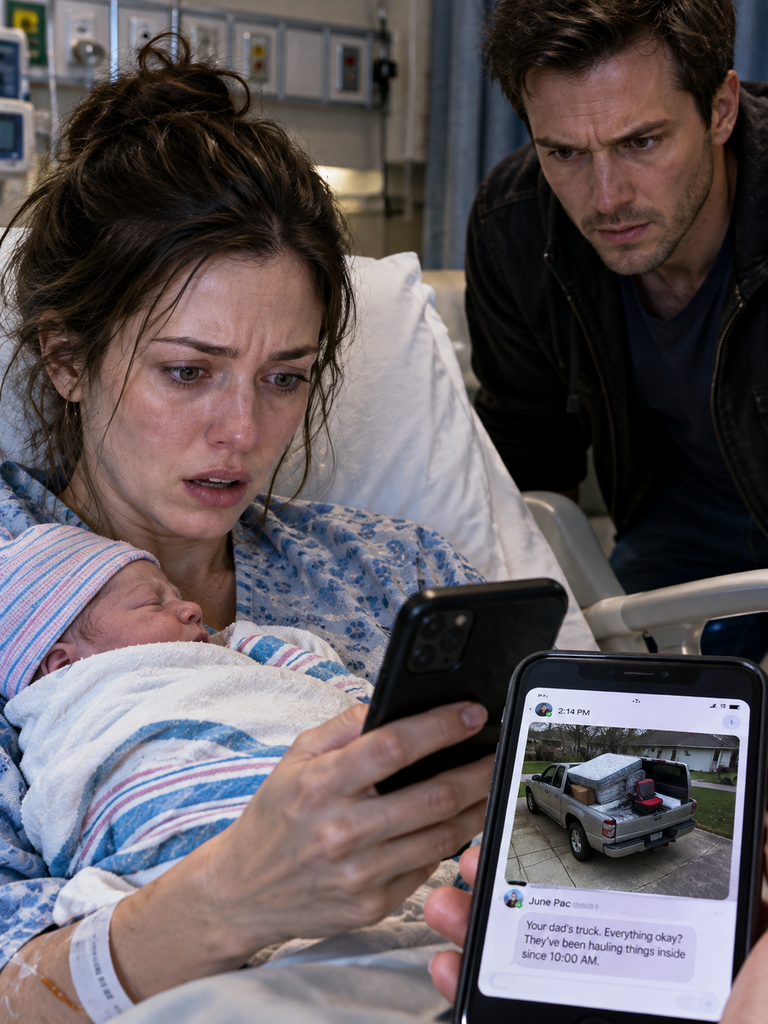
It was a message from June Pac, the eagle-eyed widow who lives directly across the street from us. June waters her prize-winning rose bushes every morning at seven o’clock sharp and considers the neighborhood’s comings and goings her personal television programming.
She had sent a photograph.
My stomach plummeted. In the grainy, zoomed-in image on my screen, my father’s silver pickup truck was backed aggressively into our driveway. Resting in the bed of the truck, secured haphazardly with neon orange ratchets, was a stained twin mattress, a towering stack of cardboard boxes, and a garish, blood-red gaming chair lying discarded on its side.
Beneath the image, June had typed a single, ominous line: Your dad’s truck. Everything okay? They’ve been hauling things inside since 10:00 AM.
My heart began a frantic drumbeat against my ribs. I immediately dialed my mother’s number. It rang five hollow times before rolling over to a generic voicemail. I didn’t leave a message. Thirty seconds later, a text illuminated my screen.
Don’t stress. You just had a baby. Tyler’s going to take the little room for a while. He needs it more right now. The baby can sleep with you.
I read the illuminated words until they blurred. Then I blinked hard and read them a third time. My fingers shook as I typed my response, abandoning every polite instinct I possessed.
No, Mom. Take it out. We talked about this.
The tiny blue word Read materialized beneath my message. And then… absolute, suffocating silence. Nothing else came through.
Just then, a postpartum nurse bustled into the room to check Wesley’s vitals. As she deftly swaddled him with three practiced, geometric folds, she casually tossed out the standard, mandated hospital advice—the very words she likely recited a dozen times a shift.
“Remember, Mom: room share, don’t bed share. Put him on his back, in his own space. Every single time.”
I nodded, my throat suddenly too thick to speak. I took digital screenshots of June’s photographic evidence and my mother’s audacious text message. I did not wake my husband. I knew Owen Carver intimately. If he laid eyes on that photo, he would be out the door and tearing down Interstate 15 in under a minute. I would be left utterly alone in a sterile hospital bed with a fragile newborn, terrified of what would transpire in our driveway between my fiercely protective husband, my passive father, and my deeply troubled brother.
So, I closed my eyes and spoon-fed myself the most comfortable, desperate lie I could manufacture. They were just dropping off some storage, I told myself. It’s a temporary misunderstanding. It will be sorted out before they discharge us.
I placed my phone facedown on the tray table, effectively turning a blind eye to the encroaching storm. Little Wesley reached out, wrapping his entire, impossibly tiny fist around my index finger, holding on with a desperate, instinctive grip. If only I had known that the sanctuary I was bringing him home to had already been breached.
Chapter 2: The Currency of Silence
To fully comprehend the sheer audacity of my mother’s text message, you have to understand the fundamental architecture of my family. I was raised in Roy, Utah, in a classic split-level house flanked by a drafty carport. The interior permanently smelled of cheap, dark-roast coffee and aggressive lemon Pine-Sol.
My brother, Tyler, is five years my junior. In the grand ledger of our family dynamic, his existence was written in bold, golden ink, while mine was penciled into the margins.
When I turned twelve, my birthday coincidentally fell on the exact same Saturday that Tyler fractured his wrist attempting a foolish stunt at the local skate park. Even at that tender age, I possessed the emotional intelligence to understand that a medical emergency supersedes a birthday celebration. What permanently etched itself into my memory, however, was the cake. It was a rich chocolate confection, my name written across the top in elegant purple icing. It sat untouched in the back of the refrigerator for four agonizing days while the entire household orbited endlessly around Tyler and his plaster cast. Eventually, the purple frosting dried out, cracked like a parched riverbed, and my mother unceremoniously dumped it into the trash.
“You understand, honey, don’t you?” she had said, not looking at me.
And I did. I always did. That was my designated role in the ecosystem of our home. My stellar report cards were briefly pinned to the refrigerator beneath a plastic strawberry magnet, only to be entirely obscured by Friday under Tyler’s colorful, unearned certificates for “Most Improved,” “Best Effort,” or “Perfect Attendance.”
By the time I was a teenager, my mother had developed a specific mantra. She deployed it to her friends over coffee, to my perplexed teachers, to my aunt on lengthy phone calls when she assumed I was out of earshot.
“Oh, Lindsay’s fine. Lindsay is always fine.”
She delivered it with the bright, ringing tone of a high compliment. And for a tragically long time, I absorbed it as one. Being “fine” translated to not needing a ride to soccer practice. It meant I didn’t require assistance with my intricate science fair projects, or demand a new winter coat when mine grew tight across the shoulders. It meant I shouldn’t expect her attendance at my spring choral concert, because Tyler had developed a mild fever, and Tyler inherently needed her more.
My father, Gary, spent three decades repairing massive diesel engines. He spent his evenings sequestered in the carport, the glow of a bare bulb illuminating the grease on his hands, a crackling AM radio drowning out the world. He was never a cruel man, but he was profoundly, structurally absent. He possessed the unique ability to be a ghost while standing ten feet away from you. Whenever my mother made a unilateral decree, he would simply wipe his blackened hands on a filthy red shop rag and allow the universe to be dictated to him.
My job was to be the shock absorber for the family’s dysfunction. At twenty-two, I discovered exactly how steep the price of that job truly was.
I had recently secured a position as a teller at Wasatch Ridge Credit Union. Feeling like a proper adult, I applied for a modest auto loan to purchase a used Toyota Corolla boasting ninety thousand miles. I was swiftly and unceremoniously denied.
The loan officer, a sharp but empathetic woman named Carla, gently rotated her bulky computer monitor toward me. She pointed a manicured finger at a credit card account I had absolutely no memory of opening. It was utterly maxed out, showing $6,400 past due, with a horrific string of missed payments. The monthly statements, Carla noted quietly, were being mailed directly to my parents’ address in Roy.
I will never forget the sensation in my gut—it was the terrifying, weightless lurch of missing the bottom step in the pitch dark.
Carla looked at me with deep, knowing eyes and asked if I wished to initiate a formal financial misconduct report. I stammered, my face burning with a toxic mix of shame and dawning realization, claiming I needed to consult with my family first.
That evening, the atmosphere in my parents’ kitchen was thick enough to choke on. I sat rigid at the chipped Formica table, a freshly printed credit report trembling in my hands. Tyler, then seventeen, slouched aggressively in the chair opposite me. His hoodie was pulled low over his eyes, his gaze locked stubbornly on the scuffed linoleum floor.
My mother stood directly behind him, her hands clamped protectively onto his shoulders. Not mine. His.
“He just made a little mistake, Lindsay,” she pleaded, her voice dripping with a sickly sweet manipulation. “He was trying to float a loan to help out a buddy. If you file that report, the authorities will come after him. He’s only seventeen. Do you really want the destruction of your brother’s future resting on your conscience for the rest of your life?”
I turned my desperate gaze toward my father. He was intensely studying the silver cap of the salt shaker, refusing to meet my eyes.
“It’s my name, Mom,” I whispered, the injustice of it strangling my vocal cords. “My credit is ruined.”
“It’s your brother,” she countered instantly, her tone hardening into steel. And then, she deployed the ultimate weapon—the phrase that cemented my compliance. “You’re the strong one, Lindsay. You can handle a little setback. Tyler can’t.”
I broke. I agreed to absorb the massive debt myself and bury the truth.
When the words of surrender left my lips, my mother rushed around the table and enveloped me in a crushing embrace. She pressed her face into my hair and murmured, “This is exactly why I never have to worry about you.”
I want to tell you that the twenty-two-year-old version of me recognized that sentence for the emotional blackmail it was. But I didn’t. In my starved, desperate heart, I interpreted it as profound love.
It took me nineteen grueling months to eradicate that fraudulent balance. I paid it down one hundred and thirty dollars at a time, bleeding my meager teller’s paychecks dry. Every single electronic transfer reinforced a deeply toxic psychological lesson: If I absorb the pain quietly, I am worthy of love. If I raise my voice, I am the villain destroying the family.
There was, however, one unforeseen silver lining to that nightmare. To protect myself, I taught myself how to dissect a credit report better than anyone else in my branch. I developed a predatory eye for anomalies—an address that didn’t align, a digital signature that leaned a fraction to the left, a borrower’s narrative that contained one too many convenient excuses.
Carla noticed my newfound ferocity. Two years later, she personally championed my promotion into the elite loan officer training program. Tyler, naturally, never reimbursed me a single dime. And nobody in that house ever suggested he should.
Over the next decade, I morphed into the family’s designated crisis management system. When Tyler fell short on his apartment rent at twenty-three, my mother called me in tears; I wired him eight hundred dollars. When he faced eviction again at twenty-four, I repeated the transaction. When my mother required gallbladder surgery, I burned my vacation days driving her to every post-op appointment. Tyler mailed her a generic hallmark card.
I never voiced my resentment. I didn’t keep a verbal scorecard. I harbored the bitterness the same way you harbor a deep tissue bruise—by desperately avoiding looking at it.
Then, three years and two months ago, Tyler’s reckless trajectory finally hit a concrete wall. He faced severe legal consequences for egregious financial misconduct. He had aggressively solicited hefty upfront deposits from four elderly homeowners in Davis County for roofing and kitchen renovations. He vanished without ever swinging a hammer. The total theft neared thirty thousand dollars. One of his victims was a frail, eighty-one-year-old widower who had handed Tyler his life savings in cash, pulled from a rusted coffee can.
My mother summoned me to the house that evening in a state of absolute hysteria. She had the documents for a second mortgage scattered frantically across the living room coffee table. She demanded a co-signer, insisting she needed my signature by Friday morning to secure the services of a flashy, aggressive defense attorney she’d seen advertised on a towering billboard along the interstate.
“I will help you research a public defender,” I told her, my voice remarkably steady for a woman whose heart was hammering against her teeth. “I will sit beside you in the gallery at every single court hearing. But I will not sign that paper.”
It was the first time in my entire existence I had ever delivered a flat, unequivocal “no” directly to her face.
My mother reeled back as if I had physically struck her. Her eyes widened with a terrifying, unadulterated venom. “After every single thing I have sacrificed for you,” she hissed, her voice vibrating with malice.
My father abruptly stood up, wiped his hands, and retreated to the carport.
They eventually found some shadowy, high-interest avenue to borrow the capital. It didn’t matter. The evidence was insurmountable, and Tyler was forced to plead guilty. He was remanded to a state correctional facility.
In the aftermath, my mother subjected me to a punitive, glacial freeze. She did not speak to me for two agonizing months. There were no phone calls. No passive-aggressive text messages. Utter silence at Easter dinner. That was the exorbitant tax levied upon the word “no” in my family: exile, sustained for however long she deemed necessary to break my spirit.
I forced myself to sit inside that suffocating silence. I learned, day by agonizing day, that I would not actually die from her disapproval. I survived it. But the experience implanted a cold, heavy stone of dread in the center of my chest. Dread is an incredibly powerful, paralyzing emotion to carry when the woman who raised you is standing in front of you, making a demand.
That silence was finally shattered the afternoon I called to timidly announce my pregnancy. She wept theatrically through the receiver, sobbing, “Oh, honey! A grandbaby! A blessing!”
I was foolish enough to believe that her tears signified a genuine shift in our dynamic. I desperately thought that providing her with a grandchild might be the catalyst that finally elevated me in her eyes—that she might finally view me as a mother, a woman worthy of respect, rather than merely the family’s silent, enduring pack mule.
I should have known that a tiger never changes its stripes, it just waits for you to step deeper into the tall grass.
Chapter 3: The Boundaries We Draw in Blue
I am exceptionally good at my profession. I’ve reigned as a senior mortgage loan officer at Wasatch Ridge for nine years. The crux of my job isn’t crunching numbers; it’s reading paper, and more importantly, reading people.
Just a few weeks before Wesley was due, a nervous young applicant sat across my mahogany desk, sliding an income verification form toward me. My trained eyes immediately caught it. The font kerning on his purported salary line was a microscopic hair thinner than the typography on the rest of the document. It had been digitally altered.
I didn’t raise my voice. I didn’t summon security or launch accusations of fraud. I simply rotated the paper smoothly back toward him, tapped my pen lightly on the forged number, and maintained absolute, unwavering eye contact.
“I cannot accept this specific document,” I stated, my tone pleasant but forged in titanium. “If you are able to procure the original, unedited version directly from your employer’s HR department, I will gladly re-evaluate your file on Monday morning.”
His complexion flushed a violent crimson. He swallowed hard, went completely mute, and then gave a sharp, defeated nod before retreating.
Most people mistakenly believe that saying “no” requires shouting or dramatic posturing. In my experience, the most devastatingly effective “no” is calm, clinically correct, and deliberately leaves the liar a quiet doorway through which to exit with whatever shreds of dignity remain.
I met my husband, Owen, when he arrived to repair our branch’s failing HVAC system during a brutal, sweltering July heatwave. He is a technician—a man built with broad, capable shoulders and an infinite reservoir of patience. He possesses the rare, comforting habit of calmly explaining his mechanical process as he works. He happened to be on a ladder near my office when I systematically dismantled a predatory real estate flipper’s loan application that afternoon.
Later, as he packed away his tools, he leaned against my doorframe and remarked, “You read people the exact same way I read a high-pressure refrigerant gauge. You see exactly where the leaks are.”
No human being had ever categorized me with such startling precision.
We were married six years ago in a quiet, sunlit ceremony. Four years ago, we pooled our savings and purchased a beautiful, three-bedroom home in Layton. It boasts a sturdy cedar fence enclosing the backyard and a magnificent, sprawling maple tree anchoring the front lawn. Because I trust no one with paperwork, I underwrote the mortgage file myself, scrutinizing every single syllable. The final deed bears exactly two names: Lindsay Carver and Owen Carver. No one else possesses a legal claim to our sanctuary.
It took us two heartbreaking years, filled with endless medical consultations and dashed hopes, to finally require the use of that third bedroom. I prefer not to dwell on the darkness of those two years. I will only say that by the time the plastic wand finally displayed a bold, unmistakable positive line, I was almost too psychologically battered to allow myself the luxury of wanting the nursery.
I refused to cross the threshold of that empty room until I was safely past my seventh month. Then, on a crisp Saturday morning, I claimed it.
Armed with a protective respirator mask and the windows thrown wide to the autumn breeze, I painted the walls myself. I selected a shade of soft, luminous blue-gray named Saltwater. On the feature wall, directly behind the designated spot for the crib, I meticulously hung a panel of custom wallpaper depicting tiny, white sailboats riding gentle waves. I used the edge of an expired credit card to ruthlessly smooth out every last imperfection and trapped air bubble.
We positioned Owen’s late grandmother’s antique wooden rocking chair in the corner beside the window. I ordered a bespoke mobile featuring five hand-stitched felt whales and anchored it firmly to a hook in the ceiling.
The crib, however, was Owen’s personal crusade. It was constructed of solid, heavy oak and arrived on our porch in a cardboard box the size of a standard front door. He dedicated an entire, obsessive Sunday to its assembly. When I offered him the efficiency of my cordless power drill, he waved it away with a stubborn grin.
“I need to feel every single screw bite into the wood,” he told me.
He tightened each heavy bolt by hand using the small, agonizingly slow Allen wrench, working until the skin on his palm was chafed red and raw. When he finally drove the last screw, he shoved the massive structure squarely against the sailboat wallpaper. We stood together in the doorway, his arm heavy and warm around my expanding waist, just staring at it. The sheer weight of the oak pressed four distinct, square indentations deep into the plush carpet.
That evening, I stood alone in the darkened doorway, both hands cradling my swollen stomach. For the first time in my life, I permitted myself to truly, fiercely believe that something wonderful belonged entirely to me.
“This space is his,” I whispered into the quiet house. “Nobody else’s.”
Owen stepped up behind me, resting his chin gently on the crown of my head. “Good luck to anybody who ever tries to move that monstrosity,” he chuckled warmly. “They’d have to dismantle the entire damn thing piece by piece.”
He was making a joke. We both laughed softly in the dark.
I should mention the spare key. It predated the crib by two years.
Owen and I had been forced to fly to Phoenix for his cousin’s destination wedding, and someone local was required to administer Biscuit’s vital thyroid medication. My mother, in a rare display of proactive helpfulness, volunteered. She stood in our pristine kitchen and triumphantly threaded the metallic spare key onto her heavily laden keyring, snapping it into place right next to a tacky, yellow rubber duck charm.
“Just so I’ll always know immediately which one grants access to your castle,” she beamed.
I attempted to establish boundaries, speaking in my most diplomatic, practiced tone. “Mom, this is strictly for emergencies and for Biscuit’s schedule. Please promise me you will text me before you ever let yourself in, okay?”
She nodded vigorously, her eyes wide with feigned sincerity. “Of course, Lindsay! I respect your privacy.”
After she backed her car out of our driveway, Owen leaned heavily against the granite kitchen counter. He looked at me with a careful, measured expression. “Do you honestly trust her with unrestricted access?”
I sighed, exhausted by the mere thought of conflict. “Owen, it’s just a piece of metal. It’s a key. It’s not a deed to the house.”
He let the matter drop, primarily because he loves me, and secondly because she was, for better or worse, my mother.
Over the subsequent two years, she utilized that key perhaps six times. Once, she deposited a foil-wrapped casserole on the counter while we were at our respective offices. Another time, I returned to find she had taken it upon herself to completely reorganize my spice drawer in alphabetical order.
Not once—not a single time—did she ever send the requested text message prior to turning the lock.
And not once did I ever muster the courage to confront her about it. Every boundary violation was seemingly microscopic, and microscopic infractions are so easily swallowed to maintain the fragile peace. What I understand now, with blinding clarity, is that small, unchecked violations are the method by which you train a predator. You train them to understand that your rules are merely suggestions. Worse, you train your own mind to believe that demanding respect constitutes “making a scene.”
The consequences of that cowardice arrived four months ago, during my lunch hour.
My cell phone buzzed violently with an unknown caller ID. I was parked in my sedan in the blindingly hot Wasatch Ridge parking lot, attempting to eat a turkey sandwich off my lap.
The woman on the other end of the connection spoke with a flat, clinical cadence devoid of any emotion.
“Am I speaking with Lindsay Carver? My name is Teresa Vigil. I am a supervising state agent with Adult Probation and Parole. I am contacting you regarding your brother, Tyler Brandt.”
My immediate, terrifying assumption was that Tyler had been injured, or worse, killed inside the facility. My breath hitched audibly.
She must have registered the spike of panic, because she immediately de-escalated. “He is physically unharmed, ma’am. However, he is rapidly approaching an eligibility date for state-supervised release. He has officially listed your primary address in Layton as his proposed, mandated residence. I am legally required to call and verify this arrangement. If he is to reside there, I require the homeowner’s explicit verbal and written consent. Furthermore, you must understand that my office would be conducting mandatory, random home inspections, frequently unannounced.”
The half-eaten sandwich slid off my lap, tumbling onto the passenger floor mat.
“He listed my home address?” I echoed, my brain struggling to process the sheer audacity. “Nobody ever asked me. Nobody consulted me.”
A heavy, cynical pause stretched across the line. “Unfortunately, Mrs. Carver, that scenario occurs significantly more often than you might imagine.”
I cast my gaze downward at the prominent swell of my five-month pregnant belly. My mind raced. I visualized the pristine, empty room down the hall waiting for its Saltwater blue paint. I vividly remembered the agonizing sensation of discovering $6,400 of fraudulent debt attached to my name. I pictured an innocent infant’s sensitive mail—a newly issued Social Security card—landing in a mailbox accessible to a man who had stolen cash from an octogenarian’s coffee can.
Then, a voice that scarcely sounded like my own reverberated in the stuffy cabin of my car.
“No. Absolutely not. I do not consent. He is forbidden from residing on my property.”
My hands were shaking violently against the steering wheel. It was only the second time in my thirty-one years of existence that I had articulated a definitive, unyielding boundary regarding my family, and the people in question weren’t even present to hear it.
Agent Vigil did not attempt to negotiate, guilt-trip, or cajole me. She operated strictly on facts.
“Understood clearly, ma’am,” she replied efficiently. “I will permanently note your denial in his master file. His proposed housing plan will immediately default to your parents’ verified address in Roy.”
Then, she deviated from her bureaucratic script. She did something that fundamentally altered the trajectory of my life.
“Mrs. Carver,” she said, her tone dropping into something resembling genuine human warning, “if you ever return home and discover him attempting to establish residency at your property… you do not call the main dispatch line. You call me directly. Here is my personal field number.”
She dictated a ten-digit sequence. Frantic, lacking a notepad, I fumbled in my leather wallet, retrieved one of my heavy-stock Wasatch Ridge business cards, and hastily scrawled Agent Vigil’s name and direct line across the back in smeared blue ink. I slipped the card deep into the concealed inner pocket of my wallet, securely wedged behind my health insurance card.
I promised myself, with desperate naivety, that I would never have cause to dial it.
I sat immobilized in my sweltering car for ten minutes after the call disconnected. A tsunami of inherited guilt threatened to drown me. Yet, lurking beneath the conditioned shame, I detected an unfamiliar, exhilarating sensation. It felt remarkably like standing on a foundation of solid concrete—a floor that refused to buckle beneath my weight.
My phone vibrated again before I could even engage the ignition.
Mom.
“Did a representative from the state contact you?” Her text was devoid of pleasantries.
I engaged my Bluetooth and called her back. She didn’t bother saying hello.
“You have deeply humiliated him, Lindsay,” she spat, her voice laced with venomous disappointment. “They officially flagged his file with a rejection. Do you possess any comprehension of how devastating that looks to a review board?”
“Mom,” I interjected, fighting to keep my voice from cracking. “I am carrying a child. I am building a life. I cannot, under any circumstances, harbor him here.”
A suffocating, prolonged silence stretched over the cellular towers. When she finally spoke, it sounded like a heavy oak door slamming shut in a stone vault.
“Fine. He will reside with us in Roy.”
Like always, I thought.
I foolishly believed the crisis had been averted.
Seven weeks ago, Tyler was released back into the wild, returning to the carport and the Pine-Sol of my childhood home. Trying to maintain a semblance of sibling civility, I dispatched a brief text: Welcome home. I hope you make the most of this chance.
He replied hours later with a singular, flippant thumbs-up emoji.
That exact same week, my mother aggressively flooded her social media with photographs of Tyler. In the centerpiece image, he was lounging regally in a massive, brand-new, blood-red gaming chair positioned in their spare bedroom. The caption read: Welcome home to my boy. The family is finally whole!
During our strained Sunday phone call, she intentionally mentioned that the chair had cost four hundred dollars. She ensured she mentioned the price tag twice.
Three weeks prior to my due date, my fiercely loyal best friend, Renee, hosted a breathtaking baby shower in her lush backyard. There were delicate paper lanterns swaying in the breeze and a towering cake masterfully crafted to resemble a stack of premium diapers.
The white folding chair reserved for my mother remained glaringly empty for the entire afternoon.
At exactly four o’clock, my phone chimed. So incredibly sorry I couldn’t make it, sweetheart. Tyler is having a rough time adjusting, and he really needs me this week. It’s his first week at a new manual labor job.
Owen leaned over my shoulder, silently reading the illuminated screen. He didn’t utter a word of condemnation. He simply wrapped his heavy, comforting arm around my waist and pulled me flush against his side, anchoring me to reality.
I rationalized her absence. I convinced myself she was still nursing her wounded pride over my refusal in May. I told myself she had ultimately accepted my sovereign boundary and was merely extracting payment in the only pathetic currency she possessed: emotional withdrawal.
I was catastrophically wrong about the first part.
So, when the hospital finally discharged us at twenty minutes to six, and I rode home in the backseat, mesmerized by the rhythmic rise and fall of Wesley’s tiny chest in his car seat, I read my mother’s text message three more times.
The baby can sleep with you.
With every repetition, the phantom voice of the postpartum nurse echoed louder in my skull: In his own space. Every single time.
Somewhere along Antelope Drive, as the suburban landscape blurred past the window, I unzipped my wallet. I slipped my index finger into the concealed pocket, blindly seeking the sharp edge of the Wasatch Ridge business card. It was still there. I didn’t extract it. I merely required the tactile reassurance of its existence.
“Whatever nightmare is waiting for us behind that door,” I said softly to Owen, my eyes fixed on the back of his headrest, “we are not going to scream our way out of it.”
Owen met my gaze in the rearview mirror. His jaw was locked tight. He didn’t offer a reply.
I understood the psychological warfare my mother was deploying. She was banking her entire coup d’état on my lifelong conditioning. She was betting that I would revert to my default setting: silently swallowing the injustice to prevent a catastrophic familial explosion. I had been executing that maneuver flawlessly since I was old enough to interpret the micro-expressions on her face.
But as the tires of our SUV crunched onto the concrete of our driveway, she was about to discover that the compliant, twenty-two-year-old girl who had paid off Tyler’s fraud was dead and buried.
Chapter 4: The Usurped Kingdom
The absolute first indicator that the sanctity of my home had been violated was the brass handle of the front door. It depressed effortlessly under my thumb. It was unlocked.
The second assault was olfactory.
Instead of the subtle, clean scent of cedar and my usual citrus cleaner, the entryway hit me with a suffocating wall of odor. It was the greasy, heavy stench of cheap delivery pizza battling desperately against the synthetic, cloying aroma of a cheap vanilla wick candle—the exact bulk-purchased brand my mother hoards from Costco.
She had commandeered my kitchen island. The granite surface was littered with flimsy paper plates, a half-empty two-liter bottle of generic root beer, and a garish, hand-lettered banner hastily taped to my custom cabinetry that proclaimed: WELCOME HOME BABIES!
Plural. Babies.
From the cramped confines of the laundry room, the frantic, muffled barking of Biscuit echoed through the house. Someone had callously locked my dog away in his own home.
My father was hunched by the stainless-steel refrigerator, a greasy slice of pepperoni pizza folded in a napkin. He glanced up, muttered a pathetic, “Hey, kiddo,” and immediately cast his eyes down at his worn boots, unable to hold my gaze.
Then, my mother materialized from the living room. She surged toward me, her arms flung wide in a theatrical display of maternal devotion, her voice pitching into a shrill, breathless coo. “Oh, my goodness! Let me see him! Let me see my precious little grandson!”
I did not stop. I did not speak. I simply adjusted my grip on the heavy infant carrier, utilizing it like a physical shield, and barged right past her outstretched arms. The suffocating dread in my chest demanded that I visually inspect the nursery before I could engage with the architects of this nightmare.
I began the grueling ascent up the staircase. When you have given birth a mere forty-eight hours prior, every single step is a monumental negotiation with pain. My stitches burned, my lower spine screamed in protest, and my legs felt entirely devoid of structural integrity.
The door to the nursery was thrown wide open.
The beautiful, calming expanse of the Saltwater blue walls and the meticulous sailboat wallpaper were still technically there. However, they were now severely obstructed by three massive, aggressively violent video game posters. The corners of the glossy paper had been brutally affixed to my walls with heavy-duty metal thumbtacks, driven ruthlessly straight through the delicate sailboats I had spent hours smoothing.
Directly beneath the window, where the antique rocking chair was supposed to sit, lay a stained, unmade twin mattress directly on the carpet.
Dominating the top of Wesley’s pristine white dresser was a colossal, curved computer monitor. A chaotic, serpentine tangle of black power cords cascaded down the front of the drawers, plunging directly into the electrical outlet. The protective, child-proof safety cover that Owen had painstakingly installed just last week had been pried off and discarded callously onto the windowsill.
The closet doors had been wrenched open. The meticulously organized rows of tiny, pastel newborn sleepers were gone, replaced by a dark, brooding collection of oversized, hooded sweatshirts hanging limply from the rod.
And there, positioned dead center in the room, resting squarely upon the four deep, square indentations where the oak crib had stood, was the four-hundred-dollar, blood-red gaming chair.
Tyler was slouched in it. His back was to the doorway, a massive gaming headset clamped over one ear, the other pushed back so he could hear the room. The colossal monitor was ablaze with the chaotic, flashing imagery of digital soldiers unleashing hell upon a ravaged cityscape.
The sound of the heavy garage door shuddering open downstairs signaled Owen’s entry with the heavy diaper bags. I heard his heavy work boots pause in the mudroom. I heard the low, dangerous hum of his voice drop to an absolute whisper.
A moment later, his heavy footfalls took the stairs two at a time. He stopped abruptly behind me, his chest practically radiating heat against my back. In his large, calloused hand, he was clutching something.
It was a transparent Ziploc bag, sealed with a ragged strip of masking tape. Across the tape, in my mother’s unmistakable, looping black marker handwriting, were the words: CRIB SCREWS.
“It’s piled up in the dark corners of the garage,” Owen stated, his voice a low, terrifying rumble that vibrated through the floorboards. “Dismantled. Leaning against the cinderblocks. Those little felt whale things are folded up inside a greasy pizza box.”
I turned slowly.
My mother had silently followed us up the stairs and was now hovering in the doorway, blocking our exit. She clutched a dish towel in her manicured hands, wringing it with manufactured anxiety.
“Now, Lindsay, before you or Owen say a single word, I demand that you just hear me out,” she began, adopting her most reasonable, long-suffering tone.
I remained utterly silent. I allowed her to dig her own grave. I needed to document, for my own sanity, the exact depth of the delusion she had constructed.
“Tyler needs this space significantly more than a baby does,” she rationalized, waving the dish towel dismissively toward the ruined room. “You have Owen. You possess this entire, beautiful house. Your brother has absolutely nothing, Lindsay. Nothing! He’s thirty years old, sleeping in the exact same bedroom he had in high school. And your father… your father relentlessly picks fights with him every single night at the dinner table. It’s a toxic environment for his rehabilitation.”
She took a step closer, lowering her voice conspiratorially. “The baby can easily sleep in bed with you and Owen. Honestly, babies intrinsically crave their mothers anyway! I promise you, for those first critical six months, he isn’t even going to utilize that massive crib. It’s a waste of space.”
I shifted the heavy car seat from my right hand to my left. A fresh wave of physical agony tore through my abdomen.
On his back, in his own space. Every single time.
“Not in our bed,” I stated, my voice eerily calm, devoid of any inflection. “The medical professionals mandate that to every new mother on the ward, Mom. It is a safety protocol to prevent suffocation. It is not a casual lifestyle suggestion.”
She scoffed, rolling her eyes dramatically. “Oh, please. I slept with both you and Tyler in my bed when you were infants, and you both turned out absolutely fine! Fine!”
There was that cursed word again. Fine.
The commotion finally penetrated Tyler’s game. He yanked the headset down around his thick neck and swiveled the red chair aggressively to face us. He looked noticeably gaunter than before his incarceration—hollowed out, carrying a distinctly older, haunted look around his eyes. Astonishingly, he looked genuinely uncomfortable to be caught in the crossfire.
“Mom swore to me that you were totally cool with this arrangement,” he muttered, crossing his arms defensively. “She told me you just didn’t want to make it a massive, dramatic issue with Owen, so we should just get it done while you were at the hospital.”
I snapped my gaze back to my mother. She refused to look at me. She stared fixedly at the blinking monitor on the dresser. Anywhere but into the eyes of the daughter she had just sold out.
An absolute, terrifying stillness descended upon my mind. It was the calm of the eye of a hurricane.
“Mom,” I asked, my voice barely above a whisper, slicing through the tension like a scalpel. “Exactly what did you tell him?”
She blatantly ignored the direct question, stepping aggressively into my personal space. Her tone dropped an octave, attempting to force me into complicity.
“Lindsay, honey, please. The judgmental neighbors on our street in Roy watch that state agent’s generic sedan pull up to our curb every single time she visits. It is profoundly humiliating for our reputation. Your father and Tyler cannot exist in the same airspace for ten consecutive minutes without screaming. Tyler needs to be situated in a genuine home, surrounded by a stable family environment. A baby in the house… a sister who clearly has her life impeccably organized. It would be incredibly grounding for him. That is literally all I am begging for. Just for your brother to have one fair chance at redemption.”
In that sickening moment, the grand tapestry of her manipulation revealed itself.
This was not a spontaneous lapse in judgment. This was not a tragic misunderstanding. My mother had meticulously orchestrated this invasion. She had bided her time, waiting like a vulture until my body was physically broken and tethered to a hospital bed. She had weaponized the emergency key I had entrusted to her for the welfare of my dog. She had deliberately selected the singular week of my entire life when I would be at my most physically and emotionally vulnerable, calculating that I would lack the sheer stamina required to expel them.
Behind me, the dangerous rumble of Owen’s voice finally erupted into the open.
“Right. Okay. I am completely done.”
He surged past me before I could even register the movement. He didn’t walk; he stalked into the center of the room.
“Get your ass out of my newborn son’s room,” Owen commanded, his voice a concussive blast that seemed to rattle the windowpanes. “Pack your garbage up, and get the hell out of my house. Now.”
He took one massive, threatening step toward the red chair.
Tyler reacted with the honed, twitchy reflexes of a man accustomed to sudden violence. He bolted upright so violently that the heavy gaming chair shot backward, the hard plastic wheels cracking aggressively against the drywall directly beneath one of his thumbtacked posters.
The chaos summoned my father. Gary came pounding heavily up the wooden stairs, his face flushed red. He shoved his way into the cramped room, throwing both of his grease-stained hands up like a desperate referee, inserting his body squarely between my furious husband and my panicked brother.
My mother erupted into a hysterical shriek. “Don’t you dare lay a finger on him, Owen Carver! He just got out! He can’t afford an incident!”
The sudden explosion of screaming shattered the peaceful slumber of the child at my feet. Wesley jerked awake in his carrier and unleashed a thin, piercing newborn wail—a sound of pure distress that bypassed my ears and stabbed directly into my biological core.
I carefully lowered the car seat to the carpeted hallway. I reached out and clamped my hand viciously onto Owen’s rigid forearm. I could feel the adrenaline-fueled muscle twitching uncontrollably beneath his flannel sleeve, begging to be unleashed.
“Don’t,” I ordered, my voice cutting through the din.
Owen whipped his head to look at me, his eyes wide with a horrific mixture of fury and absolute betrayal. He looked as though I had just driven a knife into his back.
I tightened my grip until my knuckles turned white, leaning in close. “Owen. Look at me. Don’t.”
I possessed a chilling, prophetic vision of exactly how the next five minutes would unfold if he refused to stand down. One physical shove—just one—and the entire narrative would violently shift. The story would no longer be about my mother’s sociopathic manipulation or my brother’s brazen entitlement. It would immediately mutate into a story about my husband physically assaulting a recently released felon.
Someone in this chaotic house—most likely my mother, playing the victim—would dial 911. Police cruisers would swarm our quiet Layton cul-de-sac. Tyler could sustain an injury, violating his conditions. Owen could be arrested for assault. And regardless of the legal outcome, my son’s very first night under his own roof would be forever tainted by the flashing blue and red lights of squad cars and the terrifying echoes of masculine violence.
I was absolutely, unequivocally refusing to hand my mother the power to script that tragedy.
“Pick up the carrier. Take Wesley downstairs to the kitchen,” I instructed Owen, holding his furious gaze. “And please, let Biscuit out of the laundry room.”
Owen stared at me, his chest heaving as he dragged harsh breaths through his nose. He held the standoff for three agonizing seconds. Finally, he broke eye contact, scooped up the heavy car seat with exaggerated care, and descended the stairs without a backward glance.
My mother expelled a massive, theatrical sigh of profound relief, pressing her hand dramatically to her chest. “Oh, thank God. Thank you, honey. Thank you for being reasonable.”
She genuinely believed I had capitulated. She believed she had won the war.
I slowly lowered myself onto the third stair from the top landing, my body screaming in protest. My mother, victorious, fluttered back down the stairs to resume her dominion over my kitchen. My father lingered awkwardly in the doorway for a tense moment, offered me a pitiful, apologetic grimace, and then obediently followed his wife.
From inside the desecrated nursery, I heard the distinctive squeak and clatter as Tyler dragged his red chair back into position over the four indentations.
With surgical precision, I opened my wallet. I slid two trembling fingers deep into the concealed pocket, bypassing the health insurance card, and pinched the edge of my business card. The sharp corners had softened and frayed from four months of riding around in the dark.
I flipped it over. Written in smeared blue ink across the back was a name and a direct ten-digit phone number.
Behind me, the digital gunfire erupted from the monitor once more. Tyler had replaced his headset.
I dialed.
The line rang four times. An overwhelming wave of cowardice washed over me. I legitimately considered terminating the call. If it goes to voicemail, I bargained with myself, the moment will have passed. I’ll figure out another way. I can’t do this to my own blood.
On the fifth ring, the line clicked open. A woman’s voice, sharp and uncompromising, filled my ear.
“Agent Vigil.”
“This is Lindsay Carver,” I stated, the tremor finally leaving my voice. “I am Tyler Brandt’s sister. You contacted me back in May regarding his proposed home plan.”
There was a brief, professional pause as she mentally accessed the file. “Yes, Mrs. Carver. You stated unequivocally that he was not permitted to reside there.”
“He is currently living in my house.”
Her vocal cadence did not shift a fraction of a degree, but I distinctly heard the sharp, metallic click of a retractable pen being engaged.
What followed was a rapid-fire, clinical interrogation. She fired questions as if reading off a sterile checklist, and I delivered the answers with matching detachment.
“Is the subject currently on the premises?”
“Yes. He is upstairs in my home.”
“Where, specifically, is he sleeping?”
“He has dismantled my newborn son’s nursery.”
“When did he establish this presence?”
“According to photographic evidence provided by my neighbor, yesterday morning. My father utilized his truck to transport the belongings.”
“Are his personal effects on site?”
“Yes. A mattress, a wardrobe, a computer setup, and furniture.”
“Did you, at any point, grant verbal or written permission for this relocation?”
“No. I explicitly told my mother ‘no’ in writing from my hospital bed yesterday afternoon. And I explicitly told you ‘no’ in May.”
“Who facilitated his entry into the residence?”
“My mother. She exploited a spare emergency key I had provided her solely for the care of my dog.”
The scratching of the pen abruptly ceased.
“For the official record, Mrs. Carver, do you consent to Tyler Brandt residing at your legal address?”
“I absolutely do not consent.”
I hadn’t intended to elaborate. I wanted to remain clinical. But the exhaustion, the pain, and the sheer heartbreak breached my defenses.
“Agent Vigil,” my voice cracked, betraying the depth of my despair. “I have a two-day-old infant. That was his room.”
Silence hung heavy on the line for a single, profound beat. When she spoke again, the bureaucratic chill had vanished, replaced by a slow, dangerous authority.
“I am currently conducting field visits within the Layton city limits tonight,” she stated. “I can be at your location in approximately twenty minutes. Can you ensure the environment remains de-escalated until my arrival?”
“Yes.”
“Do not confront him again. Do not allow your husband to engage physically. And under no circumstances do you inform them that you have contacted this agency.”
“I have no intention of doing so,” I replied.
She rapidly verified my street address, despite already possessing it in the system. “Twenty minutes,” she promised, and terminated the connection.
I lowered the phone from my ear, staring blindly at the digital screen. The time read 6:28 PM. I had initiated the call at 6:24. In exactly four minutes, I had crossed a Rubicon I could never uncross.
I remained seated on the staircase for a long moment, my phone heavy in my lap, feeling the contents of my stomach churn violently. I had just initiated an action that could result in my brother’s immediate return to a concrete cell. My mother would view this as an unforgivable act of high treason. I would be permanently excommunicated from the only family I had ever known.
I waited for the crushing weight of regret to arrive. I waited to feel the familiar, sickening apologies rising in my throat.
But it never came.
What rose in its place was that exact same sensation I had experienced in the sweltering parking lot four months prior. It was the undeniable feeling of solid, immovable ground materializing beneath my bare feet.
I gripped the wooden banister and slowly descended the remaining stairs, walking purposefully toward the kitchen.
Owen was standing defensively by the granite island, holding Wesley tight against his broad chest, swaying rhythmically to soothe him. Biscuit, finally liberated, was plastered anxiously against Owen’s heavy work boots.
I approached my husband, gently took my swaddled son from his arms, and carefully lowered myself onto a tall wooden barstool. I draped a soft muslin blanket over my shoulder and prepared to nurse him.
When Owen leaned in close, his face still tight with suppressed rage, I turned my head and whispered directly into his ear, so faintly that the words barely disturbed the air.
“An agent is coming. Twenty minutes. Do not go near Tyler until they arrive.”
Owen pulled back sharply, his dark eyes locking onto mine. He searched my face, looking for the terrified, compliant girl he usually had to protect from her own family. Whatever new, hardened entity he found staring back at him, he believed it implicitly.
He offered a single, sharp nod of comprehension. Then, raising his voice to a normal, conversational volume for the benefit of the room, he announced, “I’m going to head back out to the garage and hunt down the rest of those damn crib screws.”
He pivoted and exited through the mudroom.
My mother, tragically misreading the room once again, interpreted his departure as a formal surrender. She practically glided across the kitchen, pulled up a stool directly across from me, and triumphantly slid a greasy paper plate bearing a slice of pepperoni pizza across the granite.
Her entire demeanor had undergone a terrifying metamorphosis. The shrill hostility was gone, replaced by a sickeningly sweet, almost girlish conspiratorial warmth.
“Listen, honey,” she cooed, her eyes sparkling with manic energy. “Your father and I will go out and purchase you a beautiful, top-of-the-line bassinet tonight. You know, the expensive ones that gently rock all by themselves? Your dad can just run over to the Target on Main Street right now. You’ll have the baby right next to your bed! It will be infinitely easier for those exhausting middle-of-the-night feedings.”
She reached across the counter, attempting to pat my hand. I pulled it away to adjust Wesley.
“And honestly, Lindsay, this arrangement is strictly until the spring,” she continued, entirely unfazed. “By April, Tyler will have hoarded enough cash from his new job to cover first and last month’s rent on a decent apartment. That’s all we are asking for. A few tiny months of compassion.”
My father materialized at her shoulder. He awkwardly extracted a crumpled, white bank envelope from the interior pocket of his worn denim jacket and placed it tentatively on the counter between us.
“There’s five hundred dollars cash in there,” Gary mumbled, staring at the envelope as if it might bite him. “To compensate for… you know, the inconvenience with the crib.”
I didn’t reach for the money. I didn’t even acknowledge its existence. I merely flicked my eyes toward the glowing green digits on the microwave clock.
6:31.
Wesley sighed contentedly against my breast, his tiny hand curling into my shirt.
My mother, intoxicated by her perceived victory, simply couldn’t stop talking. She needed to validate her narrative. She proudly confessed that she had already broadcasted this arrangement to her social circle during Sunday services.
“Everyone in the congregation thinks it is just a profoundly beautiful testament to our family,” she beamed, practically glowing with borrowed righteousness. “Sister Hadley actually wept in the foyer. She told me that taking your troubled brother in, precisely when you are overwhelmed with a newborn, is the absolute epitome of what a Christian family is supposed to look like.”
I asked her, keeping my tone mild and inquisitive, who else she had regaled with this fabricated tale of sibling sacrifice. She eagerly listed four prominent names in her social circle, then triumphantly added a fifth, her smile expanding with every syllable.
The horrific truth crystallized in my mind. This wasn’t merely about securing a comfortable room for her golden boy. This was a carefully constructed public relations campaign. It was a fictitious narrative she had aggressively peddled to her community—a story about a fractured family beautifully reuniting under her matriarchal guidance. And in her fictionalized version of events, I had eagerly, happily played the role of the compliant savior.
I did not argue. I did not point out the glaring inconsistencies. I utilized my professional interrogation skills, deploying short, open-ended questions designed to let her ramble and incriminate herself.
“How exactly has Tyler been adjusting to the new job?”
“Oh, it’s been three weeks, and he’s thriving!”
“Is he contributing to the household expenses in Roy?”
She waved her hand dismissively, as if the concept of financial responsibility was offensive. “We’re his parents, Lindsay, not his landlords.”
6:36.
From the floor above, the muffled, chaotic staccato of automatic digital weapons filtered through the drywall.
My mother reached across the island again. This time, she gently grasped the edge of the muslin blanket on my shoulder, tucking it higher around my neck with a practiced, maternal intimacy. It was the exact, specific gesture she used to perform when adjusting my winter coat collar before I caught the school bus. I felt a sudden, sickening wave of self-loathing at how desperately a fractured part of my inner child still craved that manipulative touch.
“See?” she declared triumphantly, directing her comment toward my father rather than me. “I told you there was nothing to worry about. She always comes around in the end.”
She swiveled her attention back to me, deploying her most radiant, unbothered smile. “So! We’re all good here, right?”
I shifted Wesley’s weight slightly, my eyes boring into hers.
“I just have one final question to clarify,” I stated evenly. “Did you actually inform his parole agent that he was relocating to my property?”
The brilliant smile remained plastered to her face, frozen like a macabre mask, but the light behind her eyes instantly died. She snatched a paper napkin from the dispenser and began folding it obsessively into tighter and tighter squares.
“That bureaucratic woman does not need to be kept abreast of every microscopic family dynamic,” she deflected smoothly. “I fully intend to inform her during her next scheduled field visit. This is a private family matter, Lindsay. It’s only been forty-eight hours.”
My father’s head snapped up. He slowly lowered his slice of pizza back onto his plate.
“Darlene,” he rasped, his voice rough with sudden confusion. “You explicitly told me you called the agent last Thursday. You swore to me that she signed off on the transfer.”
“Gary,” she snapped, her voice cracking like a whip.
“You looked me in the eye and told me it was legally cleared, Darl,” he persisted, the betrayal dawning on his weathered face.
“I said not now, Gary!” she hissed, the mask finally slipping.
My father slowly leaned back on his stool. He stared at his wife for a long, terrible moment. And in the heavy silence of my kitchen, I watched the man who had passively enabled her for thirty years finally comprehend the absolute, terrifying depths of his wife’s capacity for deceit. He didn’t offer a defense. But crucially, he didn’t avert his eyes to the salt shaker, either. He just kept staring at the stranger he had married.
I remained utterly silent. My work here was done.
If my mother was brazen enough to look my father in the eye and lie about state approval, it meant she had undoubtedly fed the exact same lie to Tyler. My brother hadn’t swaggered into my home believing he was violating his release conditions. He had walked in because his mother—the one person he trusted implicitly—had assured him that his sister had capitulated and the state government had officially stamped the paperwork.
I couldn’t fathom why that specific realization caused a sharp pang of genuine sorrow in my chest. Perhaps it was because, for one fleeting, tragic second, I looked at the ceiling and saw Tyler exactly as I had once seen myself at that kitchen table at twenty-two: sitting quietly in the dark while my mother meticulously orchestrated our destruction to serve her own needs.
The mudroom door opened. Owen stepped back into the kitchen, the heavy steel Allen wrench gripped tightly in his fist like a weapon. I stood up with agonizing slowness and carefully transferred the sleeping baby into his waiting arms.
6:42.
The bright, sweeping beams of headlights washed across the closed kitchen blinds, casting elongated shadows across the floorboards. The lights abruptly died.
Through the narrow slit in the front window, I watched a dark gray, nondescript government sedan idle to a halt directly behind my father’s battered pickup truck. The heavy doors chunked open simultaneously. Two figures emerged into the cool evening air. The lead figure was a woman clad in a dark, tactical windbreaker, her dark hair pulled back into a severe, no-nonsense ponytail.
They proceeded up my concrete front path with an unhurried, terrifyingly deliberate, synchronized stride.
There was no polite chime of the doorbell. Instead, three heavy, authoritative, evenly spaced knocks struck the solid wood of my front door.
“Who on earth could that possibly be at this hour?” my mother gasped, feigning outrage.
She was up and moving toward the entryway before I could even formulate a response, propelled by the arrogant, territorial instinct that she owned every space she occupied.
Upstairs, the digital gunfire abruptly ceased.
My mother aggressively yanked open the front door.
A woman’s voice, possessing the sharp, flat trajectory of a bullet, cut through the twilight. “Good evening. Adult Probation and Parole. I am looking for Tyler Brandt.”
My mother froze in the doorframe, her hand white-knuckled around the brass knob, physically attempting to block the threshold. “He is… he isn’t a resident here. He is merely visiting his sister for the evening,” she stammered, the lie tumbling out frantically. “He resides permanently with us in Roy.”
Agent Vigil did not even blink. She simply shifted her gaze past my mother’s shoulder, scanning the interior of the house until her eyes locked onto me, standing like a sentinel at the far end of the hallway.
“Mrs. Carver?” she projected.
“Yes,” I answered clearly.
“Is this your legal residence?”
“Yes, it is.”
“Do we have your explicit permission to enter the premises?”
“Yes. You do.”
My mother remained rooted to the spot, refusing to yield the doorway. Agent Vigil did not argue. She did not threaten. She simply stepped forward and stopped mere inches from my mother’s face, projecting an aura of absolute, uncompromising state authority. She waited.
It took perhaps three excruciating seconds for my mother’s bravado to shatter. She shrank back, stepping aside.
Agent Vigil crossed the threshold, closely followed by a second, younger agent sporting a severe military buzzcut. He introduced himself briefly as Agent Ruiz, scanned the perimeter, and fell into a watchful silence.
Behind me, I heard the heavy, deliberate tread of Owen’s boots as he moved to stand squarely in the kitchen archway, Wesley held protectively to his chest.
Then, Tyler appeared at the top of the staircase.
He was still clutching his gaming headset in his left hand. He locked eyes with the dark windbreaker of Agent Vigil, and in a fraction of a second, every single microscopic drop of blood vanished from his face.
I had read the phrase “went white as a sheet” in a hundred cheap paperback novels, assuming it was a hyperbolic literary device. I assure you, it is not. My brother’s complexion shifted to the exact, sickly, grayish-white hue of the drywall behind his thumbtacked posters.
His right hand shot out, desperately gripping the wooden banister to prevent his knees from buckling.
In that crystallizing moment, I realized a profound truth. Tyler had never been intimidated by my husband’s size or fury. He had certainly never been afraid of my boundaries. There was precisely one entity on this earth that struck mortal terror into my brother’s soul, and it had just breached the front door of the sanctuary he thought he had stolen.
“Tyler,” Agent Vigil commanded, her tone devoid of malice but demanding absolute compliance. “Come down to the landing.”
He descended the stairs with the agonizing slowness of a man walking to the gallows. His eyes darted frantically, continually seeking out our mother’s face, begging for the miracle she had promised him.
“Where exactly did you sleep last night, Tyler?” Agent Vigil inquired, her tone conversational, as if asking for directions to the grocery store.
Tyler swallowed audibly, his Adam’s apple bobbing. He looked desperately at my mother.
“At our house!” my mother interjected shrilly, stepping forward. “He slept in Roy! I swear it!”
Agent Vigil didn’t even turn her head to acknowledge the outburst. She kept her laser focus entirely on my brother. “I asked Tyler, ma’am.”
The silence in my home was so absolute, so heavy, that the low, mechanical hum of the refrigerator in the kitchen sounded like a jet engine. Wesley shifted in Owen’s arms, emitting a tiny, soft coo.
Tyler swallowed again. I watched the frantic calculations racing behind his eyes. I watched him study our mother one final time—the exact same desperate, pleading look he had given her across the kitchen table when he was seventeen, begging her to wave her magic wand and make the consequences evaporate.
My mother opened her mouth to launch another volley of lies.
Agent Vigil simply raised her right hand. She didn’t raise it aggressively—just a few inches, palm out. It was a universal signal of absolute dominance. My mother snapped her mouth shut.
Tyler’s shoulders slumped in utter defeat. His gaze dropped to the floorboards.
“Here,” he whispered, the word scraping out of his dry throat. “I slept here.”
Agent Vigil nodded once, a gesture of acknowledging a fact already known. “Show me the room.”
Chapter 5: The Eviction
The procession up the stairs resembled a bizarre, silent funeral march. Agent Ruiz took the vanguard, followed closely by a trembling Tyler, then Agent Vigil, then my mother, and finally, myself, clinging to the handrail for support.
Upon reaching the landing, Agent Vigil stepped into the doorway of the ruined nursery and stopped. She did not speak for a full sixty seconds.
She methodically inventoried the scene. Her eyes swept over the stained mattress discarded on the floor. She noted the massive computer monitor dominating the white dresser, the dark hoodies invading the closet, and the plastic safety cover lying abandoned on the sill. She cataloged the violent punctures in the sailboat wallpaper holding up the violent posters.
Finally, her gaze settled on the red gaming chair, sitting victoriously over the four indentations of the missing crib.
Agent Ruiz quickly swept the bathroom across the hall. He returned to the landing, pulling a pair of nitrile gloves from his pocket. “Subject has established a hygiene footprint. Toothbrush, electric razor, and prescription medications are loaded into the vanity cabinet.”
My mother, unable to endure the silence, found a final, desperate burst of adrenaline.
“He was just trying to be helpful!” she cried, her voice echoing painfully in the small space. “He was meticulously setting up the room to surprise the baby! He fully intended to contact your office on Monday morning to formally request the transfer. He was going to call you himself, I swear to God! It has only been forty-eight hours!”
“Forty-eight hours,” Agent Vigil repeated, tasting the words. She turned her head slowly and looked directly at me.
I already held my phone in my hand. The screen was unlocked.
I stepped forward and presented the device. First, I displayed June’s photograph. I tapped the screen to highlight the digital timestamp stamped clearly across the top: Yesterday. 2:11 PM. The image unequivocally showed my father’s truck backed in, the mattress and the red chair clearly visible in the bed.
Then, I swiped left, bringing up the screenshot of my mother’s text message. I held it steady so Agent Vigil could read the damning words.
Tyler’s going to take the little room for a while. He needs it more. The baby can sleep with you.
And directly beneath it, my desperate plea: No, Mom. Take it out. We talked about this.
Agent Vigil read the exchange twice, mirroring the exact shock I had felt in the hospital bed. When she finally looked up, she directed her gaze at my mother.
The expression on the agent’s face was not one of anger. Anger implies a loss of control. It was an expression infinitely worse. It was the terrifyingly blank look of a predator who has already finalized the kill in its mind.
“Ma’am,” Agent Vigil stated, her voice dropping into a register of pure ice. “Your son’s legally mandated and approved residence is your verified property in Roy. Any deviation or relocation must be submitted, vetted, and approved by this office before the subject moves a single shoelace. Not after the fact. Not the following Monday. Before. Furthermore, the legal homeowner of this property explicitly denied consent to my face in May.”
My mother’s face underwent a catastrophic collapse. The mask of righteous indignation crumbled, replaced instantly by a hardened, vicious desperation.
“She didn’t mean that!” my mother shrieked, pointing a trembling, accusatory finger at my face. “She was heavily pregnant! She was acting completely irrational and emotional! She wasn’t thinking clearly about the sanctity of family!”
Every single person in that crowded hallway turned to look at me.
It is a strange phenomenon. Over the preceding decade, I had paced my bedroom late at night, mentally rehearsing a hundred brilliant, blistering monologues for exactly this kind of confrontation. I had drafted cinematic speeches designed to obliterate her narcissism.
But standing there in the wreckage of my son’s room, I discovered I didn’t require a monologue. The truth is remarkably efficient.
“I meant it completely then,” I said, my voice steady, my eyes locked onto my mother’s. “And I mean it absolutely now.”
Agent Vigil gave a single, sharp nod of satisfaction. She pivoted smoothly toward my brother, who looked as though he might vomit.
“Tyler,” she demanded. “Did your sister, at any point in time, ever communicate to you that you were permitted to establish residence in this home?”
Tyler didn’t respond immediately. He stared at the carpet, his thick thumb rubbing obsessively back and forth across the plastic casing of his headset.
“No,” he finally whispered, the word barely audible. “Not her. Mom did.”
He dragged his eyes up to meet the agent’s.
“Mom swore to me that Lindsay changed her mind after she got pregnant. She told me Lindsay desperately wanted family close by to help with the kid. She just… she said Lindsay didn’t want to deal with the fallout from Owen about it.”
He swallowed, a wet, clicking sound in the quiet hallway.
“She said she called your office. She told me she spoke to you, and you authorized a temporary pass for a couple of weeks while we figured out the permanent paperwork.”
“Nobody from your family contacted me or my office,” Agent Vigil stated flatly, dismantling the final lie.
The air in the hallway seemed to vanish.
Tyler slowly turned his head. He looked at our mother. The sheer, devastating weight of comprehension settled over his features.
“You swore to me you called her,” he accused, his voice breaking.
My mother shrank back against the doorframe, suddenly looking very old, and very small. “I… I was going to call her, Tyler…”
“You told me that Lindsay said yes.”
“Tyler, honey,” she pleaded, reaching out a trembling hand. “She would have! She always capitulates! She always does!”
She always does.
That was the exact moment the final cord tethering me to my family snapped. It wasn’t the heavy knock at the door. It wasn’t the presence of the armed agents. It wasn’t even the cruel text message in the hospital.
It was my mother confidently stating, She always does, while her son stood inches away from a parole violation because she had gambled his freedom on my lifelong silence.
She hadn’t merely manipulated me. She had actively wagered his very survival on my trauma. She had deliberately forced both of her children into a horrific collision—one exhausted with a newborn, the other standing before the state—simply because she desired to manifest the fictionalized narrative she had sold to the women at her church.
I looked at Tyler. I realized he hadn’t gone white solely because of Agent Vigil. He was white because he had just realized, perhaps for the first time in his sheltered, golden-boy existence, exactly who had orchestrated his potential destruction.
Agent Vigil retrieved a small, spiral-bound notebook from her chest pocket, jotted down three lines of shorthand, snapped it shut, and addressed him directly.
“Tyler, you are vacating these premises and returning to your approved residence in Roy tonight. Right this second. Your father will transport you, and Agent Ruiz and I will trail your vehicle the entire distance. I am officially documenting tonight’s events as a severe residence violation.”
She leaned in, forcing him to meet her eyes.
“I require your physical presence in my Ogden field office on Monday morning at exactly 8:00 AM. My regional supervisor will review my report, and we will have a very serious conversation regarding the immediate future of your freedom.”
Tyler nodded numbly, his jaw clenched tight to stop his teeth from chattering.
“I am electing not to remand you into custody tonight,” she clarified, her tone offering no comfort. “But this incident is permanently on your record. Do you understand me?”
“Yes, ma’am.”
She turned back to me, the professional veneer returning. “Mrs. Carver, I will require a brief, formal written statement from you. Reiterate exactly what you communicated to me on the phone. Facts only.”
“It will be in your inbox by tomorrow morning,” I promised.
Tyler crouched awkwardly beside the white dresser and began violently yanking his tangle of black power cords from the wall outlet.
The entire eviction process consumed exactly twenty minutes.
My father ascended the stairs and hoisted the stained twin mattress onto his shoulder, hauling it down the staircase in disgraced silence, the springs groaning and bumping aggressively against every corner. Agent Ruiz stood by, hands on his belt, ensuring nothing was damaged, occasionally assisting with a heavy box.
Tyler meticulously removed his violent posters one by one. I watched him pry the metal thumbtacks out of the drywall with agonizing care, as if performing the task delicately could somehow magically spackle the holes he had torn in my sailboat wallpaper.
When he handed the rolled-up posters to my father, Gary secured them with a thick rubber band. He executed the action with excruciating slowness, his eyes firmly fixed on his hands, treating the task as if it were the most critical duty he had ever performed. He never once looked in my direction.
Finally, Tyler gripped the armrests of the red gaming chair. He hoisted it up and awkwardly rolled it out of the nursery, maneuvering it down the wooden staircase one jarring bump at a time. The hard plastic casing of the left wheel dragged heavily against the drywall, leaving a distinct, dark gray streak down the length of my hallway.
Nobody uttered a word about the damage.
At the open front door, he paused. The night air was biting. My father was already standing by the tailgate of the truck, securing the mattress. The two agents were waiting silently on the edge of the porch, their sedan idling in the street.
Tyler stood awkwardly in my entryway, the ridiculous red chair resting beside his leg, and finally looked me directly in the eyes.
“Would you have actually done it?” he asked, his voice raw. “Would you really have let them take me back inside?”
His voice completely cracked on the final syllable, exposing the terrified little boy beneath the bravado.
I took a moment to consider my response. I owed him the dignity of the absolute truth.
“I didn’t send you anywhere tonight, Tyler,” I said, my voice steady, projecting across the distance between us. “I simply told the state the truth about who resides in my own house. Mom is the one who moved you into it.”
He stared at me for a long, heavy minute, processing the finality of the statement. Then, he nodded—a slow, agonizing motion, as if the realization physically pained him.
He shifted his gaze past my shoulder, looking deep into the illuminated kitchen where Owen stood stoically, holding my swaddled son.
“What did you name him?” Tyler asked softly.
“Wesley.”
“Hi, Wes,” my brother whispered quietly, speaking across the expanse of the entryway.
He did not take a single step closer. He turned, grabbed the chair, and walked out into the night.
Chapter 6: The Final Boundary
I stood motionless in the open doorway, wrapping my arms around myself against the chill, and watched the silent choreography in the driveway. My father hoisted the gaming chair into the bed of the truck, slammed the tailgate shut, and climbed behind the wheel. The dark gray sedan pulled smoothly away from the curb, its headlights illuminating the truck’s bumper, escorting my father and brother out of my neighborhood.
When the red taillights finally disappeared around the corner of the cul-de-sac, I realized I was not alone.
My mother was still standing inside my entryway. Her wool coat was draped over her arm.
I understood immediately. My father had left her behind. He would be forced to make the humiliating thirty-minute round trip back from Roy to retrieve her.
She waited in silence until the rumble of the engines had completely faded into the suburban night. Then, the performance began.
She began to weep.
It was not a loud, cathartic sobbing. My mother never cried loudly. She wept in the exact, specific, manipulative manner she had perfected when I was a child and she required me to feel personally responsible for her anguish. It was a production of quiet, tragic tears, accompanied by a trembling hand pressed dramatically against her mouth to stifle imaginary sobs.
“You would willingly send your own flesh and blood back to a concrete cell,” she whimpered, her voice dripping with manufactured heartbreak. “Over a room. Over a stupid, empty room, Lindsay. I will never, ever get the privilege of holding my grandson now, will I? That is what this orchestrated cruelty is truly about. You are deliberately severing my family. You are taking him away from me.”
She took a shaky step forward, deploying the ultimate, nuclear option of maternal guilt. Her voice dropped to a desperate, ragged whisper.
“I am your mother, Lindsay. I made one mistake. One.”
I felt it. I promised myself I would be brutally honest in this recounting, and the truth is, I felt the pull.
I felt the oldest, deepest instinct within my psychological wiring roar to life. The terrified, people-pleasing twelve-year-old girl inside me, desperate for approval, wanted to surrender. I wanted to utter the words that would make her twisted face relax. I wanted to say, I’m so sorry. I overreacted. Please, Mom, come back into the kitchen. Sit down. We can figure this out.
The ghost of her voice from a decade ago echoed in the hollow space of my chest: This is why I never have to worry about you.
For the very first time in my life, I possessed the translation key to that sentence. It didn’t mean she loved my strength. It meant she adored my utility. She never had to worry about me because I was programmed to silently absorb the shrapnel of her destructive choices, and personally finance the repairs, one hundred and thirty dollars at a time.
I looked at her tears and felt nothing but profound exhaustion.
“You didn’t make one mistake, Mom,” I said, my voice eerily calm, ringing like a bell in the quiet house. “You designed a calculated plan. You strategized this invasion while I was physically screaming in a labor ward. You weaponized the spare key I entrusted to you for the safety of my dog. You looked your son in the eye and lied, telling him I consented. And you looked your husband in the eye and lied, telling him you secured state approval. None of that constitutes a mistake. Those were deliberate, malicious decisions.”
She stopped crying instantly. The tears vanished, leaving her staring at me with a cold, terrifying emptiness.
Headlights swept aggressively into the driveway. My father’s truck had returned.
The heavy diesel engine idled roughly. Gary climbed down from the cab and stood silently by the open driver’s door. He made no move to approach the house.
I extended my right hand toward my mother, holding it suspended between us, palm facing the ceiling.
“I need the key back,” I demanded.
She looked at my outstretched hand as if I were holding a live grenade. She snapped her head toward the driveway, seeking backup.
“Gary!” she called out, a shrill demand for rescue.
My father did not move a muscle. He stood in the shadows of the driveway, his voice carrying clearly through the crisp night air.
“Give it to her, Darl,” he ordered, a note of finality in his tone I had never heard before. “Just give her the damn key.”
My mother’s hands were visibly trembling as she fumbled with her crowded keyring. The cheap, yellow rubber duck charm slid off the metal ring along with the brass house key. She practically threw them into my open palm. The metal was still unnervingly warm from being clutched in her coat pocket.
“You do not possess unrestricted access to my life anymore, Mom,” I stated, my fingers closing tightly over the brass teeth. “You possess my phone number. If you ever wish to see Wesley, you will utilize that number to ask for permission. When you cross this threshold, you will conduct yourself as a guest in my home. And tomorrow morning, I am transmitting a sworn statement to Agent Vigil detailing every single event of the past forty-eight hours, including the exact lies you confessed to in my kitchen.”
She stared at me as if I were a horrifying stranger who had somehow stolen her daughter’s face.
She turned on her heel and marched out to the waiting truck. My father pulled the passenger door open for her, a gesture of hollow chivalry. Before climbing back into the driver’s seat, he looked across the hood of the truck, met my eyes one final time, and slowly raised one hand in a gesture that looked remarkably like a salute.
Then, they backed out and drove away.
I stood barefoot on the freezing concrete of my driveway, squeezing the metal key so fiercely that it cut deep, red crescents into the flesh of my palm, until I couldn’t see the red glow of their taillights anymore.
Chapter 7: The Architecture of Peace
The following morning, at exactly 8:00 AM, Owen contacted a local, emergency locksmith. By ten o’clock, every single lock on the exterior of our home—front door, mudroom, garage entry, and sliding glass patio—had been replaced with heavy-duty deadbolts.
I sat at my granite kitchen island, the morning sun streaming through the blinds, with Wesley sleeping peacefully in his carrier at my feet. I opened my laptop and drafted my formal statement for Agent Vigil. It was exactly one page in length. It was devoid of emotion, adjectives, or editorializing. It was a sterile ledger of dates, timestamps, verified observations, and verbatim quotes.
I attached June’s digital photograph and the screenshot of my mother’s text message. I hit send. I didn’t need to embellish the truth; the truth was devastating enough on its own.
Nine days later, the mail carrier delivered a crisp, white envelope containing Wesley’s official Social Security card.
That exact same afternoon, I sat back down at my laptop and initiated a draconian, permanent protective freeze on his credit profile across all three major reporting bureaus.
Owen leaned against the counter, watching the complex process over my shoulder. “Is that level of security really necessary for an infant?” he asked gently.
I looked up at him. “I learned at twenty-two exactly how easily a family member can destroy a name on paper.”
He leaned down, pressed a warm, lingering kiss to the crown of my head, and never questioned the decision again.
Agent Vigil contacted me precisely once, a week after the incident. She maintained her professional brevity, informing me that Tyler had presented himself at her Ogden field office at exactly 7:52 AM on Monday morning. She confirmed he was currently residing at his approved address in Roy.
“The remainder of his disciplinary action,” she stated, “is strictly between him, his review board, and this office.”
I thanked her sincerely for her intervention and refrained from asking any further questions. Tyler’s trajectory was no longer my cross to bear.
On the ninth day, my phone vibrated with a text from Tyler.
I should have called you myself. Not listened to Mom. I’m sorry about messing up his room.
I read the message four times. I have not drafted a reply. I am not ready. But I didn’t delete it, either. It sits in my inbox, a digital artifact of accountability.
My mother, predictably, dispatched a sprawling, eleven-paragraph manifesto via text message. It was a masterclass in deflection, victimization, religious justification, and aggressive guilt. I read every single hysterical word.
I replied with a single, devastating sentence: Call me when you are prepared to behave like a guest.
She hasn’t called.
On the tenth night, the house was finally quiet. The scent of pizza and cheap vanilla had been thoroughly scrubbed away, replaced by the comforting aroma of Owen’s cedar shavings and baby powder.
Owen emerged from the basement holding the Ziploc bag of heavy screws. He hauled the massive oak pieces of the crib up the stairs, one agonizing trip at a time, laying the rails out gently on the nursery carpet.
I had spent the afternoon meticulously extracting the last of the metal thumbtacks from the sailboat wallpaper. If you step close and squint, you can still see the tiny, ragged punctures in the paper. I view them as battle scars.
Owen picked up the small Allen wrench, hesitated, and then slowly held it out to me.
I lowered myself onto the carpet beside him. He handed me the heavy steel bolts, one by one. I engaged the threads and turned the wrench by hand, twisting until the friction burned my palm red.
“I need to feel every single one of them bite into the wood, too,” I told him.
He threw his head back and laughed—a rich, booming sound that filled the room. It was the first time I had heard him truly laugh since the morning my water broke.
When the structure was finally secure, we lifted the heavy oak together and guided it back against the sailboat wall. The four wooden legs found the deep, square indentations in the carpet, settling into place as if the room had been holding its breath, waiting for its return.
There remains a faint, dark gray streak running along the baseboard in the hallway where the plastic wheel of the gaming chair gouged the paint. I scrubbed it aggressively with a magic eraser three separate times. It refused to lift completely.
In the end, I chose to leave it. It serves as a permanent, visual reminder of what that room almost became, and more importantly, the woman who fought to bring it back.
Owen reached up and secured the felt whale mobile to its ceiling hook. I lifted Wesley from my chest and laid him down on the pristine mattress.
On his back. In his own space. Every single time.
He stretched both of his tiny arms above his head, sighing deeply, and did not wake. Biscuit lumbered into the hallway and collapsed heavily across the threshold of the open door, an ever-vigilant furry sentinel.
I walked downstairs, approached the mudroom, and hung the newly minted, brass house key on a small hook beside the door. There is no yellow rubber duck attached to it. It does not belong to anyone else.
I climbed back up the stairs, slipped quietly into the antique rocking chair in the corner of the dark nursery, and simply watched my son breathe.
“This space is yours,” I whispered into the quiet night. “Nobody else’s.”
If you found yourself standing in my shoes, confronting the shadows of your own family in the hallway of your home, would you have found the strength to make that phone call? Or would you have surrendered the battle to keep the peace? Share your thoughts in the comments below.