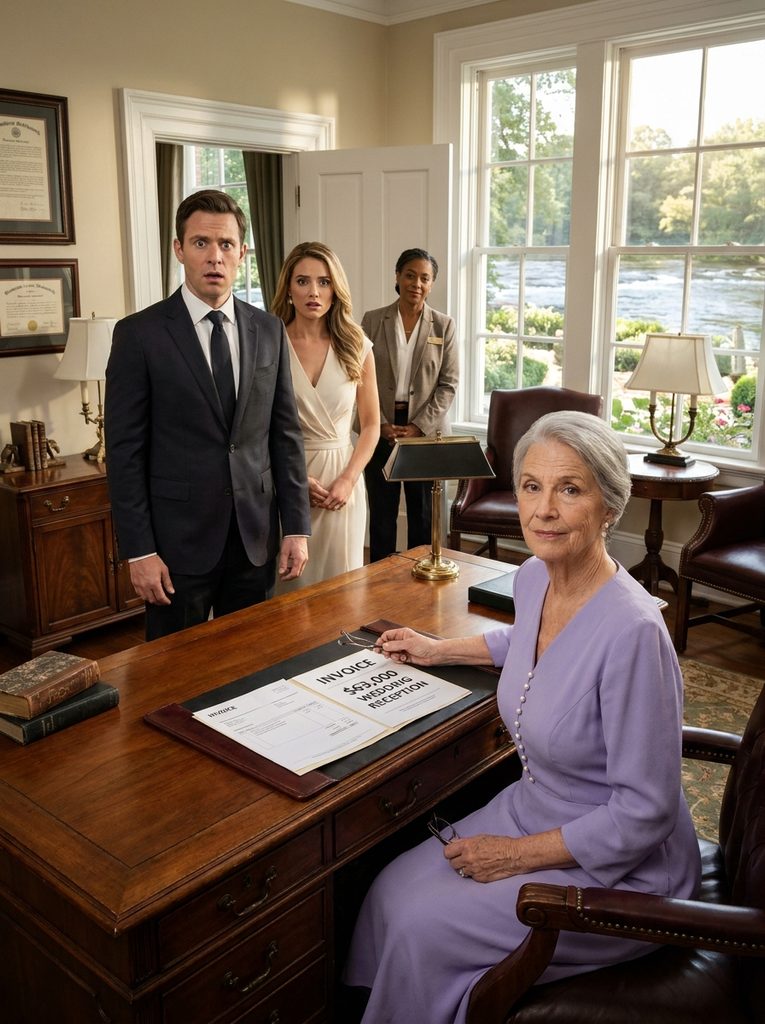
“Look, I don’t know what the problem is,” he said. “We’ve already paid the deposit, and the invitations are out. You can’t just change the arrangements six weeks before a wedding.”
Then he looked up.
His face changed.
“Mom?”
I folded my hands on Warren’s old desk.
“Good morning, Trevor.”
He looked at me, then at Ione, then back at me.
“What are you doing here?”
I almost laughed.
It was such a strange question.
I was sitting in my own office, in my own inn, behind my own desk, and my son wanted to know what I was doing there.
“I work here sometimes,” I said.
Kendall gave a small, uncomfortable laugh.
“That’s nice, Henrietta. But we really need to speak to the manager.”
Ione stood beside the filing cabinet.
“You’re speaking to her.”
Kendall frowned.
“To you?”
“No,” Ione said. “To Miss Henrietta.”
Trevor’s eyes narrowed.
“What’s going on?”
I took the printed invoice from the folder in front of me.
“Apparently, you’ve booked a wedding here.”
“Yes. Obviously.”
“And apparently, you’ve told my manager that your mother is deceased.”
Trevor’s mouth opened.
Nothing came out.
Kendall looked at him.
“What is she talking about?”
I placed the invoice on the desk.
“Forty-one thousand dollars for the reception. Twenty-two thousand for the honeymoon and additional expenses. Sixty-three thousand dollars in total.”
Trevor shifted his weight.
“Mom, this isn’t really the time.”
“Then when would be a good time, son? Before or after you spend my money?”
Kendall stepped forward.
“Excuse me. We were told the owner had approved everything.”
“I am the owner.”
Silence.
I watched the color disappear from Trevor’s face.
Kendall blinked twice.
Then she laughed.
Not because anything was funny.
Because she didn’t believe me.
“That’s impossible.”
I opened the drawer and removed a framed photograph.
It showed Warren and me standing outside the River Bend Inn on the day we finished restoring it.
Warren had his arm around my shoulder.
I was wearing an old pair of overalls and holding a hammer.
Behind us was a hand-painted sign that read:
RIVER BEND INN ESTABLISHED 1988
I turned the photograph toward them.
“Your father and I bought this place thirty-eight years ago. We rebuilt it ourselves.”
Trevor stared at the picture.
“I thought you sold it.”
“No.”
“You told me you were working at the library.”
“I do work at the library sometimes. I also manage the books for this place.”
“But—”
“But what?”
He looked at Ione.
“She’s the owner?”
Ione nodded.
“Every building, every room, every acre along this river. The property belongs to Miss Henrietta’s company.”
Kendall sat down without being invited.
“Well, this is a misunderstanding,” she said quickly. “We had no idea.”
I looked at her.
“You didn’t know I owned the inn?”
“No.”
“Did you know I was the groom’s mother?”
She glanced at Trevor.
“Of course.”
“Then why didn’t you look at me when you sat in your car outside my house?”
Her face tightened.
Trevor interrupted.
“Mom, please. We came here to discuss a booking, not to argue about family matters.”
I looked at my son for a long moment.
Then I asked the question I’d been holding inside since the day he stood on my porch.
“Trevor, why didn’t you want me at your wedding?”
He rubbed his forehead.
“Mom, we’ve been over this.”
“No. You’ve explained it. I haven’t asked you.”
He sighed.
“Kendall’s family is different. They have expectations.”
“And I don’t meet them?”
“It’s not like that.”
“Then tell me what it’s like.”
Kendall crossed her arms.
“Henrietta, I think you need to understand that this wedding is important to us. My parents have invited business partners, friends, people from our community. We want everything to look right.”
I looked down at my lavender dress.
The pearl buttons were still shining.
“I see.”
Trevor looked uncomfortable.
“Mom, I didn’t want to hurt you.”
“Then why did you?”
He didn’t answer.
I slid the invoice across the desk.
“One more thing. I want to know who told you that I would pay this bill.”
Trevor looked at me.
“You always said you’d help with my wedding.”
“I said I’d help you have a wedding. I didn’t say I’d finance a two-week first-class honeymoon while being forbidden from attending it.”
Kendall’s face reddened.
“That’s not fair.”
I nodded.
“You’re right. It isn’t.”
Then I picked up the telephone.
“Ione, would you please bring me the original booking agreement?”
She left the office.
Trevor leaned toward me.
“Mom, don’t do anything dramatic.”
I looked him straight in the eyes.
“Son, I spent forty-one years being quiet when people underestimated me. I think I’ve earned the right to speak.”
A few minutes later, Ione returned with a thick folder.
She placed it in front of me.
I opened it.
There was the contract.
And beneath it was a handwritten note from the wedding planner.
I read it once.
Then again.
My hands became cold.
Because the note contained a name I recognized.
Kendall’s mother.
And beside her name were instructions that had nothing to do with flowers, dinner, or music.
They had planned something else.
Something that made the sixty-three-thousand-dollar invoice look like the smallest part of the story.
PART 3: THE SECRET IN THE CONTRACT
I read the note aloud.
“Please make sure the owner’s office is not involved in any direct communication with the groom’s mother. The groom has confirmed she will not be attending. All correspondence should go through Mrs. Eleanor Whitmore.”
Kendall stood up.
“That’s a private note.”
“It was inside my business contract.”
“You have no right to read our private arrangements.”
I looked at her.
“This is my business file.”
Trevor took the paper from my hand.
“Mom, give me that.”
I didn’t move.
He read the note.
His expression changed.
“What is this?”
Kendall reached for the paper.
“Trevor, it’s nothing.”
“Why is your mother handling the booking?”
“Because she knows the planner!”
“Why does she need to make sure my mother doesn’t contact the office?”
Kendall said nothing.
Ione quietly closed the office door.
I turned another page.
There was an email printed from the wedding planner.
It had been sent three weeks earlier.
The subject line read:
River Bend Inn — Ownership and Payment Arrangements
I read the first paragraph.
Then I stopped.
The email said that Kendall’s mother had informed the planner that the groom’s family would be contributing a substantial amount toward the reception.
Not just the groom’s mother.
The entire groom’s family.
The note went on to mention a supposed family investment account.
I looked at Trevor.
“Did you tell them your father left you money?”
He frowned.
“No.”
“Did you tell them I had a trust fund?”
He looked away.
Kendall’s expression changed.
“Trevor, you told me your mother had money set aside.”
I felt something inside me go very still.
There it was.
The real reason.
“How much money did you tell her I had?”
He rubbed the back of his neck.
“I don’t remember.”
“Try.”
“Mom, this is embarrassing.”
“Then let’s finish being embarrassed.”
He finally said it.
“I told Kendall that Dad had left you a substantial inheritance. I said you were comfortable and that you’d probably help with the wedding.”
I nodded slowly.
“And did you tell her that I had agreed?”
He didn’t answer.
Kendall looked at him.
“You said it was already arranged.”
I turned toward the window.
Outside, a couple was walking along the riverbank.
They were holding hands.
I wondered how many promises people made to each other without understanding what those promises would cost.
“Trevor,” I said quietly, “your father left me this house, the inn, and a life we built together. He didn’t leave you a blank check.”
“I know.”
“Do you?”
He lowered his eyes.
I continued.
“I raised you in a small house. I bought you secondhand bicycles. I worked double shifts when your father was sick. I saved money so you could go to college.”
“I know, Mom.”
“And when your father died, I kept going. I never asked you to rescue me. I never asked you to pay my bills. I never asked you to give up your life for mine.”
My voice trembled.
“But I did expect you to remember that I was your mother.”
Trevor sat down.
For the first time that morning, he looked like the little boy who used to run through the inn’s garden with muddy shoes.
Kendall remained standing.
“Well, regardless of all this, the wedding is still happening,” she said.
I looked at her.
“Not here.”
Her mouth fell open.
“What?”
“The reservation will not proceed under the current agreement.”
“You can’t do that!”
“I can review any contract entered into using false information, and I will have our attorney examine the booking and payment obligations before making a final decision.”
Kendall turned to Trevor.
“Tell her!”
He looked helpless.
“Mom, please. We can’t lose this venue. Her parents have already told everyone.”
I folded my hands.
“Then perhaps you should have thought about that before telling people your mother was dead.”
He flinched.
Kendall’s eyes filled with angry tears.
“You’re humiliating us.”
I shook my head.
“No, dear. I’m no longer hiding what happened.”
She picked up her handbag.
“Come on, Trevor.”
But he didn’t move.
“Mom,” he said, “can we talk alone?”
I looked at Ione.
She nodded and stepped outside.
Kendall hesitated.
“Trevor?”
“Please. Just give me a minute.”
She walked out, closing the door behind her.
For a while, neither of us spoke.
Then Trevor said something I hadn’t expected.
“Mom, I didn’t think you’d actually find out.”
I stared at him.
“Find out what?”
He swallowed.
“The wedding wasn’t the only thing.”
I felt my heart begin to pound.
“What else?”
He looked down at his hands.
“Kendall’s father is having financial trouble. Their company has debts. They wanted the wedding at a place that would impress some investors.”
I didn’t interrupt.
“They thought having the River Bend Inn would make everything look established. They wanted to tell people the property was part of our family connections.”
I stared at him.
“Your family connections?”
He nodded.
“Her father said it would help him. He said people would feel more comfortable investing if they knew our families had a longstanding relationship with the inn.”
I slowly leaned back in Warren’s chair.
“Trevor, your father and I spent thirty-eight years building that relationship.”
He looked ashamed.
“I know.”
“No. You don’t.”
He wiped his face.
“Mom, I made a mistake.”
I looked at the contract again.
There was something else.
At the bottom of the last page was a request for a meeting with the inn’s owner.
The purpose?
A proposed long-term partnership.
I read the amount.
Then I looked up.
“Trevor, did you know they were planning to ask me to sell part of this property?”
His silence answered me.
And suddenly I understood.
The wedding was never just about the wedding.
It was an introduction.
A performance.
A way to bring two families together in front of wealthy guests while presenting a business opportunity that I had never agreed to.
I looked at the man I’d raised.
“How much of this did you know?”
He whispered:
“More than I should have.”
PART 4: THE PHONE CALL THAT CHANGED EVERYTHING
I asked Trevor to leave the office.
Not because I hated him.
Because I needed time to think.
He stood in the doorway.
“Mom, are you going to cancel everything?”
I looked at him.
“I’m going to protect what your father and I built.”
He nodded slowly.
Then he left.
I sat alone for nearly an hour.
The lavender dress felt tighter around my shoulders.
Ione came in with another cup of coffee.
“That was hard,” she said.
I nodded.
“Harder than I expected.”
“Do you want me to call the lawyer?”
“Yes. And ask him to review every document connected to this booking.”
She paused.
“Anything else?”
“Find out whether any outside party has been given permission to represent the inn.”
Ione wrote it down.
Then she asked the question I knew she had been waiting to ask.
“Miss Henrietta, what do you want to happen to the wedding?”
I looked out the window.
For years, I’d imagined my son’s wedding.
I’d imagined sitting in the front row.
I’d imagined Warren’s old pocket watch tucked into Trevor’s suit.
I’d imagined standing beside him while he promised to love someone for the rest of his life.
I’d imagined dancing with him.
Instead, I was sitting in an office reading documents about a wedding I wasn’t allowed to attend.
“I don’t know yet,” I said.
That afternoon, I received a call from a number I didn’t recognize.
“Mrs. Whitmore?”
“Speaking.”
“This is Martin Hale. I’m representing the wedding planner.”
“All right.”
“I understand there has been a disagreement regarding the River Bend booking.”
“There has been.”
He cleared his throat.
“We’re hoping to resolve the matter without unnecessary complications.”
“So am I.”
“Mrs. Whitmore would like to know whether the reception can continue as planned.”
I glanced at the contract.
“That depends on what the contract actually says and whether the representations made during booking were accurate.”
There was a pause.
“Perhaps we could arrange a meeting.”
“Send the documents to my attorney.”
“Of course.”
After the call, I sat quietly.
Then my phone rang again.
This time it was my son.
I let it ring twice before answering.
“Hello, Trevor.”
“Mom, Kendall is furious.”
“I’m sorry to hear that.”
“Her parents are saying you embarrassed them.”
I closed my eyes.
“Trevor, I didn’t invite them into my office. They came here.”
“They’re saying you’re trying to ruin the wedding.”
“I’m trying to understand why my own son told a business that I was dead.”
Silence.
Then he said:
“Can we start over?”
I looked at Warren’s photograph.
“Starting over requires telling the truth.”
“I’ll come tomorrow.”
“All right.”
“Can I bring Kendall?”
I thought for a moment.
“Bring her if she’s willing to listen.”
He said he’d try.
That night, I took the lavender dress out of the closet.
I removed the tags.
Then I carefully ironed the sleeves.
I didn’t know whether I would ever wear it to my son’s wedding.
But I wasn’t going to leave it hanging in the closet because someone had decided I wasn’t good enough.
PART 5: THE MORNING THEY CAME BACK
The following morning, Trevor arrived alone.
He looked exhausted.
His shirt was wrinkled, and there were dark circles beneath his eyes.
He sat across from me in the office.
“Where’s Kendall?” I asked.
“She didn’t want to come.”
I nodded.
“Then perhaps we should talk.”
He stared at the desk.
“Mom, I owe you an apology.”
I waited.
“I lied to Kendall about the money. I made it sound like you had agreed to pay for everything.”
“Why?”
“Because I wanted her family to think I could provide the wedding they expected.”
I folded my hands.
“You could have told them the truth.”
“I was afraid they’d think I wasn’t successful enough.”
“And what did you think I’d feel when you told me I wasn’t welcome?”
He closed his eyes.
“I didn’t think about that.”
That answer hurt more than anything else.
Not because it was cruel.
Because it was honest.
He continued.
“Her father said the wedding would help him meet investors. He wanted the inn because it’s beautiful and has a good reputation. He thought having the wedding here would make his business look more established.”
“And you agreed?”
“I didn’t think it would go that far.”
“Trevor, the invoice is sixty-three thousand dollars.”
“I know.”
“Someone expected me to pay it.”
He nodded.
“I know.”
I stood and walked toward the window.
“Do you remember when you were nine and you broke the kitchen window?”
He looked up.
“Yes.”
“You were terrified. You thought your father would be angry.”
“I remember.”
“He asked you who broke it. You told him the truth. Then he helped you replace the glass.”
Trevor gave a small, sad smile.
“I remember that, too.”
“Your father always said mistakes were easier to repair than lies.”
Trevor looked down.
“I wish he were here.”
“So do I.”
For a while, we sat in silence.
Then he said:
“Can you forgive me?”
I looked at him.
“Forgiveness isn’t a receipt, son. You don’t hand me an apology and expect everything to be paid in full.”
He nodded.
“What do I do?”
“Start by telling Kendall’s family the truth. All of it. Don’t leave anything out.”
He swallowed.
“And the wedding?”
“That is a decision you and Kendall will have to make.”
“Will you let us have it here?”
I took a deep breath.
“I haven’t decided.”
He looked disappointed.
But he didn’t argue.
That was something.
Then he reached into his jacket pocket and pulled out a small envelope.
“I found this in Dad’s desk.”
I took it.
My name was written on the front in Warren’s familiar handwriting.
Henrietta.
My fingers trembled.
I opened it carefully.
Inside was a short letter.
My darling Henny,
If you’re reading this, then I’m probably not there to remind you of something.
You have spent your life making sure everyone else has a place to sit.
Don’t ever forget that you deserve a place at your own table.
Warren.
I couldn’t speak.
Trevor watched me.
“I found it when I was going through some old boxes,” he said. “I should have brought it to you sooner.”
I pressed the letter against my chest.
For the first time in two days, I cried.
Not because of the wedding.
Because my husband had somehow found a way to sit beside me again.
PART 6: THE TRUTH COMES OUT
Three days later, Kendall’s father called.
His name was Richard Whitmore.
He had the kind of voice that sounded accustomed to being obeyed.
“Mrs. Henrietta, I think we should clear up a few misunderstandings.”
I was sitting at the kitchen table.
“All right.”
“I understand you’re concerned about the wedding arrangements.”
“I’m concerned about several things.”
He gave a little laugh.
“Well, young people sometimes get carried away. I wouldn’t read too much into it.”
“I won’t. I’ll read the contract.”
Silence.
Then he said:
“Look, the River Bend is a beautiful property. We were hoping to discuss a possible business relationship.”
“Your daughter’s wedding isn’t a business relationship.”
“Not directly.”
“Then what is it?”
He sighed.
“Mrs. Henrietta, I think we both understand that a property like yours could benefit from additional investment.”
I looked out the window at my little white house.
“I have managed this property for thirty-eight years.”
“Yes, but things change.”
“They do.”
“Perhaps we could purchase a portion of the grounds.”
“No.”
“You haven’t heard the proposal.”
“I heard enough.”
He paused.
“Your son seemed very interested.”
“My son isn’t the owner.”
“Well, perhaps you should discuss that with him.”
“I already have.”
His voice hardened.
“You’re making this unnecessarily difficult.”
I smiled.
It was a small smile, but it was real.
“Mr. Whitmore, I have spent my life doing difficult things. Raising a child, caring for a sick husband, restoring a building that was falling into the river. Saying no to a business proposal is not the difficult part.”
He hung up.
That afternoon, I received another email.
It came from Kendall.
The subject line was:
You Have Gone Too Far
I read it slowly.
She accused me of interfering with her wedding.
She said I was jealous.
She said I was trying to control Trevor.
She said her parents had already spent money on arrangements.
And then came the sentence that made me put down my coffee.
“Trevor told me you were happy to help because you wanted to make up for not being included in our lives.”
I stared at the screen.
I had never said that.
I had never asked to buy my way into anyone’s life.
I replied with just one sentence.
“Please direct all financial and contractual questions to my attorney.”
Then I closed the laptop.
For the first time in weeks, I slept peacefully.
PART 7: THE WEDDING THAT ALMOST WASN’T
The following Sunday, Trevor came to my house.
This time, he came inside.
He sat at the kitchen table where he’d eaten hundreds of meals as a child.
I made him coffee.
He looked around.
“Nothing’s changed.”
“Some things have.”
He nodded.
“Mom, Kendall and I have been arguing.”
“I’m sorry.”
“She says I embarrassed her family.”
I stirred my coffee.
“Did you?”
He looked at me.
“Yes.”
“Then you have something to apologize for.”
He rubbed his face.
“She wants to move the wedding to another venue.”
“That’s her choice.”
“Her parents are refusing to pay the extra costs.”
I said nothing.
“Mom, I don’t know what to do.”
I looked at him.
“Do you love her?”
“Yes.”
“Does she love you?”
He hesitated.
“I think so.”
I set down my spoon.
“Trevor, marriage is not a performance for other people. It isn’t a competition between families. And it certainly isn’t a business presentation.”
He stared at the table.
“I know.”
“Do you want to marry Kendall because you love her, or because you want her family to think you’re successful?”
He didn’t answer.
I reached across the table and touched his hand.
“You don’t have to be rich to be a good husband.”
He looked up.
“You don’t have to impress people with a first-class honeymoon. You don’t have to serve dinner to two hundred guests. And you don’t have to pretend your mother is someone else.”
His eyes filled.
“I know I hurt you.”
“Yes.”
“I don’t know how to fix it.”
“Then don’t try to fix it in one day.”
He stayed for lunch.
We talked about his father.
We talked about the old inn.
We even laughed about the time he fell into the pond chasing a frog.
It was the first ordinary afternoon we’d shared in years.
When he left, he hugged me with both arms.
Not the one-armed hug from my porch.
A real one.
But the wedding was still uncertain.
And so was the future of his relationship.
PART 8: THE CHOICE
A week later, Kendall came to see me.
Alone.
I was in the inn’s garden, trimming the roses.
She stood by the gate.
“Henrietta?”
I turned.
“Good afternoon.”
She looked uncomfortable.
“Can we talk?”
I put down the shears.
“Of course.”
We sat on the garden bench.
For a few minutes, she didn’t say anything.
Then she spoke.
“I owe you an apology.”
I waited.
“I was wrong to treat you the way I did.”
I looked at her.
“Why did you?”
She took a breath.
“My mother always said that the people we associate with reflect our status. She wanted everything about this wedding to look perfect.”
“And I didn’t fit?”
Kendall looked down.
“I thought you would make my family uncomfortable.”
I nodded.
“Did you ever consider that your family might make me uncomfortable?”
She looked up.
“No.”
“Well, they did.”
Her eyes filled with tears.
“I know.”
She told me that her parents had spent years making her feel that she had to marry someone who could match their lifestyle.
Trevor had told her stories about his father’s business and the inn.
She had believed those stories.
And when she discovered that Trevor had exaggerated his family’s wealth, she became angry.
“That’s why you wanted me to pay,” I said.
She nodded.
“I thought you had money. I thought Trevor had told you.”
“He didn’t.”
“I know that now.”
I looked at the river.
“Money is a funny thing, isn’t it? People spend their lives chasing it, and sometimes they forget what they’re supposed to be building.”
Kendall wiped her eyes.
“I don’t expect you to forgive me.”
“That’s good.”
She gave a small, sad laugh.
“But I wanted you to know I’m sorry.”
I nodded.
“Thank you for saying that.”
Then she asked:
“Would you still want to come to the wedding?”
I looked at her.
She wasn’t asking whether I’d pay.
She wasn’t asking whether I’d make the venue available.
She was asking whether I would come.
And that was different.
“I would like to be there,” I said. “But I won’t buy my place at the table.”
She nodded.
“You shouldn’t have to.”
PART 9: THE DAY OF THE WEDDING
The wedding took place on the third Saturday in June.
Not at the original grand reception.
Not with a string quartet and two hundred guests.
Trevor and Kendall chose a smaller ceremony at the River Bend Inn after the booking and financial arrangements had been reviewed and properly rewritten.
The honeymoon was postponed.
The extravagant reception was replaced with a modest dinner.
Their parents were told the truth.
Some people didn’t come.
Others came anyway.
And I wore my lavender dress.
The little pearl buttons shone in the afternoon sunlight.
I arrived early.
Ione met me at the front steps.
“Miss Henrietta,” she said, “you look beautiful.”
I smiled.
“Thank you, honey.”
She handed me a small bouquet of white roses.
“These are from the garden.”
I held them carefully.
Then I walked into the reception room.
The tables were decorated with simple white flowers.
There were candles along the windowsills.
The river was visible through the glass doors.
It was beautiful.
Not because it was expensive.
Because it felt like home.
Trevor stood near the entrance.
When he saw me, he walked toward me.
He was wearing Warren’s old pocket watch.
My breath caught.
“Where did you find that?”
“In Dad’s dresser.”
He smiled.
“I thought he should be here.”
I touched the watch.
“He would have liked that.”
Then Trevor took my hands.
“Mom, there’s something I want to ask you.”
“What is it?”
“Would you walk me down the aisle?”
I couldn’t answer.
For a moment, I was twenty years younger.
I could see Warren standing beside me.
I could hear Trevor laughing in the garden.
I could remember the little boy who used to fall asleep on my shoulder.
And now he was standing in front of me, asking me to walk beside him.
“Yes,” I whispered.
“Of course I will.”
The ceremony was held beneath the big oak tree.
Kendall looked beautiful.
Her father sat in the front row.
He didn’t look at me.
I didn’t need him to.
When Trevor and I reached the front, my son squeezed my hand.
Then he leaned toward me.
“I’m sorry, Mom.”
I whispered back:
“Be a good husband.”
He nodded.
And I took my seat.
When the vows were exchanged, I cried.
Not because everything had been repaired.
Some things take longer.
But because my son had finally remembered where he came from.
After the ceremony, the guests gathered in the reception room.
There was no grand announcement.
No display of wealth.
No speeches about family connections.
Just dinner, music, and people who had come to celebrate two people beginning a life together.
Then Trevor stood with a microphone.
“I want to say something about someone important.”
He looked toward me.
My stomach tightened.
“Today, I married the woman I love. But I also need to acknowledge someone I’ve hurt.”
The room became quiet.
“My mother.”
I lowered my eyes.
“She built more than I ever understood. She raised me, supported me, and worked harder than anyone I’ve known. And when I got engaged, I made her feel like she wasn’t good enough to stand beside me.”
He stopped.
His voice cracked.
“I told people she was dead because I was ashamed of a life I didn’t understand. I asked her to pay for a wedding she wasn’t even invited to.”
Someone in the room gasped.
Kendall reached for his hand.
Trevor continued.
“She didn’t deserve that. I don’t expect one speech to make things right. But I want everyone here to know that I’m proud to be her son.”
He looked directly at me.
“And I hope I can spend the rest of my life becoming someone she can be proud of, too.”
The room was silent for a moment.
Then people began to clap.
I didn’t stand.
I simply wiped my eyes.
Because the apology I had wanted wasn’t about money.
It wasn’t about the inn.
It wasn’t about the wedding.
It was about being seen.
And for the first time in a long time, my son had looked at me and truly seen me.
PART 10: THE FINAL BILL
Three months passed.
The wedding photographs arrived.
I placed one on the mantel beside Warren’s picture.
In it, Trevor and I were standing beneath the oak tree.
He was smiling.
I was holding my bouquet.
The lavender dress looked beautiful.
One afternoon, Trevor came to visit.
He brought a box of pastries from a bakery in town.
He sat at the kitchen table and looked at the photograph.
“Mom, I’ve been thinking.”
“That’s usually a dangerous beginning.”
He laughed.
Then he became serious.
“I want to pay you back.”
“For what?”
“For the money I asked you for.”
I looked at him.
“You didn’t get the money.”
“I know. But I still owe you something.”
He reached into his bag and pulled out an envelope.
Inside was a check.
Not for sixty-three thousand dollars.
For a smaller amount.
It was money he’d saved from his own account.
“I want you to have this,” he said. “Not because you need it. Because I need to make things right.”
I looked at the check.
Then I looked at him.
“Trevor, I don’t want you paying me to be your mother.”
He shook his head.
“That’s not what this is.”
I folded the check and placed it back in the envelope.
“Then let’s do something better.”
He looked confused.
I pointed toward the window.
“See that little cottage behind the inn?”
He nodded.
“It needs repairs. I want to turn it into a place where young couples who can’t afford a grand wedding can stay for a weekend.”
He smiled.
“That sounds like you.”
“Maybe we could call it Warren’s Cottage.”
He nodded slowly.
“I’d like that.”
“Then if you want to help, come work with me.”
He laughed.
“You want me to paint?”
“I want you to learn what your father and I built.”
And so, the following Saturday, Trevor showed up with work clothes.
He painted the cottage.
He repaired a broken fence.
He learned how the bookings worked.
He sat with Ione and went through the old records.
And little by little, he began to understand that the inn was not simply a beautiful building beside a river.
It was a lifetime of love, work, sacrifice, and memories.
One evening, while we were cleaning brushes, he asked me something.
“Mom, why didn’t you ever tell me how much the inn was worth?”
I smiled.
“Because I never wanted you to love it for its price.”
He looked down.
“I wish I’d understood that sooner.”
“So do I, son.”
EPILOGUE: THE WOMAN WHO NEVER NEEDED AN INVITATION
A year later, Warren’s Cottage opened.
We invited families who couldn’t afford expensive celebrations to spend a weekend at the inn.
Some came to celebrate weddings.
Others came to celebrate anniversaries.
One couple came because they’d been married for forty years and had never taken a honeymoon.
I gave them the cottage for three nights.
When Trevor heard, he smiled.
“You’re going to give the place away again, aren’t you?”
I laughed.
“Not away. I’m giving someone a memory.”
Kendall began volunteering to help organize the weekends.
She and I weren’t suddenly best friends.
Trust takes time.
But we learned to speak honestly.
She stopped worrying so much about appearances.
Trevor started visiting every Sunday.
Sometimes he brought groceries.
Sometimes he brought flowers.
Sometimes he simply came to sit at the kitchen table and talk.
And I stopped waiting for the phone to ring.
I had a life of my own.
One afternoon, I was sitting on the inn’s front porch when Ione brought me a letter.
“Miss Henrietta, this came for you.”
The envelope was addressed in Trevor’s handwriting.
Inside was a photograph of him and Kendall standing beneath the oak tree.
On the back, he’d written:
Mom, thank you for teaching me that family isn’t measured by what people own, but by how they treat the people who love them.
I hope you know that you will always have a place at our table.
Love, Trevor.
I held the photograph for a long time.
Then I looked toward the river.
The water moved slowly beneath the afternoon sun.
Warren used to say that an inn was just a house that never went to sleep.
I thought about all the people who had passed through those doors.
All the couples who had fallen in love.
All the families who had celebrated.
All the strangers who had become friends.
And I thought about my son.
He had once believed that I was poor because I lived in a small white house and drove an old sedan.
He had believed that expensive clothes and impressive guests made a person important.
He had believed that his mother’s worth could be measured by whether she fit into someone else’s idea of elegance.
But he had been wrong.
I had never needed a mansion.
I had never needed a sailboat.
I had never needed an invitation from people who thought they were better than me.
I had a home.
I had memories.
I had a business Warren and I built with our own hands.
And, eventually, I had a son who was learning how to love me properly.
That evening, I went back to my little white house.
I hung the lavender dress in the closet.
This time, I didn’t leave the tags on.
I put Warren’s letter in the drawer beside my bed.
Then I turned off the light.
And before I fell asleep, I whispered:
“Well, Warren, our boy finally understands.”
I smiled.
“Turns out, I was never the one who didn’t belong.”
Because here’s what I’ve learned after all these years:
Never mistake a person’s modest lifestyle for a lack of worth.
Some people wear expensive clothes but have very little kindness.
Some people live in little white houses but have built entire worlds with their own hands.
And sometimes the person sitting quietly at the kitchen table is the very person who owns the building everyone else is trying so hard to impress.
But the greatest lesson wasn’t that I owned the River Bend Inn.
It wasn’t that I could cancel a booking or refuse to write a check.
It wasn’t even that my son eventually apologized.
It was this:
A mother’s love should never have to be purchased with a sixty-three-thousand-dollar bill.
And a place in your child’s life should never depend on how much money you can bring to the table.
I was Henrietta.
I was a mother.
I was a widow.
I was a businesswoman.
I was the woman who had sewn every curtain in that old inn.
And I was finally done apologizing for being exactly who I was.
THE END.