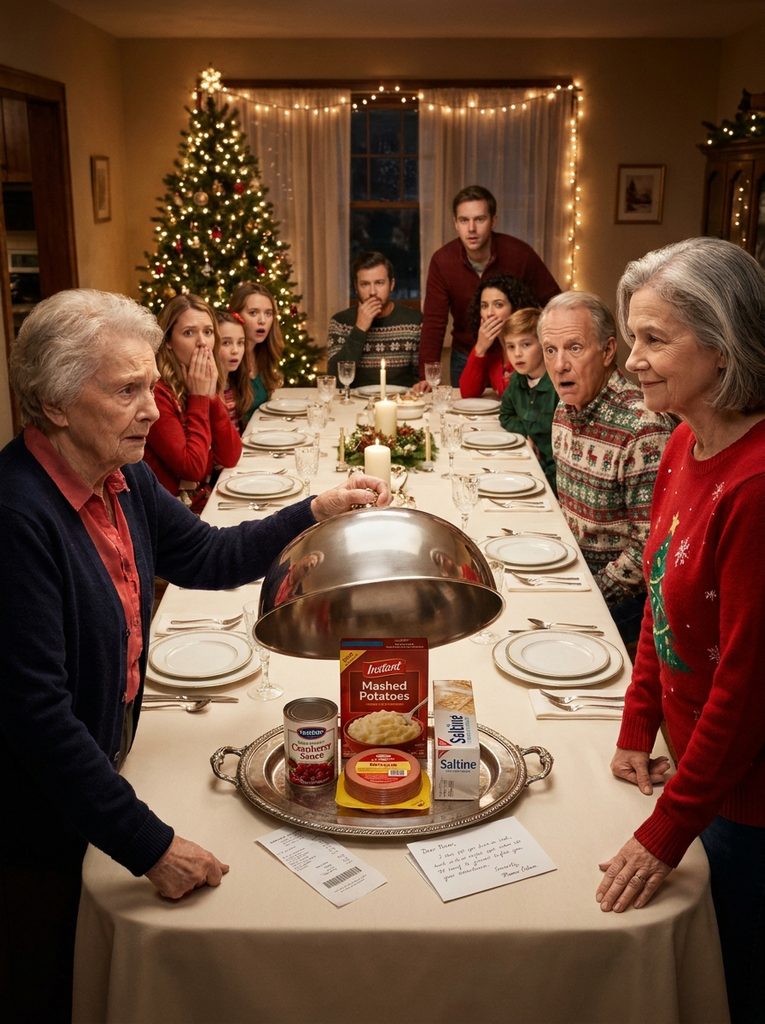
The grandchildren leaned forward.
His brother Clell raised his glass.
“Here’s to Twyla. Best cook in Missouri!”
Everybody chuckled.
Mama lifted the lid.
And then the room went completely silent.
There was no turkey.
No golden-brown skin.
No smell of sage and butter.
No steaming cornbread dressing.
Instead, sitting in the middle of my mother’s beautiful silver platter, were one can of cranberry sauce, a box of instant mashed potatoes, a package of bologna, and a sleeve of saltine crackers.
Beside them sat a little white receipt.
Nine dollars and eighty-seven cents.
Darwin stared at the platter.
Then he looked at me.
“What in the hell is this?”
I stood beside the kitchen doorway, wearing my coat and holding my purse.
“Merry Christmas, Darwin.”
He blinked.
“Where’s the turkey?”
“Under the lid, just like you asked.”
A few people laughed nervously.
Darwin didn’t.
“Twyla, this isn’t funny.”
“Neither was the lodge party.”
His face changed.
I could see him trying to understand what I was saying.
Then he spotted the folded note beside the receipt.
He picked it up.
“What is this?”
“Something I thought you might want to read.”
He unfolded it.
His eyes moved across the page.
His mouth opened, but nothing came out.
Clell leaned over.
“What does it say, Dar?”
Darwin folded the paper quickly.
“Nothing. It’s just Twyla being dramatic.”
“Then read it aloud,” I said.
He looked at me.
For the first time in forty-one years, my husband didn’t seem to know what to say.
Mama Odom reached for his arm.
“Darwin, honey, what is happening?”
I stepped closer to the table.
“I’ll tell you, Mama.”
I looked around at all eighteen people.
“Forty-one years ago, I married Darwin. I was twenty-three. I had a little apartment, a used car, and a job at the bank. I thought I was marrying a man who wanted to build a life with me.”
I paused.
“When Darwin started Odom Plumbing, he didn’t have an office. He had a toolbox, an old truck, and a dream. I believed in that dream.”
Darwin shifted in his chair.
“Twyla, sit down. We can talk about this later.”
“No, honey. We can talk about it now. You’ve spent forty-one years talking about me in front of other people. I think it’s my turn.”
Nobody moved.
“I kept his books at our kitchen table. I wrote the invoices. I called customers who hadn’t paid. I balanced payroll. I filed taxes. I tracked expenses and ordered parts. I did all of it after cooking supper and washing the dishes.”
I turned toward his brothers.
“How many of you know that your brother never paid me for one hour of that work?”
Clell looked down.
His wife, Brenda, slowly lowered her fork.
Darwin shook his head.
“We were married. It was a family business.”
“Exactly,” I said. “A family business. But somehow, only one person in this family was expected to work for free.”
I looked at the children.
“I wasn’t just keeping his books. I was keeping this family running. I made sure birthdays were remembered, Christmas presents were bought, and everybody had somewhere to sit when they came through that door.”
I touched the silver platter.
“And every Christmas, I cooked for all of you.”
My voice cracked.
“Not because I hated cooking. Not because I didn’t love you. I did it because I wanted this house to feel like a home.”
Mama Odom’s eyes were filling with tears.
I continued.
“Then, last Saturday, your brother stood in front of a room full of people and gave me ten dollars.”
Clell rubbed his forehead.
“He called me the best maid in Missouri.”
Darwin interrupted.
“It was a joke!”
I turned toward him.
“Yes. Everybody laughed. Especially Pinky Dubose. He nearly cried laughing.”
“You’re making too much of it.”
“No, Darwin. I’ve been making too little of myself for forty-one years.”
The room was so quiet I could hear the clock ticking above the fireplace.
I pointed to the groceries.
“That’s what ten dollars buys at Dollar General. Nine dollars and eighty-seven cents, to be exact. I spent your entire Christmas bonus on the Christmas dinner you said I owed your family.”
Darwin stood up.
“You cannot do this to my family!”
I looked at him.
“Your family?”
Then I smiled sadly.
“Darwin, I thought I was part of it.”
Mama Odom started crying.
And that was the moment I knew this Christmas would never be forgotten.
Because the next person to speak wasn’t Darwin.
It was his ninety-one-year-old mother.
“Twyla, sugar,” she whispered, “is that really how he’s treated you?”
I looked at her.
“I didn’t want you to be hurt, Mama.”
She turned slowly toward her son.
“Darwin Lee Odom, sit down.”
He froze.
“Now.”
He sat.
Mama took the note from his hand.
She unfolded it and began reading aloud.
And what she read next changed everything.
PART 3 — THE NOTE THAT CHANGED THE ODOM FAMILY
The note was written on a sheet of yellow legal paper.
I had written it the night before, sitting at the same kitchen table where I’d spent thousands of hours working for my husband.
Mama Odom adjusted her glasses.
Her voice trembled as she read.
“Dear Darwin,
You gave me ten dollars for forty-one years of work.
I want you to know what that means.
It means you paid me approximately twenty-four cents for every year I spent beside you.
But I don’t want to argue about the ten dollars.
I want to talk about the forty-one years.
For forty-one years, I helped build your business. I worked without wages, without benefits, and without a retirement account.
I never asked you for a raise because you always told me we were building something together.
I believed you.
I believed that when we got old, we would sit on the porch and enjoy what we had built.
But last Saturday, when you called me your maid, I finally understood something.
You never saw me as your partner.
You saw me as someone who would always be there to clean up after you.
So today, I’m giving you exactly what you paid for.
No more unpaid bookkeeping.
No more unpaid office work.
No more Christmas dinners for eighteen people.
No more pretending that a joke is harmless when the person being laughed at is the only one who knows how much it hurts.
The food on this platter is my final Christmas gift to you.
You can divide it among yourselves.
As for me, I’m going somewhere I am wanted.
Merry Christmas.
Twyla.”
Mama stopped reading.
She folded the paper.
Then she looked at her son.
“Is this true?”
Darwin rubbed his face.
“Mother, you don’t understand. Twyla and I have always handled things this way.”
Mama’s expression hardened.
“I understand more than you think.”
He sighed.
“She never asked me for money.”
I almost laughed.
There it was.
The sentence I’d heard for forty-one years.
I stepped forward.
“You’re right, Darwin. I never asked.”
He looked relieved.
Then I continued.
“But you never offered, either.”
Clell cleared his throat.
“Dar, maybe you ought to apologize.”
Darwin turned on him.
“Stay out of this.”
Brenda spoke for the first time.
“Actually, I think we should all listen.”
She looked at me.
“Twyla, I never knew you did all that paperwork.”
“Most people didn’t.”
“Why didn’t Darwin hire someone?”
I shrugged.
“Because I was free.”
Nobody answered.
Then one of the nieces, a young woman named Ashley, spoke from the far end of the table.
“Aunt Twyla, is that why you never came to the lake with us in July?”
I nodded.
“That was payroll week.”
She looked at Darwin.
“Uncle Darwin told us you didn’t like vacations.”
I smiled without humor.
“I liked vacations just fine, sweetheart. I just couldn’t take one.”
The room shifted.
People were beginning to understand that the story they’d told themselves about me wasn’t true.
I was not the woman who loved staying home.
I was the woman who had never been given a chance to leave.
Mama Odom reached for my hand.
“Come sit beside me, sugar.”
I sat.
She held my fingers in both of hers.
“When my husband was alive, I worked in the fields with him,” she said. “I raised three boys, cooked every meal, and kept that house standing. Your father-in-law never called me a maid.”
She looked at Darwin.
“He called me his wife.”
Darwin stared at the table.
Mama continued.
“I watched you work, Twyla. Every Christmas. Every birthday. Every Sunday after church when you brought food over because I wasn’t feeling well.”
She wiped her cheek.
“I thought you did it because you loved us.”
“I did, Mama.”
“Then why didn’t we see you?”
That question hurt more than anything Darwin had said.
Because she was right.
They had enjoyed everything I gave them.
But nobody had ever asked what it cost.
I reached into my purse and pulled out another envelope.
Darwin noticed it.
“What now?”
“This is the last thing.”
I placed it on the table.
Inside was a copy of the business records I’d prepared over the previous weeks.
I had printed a list of the work I’d performed for Odom Plumbing.
Payroll records.
Tax filings.
Invoices.
Customer accounts.
Supplier payments.
Dates and hours.
Forty-one years of records.
And beneath them was a second document.
A letter from a local accountant I’d consulted after the lodge party.
I hadn’t planned to make a scene at Christmas.
But after the ten-dollar bill, I needed to know something.
I needed to know whether all those years of unpaid work had left me with any rights.
The accountant had told me that the answer depended on the business structure, the records, and the laws involved.
He’d advised me to stop doing the books until I had proper independent advice.
So I had.
I handed Darwin the envelope.
“I am no longer handling your business accounts.”
He stared at me.
“You can’t just quit.”
“Watch me.”
“Payroll is next Friday!”
“Then you’d better find someone to do it.”
He shook his head.
“You know how hard that will be?”
I looked at him.
“Yes, Darwin. I’ve known for forty-one years.”
He opened the envelope.
His face went pale when he saw the list of responsibilities.
Not because he didn’t know I did those things.
Because he’d never realized how many there were.
Mama Odom leaned back.
“Well,” she said quietly, “looks like somebody’s finally going to have to learn how to take care of himself.”
A few people smiled.
But I wasn’t smiling anymore.
I picked up my purse.
“I hope you all enjoy Christmas.”
Clell stood.
“Twyla, wait. You’re leaving?”
“Yes.”
“Where are you going?”
“To the church fellowship hall. Myrtle and I are serving dinner.”
He looked confused.
“You’re cooking for them?”
“Yes.”
“But what about us?”
I looked at the platter.
“You have ten dollars’ worth of Christmas dinner right there.”
Then I opened the door.
Cold Missouri air rushed into the house.
And for the first time in forty-one years, I walked out of my own kitchen without worrying about whether anybody had enough gravy.
But I hadn’t gone far.
Because as I reached my car, I heard the front door open behind me.
“Twyla!”
It was Mama Odom.
She was standing on the porch with her coat wrapped around her shoulders.
I turned.
She walked slowly down the steps.
Then she took my hands.
“Would you mind if I came with you?”
I stared at her.
“Mama, you don’t have to.”
“I know I don’t.”
She looked back at the house.
“That’s rather the point, isn’t it?”
And then she smiled.
“Besides, I haven’t had a proper Christmas dinner at the church in years.”
I helped her into the passenger seat.
As I drove away, I looked in the rearview mirror.
Darwin was standing in the doorway.
He wasn’t laughing anymore.
PART 4 — THE CHRISTMAS I FINALLY BELONGED TO MYSELF
The church fellowship hall smelled like roasted chicken, coffee, and cinnamon.
There were paper snowflakes taped to the windows.
A small Christmas tree stood beside the piano.
Myrtle was wearing her usual green apron, with a little embroidered angel over the pocket.
When she saw me walk through the door, she threw both arms in the air.
“THERE SHE IS!”
Then she saw Mama Odom.
Her expression changed.
“Well, look at you, Miss Odom! We’ve got royalty joining us today.”
Mama laughed.
“Don’t start, Myrtle. I came for the dressing.”
“Then you’ve come to the right place.”
Myrtle turned to me.
“Come on, girl. We’ve got work to do.”
For the next hour, I helped serve dinner.
There were elderly people who lived alone.
A young couple with two small children.
A man who had recently lost his job.
A widow who had no family left.
A family passing through town whose car had broken down on the highway.
Nobody asked why I hadn’t cooked at home.
Nobody asked whether I had enough pies.
Nobody called me a maid.
They called me Twyla.
And when I carried a plate to an elderly man sitting alone by the window, he looked up and said:
“Thank you, ma’am. I was afraid I’d be eating crackers today.”
I smiled.
“Well, not today.”
He looked at the food.
“God bless you.”
I walked back to the kitchen, and suddenly my eyes filled.
Myrtle noticed.
“What’s wrong?”
I shook my head.
“Nothing.”
She put a hand on my shoulder.
“That’s not a nothing face.”
I laughed through my tears.
“I think I’m just happy.”
She nodded.
“Well, get used to it.”
Mama Odom sat at a table with a group of older women.
She was telling them stories about raising three boys in a house with one bathroom.
They were laughing so hard that one woman nearly spilled her coffee.
I watched her for a moment.
Then I realized something.
Mama wasn’t embarrassed.
She wasn’t angry with me.
She was enjoying herself.
And so was I.
At three o’clock, Myrtle handed me a paper plate with a slice of pecan pie.
“Sit down and eat.”
“I need to wash the pans.”
“They can wait.”
“But—”
“Twyla.”
I stopped.
She pointed to the chair.
“Sit.”
So I did.
I took one bite of pie.
It was warm and sweet.
And for the first time in forty-one years, I ate Christmas dinner without wondering whether everybody else had enough.
At four, my phone began ringing.
Darwin.
I let it ring.
Then it rang again.
And again.
Finally, I answered.
“Hello?”
“Where are you?”
“At the church.”
“Well, get home. Your brothers are still here.”
I looked around the fellowship hall.
People were laughing.
Children were decorating cookies.
Myrtle was singing along with the radio.
“I won’t be coming home tonight.”
There was a long pause.
“What do you mean, you won’t be coming home?”
“I mean I’m staying here until the dinner is over.”
“Twyla, this has gone far enough.”
I closed my eyes.
“No, Darwin. It went far enough forty-one years ago.”
He lowered his voice.
“Mother’s upset.”
I looked across the room.
Mama Odom was laughing with a woman named Evelyn, who had brought homemade apple butter.
“She’s right here. She seems fine.”
“Put her on the phone.”
I walked over and handed Mama my phone.
“Your son wants to talk to you.”
She took it.
“Hello, Darwin.”
I couldn’t hear what he said.
Mama listened.
Then she answered.
“No, son. I’m not coming home yet.”
Another pause.
“Because I’m having Christmas dinner.”
She listened again.
Then she said something that made me turn away so she wouldn’t see me smile.
“Darwin, you gave your wife ten dollars for forty-one years of work. I believe you can manage one afternoon without her.”
She hung up.
Then she handed me the phone.
“Men,” she said, shaking her head. “Some of them never learn.”
We laughed.
But the evening wasn’t finished.
At six o’clock, I received a message from Clell’s wife, Brenda.
It read:
Twyla, I’m sorry. I should have said something at the lodge. I laughed because everybody else laughed. I’ve thought about it all afternoon. You deserved better.
I read it twice.
Then I replied:
Thank you, Brenda. I appreciate that.
A few minutes later, another message came.
This time from Ashley.
Aunt Twyla, can I come help you at the church next Christmas? I want to learn how to cook your dressing.
I smiled.
I’d love that, sweetheart.
And then, at seven-thirty, Darwin finally called again.
This time, I answered.
“Hello?”
His voice sounded different.
Smaller.
“Twyla, the house is a mess.”
I nearly laughed.
“That sounds inconvenient.”
“Nobody knows where anything is.”
“That’s unfortunate.”
“There’s paperwork everywhere.”
“Yes.”
“And the boys are asking about payroll.”
“Then you should answer them.”
He was quiet.
Then he said:
“I don’t know how you kept track of all this.”
I looked at my hands.
Hands that had written thousands of checks.
Hands that had rolled out pie crusts.
Hands that had washed his work shirts and folded his socks.
Hands that had held his mother’s when she was sick.
I answered softly.
“That’s because you never had to know.”
He breathed into the phone.
“Are you coming home?”
I looked around the room.
At Myrtle.
At Mama Odom.
At the people sitting together over paper plates and Christmas cookies.
And I said:
“Not tonight.”
Then I hung up.
PART 5 — THE FIRST TIME DARWIN HAD TO PAY
The days after Christmas were strange.
For forty-one years, my mornings had started with coffee, a list, and whatever needed doing for Odom Plumbing.
Now I woke up and didn’t have a business to manage.
At first, I didn’t know what to do with myself.
I made coffee.
I watered the plants.
I read the newspaper.
I sat on the porch.
Sometimes I felt guilty.
Then I’d remember the lodge party.
Best maid in Missouri.
And the ten-dollar bill.
And the guilt would pass.
On December twenty-eighth, Darwin came home with a box of doughnuts.
He placed them on the kitchen counter.
“I thought we could talk.”
I poured myself coffee.
“All right.”
He sat down.
For a while, he just stared at his hands.
Then he said:
“I called an accountant.”
I nodded.
“Good.”
“He says it’s going to take a while to get everything organized.”
“I imagine.”
“He wants copies of the old records.”
“I left them in the filing cabinet.”
He looked at me.
“You kept everything?”
“Of course.”
“Forty-one years?”
“Yes.”
He shook his head.
“I don’t know how you did it.”
I took a sip of coffee.
“I do.”
He waited.
“I did it because you needed it done.”
He nodded slowly.
Then he reached into his coat pocket.
He pulled out an envelope.
“I want you to have this.”
I didn’t reach for it.
“What is it?”
“Money.”
“How much?”
“Five hundred dollars.”
I looked at him.
He pushed it across the table.
“For Christmas. I know the ten-dollar thing went wrong.”
I almost smiled.
“Darwin, you still don’t understand.”
He frowned.
“What?”
“You think this is about the amount.”
“Well, I know it wasn’t enough.”
“It wasn’t about whether you gave me ten dollars or five hundred.”
I pushed the envelope back.
“It’s about how you saw me.”
He leaned back.
“I never thought of you as a maid.”
“Then why did you call me one?”
He opened his mouth.
Closed it.
Then looked down.
“I thought everybody would laugh.”
“They did.”
“I was trying to be funny.”
“I know.”
He looked up.
“Can we just put it behind us?”
I took a breath.
“No.”
His expression fell.
“Then what do you want?”
It was a question I’d waited forty-one years to hear.
Not because I wanted money.
Not because I wanted a new car.
Not because I wanted a diamond bracelet.
I wanted something much simpler.
“I want to be your wife, Darwin. Not your unpaid employee. Not your housekeeper. Not the person who remembers everything you forget.”
He looked at me.
“I want you to see me.”
He rubbed his chin.
“I do see you.”
“No. You see what I do.”
I stood up.
“And that’s not the same thing.”
He stayed at the table.
I went upstairs.
That afternoon, I called the accountant.
I told him I wanted an independent review of my past work and the business arrangements.
He explained that we would need to examine the company’s structure and financial history before determining what claims, if any, I might have.
I agreed.
I wasn’t going to accept another envelope just because Darwin felt guilty.
If we were going to change anything, it would be done properly.
A week later, Darwin hired a part-time bookkeeper.
Her name was Melissa.
She was twenty-eight, had a degree in accounting, and charged by the hour.
Darwin complained about the bill.
I didn’t say a word.
But when he asked me to show her where the invoices were kept, I said:
“That sounds like something you should arrange with her.”
He stared.
“You’re not going to help?”
“No, Darwin.”
He sighed.
Then he called Melissa.
For the first time in forty-one years, Odom Plumbing paid someone to do the work I’d been doing.
And for the first time in forty-one years, I had a Saturday morning to myself.
I went to the beauty shop.
I bought a new blue sweater.
I met Myrtle for lunch.
And when she asked what I was going to do with the rest of my life, I told her:
“I haven’t decided yet.”
She smiled.
“Well, that’s a mighty fine place to start.”
PART 6 — THE FAMILY THAT FINALLY LEARNED MY NAME
January passed.
Then February.
Darwin and I were still living in the same house, but things were different.
We ate breakfast together.
Sometimes we talked.
Sometimes we didn’t.
He started washing his own work clothes.
The first time he put a red shop rag in with my white towels, I laughed so hard I had to sit down.
He didn’t find it funny.
But I did.
He also started remembering his mother’s appointments.
He learned where the grocery store kept the coffee filters.
He even figured out how to use the washing machine without calling me.
Small things.
But after forty-one years, small things were not small.
In March, Mama Odom called me.
“Sweetheart, are you busy Saturday?”
“No, Mama. Why?”
“I want you to come over.”
“All right.”
“And don’t bring anything.”
I laughed.
“That’s a strange request.”
“Just come.”
When I arrived, all the family was there.
Clell and Brenda.
The nephews.
The nieces.
Ashley.
Even Darwin’s brother Frank, who lived down in Poplar Bluff.
Mama was sitting in her favorite chair.
On the coffee table was a little wooden box.
She motioned for me to sit.
“I’ve been thinking about Christmas,” she said.
I looked around.
“That’s a long time to think about one dinner.”
“Well, I’m ninety-one. I’ve got time.”
Everybody chuckled.
Then she opened the box.
Inside was a small gold locket.
It wasn’t expensive-looking.
It was old and delicate, with a tiny flower engraved on the front.
“This belonged to my mother,” she said.
I shook my head.
“Mama, I can’t take that.”
“Yes, you can.”
She opened it.
Inside was a tiny photograph of a young woman.
“My mother wore this every Sunday. When she died, I kept it. I was going to give it to Darwin’s wife someday.”
She took my hand.
“I should have given it to you years ago.”
My eyes filled.
“Mama…”
She shook her head.
“Let me finish.”
She turned toward the family.
“I’ve spent a lot of years watching Twyla take care of everybody. And I never stopped to ask who was taking care of her.”
The room was silent.
“That’s my mistake.”
She placed the locket in my palm.
“I can’t give you back forty-one years. But I can tell you this: you were never a maid in my house.”
I cried.
Not the kind of crying I’d done in the laundry room.
This was different.
This was the kind that comes when someone finally says the thing you’ve needed to hear.
Brenda stood up.
“I want to say something too.”
She looked at me.
“I laughed at the lodge. I should have stood up. I didn’t, and I’m sorry.”
Clell nodded.
“Me too.”
Frank raised his hand.
“I didn’t even realize you were doing all the books.”
Ashley walked over and hugged me.
“Next Christmas, I’m helping with dinner. And I’m not taking no for an answer.”
I laughed through my tears.
“All right, sweetheart.”
Then Darwin stood.
He looked uncomfortable.
He had never been good at speaking when he wasn’t holding a microphone.
He cleared his throat.
“Twyla.”
I looked at him.
“I owe you an apology.”
Nobody moved.
He continued.
“I thought that ten-dollar joke was funny. I didn’t think about how it would make you feel. And I didn’t think about what you’d done for me.”
He swallowed.
“I’ve been thinking about it a lot.”
He looked at his brothers.
“She’s kept this business running as much as I have. Maybe more.”
Then he looked at me.
“I’m sorry.”
I nodded.
“Thank you.”
He seemed relieved.
But I wasn’t finished.
“I accept your apology, Darwin. But things are going to be different.”
He nodded.
“I know.”
“I mean it. I won’t be doing your books again. I won’t be cooking for eighteen people every Christmas just because everybody expects it. And I won’t laugh along when someone makes me the joke.”
He looked down.
“All right.”
Mama Odom smiled.
“Good. Now somebody get me a piece of cake. All this talking has made me hungry.”
Everyone laughed.
And for the first time, I felt something shift in that family.
Not because I had made them feel guilty.
Because I had finally made them see me.
PART 7 — CHRISTMAS, ONE YEAR LATER
The following December, I did something I’d never done before.
I made plans for Christmas without asking Darwin what he wanted.
I called Ashley.
“Sweetheart, are you still interested in learning how to make cornbread dressing?”
She nearly shouted.
“YES!”
So we planned a cooking day.
We invited Brenda.
We invited Mama Odom.
Myrtle came too, bringing her famous cranberry-orange relish.
We decided that Christmas dinner would be at the church fellowship hall.
Everybody could bring something.
Nobody would be expected to do everything.
Darwin wasn’t thrilled at first.
“Why can’t we just have Christmas at home?”
“Because I want to do something different.”
“Your cooking is better.”
“Then you’d better learn to cook.”
He laughed.
I didn’t.
A few days later, he asked if I would at least make a pie.
“Sure,” I said.
He smiled.
“Your pecan?”
“No. Apple.”
He looked disappointed.
But he didn’t argue.
On Christmas morning, I woke up early.
Not because I had eighteen people to feed.
Because I wanted to.
I made one apple pie.
I put on my red sweater.
The same one with the little gold bells.
And I wore Mama Odom’s locket.
At eleven, Darwin came downstairs.
He was holding something behind his back.
“What have you got there?” I asked.
“Something for you.”
He handed me a small box.
Inside was a beautiful watch.
Not a diamond-covered thing.
Just a simple gold watch with a clean white face.
“I know I can’t make up for forty-one years,” he said. “But I wanted you to have something that belongs to you.”
I looked at him.
“Thank you.”
He hesitated.
Then he said:
“And I want to say something.”
I waited.
He took a breath.
“You’re not the best maid in Missouri.”
I raised an eyebrow.
“No?”
He smiled a little.
“You’re the best woman I ever married.”
I looked at him for a long moment.
Then I said:
“Darwin, I’m the only woman you ever married.”
He laughed.
And, against my better judgment, so did I.
But then he became serious.
“I’m trying, Twyla.”
I nodded.
“I know.”
We drove to the church together.
When we arrived, Ashley was already setting tables.
Brenda was arranging flowers.
Clell was carrying chairs.
Frank had brought a ham.
And Darwin was in the kitchen, wearing an apron.
I stopped in the doorway.
“What are you doing?”
He looked up.
“Making gravy.”
I walked over and looked into the pot.
It was lumpy.
Very lumpy.
I tried not to smile.
“Well, honey, that’s certainly something.”
He laughed.
“I knew you’d say that.”
I reached for a spoon.
Then I stopped.
“Would you like some help?”
He looked at me.
“Yes, please.”
So I stood beside him.
Not because I had to.
Not because somebody expected it.
Because I wanted to.
There was a difference.
At one o’clock, everyone sat down.
Mama Odom was at the head of the table.
She was wearing her Sunday pearls and smiling like a queen.
Ashley had made the dressing.
It wasn’t quite like mine.
A little too much sage.
A little too dry.
But it was hers.
And when Mama lifted the lid off the silver platter, there was a beautiful golden turkey underneath.
The room applauded.
Then Mama looked at me.
“Twyla, sweetheart, would you do me a favor?”
“What is it, Mama?”
She took my hand.
“Would you sit beside me?”
I did.
She leaned close and whispered:
“You know what I learned this year?”
“What?”
“That a family isn’t built by the person who cooks the biggest turkey.”
I smiled.
She continued.
“It’s built by the people who remember to ask whether the cook has eaten.”
My eyes filled.
Across the table, Darwin heard her.
He raised his glass.
“To Twyla.”
Everybody raised theirs.
“To Twyla!”
I looked around the table.
At the people who had once laughed.
At the woman who had finally spoken.
At the young girl learning to cook.
At my husband, who was still learning how to be a partner.
Then I lifted my glass.
“Thank you,” I said.
And for once, I didn’t feel like I had to earn my place at that table.
I already had one.
EPILOGUE — WHAT TEN DOLLARS TAUGHT ME
People in Sikeston still talk about that Christmas.
Some say I was too harsh.
Some say Darwin deserved it.
Pinky Dubose told the story at the lodge the following year, but this time he didn’t laugh.
He said he had been there when Darwin gave me that ten-dollar bill.
He said he had laughed louder than anybody.
And he said he’d spent the whole next week thinking about it.
A few months later, he apologized.
I accepted.
Because I learned something that year.
Sometimes people laugh because they don’t understand the hurt behind the joke.
Sometimes people stay silent because speaking up makes them uncomfortable.
And sometimes the person everyone takes for granted has simply run out of reasons to keep pretending everything is fine.
Darwin and I are still married.
We’re not perfect.
He still leaves his coffee cup on the counter.
I still have to remind him to put his shoes away.
But now he does his own laundry.
He pays Melissa to keep the books.
And when I take a weekend trip with Myrtle, he doesn’t ask what he’ll eat.
He figures it out.
The biggest change, though, happened inside me.
I stopped believing that being a good wife meant being endlessly available.
I stopped believing that love required me to disappear.
And I stopped apologizing for wanting a life of my own.
I still cook.
I still sing alto at the Methodist church.
I still make pecan pie when I feel like it.
But I no longer spend every Christmas trying to make eighteen people happy while forgetting to make myself happy.
That ten-dollar bill is still in my jewelry box.
Not because I need the money.
Not because I want to remember the humiliation.
I keep it because it reminds me of the day I finally understood my own worth.
One evening, Darwin asked me why I hadn’t spent it.
I took the bill out and laid it on the kitchen table.
“Because it’s the most expensive ten dollars you ever gave me.”
He frowned.
“What do you mean?”
I smiled.
“It cost you forty-one years of free work.”
He looked down.
Then he reached for my hand.
I let him hold it.
But I didn’t forget.
And I never will.
Because the truth is, I didn’t ruin Christmas that year.
I stopped ruining myself to make Christmas perfect for everybody else.
And that was the best Christmas gift I ever gave myself.
The lesson I learned at sixty-four was simple: You can love your family with your whole heart without giving them permission to treat your whole life as something they own.
Sometimes the strongest thing a woman can say isn’t a scream.
Sometimes it’s a quiet, polite:
“Thank you, hon. I’ll spend every penny on your family.”
And then she finally does.