Whitney walked into the hospital room carrying the diaper bag her sister could no longer comfortably lift, then placed it beside the tiny baby carrier and pulled a chair close to the bed. The simple act of helping with a newborn became the moment two sisters finally realized the distance between them had never happened naturally. Someone had been building that distance for them.
For years, both women believed they understood their place inside the family. They believed they knew who was available, who was busy, who needed more support, and who was expected to handle things alone. But one frightening night after a hospital visit, a four-week-old baby, an injured arm, and one unanswered question exposed something neither sister had imagined.
The conflict did not begin with a dramatic argument. It started with a phone call from a hospital bed.
The new mother was sitting there with stitches and an arm that made even simple tasks painful. The hardest part was not only the physical injury. It was the fear of looking at the baby carrier nearby and knowing she needed another person to help safely care for her newborn.
She was not asking for a favor because she wanted attention. She was not asking her parents to take over her responsibilities. She needed someone to carry a car seat, handle the diaper bag, and give her one night where she did not have to pretend everything was manageable.
So she called her dad.
She expected concern. She expected questions. She expected the kind of immediate reaction most people hope for when they tell their parents they are hurt and sitting in a hospital.
Instead, she heard hesitation.
Her father explained that they were not coming because Whitney needed them that night.
The words landed harder than she expected. She was already tired, already overwhelmed, and already trying to stay calm for her baby. Hearing that her parents had chosen another plan made her feel like she was once again asking for something she had no right to need.
She tried to explain. She told him she was not asking them to entertain the baby or rearrange their entire lives. She needed someone who could safely help while her arm healed.
But the answer stayed the same.
They had already made plans.
That sentence carried years of history behind it.
Because this was not the first time she felt like her needs came second. Whenever Whitney was involved, there always seemed to be a reason. A birthday. A ride. A last-minute problem. A holiday arrangement. A situation that required immediate attention.
Her parents always had an explanation ready.
And over time, she stopped challenging those explanations.
She started accepting that maybe this was just how families worked. Maybe some people naturally needed more help. Maybe some people were easier to prioritize. Maybe asking for support meant preparing herself for disappointment.
But this time was different.
There was a newborn involved.
There was a medical problem involved.
And she was tired of quietly carrying the weight of a family pattern she never agreed to.
After ending the call with her father, she did something she had not done before. Instead of arguing with him, she contacted Whitney directly.
She asked a simple question: Dad says you need them tonight. I’m in the hospital and asked them to take the baby. Is everything okay?
The response came quickly.
Whitney had no idea what she was talking about.
She said she had not asked their parents to choose her. She said she did not even know her sister was in the hospital.
That was the moment everything changed.
Because suddenly the problem was no longer two sisters competing for attention.
It was two sisters realizing they had both been given incomplete versions of the truth.
Whitney explained that their mother had actually contacted her earlier. Their mother offered to come help and made it sound like everything was fine. Whitney believed she was simply accepting support that was already available.
She had no reason to think her sister was sitting injured in a hospital room.
She had no reason to believe anyone was being forced to choose between them.
The misunderstanding had been created before either sister knew there was a misunderstanding.
When Whitney asked where her sister was, the answer changed the entire conversation.
The hospital.
With the baby.
With an injured arm.
Whitney did not defend their parents. She did not tell her sister to calm down. She did not suggest that maybe there was some innocent explanation that needed to be accepted before anyone got upset.
Instead, she said something that mattered more than any apology could have at that moment.
She said she never asked them to choose her.
That sentence revealed the painful truth. The sisters had not been fighting for the same space. They had been separated by assumptions created around them.
For years, they had each believed the other person was the reason they were being overlooked.
One sister thought Whitney always came first.
Whitney thought her sister wanted distance.
Both had been responding to information they trusted.
Neither had the full picture.
In the hospital room, the new mother looked at the baby carrier and the diaper bag she struggled to move. She realized the anger she felt toward Whitney was misplaced. The person she thought she was competing with was actually the first person who showed up.
That realization was painful because it forced her to look at something bigger than one missed phone call.
It meant reconsidering years of family interactions.
The birthdays where explanations were accepted.
The holidays where disappointment was ignored.
The moments when she assumed her sister was receiving something she was denied.
She was not angry because Whitney had been helped.
She was angry because neither sister had been allowed to make their own choice about each other.
A relationship had been managed from the outside.
And once they saw that, there was no pretending the old pattern was normal anymore.
Whitney asked if she needed her to come.
The answer was simple.
Yes.
There was no long speech. No attempt to prove independence. No pretending that needing help was weakness.
The baby needed care.
She needed support.
And for the first time in a long time, she allowed herself to accept help from someone who wanted to give it.
About thirty minutes later, Whitney arrived.
She was not dressed for a major family confrontation. She was wearing ordinary clothes, the kind someone throws on when they hear a person they love is hurt.
She walked into the room, saw the stitches, saw the baby carrier, and immediately understood the seriousness of the situation.
Neither sister started with accusations.
Neither one brought up their father.
Whitney simply took the diaper bag.
Then she told her sister there was something she needed to know.
The problem had started before that night.
After the baby was born, Whitney had tried to check in. She had wanted to visit. She had wanted to know how her sister was handling the first exhausting weeks with a newborn.
But each time, their mother discouraged her.
She was told that her sister needed space.
She was told that too many people were overwhelming her.
She was told there was already plenty of help.
Whitney believed it because the message came from someone she trusted.
Meanwhile, the new mother was experiencing the opposite side of the same situation.
She wondered why Whitney had barely reached out.
She wondered why her sister seemed distant during one of the biggest changes of her life.
She assumed the distance was intentional.
But now Whitney showed her the messages.
The words were there on the phone screen.
Don’t bother them right now.
They have plenty of help.
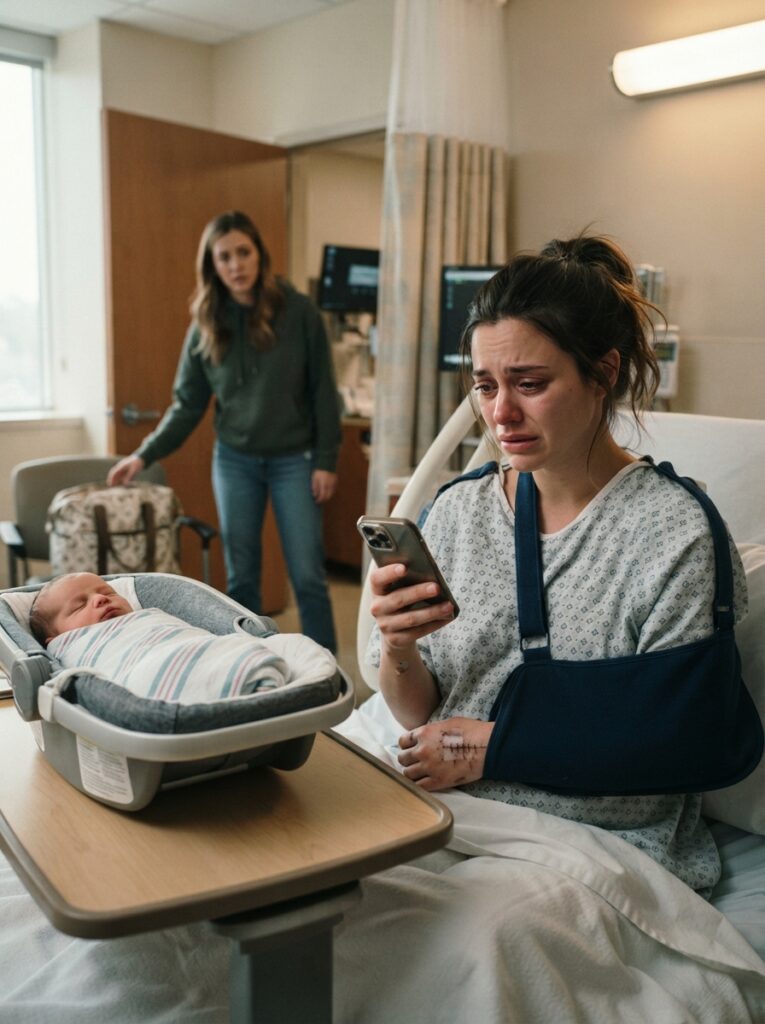
The two sisters looked at those messages and finally saw the pattern clearly.
They had both been waiting for the other person to care.
They had both been hurt by the other person’s absence.
But neither absence had been a choice.
The silence between them had been created by someone else.
The discovery did not erase the years of misunderstanding. It did not instantly repair every hurt feeling. Family damage rarely disappears because one truth is finally revealed.
But it changed the direction of the relationship.
Because now they could stop fighting a version of each other that was never real.
They could have a conversation based on what actually happened instead of what they had been told.
That was the first honest conversation they had shared in a long time.
Then the phone rang.
Their father’s name appeared on the screen.
The room changed.
The call represented everything that had happened before it: the assumptions, the excuses, the years of believing separate stories.
Whitney reached over and turned on the speaker before her sister could decide whether to answer.
For once, there would be no private explanation given to one daughter while another daughter carried the consequences.
The two sisters sat together in the hospital room with the baby nearby, listening as the person who had controlled the story was finally forced to face both sides at once.
And that was the moment their family dynamic began to shift.
Not because someone gave the perfect apology.
Not because every old wound disappeared overnight.
But because two sisters who had been separated by misunderstanding finally stood on the same side.
The most important part of that night was never whether their parents came to the hospital.
It was that the sisters stopped believing they were each other’s problem.
Sometimes families do not break because people stop loving each other.
Sometimes they break because people stop asking questions.
A missed call becomes an assumption.
An unanswered message becomes a rejection.
A decision made by someone else becomes a story everyone believes.
But when people finally compare what they were told with what actually happened, the truth can create a different kind of beginning.
For this mother, the help she needed came from the person she thought had been unavailable.
For Whitney, the sister she thought wanted distance was the person who needed her most.
And for both of them, the lesson was the same: family relationships cannot survive on secondhand explanations forever.
Sometimes the person you think walked away is the person who was waiting for the chance to come closer.