I married a dying stranger because I couldn’t bear the thought of him leaving this world alone.
For seven days, I was his wife. Then his attorney placed Ethan’s worn blue backpack in my hands and said, “He wanted you to know who he really was.” I expected hidden money, family secrets, maybe some unfinished obligation. Instead, I found places.
The first envelope said Train Station.
That was all.
No date.
No explanation.
Just two words written in Ethan’s neat handwriting across ivory paper, tucked inside the faded blue backpack his lawyer had handed me less than an hour after my husband died.
The first envelope said Train Station.
My husband.
I had been married to Ethan for seven days.
Even thinking the word felt strange, like wearing someone else’s coat and pretending it belonged to me.
The attorney stood beside the empty hospital bed, one hand still resting on the backpack strap.
“Emily,” he said softly, “Ethan wasn’t exactly who you believed he was.”
I had been married to Ethan for seven days.
I looked toward the bed.
The pillow still carried the shape of his head.
His mint tea sat untouched on the tray beside him.
The aluminum pull tab he had used as my wedding ring still circled my finger, almost weightless and somehow heavier than any real ring could have been.
“What truth?” I asked.
The pillow still carried the shape of his head.
The attorney’s expression shifted.
“He thought you would understand better if you went through it by yourself.”
Then he left.
That was how Ethan always did things.
Quietly.
Indirectly.
He never forced open a door if he could simply leave it unlocked and allow you to decide whether to walk through.
That was how Ethan always did things.
I opened the backpack with trembling hands.
There was no cash.
No jewelry.
No legal paperwork promising me some fortune or tying me to an unexpected responsibility.
There were only envelopes.
Dozens of them.
There was no cash.
Every one was labeled with a place.
Train Station.
Supermarket.
Airport.
Laundry Room.
City Park.
Waiting Area.
Hospital Chapel.
At the bottom was an old notebook with frayed corners, but I left it there.
At the bottom was an old notebook.
The envelopes bothered me more.
I opened Train Station first.
Inside was an old bus ticket, worn soft with age.
On the back, Ethan had written:
“She finally left.”
I stared at those words until they became blurry.
Left where?
Who was she?
Why had Ethan kept the ticket?
The envelopes bothered me more.
I opened Supermarket.
Inside was a receipt for two cans of chicken soup and a loaf of bread.
On the back:
“She took the food.”
Then came City Park.
A faded photograph showed Ethan sitting beside a man in a gray coat, both staring toward something beyond the frame.
“She took the food.”
On the back:
“He smiled before I walked away.”
I opened three more.
A child’s drawing made with crayons.
A coffee shop receipt.
A paper napkin with a phone number written across it, then crossed out.
None of it made sense.
I opened three more.
Every envelope seemed to offer me part of a story without ever giving me enough to understand the whole thing.
By the time I reached Waiting Area, my hands were steady.
My chest wasn’t.
Inside was a hospital visitor sticker from almost a year earlier.
On the back:
“She said her mother laughed like she was trying to hold it in.”
My body went cold.
That was me.
Every envelope seemed to offer me part of a story.
Ethan had asked me that the first day we met.
Not how my mother died.
Not how long I had been grieving.
He had asked what her laugh sounded like.
I nearly walked away.
Instead, I sat beside him in the waiting area and answered.
“Like she was trying not to laugh.”
I nearly walked away.
Ethan smiled.
“Those are the best kinds.”
I was 29 when I met him, although for months I had felt much older.
After my mother died, my life didn’t fall apart in some dramatic way.
It simply stopped going forward.
I still went to work.
Paid my bills.
Responded to messages with smiling emojis.
It simply stopped going forward.
Then I began volunteering at the hospital because after the first time I saw someone die with no one beside them, something inside me refused to walk away.
I sat with patients whose relatives lived too far away, had stopped calling, or simply couldn’t bring themselves to come.
I held cups of water.
Read magazines out loud.
Learned which rooms were always freezing and which nurses hummed when they were nervous.
I began volunteering at the hospital.
People called me kind.
They were wrong.
I was hiding in the only place where grief seemed normal.
Ethan noticed before I did.
He was 74, with tired eyes, hollow cheeks, a faint smile, and that old blue backpack always resting beside his chair.
I was hiding in the only place where grief seemed normal.
Sometimes I found him near the oncology wing.
Sometimes beside the vending machines, where he insisted the coffee tasted awful but at least didn’t pretend otherwise.
Sometimes in the chapel, seated in the last pew like someone waiting for a person who might still show up.
Ethan never spoke like a dying man.
He spoke like someone keeping track of small things.
Ethan never spoke like a dying man.
“Did the cafeteria worker’s grandson pass his road test?” he asked me one afternoon.
“I have no idea.”
“He was supposed to take it Wednesday.”
“You remembered that?”
Ethan shrugged. “She told me.”
“You remembered that?”
Another day, a housekeeper entered humming while replacing the trash bag.
“Morning, Denise,” Ethan said. “Same song again?”
She laughed.
“My dad loved this song, Ethan.”
“I know.”
She stopped.
“You remembered?”
He simply smiled.
“My dad loved this song, Ethan.”
That was Ethan.
At least, that was who I believed he was.
A kind old man.
A lonely man.
A dying one.
Then one afternoon, he asked me to marry him.
“Marry me, Emily,” he whispered.
I stood frozen beside his bed with a cup of ice chips in my hand.
Then one afternoon, he asked me to marry him.
“Ethan…”
“I know.”
“You’re very sick.”
“Yes.”
“We hardly know each other.”
He watched me quietly for a long time.
“I know enough.”
“Enough to get married?”
“Enough to know you’re the kind of person who doesn’t walk away. I don’t want my last identity in this world to be a patient number on a chart. I want to leave as someone’s husband.”
“We hardly know each other.”
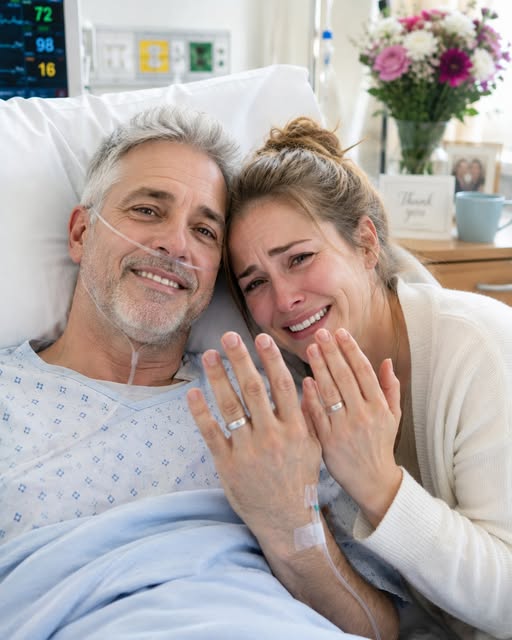
Two days later, a hospital chaplain married us beside Ethan’s bed.
I wore a pale green sweater because Ethan said it made the room feel more alive.
He wore the same brown cardigan with a missing button.
One nurse quietly asked whether I was certain.
She pointed out that Ethan was old enough to be my grandfather.
I simply said yes.
My heart had made the decision before my mind understood it.
Ethan was old enough to be my grandfather.
When the chaplain asked about rings, Ethan lifted his ginger ale can, carefully worked the pull tab free with his thin fingers, and slipped it onto mine.
It was too loose.
He smiled.
“We’ll just say your finger is being modest.”
For seven days, I was his wife.
“We’ll just say your finger is being modest.”
I signed forms.
Straightened blankets.
Snuck better tea into his room.
Sat beside him when the pain made each breath short.
Near the end, he opened his eyes once and said, “Don’t confuse being still with being at peace.”
“What does that mean?”
“Don’t confuse being still with being at peace.”
His smile was barely there.
“You’ll understand.”
Then he closed his eyes.
He never opened them again.
And now the blue backpack sat at my feet like a map whose roads had been erased.
I didn’t open the notebook that night.
He never opened his eyes again.
I brought the backpack home, placed it on the kitchen table, and spent almost two hours walking around it.
My apartment felt unnaturally silent.
My mother’s coffee cup was still sitting beside the sink even though she had been gone almost a year.
I had never moved it.
I told myself it was because I wasn’t ready.
I brought the backpack home.
Around midnight, I opened another envelope.
Airport.
Inside was a boarding pass from eight years earlier.
On the back:
“He called his brother from Gate 9.”
Then Laundry Room.
A folded dryer sheet.
“We waited together for the red sweater. She said it still smelled like her house.”
Around midnight, I opened another envelope.
Then Hospital Chapel.
A small religious card.
“He finally stopped saying sorry every time he cried.”
I spread the envelopes across the table.
Train station.
Supermarket.
Airport.
Laundry room.
City park.
Waiting area.
Chapel.
Ordinary places.
Fragments of unfinished lives.
“He finally stopped saying sorry every time he cried.”
By morning, I had slept perhaps an hour.
The backpack remained open.
The notebook was still sitting at the bottom.
This time, I took it out.
The first page contained only two sentences.
“People believe loneliness means having nobody around.
Usually, it means believing nobody notices you.”
The notebook was still sitting at the bottom.
The words felt strangely familiar, although I couldn’t remember Ethan ever saying them to me.
I turned the page.
It wasn’t a diary.
There were no childhood memories.
No confessions.
No chronological account of his life.
Instead, every page described one ordinary encounter.
There was no timeline.
No names.
Only moments.
“A young father outside the maternity ward checked his watch every thirty seconds. He wasn’t worried about the time. He was trying not to cry in front of his own father.”
At the bottom Ethan had written:
“He finally hugged him.”
I frowned.
“He was trying not to cry in front of his own father.”
That was all.
Only what happened afterward.
I turned another page.
“An elderly woman stood in the supermarket looking at soup cans for nearly twenty minutes. She wasn’t trying to choose one. She was wondering whether anyone would notice if she never came back.”
Below that:
“She took the food.”
Only what happened afterward.
Another page.
“Teenage girl. Train station. Let four trains leave without boarding. Said she wasn’t waiting for one. She simply wasn’t ready to go home.”
At the bottom:
“She boarded the fifth.”
Page after page followed the same pattern.
A veteran alone on a bench.
A widower eating dinner by himself.
A young boy refusing to enter his grandmother’s hospital room.
Page after page followed the same pattern.
Ethan never described himself as saving anyone.
Most of the time, he barely mentioned himself at all.
Every entry ended instead with one small step forward.
She smiled.
He slept.
She called her brother.
He walked inside.
He barely mentioned himself at all.
Slowly, I understood.
Ethan had not been collecting souvenirs.
He had been collecting moments when someone chose to step back into life.
I looked toward the faded blue backpack beside my chair.
For the first time, it didn’t seem heavy.
It seemed full.
He had been collecting moments.
During the next week, I kept replaying conversations we had shared.
The nurse whose wife had started growing tomatoes.
The volunteer whose granddaughter had finally passed her driving test.
The cafeteria employee who always added an extra peppermint to Ethan’s tray because she had noticed he gave the first one to nervous visitors.
I kept replaying conversations we had shared.
He remembered everything.
Once, I had asked him,
“How do you remember so many details about people?”
Ethan smiled.
“I don’t.”
“You obviously do.”
“No.” He looked out the window. “I just listen while they’re talking.”
He remembered everything.
At the time, I laughed.
Now I understood.
Paying attention was how Ethan loved people.
Three days later, I returned to his attorney’s office.
The small office above a coffee shop smelled like old paper and dark roast.
The blue backpack sat beside my chair.
“I read the notebook,” I said.
Paying attention was how Ethan loved people.
The attorney nodded.
“I thought you probably would.”
“But I still don’t understand why he married me.”
The attorney stayed quiet for several seconds.
Then he asked, “What did Ethan ever ask you to give him?”
I blinked.
“What do you mean?”
“Think.”
I did.
“But I still don’t understand why he married me.”
He never asked for money.
Never demanded that I spend more time with him.
Never asked me to cancel anything.
Never even asked me to make some promise about what I would do after his death.
Finally, I whispered, “Nothing.”
He never asked for money.
The attorney gave me a sad smile.
“Exactly.”
Then he opened a folder on his desk.
Inside was an old newspaper clipping.
The photograph showed Ethan standing in front of a community mental health center.
The headline read:
Beloved Bereavement Counselor Retires After Four Decades.
Inside was an old newspaper clipping.
I stared at the photograph.
“He was a grief counselor?”
“Yes. Ethan spent most of his adult life helping people after loss.”
I looked at the article again.
“He never told me.”
“He rarely told anyone.”
The attorney folded the clipping.
“He believed people were more willing to talk when they didn’t feel as if someone was trying to fix them.”
“He never told me.”
I laughed softly through my tears.
That sounded exactly like Ethan.
Then the attorney opened one of his desk drawers.
“There’s one more thing.”
He placed another envelope in front of me.
Written across it in Ethan’s handwriting were two words.
“Next Tuesday.”
I laughed softly through my tears.
“He specifically asked me not to give you this until after the funeral.”
I didn’t open it in the office.
That evening, I took it to the little riverside park across from my building.
I opened it slowly.
There was no letter inside.
Only one folded page from his notebook.
I didn’t open it in the office.
It was a list.
Rose Garden
Saturday Market
Chocolate ice cream from Willow Street
Feed the geese even if they completely ignore you
I laughed before I realized tears were sliding down my cheeks.
Feed the geese even if they completely ignore you.
At the bottom, Ethan had written:
“Ordinary Tuesdays are where life quietly waits for us.”
I looked around the park.
Children chased birds across the grass.
A woman walked an exhausted-looking golden retriever.
An elderly couple argued happily over a crossword puzzle.
Life had never stopped.
I had.
Life had never stopped.
The following Tuesday, I went to the rose garden.
Afterward, I wandered through the market and bought strawberries I didn’t need.
Then I drove to the little ice cream shop on Willow Street.
Chocolate.
Ethan had guessed right.
It was my favorite.
Ethan had guessed right.
On the way home, I stopped beside the pond.
The geese ignored me completely.
I laughed out loud.
A few people looked at me.
For once, I didn’t care.
The geese ignored me completely.
Months have passed.
I still haven’t figured out how to repair grief.
Because Ethan never did either.
He taught me something far smaller.
And far more important.
Sometimes the greatest act of kindness isn’t finding the perfect words.
It’s making sure another person never has to carry those words by themselves.
I still haven’t figured out how to repair grief.