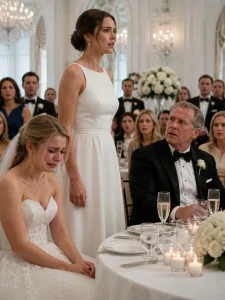
The entire ballroom fell silent.
I slowly rose from my chair, locked eyes with him, and asked one simple question.
“Do you have any idea who you’re talking to?”
The color drained from his face.
Because a secret I had protected for nearly a decade was finally about to come into the open.
My name is Victoria Bennett, and I was only twenty-two years old when I became the closest thing my little sister ever had to a parent.
People love stories like that.
They imagine courage.
Sacrifice.
Inspiration.
The truth was much less glamorous.
It was survival.
Our parents didn’t die.
They didn’t disappear in some tragedy that people could grieve and understand.
They simply chose themselves.
First emotionally.
Then financially.
Then physically.
Our father left chasing one business dream after another, never staying long enough to explain where he was going.
Our mother eventually remarried a man who wanted a fresh start—a fresh start that apparently didn’t include her daughters.
And just like that, they were gone.
Leaving me behind with Grace.
She was only nine years old.
Too young to understand why nobody tucked her in at night anymore.
Too young to understand why I suddenly worked every hour I could find.
Too young to understand why her big sister kept crying in the bathroom after she fell asleep.
I worked double shifts at a twenty-four-hour diner outside Nashville.
I attended community college classes at night.
I learned how to braid hair from online videos.
I packed lunches.
Signed report cards.
Attended school conferences pretending I was far more confident than I actually felt.
Every day felt like a balancing act over a cliff.
But somehow, we survived.
For years it was just the two of us.
Bills.
Birthdays.
School plays.
Doctor appointments.
Broken hearts.
No parents.
No safety net.
Just me and a little girl who eventually stopped calling me “Victoria” and started calling me “Tori” with a kind of affection that felt halfway between sisterhood and motherhood.
By the time Grace graduated high school, she had become everything I hoped she would be.
Strong.
Compassionate.
Smart.
Determined.
Then she met Daniel Montgomery.
Daniel came from a world neither of us understood.
His family had old money.
Old traditions.
Old expectations.
The kind of family whose last name opened doors before they even knocked.
The wedding was held at a private estate outside Charleston.
Everything looked perfect.
Crystal chandeliers glowed above marble floors.
White roses filled the room.
String musicians played softly in the background.
The kind of place where even the silence felt expensive.
I had helped Grace pay for college.
Helped choose her wedding dress.
Helped calm her fears every time she questioned whether she truly belonged in Daniel’s world.
But the wedding itself belonged largely to his family.
Especially his father.
Richard Montgomery.
From the moment I met him, Richard made it clear he believed some people belonged at the table and others merely sat near it.
During the reception, he stood to give a toast.
At first, everything sounded polished.
Elegant.
Predictable.
He praised Daniel.
Welcomed Grace.
Thanked the guests.
The room relaxed.
Then his attention shifted toward me.
“And of course,” he said with a pleasant smile, “we should recognize Victoria, the sister who raised our lovely bride. Quite a remarkable story. Very modest beginnings.”
A few nervous laughs floated through the room.
Grace immediately stiffened.
I could feel it.
Richard continued.
“Every family needs someone to remind them where they came from.”
More uncomfortable laughter.
Then he smiled wider.
The kind of smile people wear when they’re convinced nobody will challenge them.
“Victoria,” he said, turning directly toward me, “when Daniel first told us about you, I expected someone a little less… noticeable.”
The room froze.
Every guest suddenly became interested in their champagne glasses.
Grace looked horrified.
Daniel’s jaw tightened.
Then Richard delivered the line that changed everything.
“So you’re the poor relation who raised the bride?”
Silence crashed over the ballroom.
Complete.
Absolute.
I could feel hundreds of eyes staring at me.
Waiting.
Judging.
Wondering how I would respond.
Slowly, I folded my napkin and placed it on the table.
Then I stood.
Calmly.
Deliberately.
Without a trace of panic.
I looked directly at Richard Montgomery.
“Do you even know who I am?”
Part 2
For the first time all evening, Richard looked uncomfortable.
His confidence cracked.
Just slightly.
But enough.
“What exactly is that supposed to mean?” he asked.
Before I could answer, the venue director hurried toward our table.
The poor man looked like he wanted to disappear.
“Mr. Montgomery,” he said carefully, “perhaps we should move on with the evening.”
Richard frowned.
“Why?”
The director hesitated.
Then he glanced toward me.
“Because Ms. Bennett owns this property.”
The silence somehow became even louder.
A glass slipped from someone’s hand.
Across the room, several guests exchanged stunned looks.
Grace covered her mouth.
Daniel stared at me.
Richard laughed nervously.
“That can’t be right.”
I smiled.
“It is.”
He blinked.
The director nodded.
“Ms. Bennett purchased the estate through Bennett Hospitality Holdings three years ago.”
Richard’s face drained of color.
The truth was simple.
After years of working multiple jobs and saving every dollar I could, I opened a small coffee shop.
Then another.
Then a restaurant.
Then event spaces.
Then hotels.
I built everything slowly.
Painfully.
Brick by brick.
While most people assumed I was simply Grace’s hardworking older sister.
I never corrected them.
Not because I was embarrassed.
Because I preferred seeing who people were before they knew what I owned.
Richard cleared his throat.
“Well, ownership doesn’t change where someone comes from.”
“No,” I replied.
“It doesn’t.”
The room listened carefully.
“My background taught me discipline.”
I paused.
“Something money can’t always buy.”
A wave of murmurs spread through the crowd.
Richard shifted uncomfortably.
His wife, Eleanor, quietly touched his arm.
“Richard, enough.”
But pride is a difficult thing to surrender.
Especially in public.
“It was just a joke,” he said.
Grace stood immediately.
“No.”
Everyone turned toward her.
Her voice trembled.
But she didn’t back down.
“It wasn’t a joke.”
Richard stared at her.
“You misunderstood.”
“No,” Grace replied.
“I understood perfectly.”
Daniel stood beside her.
Taking her hand.
Supporting her without hesitation.
My respect for him doubled in that moment.
“You wanted everyone here to remember where Victoria came from,” Grace continued.
“You wanted to remind me that I came from there too.”
The room became perfectly still.
Richard looked toward his son.
“Daniel?”
But Daniel shook his head.
“Dad, she’s right.”
That clearly wasn’t the answer Richard expected.
“I paid for this wedding.”
Daniel’s expression hardened.
“You paid for flowers and catering.”
Then he pointed toward me.
“She gave Grace a life.”
No one spoke.
Not even Richard.
Then he made one final mistake.
He looked directly at me and said,
“You may own the building, but people like you will never truly belong among families like ours.”
I slowly scanned the ballroom.
The chandeliers.
The guests.
The dance floor.
Then I looked back at him.
“Richard,” I said quietly, “I never wanted to belong in your world.”
I glanced toward Grace.
“I came because my sister asked me to stand beside her in hers.”
Part 3
The room remained silent for several long seconds.
Then Grace crossed the floor and wrapped her arms around me.
Holding me so tightly I could barely breathe.
“You raised me better than that,” she whispered.
I smiled.
“Yes, I did.”
When she stepped back, Daniel addressed the guests.
His voice shook slightly.
But his conviction didn’t.
“My wife and I are going to enjoy our wedding.”
He looked around the ballroom.
“Anyone here to celebrate with us is welcome to stay.”
Then his eyes settled on his father.
“Anyone here to measure people’s worth by money or social status can leave.”
Richard looked stunned.
Eleanor stood first.
She picked up her purse and walked toward Grace.
“Congratulations, sweetheart,” she said warmly.
Then she sat back down.
Without her husband.
Richard remained standing alone.
For a brief moment, I thought he might argue.
Instead, he turned and walked out of the ballroom.
The doors closed behind him.
And the entire room seemed to exhale.
The reception continued.
The music returned.
People relaxed.
Laughter slowly replaced tension.
Later that evening, Grace insisted on sharing a dance with me.
Halfway through the song, she rested her head against my shoulder.
“I hate what he said.”
“I’ve heard worse.”
“That doesn’t make it acceptable.”
“No,” I admitted.
“It doesn’t.”
She looked up at me.
“Why didn’t you ever tell me you owned this place?”
I laughed softly.
“Because this day wasn’t supposed to be about me.”
“But you built all of this.”
I shook my head.
“No.”
I looked around the ballroom.
“The estate is just a building.”
Then I looked at her.
“You’re what I built.”
Tears immediately filled her eyes.
And honestly, mine too.
The business empire came later.
The hotels.
The restaurants.
The event venues.
None of that felt as important as helping a frightened little girl become the woman she was today.
A week after the wedding, Richard sent an expensive floral arrangement.
No card.
No message.
Just flowers.
I donated them to a local children’s shelter.
Several months later, he requested a meeting.
I only agreed because Grace hoped for peace.
His apology wasn’t graceful.
It wasn’t eloquent.
But it was sincere enough to show he had finally learned something humility had never taught him before.
I didn’t rush to forgive him.
I didn’t need revenge either.
The most important victory had already happened.
Grace knew her worth long before anyone could convince her otherwise.
Today, she and Daniel are happily married.
Eleanor occasionally joins me for lunch.
Richard behaves considerably better.
And Grace still calls whenever she needs advice, even though she no longer needs raising.
As for me, I stopped explaining why I deserve respect.
People reveal their character quickly when they think you’re beneath them.
The trick is simply giving them enough time to show it.
And sometimes, the most powerful response isn’t proving them wrong.
It’s calmly reminding them that they never understood who they were judging in the first place.