One complaint can turn every elevator ride into a hearing. A second can make people choose sides before they know what happened.
And I had already begun to suspect there was more to it than a careless habit.
His apology had sounded genuine. The tea bags kept falling anyway.
That was the detail I couldn’t make fit.
I went back through the photographs on my phone. At first, I had taken them to document the stains. Later, I had photographed each bag before picking it up, with the balcony clock visible through the glass door.
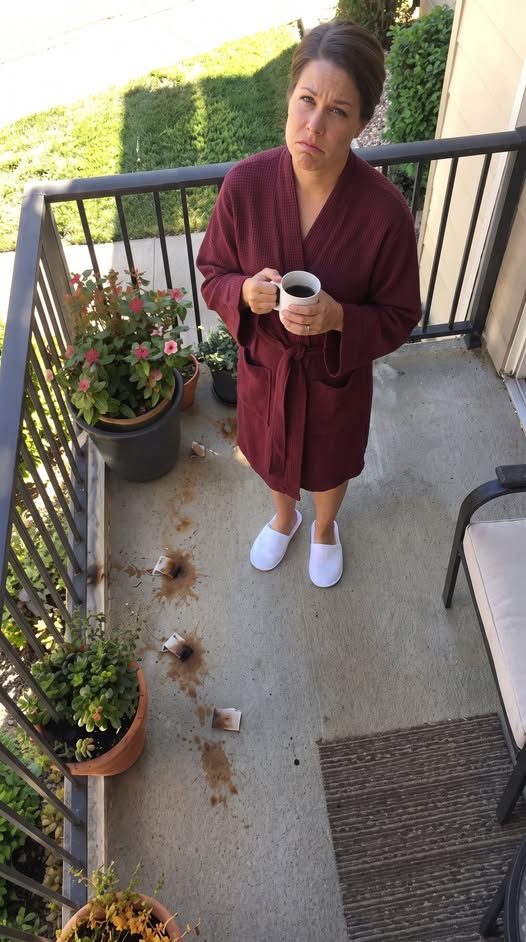
There were more than I remembered. Some landed near the flowerpots. Some struck the chair. Two had caught on the narrow rail beneath my balcony before dropping to the courtyard.
The brands varied. The tags varied too.
A few were ordinary paper squares with a supermarket logo. Others had no tags at all. One had a length of blue string tied around its neck.
I turned that photograph sideways and enlarged it until the image blurred.
Blue string.
At the time, I thought it was a broken tag. Now I remembered seeing the same string tied around the handle of a parcel Daniel had asked me to accept. He had collected that parcel at my door and thanked me without meeting my eyes.
It might have meant nothing. Blue string was hardly rare.
But instead of walking upstairs again, I called the building office.
Our property manager, Mrs. Alvarez, listened without interrupting. When I finished, she asked whether I had pictures of the damage and whether I wanted to submit a formal complaint.
“I have pictures,” I said. “I’m still deciding about the complaint.”
“That’s fine. Send me the dates so I have a record.”
Her voice grew quieter.
“Have you spoken with anyone else about it?”
“No.”
There was a pause.
“If anything else falls, please tell me.”
I sent the photos that afternoon. Before pressing send, I hesitated over the image of Daniel’s hand above the railing.
I had taken it that morning while sitting outside with my coffee. He had released the bag before noticing me below. It had struck an empty ceramic saucer I placed near my chair, making a small, unmistakable tap.
When he leaned over, I looked up.
“Morning,” I said.
His face changed for an instant. Surprise first. Then something harder to name.
“Morning.”
I picked up the bag with a tissue, set it in a jar, and carried my coffee inside. I had labeled the jar with the date, just as I had labeled the photographs. That had been the entire plan: make a record, put the complaint in writing, and stop offering him an argument he could turn into a story about me.
At nine that night, another bag arrived.
This one landed near the drain.
I heard Daniel’s balcony door slide shut above me, then a second sound from across the courtyard: a window closing with a sharp rattle.
I stepped outside and looked up. The windows opposite mine were dark except for a kitchen light on the fifth floor. Beneath it was a balcony with three empty planters and a folded green chair.
I couldn’t see anyone.
The next morning, Mrs. Alvarez called.
“I spoke to Daniel,” she said.
My stomach tightened. “Already?”
“I asked him to come by the office. I showed him the photos.”
“What did he say?”
“He said he threw the morning bags. He says the evening ones aren’t his.”
I looked toward my balcony door.
“That’s convenient.”
“I told him the same thing. He didn’t deny the damage.”
That surprised me. I had expected him to call me unreasonable.
Mrs. Alvarez continued. “He offered to pay for the towel and cushion.”
The conversation might have ended there. I could have accepted the money, waited to see whether he stopped, and tried to forget the weeks of wet stains and slammed doors.
Then she said, “He asked whether you kept any of the bags.”
“Why?”
“I don’t know. He seemed particularly interested in the evening ones.”
I told her about the jar. I had collected only a few bags, most of them from the previous week.
“Would you bring it down?” she asked.
I said I would.
As soon as we hung up, I went to the kitchen cabinet and took out the jar. Through the glass, the bags looked like scraps pulled from a muddy puddle. I unscrewed the lid. A stale, sweet smell rose from them.
The blue string lay curled against the glass.
I set the jar down and opened my phone again.
In one evening photograph, taken through my balcony door, the shadow of a bag was visible just above the chair cushion. The balcony above mine was out of frame. I had assumed every bag came straight down.
But the shadow angled in from the side.
I went outside and looked across the courtyard.
From the fifth-floor balcony, someone could throw a small object toward mine. It would have to pass Daniel’s balcony on the way down. A person watching from my apartment might easily think it had come from directly overhead.
I stared at the empty planters for a long time.
Then I went downstairs.
Mrs. Alvarez had managed the building for almost as long as I had lived there. She knew which doors stuck in winter, whose packages could be left with whom, and how long the heating pipes took to warm after a cold night.
Her office smelled of copier paper and oranges. Daniel sat across from her desk with his arms folded. He stood when I entered, then seemed unsure whether he should have.
I set the jar on the desk.
He looked at it and winced.
“Those are all from my balcony?” he asked.
“From mine.”
“Right.” He swallowed. “I meant—I’m sorry.”
Mrs. Alvarez moved the jar toward him. “Please look carefully.”
He picked out a bag with a supermarket tag.
“Mine,” he said.
Another, with no tag.
“Probably mine.”
He reached the blue string and stopped.
“I’ve seen this before.”
“On your parcel?” I asked.
He glanced up. “You noticed that?”
“I photographed it by accident.”
Daniel laid the bag on a tissue. “That parcel had tea in it. My sister sends it from a small shop near her house. The shop ties the bags with blue thread.”
“So it’s yours.”
“It could be.” He sounded miserable. “But my sister sent that box in November. It went missing.”
I remembered the parcel immediately. It had been addressed to Daniel in 4B. I had accepted it from a delivery driver one afternoon, when the building’s front door buzzer was broken.
That evening, Daniel knocked at my door.
“Did a box come for me?” he asked.
I gave it to him. He thanked me and left.
“It didn’t go missing,” I said.
“The box you gave me was empty.”
I stared at him.
“Why didn’t you tell me?”
“I thought the shop had packed it wrong.” He pressed his palms together. “My sister said she’d sent forty bags. The box had the wrapping paper and her note, but no tea. I figured she was mistaken, and I didn’t want to upset her.”
Mrs. Alvarez checked the parcel log on her computer. I had signed for the box at 2:18. Daniel had collected it from me around six. No one else had handled it while it was in my apartment.
“You’re sure it was empty when you opened it?” I asked.
“Yes.”
“Was the tape cut?”
“I don’t remember.”
“Think.”
He looked toward the floor. “I remember thinking the tape was crooked. I thought maybe my sister had reused a box.”
I felt heat rise in my face. I had kept the parcel on the little table beside my door. Delivery boxes sat there often. I could picture it, but not the tape.
“Are you suggesting somebody opened it in my apartment?”
“No,” Daniel said quickly. “I’m telling you what happened when I opened it in mine.”
Mrs. Alvarez raised a hand before either of us could say more.
“We should stay with what we can establish,” she said. “Daniel, which bags did you throw?”
“The ones in the morning. Not every morning at first, but after she came upstairs…” He looked at me. “More often.”
“Why?” I asked.
He drew a breath and didn’t answer.
“Why did you keep doing it after you promised to stop?”
He stared at the jar. “Because you came upstairs about my tea while I was trying to work out who kept moving things outside my door. I know that sounds ridiculous.”
Mrs. Alvarez frowned. “What things?”
“My recycling bin. The mat. Deliveries left for me.” His words came faster. “Little things, but always after I got home late. Then I found a note pushed under my door saying I kept people awake.”
“That wasn’t from me,” I said.
“I know that now.”
“Did you know it when you told me to be grateful it was just tea?”
He flinched. For a moment, he looked exactly as he had at the door: a man prepared to turn his own cruelty into a joke before anyone else could name it.
“No,” he said. “I thought you were the one leaving the notes. I thought the bags were a stupid way to show you I knew.”
I heard the words, but they did not make me feel better.
“You stained my towel.”
“I did.”
“And my chair.”
“I did.”
“You could have asked me whether I’d written a note.”
“I should have.”
Mrs. Alvarez wrote something down. Then she asked Daniel to bring her the notes and any records he had of missing deliveries. She asked me to leave the jar with her for the day. She would document each bag and call both of us after reviewing the building cameras.
There was no camera overlooking the balconies. The one at the front entrance could at least show who entered with parcels.
As I left, Daniel said, “I’m sorry about what I said.”
I stopped with my hand on the office door.
“You said I should be grateful it was just tea.”
“I know.”
“I believed you meant it.”
He said nothing. Neither did I.
By the following evening, he had put the cost of a new towel and cushion in an envelope under my door. There was no note asking me to forgive him. He wrote only what the money was for and that he would stop throwing anything from his balcony.
I put the envelope in a drawer.
At 9:11 that night, a tea bag landed in my flowerpot.
For several seconds, I couldn’t move.
Daniel had just promised to stop. He might have broken that promise within hours. Or Mrs. Alvarez might have been right to ask about the evening bags.
I left the bag where it was and took photographs from inside. Then I called the office’s after-hours number.
Mrs. Alvarez answered herself.
“Don’t go upstairs,” she said after I explained. “I’ve got it.”
The next morning, she met me in the lobby. She looked tired and carried a thin folder against her chest.
“Daniel has been with his sister since yesterday afternoon,” she said. “I confirmed it with him last night.”
“That doesn’t prove—”
“I know. But the building camera shows him leaving with an overnight bag at four. He hasn’t come back.”
For the first time in weeks, I allowed myself to consider that someone else had been dropping the evening bags.
Mrs. Alvarez opened the folder.
“The fifth-floor apartment across from yours belongs to a woman named Mrs. Bell. She has lived here since before I started.”
“I know her,” I said. “A little.”
Mrs. Bell was small and straight-backed, with silver hair she pinned neatly away from her face. Years earlier, we had shared a bus ride during a storm. She had lent me a grocery bag when mine split. Since then, we usually nodded in the elevator. Sometimes she asked after the flowers on my balcony.
“Is she throwing them?”
“I don’t know,” Mrs. Alvarez said. “I spoke to her about the bags this morning. She asked if you’d been coming outside at night.”
A chill passed through me.
“Why?”
“She wouldn’t say.”
I thought of the window shutting across the courtyard.
“Could I speak with her?”
Mrs. Alvarez considered it. “I’ll ask whether she’s willing.”
Mrs. Bell came downstairs twenty minutes later in a green cardigan. She looked from Mrs. Alvarez to me, then took the chair beside the office door.
“I’ve made a mess of something,” she said.
Her hands were shaking. I had never seen that before.
“You threw the bags?” I asked.
“Some of them.”
The answer was so plain that I nearly missed it.
“Why?”
She glanced at Mrs. Alvarez. “Can I tell her here?”
“Of course,” Mrs. Alvarez said.
Mrs. Bell folded her hands in her lap.
“In November, I saw a man open a parcel outside your door.”
The office seemed to narrow around us.
“He wasn’t the delivery driver?”
“No. The driver had gone. This man came up the stairs a few minutes later.”
“Who was he?”
“I didn’t see his face well enough to be certain. He wore a maintenance jacket. I thought he worked here.”
Mrs. Alvarez sat forward. “We had contractors replacing hallway lights that week.”
Mrs. Bell nodded. “He lifted the box, cut the tape, and took something out. Then he put it back.”
“Why didn’t you say anything?” I asked.
Her face tightened. “I did. I told the man I had seen him. He said he was checking a damaged delivery.”
“You didn’t tell the office?”
“I should have. I wasn’t sure what I’d seen, and I didn’t know whose parcel it was.” She pressed one hand against the other. “The next morning I found a note on my door telling me to mind my own business.”
Mrs. Alvarez asked whether she still had it. Mrs. Bell nodded.
“And the tea bags?” I asked.
Mrs. Bell’s eyes filled.
“I began watching the balconies. The man came back twice in that jacket. I saw him enter the building, but I never saw where he went. I was afraid he’d know if I made a report.”
“So you threw tea onto my balcony?”
“The first evening, I was trying to get your attention,” she said. “You were inside, and I thought you might come out if you heard it land. Then you did. I tried to wave, but you looked up at Daniel’s balcony, and I stepped back.”
“Why didn’t you knock on my door?”
“I did once. You weren’t home. After that, I saw you go upstairs to Daniel. I thought perhaps you already knew.”
“You could have left a note.”
She looked ashamed. “I was frightened of notes. It sounds foolish now.”
It did sound foolish. It also sounded like fear could make a person repeat one small action long after it had stopped making sense.
“I didn’t know about the towel,” she said. “Or the chair. When I saw you begin photographing the bags, I thought you had found a way to make people listen.”
I sat back.
“You thought you were helping.”
“At first. Then I was afraid to admit what I’d done.”
Two people had kept throwing tea onto my balcony for different reasons. Neither had once asked me what I needed.
The thought was sharp enough that I stood.
Mrs. Bell stood too. “I’m sorry.”
“I need a minute.”
I went out to the lobby, where someone had left a small pile of mail on the radiator. Through the front glass, I could see people crossing the street in the pale morning light. They were carrying groceries and walking dogs. The day looked ordinary.
I wanted it to be ordinary.
Mrs. Alvarez joined me after a few minutes. She didn’t try to tell me that either neighbor meant well. She asked if I wanted Mrs. Bell to leave and whether I wanted her to call someone to sit with me.
“No,” I said. “I want to know who opened the box.”
“So do I.”
The front camera showed the contractor entering on the day Daniel’s parcel arrived. It showed him leaving eleven minutes later with his tool bag. Mrs. Alvarez found the work order and called the lighting company while I sat beside her desk.
They identified him from the footage. His name was Peter. He had worked in the building on three days that month, all scheduled. He had no reason to handle a parcel.
Mrs. Alvarez asked the company to have him call her. Before he did, she called Daniel.
He arrived an hour later, still carrying his overnight bag. Mrs. Bell waited in the office too. None of us spoke much.
When Peter finally called, Mrs. Alvarez put him on speaker. She told him what the camera showed and asked about the parcel.
There was a long pause.
“I can bring the tea back,” he said.
Daniel closed his eyes.
Peter explained haltingly. He had seen the box outside my door while repairing a light. The shop name was printed on its side. He knew the tea; his wife liked it, and it was expensive. He had opened the parcel and taken most of the bags.
“What about the notes?” Mrs. Alvarez asked.
Another pause.
“I wrote one to the lady who saw me. I panicked. I shouldn’t have.”
“And the one under Daniel’s door?”
“I thought he might ask around about the box.” His voice grew faint through the speaker. “I wanted him to think a neighbor was angry with him.”
Daniel opened his eyes and looked at me.
A note under his door. A missing gift from his sister. A neighbor downstairs who came to complain about tea.
I could see how he had joined those facts together. I could also see every point where he could have stopped and asked a question.
Mrs. Alvarez told Peter to return the tea to her office and said she would speak with his employer. Then she ended the call. She began writing an incident report while we sat in the silence he left behind.
Daniel spoke first.
“My sister made the tea bags herself,” he said to no one in particular. “She bought the blend, filled them, tied the strings. She sent them because I’ve had trouble sleeping.”
Mrs. Bell looked at her hands.
“I thought it was something important,” she whispered. “That’s why I kept watching.”
“It was important,” Daniel said. “But I could have asked her to send more.”
Mrs. Alvarez looked up from her report. “Peter is responsible for opening the parcel and sending those notes. I’ll deal with the company. You two are responsible for what landed on her balcony.”
Neither neighbor objected.
I was grateful she had said it. I was too tired to explain it myself.
I told Mrs. Bell about the towel and the nights I had stood beneath her balcony, trying to catch a glimpse of whoever was there. I told Daniel that his laughter had frightened me more than the stains. He had made it sound as though he might throw something worse next.
“I wanted you to leave me alone,” he said. “I knew you’d gone upstairs because of the bags. I said the cruelest thing I could think of.”
“And it worked,” I said. “For a while.”
He looked down. “I’m sorry.”
I believed him this time. Believing him did not erase what he had done.
Over the next few days, the building grew quieter. Peter returned the remaining tea to the office. His employer removed him from the building’s contract, and Mrs. Alvarez changed the procedure for deliveries: no parcels would be left outside apartment doors.
Mrs. Bell paid to have my cushion cleaned. The stain lightened but did not disappear. Daniel bought me a new towel, although I told him I had already replaced the old one. I kept both. It seemed better to accept what they could repair than to pretend there had been no damage.
Daniel stopped by one evening to ask if he could collect a parcel the delivery driver had left with me before the new procedure began.
I handed it to him at the door.
“I told my sister,” he said.
“About the missing tea?”
“About all of it. She asked why I didn’t just talk to you.”
I almost smiled. “What did you say?”
“That I didn’t have a good answer.”
He shifted the parcel under his arm.
“I used to think you accepted my deliveries because you didn’t mind.”
“I didn’t mind.”
“I started expecting it, though. I never asked if it was becoming a chore.”
“It was, some days.”
He nodded slowly. “You can tell me that.”
“I am telling you.”
For the first time since I had met him, Daniel didn’t try to make the conversation easier with a joke. He thanked me for the parcel and went upstairs.
Mrs. Bell was harder to speak to. She avoided the elevator when I was in it. Once, I caught sight of her at the mailboxes, and she turned so quickly that she left her letters behind.
I picked them up and carried them to her door.
When she opened it, she seemed braced for me to be angry. I was still angry. I also remembered her standing in the office, admitting what she had done in front of the person she had feared most.
“You forgot these,” I said.
“Thank you.”
I gave her the letters. Then I asked, “Did the note frighten you that much?”
She nodded. “I’ve lived alone a long time. I knew someone had been outside my door. I didn’t know if he’d come back.”
I looked past her to the neat little table in the hall and a pair of walking shoes set beside it.
“I wish you’d told me.”
“So do I.”
“I would have listened.”
“I know that now.”
We stood there a moment. I didn’t offer to forget it. She didn’t ask me to. Before I left, she said she had spoken with Mrs. Alvarez about adding better lighting by the stairs. It was a small request, but she had made it herself.
In January, the building held its annual residents’ meeting. I had missed most of them over the years. This time, I went.
Mrs. Alvarez reviewed the new parcel procedure. Several people asked practical questions. Mrs. Bell stood and spoke about the hallway lights. Her voice shook at first, then steadied as she explained which landing was hardest to see at night.
Daniel sat a few chairs away from me. He didn’t speak until the end, when he asked whether the building could put a waste bin near the ground-floor exit for people carrying drinks or food outdoors.
It was a sensible suggestion. Mrs. Alvarez wrote it down.
After the meeting, the three of us walked toward the elevator at roughly the same time. Daniel held the door while Mrs. Bell stepped in. I followed. No one forced a conversation.
At the third floor, I got out. Mrs. Bell said good night. Daniel did too.
I went into my apartment and opened the balcony door. The cushion had dried after its cleaning. A faint brown mark remained along one seam. Beyond the railing, the courtyard windows glowed softly in the evening.
I touched the back of the chair, then sat down with my cup of tea.
For the first time in months, nothing fell from above.
I heard a window open across the courtyard. Mrs. Bell lifted one hand. I lifted mine. Then we each went back inside with our tea.
He Mocked His Sister at His Navy Ceremony, Until an Admiral Revealed the Classified Mission She Had Just Completed.
“You look lost here.”
Daniel Mercer stepped into Samantha’s path while applause rolled through the bright Coronado naval auditorium.
His fingertips rested proudly against the gold warfare insignia pinned above his uniform pocket.
Samantha stood near the guest entrance, wearing a navy blazer, modest slacks, and a white visitor badge.
Families crowded around newly qualified sailors, raising phones and calling names beneath banners celebrating their achievement.
Daniel’s smile carried enough contempt to make two nearby sailors stop talking.
Samantha remained still.
“I’m exactly where I need to be,” she replied.
Her voice stayed calm, although Daniel had positioned himself so everyone nearby could hear him.
A camera flashed behind him.
Polished shoes struck the floor as officers moved between rows of folding chairs.
“You’re standing with the families,” Daniel said. “That doesn’t mean you belong with the Navy.”
His teammates exchanged uncomfortable glances.
One sailor looked toward Samantha, then quickly studied the ceremony program in his hands.
Samantha noticed every reaction.
She also noticed her phone vibrating beneath her blazer.
She reached inside, checked one secure notification, and locked the screen before Daniel could see it.
He caught the movement anyway.
“Still hiding secrets?”
Samantha slipped the phone away.
“Not today, Daniel.”
Robert Mercer stood several feet behind his son, wearing the formal navy suit he reserved for military ceremonies.
The retired captain adjusted one silver cuff link without speaking.
His silence hurt Samantha more than Daniel’s laughter.
Their mother, Linda, held a bouquet wrapped in blue paper.
She looked between her children, uncertainty tightening her face.
“Daniel,” Linda whispered, “people are watching.”
“Good,” he answered. “Maybe somebody should finally ask why she keeps pretending.”
A few conversations faded around them.
Samantha felt the attention spreading through the crowd like a cold draft.
Daniel touched his insignia again.
“You know what this means?”
“I do.”
“I earned it.”
“I know.”
Daniel leaned closer.
“Then congratulate me like you understand what today represents.”
Samantha held his gaze.
“Congratulations, Daniel. You worked hard.”
“That sounded convincing.”
Robert finally raised his eyes.
“Let’s keep this respectful.”
Daniel laughed softly.
“You should tell her that.”
Samantha’s phone vibrated again.
She ignored it.
A ceremonial march played through the auditorium speakers while guests formed lines around the graduates.
Daniel’s teammates waited nearby, uncertain whether to interrupt.
Samantha could have walked away.
Instead, she remained beside the entrance because someone had instructed her to stay visible.
The message had been precise.
Remain inside the main auditorium after the qualification ceremony.
Do not leave until contacted by Rear Admiral Thomas Caldwell.
Samantha knew Daniel would interpret her silence as weakness.
She accepted that cost.
For the moment, silence protected more people than the truth ever could.
Daniel turned toward his teammates and raised his voice.
“My sister works in records administration.”
Samantha watched three sailors smile politely.
Daniel continued.
“She stamps forms, organizes files, and probably tells people where the copier paper is stored.”
One teammate, Petty Officer Mason Reed, shifted uncomfortably.
“Administrative work keeps the Navy running,” Mason said.
Daniel glanced at him.
“I never said it didn’t.”
“You made it sound that way.”
Daniel’s smile hardened.
“I’m explaining why she doesn’t understand operational achievement.”
Samantha saw Robert’s jaw tighten.
Still, her father said nothing.
That silence belonged to an argument stretching back twelve years.
It belonged to an academy brochure, a rain-soaked window, and a decision Samantha had never been permitted to explain.
Daniel had been sixteen then.
He remembered only that his older sister had abandoned the path their father considered sacred.
Robert remembered the embarrassment.
Linda remembered the shouting.
Only Samantha knew what happened afterward.
Daniel stepped closer again.
“You could have stayed home.”
“Mom invited me.”
“I invited her,” Linda corrected.
Daniel glanced toward their mother.
“You felt guilty.”
“I wanted both my children here.”
“This day is about the people who finished something.”
The remark landed exactly where Daniel intended.
Samantha’s fingers tightened around the edge of her visitor badge.
Robert noticed.
For one hopeful second, she thought he might defend her.
Instead, he looked toward the stage.
Daniel followed his father’s gaze and smiled.
“There’s Commander Hayes,” he said. “I should introduce Dad.”
“You already met her during rehearsal,” Linda replied.
“That was different. Today, Dad is meeting her as Captain Mercer.”
“Retired Captain Mercer,” Robert corrected quietly.
Daniel grinned.
“Still a captain.”
Samantha’s phone vibrated for the third time.
Daniel moved before she could turn away.
He caught her wrist without squeezing it, but the gesture drew immediate attention.
“What keeps happening on that phone?”
“Let go.”
“Is your office having a filing emergency?”
“Daniel.”
Something in her voice made him release her.
The surrounding silence lasted only two seconds.
Then applause erupted near the stage, covering the tension.
A senior chief announced another graduate’s name.
Families cheered.
Daniel lowered his voice.
“You always do this.”
“Do what?”
“Act like everyone else is too stupid to understand your life.”
Samantha looked at him carefully.
“I have never called you stupid.”
“You don’t have to.”
“You decided what my silence meant.”
“Because you never explain anything.”
“I wasn’t allowed to explain.”
Daniel rolled his eyes.
“There it is again.”
“What?”
“The mysterious excuse.”
Robert stepped forward.
“That is enough.”
Samantha expected his warning to face Daniel.
Instead, Robert looked directly at her.
“This is his ceremony.”
The old wound opened with astonishing speed.
Samantha felt twelve years disappear.
She heard rain striking the windows of their Virginia home.
She saw Naval Academy brochures scattered across the dining table.
She heard her father demanding an explanation she could not legally provide.
Now he was making the same judgment beneath California sunlight.
Samantha swallowed.
“I know whose ceremony this is.”
“Then stop creating tension,” Robert said.
Daniel looked satisfied.
Linda lowered the flowers.
“Robert, she hasn’t done anything.”
“She could simply answer her brother.”
“I have answered him,” Samantha said.
“No,” Daniel replied. “You hide behind three-word sentences and locked screens.”
Mason Reed stepped backward, apparently deciding family conflict exceeded his training.
Daniel noticed and gave him an apologetic smile.
“Sorry. Every family has one complicated person.”
Samantha’s phone vibrated once more.
This time, she removed it.
A secure application displayed three short confirmation lines.
PRIMARY TRANSFER COMPLETE.
CREW ACCOUNTABILITY VERIFIED.
MISSION STATUS: CLOSED.
Below them appeared a final instruction.
AWAIT SENIOR REVIEW.
Relief passed through Samantha so strongly that her knees almost weakened.
For seventy-three days, she had slept in fragments.
For nineteen nights, she had worked from temporary offices without windows.
For the previous six hours, she had waited for confirmation that everyone was safe.
Daniel saw her expression change.
“What is that?”
She locked the screen.
“Mission completed.”
Daniel stared at her, then laughed.
Robert did not.
Something about those words disturbed him.
Samantha saw recognition flicker across his face, followed by immediate rejection.
Daniel turned toward his teammates.
“Apparently, the paperwork mission was successful.”
Nobody laughed with him.
The moment should have embarrassed Daniel.
Instead, it made him more determined.
He squared his shoulders and gestured toward Samantha’s visitor badge.
“If you’re so important, why are you wearing that?”
“Because I am a visitor today.”
“At a Navy facility?”
“Yes.”
“Doing what?”
“Supporting my brother.”
Daniel’s face reddened.
“You don’t get to say that after disappearing for months.”
“I called when I could.”
“You missed Christmas.”
“I know.”
“You missed Mom’s surgery.”
“I spoke with her afterward.”
“You sent flowers.”
Samantha’s eyes moved toward Linda.
Their mother’s expression softened with private understanding.
Daniel noticed.
“Wait,” he said. “You knew where she was?”
“No,” Linda replied. “I knew she was safe.”
“That is not the same thing.”
“It was all she could tell me.”
Daniel looked toward Robert.
“Did you know?”
Robert’s face remained unreadable.
“No.”
That answer deepened the humiliation Samantha had carried since entering the auditorium.
Her father had not asked whether she was safe.
He had asked whether she had finally found a stable job.
When she answered yes, he had changed the subject.
Daniel shook his head.
“This is unbelievable.”
“It isn’t about you,” Samantha said.
“Today absolutely is.”
“You’re right. So enjoy it.”
She stepped aside, opening his path toward the stage.
Daniel did not move.
Her refusal to fight unsettled him more than any argument could.
“You think you’re better than me.”
Samantha’s patience finally thinned.
“I think you earned that insignia.”
Daniel blinked.
“I think Dad is proud of you,” she continued. “I think Mom crossed the country because this mattered.”
Linda’s eyes shone.
Samantha lowered her voice.
“I also think humiliating me will not make your achievement larger.”
The nearby sailors became motionless.
Robert looked at the floor.
Daniel’s proud posture faltered.
Then Commander Elaine Hayes called his name from near the stage.
“Petty Officer Mercer, your division is assembling for photographs.”
Daniel looked toward her.
The interruption saved him.
He straightened his uniform and stepped away.
Before leaving, he turned back to Samantha.
“Try not to disappear before the family picture.”
She watched him cross the auditorium.
Their mother released a breath.
“I’m sorry.”
“You didn’t do anything.”
“I asked him to stop doing this.”
Samantha glanced at Robert.
“You shouldn’t have needed to.”
Robert’s face tightened.
“This is neither the place nor the time.”
“That has been your answer for twelve years.”
He looked sharply at her.
Linda stepped between them.
“Please.”
Samantha nodded and moved toward a quiet section beside the rear wall.
She had spent years controlling fear in rooms where panic could expose operations.
Yet one disappointed look from her father still reduced her to the twenty-two-year-old he believed had failed.
Across the auditorium, Daniel accepted congratulations beneath a bright blue Navy banner.
Robert watched him with unmistakable pride.
Samantha did not resent that pride.
She resented the belief that only visible service counted.
Her career existed behind sealed doors, temporary names, and unreadable government budget lines.
There were no public ceremonies.
There were rarely photographs.
Success meant nobody learned what almost happened.
Failure meant families received folded flags without understanding why.
Samantha had chosen that world willingly.
She had not expected the choice to cost her family.
Linda joined her beside the wall.
“You look exhausted.”
“I’m fine.”
“That answer never works on mothers.”
Samantha almost smiled.
“I haven’t slept much.”
“Because of work?”
“Yes.”
“Is it over?”
Samantha touched the phone beneath her blazer.
“The dangerous part is.”
Linda studied her.
“Were you in danger?”
“I can’t answer that.”
“That means yes.”
“It means I can’t answer.”
Linda looked toward Daniel.
“He thinks you abandoned us.”
“I know.”
“Your father thinks you abandoned yourself.”
“I know that too.”
“What do you think?”
Samantha watched sailors embracing their families.
“I think I made the only choice I could live with.”
Linda reached for her hand.
“Then why does it make you look so alone?”
Before Samantha could answer, Daniel’s laughter rose from the photography area.
He stood between Robert and Commander Hayes.
His insignia caught the overhead light.
The photographer waved for Linda.
She squeezed Samantha’s hand.
“Come with me.”
“In a minute.”
“Samantha.”
“I need to wait here.”
“For what?”
Samantha looked toward the main aisle.
“I’m not sure.”
That answer was partly true.
She knew who was coming.
She did not know what he intended to say.
Rear Admiral Caldwell had reviewed her final operation from Washington.
He had flown to San Diego without appearing on the public schedule.
His message ordering her to remain visible had broken standard procedure.
Samantha disliked surprises.
In her profession, surprises often meant somebody had missed a threat.
Linda reluctantly joined the photograph.
Samantha remained alone near the entrance.
The photographer arranged the Mercer family without her.
Daniel looked across the room and noticed.
He said something to Robert.
Then he left the group and marched toward Samantha.
“Mom said you won’t take the picture.”
“I said I need one minute.”
“You always need one minute.”
“I’m waiting for someone.”
Daniel folded his arms.
“Who?”
“I can’t discuss it.”
“Of course.”
He looked over his shoulder.
Several relatives were watching.
Their aunt Carol had flown from Maryland.
Two cousins stood beside her, whispering.
Daniel lowered his voice without lowering its cruelty.
“You know what Dad told me before I entered basic training?”
Samantha remained silent.
“He said talent means nothing without commitment.”
“I remember that speech.”
“He was talking about you.”
“I assumed he was.”
Daniel searched her face for pain.
When he found it, his confidence returned.
“You had everything.”
“Not everything.”
“You had an Academy nomination.”
“Yes.”
“You had perfect grades.”
“Almost perfect.”
“You had Dad’s connections.”
“I never used them.”
“You still walked away.”
Samantha glanced toward Robert.
He had heard the last sentence.
The entire family photograph had dissolved into another audience.
Daniel continued.
“Do you understand what that did to him?”
“Do you understand what his expectations did to me?”
Robert approached before Daniel could answer.
“My expectations gave you opportunities.”
“They did.”
“And you discarded them.”
“I chose another opportunity.”
“You chose an office.”
Samantha held his gaze.
“I chose service.”
Robert’s expression hardened.
“Do not use that word casually.”
Linda reached them with the abandoned bouquet.
“Robert, stop.”
“No,” he replied. “She has repeated that claim for years.”
“It is not a claim,” Samantha said.
“Then explain it.”
“I cannot.”
“Won’t.”
“Cannot.”
Daniel gave a bitter laugh.
“Same secret, different year.”
Samantha felt dozens of eyes around them.
She wanted to tell them everything.
She wanted to describe the encrypted warning received before dawn seventy-three days earlier.
She wanted to name the submarine tender carrying compromised navigation hardware toward the Pacific.
She wanted to explain how one altered component could reveal deployment patterns to a hostile intelligence service.
She wanted to describe the sailors who would never know how close they came to exposure.
Instead, she said nothing.
Robert pointed toward her badge.
“You stand here dressed like a guest and ask us to treat you like someone serving beside him.”
“I never asked that.”
“You imply it.”
“I came because Mom invited me.”
Daniel stepped between them.
“You came because you knew people would ask questions.”
“What questions?”
“Why Captain Robert Mercer’s daughter quit the Academy.”
Samantha stared at him.
“This ceremony is not about Dad.”
Daniel recoiled.
Robert’s voice turned cold.
“Watch yourself.”
“There,” Samantha said quietly. “That is the entire problem.”
“What does that mean?”
“Daniel’s achievement belongs to Daniel. My choices belong to me.”
Robert’s nostrils flared.
“You never understood tradition.”
“I understood it better than you know.”
“Then prove it.”
Samantha’s phone chimed once.
Unlike the earlier vibrations, this sound carried a priority tone.
Several officers nearby turned instinctively.
Daniel glanced at the phone.
Samantha read the new message.
CALDWELL ON SITE.
HOLD POSITION.
Her heartbeat accelerated.
Daniel saw the admiral’s surname before she locked the screen.
“Who is Caldwell?”
“Someone I’m meeting.”
Robert frowned.
“Rear Admiral Caldwell?”
Samantha said nothing.
Daniel looked toward the stage.
“You expect us to believe an admiral is meeting you?”
“I didn’t ask you to believe anything.”
“Why would he meet a records clerk?”
Commander Hayes approached from behind Daniel.
“Petty Officer Mercer.”
Daniel turned quickly.
“Yes, Commander?”
“Your division is waiting.”
“I apologize, ma’am. We’re handling a family matter.”
Commander Hayes looked at Samantha.
Her attention settled briefly on the visitor badge.
“Are you Ms. Mercer?”
Samantha nodded.
Hayes appeared surprised.
Before she could speak, her radio earpiece crackled beneath her hair.
The sound was faint.
Samantha touched one finger behind her ear.
Commander Hayes noticed the movement.
So did Robert.
A controlled voice reached Samantha.
“North entrance secure. Principal approaching.”
Samantha pressed her thumb against the small transmitter hidden inside her sleeve.
“Copy.”
Daniel’s expression changed.
“What was that?”
Samantha looked toward the northern doors.
“Please step away from the aisle.”
Daniel stared at her.
“Did you just give me an order?”
“No. I made a request.”
Commander Hayes studied Samantha more carefully.
“Ma’am, should I know what is happening?”
“Not yet.”
Daniel laughed again, although uncertainty weakened the sound.
“She does this constantly.”
“Daniel,” Hayes warned.
“She says three mysterious words, then everyone is supposed to wait.”
A pair of uniformed security officers entered through the northern doors.
They did not scan the crowd randomly.
Both looked directly toward Samantha.
She gave them a subtle nod.
Robert saw it.
His face lost some color.
One officer moved left.
The other remained beside the door.
Guests began noticing the shift.
Conversations faded.
The ceremonial music continued, suddenly too cheerful for the tightening atmosphere.
Daniel looked between the officers and Samantha.
“What did you do?”
“Nothing.”
“Are they here for you?”
“Technically.”
Linda gripped the bouquet.
“Samantha, are you in trouble?”
“No, Mom.”
Daniel’s anxiety became anger.
“You brought trouble into my ceremony?”
“I brought nothing here.”
Commander Hayes stepped closer.
“Everyone, lower your voices.”
The northern doors opened again.
A broad-shouldered man entered wearing service dress whites and two silver stars.
Rear Admiral Thomas Caldwell moved with deliberate speed.
A civilian aide followed him, carrying a sealed portfolio.
The room recognized rank before it recognized the man.
Sailors straightened.
Officers turned.
Within seconds, the entire auditorium stood at attention.
Daniel’s mockery vanished.
Robert instinctively squared his shoulders, years of retired life disappearing from his posture.
Caldwell paused inside the entrance.
His eyes crossed the room and stopped on Samantha.
He did not acknowledge Commander Hayes first.
He did not approach Robert.
He walked directly toward the woman wearing the visitor badge.
Samantha stood straighter.
Every private emotion left her face.
Daniel stepped aside without being asked.
Caldwell stopped before Samantha.
For one long second, neither spoke.
Then he extended his hand.
“Ms. Mercer.”
“Admiral.”
She accepted the handshake.
Caldwell covered her hand with his other palm.
“Confirmation arrived eleven minutes ago.”
“I received it.”
“All personnel?”
“Accounted for.”
“The secondary team?”
“Extracted safely.”
“And the compromised hardware?”
“Recovered before transfer.”
Relief softened Caldwell’s expression.
“Well done.”
The words traveled through the silent auditorium.
Daniel stared at Samantha.
Robert looked as if the floor had shifted beneath him.
Commander Hayes remained at attention, but surprise widened her eyes.
Caldwell released Samantha’s hand.
“You look tired.”
“I’ve had easier weeks.”
“That operation lasted eleven weeks.”
“Seventy-three days.”
“You counted.”
“My mother taught me to finish what I start.”
Linda covered her mouth.
Caldwell turned toward her.
“You must be Mrs. Mercer.”
“Yes, sir.”
“Your daughter saved several families from receiving terrible news.”
Samantha’s expression sharpened.
“Admiral.”
He understood the warning.
“I will stay within cleared boundaries.”
Daniel found his voice.
“Sir, what operation?”
Caldwell looked at him.
Samantha saw recognition as he noticed Daniel’s insignia.
“You are Petty Officer Daniel Mercer.”
“Yes, sir.”
“Congratulations.”
“Thank you, sir.”
Daniel swallowed.
“With respect, Samantha works in records administration.”
Caldwell studied him for several seconds.
“Is that what she told you?”
“She said she manages federal records.”
“That statement is accurate.”
Daniel looked relieved for half a breath.
Then Caldwell continued.
“It is also the least important part of her responsibilities.”
Robert stepped forward.
“Admiral Caldwell, I am retired Captain Robert Mercer.”
“I know who you are, Captain.”
Robert looked surprised.
Caldwell’s voice remained courteous.
“I reviewed your daughter’s background when she entered the program.”
“What program?”
Samantha looked at the admiral.
He gave a nearly invisible nod.
The clearance restriction had changed.
Caldwell turned toward the gathered family.
“Samantha is a senior civilian mission director with Naval Intelligence.”
Silence filled the auditorium.
No cameras clicked.
No shoes moved.
Even the ceremonial music had stopped.
Daniel stared at his sister’s visitor badge as though it had become evidence against him.
Caldwell continued.
“She specializes in counterintelligence operations protecting naval personnel, equipment, and deployment security.”
Robert’s lips parted.
“Civilian mission director?”
“Yes.”
“How long?”
“Twelve years.”
The number landed harder than any accusation.
Robert looked at Samantha.
“Twelve?”
She nodded.
Caldwell accepted the sealed portfolio from his aide.
“Her work began after she declined her Naval Academy appointment.”
Daniel shook his head.
“She quit.”
“No,” Caldwell said. “She was recruited.”
Robert’s face emptied.
“By whom?”
“Initially, the Office of Naval Intelligence.”
Caldwell looked toward Samantha.
“She identified a vulnerability during a summer research assignment before entering the Academy.”
Samantha remembered the rented office near Annapolis.
She remembered data sheets, shipping records, and one serial number appearing where it should not.
She had been twenty-two, idealistic, and terrified.
Caldwell continued.
“Her analysis exposed a procurement network supplying falsified components to multiple defense contractors.”
Commander Hayes slowly lowered her chin.
Several officers exchanged looks.
Caldwell held the portfolio against his side.
“The network changed methods after exposure.”
He faced Samantha.
“She followed those changes for more than a decade.”
Daniel’s voice dropped.
“And the mission she just completed?”
Samantha answered before Caldwell could.
“It involved that network.”
“What did they do?”
“I cannot tell you the operational details.”
Daniel’s eyes flashed with familiar frustration.
This time, it carried no mockery.
It carried shame.
Caldwell spared him from asking again.
“What matters is that compromised equipment was intercepted before reaching an active vessel.”
Robert looked toward the newly qualified sailors.
His expression changed as he understood the stakes.
“Would sailors have died?”
Caldwell paused.
“We cannot prove what the adversary intended.”
“That was not my question.”
“No,” Samantha said gently. “It wasn’t.”
Robert turned toward her.
“Would they?”
Samantha thought about the altered navigation modules.
She remembered the technician who vanished after sending one frightened email.
She remembered the Pacific crew continuing preparations without knowing their systems had been mapped.
“Yes,” she said. “Eventually, someone probably would have.”
Linda’s bouquet slipped from her fingers.
Blue paper struck the floor.
Daniel bent automatically, but his hands stopped before reaching it.
Samantha picked up the flowers and returned them to their mother.
Linda caught Samantha’s wrist.
“You prevented that?”
“We had a team.”
“Did you lead it?”
Samantha hesitated.
Caldwell answered.
“She designed the operation.”
Robert looked away.
Around them, the audience remained silent.
The confrontation had become too personal for applause.
Caldwell glanced toward Commander Hayes.
“Commander, I apologize for interrupting your ceremony.”
“No apology is necessary, Admiral.”
“It is Daniel’s day.”
Daniel flinched when the admiral used his first name.
Caldwell continued.
“I came because official recognition could not wait.”
Samantha lowered her voice.
“We discussed avoiding public attention.”
“We discussed avoiding operational exposure.”
“This feels exposed.”
“Your family now holds temporary clearance for limited disclosure.”
Daniel looked bewildered.
“You cleared us?”
“Only for what you have heard.”
“Why?”
Caldwell glanced toward Robert.
“Because secrecy was damaging a family that had already sacrificed enough.”
Samantha stiffened.
“That was not part of our agreement.”
“No,” Caldwell said. “It was part of mine.”
“You had no authority to interfere personally.”
“I had sufficient authority to release limited information.”
“That is not what I meant.”
“I know.”
The unexpected disagreement made everyone uncomfortable.
It also changed how Daniel saw his sister.
She was not receiving praise passively.
She was challenging an admiral because boundaries mattered to her.
Caldwell lowered his voice.
“You completed the assignment despite refusing medical stand-down twice.”
Linda looked alarmed.
“Medical stand-down?”
Samantha closed her eyes briefly.
“Minor injuries.”
Caldwell raised an eyebrow.
“A fractured wrist is not minor.”
Daniel stared at her left hand.
Only then did he notice the faint stiffness in her movements.
She had kept that hand near her side throughout the ceremony.
“What happened?” he asked.
“An equipment case fell.”
Caldwell said nothing.
Samantha met his eyes.
The admiral accepted the boundary.
Robert looked at her wrist.
“You came here injured?”
“It is healing.”
“You should have said something.”
Samantha almost laughed, but no humor reached her face.
“When?”
Robert had no answer.
Caldwell opened the portfolio.
Inside rested a formal commendation, its wording deliberately vague.
He did not remove it yet.
“Ms. Mercer requested that this presentation occur privately.”
Samantha looked toward the watching crowd.
“This is not private.”
“No,” he admitted.
“Why?”
“Because Petty Officer Mercer’s division deserves to understand one lesson.”
Daniel straightened.
Caldwell faced the newly qualified sailors.
“Military service is visible.”
His voice carried easily through the auditorium.
“Uniforms, insignia, formations, and ceremonies allow the public to recognize sacrifice.”
He glanced toward Samantha.
“Other forms of service must remain invisible.”
No one moved.
“Those people receive fewer celebrations.”
Caldwell’s expression grew solemn.
“Their families often misunderstand their absence.”
Robert lowered his eyes.
“Their silence can appear like indifference,” Caldwell continued. “Their secrecy can resemble arrogance.”
Samantha felt every word pressing against old scars.
“However, invisible service is still service.”
Caldwell looked directly at Daniel.
“Never mistake someone’s inability to explain for an absence of achievement.”
Daniel’s face reddened.
“Yes, sir.”
Caldwell’s tone softened.
“You earned your insignia.”
“Thank you, sir.”
“Wear it proudly.”
Daniel glanced toward Samantha.
The pride in his expression had changed.
“Understood.”
“Then understand something else.”
Caldwell waited until Daniel looked back.
“Your sister spent seventy-three days protecting sailors she had never met.”
Daniel swallowed.
“You may have been among them.”
That possibility spread across Daniel’s face slowly.
He looked toward his teammates.
Mason Reed was watching Samantha with stunned respect.
Daniel touched his gold insignia, but the gesture no longer looked triumphant.
It looked grounding.
Caldwell removed the commendation.
The heading remained visible, while operational details had been redacted.
He handed it to Samantha.
She did not immediately accept it.
“Admiral, the team deserves recognition.”
“They are receiving it.”
“Together?”
“Together.”
“Then why separate mine?”
Caldwell’s mouth tightened.
“Because your decision kept them alive.”
Samantha took the document with her uninjured hand.
No one applauded.
The moment felt too heavy for celebration.
Caldwell offered a formal salute.
As a civilian, Samantha was not required to return it.
Still, she stood straighter and placed her hand over her heart.
The gesture carried no regulation.
It carried gratitude.
Caldwell lowered his hand.
“Well done, Director Mercer.”
Daniel closed his eyes.
The title destroyed the last remnants of his certainty.
Caldwell stepped aside and spoke quietly with Commander Hayes.
The audience slowly began breathing again.
Whispers rose across the room.
Samantha looked at Daniel.
He could not meet her eyes.
Robert studied the commendation in her hands.
“Twelve years,” he repeated.
“Yes.”
“You let me believe you had thrown everything away.”
“I signed an agreement.”
“You could have told me something.”
“I told you I had chosen another way to serve.”
“You knew I misunderstood.”
“I knew you did not believe me.”
Robert’s voice cracked.
“I was your father.”
“That did not give me permission to break national security laws.”
“You could have asked me to trust you.”
“I did.”
The words stopped him.
Samantha remembered that night clearly.
Rain had run down the dining room windows while academy brochures covered the table.
Robert had demanded one reason for her decision.
She had told him she needed him to trust her.
He had called trust an excuse used by people afraid of accountability.
Now the sentence returned between them.
Robert’s shoulders sank.
“I said terrible things.”
“Yes.”
“I thought pressure would bring you back.”
“It pushed me away.”
Linda reached for both of them.
Robert looked at his daughter’s fractured wrist.
“Did you ever want to come home?”
“Every day.”
“Then why didn’t you?”
“Because coming home required pretending your judgment had not hurt me.”
Robert absorbed that answer without defending himself.
Daniel remained beside them, painfully silent.
His teammates had moved away, offering privacy without leaving the auditorium.
Samantha turned toward him.
He looked younger than he had minutes earlier.
“I didn’t know,” he said.
“No.”
“You could have stopped me.”
“Not without compromising my work.”
“I mean today.”
“I tried.”
Daniel’s eyes filled.
“You told me to enjoy my ceremony.”
“I meant it.”
“After everything I said?”
“You earned your qualification.”
He shook his head.
“I called you a failure.”
“Yes.”
“In front of everyone.”
“Yes.”
“I made Dad’s disappointment into a joke.”
Samantha’s composure finally slipped.
Her eyes shone, although her voice remained steady.
“That hurt more than the joke itself.”
Daniel looked toward Robert.
Their father did not rescue him.
For once, Daniel had to stand inside the consequences of his own words.
“I thought you looked down on me,” he said.
“I never did.”
“You never talked about my training.”
“I asked questions.”
“You asked whether I was sleeping.”
“Because you sounded exhausted.”
“You asked whether I trusted my team.”
“Because trust matters.”
Daniel remembered those conversations differently now.
Questions he had dismissed as empty suddenly carried professional weight.
“You understood everything I was describing.”
“Most of it.”
“You let me explain basic procedures.”
“You sounded proud.”
“I must have sounded ridiculous.”
“No.”
Samantha stepped closer.
“You sounded like my little brother discovering the responsibility behind the uniform.”
Daniel wiped one eye quickly.
“I used that pride against you.”
“Yes.”
“I’m sorry.”
The apology came without performance.
He did not look toward the crowd.
He did not wait for witnesses to approve.
Samantha studied him.
“I believe you.”
Daniel released a breath.
“Does that mean you forgive me?”
“Not yet.”
The answer surprised everyone.
Samantha kept her tone gentle.
“Forgiveness is not a switch.”
Daniel nodded slowly.
“I understand.”
“You humiliated me because you believed achievement gave you authority over my worth.”
His face tightened.
“I know.”
“That cannot disappear because an admiral proved you wrong.”
“No.”
“You need to decide whether you respect people before learning their titles.”
Daniel looked toward the support staff near the doors.
He remembered dismissing their jobs during rehearsals.
He remembered jokes about cooks, clerks, and custodians.
His shame deepened.
“I have work to do.”
“Yes.”
“I’ll do it.”
Samantha nodded.
“That matters more than one apology.”
Robert looked at her.
“Does the same apply to me?”
She met his eyes.
“It applies more to you.”
He accepted the answer.
Commander Hayes approached with Caldwell beside her.
“Director Mercer,” Hayes said, testing the unfamiliar title, “may I ask one question?”
“If it stays within what Admiral Caldwell disclosed.”
Hayes nodded.
“Why attend today after seventy-three days in an operation?”
Samantha looked toward Daniel.
“Because my brother earned something important.”
Daniel’s face crumpled.
He turned away, pressing his fist against his mouth.
Mason Reed placed a steadying hand on his shoulder.
Commander Hayes watched the exchange.
“Then we should finish his ceremony properly.”
She looked toward the photographer.
“Could we arrange one final division photograph?”
The photographer lifted his camera.
Hayes faced Samantha.
“I would like you in it.”
Samantha shook her head.
“This is their achievement.”
Daniel turned back.
“Please.”
She hesitated.
His request carried none of the earlier entitlement.
“You don’t need me in the picture.”
“I know.”
“Then why ask?”
Daniel looked at his insignia.
“Because I want to remember who taught me what it means.”
Samantha’s throat tightened.
Caldwell gave her a small nod.
She joined the group.
The sailors arranged themselves beneath the Navy banner.
Daniel stood beside Samantha without touching her.
He seemed uncertain whether closeness had to be earned again.
Samantha gently linked her arm through his.
His shoulders trembled once.
The photographer raised the camera.
“Everyone ready?”
Robert and Linda stood behind them.
Commander Hayes joined one side.
Caldwell refused the center and took a place near the edge.
For the first photograph, nobody smiled.
The emotion was too raw.
The photographer lowered the camera.
“One more.”
Daniel looked toward Samantha.
“I really am sorry.”
“I know.”
“Will we be okay?”
She considered the question honestly.
“Not immediately.”
He nodded.
“But we can start,” she added.
Daniel managed a small smile.
The camera flashed.
Afterward, families resumed their celebrations.
The atmosphere never returned completely to normal.
People approached Samantha carefully.
Some offered congratulations.
Others simply thanked her without asking questions.
She accepted each gesture, although public attention made her uncomfortable.
Mason Reed waited until the others moved away.
“Director Mercer?”
“Samantha is fine.”
He glanced toward Daniel.
“He talks too much.”
“I noticed.”
“He also stayed awake with me after my mother entered the hospital.”
Samantha studied Mason.
“Thank you for telling me.”
“I thought you should know he isn’t always the man you saw today.”
“I know he isn’t.”
Mason nodded.
“That probably makes today hurt worse.”
“It does.”
Daniel overheard from several feet away.
He did not interrupt.
He seemed to understand that explanations could not erase consequences.
Robert stood near the empty chairs, holding Samantha’s commendation.
He read every visible line repeatedly.
Most details were redacted.
The remaining language praised judgment, endurance, and extraordinary service.
Samantha approached him.
“You’re going to damage the paper.”
He loosened his grip.
“Sorry.”
She took the document.
Robert looked toward Caldwell.
“Did you know him at the Academy?”
“No.”
“Who recruited you?”
“A civilian analyst named Grace Bell.”
“Why didn’t she contact us?”
“Because I was an adult.”
“You were twenty-two.”
“I was still an adult.”
Robert rubbed his forehead.
“I treated your decision like rebellion.”
“You treated it like betrayal.”
“I had imagined your commissioning.”
“I know.”
“I imagined pinning your rank.”
“I know that too.”
He looked at the commendation.
“I made your life about my ceremony.”
Samantha said nothing.
Robert’s voice weakened.
“Daniel learned that from me.”
“He made his own choices.”
“But I gave him the language.”
“Yes.”
Robert nodded painfully.
“Then I owe both of you an apology.”
“Daniel received your pride.”
“He also inherited my arrogance.”
“That does not excuse him.”
“No.”
Robert looked across the room.
“It does explain why he believed visible rank determined value.”
Samantha watched Daniel helping a custodian move abandoned chairs.
Before today, he might have walked past without noticing.
Now he carried stacks while listening to the older man’s instructions.
“He can change,” she said.
“Can I?”
“That depends on what you do next.”
Robert looked at her.
“What should I do?”
“Stop demanding immediate forgiveness.”
He nodded.
“Then what?”
“Ask questions you are willing to hear answered.”
“All right.”
“Respect the answers I cannot give.”
“That will be harder.”
“I know.”
“But I will.”
Samantha believed he wanted to try.
She did not yet know whether trying would survive the next difficult silence.
That uncertainty kept the resolution honest.
Rear Admiral Caldwell approached with his aide.
“My car leaves in fifteen minutes.”
Samantha sighed.
“You could have sent the commendation.”
“Yes.”
“You could have arranged a secure meeting tomorrow.”
“Yes.”
“You deliberately created this.”
“I created an opportunity.”
“You interfered.”
“Also true.”
Robert looked between them.
“Does she always speak to admirals like this?”
Caldwell almost smiled.
“Only when she believes they are wrong.”
“Which is often,” Samantha added.
Caldwell’s smile appeared briefly.
“The operation’s closing review begins Tuesday.”
“I’ll be there.”
“You are taking leave first.”
“I have reports.”
“Your deputy has reports.”
“My deputy has not slept either.”
“Then both of you are taking leave.”
Samantha folded her arms.
“Was that a request?”
“No.”
Daniel approached in time to hear the exchange.
For the first time that day, he laughed without cruelty.
Samantha looked at him.
“What?”
“I spent years imagining you quietly obeying office managers.”
Caldwell raised one eyebrow.
Daniel immediately straightened.
“Respectfully, sir.”
“Relax, Petty Officer.”
Daniel turned toward Samantha.
“What will you do on leave?”
“Sleep.”
“After that?”
She considered.
“I haven’t decided.”
Linda joined them.
“You could come to Virginia.”
The old invitation hung between Samantha and Robert.
Their father did not speak for her.
Instead, he waited.
Samantha appreciated that restraint.
“Maybe,” she said.
Linda smiled carefully.
“Maybe is enough.”
Daniel looked around the auditorium.
“Could we have dinner tonight?”
Samantha glanced toward Caldwell.
The admiral checked his watch.
“You are released from official obligations after signing one document.”
“Which document?”
“A medical leave acknowledgment.”
She narrowed her eyes.
“You planned that.”
“Of course.”
Daniel smiled again.
“There’s a diner near the bridge.”
Robert looked surprised.
“You wanted steak.”
“I changed my mind.”
Linda touched his insignia.
“You have reservations at the hotel.”
“We can cancel them.”
Samantha watched her brother.
“Why the diner?”
Daniel looked toward the gleaming auditorium.
“Because nobody there will care about titles.”
“That might be good for us,” Linda said.
Robert nodded.
“It might.”
Caldwell handed Samantha a pen.
She signed the medical leave form against the portfolio.
He inspected the signature.
“Seven days.”
“Three.”
“Seven.”
“Five.”
“Seven, or I suspend your system access for ten.”
Samantha returned the pen.
“You negotiate unfairly.”
“I outrank your stubbornness.”
“You’re not in my chain of command.”
“I control your access credentials.”
Samantha frowned.
“Seven days.”
Caldwell closed the portfolio.
“Excellent decision.”
Daniel stared between them.
“This is the strangest conversation I’ve ever witnessed.”
“You should attend budget meetings,” Samantha said.
Caldwell shook Robert’s hand.
Then he congratulated Daniel again.
Before leaving, he turned toward Samantha.
“One more thing.”
She waited.
“The technician’s family has been notified that he is safe.”
Her breath caught.
That information mattered more than the commendation.
“Where is he?”
“Secure location.”
“His daughter?”
“With him.”
Samantha closed her eyes.
For weeks, she had carried the technician’s final request.
If anything happened, he wanted his eight-year-old daughter protected.
“She knows he didn’t abandon her?”
“She knows.”
Samantha nodded.
“Thank you.”
Caldwell’s expression softened.
“That was your victory.”
He left through the northern doors with his aide and security detail.
The crowd watched him depart.
Then ordinary sound slowly returned.
Programs rustled.
Children complained about hunger.
Families searched for missing purses and misplaced phones.
The world continued, as it always did after danger passed unnoticed.
Daniel stood beside Samantha.
“Was the technician part of your mission?”
“Yes.”
“Did he help you?”
“He took an enormous risk.”
“Is that why you looked relieved?”
“Partly.”
Daniel nodded.
He did not ask for more.
That restraint became his first meaningful apology.
The Mercer family left the auditorium together.
Outside, brilliant California sunlight reflected from parked cars.
A salty breeze moved between buildings.
Across the bay, San Diego rose beneath a clear afternoon sky.
Daniel paused on the steps as teammates called his name.
They wanted one final group picture.
He looked toward Samantha.
“Go,” she said.
“You’ll wait?”
“I’ll wait.”
He hesitated.
Then he trusted her and joined them.
Samantha watched him stand among sailors who had endured the same qualification process.
Their pride looked different now.
It was no longer something Daniel needed to use as a weapon.
Robert stood beside Samantha with his hands in his pockets.
“I never waited for you,” he said.
She looked at him.
“When you left the Academy path, I decided you would eventually admit regret.”
“I did have regrets.”
His head turned sharply.
“You did?”
“I regretted losing my family.”
Robert’s eyes lowered.
“But not the work?”
“Never the work.”
He absorbed that distinction.
“I was wrong about you.”
“You were wrong about what success had to look like.”
“Yes.”
“That matters more.”
Robert watched Daniel laugh with his teammates.
“I thought tradition kept families together.”
“Sometimes tradition becomes a door.”
“A door?”
“It can welcome people inside.”
Samantha looked at him.
“Or it can decide who deserves to enter.”
Robert considered her visitor badge.
“You stood outside ours for twelve years.”
“Yes.”
“I put you there.”
“Yes.”
The repeated agreement hurt him, but Samantha refused to soften truth for his comfort.
After a moment, Robert nodded.
“I don’t expect you to make that easier.”
“Good.”
“Can I make anything easier for you?”
She looked across the parking lot.
Linda was speaking with their aunt Carol.
Daniel’s teammates were shouting at the photographer.
Samantha felt exhaustion settling into her bones.
“You can drive to the diner.”
Robert almost smiled.
“That I can do.”
“And don’t ask where I’ve been.”
“I won’t.”
“You can ask whether I’m all right.”
He looked at her carefully.
“Are you all right?”
Samantha considered lying.
Habit urged her to protect everyone from the answer.
Instead, she shook her head.
“Not completely.”
Robert’s eyes filled.
“What do you need?”
“Time.”
“You have it.”
“I need you to mean that next week too.”
“I will try.”
“Good.”
It was not forgiveness.
It was something smaller and more useful.
It was a beginning without guarantees.
Daniel returned from the photograph carrying his white cover beneath one arm.
“We’re ready.”
Linda joined them.
Aunt Carol had already left with the cousins, giving the family privacy.
They crossed the parking lot toward Robert’s rental car.
Daniel opened the passenger door for Samantha.
She raised an eyebrow.
“You never open doors for me.”
“I’m improving.”
“You’ve had seven minutes.”
“I learn quickly.”
She almost smiled.
Robert drove across Coronado beneath swaying palm trees.
Daniel sat in the back beside Linda.
For several minutes, nobody spoke.
The silence felt different from earlier silence.
It did not demand secrets.
It allowed everyone to gather courage.
Daniel broke it first.
“Did you really choose today because of me?”
Samantha looked through the windshield.
“I didn’t choose the operation’s ending.”
“I mean coming to the ceremony.”
“Yes.”
“You could barely move your wrist.”
“It was manageable.”
“You hadn’t slept.”
“I slept Thursday.”
“Today is Sunday.”
“I know what day it is.”
Daniel leaned forward.
“Why didn’t you stay home?”
Samantha glanced back.
“Because you are my brother.”
His face tightened again.
“That answer makes me feel worse.”
“It should.”
Linda whispered Samantha’s name, worried the answer was too harsh.
Daniel shook his head.
“No, she’s right.”
He sat back.
“I need to feel it before I can learn from it.”
Robert looked at him through the mirror.
“That may be the smartest thing you said today.”
Daniel nodded.
“I had a terrible first half.”
A small laugh escaped Samantha.
The others looked at her.
“What?” Daniel asked.
“Nothing.”
“You laughed.”
“You did have a terrible first half.”
Daniel smiled cautiously.
“At least the ending improved.”
“The ending hasn’t happened yet.”
He considered that.
“No. I guess it hasn’t.”
They reached a small diner near Orange Avenue.
Chrome trim reflected the afternoon sun.
A neon sign glowed weakly behind the front window.
Inside, families occupied red vinyl booths.
A waitress carried coffee between tables while an old baseball game played silently above the counter.
Nobody looked twice at Samantha’s visitor badge.
Several people noticed Daniel’s uniform.
An elderly veteran near the window stood and shook his hand.
“Congratulations, sailor.”
“Thank you, sir.”
The veteran pointed toward Daniel’s insignia.
“Earned mine in 1978.”
Daniel smiled.
“I’d like to hear about it.”
The man’s wife tugged his sleeve.
“You’ll be here until breakfast.”
Daniel laughed.
Before moving away, he noticed the waitress balancing six plates.
He stepped aside and held the aisle clear.
Samantha saw the small action.
It did not erase anything.
It still mattered.
They chose a booth near the back.
Robert sat beside Linda.
Daniel sat opposite them with Samantha.
The waitress distributed menus.
“What are we celebrating?” she asked.
Daniel looked at his insignia.
Then he looked at Samantha.
“My family getting another chance.”
The waitress smiled as if she heard answers like that every day.
“That deserves pie.”
She walked away.
Robert opened his menu.
“Do they serve steak?”
Daniel stared at him.
“You agreed to a diner.”
“I can still want steak.”
Linda laughed.
The sound released something inside the booth.
Daniel began describing the qualification ceremony from his perspective.
This time, he did not exaggerate.
He named instructors who challenged him and sailors who supported him.
He credited Mason for helping him master an evaluation after two failed attempts.
Samantha listened.
When Daniel mentioned classified procedures, he stopped himself.
“Sorry. I can’t discuss that.”
Samantha nodded solemnly.
“I understand how difficult that must be.”
Daniel groaned.
“I deserved that.”
“Yes.”
Their food arrived.
Robert ordered meatloaf after discovering the diner served no steak.
Linda chose chicken soup.
Daniel ordered a cheeseburger.
Samantha realized she had not eaten since the previous morning.
She finished half her turkey sandwich before anyone else touched their plates.
Linda noticed.
“You really were hungry.”
Samantha slowed down.
“I forgot breakfast.”
“And dinner?”
“I was busy.”
Robert pushed his fries toward her without comment.
She looked at them.
He had done the same thing when she was a child.
Back then, he always pretended he had ordered too many.
Samantha took one.
Robert said nothing.
Daniel watched the exchange.
He lowered his eyes and continued eating.
After several minutes, he removed his phone.
“I need to do something.”
Samantha tensed instinctively.
Daniel opened the group chat shared by his division.
Earlier, he had posted a picture of Samantha standing beside the visitor entrance.
The caption called her the family’s professional spectator.
Several laughing reactions sat beneath it.
His face burned as he saw them.
Samantha had never seen the post.
Daniel showed her the screen.
“I did this before the ceremony.”
She read the caption.
Pain moved across her face.
Daniel deleted the post.
“That isn’t enough,” he said.
“No.”
He typed a new message.
He did not identify Samantha’s position or mention the classified operation.
He wrote that he had mocked a family member whose service he did not understand.
He admitted using his qualification to demean someone else.
Then he apologized to anyone whose quiet contribution he had dismissed.
He showed Samantha before sending it.
“Is this acceptable?”
“It is honest.”
“Should I mention you?”
“No.”
Daniel sent the message.
Responses appeared slowly.
Mason wrote first.
Accountability matters.
Another sailor added that everyone had behaved carelessly around support staff.
Commander Hayes eventually responded.
Learn from today, then demonstrate that lesson tomorrow.
Daniel locked his phone.
“I thought an apology would make me feel lighter.”
“Sometimes it should make you responsible.”
He nodded.
“I can handle that.”
The waitress returned with four slices of apple pie.
“We didn’t order dessert,” Robert said.
“Celebrations need pie.”
She placed the largest slice before Samantha.
Daniel smiled.
“You heard her.”
Samantha looked at the pie.
For seventy-three days, meals had come from sealed containers beneath fluorescent lights.
The smell of cinnamon felt almost unreal.
Linda raised her coffee cup.
“To Daniel.”
Daniel touched his water glass against it.
“To the team.”
Robert lifted his cup.
“To service in every form.”
They looked toward Samantha.
She considered the commendation resting inside her bag.
Then she raised her glass.
“To coming home.”
They drank.
The words did not promise perfection.
Robert still had twelve years of assumptions to unlearn.
Daniel still carried the consequences of public cruelty.
Samantha still had secrets she could never share.
Yet nobody demanded that silence mean rejection anymore.
After dinner, they returned to the parking lot beneath warm evening light.
Daniel’s teammates had invited him to a celebration at the hotel.
He declined.
“You should go,” Samantha said.
“I want to stay with you.”
“You spent months earning today.”
“I spent years misunderstanding you.”
“Those problems don’t require the same evening.”
Daniel studied her.
“You mean that?”
“Yes.”
He looked toward Linda.
“She’s leaving tomorrow.”
“Then have breakfast with her,” Samantha said.
“What about you?”
“I’ll be asleep.”
Daniel smiled.
“Seven days?”
“Apparently.”
He opened his arms, then stopped.
“Can I hug you?”
Samantha appreciated the question.
“Yes.”
Daniel held her carefully, avoiding her injured wrist.
His uniform felt rough against her cheek.
For a moment, she remembered the boy who followed her through their backyard with a plastic sword.
She remembered him crying when she left for college.
She remembered promising distance would never make them strangers.
Distance had not done that.
Pride had.
Now he held her without asking what title she carried.
“I’m proud of you,” he whispered.
“You don’t know enough about my work to say that.”
“I’m proud you came.”
That answer reached her.
She closed her eyes.
“I’m proud of you too.”
When they separated, Daniel touched his insignia.
“This felt different this morning.”
“How?”
“Like proof that I mattered.”
“And now?”
“Like a reminder that I’m responsible for how I treat people.”
Samantha nodded.
“Then you earned more today than qualification.”
Daniel joined his teammates after promising breakfast with Linda.
Robert drove Samantha to her hotel.
He carried her bag upstairs without making a speech about it.
At the door, he paused.
“I know you asked for time.”
“I did.”
“I want to say one thing, then I’ll leave.”
Samantha waited.
“I was proud of the daughter I imagined.”
Robert’s voice trembled.
“I failed to learn the daughter standing in front of me.”
She looked down.
“I cannot recover those years,” he continued. “I can stop wasting the years ahead.”
Samantha raised her eyes.
“That is more than one thing.”
A faint smile touched his face.
“I was never good at briefings.”
“No.”
He placed her bag inside the doorway.
“I’ll call next Sunday.”
“I may not answer.”
“Then I’ll call the Sunday after that.”
She studied him.
He did not ask whether that was enough.
He accepted the uncertainty.
“Good night, Dad.”
“Good night, Samantha.”
He walked toward the elevator.
Before the doors closed, she spoke.
“Dad.”
He turned.
“When I chose differently, I was terrified.”
Robert stepped out of the elevator.
Samantha continued before courage failed.
“I wanted your approval more than I wanted the Academy appointment.”
His eyes filled.
“I wish I had given it.”
“So do I.”
He nodded.
“Thank you for telling me.”
The elevator doors closed between them.
Samantha entered her room and removed the visitor badge.
For hours, Daniel had treated it as evidence that she did not belong.
Now it rested beside a classified commendation proving how misleading appearances could become.
She did not frame the document.
She placed it inside her bag.
Then she opened the curtains.
San Diego Bay shimmered beyond the glass.
Lights began appearing across the water as daylight softened.
Her secure phone displayed no emergency alerts.
For the first time in seventy-three days, nobody needed an immediate decision.
Samantha sat beside the window.
A message arrived from Daniel.
It contained the family photograph beneath the Navy banner.
In the picture, his gold insignia shone brightly.
Samantha stood beside him wearing her plain badge.
His message contained only seven words.
I’m glad you were exactly where needed.
Samantha read it twice.
Then she replied.
So am I.
She set the phone down and listened to the quiet room.
The operation was over.
The family’s repair had only begun.
For once, Samantha did not need to know every risk waiting beyond morning.
She closed her eyes as sunset warmed the glass, while her brother’s photograph remained glowing beside her in the gathering silence.