PART 1 — The Anatomy of a Betrayal
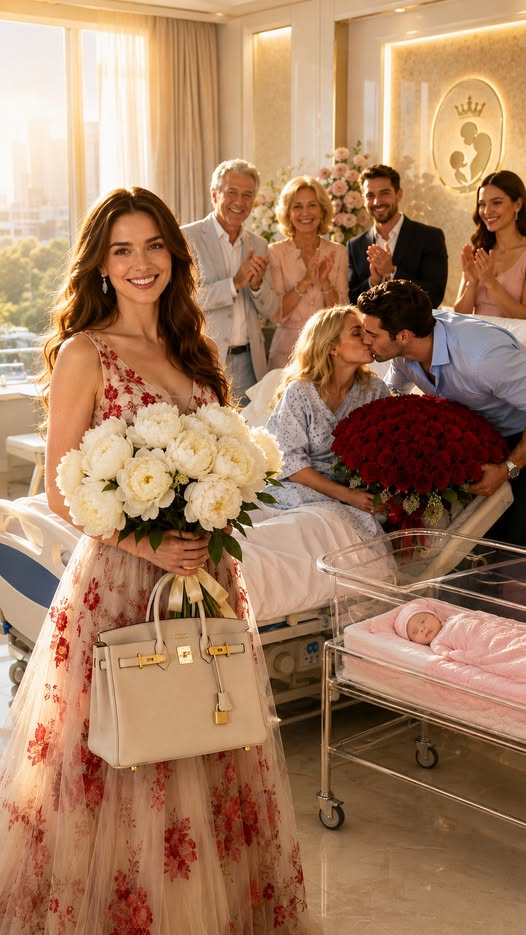
I pushed open the heavy oak door to room 314, my arms full of pristine white peonies. The sterile, metallic scent of hospital antiseptic immediately clashed with the sweet fragrance of the blooms.
My husband, Weston, was leaning over the hospital bed, pressing a tender, lingering kiss against my sister’s forehead. Hadley was cradling their newborn son against her chest. When the heavy door clicked shut behind me, she looked up.
There was no gasp of horror. No frantic scrambling to explain. Hadley simply looked at me, her eyes narrowing into a smile of pure, venomous satisfaction.
“Ashton Marguerite. That’s his name,” she announced, her voice echoing in the quiet recovery room. Her eyes dropped to my designer handbag, then back to my face. “You just keep paying the mortgage on that house like the pathetic, blind cash machine you’ve always been, Scarlet. We will let you know when we are properly ready to move in.”
My mother, Adelaide, stepped into the room right behind me, carrying a cellophane-wrapped fruit tray. She didn’t drop it. She didn’t even pretend to manufacture a gasp of maternal shock. My father, Sinclair, lingered awkwardly in the corridor, using his large frame to block the doorway while staring intently at the linoleum floor like a magnificent coward.
My pulse thrummed violently against my neck, but my hands remained perfectly steady. I walked to the bedside table and set the white peonies down with deliberate, agonizing care.
“Congratulations,” I whispered.
They honestly believed they had completely destroyed me in that sterile room. They possessed absolutely no idea that exactly sixteen days later, at the lavish “engagement and christening” garden party they had orchestrated behind my back, I would hand every single invited guest a document that would make the entire manicured lawn go deathly silent.
My name is Scarlet Fairchild. I am thirty-four years old.
Twenty minutes after leaving the maternity ward, I sat in my silver Volvo on the third level of the Mission Health parking deck. My tear ducts remained stubbornly, mercifully dry. My gaze dropped to the heavy gold chain resting against my left wrist. My grandmother, Marguerite, had clasped it around my arm the summer before the pancreatic cancer took her. The inner band was engraved with two simple words: First Star.
For the very first time in eight years, the metal felt unbearably heavy, as though it had been holding my hand up this entire time, and I had simply been too busy to notice the strain.
I unlatched the center console and extracted a small, antique brass key. It didn’t belong to any vehicle or door. Then, staring at the concrete wall of the garage, I allowed myself to remember Charleston.
April 2018. I was twenty-six, grinding as a sous-chef at a high-end lowcountry kitchen. I was standing in the Bellund ballroom during a regional food and wine festival, my apron dusted with imported flour, pouring Domaine Tempier rosé at eleven in the morning. I was demonstrating a French-pressed brioche—a notoriously finicky, high-hydration technique that most Southern kitchens refuse to touch because the payoff is only apparent to a highly educated palate.
Weston Row was thirty. He was a pastry chef at a mid-tier Asheville bistro I had never bothered to visit. He stood by my station, observing my meticulous arrangement of the loaves.
“You’re the whole show, aren’t you?” he noted, his voice a low, steady rumble. “Nobody in this zip code can manufacture that crumb texture. You need your own name on a door.”
I relayed that exact interaction to my grandmother three weekends later on her screened-in porch in Mount Pleasant. She was already losing weight by then, though the lethal diagnosis was still months away. She listened to me describe his charm, his dark eyes, his ambition.
She took a slow sip of her sweet tea. “He watches you cook the exact same way some men watch the stock market, Scarlet.”
I laughed it off. I didn’t comprehend the warning. It would take me nearly a decade to decipher her translation.
We navigated a long-distance romance through 2019 and into 2020. In the early spring, an executive chef position at a newly minted King Street establishment was handed to me on a silver platter. Ninety-five thousand a year, absolute creative control over the pass, and a path to equity within twelve months.
I declined the offer. I packed my life into boxes and moved to Asheville to be with Weston.
I closed on a 1920s craftsman property on Cumberland Avenue. The purchase price was $412,000. I put down $82,000—capital scraped together from twelve years of grueling, paycheck-to-paycheck restaurant shifts, bolstered by a $40,000 inheritance from my grandmother.
The funds were routed through Wren Kavanaugh, my grandmother’s iron-willed estate attorney in Charleston. Wren had sent me a highly specific email a week prior to closing:
Scarlet. As we extensively discussed, keep the deed in your name, and your name only. North Carolina does not automatically convert separate property into marital assets, but titles get dangerously sloppy. Your grandmother would insist. – W.C.
I obeyed. The deed carried my name alone. Weston questioned it twice, asking why we couldn’t just list both names to “streamline the paperwork.” I repeated my attorney’s advice. He dropped the issue immediately. He always dropped things quickly if I stood as an immovable object the first time. I didn’t learn the anatomy of that manipulation tactic early enough.
We married in a micro-ceremony at the Biltmore Estate that September. I wore my grandmother’s gold bracelet on my left wrist. As I peeled off my satin glove to allow the diamond wedding band to slide onto my finger, the ring scraped against the engraved gold.
Weston noticed the friction. He tilted his head. “You’re still wearing that heavy thing?”
“Always,” I replied.
He smiled, but the warmth completely failed to reach his retinas. That was the absolute first red flag I forgave. I never should have forgiven it.
Six years later, driving back from the hospital where my sister had proudly announced my status as her personal ATM, I turned onto Cumberland Avenue. I slowed the Volvo to a crawl. The warm, inviting lights of my front parlor were blazing. Parked arrogantly at my curb was a silver Volvo XC90. The license plate began with HXR—the exact kind of vanity tag Weston always selected because his brain could memorize it in a single glance.
I didn’t hit the brakes. I didn’t march inside to scream.
I pressed the accelerator and drove straight to the restaurant, completely unaware that my accountant was currently sitting in the dark, waiting to hand me the exact weapon I needed to burn their entire world to ash.
PART 2 — The Paper Trail
The heavy steel service door at Fairchild and Row opens onto a grim, brick-lined alleyway off Broadway. I keyed myself in at 2:37 AM.
The stainless-steel service pass was immaculate. The overhead infrared heat lamps had been powered down for hours. The solitary illumination emanated from a pendant light suspended over my custom walnut butcher block—a massive, three-inch-thick slab I oiled religiously twice a month. It was the altar where I had executed every mise en place for the last four years.
Francis McKinley was already there. She was fifty-eight, a mathematical savant, and she had served as my lead accountant since our opening week. She was methodically wiping down a pristine section of prep counter with a damp bar towel—a nervous tic she employed whenever she lingered late without a scheduled reason.
“Kettle is hot,” she said quietly.
I brewed two cups of Earl Gray. I sat on a steel prep stool.
My grandmother had left me her $40,000 inheritance alongside a hand-typed, notarized trust letter. The document contained one paragraph dictating the distribution of her jewelry, one paragraph regarding my mother’s erratic behavior, and a final paragraph regarding business.
If Scarlet ever enters into a joint commercial venture with a co-owner, particularly a legal spouse, the incorporation documents shall explicitly include a material breach of fiduciary duty clause, triggering automatic buyback rights at base book value. This provision is absolutely non-negotiable. Legal fees for said incorporation have been prepaid from this trust.
When we formally incorporated the restaurant group in 2021, my lawyer embedded the clause. Weston had read Section 8.3 twice. He had scoffed, asking if I truly distrusted him. I told him it was Marguerite’s dying condition, paid for by her estate. He took the 25% minority equity and signed the line. He never mentioned it again.
Now, sitting in the dim kitchen, Francis slid a thick, heavy kraft envelope across the walnut block. There was a small, precise pencil mark in the upper right corner: March 12, 2026.
“I have been holding this file in my safe for exactly six weeks, Scarlet,” Francis whispered, her eyes tracking my hands. “Read it when you are in a secure headspace. But please know, you are not isolated in this. Not with me.”
Before I cracked the wax seal on the envelope, my brain instinctively walked backward, surveying the wreckage of the preceding year.
July 12th, 2025. My mother’s sixtieth birthday gala. Forty elite guests gathered in the sprawling garden at 42 Lake View Circle under a massive white oak. I had catered the event for free, pulling double shifts. I had to abandon the party at 8:45 PM to manage a private VIP booking back at the restaurant.
“You head back to the pass,” Weston had urged, kissing my cheek. “I’ll stay and manage the breakdown. Your parents need the muscle.”
I worked the line until midnight. When I finally dragged myself home at 12:30 AM, the house was dark. Weston didn’t walk through the door until 1:17 AM. I remember the exact digital timestamp glaring from the microwave display. He smelled overwhelmingly of a rich Petit Verdot—a vintage I absolutely knew we hadn’t poured at the restaurant that week. He claimed the hired caterers had left a case behind, and he had simply shared a glass with Hadley in the cellar.
September. My mother began calling me on Sunday afternoons. The timing was suspiciously precise: always between 3:00 and 4:00 PM. She would weep into the receiver, spinning elaborate, panicked tales about memories slipping through her fingers. She forgot a neighbor’s name. She got lost driving home from choir practice. I would abandon my prep station, drive across the city, and find her sitting in her immaculate kitchen, her hands perfectly steady as she sipped chamomile.
In October, staring into her teacup, she casually planted the seed. “Maybe your sister should consider relocating back home. Just for a little while. I need family close.”
By February, Hadley had moved into my parents’ front guest suite—exactly 4.2 miles from my kitchen, fifteen minutes in standard traffic. Within her first week, she visited the restaurant three separate times during the chaotic lunch rush. She brought Weston artisanal honey cakes, cooing in a cloying, helpless tone, “Someone has to ensure my hardworking brother-in-law eats.”
I was busy violently julienning shallots. I didn’t look up.
Then came the night in March. I woke at 2:14 AM because Weston’s iPhone illuminated the dark bedroom ceiling. The banner notification displayed a single, solitary letter: H.
I didn’t touch his phone. I didn’t need to. I simply closed my eyes and thought, So, it’s her.
I ripped open the kraft envelope on the butcher block.
The first document was a certified wire transfer confirmation. August 15, 2025. Twelve thousand dollars drained directly from Fairchild and Row’s operating accounts, routed to a shell LLC named Row Hospitality Group at South State Bank. The memo line read: Consulting & Brand Development – Charlotte Expansion Phase One.
There was no Charlotte expansion. I was the managing partner; I governed the real estate pipeline.
“That is merely the first one,” Francis murmured, watching the blood drain from my face. “There are twenty-two more.”
I flipped the heavy pages. Twenty-two distinct transfers spanning eight months. The smallest theft was $1,800. The largest was $8,600. Every single memo line fabricated a ghost project: Menu Design Services, Satellite Location Scouting.
Weston had generated fraudulent invoices utilizing a corporate logo he had secretly commissioned—a serif font that mirrored our restaurant’s branding almost flawlessly, save for a slight, cowardly curve on the letter R.
The grand total embezzled was $84,000.
“There is one final page,” Francis instructed, her voice thick with suppressed rage. “Page twenty.”
It was a cleared invoice from Volvo of Asheville. March 18th, 2026. A silver XC90 Momentum trim, delivered directly to Row Hospitality Group LLC.
The shipping address listed on the commercial invoice was 42 Lake View Circle. My parents’ estate.
I had personally witnessed my sister step out of that exact silver luxury SUV in front of my restaurant three times over the past month. I had never bothered to ask how an unemployed graphic designer afforded it. I hadn’t wanted to know the answer.
I looked up from the butcher block, the cold reality settling into my marrow. “Why did you wait six weeks to show me this, Francis?”
She stared at her hands. “My husband, Terrence, had stage four cancer before we caught it. His oncologist wanted to tell me the diagnosis first, to cushion the blow. Terrence forbade it. He wanted to look me in the eye and tell me himself. I never got the agency to choose when my world ended. I promised myself I would never inflict that blindside on another woman. So, I waited until I had the entire, undeniable paper trail.”
I stood up. I slid the documents back into the kraft envelope.
“Thank you, Francis,” I said, my voice hardening into steel. “Go home. Tomorrow morning, we initiate the slaughter.”
PART 3 — The Anatomy of a Trap
I dialed Merritt Vance, my corporate attorney, at exactly 8:00 AM.
He was already at his mahogany desk on Wall Street in downtown Asheville. When I summarized the wire transfers, he uttered a single command: “Come.”
By 9:00 AM, I was seated across from him, laying Francis’s meticulously audited pages out like a deck of tarot cards predicting absolute ruin. Merritt reviewed them without a single micro-expression betraying his thoughts. When he finished, he steepled his fingers, leveling a gaze at me that chillingly mirrored my late grandmother’s.
“Section 8.3 of your operating agreement automatically triggers the precise moment we possess documented proof of a fiduciary breach,” Merritt explained, his tone clinical. “Francis’s ledgers are a solid foundation, but we require a bulletproof secondary layer. I want to know exactly what illicit activities are occurring inside your parents’ residence, and I demand a licensed investigator’s chain of custody, not the emotional testimony of a betrayed spouse.”
He slid a business card across the desk. “Callum Bishop. Tell him I sent you.”
Callum Bishop was a fifty-one-year-old former Charlotte-Mecklenburg homicide detective. He refused to bug bedrooms or tail targets through public restrooms. I met him at a high-top table at High-Five Coffee. He wore a charcoal tactical shirt and ordered a black drip coffee that he never touched.
I spoke for thirty uninterrupted minutes. When I concluded, he slid a three-page retainer agreement across the table.
“Three weeks,” Callum grunted. “Deposit is forty-five hundred. Everything I pull has to be legally admissible or strictly defensible in a civil suit. You get a sterile, undeniable file.”
“Three targets,” I clarified, signing the check. “Verify Weston’s Vegas trip. Document my sister’s timeline. And forensically verify my mother’s cognitive condition.”
That afternoon, I returned to Merritt’s office. He unlocked a fireproof drawer and extracted the original operating agreement, flipping directly to page eleven. His index finger tapped heavily on Section 8.3.
“The book value of the LLC on the date of the very first documented breach—August 15, 2025—was exactly $112,000, factoring in your heavy SBA loans and equipment depreciation,” Merritt calculated. “His 25% minority share equates to $28,000.”
He looked up, a predatory gleam in his eye. “However, the fair market value today, after four years of relentless press coverage and a fully booked reservation ledger, is hovering around 1.2 million. His share at market rate would be $300,000. Your grandmother wrote this specific chronological trap into your corporate structure. She knew exactly what kind of parasite you were dealing with.”
“We execute the buyback,” I ordered.
“Not until Callum delivers the complete dossier,” Merritt cautioned. “Can you carry the illusion of a happy marriage for twenty-one days without him suspecting a thing?”
“I can.”
For twenty-one agonizing nights, I kissed the man who was bankrupting my soul. I asked about his pastry prep. I smiled when his hand brushed my shoulder. I got out of bed at 2:00 AM, drove to the restaurant, and sat with Francis under the pendant light, auditing every single historical receipt. I quietly opened a shadow checking account at Wells Fargo. I locked down my personal credit file.
This is what absolute, lethal discipline looks like when you cannot afford the luxury of blinking.
On April 15th, Callum’s encrypted file finally hit my inbox.
The first attachment was a certified copy of a marriage certificate from Clark County, Nevada. Date of solemnization: November 14, 2025. Location: Chapel of the Flowers, Las Vegas.
Groom: Weston Allen Row. Bride: Hadley Marguerite Fairchild.
I stared at the middle name. My sister does not possess a middle name. It was an eccentric rule my mother had established during our childhood. Hadley had legally adopted Marguerite in Nevada—usurping my grandmother’s legacy five full months before she stood in that maternity ward and bestowed it upon her illegitimate son.
She hadn’t honored my grandmother. She had systematically replaced me.
I called Merritt. “Do we file for an annulment based on bigamy, or execute a standard divorce?”
“Divorce from bed and board,” Merritt advised instantly. “It’s significantly faster and less public. Bigamy is a nuclear warhead. You keep it locked in the vault. If they attempt to push back on the asset division, you press the launch button.”
Callum’s second email arrived the following evening. Preliminary on Adelaide. You need to read this immediately.
The dossier contained four items. First, a YouTube link to a keynote speech my mother had delivered at the Grove Park Inn ballroom in February. She spoke for twelve minutes on urban historical preservation without a single note card, flawlessly recalling dates and quoting legislation. There was zero cognitive slippage. Seven days prior to that brilliant speech, she had called me weeping, claiming she couldn’t remember her own daughter’s phone number.
The third item was Callum’s analytical breakdown of her phone records. Six distress calls regarding her “dementia” between September and March. Every single call originated on a Sunday. Every call commenced precisely between 3:00 and 4:00 PM.
Consistent pattern, Callum had scrawled in the margins. Preceded every one of your Sunday dinner services by roughly one hour. Statistically impossible if randomly occurring.
The final nail in the coffin was my mother’s iCloud Safari history, which I legally accessed using the master family password my father had established years prior.
August 12, 2025: How to fake early onset dementia symptoms convincingly.
How to cry on demand naturally.
Convincing dementia phone call script.
I closed my laptop. I sat in the suffocating darkness of my kitchen for an hour.
Then, I picked up my phone and dialed Prescott Everly, the ruthless, silver-haired owner of the Ivy Boutique Hotel. She had made a soft offer to invest in Fairchild and Row a year ago—an offer Weston claimed he had “handled.”
“Prescott,” I said, my voice dead calm. “I would like to sell forty percent of my restaurant group. Are you still interested?”
“I have been waiting for this exact phone call for four years, Scarlet,” she purred.
We met in her private veranda booth. I laid out the entire betrayal. When I finished, she signaled the bartender for two glasses of Sancerre.
“I will wire you $520,000 cash for a 40% equity stake,” Prescott stated, not even glancing at a ledger. “Escrow closes in fourteen days. I demand operational veto power on major brand expansions, but you retain absolute dictatorial control over the kitchen. And I want your fraudulent husband permanently evicted from the cap table before my ink dries.”
“He will be gone by Monday,” I promised.
On Monday morning, Merritt Vance deposited exactly $28,000 into a blind escrow account and dispatched a registered legal notice to Weston’s official address of record—the restaurant. By Tuesday morning, I legally owned 100% of the restaurant group. Weston, who was too arrogant to open his own certified mail, remained completely oblivious as he plated desserts ten feet away from the envelope.
The trap was fully armed. All that remained was designing the invitations to the slaughter.
PART 4 — The Six-Course Execution
Bo Ashworth, my fiercely loyal sommelier, drove me to Southern Print and Bind on Lexington Avenue. Our lead graphic designer, Isla, did not ask a single question when I requested eighty-two custom menus to be produced overnight.
We selected a heavy cream cover stock with a gold foil edge and a navy wax seal—the exact, luxurious formatting we utilized for the restaurant’s exclusive tasting menus. However, inside the fold, there were six distinct pages, labeled as courses.
Underneath each elegant heading, printed as calmly as a wine pairing, was a catastrophic legal document.
On Saturday, May 2nd, the official complaint for absolute divorce was electronically filed and sealed by the Buncombe County Superior Court.
On Sunday morning, I dressed in a stark black, three-quarter-sleeve shift dress. I fastened my grandmother’s gold bracelet to my left wrist. I applied a single coat of waterproof mascara.
I arrived at 42 Lake View Circle at 1:45 PM.
The sprawling back lawn was a masterclass in Southern hypocrisy. Eighty white Chiavari chairs were perfectly aligned facing a vibrant hedge of camellias. A string trio played softly under the magnolia canopy. Servers circulated with expensive prosecco.
Prescott Everly was already seated in the third row, looking completely unbothered. Nobody at the gathering realized she had just purchased nearly half of my empire.
Adelaide floated down the cobblestone walkway to intercept me, draped in a cream linen suit. She kissed the air near my cheek. “Sweetheart, you made it. Please, take a seat in the front row. Your father is in the greenhouse fetching Hadley’s bouquet. Everything is perfectly fine.”
I didn’t sit.
“Let me help you host, Mom,” I offered, my tone bright and hollow. “I brought a small keepsake for the guests. I thought they would enjoy reading them before you give your welcoming toast.”
I opened the carved walnut box Francis had placed in my car. I began walking the center aisle.
I handed a navy-ribboned menu to every single guest. Bo assisted on the far side of the lawn. Within eight minutes, eighty people were holding the exact blueprints of my family’s betrayal. Weston held one. Hadley held one. My mother held hers pinched between two manicured fingers, as if it were a soiled napkin.
Adelaide marched toward me, catching my elbow with a sharp, familiar pressure—the maternal grip that silently communicated, Do not embarrass me in public.
“Scarlet, honey,” she hissed under her breath. “What on earth is this?”
“It’s the menu, Mom,” I replied smoothly, projecting my voice. “Six unique courses. Please, everyone, open yours.”
Eighty guests untied eighty navy ribbons in unison.
Course One: The certified Nevada marriage certificate proving Weston and Hadley committed felony bigamy.
Twenty seconds of profound, suffocating silence. Then, a collective, horrified gasp rippled from the second row.
Course Two: The financial chart exposing the twenty-two fraudulent wire transfers totaling $84,000, juxtaposed with the invoice for the luxury Volvo parked in my parents’ driveway.
Course Three: The executed Section 8.3 Buyback Notice, legally confirming Weston’s entire corporate ownership had been forcefully seized for a pitiful $28,000.
Course Four: The certificate of sale verifying Prescott Everly now owned 40% of the enterprise.
Prescott slowly stood up in the third row. She didn’t smile. She simply nodded once, asserting her dominance over the shocked crowd.
Course Five: The filed complaint for divorce, citing adultery and indignities.
Course Six: A single, devastating paragraph printed in the center of the final cream page.
To Ashton: May you somehow manage to grow up honest.
To everyone else: Fairchild reopens this Tuesday under new ownership. The wine list is curated by Bo Ashworth. – Scarlet Fairchild.
The string trio had stopped playing. The silence in the garden was absolute, heavy enough to crack the pavement.
Weston scrambled to his feet, dropping his menu onto the grass. “Scarlet, please—”
I raised a single hand, palm out. The micro-gesture froze him in his tracks.
“Weston,” I said, letting the silence stretch until it was agonizing. “You continuously insisted I should just let you handle the heavy paperwork. I finally took your advice. This is how the audit turned out.”
I pivoted toward my sister. The smug satisfaction she had worn in the hospital room was entirely eradicated. Her cheeks were flushed a violent, panicked crimson. Baby Ashton was sleeping soundly in a bassinet at her side.
“Ashton didn’t ask for any of this corruption,” I stated, my voice echoing across the lawn. “When he is old enough to understand, inform him that his aunt financed the christening gown he never had the chance to wear today.”
I reached down and unclasped the gold bracelet from my wrist. I stepped past Hadley, ignoring her completely, and stopped directly in front of Weston. I pressed the heavy gold metal into his trembling palm.
“This belonged to Grandmother Marguerite,” I commanded. “It strictly goes to whoever manages to grow up honest in this bloodline. Secure it for your son. Not for yourself.”
He closed his fist around the gold. Tears were freely spilling down his cheeks.
I plucked a flute of champagne from a paralyzed server’s tray, took a long, satisfying sip, and set it down on a side table. I glanced toward the greenhouse. My father was standing entirely motionless behind the glass panes, watching his family’s reputation detonate in real-time. His face was a mask of utter devastation.
I turned my back on all of them and walked down the center aisle. Bo fell into step beside me.
“Where to, Chef?” he asked quietly as we reached my car.
“Home,” I replied.
PART 5 — The Name on the Door
I didn’t answer a single phone call for a week.
Weston was legally barred from entering the Montford house; the deed remained strictly mine, and the divorce filing granted me exclusive jurisdictional occupancy. He was forced to crash on a former line cook’s pull-out sofa in Weaverville.
The restaurant reopened on Tuesday evening. Prescott had insisted we simplify the branding. We commissioned a massive walnut plaque, sanded and oiled by Francis herself, and mounted it directly above the kitchen pass.
Fairchild.
The reservation ledger completely sold out for the next six weeks within forty-eight hours. The local press covered the “quiet ownership transition” without breathing a single word about the garden party execution.
The fallout, however, was biblical.
Hadley immediately filed for an annulment of her Nevada marriage, desperately attempting to insulate herself from federal bigamy charges by throwing Weston directly under the legal bus. She chose self-preservation over her “husband” with blinding speed.
Adelaide received a highly classified, devastatingly polite letter from the Heritage Preservation Society’s board of directors. She was quietly, forcefully asked to resign from all her honorary chair positions. She had been exiled from the only society she ever truly cared about.
On Friday afternoon, my father, Sinclair, walked into Fairchild through the main dining room doors. He sat at the copper bar, requesting a single glass of water.
I emerged from the kitchen, wiping my hands on my apron. I stopped three paces away.
“I didn’t know about the Vegas wedding,” he rasped, his hands violently shaking against the copper bar top. “I swear it. But I knew about your sister staying there. I didn’t stop the affair. That’s the exact same sin, isn’t it?”
“Yes, Dad. It is.”
“My hardware store owes $95,000 in commercial debt,” he confessed, his voice breaking. “Your mother promised her elite network was going to bail us out if I just kept my mouth shut. I chose the store’s survival over you. I want you to know that I recognize my failure.”
I felt the immense weight of the space between us. I didn’t step forward to comfort him.
“Thank you for finally saying it out loud,” I replied, my voice steady. “I need time. Maybe two years. Do not send letters. Do not attempt to call. If an emergency arises, route it through Merritt Vance.”
He nodded slowly. He left a folded piece of paper on the bar and walked out into the fading sunlight. The note simply read: I am so sorry, my girl.
A week later, I signed a listing agreement for the house on Cumberland Avenue. The Asheville real estate market had exploded, and the property’s value had climbed nearly $240,000 in six years—equity I had built while chopping shallots at 2:00 AM, entirely unappreciated by the family I was feeding.
I drove to the house one final time before the private showings commenced. I parked in the driveway but refused to cross the threshold.
The wooden plaque on the front door was still affixed to the frame. Weston had carved it by hand the winter we married: The Row Family, Established 2020.
I retrieved a small chisel and a mallet from my trunk. I worked the iron behind the wood slowly, ensuring I didn’t splinter the doorframe. When the sign popped free, I placed it face-up on the porch floorboards. The next buyer could throw it in the trash.
I opened my trunk. Resting on a velvet cloth was a new, live-edge walnut slab I had commissioned. The font was sharp, uncompromising, and cut deep into the grain.
Fairchild.
I didn’t hang it on the Cumberland house. That property was merely a chapter I had already finished reading.
I drove downtown, letting myself into the restaurant through the alley door. Francis was at the butcher block, methodically chopping chives in the exact, comforting rhythm she had utilized for years.
I walked past her and mounted the new Fairchild plaque on the exposed brick wall directly beside my prep station—the exact spot I had always envisioned it belonging.
Francis paused her knife, tipped her chin in a silent nod of approval, and returned to her mise en place.
I opened the heavy stainless-steel walk-in cooler, selected a pristine Meyer lemon, and placed it on the board. I picked up my chef’s knife, feeling the familiar, perfect balance of the steel in my grip.
My grandmother had warned me years ago, “If you are going to marry a man, make sure you own your own kitchen first.”
I originally thought she was referring to the physical stove. It took me thirty-four years, a broken marriage, and an act of absolute corporate warfare to finally understand that she meant the deed.
Because at the end of the day, romantic names can be hastily added to contracts, and they can be violently scrubbed away. But only one signature pays the mortgage. And when the smoke clears, only one name possesses the power to feed the people who actually matter.
Mine.