PART 1 — The Yellow Tape Measure
My name is Whitney Cole, and I am twenty-nine years old.
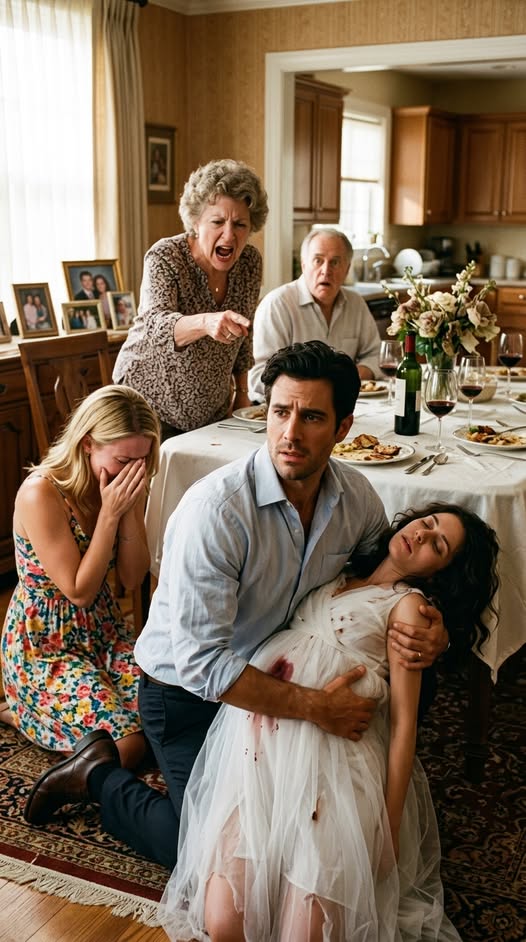
The exact night I finally gathered the courage to tell my family I was pregnant, my own mother lunged around our mahogany dining table and buried her closed fist deep into my stomach. She was screaming, her voice tearing through the civilized air of the room, that the very first grandchild belonged exclusively to my older sister.
I was exactly eleven weeks along.
I spent the remainder of that horrific night in a sterile, brightly lit emergency room. I lay perfectly still on a crinkling paper bed, watching a tiny, erratic heartbeat flicker on a grayscale ultrasound monitor, simultaneously discovering exactly what my own hands do when they cannot stop shaking.
But here is the absolute truth of that night: the violent, physical blow isn’t the part that ultimately broke my mother’s mind.
The part that entirely shattered her reality was the chime of the front doorbell, sounding exactly twenty minutes after she struck me, and the woman who was standing on my parents’ porch, wearing my exact face.
What transpired after that doorbell rang eventually concluded in front of a county judge. And what my mother desperately offered me in that quiet courtroom, in front of everyone who knew us, was infinitely crueler than the fist.
To understand my mother, you must first understand the morning inspection.
In her house, every single day commenced with an audit. She would stand at the bottom of the grand oak staircase, a mug of black coffee in hand. My sister, Chelsea, and I would descend, and my mother’s eyes would sweep over us with the precise, ruthless calculation of a diamond appraiser sorting gems. Fast, expert, and entirely devoid of warmth.
Chelsea always received physical adjustments. A velvet barrette straightened. A linen collar sharply smoothed. A stray blonde hair tucked behind her ear with two manicured fingers. It was an action that expertly mimicked maternal tenderness, but functioned entirely as structural maintenance.
I, however, received a glance. A single, sweeping visual pass from crown to floorboard. Then, her eyes would immediately dismiss me and pivot to the day’s actual business. I would stand frozen in the hallway, feeling exactly like a parcel that had been weighed on a scale and abruptly stamped postage due.
There was a specific tape measure kept in our kitchen’s top drawer. It was bright sunflower yellow. Every single Sunday night, my mother extracted it, wrapped it tightly around Chelsea’s waist, and meticulously recorded the resulting number on a small notepad shaped like a tiered wedding cake.
She never measured me. Not once.
For the majority of my childhood, I fundamentally misunderstood this omission. I genuinely believed that not being measured equated to freedom. I thought I was the lucky, unwatched child—the one permitted to consume her Halloween candy in absolute peace while Chelsea ate plain celery.
It wasn’t freedom. It was a brutal, silent disqualification. You do not bother to measure the inventory that you have already decided will never go to market.
I survived by learning to read my mother’s emotional weather the way a seasoned sailor reads a darkening horizon. The microscopic tightening of her jawline. The exact, rigid angle at which she placed her crystal water goblet. The stark, terrifying difference between her high, musical public laugh and her real one—a dry, hacking sound I had heard perhaps five times in my entire existence.
That specific survival skill—the ability to scan a room for incoming danger before the danger even recognized itself—is the single most valuable asset my childhood provided. It has never once failed me.
But my mother only truly makes sense when you stand inside her sanctuary.
Sandra’s Bridal opened its doors in 1998 on Main Street in Corin, Indiana. I will say this plainly: the establishment is breathtaking. My mother possesses a genuine, ruthless gift for aesthetics, and that shop is her personal cathedral. It is walled with cream carpet, gilded antique mirrors, and endless rows of white silk gowns illuminated like holy relics.
She was crowned Miss Harlan County in 1986. The faded satin sash still hangs, custom-framed, directly behind the cash register. Brides will eagerly drive in from three adjacent counties because, in this part of the state, being personally dressed by Sandra Renner still carries immense social currency.
Chelsea modeled for the boutique from the moment she turned six. Junior bridesmaid layouts. Flower girl catalogs. Later, she graduated to modeling the sample couture gowns. She possesses our mother’s face. I mean that almost literally. The exact same high, sweeping cheekbones. The same wide-set, calculating green eyes. It was a genetic resemblance so profound that strangers often found it charming. I eventually found it deeply ominous.
I worked at the shop, too. I existed exclusively in the back stockroom, wrestling inventory out of cardboard boxes, aggressively steaming miles of tulle, entirely invisible to the showroom floor.
I was nine years old, crouched unseen behind a dense rack of cathedral veils, the day a wealthy customer openly cooed over Chelsea as she twirled on the velvet fitting pedestal. The woman asked my mother how she had gotten so incredibly lucky to have such a beautiful daughter.
My mother laughed her bright, musical public laugh. “Oh, believe me, we work at it! In this family, pretty is the rent.”
The entire showroom erupted into polite, appreciative laughter.
I remember freezing back there among the plastic garment bags, my nine-year-old brain doing the brutal, silent math that would define my life forever. If pretty was the rent, I was severely, irreparably behind on my payments. I possessed, according to the official family ledger, the wrong face.
Once, in a rare moment of childish bravery, I asked my mother whose face I actually had, since it so clearly wasn’t hers.
She stared at me. She held the gaze a beat too long, her green eyes icing over. “Not from my side of the family,” she snapped, her mouth snapping shut like a heavy drawer.
Hold on to that specific detail. It matters more than anything else in this story.
My father, Alan, is a retail pharmacist. For twenty uninterrupted years, he voluntarily worked the graveyard shift. I intuitively understood his choice long before I possessed the vocabulary to articulate it out loud.
Our house at 7:00 PM was a tightly controlled theatrical stage governed by a single, ruthless director. My father had simply discovered the only available exit that didn’t require a screaming match.
He loved us in quiet, invisible tenses. There would magically be a slice of cherry pie left wrapped in the fridge with a small, printed sticky note attached. My bicycle chain, which snapped on a chaotic Tuesday, would be miraculously repaired and oiled by Thursday dawn, though nobody ever witnessed him holding a wrench.
Whenever my mother’s morning inspections stretched too long, turning sharp and critical, he would quietly materialize in the kitchen doorway, jingling his car keys, ready to leave for work an entire hour early. Sometimes his mere physical presence siphoned the dangerous electricity out of the room. Sometimes it failed completely.
Either way, he always left.
I want to be exceedingly fair to him, but I also want to be honest, and those are two entirely different assignments. He never raised a hand to me. He never raised his voice in anger. He never once joined in on the cruel critiques.
He also never, ever stepped in front of me to block a blow. He was present in our lives the exact same way a heavy piece of furniture is present: solid, warm-colored, and absolutely zero help in an emergency.
There is one exception. When I was twelve, I padded downstairs at midnight for a glass of water. I caught him sitting alone at the kitchen table. His old, moss-green fishing tackle box—the one with the heavy brass locking compartment—was wide open.
He was hurriedly sliding a thick envelope into it. I caught a flash of red and blue airmail edging, and a looping, elegant handwriting I didn’t recognize.
He saw me see it. He didn’t offer a frantic explanation. He simply stared at me for a long, heavy moment, then raised one index finger to his lips.
I nodded silently. Keeping quiet was the family trade, and I had been raised in the stockroom.
I didn’t learn what was locked inside that tackle box for seventeen more years. It wouldn’t arrive until the night of a dinner party that ended in blood.
PART 2 — The Golden Mannequin
I escaped the house the exact same way a lot of unphotographed, unmeasured daughters escape: I simply became useful somewhere else.
I navigated nursing school in Indianapolis, eventually securing a position in a high-acuity pediatric unit back in Fort Wayne. I quickly discovered that hospitals operate on the exact, hyper-vigilant skill set my childhood had drilled into me.
Noticing.
Absolutely nobody on a pediatric floor cares what your cheekbones look like. They only care that you caught the subtle, deadly fever spike at 2:00 AM. They care that you instantly recognized the microscopic shift in a premature baby’s cry from halfway down the corridor. For the very first time in my existence, being intensely watchful was valued far more than being watched.
I met Ben Cole when his ancient, rusting Toyota Corolla violently died in the hospital parking garage at the tail end of my exhausting double shift. I systematically diagnosed his dead alternator the exact same way I would read a patient’s chart. As I attached the jumper cables in the freezing rain, he leaned over the open hood and asked, with a wide, genuine grin, if I was this terrifyingly calm about absolutely everything in life.
Ben is a high school earth science teacher. He laughs with his entire chest. He maintains a running list on our refrigerator playfully titled ‘Things Whitney Was Right About.’
When he finally met my mother, she assessed him with one swift, jeweler’s pass. She pronounced him “sweet,” which, translated from Sandra’s dialect, explicitly means “zero resale value.”
We married in 2023. A small, unpretentious outdoor ceremony. My mother attended, wearing a pristine beige silk suit—the traditional mother-of-the-bride’s privilege, cheerfully and blatantly violated. I overheard her loudly informing the wedding photographer that my dress was “sadly just off the rack, but Whitney has always been painfully practical.”
I let the insult slide off me like water. I was armored with twenty-six years of rigorous conditioning and one very strong glass of champagne.
But there is one specific detail from that reception I kept locked away. During the toasts, my sister Chelsea reached under the linen tablecloth and grabbed my hand. She held it hard. Too hard. She gripped my fingers the way a drowning victim grips a railing.
At the time, I assumed she was merely being sentimental. I didn’t yet realize that the golden child was white-knuckling her way through her own life.
Because here is the horrific reality of what being worshipped in my family actually cost.
Chelsea was thirty-three years old. She had spent the last three agonizing years, and four brutal rounds of IVF, desperately attempting to produce what my mother had publicly, repeatedly, and giddily branded “the first Renner grandbaby.”
My mother had personally financed two of those expensive medical rounds. She announced her financial contribution at Easter dinner the exact same way a corporation announces a NASCAR sponsorship. And my mother’s money never, ever arrived without a choke-chain attached.
She maintained a running, vocal countdown at Sunday family dinners. “By next Christmas, God willing, there will be a beautiful bassinet right by that bay window!” She referred to my sister’s hypothetical future child, on more than one occasion, as “the next face of the shop.”
I observed this suffocating pressure and, to my profound shame, mostly felt the old, dull relief of the unmeasured daughter. At least the blinding spotlight isn’t aimed at me.
Then, one rainy Tuesday afternoon, I saw the frayed wiring underneath the golden pedestal.
I had driven Chelsea to her fertility clinic in Fort Wayne because her husband, Paul, had a mandatory work conference. My mother insisted on meeting us at the glass entrance doors. Before my sister even walked inside for her blood draw, our mother grabbed her tightly by both shoulders, kissed her pale cheek, and said, smiling with a terrifying intensity at a volume only the three of us could register:
“Do not disappoint me again, sweetheart.”
Again.
I sat in the sterile clinic waiting room with my paperback novel resting completely upside down in my lap, doing terrifying new math. Chelsea wasn’t the lucky one. Chelsea was the franchise. Her physical body was merely a product launch running dangerously behind schedule. And the woman we both called ‘Mom’ was the primary investor, and she was growing violently impatient.
I remember thinking, with cold, clinical, nurse-brained detachment: If a fifth round fails, someone in this family is going to get severely hurt.
I simply assumed, because the spotlight had never once swung toward the shadows where I stood, that the incoming blow wouldn’t be mine to absorb.
Eight weeks later, two stark pink lines materialized on a plastic stick in my bathroom.
Ben cried first. He slid down the bathroom wall, sitting hard on the tile floor with his back pressed against the bathtub. He was laughing and leaking tears simultaneously, repeating “Okay, okay, okay,” like a man frantically counting a stack of precious gold coins.
I stood paralyzed, holding the test. I felt the two competing emotions arrive simultaneously, holding hands the way they always do in my family: pure, blinding joy, and immediate, calculated threat assessment.
Because I knew exactly what this meant. This wasn’t just our baby. By the strict accounting of a woman on Main Street, this was an unauthorized product launch. The highly anticipated ‘first Renner grandbaby’ was currently gestating inside the wrong daughter.
So, I planned the announcement the exact same way I plan a high-risk medication pass. Carefully. Defensively. In writing.
We waited past the crucial first ultrasound. A strong, galloping heartbeat at eleven weeks. A blurry gray bean on the thermal paper that already seemed to possess Ben’s stubborn chin. We deliberately waited past my mother’s birthday, because minor tributaries must never compete with the main river.
I strategically chose a Sunday dinner at my parents’ house. A full table. Dad was home. Chelsea and Paul were present. I knew that having an audience had always forced my mother’s leash tighter. Witnesses made her performative, and performative meant gentler.
I even meticulously scripted the conversational pivot. I swear to you, I wrote it down on a neon index card and memorized it. The minute the news lands, immediately redirect the attention to Chelsea. Say: ‘And we absolutely cannot wait for this baby to have a cousin right behind it!’
I prepared for icy tears. I prepared for cold, dismissive silence. I prepared for the heavy spotlight swinging toward me like a heavy boom on a sailboat.
I prepared for absolutely everything, except the one variable I couldn’t possibly see coming.
Three hours before that dinner, while I was standing in my bedroom debating between two cardigans, my mother’s cell phone rang. It was Chelsea, calling weeping from the clinic parking lot. It was about round four. And it was devastating news.
I knew something was catastrophically wrong before I even had my winter coat off in their foyer.
Reading that house is my first language, and every single instrument in the room was aggressively reporting a severe pressure drop. Chelsea’s eyes were visibly swollen beneath a fresh, thick layer of concealer. Paul sat unnaturally close to her, his arm draped rigidly along the back of her chair—less like affection and more like a physical guardrail.
My father was carving the roast beef with the intense, hyper-focused thoroughness he only employs when he desperately wants a task that requires looking down.
And my mother… my mother was radiant.
That is the terrifying tell that took me years to decode. My mother’s outward brightness always runs in direct, inverse proportion to her internal weather. She was pouring expensive wine, complimenting everyone’s posture, and spinning a long, sparkling, animated story about a difficult bride from Decatur.
But her silver fork and knife touched her porcelain plate with exactly one millimeter too much force.
Click. Click. Like a metronome ticking down to an explosion.
Every childhood alarm bell I possessed was screaming. I actually found Ben’s knee under the table and squeezed it hard. It was our pre-arranged signal, developed specifically for this dining room, meaning: Hold. Abort mission. Not tonight.
But Ben had spent eleven weeks carrying a secret the size of a sun in his chest. And he was incredibly proud of me. And proud people are highly flammable.
When my mother turned her blinding, bright beam onto us and chirped, “And you two? You look positively lit up tonight! What on earth is going on over there?”
Ben’s hand was already lifting his wine glass. His wide smile was already breaking open. The words were already leaving his mouth.
“Well, actually, Sandra, we have some incredible news.”
I watched the disaster unfold in slow motion, the way you watch a glass tip off the edge of a counter. Too far to catch.
Chelsea’s red, swollen eyes snapped up. My father’s carving knife halted mid-slice.
And my mother’s face did something I had never, ever witnessed it do in twenty-nine years. It went perfectly, completely, terrifyingly still. The mask simply dissolved.
“I’m pregnant,” I said, because the sentence was already airborne, and it was my responsibility to land it. “Eleven weeks. We heard the heartbeat on Tuesday.”
For half a second, the entire room held its breath. And then, the silence broke in entirely the wrong order.
Chelsea moved first. My sister, the golden child, who had received the most devastating phone call of her fourth failed round that very afternoon, abruptly stood up. She walked around the table and she hugged me. She hugged me first, before anyone else. Her wet cheek pressed hard against mine, and she whispered into my ear, “Oh, Whit.”
That whisper possessed a jagged crack running straight down the middle of it. Agonizing grief and profound gladness fused so tightly together that even a trauma nurse couldn’t have surgically separated them. I will fiercely love her for that specific hug until the day I die.
My father set the heavy carving knife down, gripped the table’s edge with both hands, his eyes shining with unshed tears, and he looked at me. He nodded at his wife first, which, in the context of our house, was practically a declaration of war.
And my mother… my mother rose from her chair like a dark, violent storm system pulling up off a freezing lake.
PART 3 — The Ghost on the Porch
“Today,” she whispered. The sheer quietness of her voice was infinitely worse than any volume. “You purposely chose today.”
I frantically started to say that I didn’t know about the clinic’s phone call, which was the absolute truth, but she wasn’t processing auditory information anymore.
The terrifying stillness vanished. Her voice began to climb with every single syllable. That carefully trained, pageant-perfect diction cracked apart into something raw, feral, and utterly unrecognizable.
She started screaming about her four rounds. Her two rounds she paid for. Her Christmas bassinet. Three years of meticulous planning, and now this. She violently flung her hand toward me, pointing directly at my midsection. At my news.
“The first grandchild was supposed to be Chelsea’s! It has to be hers! The first grandchild must be hers!”
And then, she came around the table.
I am going to dictate this part the exact same way I told it later for the official police record. Because the police record is where I finally learned to keep the brutal truth plainly in order, without any decorative softening.
My mother came around the table fast. Unnaturally fast. Ben was rising from his chair. Paul was rising. Nobody was fast enough. Because nobody at that table—not one of us, not even me, the professional weather reader—could logically compute what was already happening.
She grabbed my left shoulder with her left hand, anchoring me. And she swung her right fist violently into my stomach.
Low. Deliberate. Exactly where the baby was. Screaming, “Get rid of it!”
One blow. I want to be clinically accurate. One.
It knocked the oxygen completely out of my lungs. I folded heavily over the arm of my chair. The chair slid out from under me, and I ended up on my knees on my mother’s expensive dining room carpet. I wrapped both arms tightly around my middle, gasping for air.
Somewhere very far above me, the room was violently exploding.
Ben’s large body was suddenly wedged between us, going up like a brick wall. Chelsea was screaming, “Mom! Oh my god, Mom!” Paul had both of his arms locked tightly around my mother’s waist. She was still surging forward, still thrashing, still screaming about her grandchild. Hers. Hers.
And then, a sound cut through the chaos that I had never, ever heard in thirty-five years of that marriage.
My father. On his feet. Roaring with a volume that shook the crystal chandelier: “SANDRA, ENOUGH!”
The room froze like a paused film reel.
My mother stood there, trapped in Paul’s arms, her chest heaving violently. Her perfectly pinned hair had fallen loose around her face. She was staring down at me on the floor. I looked up at her, my hands protectively shielding my stomach, my brain executing silent, frantic medical math about eleven weeks, pelvic bone density, what is biologically shielded, and what isn’t.
For one fleeting second, something mirroring actual horror crossed her face. I have replayed that specific second a thousand times in my mind. Whether it was genuine horror at the violence she had just committed, or horror at the fact that four witnesses had just seen the mask slip, I never got the chance to decide.
Because the doorbell rang.
Nobody moved a muscle. So, it rang again. Two polite, patient, cheerful chimes. It sounded utterly absurd against the violent wreckage of that dining room.
My father crossed to the foyer like a man wading through chest-deep water. He opened the heavy door.
Standing on the porch, bathed in the yellow glow of the security light, was a woman. She was wearing a tailored gray trench coat with a canvas weekend bag slung casually over her shoulder. She was in her early sixties. She had cropped, silver hair. She was tall, unhurried, and entirely, terrifyingly calm.
And her face.
I heard Ben’s breath hitch sharply before my own brain even finished processing the sentence.
She had my face. Not resembled it. Not shared a passing familial trait. She had my face. My strong jawline. My wide-set green eyes. My stubborn, pronounced chin that no one in any of the family photo albums had ever matched. She was thirty years ahead of me, a complete stranger standing on my parents’ welcome mat, but she was me.
Still folded protectively around my baby on the carpet, I stared up at her like she was a mirror that had suddenly learned how to walk.
My mother… my mother went paper white. All the color evacuated her face simultaneously, like water draining rapidly from a sink. And then, she began to visibly shake. My mother, who had just thrown a ruthless punch, who ruled every single room she had ever entered with an iron fist, stood trembling violently behind Paul’s arms as if the porch light had reached in and burned her.
The woman looked past my father. She scanned the scene. The overturned chair. Me on the carpet. Sandra shaking. She read the entire room with one slow, calculated pass of her eyes. A jeweler’s pass.
When she finally spoke, her voice was low, level, and aimed directly at my mother like a loaded weapon.
“Hello, Sandra. Thirty-six years, and it is still the exact same violent show.” A beat. “Who gave you permission to lay a hand on that girl?”
My father cleared his throat, his voice raspy and broken. “Whitney. This is your Aunt Renee.”
And that was the exact moment I felt something warm dampening the carpet beneath my knees, and realized with a sickening jolt that I was bleeding.
The next six hours I know by heart, because they are meticulously charted in a hospital database.
Fort Wayne ER. The exact same trauma bay where I have delivered patient handoffs a hundred times. Except now, I was the one shivering in the thin paper gown. I was watching the ultrasound monitor from the patient’s side of the bed—an experience I do not recommend to anyone in my profession. You know far too much, and entirely too little, all at once.
The bleeding was light, and it eventually stopped.
The wand moved across my gel-covered stomach. And there, gray on gray, was the flicker.
Heart rate: 164. Steady as a metronome. Mine was resting at 118.
“A small subchorionic hematoma,” the attending OB, Dr. Okonkwo, explained softly. “Basically, a bruise between the layers of tissue. We’ll watch it. Strict pelvic rest. Forty-eight hours of taking it very easy. Come back immediately if anything changes.”
At eleven weeks, the uterus still sits very low, shielded heavily by the pelvic bone. My mother’s fist had bought a terrifying bruise and a night of unspeakable terror, but by pure anatomical mercy, it had missed everything that actually mattered. I lay there on the crinkling paper, executing silent gratitude math with shaking hands.
And then, Dr. Okonkwo pulled up her rolling stool. Her voice dropped into a specific, clinical register. I recognized it instantly, because it’s the exact tone I use when I suspect abuse.
“Whitney. I am required to ask how this blunt trauma happened.”
Here is the exact moment I want you to see clearly. My entire life had been rigorously trained for this specific question. I fell. The family catechism, worn smooth by three generations of women covering up the bruises. I could physically feel the lie sitting heavy in my mouth like old copper coins. I could hear my mother’s commanding voice echoing underneath them: Pretty is the rent. Don’t air the dirty laundry. Family business stays in the family.
I looked at the monitor. 164. Steady. Somebody in this room could not lie yet, and I was her entire sky.
“My mother struck me,” I stated clearly. “Closed fist. Once. Directly to the abdomen. At approximately 7:40 PM.”
Plainly. In order. Without decoration.
Dr. Okonkwo nodded once, expressionless, and typed the words into her tablet. The undeniable truth went into a permanent chart. And charts, unlike terrified daughters, do not recant.
PART 4 — The Tackle Box and the Truth
My father arrived at our duplex early the next morning.
He stood on the front step looking exactly like a man applying for a job he fully expected to be rejected for. When Ben silently let him inside, he refused to sit down until I told him twice.
He had brought two things. A warm Pyrex pan of his homemade scrambled eggs—which is Alan’s dialect for I love you—and the tackle box. The old, moss-green one.
He set it gently on our kitchen table, worked the small brass lock with trembling fingers, and popped open the top compartment I had been quietly wondering about since I was twelve years old.
Envelopes. Dozens of them. Thickly rubber-banded together by decade. Red and blue airmail edging. The same elegant, looping handwriting. Postmarks from Taos, from Santa Fe. Thirty-six years of unopened Christmas cards from a sister-in-law he was strictly forbidden to mention.
Every single one of them had been carefully sliced open. Every single one of them kept.
“Renee,” he began, his voice thick. “Your mother completely cut her off in 1990. Took scissors to the photo albums. Banned her name from the house. But Renee never stopped writing to me to ask how you girls were doing. One card a year. And I never had the guts to do anything about it… except not throw them away.”
He turned one faded envelope over in his hands. “When you called last week and said you were bringing a Sunday dinner with ‘big news,’ I got a sick feeling in my gut. Your mother had been wound incredibly tight about Chelsea’s treatments for months. She was a powder keg. So… I did the one brave thing I know how to do, which is make a phone call and not tell anyone.”
He had secretly tracked down Renee, who happened to be passing through Ohio on a road trip, and asked her to come for dessert. Insurance. He had thought bringing the only person alive who had ever successfully stood up to Sandra might keep a lid on the explosion.
He looked down at his calloused hands. “I budgeted for a screaming match, Whit. Not for a fist.” He stopped, his jaw working as he fought tears. Then, he delivered the truest sentence of his entire life. “I spent thirty years thinking that staying quiet was holding the family together. Turns out… I was just holding onto my seat.”
Renee arrived that afternoon.
She filled our small, cramped kitchen with the deeply disorienting experience of watching my own face confidently pour tea. Up close, the genetic resemblance was almost comical. Ben kept looking back and forth between us like a spectator at a tennis match.
Then, she reached into her canvas bag and set a photograph face-up on the table. And suddenly, absolutely nothing was funny at all.
It was a Polaroid. 1989 was scrawled in blue ink on the white border.
Two young women were standing in front of an old Buick. One is my mother at twenty-one. Already heavily lacquered in hairspray, already posing, her smile aimed aggressively at the camera lens like a chrome hood ornament. And she is deliberately leaning away from the other woman.
The other woman is twenty-four, wearing a faded denim jacket, laughing genuinely at something off-frame. And she has my face.
Mine. Not a close approximation. Mine. The strong chin, the wide eyes, all of it, plastered on a woman standing in a sunny driveway three full years before I would even exist.
“That is the absolute last picture of us together,” Renee said, tapping the glossy paper. “I was the oldest. The one who ‘didn’t photograph well.’ That was the actual, spoken phrase in our house. Our mother graded us at the breakfast table, Whitney. Posture, skin clarity, waist measurements. I ate my toast getting brutally scored every morning for eighteen years. I was the rough draft. Your mother was the fair copy. So, I packed my bags and I left. 1990. I was twenty-five.”
She slid the Polaroid across the table to me.
“Sandra told everyone in town I ran completely off the rails on drugs,” Renee chuckled dryly. “What I actually ran was a highly successful pottery studio in Santa Fe. But the truth doesn’t matter to her show. The show desperately needs a tragic villain and a shining star.”
She looked at me then. And her eyes—my eyes—went very soft, and incredibly hard, at the exact same time.
“You have my face, sweetheart. Do not take her script.”
I picked up the Polaroid. My hands, I noted clinically, were no longer shaking.
Keep that specific photograph in your mind. It goes exactly where this entire story goes.
You might logically assume that a woman who punched her pregnant daughter in the stomach in front of four witnesses would go quiet for a while out of sheer shame. You would be thinking of an entirely different woman.
By Wednesday afternoon, my mother had a fully formed counter-narrative in aggressive circulation. And it was elegant, because her work always is.
Whitney had a severe dizzy spell. Poor thing. First trimester, you know how fragile they are. She took a terrible fall against the edge of the dining table. And now, hormones being hormones, and having always been deeply, irrationally jealous of her sister, she’s telling people something monstrous.
She deployed this narrative through the boutique the exact same way you would run a wire service. To the church altar guild. To the aunts in Ohio. To two wealthy neighbors. To her hairdresser.
My great-aunt in Dayton texted me a prayer hands emoji and the words: “Please don’t tear this beautiful family apart over a silly misunderstanding, honey.”
A woman I had babysat for a decade ago physically stopped me at the grocery store, gripped my forearm near the register, and loudly announced she was “praying for my whole… situation,” inserting a dramatic pause before the word, handling it like dirty laundry with tongs.
That is exactly how it works in a town where your mother sells every single wedding dress within a thirty-mile radius. Her version got custom-fitted, and mine stood there lonely, off the rack.
I want you to know exactly what I did about it. Because it is the part of this ordeal I am proudest of.
I did nothing loud. No angry Facebook posts. No aggressive ‘reply-all’ to the toxic family group thread. No frantic counter-campaign.
The unmeasured daughter had cultivated one massive advantage her entire life: she had learned how to work quietly in the back room with documents.
I formally requested my complete, unredacted ER records. All of them. The imaging scans, the detailed nursing notes, and Dr. Okonkwo’s blunt, factual sentences. I printed three hard copies. Two went immediately into our fire safe. The third went into a manila folder on the kitchen counter, resting next to a phone number Dr. Okonkwo had quietly slipped me before we left the hospital—a legal advocate who specialized in domestic violence.
On the cover of the folder, Ben wrote in thick black Sharpie: ‘When you’re ready.’
My mother came to the duplex exactly nine days after the dinner. She arrived unannounced, carrying a plastic-wrapped garment bag.
I watched her approach through the mesh of the screen door. I noted the way she had elegantly re-pinned her hair. The way she had deliberately chosen her second-best string of pearls. It was a costume tailored for a specific role called Gracious Mother Extends Olive Branch.
A week earlier, I would have felt my stomach drop with desperate, pathetic hope. That reflex was entirely gone. The Polaroid had burned it out of my nervous system. Once you have seen the magic show from the wings, you can’t unsee the tape marks on the stage floor.
“I brought you something,” she cooed, her voice as warm and inviting as the shop floor. She unzipped the bag. It was a designer maternity dress. Silk. Cream-colored. Easily four hundred dollars. “You’ll want to look put-together for whatever comes next, honey. People are talking. You know how they talk.”
Every word strategically placed. Every word doing two jobs.
Not one single syllable of an apology. No verb anywhere in her visit that admitted a violent action had occurred. The absolute closest she came was a linguistic masterpiece I wrote down immediately afterward so I would never gaslight myself about it later:
“Things got so out of hand at dinner, and I just hate that for us.”
Things got. As if the fist had been a sudden gust of wind. As if we had both simply been rained on.
I stood in my doorway with my hand resting protectively on the eleven-week curve nobody could even see yet. And I did something I had never once done in twenty-nine years. I watched my mother work her magic, I saw the manipulation technique, and I politely declined the merchandise.
“I’m not taking the dress, Mom.”
A pause. One slow blink. A rapid, internal recalculation. And then, absolute frost.
“I see Renee has gotten to you,” she sneered, her mask slipping. “She always was a poison in this family.”
She walked back to her luxury SUV with her spine perfectly, rigidly straight. And I noted, nurse-brained, that she never once asked how the baby was doing. Not during that visit. Not ever, actually. To this very day.
PART 5 — The Courtroom
Ben found me sitting at the kitchen table at 1:00 AM. My laptop was open, the manila folder beside it. I was filling in the state’s Protection Order petition. I was completely stalled on the dropdown box where you must describe the respondent’s relationship to the petitioner.
Mother.
The cursor blinked in that sterile white box like a flatlining monitor tone.
Ben didn’t hover. He didn’t push. He pulled a chair around beside me, read the digital form for a minute, and asked the exact right question, which is his true gift.
“What do you need to hit file?”
I said it out loud before I even knew it was true. “A witness who isn’t married to me, and isn’t my father. Someone the town can’t wave off as biased. Because I can already hear the boutique’s version: The husband will say anything to protect her. The father has gone soft. The aunt is a bitter poison.”
I needed the impossible witness. I needed the one person the entire county believed my mother loved the most.
We sat with that heavy realization. Both of us knew the ask was obscene. Chelsea was actively grieving four failed rounds. She was the undisputed star of the show. She had spent thirty-three years ruthlessly earning her spot on the pedestal, and it was the only emotional pension she possessed.
I slowly closed the laptop. “I can’t ask Chelsea to burn her whole life down for me.”
“Maybe stop deciding things for her,” Ben said quietly. “Your family is very good at doing that.”
And, as if the universe had been holding its breath waiting on its cue, my phone lit up on the table between us. I am aware of how dramatic this sounds, but I still have the screenshot. Timestamped 1:14 AM.
Chelsea. Three texts stacked rapidly.
File it, Whit.
I’ll testify.
You have no idea how tired I am.
Chelsea came over the next evening. My sister and I had the very first true, unfiltered conversation of our adult lives at my sticky kitchen table, over cups of decaf coffee she kept forgetting to drink.
I had spent my entire childhood believing she lived blissfully in the sun. She had spent it, it turns out, living trapped under a scorching heat lamp.
She told me things in a flat, careful voice, like someone unpacking a box they had taped tightly shut years ago. The Sunday tape measure. I knew about that. What I didn’t know was that it never, ever stopped. Thirty-three years old, and our mother still casually commented on her waist measurements at the shop, right in front of brides, masking it with a little laugh that made it sound like hospitality.
That Mom had actually scheduled two of Chelsea’s delicate embryo transfers around the boutique’s promotional calendar because the spring trunk show desperately needed Chelsea looking ‘photographable.’ And when Chelsea quietly objected, Mom sweetly reminded her exactly who was paying the clinic bills.
That “Don’t disappoint me again” wasn’t a slip I had overheard once. It was a daily liturgy.
“You always thought I was the princess,” Chelsea said, turning her ceramic mug in slow circles. “I was the mannequin, Whit. And a mannequin isn’t loved. It’s dressed. You, at least, got to be a real person back there in the stockroom. I know it didn’t feel like a privilege, but nobody ever measured your body for the company’s profit margin.”
We both cried a little, in the undramatic, quiet way of people who simply don’t have any spare energy left for hysterics.
And then my sister—my worshipped, gilded, exhausted sister—picked up the manila folder, read the ER summary all the way through, set it down, and said the exact thing that ended one family and started another.
“She hit the wrong daughter, and she’s going to stand in front of a judge and call it love. She’s been calling it love my whole life. I’ll say that to the judge, in those exact words.”
We filed on a Tuesday morning. The petition, the ER records, and three sworn witness statements. Ben’s, Chelsea’s, and one more that I will be intensely proud of until the day I die: my father’s.
He wrote it at our kitchen table in his tiny, exact pharmacist’s print. His hand shook vastly worse than his handwriting. When he finally signed his name at the bottom, he sat back and said to nobody in particular, “Thirty-five years married. First time I’ve ever testified against her.” He squared the pages meticulously, added, “Should have done it thirty years ago, before the rot grew,” and handed it to me.
The court granted the ex-parte temporary order that same day. Protection first, formal hearing within a few weeks.
Orders must be legally served on the respondent. The sheriff’s deputy found my mother where anyone could: at the boutique on a busy Saturday, mid-fitting. I wasn’t there to witness it. I heard it third-hand.
I heard how she calmly accepted the legal papers with a bright, hostess smile right in front of a bride from Auburn and her entire entourage. She thanked the deputy as if he had just hand-delivered a bouquet of flowers, and finished pinning the dress flawlessly.
That is my mother. The show must, and did, and will always go on.
People ask me if that specific part felt like winning. The legal papers landing in her kingdom in front of an audience.
It didn’t feel warm or triumphant. I stood in my kitchen when I received the news, one hand resting on my stomach, doing the only accounting that mattered. Fourteen weeks. Heartbeat strong. An enforceable piece of legal paper now standing in the space where my physical body used to stand alone against her.
I didn’t win anything that day. I just, for the very first time in my life, stopped losing.
The hearing was scheduled eleven days out.
My lawyer’s name is Meg Doyle. Forty-seven, courthouse-gray suits, a handshake like a heavy door closing. She prepared me for the hearing the exact way I would want a surgeon to prepare me for a bypass. No adjectives. All strict sequence. Records go in. Witnesses go up. The other side gets to cross-examine. Keep every answer rigidly inside the question.
At the end of our final prep session, she closed her leather folder, took off her reading glasses, and delivered the only warning that mattered.
“Their side has signaled they will propose a resolution before we see the judge,” Meg said. “Withdrawal of the petition in exchange for some structured family reconciliation. Mandatory counseling, supervised contact, flowery language like that. It will sound incredibly reasonable. Judges love ‘reasonable.’”
She paused, choosing her next words with visible, heavy care. “And Whitney… it will come wrapped in the exact thing you want the most. That is how these offers work on abused daughters. I’ve watched it happen for twenty years. Prepare yourself now, in this office, because you cannot prepare when you are sitting in that room.”
“What do I want most?” I asked. I genuinely meant it as a question, which tells you exactly how deeply the desire was buried.
Meg looked at me for a long moment, not unkindly. “You know.”
That night, I sat on our bed with the Polaroid. I had started carrying it everywhere, the way some people carry religious icons. I looked at Renee, laughing off-frame in 1989. And at twenty-one-year-old Sandra beside her—posed, lacquered, profoundly alone in a way I had never truly noticed.
And I said the answer out loud to the empty bedroom. Meg was right. I did know.
I wanted my mother to say she loved me.
Twenty-nine years. One single sentence. And someone in Indianapolis was, at that very hour, drafting it into a legally binding settlement offer.
The night before the hearing, my mother blatantly violated the temporary order to stand on my front porch. I know, technically, I should have called 911 immediately. Meg half-expected me to, and never scolded me that I didn’t. Because when I looked through the mesh screen door, I saw something I had never seen in my life.
My mother, undone.
No pearls. No tightly pinned hair. A gray cardigan buttoned incorrectly at the bottom, which, for Sandra Renner, is the wardrobe equivalent of a primal scream.
“Two minutes,” she pleaded, her voice cracking. “I’ll stay out here on the mat.”
And then, my mother stood under the harsh porch light and told me a true thing. The first one I ever heard from her about herself.
“My mother weighed me every single Monday morning,” she said flatly, staring at the wooden porch rail. “On the cold bathroom scale. Before school. Before I was allowed to eat breakfast. That number decided my worth for the week.”
A heavy pause.
“The year I was fifteen. Before the county pageant final. She locked the kitchen pantry for three days. Three days, Whitney. I competed dizzy. I won. She framed the sash and hung it exactly where the kitchen key used to hang.”
I stood there with my hand on my sixteen-week curve and felt the ground physically tilt beneath me. Because it was real. The generational wound was real. And it explained absolutely everything. My entire chest ached for that starving fifteen-year-old girl.
And then, my mother lifted her eyes, and with her very next breath, she cashed that trauma in.
“So, you know I don’t mean the things that happen when I’m wound tight,” she reasoned, her voice smoothing out into a negotiation. “Withdraw the petition tomorrow. We’ll do the counseling, whatever they want. And I’ll say it, Whitney. I’ll say I love you. I’ve never said that to anyone. Not your father. Not Chelsea. You’d be the very first.”
There it was. The sentence I had desperately waited my entire life for, quoted to me in advance like a retail price tag.
“Good night, Mom,” I said, my voice dead. “I’ll see you in court.”
I closed the heavy wooden door. And then I sat down against it, and I sobbed until I couldn’t breathe, because I had come so terrifyingly close to opening it.
Allen County Superior Court. 8:40 AM.
The courtroom smelled of industrial floor wax and stale coffee. Our side of the gallery filled up in a way I hadn’t dared to picture. Ben, wearing the dark tie he saves for funerals. My father in his church suit, sitting rigidly straight, his written statement folded in his breast pocket like a boarding pass he was terrified someone would revoke. Chelsea, who walked directly past our mother’s defense table without turning her head, wearing a plain navy dress I guarantee was chosen specifically for its plainness. The mannequin, off duty. On strike.
And Renee. Flown back from Santa Fe on nine days’ notice. Sitting on the aisle with her silver hair and my exact face, as calm as a woman who had been patiently waiting thirty-six years for a room exactly like this.
My mother entered at 8:50 AM with her expensive Indianapolis lawyer. She swept into the room the way she enters everything: chin lifted, camera-ready, the county’s most beautiful fifty-eight-year-old woman, wearing the deep emerald suit she reserves for major bank meetings.
She swept the room in one jeweler’s pass. It snagged for half a step on Renee.
I watched my mother see her sister. See the face she had violently cut out of the family albums, sitting in daylight where the entire county could compare them. I watched her chin come up another degree to conceal whatever had just fractured beneath it. She did not look at me at all.
The bailiff announced the case number. My name and my mother’s name, permanently welded together by the word versus.
The evidence went in dry, and dry turned out to be utterly devastating. The ER records projected on the screen. The intake note. The imaging report. The OB’s flat, clinical sentences: Patient reports being struck in the abdomen by her mother with a closed fist. Words entirely devoid of adjectives, which meant absolutely no handholds for a defense attorney trying to climb around them.
Ben testified, steady, wrecked, precise.
Then Chelsea took the stand, and the entire room leaned a half-inch forward, because everyone in that county knew exactly who she was. The beautiful one. The shop’s face. Sandra’s girl.
She kept her hands politely folded and her voice level. She delivered the exact sentences she had promised me at my kitchen table, word for word. I watched them land on the courtroom like a bomb.
“My mother didn’t lose control. My mother lost possession,” Chelsea testified, her chin steady. “My sister had something that was supposed to be mine, because everything about me was supposed to be my mother’s property. I know how that works. I’ve been hers for thirty-three years.” A pause. “She hit the wrong daughter, and she’s going to call it love. She’s been calling it love my whole life.”
My mother’s lawyer, to his credit, did not cross-examine her for long. There was no traction in it.
Instead, at the recess, he approached Meg with the exact offer we knew was coming. Respondent proposes withdrawal of the petition in favor of structured family counseling. Respondent is prepared to make a personal statement of reconciliation to the petitioner here today, on the record.
We declined the deal.
The hearing resumed, and Meg called Renee Marsh to the stand. My mother’s chin finally dropped one degree.
Renee testified the way she pours tea: level, unhurried, terribly clear. She wasn’t there to discuss the dinner; she hadn’t witnessed the blow. She was there to establish pattern, and the judge permitted it. My aunt laid three generations of trauma onto the public record in nine minutes.
The breakfast gradings. The album purges. The assembly line that converted daughters into inventory. And then, quietly, she recounted the story of the fifteen-year-old girl locked out of the kitchen for three days before the county final, competing and winning while starving.
Renee looked directly at her sister, and her voice, for the very first time, bent with emotion.
“In this family, pretty is the rent. That was our mother’s phrase before it was Sandra’s. My sister is the first product of that violent line, and I am the only escape. I want the court to understand I am not here because I hate her. I am here because I know exactly what she is going to do to that unborn baby, because it is the only thing she was ever taught to do.”
I looked at my mother during that testimony. She sat perfectly composed, the rigid spine of a pageant queen, her eyes shining wet but unfallen. And I watched her, in the middle of her own public autopsy, tilt her head one degree and check her reflection in the glass tabletop.
Both things were true at once, forever. The starving fifteen-year-old victim, and the monster who became the scale. My chest ached, but my resolve did not move an inch.
Before ruling, the judge asked whether the respondent wished to make a final statement.
My mother’s lawyer began to answer, but my mother, for the first time in the proceedings, overrode her counsel. She stood. She smoothed the emerald suit. She turned, not to the judge, but to me, across the aisle.
“Whitney.” Her voice caught. And what came through that catch was not performance. “I love you, Whitney.”
There it was. Out loud. In public. On a court reporter’s tape. The sentence I had waited for since before I possessed the words to wait with.
“I love you, and I have never… I don’t say it, because where I come from, you didn’t get to.” Her hand made a small, helpless motion. I watched her reach the absolute edge of the truth. Closer than she had ever stood to it in her life.
And then, I watched her step back from it, and land where she always landed.
“So, withdraw this order, sweetheart. Come home, and we will be a family. That’s all I’m asking. You get everything you ever wanted. All you have to do is take it back.”
The Polaroid was burning in my blazer pocket, right over my heart. My daughter turned in my womb. Seventeen weeks. The first flutters, right on schedule.
The judge looked at me. “Miss Cole?”
I stood up slowly. I kept one hand on the curve of my daughter, and I spoke quietly. Because I had learned that in my family, quiet is the only volume that cannot be performed over.
“I believe you, Mom.”
Her face lifted. For one terrible second, it was radiant with victory. I had to deliver the rest of the sentence into that radiance.
“That’s the saddest part of this whole room. I believe you love me today, here, now that love can buy something you desperately need. That’s the only kind of love your mother ever taught you. Love with a receipt attached.”
I breathed in the stale courtroom air.
“I have watched you my whole life, and I am telling this court the truth. You are offering me the one sentence I have wanted for twenty-nine years, and you are offering it as a price. And I am not buying my safety with it. Because my daughter is listening. Love isn’t rent, Mom. Nobody owes you for a face.”
I turned to the judge. “I ask the court to issue the order. Two years.”
She granted it in four unhurried sentences. Effective immediately.
What I remember after that is mostly sound. The sharp crack of the gavel. My mother rising, gathering her luxury handbag, and walking out of that courtroom at pageant tempo. Chin high. Heels striking the aisle tile in perfect, unbothered meter. Click, click, click. The exact same metronome I had heard ticking over dinner plates my entire childhood.
She did not glance at a single one of us on her way past the heavy doors. That sound—heels departing on tile—is the absolute last sound of my mother I possess.
I sat down, and my legs finally gave out, shaking violently. The person they had been holding up all morning weighed six ounces and had my chin. I had just paid for her permanent safety with the only sentence I had ever wanted to hear.
In the hallway outside, my family—the elected one, the one that had voted with its presence—closed tightly around me.
My father hugged me first. I realized, with my face pressed against his church suit, that I could not recall the last time he had initiated physical contact.
“Thirty years late,” he whispered into my hair. “I know, Whit. I know.”
Chelsea stepped forward, gripping my hand with the railing grip. Except this time, I understood exactly what it was, and I gripped back just as hard.
“So,” she said, her eyes wet, attempting our family’s native dialect of deflection. “I guess I have to learn how to be an actual sister now. I hear it’s a lot like being a mannequin, but you occasionally get to move.”
And Renee pressed the Polaroid into my palm, folding my fingers over the two young women in front of the Buick.
“Keep this where you’ll see it every day,” she instructed, my own future face looking down at me, steady as a level. “Not to remember what she did. To remember where the toxic script finally ends. It ends with whoever finally refuses the part.”
My daughter was born in November. Seven pounds even. Loud as a fire alarm, and completely, perfectly unharmed.
The waiting room held my entire elected family. Ben’s parents. My father, clutching gas station flowers he had clearly panicked over. Chelsea, holding a mylar balloon and the early, guarded good news that round five—the one she and Paul had paid for themselves, entirely off the boutique’s calendar—was holding steady at nine weeks. Renee attended via FaceTime from Santa Fe, weeping happily over a hot kiln.
There was no empty chair in the room. Because we didn’t set one.
My mother learned about the birth the way the town learns everything, and she responded in her native language. A package arrived via Chelsea, exquisitely wrapped at the boutique. It contained a white newborn gown. Silk. Easily two hundred dollars. No card with a verb in it. Just: Blessings, Sandra.
I held that little dress for a long moment. It was soft, and beautiful, and it weighed three generations of trauma. And then, I drove it directly to the hospital’s charity closet, where it will eventually dress a baby whose grandmother’s love carries absolutely no dress code.
Here is what I know now, one year out.
Sometimes, you have to grieve a mother who is still very much alive. And breaking the cycle doesn’t feel like a triumphant victory. It feels like actively choosing your child’s face over your mother’s mirror, every single day, starting right before breakfast.
My daughter has my chin. Which is to say, she has Renee’s. I hope she keeps it. Nobody in this house will ever measure it