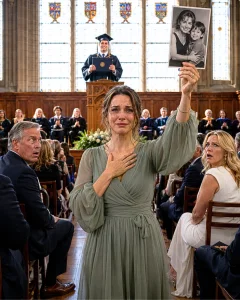
Daniel walked across the stage like every other graduate that morning, but I knew, with the deep instinct only a mother has, that something inside him had changed.
His shoulders were too straight. His jaw was locked tight beneath the bright auditorium lights. His blue graduation cap sat a little crooked, the way it always did when he was fighting hard not to cry. From the very back of the huge auditorium, standing beneath the glowing red EXIT sign, I watched my son take his seat in the front row of graduates.
And I knew he had seen me.
Not just noticed me. Seen me.
He had seen his mother standing against the cold cinderblock wall while strangers sat in the seat he had saved for me. He had seen his father, Mark, sitting proudly in the center of the first row like a king. He had seen Brianna, Mark’s perfect new wife, smiling from a chair that had never belonged to her.
And Daniel did not smile back.
My older sister, Emily, stood beside me, gripping a huge bouquet of sunflowers so tightly that one of the stems snapped in her hand.
“I told you,” Emily whispered, her voice shaking with grief and fury. “He didn’t know. He didn’t know they did this to you.”
I couldn’t answer. My throat felt full of sand.
At the podium, the principal, Dr. Bennett, continued speaking warmly about achievement, resilience, community, and the devoted families who had helped the Class of 2026 reach this milestone.
Families who helped.
The words pressed down on my chest. I stared at the back of Mark’s perfectly groomed head.
For twelve painful years after our divorce, Mark had mostly been a father in photographs. He appeared for award ceremonies when cameras were flashing. He arranged expensive birthday lunches. He showed up for Daniel’s graduation suit fitting because it allowed him to pay for something visible.
But he missed the fevers. The 2 a.m. tears over AP Calculus. The broken sneakers two weeks before payday. The months when rent was short. The college applications. The early mornings when Daniel sat at the kitchen table pretending not to hear me crying over past-due bills.
Mark knew how to arrive when applause was available.
I knew how to stay when no one was watching.
And Brianna knew only how to take up space. She sat in the first row with her legs crossed, one manicured hand resting on Mark’s sleeve as if she owned him, the seat, and the entire moment. Beside her sat her mother, her cousin, and two men in business suits I had never seen before. They snapped photos on expensive phones as though they had earned the right to frame my son’s future.
Emily leaned closer. “I’m going down there. I’m going to say something, Grace.”
“No,” I choked out.
“Grace, she peeled your name—”
“No,” I whispered harder. “Not today. Don’t ruin this. Let him have his day.”
Emily’s eyes filled with angry tears. “This is his day because of you.”
I looked toward the stage. “I know.”
But knowing did not make the humiliation hurt less.
The school was one of the most elite private high schools in Maryland, with stone columns, perfect lawns, and wealthy parents who talked about Ivy League admissions like casual weather. Daniel had earned a nearly full academic scholarship after scoring in the top one percent on his entrance exam.
I had paid the rest by working double shifts at a busy community medical clinic in Silver Spring. I cleaned exam rooms, handled patient files, translated medical language for frightened Spanish-speaking families, and stayed up until 3 a.m. sewing alterations for neighbors who paid me in wrinkled cash.
I never told Daniel how close we came to losing his place during sophomore year when my car transmission died.
He found out anyway.
One rainy Tuesday night, when he was sixteen, he walked into the kitchen and placed a folded envelope beside my lukewarm coffee. Inside was $312 in small bills. He had earned it tutoring younger students in geometry.
“For tuition,” he said, looking at the floor.
I cried so hard I had to sit down on the linoleum. “Mijo, that is not your job,” I told him.
He hugged me from behind, rested his chin on my tired shoulder, and whispered, “Then let me help with our dream.”
Our dream.
That was what this graduation was supposed to be. A celebration of a thousand quiet sacrifices. It was not supposed to be Mark’s photo opportunity. It was not supposed to be Brianna’s performance.
Then Dr. Bennett stepped back to the microphone.
“And now,” she said, her voice echoing through the room, “it is my honor to introduce the Class of 2026 Valedictorian and recipient of the Sterling Leadership Award… Daniel Angel Rivera.”
The auditorium exploded.
My knees nearly gave out. I caught myself against the wall.
Valedictorian?
I knew he had high honors. I knew he had worked himself to exhaustion. But he had not told me this. That morning, he had only hugged me tightly and said, “Mom, please just make sure you’re near the front when I walk.”
Emily grabbed my arm. “Valedictorian?” she gasped, crying openly. “That beautiful boy hid this from you?”
My tears spilled before I could stop them.
On stage, Daniel rose from the front row.
In the audience, Mark stood first, clapping loudly and turning slightly toward the crowd, absorbing the attention like it belonged partly to him. Brianna stood too, smiling with her camera raised. Her mother wiped fake tears. The two business-suit men clapped like investors closing a deal.
Daniel did not look at them.
He walked to the podium, placed both hands on the wood, and waited until the applause faded.
Then his eyes moved across the auditorium.
Past the wealthy parents. Past the front rows. Past his father.
Until they found me under the EXIT sign.
For one long second, the entire room disappeared. There was only the mother who had given everything, and the son who had finally understood the cost.
Daniel looked down at his printed speech.
He did not read it.
Slowly, he folded the pages in half. Then he folded them again and placed them inside his gown pocket.
A nervous murmur moved through the faculty behind him. Dr. Bennett smiled politely, but her eyes looked uncertain.
Daniel adjusted the microphone. Feedback screeched, and the room fell silent.
“I had a speech prepared today,” he began, his voice steady. “It was exactly what you’d expect. Perseverance. Gratitude. The future. A couple of mild jokes, two inspirational quotes, and a paragraph about how proud we should all be.”
Soft laughter moved through the room.
Daniel smiled faintly. “But something happened this morning. And while I sat there watching this room fill up, I realized I couldn’t give that speech.”
I stopped breathing.
Mark’s shoulders stiffened. Brianna lowered her phone.
“When I was little,” Daniel said, “I thought heroes wore uniforms. Firefighters. Soldiers. Surgeons. People who ran toward danger while everyone else ran away.”
He paused.
“Then I grew up. And I realized real heroes don’t always get medals. Some heroes wear faded clinic scrubs that smell like bleach and old coffee. Some heroes come home at midnight after standing for fourteen hours, take off their shoes in the dark, and still ask if you need help with homework.”
The room went still.
“Some heroes skip dinner,” his voice cracked, but he held it steady. “They smile and say they already ate at work, just so there is enough food for the child across the table.”
I covered my mouth, holding back a sob. Emily was shaking beside me.
Daniel lifted his head and looked straight toward the back of the room.
“My hero,” he said clearly, “is standing in the shadows under the EXIT sign. She is standing there because someone with money and audacity decided she did not belong in the front row.”
A sharp gasp swept through the auditorium.
Mark slowly sank into his chair. Brianna’s face went pale.
“My mother, Grace Rivera, worked double shifts for ten years so I could stand on this stage today. She cleaned clinic rooms, translated medical forms, sewed hems on rich kids’ uniforms late at night, packed my lunches, held me when I thought I was breaking, and never let me believe that not having money made me worth less.”
He gripped the podium.
“She did not have a front-row life. But she bled to build one for me anyway.”
The first person to stand was an elderly English teacher near the center aisle. Then another teacher stood. Then a row of graduates. Then more parents.
Applause began softly, then grew like thunder.
Daniel raised one hand, asking for one more moment. The room quieted instantly.
He looked at me, tears finally falling down his face.
“So if my mother is standing at the back of this auditorium,” he said, his voice breaking with pride, “then the back is where the most important person in this room is standing.”
For one heartbeat, there was silence.
Then the entire auditorium rose.
Not half. Not a few people. Everyone.
Students turned around to look at me. Teachers clapped with tears on their faces. Parents I had never met wiped their eyes. Even the young usher who had sent me to the back stood near the door, clapping slowly, his face full of shame.
I couldn’t move.
Emily shoved the sunflowers into my arms. “Stand tall, Grace!” she yelled over the applause. “Let them see you!”
So I pulled my shoulders back. I lifted my chin. I stepped fully into the red light.
The applause grew louder.
On stage, Dr. Bennett rushed toward Daniel and whispered urgently in his ear.
Daniel nodded once, then returned to the microphone.
“Dr. Bennett,” he said, “with all respect to this school, I cannot accept my diploma until my mother is seated in the exact chair I reserved for her.”
The room erupted.
Mark shot halfway out of his chair, his face dark red. Brianna grabbed his wrist and hissed, “Mark, do something!”
But there was nothing left for Mark to do.
Dr. Bennett stepped to the microphone. “Mrs. Rivera,” she called, scanning the back wall. “Please come forward.”
My first instinct was to refuse. For twelve years, I had made myself small to avoid conflict. I had swallowed humiliation so Daniel could keep peace with a father who appeared just often enough to confuse him. I had believed dignity meant silent endurance.
But my son was waiting.
Emily took my hand. “Walk, Grace.”
So I walked.
The aisle felt endless. People turned as I passed. Some smiled. Some cried. Some looked ashamed because they had seen what happened earlier and said nothing.
A young usher bowed his head. “I’m so sorry, ma’am,” he whispered.
I kept walking.
When I reached the front row, Brianna stayed seated, stiff as marble.
The best seat in the house still had a torn white reservation card stuck to it. Someone had tried to peel it off, but the bottom half remained.
Grace Rivera.
I looked at the card. Then at Brianna.
Her mouth tightened. “This is ridiculous. You’re ruining his graduation for a petty stunt.”
Emily stepped close behind me. “Move,” she said.
Brianna looked to Mark for help.
Mark stared at the floor.
Dr. Bennett stepped down from the stage, her voice icy. “Mrs. Vance, that seat was reserved by the valedictorian for his mother. You need to vacate it immediately.”
Brianna flushed. “There must have been some misunderstanding—”
“There wasn’t,” Daniel said through the microphone.
The entire auditorium heard him.
Brianna stood slowly, humiliated. Her mother rose next. Then her cousin. The two men collected their phones and programs, avoiding everyone’s eyes.
Mark stayed seated for one frozen moment.
Then Daniel said, “Dad, you can sit anywhere you want in this building. But that seat was never yours to give away.”
Mark’s face turned gray.
He stood.
I sat in the front row.
Emily sat beside me, holding the sunflowers like a victory flag.
Mark and his group moved to a side section three rows back. It wasn’t the back wall beneath the exit sign, but it was far enough for everyone to understand that the map of power had changed.
Daniel returned to the podium, calmer now.
“Thank you,” he said simply.
A soft, emotional laugh moved through the room.
Then he gave the real speech.
He spoke about students who worked drive-thru shifts after school to buy textbooks. Immigrant parents who packed lunches before dawn. Grandparents raising children again because life had broken their own kids. Janitors who unlocked the school before sunrise. He spoke of success not as one person climbing alone, but as proof of many invisible hands pushing someone upward.
“Every diploma handed out today has names written on it in invisible ink,” Daniel said, looking at me. “Mine has my mother’s name on every corner.”
I sobbed into my hands.
Then Daniel delivered the line no one would forget.
“I am graduating as valedictorian today,” he said, “because my mother stood in every dark, forgotten place life pushed her into… and made that place holy.”
Even Dr. Bennett was crying when she handed him his diploma.
When Daniel received it, he didn’t turn toward the school photographer.
He turned toward me.
He lifted the diploma with both hands.
For you, Mom, he mouthed.
I broke completely.
After the ceremony, the auditorium became a sea of balloons, cameras, flowers, and families. I stayed seated because my legs felt numb.
Emily wiped her mascara. “You know this is going to be all over the internet by noon, right?”
“What?”
“Look at the phones, Grace. Half the room recorded it.”
She was right. Clips were already moving through parent group chats and local Facebook pages.
But I didn’t care. I only saw Daniel pushing through the crowd, running down the aisle toward me.
He was taller now. Broader. Almost a man. But when he reached me, he folded into my arms like the little boy I still carried inside my heart.
“I’m so sorry,” he whispered into my hair.
“No, baby,” I said, holding him tightly. “You did nothing wrong.”
“I sent Dad the exact seat numbers. I told him those seats were for you and Aunt Emily.”
“I know.”
“I didn’t know she would take them.”
“I know.”
He shook in my arms. I held his face in my hands. “Look at me, Daniel. This is your day. Don’t let them steal the joy.”
He shook his head. “No. It’s ours.”
Then a shadow fell over us.
Mark approached slowly, with Brianna a few feet behind him. Her face was tight with humiliation. Nearby families went quiet. A few students raised their phones again.
“Daniel,” Mark said carefully. “Can we talk privately?”
Daniel turned.
For years, I had watched my son soften around his father, desperate to be chosen. Even crumbs of attention had once felt like a feast to him.
But something had changed on that stage.
“There’s nothing private about what happened in there,” Daniel said.
Mark flinched.
Brianna stepped forward, forcing a sweet voice. “Daniel, sweetheart, emotions are high today. I only wanted to avoid awkward tension for you—”
“You created the tension,” Daniel said.
She froze.
Mark tried again. “Son, be reasonable. I didn’t know she moved your mother.”
Daniel stared at him. “Yes, Dad. You did.”
Mark’s face hardened. “Careful how you speak to me.”
The old fear from my marriage rose inside me, and I started to step forward.
But Daniel didn’t need me to shield him anymore.
“No,” Daniel said. “You need to be careful. I am done pretending not to notice things just so you don’t have to feel guilty about abandoning us.”
Mark stepped back as if struck.
“Mom never told me the worst things about you,” Daniel continued. “She could have destroyed you to me. She didn’t. She told me you loved me in your own flawed way. She saved every late birthday card. She made excuses when you missed games. She broke herself so I wouldn’t have to hate you.”
Shame crossed Mark’s face.
“And today,” Daniel said, “your reward for her grace was letting your new wife publicly humiliate her.”
Brianna snapped. “I did not humiliate anyone! Your mother was being difficult and dramatic!”
Daniel looked at her coldly. “My mother went to the back so my graduation wouldn’t become your performance. That is dignity, Brianna. I wouldn’t expect you to recognize it.”
Someone nearby gasped. Emily whispered, “Amen.”
Mark’s voice turned desperate. “Daniel, please. Enough.”
“No,” Daniel said. “I think it’s finally enough for you.”
Then he turned his back on his father.
“Mom,” he said softly, “can we take pictures outside?”
“Yes, baby,” I said. “Let’s go.”
We walked past Mark and Brianna without looking back.
Outside, students posed near the stone fountain. Parents adjusted caps. Friends surrounded Daniel, cheering his speech. Someone showed me a phone with thousands of likes already.
We moved under the old oak trees for pictures. Emily took dozens, crying through every one. Then Daniel asked for one photo with just me.
He opened the leather diploma cover and placed the certificate in my hands.
“Hold it,” he said.
“No, mijo. This is yours.”
“Mom,” he whispered, “look at it.”
I looked down.
I expected to see Daniel Angel Vance.
Instead, in elegant black calligraphy, it read:
Daniel Angel Rivera.
My name. My family. My blood.
“I filed the paperwork months ago,” he whispered, pressing his forehead to mine as the camera clicked. “Legally, it’s hyphenated for now. But today, on this stage, I’m a Rivera. Dad gave me a last name, Mom. You gave me a life.”
Behind us, Mark had followed. He stood ten feet away, staring at the diploma like a man watching his house burn.
Later, we didn’t go to a fancy steakhouse. We went to a tiny Salvadoran restaurant in Silver Spring. The owner, Rosa, brought us steaming pupusas and curtido on the house, crying when she saw Daniel’s cap and gown.
For one hour, we were happy.
Then Daniel checked his phone. The joy faded from his face. He slid it across the table.
It was a text from Mark.
You embarrassed me and devastated Brianna. I expect a public apology tonight, or you can forget about the Georgetown tuition supplement. Think carefully.
Emily scoffed. “He’s trying to buy his way out.”
Daniel typed, sent the message, and turned off his phone.
“What did you say?” I asked.
“I told him the truth,” Daniel said. “Keep the money. Mom and I already learned how to pay for my life without you. Don’t contact me until you learn how to be a father instead of a bank.”
The fallout was enormous. Daniel’s speech went viral, gaining millions of views. Mark posted a polished statement about a “regrettable seating misunderstanding.” The internet tore him apart. Classmates exposed the truth in the comments. Mark deleted the post, and Brianna disappeared from her country club social circles.
The school apologized. Dr. Bennett called me personally and invited me to the Senior Awards Reception. When I arrived, the center seat in the front row had a laminated sign tied to it:
Reserved for Mrs. Grace Rivera.
Nobody dared question it.
In August, Daniel left for college. I helped him pack towels and clothes, hiding my tears. In his tiny Georgetown dorm room, the truth hit me.
My job was done.
Daniel hugged me tightly. “You’re going to be okay, Mom.”
“I’m the mother,” I cried. “I’m supposed to say that to you.”
“We can both say it,” he whispered, kissing my forehead. “Go home. Rest. It’s your turn now.”
For months, I didn’t know what “my turn” meant. Then I remembered standing under that EXIT sign and refusing to disappear.
At forty-two, I filled out the FAFSA and enrolled in an accelerated nursing program.
Two difficult years later, I stood in another auditorium, wearing a crisp white uniform. My feet hurt from walking hospital floors, not cleaning them.
When my name was called—Grace Rivera, Licensed Practical Nurse—I walked across the stage. I didn’t look at the back wall.
I looked straight at the center of the front row.
Daniel sat there in a sharp suit, cheering louder than anyone. Taped to his chair was a paper he had printed himself:
Reserved for Daniel Rivera, Proud Son of the Front Row.
I lifted my certificate high and looked at the boy who taught me how to stop hiding.
For you, I mouthed.
He shook his head, pressing one hand to his chest.
For us, he mouthed back.