My Parents Had Me Arrested At Grandma’s Funeral In Front Of 80 Relatives. Mom Pointed At Me. “She Stole From A Dying Woman.” Dad Said, “Handcuff Her.” My Sister Livestreamed It. “Say Goodbye To Your Career.” At The Station, The Detective Opened Grandma’s File, Then Froze. “Your Family Doesn’t Know You Have This, Do They?”
My parents had me handcuffed at my grandmother’s funeral and walked past her open casket while eighty relatives watched. My mother swore I had stolen money and taken Grandma’s wedding ring, my father demanded the police make an example of me, and my sister livestreamed my humiliation like entertainment. I said almost nothing because six days earlier, Grandma had died holding a secret none of them understood. Three hours after my arrest, a detective opened an old file and asked me one chilling question: “Your family has no idea this exists, do they?”
### Part 1
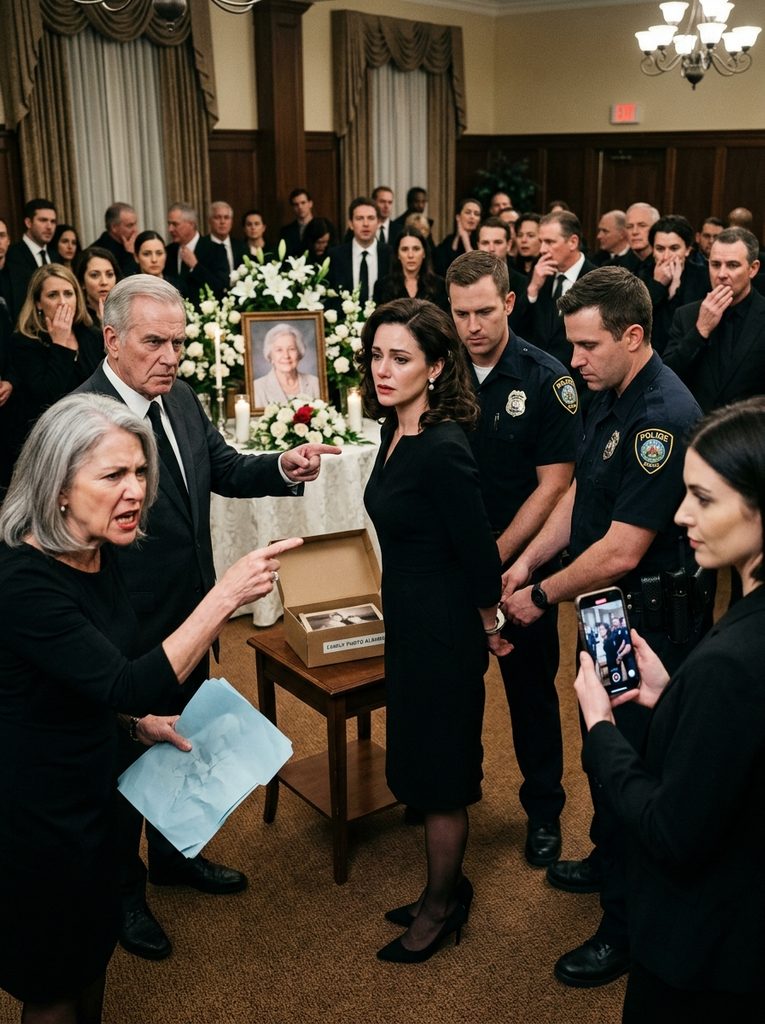
My name is Rachel Bennett. I’m thirty-eight years old, a registered nurse, and the last intimate thing I ever did for my grandmother was wash her hair in a plastic basin beside her bed. Six days later, at her funeral, my mother pointed at me in front of eighty relatives and said, “She stole from a dying woman. She’s a nurse, so she knew exactly how to hide it. She even took Mom’s wedding ring off her hand.” My father stood beside two police officers and added, “Handcuff her. Walk her past the casket. I want everyone to see.”
To understand why I didn’t scream when the cuffs closed around my wrists, you have to understand my grandmother, Margaret Bennett. She taught math at Fairmont High School for thirty-four years and retired when I was seven, which meant that by the time I was fourteen and fighting with my parents about nearly everything, Grandma had endless patience for one thing: making me show my work. I could give her the correct answer to an algebra problem and she would still slide the paper back across her kitchen table on Ridgeway Road. “Anybody can guess, Rachel. Show me how you got there.”
Beside my homework she kept a green cloth notebook that looked older than most furniture. Every dollar that entered or left her house went into it in neat teacher handwriting: groceries, stamps, furnace filters, church envelopes, everything. When I was sixteen she taught me to balance a checkbook in that notebook and made me carry the numbers aloud while she watched. “Money doesn’t lie,” she told me. “People just stop reading it.”
At my parents’ house, I was the difficult daughter because I asked questions. My sister Ashley was three years older, prettier, agreeable, and had the magical ability to hear Dad give an order without asking why. When Ashley married in 2008, my parents spent thirty-eight thousand dollars on her wedding; the following year, when I was short on my nursing tuition, Mom calmly told me they had already done enough by letting me live at home through high school. Two days after I mentioned the problem to Grandma over coffee, the balance disappeared from my account, and when I tried to thank her she said, “Don’t tell your father. He’ll make it about him.”
I graduated in 2010 and spent six years working hospital floors before joining Brightwater Home Health, where I eventually became a certified geriatric care manager. I handled fourteen patients, the appointments their adult children forgot, the pill organizers nobody wanted to fill, and the uncomfortable conversations families avoided until emergencies forced them into the open. That mattered later because by 2023, when Grandma was diagnosed with congestive heart failure at eighty-seven, helping older people maintain control over their lives was not just something I did for family. It was literally my profession.
Grandpa had been gone twelve years by then, and Grandma still lived alone in the Ridgeway Road house with her books, her precise routines, and opinions strong enough to survive three presidencies. My parents lived fifteen minutes away, but their Sunday visits gradually became every-other-Sunday visits, then whenever convenient, while I began coming three days a week. I organized medications, drove Grandma to cardiology, stocked the freezer, changed lightbulbs, and listened when she complained about doctors talking to me instead of her. “I’m the one dying eventually,” she once snapped at a cardiologist. “You can look at me while discussing it.”
In February 2025, she asked me to sit at the kitchen table after lunch. The winter light through the blinds made pale stripes across the same scratched wood where I had done homework as a teenager, and she pushed a business card toward me. “I want someone who actually reads statements handling my bills,” she said. “That’s you.”
The card belonged to Evelyn Harper, an elder-law attorney in Dayton. On February 18, Grandma signed a durable power of attorney naming me as her agent, then opened a separate Heartland Savings account for care expenses and transferred her savings into it. At the bank, a woman named Susan Pike placed a signature card in front of me for a safe-deposit box, and Grandma watched me sign it without explaining anything. “For later,” she said. “There’s nothing in there you need yet.”
That month, Grandma also started having her younger sister Ruth drive her to several appointments. Aunt Ruth was eighty-three then, lived on a farm outside Xenia, and drove a beige Buick as if speed limits were personal insults. When I offered to take Grandma instead, she waved me away. “You have patients. Some things a sister should do.”
In March my father called unexpectedly and skipped hello entirely. “Her card got declined at the pharmacy. Rachel, what did you do?” I asked what card he meant, but he hung up before answering. Around the same time, Mom began telling relatives that I was “managing” Grandma, saying the word in a way that made ordinary caregiving sound like I had erected a fence around the house.
Then I noticed Grandma had stopped wearing her wedding ring.
She had worn that thin gold band for nearly sixty years. When I asked about it, she flexed swollen fingers and told me the ring had become uncomfortable, which was true but, as I later learned, incomplete. At Christmas, Mom found Evelyn Harper’s business card beneath a refrigerator magnet, asked who she was, then quietly copied the name onto the back of a Christmas card after I told her to ask Grandma.
By February 2026, Grandma was receiving hospice care at home. A hospice aide named Camille Foster came in afternoons while I visited before and after work, and on March 14 my mother finally sat beside Grandma’s bed after weeks of mostly phone calls. I was standing in the doorway when Mom leaned closer and said, “When the time comes, the ring should stay in the family. Ashley has the girls.”
Grandma opened her eyes.
“It’s where it belongs.”
That was all she said.
Camille, standing near the foot of the bed, lowered her eyes to the chart in her hands and wrote something.
Eight days later, Grandma asked me to bring her the green notebook. She held it on her lap, rubbed the cloth cover with her thumb, and finally handed it to me. “Keep this. It’s just my numbers.”
One week after that, on a quiet Sunday morning, I washed her hair with warm water scented faintly with lavender shampoo. She sighed when I rinsed the last soap away, and sometime before noon, she died.
Six days later, Grace Lutheran Church was nearly full for her funeral. Grandma came from a family of six siblings, had taught hundreds of students, and knew half of Kettering, so eighty relatives attended the luncheon alone while former students filled the sanctuary. My parents barely looked at me that morning, Ashley kept her phone in her hand, and two police cruisers sat at the far edge of the parking lot.
I assumed they were there to assist the procession.
At one o’clock, I picked up a cardboard box of Grandma’s photo albums from the memory table and started toward the side door. My father disappeared outside, returned with two uniformed officers, and pointed directly at me. “That’s her. There’s already a sworn complaint on file, and she’s carrying my mother’s property out right now.”
The entire fellowship hall seemed to lose its sound.
Mom rose from the family table holding a pale blue folder with my name written on the tab.
And then she smiled at the older officer as she handed him the first page.
### Part 2
.
Officer Walsh opened Mom’s folder while eighty people watched him decide what kind of woman I was. I could see bank statements marked with yellow highlighter, a photocopied document with a notary seal, and notes in my mother’s handwriting running down the margins. Mom turned slightly so her voice would carry beyond the officer and said, “Rachel was alone with Mom constantly. She controlled everything, and now thousands of dollars are missing.”
“I held her power of attorney,” I said.
“Forged,” Dad answered instantly. “Or manipulated. She’s a nurse. She understands confused elderly people.”
The cruelty wasn’t that he accused me. It was how rehearsed he sounded.
Walsh looked from the paperwork to me and lowered his voice. “Ma’am, I need you to come with us while this is reviewed.” Dad immediately said, “Handcuff her,” then pointed toward the sanctuary. “Take her that way. Walk her past the casket.”
Walsh didn’t obey my father because he was ordered to, but he did place me in cuffs because I was being detained and the church was crowded. The metal felt shockingly cold against my skin, and as he guided me toward the sanctuary, Ashley climbed onto a folding chair with her phone raised above everyone’s heads. Her expression changed the instant she saw the red live-stream icon, becoming brighter and more theatrical. “For everyone asking, yes, this is my sister. Yes, she’s a nurse. Probably not for long.”
She angled the camera toward me.
“Say goodbye to your career, Rachel. Grandma died ashamed of you.”
Most relatives suddenly found the floor fascinating. Two of Grandma’s brothers turned toward the wall, one cousin covered her mouth, and somebody near the coffee urn whispered my name. Only my cousin Jenna behaved differently: she stood beside a pillar with her own phone raised, but unlike Ashley, Jenna’s camera was pointed toward Ashley.
As Walsh moved me toward the sanctuary doors, Dad leaned close enough to speak privately to him.
“Cuff her before she gets to that lawyer of hers.”
His voice was low, but I heard it.
So did Jenna’s phone.
We crossed the sanctuary, cool and dim after the bright fellowship hall, and there was Grandma in the open casket with her hands folded over her dress. Her left hand was bare, which I had known it would be, but seeing that empty finger while everyone had just been handed a story about where the ring went made my stomach tighten. Aunt Ruth followed us down the aisle and out the front doors in her navy church coat.
“I’m her great-aunt,” Ruth told the officers. “Where are you taking her?”
.
Then she looked directly at me.
“Rachel, don’t explain anything tonight. Sleep first.”
The cruiser door closed before I could ask what she meant.
At the Kettering Police station, I sat in my funeral dress inside a small interview room that smelled like floor cleaner and stale coffee. Nobody told me I was formally charged, but nobody promised I was leaving either; they took fingerprints, photographed me against a height chart, and asked routine medical questions. When I said I was a nurse, the young officer wrote it down with the same neutral expression she might have used for an allergy.
Three hours after I entered the building, Detective Dana Mercer arrived carrying a laptop and a thin yellow-tabbed folder. She was in her fifties, wore reading glasses pushed into gray-streaked hair, and had the exhausted calm of someone who had spent years watching relatives weaponize money after funerals. She opened her laptop, typed my grandmother’s name, then stopped.
Mercer pulled the folder closer.
She turned to the second page.
Something in her posture changed.
“You’re Margaret Bennett’s agent under a durable power of attorney.”
“Yes.”
“Signed February eighteenth last year?”
“Yes.”
“Who drafted it?”
“Evelyn Harper.”
Mercer closed the folder halfway.
“Your family doesn’t know you have this, do they?”
I stared at her. “Have what?”
“A power of attorney that was already attached to another file involving your grandmother fourteen months before today.”
My heartbeat suddenly felt louder than the ventilation fan.
“What file?”
“I can’t discuss everything in it yet. But I can tell you that the transfers your mother identified as theft were executed by someone your grandmother authorized in writing, with notarized documentation and a medical evaluation attached. That doesn’t make every question disappear, but it changes the nature of the complaint significantly.”
I reached for the paper cup of water I had ignored for hours.
“Then why am I here?”
“Because your mother also gave a sworn statement regarding a wedding ring, and I need full bank records before closing anything. You’re being released pending investigation. No charges today.”
Mercer stood, then paused at the door.
“If I were you, I’d talk to whoever drove your grandmother to appointments last February.”
They released me shortly after seven. My car was still at the church, so I stood beneath the parking-lot lights waiting for a ride and switched on my phone to sixty-three messages, four missed calls from Marlene Ortiz, my director of nursing, and nothing from Mom, Dad, or Ashley. Marlene’s final text read, “Call me tonight. Not tomorrow.”
Instead, I opened Ashley’s livestream.
Twenty-two minutes.
Thousands of views.
I watched the entire thing.
At nineteen minutes and four seconds, Dad’s voice appeared beneath the room noise: “Cuff her before she gets to that lawyer of hers.”
Evelyn Harper.
The attorney whose name Mom had copied from a business card four months earlier.
By Sunday morning, someone had cut the video to forty seconds: my handcuffs, Ashley’s accusation, the walk past Grandma’s casket. It spread through a local community page under a caption calling me a nurse arrested for stealing from her dying grandmother, and strangers began demanding my nursing license. Ashley deleted the original replay that evening, but screenshots and copies had already escaped her control.
Monday morning, Marlene met me in Brightwater’s lobby before I reached my desk. She closed her office door and sat on the edge of it rather than behind it. “Five families called this weekend,” she said. “Corporate compliance wants an answer, and I have to place you on paid administrative leave.”
I removed my badge.
Marlene held up her hand.
“I’ve read your documentation for ten years. I’m not building a case against you, Rachel. I’m building a file for you.”
That afternoon, she reassigned all fourteen of my patients.
Tuesday, I drove to Grandma’s house.
My key no longer worked.
The deadbolt was brand-new, bright brass against the weathered door, and taped inside the storm window was an index card in Dad’s block handwriting: PROPERTY OF THE ESTATE. NO ENTRY WITHOUT AUTHORIZATION.
Through the window I could see Grandma’s chair, her side table, and the stack of mail she had always insisted on opening herself.
And suddenly I remembered Mom’s blue folder.
Those highlighted bank statements had come from somewhere.
I photographed the new lock and sent the picture to Evelyn.
Her answer arrived four minutes later.
“Do not enter. Document everything. He cannot legally do this, but we will win it on paper, not on a porch.”
Ten days later, I received notice that someone had filed a complaint against me with the Ohio Board of Nursing. The complainant’s identity was withheld, but the language sounded exactly like Mom: confused elderly woman, undue influence, nurse with access to accounts. Aunt Ruth quietly began forwarding screenshots from the extended family group chat, where Mom wrote that she had never wanted to involve police but I had “left them no choice.”
Thirty-one relatives reacted with hearts.
That night, the green notebook still sat unopened on my kitchen table.
Ruth called around eight.
“Have you read Margaret’s numbers yet?”
“No.”
There was a small pause.
“You should.”
Four days later, a letter arrived from Evelyn Harper’s office containing Grandma’s will.
It named me executor.
Dad texted me for the first time since the funeral.
“Whatever you got her to sign, it won’t hold. We have a lawyer too.”
I placed his message beside the green notebook.
Then, for the first time since Grandma handed it to me, I opened the cover.
### Part 3
The first pages smelled faintly of dust and the drawer where Grandma had kept the notebook for decades. The opening entry was from 1960: rent, milk, gasoline, church offering, each number written with the careful precision I remembered from childhood. I turned pages slowly, not hunting evidence so much as looking for the woman who had written them.
I found myself in May 2009.
“Rachel — tuition — $6,200.”
Beside it, Grandma had written, “Don’t tell Thomas.”
I had not cried when police cuffed me. I had not cried in Marlene’s office or when strangers online called me a thief. But that small margin note broke something open because seventeen years earlier, Grandma had known exactly what my father would do with an act of generosity: make it about himself.
I kept turning pages until I reached January 2022.
Then the entries changed.
“T card — $1,800.”
The following month: “T card — $2,400.”
Then $1,600, $2,100, $1,500.
Month after month, for three years.
Thomas.
My father.
When Grandpa died, Dad had helped Grandma with the funeral, insurance, and banking. A year later she had given him a supplemental card “for emergencies,” and I had forgotten about it because nothing in my life had ever required me to remember. Grandma had not forgotten.
I counted the entries twice.
Thirty-six transactions.
In November 2024, one line appeared between ordinary household expenses: “Statements Rachel printed — doesn’t match.”
I remembered that weekend. Grandma had asked me to print six months of bank activity because she hated reading financial statements on a screen. I had handed the pages to her and joked that she was about to audit her own bank.
“I’ll do my own math,” she had replied.
At the time, I laughed.
Now I reached January 2025 and found the final card entry.
Beneath it, Grandma had added the entire column.
$61,000.
Then one word.
“Enough.”
Underlined once.
Dad’s furious March phone call returned to me: “Her card got declined. What did you do?”
I suddenly understood.
Grandma had found the pattern.
She had cut him off.
Three pages later were entries from February 2025: Evelyn Harper’s fee on the fourth, a medical copay on the eleventh, then something strange on the twelfth.
“R drove — $0.”
Aunt Ruth had driven Grandma somewhere that cost nothing, and Grandma had considered the trip important enough to record.
When I closed the notebook, the back cover felt strangely thick.
I pressed it.
Something moved beneath the cloth.
Using a butter knife, I carefully lifted the inner lining and found a small flat key taped to the board. The number 218 was stamped into the metal, and beside it was a folded scrap of paper.
“Heartland. You’re on the box. E for later.”
My hands went cold.
“There’s nothing in it you need yet.”
That was what Grandma had told me at the bank.
The next Monday, Detective Mercer called and asked me to bring the notebook to the station. Evelyn came with me because I wanted someone who had known Grandma sitting in the room. In the parking lot she looked at the key in my palm and shook her head. “Margaret never told me what was in the box. She only told me one existed and that you were not to know about it unless you discovered it yourself.”
“Why?”
“Because if you found something while she was alive, you would have confronted your family. She knew that.”
Mercer studied photocopies of the notebook inside the interview room. She stopped at the page marked “Enough,” then rested one finger against the $61,000 total. “Your grandmother calculated this herself?”
“That’s her handwriting.”
Mercer nodded.
“People with severe cognitive impairment don’t usually identify a three-year transaction pattern and reconcile it down to the dollar.”
She told us she had subpoenaed Grandma’s complete banking records, including the supplemental-card history and authorization for every transfer. Until those arrived, Mom’s complaint technically remained open, but Mercer made one thing clear. “That is a paperwork status, Rachel. It is not my assessment of you.”
Then I asked about the mysterious file Grandma had created fourteen months earlier.
Mercer would not tell me.
Instead, she repeated her question.
“Who drove Margaret last February?”
“Aunt Ruth.”
Mercer leaned back slightly.
“You should talk to her.”
Ruth lived on a farm outside Xenia, and when I pulled into her gravel drive Saturday morning, she was already standing on the porch in the same navy coat she had worn to the funeral. She crossed her arms. “You took your time.”
“You told me to sleep.”
“I did.”
She opened the door.
“Coffee’s on.”
Her kitchen reminded me painfully of Grandma’s: the humming refrigerator, yellowed recipe cards, wall calendar beside a corded telephone. Ruth set her February 2025 calendar beside my mug.
Three dates were circled in red.
February 4.
February 11.
February 12.
“Margaret made me promise,” Ruth said. “If Rachel asks, tell her. If she doesn’t ask, she doesn’t need to know.”
I placed the notebook between us.
Ruth read the three entries without glasses.
“The fourth was Evelyn. The eleventh was the doctor. The twelfth is the one your parents are going to hate.”
On February 4, Grandma had gone to Evelyn with six months of statements and the green notebook. After the meeting she told Ruth, “She says I’m not crazy, and she says I should get that in writing from someone with a medical degree.”
So one week later, Ruth drove Grandma to Dr. Helen Monroe, a geriatric specialist in Centerville, for a full cognitive examination.
“She knew what they would say someday,” Ruth told me. “That she was confused. That somebody manipulated her. She wanted a doctor to put the opposite on paper first.”
I thought of Mom’s family-chat message: “Mom was confused at the end.”
Grandma had anticipated those exact words.
Then came February 12.
Ruth drove her to Montgomery County Job and Family Services.
Adult Protective Services.
Grandma sat two hours in a plastic chair wearing the blue suit she had worn to Grandpa’s funeral. She brought copies of the bank records, listed Dad’s card transactions, gave dates and amounts, and filed a report naming her own son.
My throat tightened.
“Why didn’t anyone investigate?”
“Because Margaret wouldn’t ask them to prosecute. The worker asked what she wanted done.”
Ruth’s voice shook for the first time.
“She said, ‘I don’t want him arrested. He’s my son. I want it written down that I knew, so nobody can ever say my granddaughter did it.’”
I stared at her.
The mysterious file at the police station.
Grandma’s name.
Fourteen months earlier.
“She filed it for me.”
Ruth nodded.
“She knew Thomas would blame somebody if the money ever became public. She knew you were the easiest target because you handled her bills.”
“Why didn’t she tell me?”
“Because you would have confronted him.”
Ruth gave a sad little smile.
“You’ve always asked why, Rachel. Your grandmother loved that about you. Your parents never did.”
Grandma had built an official record before my parents had accused me of anything. She had gotten a cognitive evaluation before anyone called her confused. She had hired a lawyer before my father told police to stop me from reaching one.
She had planned for the lie.
What she had not planned for was the spectacle.
Ruth looked toward the window.
“Memorial Day reunion is here this year.”
“I’m not coming.”
“Thomas already asked for the microphone.”
I looked at her.
“Same family that was at the funeral,” Ruth said. “Same eighty people, give or take.”
Then she tapped the notebook.
“Bring everything Margaret left you.”
Three days later, I walked into Heartland Savings with key 218 in my pocket.
Inside Grandma’s safe-deposit box were three things.
A folder.
A thick envelope with my name written across it.
And a dark blue velvet jewelry box.
I opened the jewelry box first.
Grandma’s wedding ring was inside.
### Part 4
For fourteen months, Grandma’s wedding ring had been sitting inside a steel drawer at Heartland Savings. The bank access log showed exactly one visit: Margaret Bennett, February 18, 2025, the same day she signed her will and power of attorney. No one touched box 218 again until I opened it.
Susan Pike printed the access record because by then I had learned to ask for paper.
“Your grandmother came alone,” she said. “Wouldn’t let me carry her bag.”
The folder contained copies of her legal documents and a letter from Dr. Monroe. The envelope contained two handwritten pages dated February 18, addressed to me in Grandma’s familiar teacher handwriting.
She wrote plainly.
She knew Dad had taken money from her account for three years.
She had totaled it.
She could not bring herself to have her son prosecuted, so she filed an Adult Protective Services report to establish that she had discovered the transactions herself. She wanted a neutral record somewhere outside the family because she had watched my parents decide who I was since I was fourteen.
Then I reached the sentence that made me stop.
“They will say you took it. I have made sure a stranger with a badge can say you didn’t.”
I read it twice.
Grandma wrote that the ring was mine, not because it was valuable, but because “it should stay on a hand that held mine.” Then she told me I could burn the notebook, hand it to police, give the ring to Ashley if that bought me peace, or walk away from everyone and never explain myself.
Her final paragraph said:
“I trust the girl who showed her work. Being loved by me never required you to be quiet. Do not let anyone else require it.”
I sat alone in that little bank room with the ring in my palm and finally understood why Grandma had hidden everything from me while she was alive.
She wasn’t protecting herself.
She was protecting my choice.
I called Evelyn from the parking lot.
“I’m ready to hear the will.”
Her answer came carefully.
“There’s a sentence about your father you should know before he hears it.”
The family meeting happened April 24 in Evelyn’s conference room. My parents arrived with Ashley, her husband Eric, and an attorney named Curtis Blanchard, who had already filed an objection to my appointment as executor on the grounds that I was under criminal investigation. He had even attached the forty-second funeral video from the community page.
Evelyn read Grandma’s will without theatrics.
The Ridgeway Road house would be sold.
Half the proceeds would go to me.
One quarter would go to Ashley.
The remaining quarter would establish a Fairmont High School scholarship for a graduating senior entering teaching, called the Show Your Work Scholarship.
Then Evelyn turned the page.
“I acknowledge that my son, Thomas Bennett, has received from me during my lifetime the sum of sixty-one thousand dollars, which I intend as his full share of my estate.”
Nobody moved.
Dad’s expression froze.
“Sixty-one thousand what?”
Evelyn looked directly at him.
“I believe your mother expected you to understand.”
Mom recovered first.
“She was confused.”
Evelyn slid Dr. Monroe’s evaluation across the table.
Every cognitive score fell within normal range. The physician had specifically written that Margaret Bennett understood the nature of her property, the identity of her heirs, and the consequences of legal decisions made on February 18, 2025.
“Your mother anticipated that argument,” Evelyn said.
Blanchard asked for a break.
Dad left before it ended.
Mom leaned toward me on her way out, her church perfume sharp in the conference room.
“This isn’t over. The police still have a file on you.”
She was right.
She just didn’t understand whose evidence was inside it.
Over the next three weeks, I stopped answering family accusations and started creating records. I sent Detective Mercer Grandma’s handwritten letter, the safe-deposit access log, and Susan Pike’s contact information. I gave Marlene the power of attorney, cognitive evaluation, and will for my employment file.
Then I texted Jenna.
“Do you still have the funeral video?”
Her answer came immediately.
“All twenty-two minutes. I screen-recorded Ashley’s replay before she deleted it. I also recorded my own angle.”
Then another message appeared.
“Want me to post it?”
“No.”
I stared at the screen before adding two more words.
“Not yet.”
Evelyn also contacted Camille Foster, Grandma’s hospice aide. Camille signed a statement describing the March 14 conversation exactly as she had charted it: Mom said the wedding ring should remain with Ashley’s daughters, and Grandma answered, “It’s where it belongs.”
Nothing else.
No accusation against me.
No claim I possessed it.
On May 8, Detective Mercer called.
“The bank subpoena came back.”
Every February 2025 transfer Mom had labeled suspicious was authorized under Grandma’s valid durable power of attorney and moved into Grandma’s own care account with me listed only as agent. Meanwhile, thirty-six debit-card withdrawals and purchases between January 2022 and January 2025 had been made using the supplemental card issued to Thomas Bennett.
“The theft complaint against you is closed,” Mercer said. “Unfounded. No charges.”
I closed my eyes.
“What happens to my parents?”
“I can’t discuss any other investigation.”
Then her voice softened.
“And that isn’t yours to carry.”
The public incident report arrived days later.
Disposition: UNFOUNDED.
Transfers executed under valid durable POA.
No charges.
The Ohio Board of Nursing received it with Grandma’s cognitive evaluation, and on May 14, Marlene slid my badge across her desk.
“You’re reinstated Monday.”
Then she smiled.
“One more thing. Ida Brennan has been asking when you’re coming back.”
My ninety-one-year-old patient had apparently refused to accept a replacement care manager permanently.
That evening, Aunt Ruth finally added me to the family group chat.
Dad had posted one message.
“Family meeting at Ruth’s Saturday. Everyone. We’re settling this.”
He still thought the police investigation remained open because Mercer had formally notified Mom, not him, and Mom had apparently hidden the result. He believed Saturday would be another vote on whether I deserved to control Grandma’s estate.
Uncle Frank called me that night.
“Thomas says the family needs to decide what to do about you.”
“I know.”
“Is what he’s saying true?”
I could have explained everything over the phone.
Instead, I looked at the tote bag by my door containing the police report, access log, Camille’s statement, velvet jewelry box, and Grandma’s green notebook.
“Come Saturday,” I said. “Sit close.”
Frank was silent.
Then he laughed once.
“That sounds like Margaret.”
“I know.”
Saturday morning, I drove toward Aunt Ruth’s farm with Grandma’s ring in my pocket.
Dad had picked the same audience twice.
This time, he had no idea I was bringing Grandma’s answer.
### Part 5
The Bennett-Carver reunion had happened every Memorial Day weekend for longer than I had been alive. Aunt Ruth’s version meant folding tables beneath walnut trees, coolers lined against the barn, casseroles sweating under plastic wrap, children chasing each other through grass, and eighty-two relatives trying not to stare when I arrived. Some looked away immediately; Uncle Frank walked straight across the yard and shook my hand where everyone could see.
Ruth had saved me a chair beside hers.
My tote bag rested beneath the table.
Jenna sat two seats away with her laptop.
Mom and Dad arrived at twelve-thirty, followed by Ashley and Eric. Mom carried twenty pale blue folders identical to the one she had handed police at the funeral, and Dad immediately borrowed the wireless microphone used for the blessing.
He began by talking about Grandma.
“She was the smartest person I knew,” he said. “I never won an argument with her.”
People laughed softly.
Then he turned toward me.
“Before we eat, this family needs to settle something. Most of you saw what happened at the church. What you don’t know is that Rachel remains under police investigation, and because of that, Mom’s estate is tied up.”
Mom began distributing blue folders.
Dad continued.
“The police have her file. Ask her why she hasn’t been cleared.”
I stood.
From my tote bag, I removed one sheet of paper and unfolded it on the table.
“Actually, ask the police.”
I read the disposition exactly as written.
“Unfounded. Transfers executed under valid durable power of attorney on file. No charges.”
Then I handed the report to Uncle Frank.
He put on his reading glasses.
“Kettering Police Department,” he read slowly. “Case closed May eighth.”
Dad turned toward Mom.
“You told me they were still investigating.”
Mom said nothing.
She held two remaining folders tightly against her chest.
That silence was the first crack.
Then she found her voice.
“That report says nothing about the ring.”
The old confidence returned.
“Whatever happened with the money, Rachel took Mom’s wedding ring. I was there. Mom told me.”
I reached into my bag and removed the dark blue velvet box.
When I opened it, dozens of people leaned forward.
Grandma’s thin gold ring caught sunlight filtering through the walnut leaves.
Beside it, I placed the Heartland Savings access log.
“Safe-deposit box 218. Grandma placed the ring there February eighteenth, 2025. This record shows one visit by Margaret Bennett and no further entry until I opened the box after her death.”
Aunt Ruth stood next.
She unfolded Camille’s signed statement.
“This is from Margaret’s hospice aide, who stood at the foot of the bed on March fourteenth.”
Ruth read the statement in full.
“Linda Bennett asked what would happen to the wedding ring. Margaret opened her eyes and said, ‘It’s where it belongs.’ She did not state that Rachel possessed the ring. She did not say Rachel had taken it.”
Ruth lowered the page.
“Linda, you told police Margaret accused Rachel.”
Mom stared at Dad.
I opened the green notebook.
I had decided on the drive that I would not explain the pages because explanations invite arguments.
I would read.
“January 2022. T card, eighteen hundred dollars.”
I turned a page.
“March 2022. T card, twenty-one hundred.”
Another.
“August 2022. T card, fifteen hundred.”
I read six transactions.
Then the final entry.
“January 2025. T card, fifteen hundred.”
I placed my finger beneath Grandma’s total.
“Sixty-one thousand dollars.”
And below it:
“Enough.”
The field became completely quiet.
Ruth took the notebook.
“February fourth, Evelyn Harper, attorney. February eleventh, Dr. Helen Monroe, cognitive evaluation. February twelfth, R drove, zero dollars.”
She looked directly at Dad.
“That last trip was Adult Protective Services, Thomas.”
His face changed.
Ruth continued.
“Your mother sat in a government office for two hours and documented your use of her supplemental card. She specifically refused to ask that you be arrested because you were her son. What she wanted was a record showing she knew about the money.”
Ruth pointed toward me.
“She said she wanted it documented so nobody could ever blame Rachel.”
Dad pushed his chair backward.
“She was confused.”
Jenna opened her laptop.
The funeral appeared on the screen.
Mom’s voice filled the yard.
“She stole from a dying woman.”
Then Ashley:
“Say goodbye to your career, Rachel.”
Jenna fast-forwarded.
Nineteen minutes, four seconds.
Dad’s voice, quiet but unmistakable:
“Cuff her before she gets to that lawyer of hers.”
Jenna paused the video.
Dad’s face froze on the screen.
I looked at him.
“How did you know I had a lawyer?”
He opened his mouth.
Mom answered first.
“Because your grandmother threatened us with her. She said if we touched one more dollar she’d—”
Mom stopped.
Nobody moved.
“If we touched one more dollar.”
Ashley slowly turned her phone facedown on the table.
For once, she did not film.
Dad looked around at eighty relatives who had watched police walk me past Grandma’s casket, and his expression hardened into the one I remembered from childhood whenever facts became inconvenient.
“That money was mine.”
Nobody spoke.
“I was her son. Sixty-one thousand dollars over three years from a woman who owned a paid-off house and had money in the bank? I was owed that.”
There it was.
Not denial.
Entitlement.
Uncle Frank held out his palm for the microphone.
Dad surrendered it.
“Thomas,” Frank said, “sit down.”
Dad sat.
Nobody applauded. Nobody needed to.
Several relatives who had reacted to Mom’s accusations walked over quietly and sat near me. Others remained exactly where they were, including an aunt who placed one hand on Mom’s shoulder, and I understood that some people choose loyalty over evidence because truth is expensive.
I picked up Grandma’s ring.
At the funeral, everyone had watched my hands pulled behind my back.
At the reunion, I slipped Grandma’s ring onto my finger.
“I’m not asking anyone to choose a side,” I said. “Grandma already wrote hers down.”
That was my entire speech.
Ruth took the microphone.
“Margaret showed her work. Now you’ve seen it. Eat something.”
Mom remained standing with those last blue folders pressed to her chest.
For the first time in my life, she looked like a woman who had run out of pages.
That night, Jenna uploaded the complete twenty-two-minute funeral video only to our extended family group, alongside a photograph of the police report. Her caption was simple: “Some of you saw the first forty seconds. Here are the other twenty-one minutes.”
Three days later, Dad’s attorney withdrew his objection to my appointment as executor.
The probate court approved me shortly afterward.
Grandma’s house was sold by a realtor who was not Ashley.
The Show Your Work Scholarship was established at Fairmont High School exactly as Grandma requested.
The nursing board closed the complaint against me during preliminary review.
I never asked Detective Mercer whether Dad faced consequences over the bank card or whether Mom faced consequences for her sworn statement. Mercer had told me that part was not mine to carry, and I decided she was right.
Ashley sent me a message two days after the reunion.
“I didn’t know about Dad’s card. I’m sorry about the video.”
I believed the first sentence.
Maybe she even believed the second.
I never answered.
Mom sent four paragraphs about “moving forward as a family,” saying Grandma would hate the division and reminding me that Ashley’s daughters missed their aunt. I replied with three lines.
“Tell the family exactly what you told police. Then tell them which parts were untrue. Say it in the same group where you accused me. After that, we can discuss family.”
She never did.
Dad never apologized.
I eventually blocked both their numbers and instructed them to communicate through Evelyn regarding the estate. I had expected cutting contact to feel dramatic, but it felt surprisingly ordinary, like closing a patient chart after every relevant fact had been entered.
I returned to work on Monday.
Ida Brennan, ninety-one years old and observant enough to frighten younger people, looked at Grandma’s ring while I organized her medications.
“That new?”
“It was my grandmother’s.”
Ida nodded.
“Nice that you’ve got it.”
I smiled.
“It’s where it belongs.”
These days I wear the ring on a chain beneath my scrubs because gloves and rings are a terrible combination. The green notebook sits on the shelf beside my cookbooks, and Aunt Ruth mailed me her February 2025 calendar page with the three red circles, which I tucked into the back cover where Grandma had hidden the key.
For a while, I believed Grandma had left me an answer.
She hadn’t.
She had left me a method.
Write things down.
Keep the dates.
Save the receipts.
Show the work.
Because sometimes someone can stand in a crowded room and tell eighty people exactly who they want you to be.
And somewhere, if you are lucky, there is a woman who loved you enough to leave evidence of who you really are.
On the last Friday in May, I opened Grandma’s notebook to the page after the word “Enough.”
There was empty space beneath it.
I picked up a pen.
“May 2026. Rachel. Ring — $0. Show your work.”
Then I closed the notebook and put it back on the shelf.
My parents tried to write the ending of my story in front of eighty people.
Grandma had prepared for their sentence before they ever spoke it.
And now I’m the one who gets to keep writing.
THE END!