Chapter 1: The Anatomy of a Question
The inquiry hung in the sterile hospital air, devoid of greeting or grief. What time is the funeral? It was delivered with the dispassionate flatness of a man confirming a dental cleaning.
I was standing like a ghost in the fourth-floor corridor of Valley Brook Children’s Hospital. My exhausted body had managed perhaps ninety minutes of fractured sleep in a cracked vinyl lounge chair. My phone, vibrating violently against my hip at exactly 11:07 p.m., had dragged me back to a waking nightmare. I had stumbled to the glass partition of Room 412 before a single syllable of his voice registered in my brain.
On the other side of that glass lay Emma. My five-year-old daughter was a tangle of translucent tubes, a pulse monitor clipped to an index finger no larger than a pink crayon. Pickles, her threadbare gray rabbit, was wedged beneath her chin right where I had positioned him hours ago. Beside her mechanical bed, the visitor’s chair sat entirely vacant. The jacket belonging to my husband, Trevor Brooks, had vanished from its back.
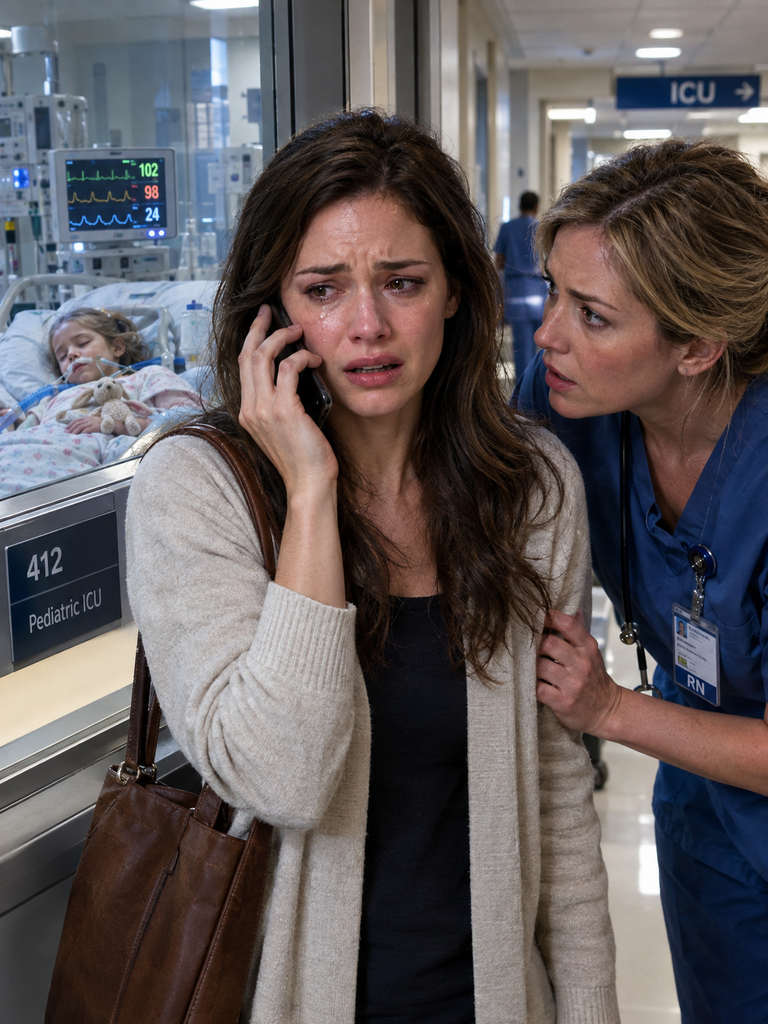
Emma’s tiny chest rose, hitched, and fell.
I stood paralyzed. The cellular device trembled violently in my palm. “Our daughter is breathing, Trevor,” I forced the words through a tight throat.
A heavy, deliberate sigh crackled through the speaker. It did not carry the weight of shock, nor the breathless cadence of relief. It was the distinct sound of a man deeply inconvenienced—a patron whose waiter had delivered the wrong appetizer. It felt as though my daughter’s survival was a logistical hurdle he now had to manage.
“Didn’t the doctors update you?” he asked, his tone maddeningly level.
“Update me on what?”
Before his response could manifest, the rhythmic squeak of rubber-soled shoes against polished linoleum broke my focus. A nurse was moving toward me with urgent, clipped strides. It was Amy Collins, the night-shift caretaker identifiable by her violet stethoscope cover and eternally gentle demeanor. She had meticulously fluffed Emma’s pillows three times since nightfall, solely because she noticed my manic, unblinking stares at them.
Right now, Amy’s complexion was completely wrong. It was the color of chalk.
“Mrs. Brooks,” she breathed, her voice tight. “I need to converse with you in private.”
“I’m on a call with my husband.”
“I am aware,” Amy whispered, glancing at the glowing screen. “That is precisely why.”
She gripped my elbow—her fingers surprisingly unsteady—and guided me several paces down the corridor, out of the direct line of sight of the glass.
“Your husband contacted the unit yesterday,” Amy murmured, her voice barely a scrape against the ambient hum of the ward. “He informed the staff that the two of you had deliberated at length. He stated that you were both in agreement. If Emma’s heart ceases beating… nobody should attempt to resuscitate her.”
The floor beneath my feet seemed to dissolve. My knees buckled, and I slammed my free hand against the plaster wall to keep from collapsing.
“I never authorized that,” I gasped.
“I know you didn’t.” Amy’s eyes were glassy under the fluorescent glare. “I knew you would never consent to that. Dr. Priya Raman flatly refused to alter a single directive on her chart without your explicit, verbal confirmation. She intended to discuss it with you at sunrise.”
From the phone still gripped in my trembling hand, Trevor’s voice bled into the quiet hallway. Small, metallic, and dripping with perfectly calibrated patience. “Hannah, I need you to not make a scene. You’re sleep-deprived.”
I slowly elevated the receiver to my ear. “You instructed them to let our child die.”
“She is in agony, Han. You’re acting selfishly.”
Selfish. That was the specific ammunition he chose. A sharp, mechanical click severed the connection. I was left holding a dead piece of plastic. Down the hall, a cardiac monitor chimed its persistent, rhythmic reassurance. My daughter’s heart was still fighting. Still ours.
Amy’s hand returned to my forearm. She threw a nervous glance over her shoulder toward the nurses’ station, then leaned in so closely I could smell the peppermint on her breath.
“There is another detail,” she said, her voice dropping into a register of pure dread. “During his call, he had a secondary inquiry. He wanted to know the exact time of death required to process a life insurance claim.”
The word pierced my ribs like a blade of ice. I didn’t fully comprehend the vast, horrific mechanics of it yet, but some primal, maternal instinct inside me woke up, baring its teeth before my logical mind could even process the threat.
Chapter 2: The Illusion of Practicality
To make sense of how that singular word shattered my reality, I must rewind the tape. Not by decades, but just enough to introduce the phantom I married.
I was thirty-four on that terrible night, tethered to Trevor for eight years. We collided at a mutual friend’s engagement soirée in Hoboken when I was twenty-five. He was twenty-eight, draped in a tailored navy blazer that was entirely too sophisticated for the dive bar setting. He asked me an earnest question about my career, and the miracle was—he actually absorbed the answer. After enduring a parade of men who treated conversations as background noise to their smartphones, his attention felt like a sanctuary.
Trevor was a purveyor of commercial flooring. He spoke of industrial carpet tiles and warehouse laminates with the reverent passion most men reserve for professional sports. I worked as a dental hygienist at Dr. Okafor’s clinic in Montclair, pulling in forty-one dollars an hour, four days a week. We wed in June 2017 at a sun-drenched vineyard in Warren County. When Emma arrived in the suffocating heat of August 2019, weighing a sturdy seven pounds, one ounce, Trevor openly wept in the delivery suite.
I state this unequivocally because the truth matters. I do not believe those tears were fabricated. That genuine display of emotion is the riddle I still chew on in the dark. The man in that maternity ward was real; he simply evacuated the premises years ago.
Trevor’s defining characteristic was his impenetrable tranquility. He never raised his voice. Not a single time in nearly a decade. When conflict brewed, he merely dropped his volume and decelerated his speech, manipulating the atmosphere until I somehow found myself apologizing for my own grievances.
His favorite weapon was a specific adjective: practical.
Be practical, Han. We need to be practical about this.
He wielded it to dismantle grocery budgets, veto vacation destinations, and once, to suggest liquidating my deceased mother’s engagement ring because keeping it was “sentimentally inefficient.” Naturally, he controlled the finances. It was a gradual erosion of my autonomy. In our freshman year of marriage, he observed that I detested mathematics—an accurate assessment. Consequently, he commandeered the joint accounts, the utility payments, the annual tax filings. Every digital key was locked inside his private notes application. When legal documents required a signature, he would slide them across the granite kitchen island, deposit a pen in my hand, and press a gentle kiss to my crown.
Mortgage refinances. Tax returns. I scribbled my name. I never scrutinized the fine print.
I wish I could claim the defense of youthful naivety. But I was thirty-one. I was chronically fatigued and inherently trusting, and Trevor engineered an environment where it was effortless to be both. I handed a stranger the steering wheel of my life and never once bothered to look out the window to see where we were heading.
His family arrived as a heavily enmeshed package deal. His mother, Linda Brooks, was a sixty-six-year-old widow who resided in a pristine Paramus colonial, its entryway a shrine of Trevor’s adolescent portraits. She navigated grocery aisles adorned in pearls and addressed me as “dear” with the exact intonation one uses to say “move aside.” In Linda’s heavily edited reality, her son hadn’t committed a sin since the Reagan administration.
His younger sister, Megan Brooks, was thirty-one, perpetually clutching an iced latte and a glowing smartphone. She operated as a closing coordinator for a local title firm, and recently, she had proudly secured her notary public commission. Megan was the accessible one. We traded recipes. She bestowed Emma with Pickles the rabbit. Emma affectionately dubbed her “Aunt Meg.” I harbored genuine love for her.
My own lineage was tragically sparse. My mother succumbed to ovarian cancer during my sophomore year of college. Following her departure, it was just myself and my father, Walter Pruitt—a grizzled, retired electrician possessing hands the size of dinner plates and zero tolerance for absurdity. He suffered a fatal cardiac event fourteen months prior to this nightmare.
Walter bequeathed me a modest life insurance payout of $47,213, alongside his battered red steel Craftsman toolbox. I funneled the capital directly into our joint checking because Trevor insisted it was “fiscally cleaner.” The toolbox was banished to the garage; it hurt too much to look at it.
Following my father’s repast, Trevor leaned into my shoulder by the catering trays. “Did Walter leave anything else behind?” he inquired. “Any secondary policies?”
My father had been dead for eight days. At the time, I convinced myself Trevor was merely executing his signature practicality.
But the memory that truly haunts the architecture of this betrayal occurred two winters prior. Emma was three. It was a frigid February evening. Her forehead radiated heat like an iron skillet. The thermometer read 104.1. She lay terrifyingly limp against my chest, her breathing shallow and frantic.
“Administer the Tylenol,” Trevor directed from the sofa, his eyes permanently glued to a basketball broadcast. “If it doesn’t break by dawn, we’ll phone the pediatrician. Be practical, Han. You catastrophize everything.”
I should have waged a war right then. Instead, defying my usual submission, I snatched my car keys and hauled my burning child into the freezing night.
Emma had severe pneumonia. Her oxygen saturation was hovering at a lethal 88% upon our arrival at the ER. She was hospitalized for four days. A severely fatigued physician named Dr. Patel cornered me in the hallway on night two. “Your instincts saved her,” she stated grimly. “A few more hours at home, and we would be having a drastically different conversation.”
A few more hours.
Trevor materialized the following morning wielding artisanal coffee and an unbothered expression. “In the future, consult me first,” he murmured gently in the corridor. “We cannot treat the ER like a walk-in clinic every time she sniffles.”
At Sunday dinner, Linda patted my knuckles. “Trevor mentioned you rushed our girl to the hospital over a common chest cold, dear. You must get a handle on your nerves. The child absorbs that chaotic energy.”
Nerves. That was the loaded term. Post-Emma, I had battled severe postpartum anxiety. I was prescribed a standard dose of Sertraline for eight months and attended weekly therapy sessions. Trevor had chauffeured me to the inaugural appointment. He was seemingly spectacular about it. He never overtly weaponized my mental health.
He just meticulously cataloged it. He filed my vulnerability away like a faded receipt, waiting for the exact moment he might need a refund.
The fracture in my marriage wasn’t a sudden, violent snap. It was a slow, invisible hemorrhage. Last April, Trevor announced a corporate restructuring that necessitated aggressive travel. He began retreating to the garage to field phone calls. He migrated to the guest bedroom, citing fictitious snoring. When I probed for answers, I was met with the same patronizing deflection: “You’re overworking yourself, Han.”
Standing against the cold plaster of the hospital wall, clutching a phone that felt like a grenade, I decided to stop letting him handle things. I opened the web browser on my device and navigated to our shared family email—the one he created years ago to capture spam, the one he assumed I had forgotten how to access.
My thumb hovered, trembling over the screen. An unread message sat at the top of the inbox. Time-stamped Tuesday, 5:44 p.m.
Subject: Your claims inquiry – Policy FML44712209. Sender: Franklin Mutual Life.
I opened it, and the floor dropped out from under the world.
Chapter 3: The Currency of Time
The automated email was a masterpiece of corporate morbidity.
We are deeply sorry to hear about your loss.
I read the sentence until the letters blurred into meaningless shapes. On Tuesday afternoon, my daughter was very much alive, clutching her stuffed rabbit. Yet, a monolithic insurance conglomerate was already dispensing its condolences.
Beneath the pleasantries rested the policy summary. Insured: Emma R. Brooks. Face Amount: $750,000. Policy Owner: Trevor J. Brooks. Primary Beneficiary: Trevor J. Brooks.
I had never laid eyes on this document. I had never scrawled my looping signature on its dotted lines. I would later discover the application fraudulently inflated our annual household revenue to $590,000—a sum we had never remotely approached. Trevor had essentially conjured a lucrative, fictional existence, and the underwriters simply rubber-stamped it.
Operating purely on adrenaline, my fingers navigated to our mobile banking application. Just three months prior, bolstered by my father’s meager inheritance, our joint checking had boasted a balance of $47,000.
I stared at the digitized digits, my brain aggressively rejecting the visual input.
$2,813.00.
I frantically scrolled through the transaction history. Four distinct cash withdrawals of $8,500, sequentially executed at an obscure ATM on Bloomfield Avenue. Nine incremental wire transfers routed to an untethered account ending in 6612.
My husband hadn’t panicked under the weight of Emma’s sudden illness. He had mobilized.
Suddenly, the events of the preceding four days violently rearranged themselves in my psyche. The puzzle pieces snapped into horrific alignment. It originated on Saturday dawn when Emma awoke clutching her lower right abdomen, refusing to let me palpate the area. I demanded we seek urgent care.
“Wait,” Trevor commanded. “She gorged herself on icing at that birthday party. Don’t be dramatic.”
By Sunday morning, the fever breached 102. When I contacted the after-hours pediatric line, the nurse ordered an immediate ER visit. Trevor, who had vanished for four hours to “run errands,” texted me from parts unknown: “Give her Tylenol. She’s milking it.”
By Sunday evening, Emma lost the ability to stand. She collapsed onto the area rug, her small body folding like a broken umbrella. She didn’t even possess the energy to cry. That absolute, terrifying silence frightened me more than any scream. I begged him to let me load her into the Honda.
“Wait until dawn,” he insisted, his voice eerily placid. “I am not spending midnight in a waiting room over trapped gas.”
I defied him. I carried her out myself. Trevor didn’t follow.
The pediatric surgeon, a weary man named Dr. Marcus Feld, intercepted me at three in the morning. Emma’s appendix had ruptured. Septic infection was actively flooding her abdominal cavity. “If you had waited until sunrise,” Dr. Feld murmured, pulling off his surgical cap, “I do not believe she would have survived. A few more hours, and we would have lost her.”
A few more hours.
The echo of the past collided with the present. Trevor hadn’t been negligent; he had been tactical. He had been intentionally squandering my daughter’s time, treating her fading heartbeat as an investment vehicle.
My hands ceased their trembling. A terrifying, subterranean calm flooded my veins. This wasn’t the fiery, chaotic heat of rage. Rage is sloppy. Rage leaves fingerprints. This felt like standing in the absolute center of a frozen lake.
Dr. Priya Raman materialized from the shadows of the ward before I could seek her out. She was petite, formidable, and clad in rumpled gray fleece. She assessed my posture and bypassed all medical pleasantries.
“Mrs. Brooks,” her voice was smooth river stone. “Emma remains a full code. If her vitals crash, we will move heaven and earth. I am deeply sorry you were exposed to that phone call.”
She exchanged a loaded glance with Nurse Amy. “There is another detail,” Dr. Raman continued. “At 10:08 p.m., Emma’s oxygen plummeted to 81. We intervened immediately. She is stabilized.”
My heart stalled. “Was Trevor in the room?”
“He was standing motionless in the doorway when the alarms triggered,” Dr. Raman stated, her jaw tightening. “Nurse Collins instructed him to wake you in the lounge. He insisted he would handle it. He subsequently abandoned the unit at 10:21 p.m.”
I had been asleep twenty feet away while my child suffocated, because the man assigned to protect her had ordered the staff to let me dream.
“Tell me everything about the phone calls,” I demanded, my voice dropping an octave, sounding like a stranger’s.
Dr. Raman retrieved a folded parchment from her scrub pocket. “Tuesday, 3:48 p.m. He inquired if he would be notified prior to the initiation of CPR. 4:12 p.m.: He contacted the support line requesting data on direct cremation services. 4:31 p.m.: He phoned our clinical social worker, Gloria Mendes.”
Dr. Raman paused, her eyes flashing with a protective fire. “He explicitly warned Gloria that you possessed a documented history of psychiatric instability. He claimed your judgment was compromised by medication and demanded all medical authority be transferred exclusively to him.”
He was weaponizing the Sertraline. He was cashing in the receipt.
“I placed a legal preservation hold on the hospital’s audio servers before you woke up,” Dr. Raman added softly. “Every syllable he uttered is locked in the digital vault. Nothing can be purged.”
I stared at her, feeling the first genuine surge of gratitude I’d experienced in days. “Thank you.”
But Trevor was not finished digging his grave. At midnight, I locked myself in the family lounge and dialed his number. He answered with the faux-weariness of a martyr.
“I’m home, Han,” he sighed. “I’m running on empty.”
“You called a funeral parlor for a breathing child,” I stated, my tone lethal.
“I was exploring contingencies, Hannah. That is what practical people do. I am attempting to shield our family from a protracted, agonizing decline, and you are villainizing my pragmatism.”
I looked down at the $750,000 policy illuminating my screen. “You drained the checking account.”
A micro-second of silence. The mask slipped. “I possess the legal right to secure our assets. You are financially illiterate. If you continue this hysterical witch hunt, I will expose you to this hospital. The panic attacks. The medication. Who do you think they will believe? The hysterical mother, or the stable patriarch?”
He severed the line.
Ten minutes later, I received a text from his mother, Linda: Whatever venom you spewed at my son, I hope you are satisfied. Megan and I will be at the hospital at 6:00 a.m. Make zero decisions without family.
He had deployed his infantry. I typed a single-word response: Okay.
Then, I dialed 9-1-1.
Officer Daniel Reed arrived just before 1:00 a.m., a mountain of a man who carefully documented the drained accounts and the life insurance anomaly. While we spoke, a motion notification pinged from my home security application.
I opened the live video feed. Officer Reed leaned over my shoulder.
On the screen, Trevor stood beneath the porch light, gripping two massive suitcases and a bulging duffel bag. A white SUV idled silently at the curb, its exhaust pluming in the frigid March air. He loaded his cargo, climbed into the passenger seat, and the vehicle vanished into the night.
“People don’t pack three bags for a local funeral,” Reed muttered, keying his shoulder radio. “I’m waking up Detective Jensen.”
At 2:41 a.m., my phone rang. Detective Sarah Jensen from the Prosecutor’s Office possessed a voice like crushed gravel.
“We intercepted him at Newark Liberty International,” she reported flatly. “He possessed a one-way boarding pass to San Jose, Costa Rica. We apprehended him twelve minutes from the jet bridge.”
I slid down the wall, my spine scraping the plaster, and finally wept.
“But here is the infuriating reality, Hannah,” Jensen continued, her tone heavy with disgust. “Purchasing a one-way ticket isn’t a felony. Inquiring about cremation isn’t illegal. Securing a policy on your own offspring is terrifying, but it is not a crime. The on-call judge refuses to hold him. He told Port Authority he was merely seeking a brief mental health retreat and promised to appear at the hospital by dawn.”
“He’s going to run,” I choked out.
“I am aware. Which is why I need undeniable, tangible proof of malicious intent. I need paper. I need a smoking gun.”
I stared through the glass at my sleeping daughter. I thought about the insurance policy. I thought about the one element required to validate that $750,000 document.
“I’ll get it for you,” I whispered to the detective. “I’m going to make him walk right into his own trap.”
Chapter 4: The Paper Trail
At 4:20 a.m., I retreated to Room 412 and collapsed into the vinyl chair Trevor had abandoned. I enveloped Emma’s fever-dry hand within my own. Even heavily sedated, her tiny fingers instinctively curled around mine.
I couldn’t sleep. My mind was a forensic laboratory, dissecting every frame of the past seventy-two hours. Desperate for a focal point, I reopened the security footage of Trevor’s midnight escape. I watched the white SUV idle. Once. Twice.
On the fourth viewing, a detail I had overlooked paralyzed my lungs.
As Trevor hoisted the duffel bag into the backseat, the vehicle’s interior dome light flared to life for precisely two seconds. It illuminated the driver. A woman. Her hair was hastily secured with a crimson scrunchie. Around her neck, a delicate silver chain caught the amber glow of the streetlamp. A silver pendant in the shape of an ‘M’.
I paused the playback. I zoomed in until the pixels distorted. The license plate frame read: Ramsay Subaru.
I had occupied the passenger seat of that specific Subaru dozens of times. The silver ‘M’ pendant was a birthday gift I had purchased at the mall for eighty-five dollars. Megan had wept when she unwrapped it.
I sat frozen in the suffocating quiet of the ICU. I navigated back to the Franklin Mutual Life email and downloaded the 31-page policy PDF.
Page three: Applicant: Trevor J. Brooks. Insured: Emma R. Brooks. Page nine: Spousal Consent to Coverage.
There, sitting cleanly on the digital dotted line, was my signature. The grand, sweeping ‘H’. The elongated, dramatic tail of the ‘S’. It was an immaculate forgery.
Directly beneath it lay the notary block. State of New Jersey. Appeared before me: Hannah Brooks, proving identity via US Passport. Signed: Megan R. Brooks, Notary Public.
I do not own, nor have I ever possessed, a United States Passport.
The Thanksgiving dish towel banter. “Your signature is the easiest one in New Jersey, Han. I could stamp that thing in my sleep.” We had laughed. I had laughed the hardest.
The pieces slammed together with sickening velocity. Megan, earning a modest salary, had miraculously purchased a $389,000 home the previous summer. Trevor had claimed Linda provided the down payment. The nine wire transfers to the unknown account ending in 6612. It was blood money. A payout for a fraudulent notary stamp that would eventually authorize the execution of my child.
It wasn’t a solitary act of madness. It was a syndicated family project.
I slipped into the corridor and dialed Detective Jensen. “I have a notarized signature on a fraudulent life insurance application,” I said, my voice eerily hollow. “The notary is his sister, Megan. She was piloting the getaway vehicle at 1:20 a.m. I am transmitting the video and the PDF right now.”
Forty seconds of agonizing silence passed.
“Hannah,” Jensen breathed, the professional detachment evaporating from her voice. “This is actionable fraud. This is a forged legal instrument. I am waking up Judge Alvarez for a multi-property search warrant.”
“Will it hold him?”
“It will secure an arrest for financial crimes,” Jensen clarified. “But to prove he intended to harvest your daughter’s life… I need him to enter that hospital carrying the instruments of her demise in his physical possession. We cannot let Megan realize the walls are closing in.”
I glanced at my reflection in the darkened window. A hollow-eyed, betrayed woman stared back. “I will handle Trevor.”
Chapter 5: The Lobby of Reckoning
By 5:40 a.m., the first-floor reception area was transformed into a theater of covert operations.
Detective Jensen had positioned herself near the elevator banks, ostensibly engrossed in a morning periodical, a badge discreetly clipped to her belt. Officer Reed and a tactical partner loitered by the cafeteria entrance. Paul Delgado, the hospital’s lead counsel, stood stone-faced behind the reception counter, his hand resting millimeters from the PA system controls.
At precisely 6:02 a.m., the pneumatic doors parted, and the Brooks matriarch arrived.
Linda marched in as if attending a hostile corporate takeover, draped in her signature pearls. Megan trailed two paces behind, aggressively typing on her smartphone, an iced coffee clamped in her left hand.
“What venom have you spewed at my boy?” Linda hissed, bypassing any inquiry about her dying granddaughter. “He contacted me in hysterics. You have always possessed a flair for the dramatic, Hannah, but this hysteria is a new nadir.”
“He contacted a crematorium for a breathing child, Linda.”
“He was exploring practical avenues!” she snapped.
Practical. The word hung in the sterile air. For eight years, it had been the padlock on my cage. Today, it was the key to their destruction.
“Take a seat,” I commanded softly. “You are going to want to be present for this.”
Megan settled into a plastic chair, her eyes darting nervously. “How is Emma holding on, Han?” she cooed, reaching out to grasp my hand. Her palm was clammy. “She is so resilient.”
I allowed her to touch me. I counted the seconds, etching the sensation of a traitor’s skin into my memory.
At 7:48 a.m., Jensen’s text illuminated my screen. Warrants executed. Found $34,000 strapped in rubber bands hidden inside your father’s red toolbox in the garage. Also uncovered a forged $135,000 home equity line, notarized by Megan. The trap is primed.
He had defiled my father’s memory to hide his Judas silver.
I opened my messaging app and drafted a singular text to my husband. The surgical team says Emma’s organs are failing. Come say goodbye. I will sign whatever documentation you need.
His response materialized in nine seconds. On my way.
At 9:12 a.m., Trevor strode through the sliding glass doors. He had executed a costume change—a pressed blue Oxford shirt, his hair immaculately tousled to simulate grief. He clutched a blue paper folder to his chest with the reverence of a priest holding scripture.
He surveyed the lobby. His mother. His sister. The unusually alert “civilians” loitering nearby. His carefully constructed mask of sorrow fractured, exposing a flash of raw, terrifying calculation beneath.
“Hannah,” he whispered, stepping forward. “Where is our girl?”
“Still breathing,” I replied.
Linda immediately intercepted him, wrapping a protective arm around his shoulders. “Leave my son be! He is mourning!”
“Is he?” I challenged. I locked eyes with Paul Delgado behind the desk and delivered a subtle nod.
The hospital’s overhead PA system hummed to life.
Trevor’s own calm, clinical voice echoed through the expansive lobby. “If her heart stops overnight, would anyone contact me before initiating CPR?”
The ambient noise of the lobby vanished. A janitor froze.
The audio continued. “I’d like to arrange a direct cremation. My daughter will expire within twenty-four hours.”
Linda’s arm slowly detached from her son’s shoulder, sliding away as if she had suddenly touched a hot stove.
Then came the finale. “What if the mother is emotionally unstable? Her judgment is compromised.”
Trevor staggered backward. “This is fabricated,” he stammered, frantically searching for the exit. “She’s insane. This is AI—”
Detective Jensen folded her newspaper and stepped into his path. “Mr. Brooks. We intercepted the $34,000 secreted in Walter Pruitt’s toolbox. We possess the fraudulent life insurance policy. What is inside the blue folder?”
Trevor clutched the cardboard to his chest. “Personal effects.”
Officer Reed closed the distance, extending a massive hand. “Hand it over, Trevor.”
Trevor’s eyes darted frantically, assessing the tactical geometry of the room. He was trapped. Slowly, his fingers uncurled. Jensen seized the folder, splayed it across the reception desk, and projected her voice for the entire gallery.
“Document one: Authorization for Direct Cremation of a Minor. Signature line: Hannah Brooks, intentionally left blank. Document two: Consent to Withdraw Life-Sustaining Treatment. Blank. Document three: Franklin Mutual Life Claim Form. Beneficiary: Trevor Brooks.”
He had walked into a pediatric sanctuary to collect the bounty on his living child.
“Trevor…” Linda’s voice was completely hollowed out. She looked like a woman peering over the edge of a bottomless ravine. “What is this?”
“Somebody had to be practical, Mom!” Trevor screamed, the pristine facade finally shattering into violent, jagged shards.
I closed the distance between us. My legs felt untethered to gravity, but my voice was forged steel.
“You instructed me to wait,” I stated, staring into the abyss of his eyes. “Wait on the fever. Wait on the screaming. Wait on my own instincts for eight years. I am finished waiting, Trevor. Emma is going to survive. She is going to learn to drive, and she is going to ask me where her father went. And I will tell her the singular truth.”
I leaned in, ensuring the words branded his soul.
“I will tell her he only wanted to know what time the funeral was.”
“You are under arrest,” Officer Reed barked, ratcheting the steel cuffs around Trevor’s wrists. Linda unleashed a guttural, horrific wail that tore through the lobby.
As they dragged him toward the automatic doors, Trevor twisted his neck, his eyes burning with a venomous, cornered rage. “You think I orchestrated this alone?” he spat. “Ask Megan who paid the down payment on her suburban dream!”
I whipped around.
The plastic chair was empty. A puddle of condensation pooled beneath an abandoned iced coffee. Megan’s smartphone lay discarded on the carpet, its screen illuminated with an incoming notification.
Jensen snatched the device. The text read: Whitaker & Sons Funeral Home: Confirming your 10:30 a.m. arrangement conference. Please provide the death certificate as soon as available.
“Lock down the perimeter!” Jensen roared into her radio. “Silver Subaru, Ramsay plates!”
They mobilized. I stood in the epicenter of the chaos, the morning sun painting the linoleum, and realized I was finally breathing free air. I turned my back on the wreckage of the Brooks family and walked toward the elevators.
There was only one soul in this fortress who required my presence, and she was waiting on the fourth floor with a gray rabbit.
Chapter 6: The Weight of the Aftermath
They apprehended Megan a mere twenty minutes later in the gravel lot behind Whitaker & Sons. She was sitting in the driver’s seat, staring blankly through the windshield, the forged cremation authorization resting on her passenger seat. She didn’t even attempt to flee. She merely asked the arresting officer if she could finish her latte.
The ensuing months were a masterclass in dismantling a life.
Trevor had been terminated from the flooring conglomerate nearly a year prior for embezzling client funds. Drowning in gambling debts and credit defaults, he saw Emma not as a daughter, but as a $750,000 liquidation asset. The home equity line was his pilot program. The life insurance was his magnum opus. Megan had simply kept stamping the paperwork, blinded by the $78,000 bribe that bought her the house on Larksburg Lane.
He pleaded guilty to second-degree forgery, attempted insurance fraud, and child endangerment to avoid a jury hearing his own voice on those hospital tapes. He secured eleven years in state penitentiary. Megan accepted a four-year sentence and permanent revocation of her notary commission.
I sold my father’s house to finance the legal nuclear war required to untangle my identity from Trevor’s financial wreckage. Emma and I relocated to a modest, sunlit apartment in Verona.
Today, Emma is a vibrant, chaotic six-year-old. She proudly displays the crescent-shaped surgical scar on her abdomen, referring to it as her “zipper.”
Last week, while we were eating strawberries on the window seat, she looked up at me with profound, innocent curiosity. “Mommy, why doesn’t Daddy visit anymore?”
I had rehearsed this moment in the shower a thousand times.
“He made a terrible choice,” I told her softly, stroking her hair. “He tried to hurt us, but he failed because we are surrounded by people who wouldn’t let him.”
She processed the data, nodded, and asked for another strawberry. The time for the unvarnished truth will come, delivered in manageable fragments as she grows.
I still maintain the battered red toolbox under our window seat. It is empty now, stripped of its stolen cash and painful memories. I keep it not as a shrine to trauma, but as a monument to the instinct I almost allowed a man to bury.
Be practical.
The word holds no power here anymore. The only practicality I observe now is the rhythmic, beautiful rise and fall of my daughter’s chest as she sleeps, a living, breathing defiance against the man who tried to put a price tag on her last breath. There will be no funeral. There is only tomorrow.